Manuscript Draft
Manuscript Number: OE-D-17-00367R5
Title: Non-parametric Dynamic System Identification of Ships Using Multi-Output Gaussian Processes
Article Type: Full length article
Keywords: Dependent Gaussian processes; Dynamic System identification; Multi-output Gaussian processes; Non-Parametric Identification; Oceanic Vehicles
Corresponding Author: Mr. Wilmer Ariza Ramirez, Ph.D. Student, M.Eng. (AMT)
Corresponding Author's Institution: University of Tasmania First Author: Wilmer Ariza Ramirez, Ph.D. Student, M.Eng. (AMT)
Order of Authors: Wilmer Ariza Ramirez, Ph.D. Student, M.Eng. (AMT); Zhi Leong, Dr.; Hung Nguyen, Dr.; Shantha Gamini Jayasinghe, Dr.
Abstract: A novel non-parametric system identification algorithm for a surface ship has been developed in this study with the aim of modelling ships dynamics with low quantity of data. The algorithm is based on multi-output Gaussian processes and its ability to model the dynamic system of a ship without losing the relationships between coupled outputs is explored. Data obtained from the simulation of a parametric model of a container ship is used for the training and validation of the
Wilmer Ariza Ramirez University of Tasmania Maritime Way, Launceston, Tasmania, Australia
Ph: 0404458032
Dears Editor-in-Chief:
Atilla Incecik and Matthew Collette
I am pleased to submit an original research article entitled “Non-parametric Dynamic System Identification of Ships Using Multi-Output Gaussian Processes” for consideration for
publication in the journal of Ocean Engineering.
In this manuscript, we propose a new algorithm for ship system identification by the application of multi-output Gaussian processes and its application to a container ship.
We believe that this manuscript is appropriate for publication by Ocean engineering because it covers a direct application of naval engineering and brings a tool for the application of nonlinear model predictive control.
This manuscript has not been published and is not under consideration for publication elsewhere. We have no conflicts of interest to disclose.
Thank you for your consideration!
Sincerely,
Wilmer Ariza Ramirez PhD student
1
Highlights:
A methodology for the application of multi-output Gaussian processes for dynamic system
identification of ships has been developed
Qualities and defects of multi-output Gaussian processes based dynamic system
identification are presented
Study of the viability of Ship dynamic system identification with Multi-output Gaussian
Response to reviewer’s comments on the manuscript titled
‘Non-parametric Dynamic System Identification of Ships Using Multi-Output Gaussian Processes’
We would like to thank the editor for arranging a review for the manuscript and reviewers for spending their time to review the paper and providing valuable comments that helped improve the paper. All the comments are taken into serious consideration and suggested changes are incorporated in the revised manuscript. The following table lists our responses, corrections made, and locations of the changes made in the revised manuscript. Changes are highlighted in the revised manuscript.
Authors’ responses to Reviewer 5 comments
Comment Number
Comment Changes Location of the
change
Authors’ Comment
1 have read through paper and noticed that response to reviewer's comments and revised manuscript are not consistent. The promised changes have not been put into manuscript.
We apologize for this
inconvenient, at the conversion of the file the changes were under review and we didn’t notice that they didn’t were accepted generating that the changes do not appear in the manuscript.
The change had been marked in yellow in the manuscript.
2 Comment 4: The notation is still ambigous. Why are you writting a matrix as an argument to function f?
“Page 10, line 191: This is strange notation for input vectors. If you insist in using it, add a reference to a published paper, not software, where this kind of notation is used for multi-input multi-output identification.”
In the case of a four DoF ship, the system can be defined as a function f that depends on a vector formed by the respective regressors of each output and the regressors of the command signals of propeller and rudder such as.
(k 1: )n , RPM k( 1: )n , rudder k( 1: )n
f
y y u u
“Page 14, line 281: strange notation for multi-output system and not coherent with page 10, line 191.
Page 14, line 284: again strange notation and, moreover, the direct influence of input u(k) to output, which is not common for physical systems.”
(k 1), RPM k( 1:2), rudder k( 1:2)
f y u u for each output. The
second NN system (NN2) use a common NARX identification methodology and used the last four delayed outputs of the system
and the last delayed input commands
(k 1:4), (k 1:2), 2(k 1:2)
f y u1 u for each output.”
4 Comment 10: What does not encompass the entire operating region? Train data does. Expand the sentence.
“Page 17, Fig7abcd: Discuss the increasing variance with time! What are the good and bad consequences of the increasing variance? The variance is increasing because you predict in the non-identified region. This tells you that training signal is poor and does not encompass the entire operating region, so you need to justify the use of the selected training signal. Have you considered swapping or changing training and test signals?”
“The variance in our validation results increase as the data used for validation drift away from the trained operational region. This was done with the objective to test the capability of GPs to predict outside the trained operational region.”
1 2 3 4 5 6 7 8 9 10 11 12 13 14 15 16 17 18 19 20 21 22 23 24 25 26 27 28 29 30 31 32 33 34 35 36 37 38 39 40 41 42 43 44 45 46 47 48 49 50 51 52 53 54 55 56 57 58 59 60
1
Non-parametric Dynamic System
Identification of Ships Using Multi-Output
Gaussian Processes
Wilmer Ariza Ramirez*1, Zhi Quan Leong1, Hung Nguyen1, Shantha Gamini Jayasinghe1
1
Australian Maritime College, University of Tasmania, Newnham TAS 7248, Australia [email protected] (* Corresponding author), [email protected],
[email protected], [email protected]
Abstract 1
A novel application of non-parametric system identification algorithm for a surface 2
ship has been employ on this study with the aim of modelling ships dynamics with 3
low quantity of data. The algorithm is based on multi-output Gaussian processes and 4
its ability to model the dynamic system of a ship without losing the relationships 5
between coupled outputs is explored. Data obtained from the simulation of a 6
parametric model of a container ship is used for the training and validation of the 7
multi-output Gaussian processes. The required methodology and metric to 8
implement Gaussian processes for a 4 degrees of freedom (DoF) ship is also 9
presented in this paper. Results show that multi-output Gaussian processes can be 10
accurately applied for non-parametric dynamic system identification in ships with 11
highly coupled DoF. 12
Keywords 13
Dependent Gaussian processes; Dynamic System identification; Multi-output 14
1 2 3 4 5 6 7 8 9 10 11 12 13 14 15 16 17 18 19 20 21 22 23 24 25 26 27 28 29 30 31 32 33 34 35 36 37 38 39 40 41 42 43 44 45 46 47 48 49 50 51 52 53 54 55 56 57 58 59 60
16 17
Introduction 18
Dynamic modelling of oceanic vehicles including surface ships, semisubmersibles/ 19
submersible platforms, and unmanned underwater vehicles is an active research 20
field due to the application importance of these vessels such as goods transport, oil 21
and gas exploration (Olsgard and Gray, 1995), underwater survey, and fishery. The 22
common approach to modelling such vehicles is the use of Newtonian-Lagrangian 23
mathematical models which are usually predefined. However, the presence of 24
unaccounted dynamics caused by parametric and non-parametric uncertainties in a 25
predefined model can increase the error between the predicted output and the real 26
output. The cause of these uncertainties is commonly attributed to ocean currents, 27
waves, wind, and hydrodynamic interaction with nearby structures. Since oceanic 28
vehicles operate in dynamically changing environments performance of traditional 29
controllers such as PID, LQR, and backstepping controllers (Fossen, 2011; 30
Pettersen and Nijmeijer, 2001) degrade over time of operation as they require an 31
initial offline design, calibration and are directly dependent on the predefined system 32
parameters. An optional approach to predefined mathematical modelling is the use 33
of non-parametric system identification (SI) methods. In this context, the application 34
of modern machine learning algorithms that are capable of producing evolutionary 35
adaptability to the environment has been identified as a promising approach for SI 36
(Ljung, 1999). The present study focuses on its application for the identification of 37
surface ship dynamics. 38
There are multiple mathematical models for the representation of ships dynamics. 39
Some models are 3 DoF models where the surge, sway and yaw are represented by 40
1 2 3 4 5 6 7 8 9 10 11 12 13 14 15 16 17 18 19 20 21 22 23 24 25 26 27 28 29 30 31 32 33 34 35 36 37 38 39 40 41 42 43 44 45 46 47 48 49 50 51 52 53 54 55 56 57 58 59 60
advanced models such as (Son and Nomoto, 1982) used a 4 DoF nonlinear model 42
for ships including the rolling effect. The dynamic modelling of ship is a prerequisite 43
for the design of its autopilot, navigation, steering control, and damage identification 44
systems. The exactitude of the model can lead to the reduction of fuel consumption 45
(Källström et al., 1979) by the correct tuning of an autopilot, better vehicle stability, 46
and less stress over the vehicle structure (Fossen, 1994) and the possibility of 47
advanced algorithms such as automatic ship berthing (Ahmed and Hasegawa, 2013). 48
Dynamic mathematical models are usually obtained by the application of Newtonian 49
and Lagrangian mechanics, which lead to a complex system of coupled equations 50
defined by a series of parameters. The parameters are the representation of added 51
masses, hydrodynamics damping constants, and constants related directly with 52
control forces such as propellers and rudders. Over the years, multiple methods 53
have been developed to determine the hydrodynamic parameters of ships, e.g. 54
empirical formulas, captive model test, computational fluid dynamics (CFD) 55
calculation and parameter estimation based in SI. The most recognized and 56
accepted method is captive model test with planar motion mechanics (Bishop and 57
Parkinson, 1970). This method requires the use of sophisticate facilities such as 58
towing tanks, rotating arms and planar motion mechanism to produce the required 59
ship manoeuvres that allow the parameters to be identified. These manoeuvres can 60
also be replicated virtually via CFD which can be a more affordable option (Stern et 61
al., 2011). However, as the accuracy of CFD is highly dependent on the numerical 62
settings and requires validation, physical experiments are still preferred over 63
computational solutions. 64
Parameter estimation based in SI methodologies offer a practical way to identify the 65
1 2 3 4 5 6 7 8 9 10 11 12 13 14 15 16 17 18 19 20 21 22 23 24 25 26 27 28 29 30 31 32 33 34 35 36 37 38 39 40 41 42 43 44 45 46 47 48 49 50 51 52 53 54 55 56 57 58 59 60
SI can be free-running model tests or full-scales trials of existing ships. SI can be 67
categorized in two groups, parametric and non-parametric identification. Parametric 68
identification is based on the use of numerical methods to obtain the hydrodynamics 69
parameters of proposed mathematical models with unknown parameters. 70
Alternatively, non-parametric identification is based on the use of single or multiple 71
kernel functions to create a non-physics related mathematical model which is tuned 72
by a learning procedure that uses data obtained from the original system. 73
Methods like Extended Kalman Filter (Åström and Källström, 1976; Brinati and Neto, 74
1975), Unscented Kalman Filter(Zhou and Blanke, 1987), Estimation-Before-75
Modelling (Yoon and Rhee, 2003), and Backstepping (Casado et al., 2007) are the 76
most popular numerical methods for coefficient estimation. However, these methods 77
can suffer from linearization and convergence errors. Therefore, more advanced SI 78
methods from machine learning, e.g. neural networks (Haddara and Wang, 1999), 79
and support vector machines (Luo and Zou, 2009) had found their space in 80
parametric ship SI with the use of specific structures (NN) or specific selection of 81
kernel functions(SVM), these specific structure allow the techniques to calculate 82
some coefficients. The principal disadvantage of parametric system identification is 83
the need of controlled test with low external perturbations and specific procedures to 84
reduce the interference and nonlinearities between degrees of freedom. 85
In contrast to the parametric SI, non-parametric SI has the capacity to learn a
86
complete model without prior knowledge of the system structure. This learning
87
procedure leads to a simpler model with fewer parameters. Non-parametric SI brings
88
the possibility of incorporating online learning giving the ability to improve the
89
adaptability of the model. The capability to adapt to change is very important for 90
application of evolutionary control techniques and damage identification. The most
1 2 3 4 5 6 7 8 9 10 11 12 13 14 15 16 17 18 19 20 21 22 23 24 25 26 27 28 29 30 31 32 33 34 35 36 37 38 39 40 41 42 43 44 45 46 47 48 49 50 51 52 53 54 55 56 57 58 59 60
recognized method of non-parametric identification for ships is recursive neural
92
network (RNN). RNN differs over standard neural networks in the aspect that the
93
structure of the network is organized hierarchically applying the same set of weights
94
recursively over the structure, to produce a scalar prediction on it. (Irsoy and Cardie,
95
2014). This method has been used with success to identify complex ship designs like
96
catamarans with the final purpose of offline simulation of ship behaviours (Moreira
97
and Soares, 2012). Wang et al. (2015) presented a modified version of SVMs to
98
capture the full coupled system in four degrees of a ship following a similar
99
methodology to RNNs. The difference between the SVM and the neural network
100
methods is that the SMV is less prone to overfitting, thus can reach a global optimum
101
and require less memory. Wang’s proposed a white, grey and black box system, the
102
black box is the result of the mathematical analysis of the grey black box that leads
103
them to recognize an applicable kernel. The drawback of neural networks and SVM
104
machine learning methods is the lack of confident measures, and thus, an error in
105
the prediction cannot be corrected.
106
Depending on the budget and availability of infrastructure and time, the parametric or 107
non-parametric model characterization can be chosen for a given system. In the 108
case of new designs with low complexity, the parametric identification can be carried 109
out without inconvenience as scale model can be produced and computational CAD 110
files are available. However, for old oceanic vehicles that require fitting of new 111
technology, vehicles that require operation in evolving environments, and vehicles 112
with complex designs the use of non-parametric methods can be more practical. 113
Nevertheless, not all possible methods of machine learning had found their way to
114
dynamic SI of ships. If a neural network is used to generate a non-parametric model
115
with the inclusion of the variance, the number of hidden units ideally has to be taken
1 2 3 4 5 6 7 8 9 10 11 12 13 14 15 16 17 18 19 20 21 22 23 24 25 26 27 28 29 30 31 32 33 34 35 36 37 38 39 40 41 42 43 44 45 46 47 48 49 50 51 52 53 54 55 56 57 58 59 60
to infinity, in which case it turns that a neural network with infinite hidden layers is
117
equivalent to another machine learning method known as Gaussian Processes (Neal,
118
2012). GPs is a well-established method in fields such as geostatistics, where the
119
GPs method is renamed ‘kriging’ (Kbiob, 1951). In GPs based SI the model is built
120
over input-output data and a covariance function is used to characterise the ship
121
behaviour. The advantage of GPs is their ability to work with small quantities of data
122
and noisy data, and the predicted results consist of a mean and variance value. The
123
variance of a future prediction can be used for other purposes as well such as
124
control and model based fault detection since it contains a measure of confidence.
125
(Kocijan et al., 2005) and (Ažman and Kocijan, 2011) described the application of
126
GPs for the identification of nonlinear dynamics system and provided examples over
127
simple input and single outputs systems. The standard technique of modelling
multi-128
output systems as a combination of single output GPs has the disadvantage of not
129
modelling the coupling relationships among the outputs of a system as a ship. A ship
130
is a system with highly related outputs where the absence of the relation between
131
outputs can carry to error in prediction.
132
In the present study, non-parametric dynamic SI for ships is proposed with the use of
133
multi-output GPs, NARX structure and gradient descent optimization. The output
134
from the algorithm will be a predictive value and a measure of confidence of the
135
predictive value. Multi-output GPs is a special case of GPs with the capability to
136
model the nonlinear behaviour and coupling among outputs of a multi-output system.
137
Ships are ideal candidates for the use of multi-output GPs owing to their dynamic
138
system with highly coupled outputs, i.e. the ship’s motion in 4 DoF. The present
139
implementation was made over data obtained from a non-conventional zig-zag test
140
with variable frequency of a 4 DoF simulated container ship. Multiple sample times
1 2 3 4 5 6 7 8 9 10 11 12 13 14 15 16 17 18 19 20 21 22 23 24 25 26 27 28 29 30 31 32 33 34 35 36 37 38 39 40 41 42 43 44 45 46 47 48 49 50 51 52 53 54 55 56 57 58 59 60
and data length were tested to find the best metric that can describe a ship. In
142
addition to the algorithm development, another immediate objective of the study is
143
the demonstration of the viability of GPs in modelling ships.
144
Nonlinear Dynamic Ship Model 145
(Son and Nomoto, 1982) proposed a 4 DoF (surge, sway, yaw and pitch) 146
mathematical nonlinear model for ships including the contribution from 147
hydrodynamics added masses. In respect to a body fixed frame (Fig. 1) the 148
mathematical model can be expressed as: 149
x y
y x y y y y
x x y y x x T
z z y y G
m m u m m vr X
m m v m m ur m r m l p Y
I J p m l v m l ur K W GM
I J r m v N x Y
(1) 150
Fig. 1 here 151
where the added mass in x-axis and y-axis are represented bymx, my and the added 152
moment of inertia about x-axis and y-axis are represented by JxandJy. The centre 153
of added mass is denoted by the vector
x, y, z
, while the added mass centre for 154x
m and my is denoted by the z-coordinates of lx and ly. The vector [ , ,X Y K N, ] 155
1 2 3 4 5 6 7 8 9 10 11 12 13 14 15 16 17 18 19 20 21 22 23 24 25 26 27 28 29 30 31 32 33 34 35 36 37 38 39 40 41 42 43 44 45 46 47 48 49 50 51 52 53 54 55 56 57 58 59 60
2 2 2 3 32 2 2 2
2 2
3 3
2
( ) (1 )
sin( ) sin
cos( )
1 cos
vr vv rr
RX N
v r p vvv rrr
vvr vrr vv v
rr r
H R N
v r p vvv rrr
vvr vr
X X u t T X vr X v X r
X X c F
Y Y v Y r Y Y p Y v Y r
Y v r Y vr Y v Y v
Y r Y r Y
a z F
K K v K r K K p K v K r
K v r K
2 2 2
2 2
3 3
2 2 2 2
2 2
cos( )
1 cos
cos( ) cos
r vv v
rr r
H N
v r p vvv rrr
vvr vrr vv v
rr r
R H H R N
vr K v K v
K r K r K
a F
N N v N r N N p N v N r
N v r N vr N v N v
N r N r N
x a x z F
(2) 157 where: 158 ( )
X u = function dependent on the velocity Xu u u u
159
= rudder angle 160
N
F =rudder force 161
,...
vr vv r
X X N =model parameters 162
As can be seen, the mathematical model is defined by more than 50 parameters 163
including parameters from the actuation surfaces. An example of the hydrodynamic 164
parameters and its application can be found in Fossen (1994). 165
1 2 3 4 5 6 7 8 9 10 11 12 13 14 15 16 17 18 19 20 21 22 23 24 25 26 27 28 29 30 31 32 33 34 35 36 37 38 39 40 41 42 43 44 45 46 47 48 49 50 51 52 53 54 55 56 57 58 59 60
The design of the algorithm for multi-output SI with GPs is based on the previous 167
work of Kocijan (2016). The dynamic identification problem can be defined as the 168
search for relation between a vector formed by delayed samples from the inputsu k( )
169
and outputs y k( 1)and the future output values. The relationship can be expressed 170
by the equation: 171
(k 1) f ( ),k v k( )
y z Θ (3)
172
where f
z( ),k Θ
is a function that maps the sample data vector z( )k that contains 173the vector[ (u k1), (y k1)] to the output space based on the hyperparameters Θ. 174
( )k
v accounts for the noise and error in the prediction of output y( )k . In the case of 175
dynamic SI, the discrete time variable ( )k is presented as an embedded element in 176
the regression process as it is accounted in the delayed samples. 177
A requirement for dynamic SI of nonlinear systems is the selection of a nonlinear 178
model structure as nonlinear autoregressive model with exogenous input (NARX), 179
nonlinear autoregressive (NAR), nonlinear output-error (NOE), nonlinear finite-180
impulse response (NFIR), etc. From all the possible structures, the simpler and most 181
popular structure to implement is NARX as its predictions are based on previous 182
measurements of the input signals and output signals and require a more simplified 183
optimization scheme. In the case of a ship, NARX is the most practical configuration 184
since the measuring points are restricted to the available sensors. Fig. 2 shows the 185
NARX configuration for Dynamic GPs for a simple case of one-input one-output 186
system. 187
1 2 3 4 5 6 7 8 9 10 11 12 13 14 15 16 17 18 19 20 21 22 23 24 25 26 27 28 29 30 31 32 33 34 35 36 37 38 39 40 41 42 43 44 45 46 47 48 49 50 51 52 53 54 55 56 57 58 59 60
In the case of a single-input single-output structure NARX for a GPs, the inputs 189
signals are not considered separately as they are grouped into a single vector of 190
dimension
n
that derives to an output of single dimension. In the case of a four DoF 191ship, the system can be defined a function f who depends of a vector formed by the 192
respective regressors of each output and the regressors of the command signals of 193
propeller and rudder such as. 194
(k 1: )n , RPM k( 1: )n , rudder k( 1: )n
f
y y u u
195
If a Newton-Lagrange mathematical model had been used, our system will have two-196
input signals, four-output system signals. (Fig. 3) presents the graphical 197
representation of the NARX architecture used with multi-output GPs with four vector 198
of dimension R3. 199
Fig. 3 Here 200
Multi-output GPs 201
The previous sections outline Eq.(1) and Eq.(2) which show the level of coupling 202
between the Newton-Lagrange equations of a ship. The nonlinearity and coupling 203
between outputs are better represented by a multi-output GPs. multi-output GPs 204
presented here is based on the work of Alvarez and Lawrence (2009). multi-output 205
GPs are founded in the regression of data by the convolution of white noise process 206
with a smoothing function(Higdon, 2002). This was later introduced by Boyle and 207
Frean (2004) to the machine learning community by assuming multiple latent 208
process defined over a spaceq. The dependency between two outputs is modelled 209
with a common latent process and their independency with a latent function who 210
does not interact with other outputs. If a set of functions
1 Qq q
1 2 3 4 5 6 7 8 9 10 11 12 13 14 15 16 17 18 19 20 21 22 23 24 25 26 27 28 29 30 31 32 33 34 35 36 37 38 39 40 41 42 43 44 45 46 47 48 49 50 51 52 53 54 55 56 57 58 59 60
where Q is the Output Dimension for a N number of data points, where each 212
function is expressed as the convolution between a smoothing kernel
1 Qq q
k x and a 213
latent function u
z , 214
( )
q q
f x k u d
x - z z z (4)215
This equation can be generalized for more than one latent function
1 Rr r
u x and 216
include a corruption function (noise) independent to each of the outputswq
x , to 217 obtain 218
1q q q
R
q qr r q
r
f w
k u d w
y x x x
y x x z z z x (5)
219
The covariance between two different functions yq
x and y xs
' is: 220
cov , ( ) cov , ( )
cov , ( )
q s q s
q s qs
f f
w w
y x y x x x
x x (6) 221 where 222
1 1cov , ( ) ( )
( ) cov , ( )
R R
q s qr
r p
sp r p
f f k
k u u d d
x x x z
x z z z z z
(7) 223
If it is assumed that ur
z is an independent white noisecovur
z ,up( )z ur2 rp z z,, 224Equation (7) will become: 225
21
cov , ( ) ( ) ( )
R
q s ur qr sp
r
f f k k d
x x
x z x z z (8)1 2 3 4 5 6 7 8 9 10 11 12 13 14 15 16 17 18 19 20 21 22 23 24 25 26 27 28 29 30 31 32 33 34 35 36 37 38 39 40 41 42 43 44 45 46 47 48 49 50 51 52 53 54 55 56 57 58 59 60
The mean y with variance σyof a predictive distribution at the point x given the 227
hyperparameters Θ can be defined as 228
1
( ) ( )
k k
y x , x x, x y (9)
229
and variance 230
2 1
( , ) ( , )T ( , ) ( , )
y k k k k
σ x x x x x x x x (10)
231
A complete explanation over the convolution process can be found in (Alvarez and 232
Lawrence, 2009) and a complete implementation in Alvarez and Lawrence (2014). 233
Learning Hyperparameters 234
There are two principal methods for learning the hyperparameters , Bayesian 235
model interference and marginal likelihood. Bayesian inference is based on the 236
assumption that a prior data of the unknown function to be mapped is known. A 237
posterior distribution over the function is refined by incorporation of observations. 238
The marginal likelihood method is based on the aspect that some hyperparameters 239
are going to be more noticeable. Over this base the posterior distribution of 240
hyperparameters can be described with a unimodal narrow Gaussian distribution. 241
The learning of GPs hyperparameters is commonly done by the maximization of 242
the marginal likelihood. The marginal likelihood can be expressed as: 243
1 1 2 1 2 2 1 , 2 T N p e y K y
y x Θ
K
(11) 244
where Kis the covariance matrix, N is the number of input learning data points and 245
1 2 3 4 5 6 7 8 9 10 11 12 13 14 15 16 17 18 19 20 21 22 23 24 25 26 27 28 29 30 31 32 33 34 35 36 37 38 39 40 41 42 43 44 45 46 47 48 49 50 51 52 53 54 55 56 57 58 59 60
calculation complexity, it is preferred to use the logarithmical marginal likelihood that 247
is obtained by the application of logarithmic properties to (11). 248
1
1 1 log log 2
2 2 2
T N
Θ K y K y (12)
249
To find a solution for the maximization of log-likelihood multiples methods of 250
optimization can be applied, like, particle swarm optimization, genetic algorithms, or 251
gradient descent. For deterministic optimization methods, the computation of 252
likelihood partial derivatives with respect to each hyperparameter is require. From 253
(Williams and Rasmussen, 2006, p. 114) log-likelihood derivatives for each 254
hyperparameter can be calculated by: 255
1 1 1 1 1
2 2
T
i i i
trace
Θ K K
K y K K
Θ Θ Θ (13)
256
Equation (12) gives us the learning process computational complexity, for each cycle 257
the inverse of the covariance matrix of K has to be calculated. This calculation 258
carries a complexityO NM 3 where N is the number of data points and M is the 259
number of outputs of the system. After learning, the complexity of predicting the 260
value y(k1) is O NM and to predict the mean value σ(k1) isO NM 2 .The 261
higher training complexity O NM 3is the major disadvantage of using multi-output 262
GPs. If the number of data increases the complexity of learning the hyperparameters 263
increases in a cubic form. Methods such as genetic algorithms, differential equations, 264
and particle swarm optimization can be applied to avoid the calculation of the 265
marginal likelihood partial derivatives and thereby reduce the computational time. 266
Experiment Setup and Results 267
1 2 3 4 5 6 7 8 9 10 11 12 13 14 15 16 17 18 19 20 21 22 23 24 25 26 27 28 29 30 31 32 33 34 35 36 37 38 39 40 41 42 43 44 45 46 47 48 49 50 51 52 53 54 55 56 57 58 59 60
The implementation of Son and Nomoto (1982) mathematical model of a container 269
ship programmed in the Marine Systems Simulator (Fossen and Perez, 2004) was 270
used to create the required databases. The container ship particulars can be found 271
in Table 1. A simulation setup was developed in MATLAB/Simulink to emulate the 272
behaviour of a container ship (Fig. 4). 1400 seconds were simulated where the 273
inputs signals are constant shaft speed in RPM and a cosine signal with frequency 274
change for rudder angle in radians (Fig. 5). The objective of not using a standard test 275
as zigzag or turning circle is to test the ability of GPs for online learning. A sample 276
data point was captured for each three steps over the input and outputs. A total of 277
1868 points were captured over four outputs and 934 point over two input signals. 278
The data set was divided in two sets of points, the first set of points is used for the 279
model learning, and the second set of points is used for learning validation. The 280
Validation data is purposely chosen to be beyond the range of training data to test 281
the ability of the method to predict beyond the training range. Two neural network 282
nonlinear system identification models were also prepared. The first system (RNN1) 283
was a recurrent neural network system and it has a similar architecture to the Multi-284
output GPs f y(k1),uRPM k( 1:2),urudder k( 1:2) for each output. The second NN system 285
(NN2) use a common NARX identification methodology and used the last four 286
delayed outputs of the system and the last delayed input commands 287
(k 1:4), (k 1:2), 2(k 1:2)
f y u1 u for each output. The neural network systems use a Log-288
sigmoid transfer function, at different of GPs the training of NN was done by 289
Levenberg-Marquardt backpropagation. Both neural network systems were trained, 290
validated, and tested with the same data used for the multi-output GPs. The 291
complete implementation code can be found at the GitHub Repository (FOOTNOTE 292
1 2 3 4 5 6 7 8 9 10 11 12 13 14 15 16 17 18 19 20 21 22 23 24 25 26 27 28 29 30 31 32 33 34 35 36 37 38 39 40 41 42 43 44 45 46 47 48 49 50 51 52 53 54 55 56 57 58 59 60
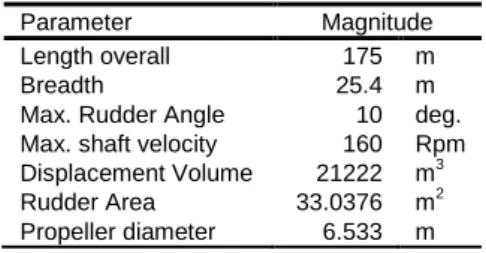
Table 1 Particulars of Container Ship 294
Parameter Magnitude Length overall 175 m Breadth 25.4 m Max. Rudder Angle 10 deg. Max. shaft velocity 160 Rpm Displacement Volume 21222 m3 Rudder Area 33.0376 m2 Propeller diameter 6.533 m
295
Fig. 4 Here 296
Fig. 5 Here 297
Training and validation 298
The software written by Alvarez and Lawrence (2014) was softly modified to accept 299
the multidimensional input vectors and a script was written to implement the NARX 300
structure. The convolution of two square exponential Gaussian processes and a 301
white noise was chosen as kernel. The inputs of the GPs were defined as four inputs 302
of dimension five of the form: 303
1, ( 1:2), ( 1:2)
k
k
k RPM k rudder k k
k
u v
f r p
y u u (14)
304
where yk1 is the first regressor of the output vector
u v r pk, k, ,k k
. 305The selection of the structure of regressors was determined via the examination of 306
the mathematical model. Each output is affected by the past states of output and 307
rudder force FN produced by the interaction of the rudder angle and the propeller 308
RPM as both signals are required for the calculation of FN. Under this assumption 309
different structures were tested to verify the responsiveness to each regressor. The 310
test showed that the container ship system is more responsive to regressors from 311
1 2 3 4 5 6 7 8 9 10 11 12 13 14 15 16 17 18 19 20 21 22 23 24 25 26 27 28 29 30 31 32 33 34 35 36 37 38 39 40 41 42 43 44 45 46 47 48 49 50 51 52 53 54 55 56 57 58 59 60
The captured output vector was the derivative of surge speed, the speed in sway 313
and the angular speeds of yaw and roll,
u v r p, , ,
. As can be seen in eq.(1) and 314eq.(2) the surge speed is not highly couple to the other system outputs, in our 315
simulation capturing the surge speed and posterior simulation was not converging to 316
the real output, in contrast the surge speed derivative shows coupling with other 317
system outputs. The input signals and outputs were normalized between -1 and 1 to 318
give all the inputs and outputs the same weight in the learning process. 319
For the training, the minimization of the negative logarithmical likelihood was used 320
along with the scaled conjugate gradient with multiple start points to insure 321
convergence. Fig. 6 shows the results of GPs training compared to the real system 322
signals, and the error plots between the predicted and real systems. In all the graphs, 323
a confidence band 2 is plotted. The error for the surge derivative is less than 0.02 324
over the training data. 325
Fig. 6a Here 326
Fig. 6b Here 327
Fig. 6c Here 328
Fig. 6d Here 329
The validation data consisted of the real output from the training data with the 330
system delay (k1) in vector form with the delayed commanded inputs. The 331
segments of results from the validation with the second set of data are depicted in 332
Fig. 7, the predicted output and confidence of 2 band is portrayed in comparison to 333
the original system. The low validation errors show a good system prediction for the 334
sway speed and yaw speed. It can be notice that the simulation precision is lose by 335
how far from the training data the step is. The variance in our validation results 336
1 2 3 4 5 6 7 8 9 10 11 12 13 14 15 16 17 18 19 20 21 22 23 24 25 26 27 28 29 30 31 32 33 34 35 36 37 38 39 40 41 42 43 44 45 46 47 48 49 50 51 52 53 54 55 56 57 58 59 60
This was done with the objective to test the capability of GPs to predict outside the 338
trained operational region. 339
Fig. 7a Here 340
Fig. 7b Here 341
Fig. 7c Here 342
Fig. 7d Here 343
344
Simulation 345
A third step was implemented in the way of a naive simulation. Methods of control 346
with non-parametric models require a number of step forward of prediction to be able 347
to control a system. With the objective of testing the ability to predict a system from 348
past data, a naive simulation was setup. At each step the output from the simulation 349
is feedback to the simulation as the past input y ki( 1), the initial position and control 350
signal of rudder and forward speed where used, the naive simulation covers 351
training(0-700s) and validation data(701-1400s) acquired from the original simulation. 352
Table 2 shows the root mean square error (RMSE), the predicted residual error sum 353
of squares (PRESS) measurements for the simulation stage over the training and 354
validation data, and the training time and step simulation time for each of the 355
methodologies. The RMSE and PRESS value for the proposed GPs are smaller than 356
the other systems. As evident in Fig. 8(a-c) NNARX system with the same 357
architecture (marked as NarxNN) and data as in the multi output GPs has limitations 358
in the capability to predict the system behaviour beyond the training range in all DoF. 359
The more complex RNN system (RNN1) produces relatively good results, except in 360
1 2 3 4 5 6 7 8 9 10 11 12 13 14 15 16 17 18 19 20 21 22 23 24 25 26 27 28 29 30 31 32 33 34 35 36 37 38 39 40 41 42 43 44 45 46 47 48 49 50 51 52 53 54 55 56 57 58 59 60
from the original system, especially after 1000s.The yaw output in Fig. 8 (c) shows a 362
higher variance as results of higher association to the other outputs of the system 363
and similitude to other training data this is because of normalization of the outputs in 364
the training data. The difference in capability of prediction of the system is related to 365
their internal functions and how they relate the training data. In comparison to NNRX 366
and RNN, the multi-output GPs show similar performance than RNN outside the 367
training horizon in all the DoF. This is evident in all the results shown in Fig. 8 with 368
the close match to the system from the simulation, it can be established that the 369
Gaussian model can be used for applications as control and failure detection as it 370
can predict future system states with the added value of a confidence measure. 371
Table 2 Summary prediction quality measurements 372
GPs NarxNN RNN1
RMSE 0.0091 0.0092 0.044
PRESS 0.2327 5.47 0.2382
Training time(s) 779 245 125
Step simulation time 0.0625 0.032 0.027
373
Fig. 8a Here 374
Fig. 8b Here 375
Fig. 8c Here 376
Fig. 8d Here 377
Conclusion 378
The basic methodology for the use of multiple-output Gaussian distribution for the 379
identification of ships dynamical models is presented in this paper. The methodology 380
has been validated with the data obtained from a coupled dynamical system of a 381
container ship. With the proposed Gaussian model, the large number of system 382
parameters found in a typical ship model can be reduced to a smaller number of 383
1 2 3 4 5 6 7 8 9 10 11 12 13 14 15 16 17 18 19 20 21 22 23 24 25 26 27 28 29 30 31 32 33 34 35 36 37 38 39 40 41 42 43 44 45 46 47 48 49 50 51 52 53 54 55 56 57 58 59 60
over the complete data set of training and validation were executed to establish the 385
model quality and robustness of the algorithm. The prediction of the full set of data 386
based in a start value and feedback from the last prediction step show low error. As 387
the results indicate, multi-output GPs has the ability to model complex dynamic 388
system having highly coupled outputs and provide a measure of the confidence 389
represented by the variance. 390
The use of other methods such as sparse multi-output GPs and the use of more 391
powerful prediction techniques as Taylor series or Montecarlo method can take 392
advantage of the variance to increase the horizon of cover manoeuvres and the 393
prediction accuracy. Although the results obtained look encouraging, conclusion 394
about the practical value of the method can only be obtained by comparison with 395
other GPs methods and validation with real data from a ship or other oceanic vehicle. 396
References 397
398
Abkowitz, M.A., 1964. Lectures on ship hydrodynamics--Steering and manoeuvrability.
399
Ahmed, Y.A., Hasegawa, K., 2013. Automatic ship berthing using artificial neural network trained by consistent
400
teaching data using nonlinear programming method. Engineering Applications of Artificial Intelligence 26 (10),
401
2287-2304.
402
Alvarez, M., Lawrence, N., 2014. Multiple output Gaussian processes in MATLAB, Github, GitHub repository.
403
Alvarez, M., Lawrence, N.D., 2009. Sparse convolved Gaussian processes for multi-output regression, Advances
404
in neural information processing systems, pp. 57-64.
405
Åström, K.J., Källström, C., 1976. Identification of ship steering dynamics. Automatica 12 (1), 9-22.
406
Ažman, K., Kocijan, J., 2011. Dynamical systems identification using Gaussian process models with incorporated
407
local models. Engineering Applications of Artificial Intelligence 24 (2), 398-408.
408
Bishop, R.E.D., Parkinson, A.G., 1970. On the Planar Motion Mechanism Used in Ship Model Testing.
409
Philosophical Transactions of the Royal Society of London. Series A, Mathematical and Physical Sciences 266
410
(1171), 35-61.
411
Boyle, P., Frean, M., 2004. Dependent gaussian processes, Advances in neural information processing systems,
412
pp. 217-224.
413
Brinati, H., Neto, A.R., 1975. Application of the extended Kalman filtering to the identification of ship
414
hydrodynamic coefficients, Proceedings of the Third Brazilian Congress of Mechanical Engineering, pp. 791-804.
415
Casado, M.H., Ferreiro, R., Velasco, F., 2007. Identification of nonlinear ship model parameters based on the
416
turning circle test. Journal of Ship Research 51 (2), 174-181.
417
Fossen, T., Perez, T., 2004. Marine systems simulator (MSS). URL www. marinecontrol. org.
418
Fossen, T.I., 1994. Guidance and control of ocean vehicles. John Wiley & Sons Inc.
419
Fossen, T.I., 2011. Handbook of marine craft hydrodynamics and motion control. John Wiley & Sons.
420
Haddara, M.R., Wang, Y., 1999. Parametric identification of manoeuvring models for ships. International
421
Shipbuilding Progress 46 (445), 5-27.
422
Higdon, D., 2002. Space and space-time modeling using process convolutions, Quantitative methods for current
423
environmental issues. Springer, pp. 37-56.
424
Irsoy, O., Cardie, C., 2014. Deep recursive neural networks for compositionality in language, Advances in Neural
425
Information Processing Systems, pp. 2096-2104.
1 2 3 4 5 6 7 8 9 10 11 12 13 14 15 16 17 18 19 20 21 22 23 24 25 26 27 28 29 30 31 32 33 34 35 36 37 38 39 40 41 42 43 44 45 46 47 48 49 50 51 52 53 54 55 56 57 58 59 60
Källström, C.G., Åström, K.J., Thorell, N., Eriksson, J., Sten, L., 1979. Adaptive autopilots for tankers. Automatica
427
15 (3), 241-254.
428
Kbiob, D., 1951. A statistical approach to some basic mine valuation problems on the Witwatersrand. Journal of
429
Chemical, Metallurgical, and Mining Society of South Africa.
430
Kocijan, J., 2016. Modelling and Control of Dynamic Systems Using Gaussian Process Models. Springer.
431
Kocijan, J., Girard, A., Banko, B., Murray-Smith, R., 2005. Dynamic systems identification with Gaussian
432
processes. Mathematical and Computer Modelling of Dynamical Systems 11 (4), 411-424.
433
Ljung, L., 1999. System identification. Wiley Online Library.
434
Luo, W., Zou, Z., 2009. Parametric identification of ship maneuvering models by using support vector machines.
435
Journal of Ship Research 53 (1), 19-30.
436
Moreira, L., Soares, C.G., 2012. Recursive neural network model of catamaran manoeuvring. Int. J. Marit. Eng.
437
RINA 154, A121-A130.
438
Neal, R.M., 2012. Bayesian learning for neural networks. Springer Science & Business Media.
439
Norrbin, N.H., 1971. Theory and observations on the use of a mathematical model for ship manoeuvring in deep
440
and confined waters. DTIC Document.
441
Olsgard, F., Gray, J.S., 1995. A comprehensive analysis of the effects of offshore oil and gas exploration and
442
production on the benthic communities of the Norwegian continental shelf. Marine Ecology Progress Series 122,
443
277-306.
444
Pettersen, K.Y., Nijmeijer, H., 2001. Underactuated ship tracking control: theory and experiments. International
445
Journal of Control 74 (14), 1435-1446.
446
Son, K.-H., Nomoto, K., 1982. 5. On the Coupled Motion of Steering and Rolling of a High-speed Container Ship.
447
Naval Architecture and Ocean Engineering 20, 73-83.
448
Stern, F., Agdrup, K., Kim, S., Hochbaum, A., Rhee, K., Quadvlieg, F., Perdon, P., Hino, T., Broglia, R., Gorski, J.,
449
2011. Experience from SIMMAN 2008—the first workshop on verification and validation of ship maneuvering
450
simulation methods, Journal of Ship Research, pp. 135-147.
451
Sutulo, S., Soares, C.G., 2014. An algorithm for offline identification of ship manoeuvring mathematical models
452
from free-running tests. Ocean Engineering 79, 10-25.
453
Wang, X.-g., Zou, Z.-j., Yu, L., Cai, W., 2015. System identification modeling of ship manoeuvring motion in 4
454
degrees of freedom based on support vector machines. China Ocean Engineering 29, 519-534.
455
Williams, C.K., Rasmussen, C.E., 2006. Gaussian processes for machine learning.
456
Yoon, H.K., Rhee, K.P., 2003. Identification of hydrodynamic coefficients in ship maneuvering equations of
457
motion by Estimation-Before-Modeling technique. Ocean Engineering 30 (18), 2379-2404.
458
Zhou, W., Blanke, M., 1987. Nonlinear recursive prediction error method applied to identification of ship steering
459
dynamics.
460
Acknowledgement 461
We thank Dr. Juš Kocijan for his assistance with the implementation of dynamic 462
system identification with GPs and for comments that greatly improved the 463
manuscript. 464
Funding: This research did not receive any specific grant from funding agencies in 465
the public, commercial, or not-for-profit sectors. 466
Figures Caption 467
Fig. 1 Definition of Body fixed coordinated system 468
Fig. 2 NARX for single input, single output system. 469
Fig. 3 NARX structure for dynamic SI of nonlinear container ships. u1is the measure 470
RPM and u2 is the rudder angle at time .k.. 471
1 2 3 4 5 6 7 8 9 10 11 12 13 14 15 16 17 18 19 20 21 22 23 24 25 26 27 28 29 30 31 32 33 34 35 36 37 38 39 40 41 42 43 44 45 46 47 48 49 50 51 52 53 54 55 56 57 58 59 60
Fig. 6 Prediction from Multioutput-GPs obtained model with training data (0-700 473
seconds) compared to mathematical model, a) controlled surge acceleration, b) 474
induced sway speed, c) controlled yaw speed, and d) induced roll speed 475
Fig. 7 Prediction from Multioutput-GPs obtained model with validation data (700-476
1400 seconds) compared to mathematical model, a) controlled surge acceleration, b) 477
induced sway speed, c) controlled yaw speed, and d) induced roll speed 478
Fig. 8 Prediction from Multi-output GPs by algorithm of Naive Simulation with full 479
data from input signals compared to mathematical model, a) controlled surge 480
acceleration, b) induced sway speed, c) controlled yaw speed, and d) induced roll 481
speed 482
Footnotes: 483
Footnote 1: https://github.com/ArizaWilmerUTAS/Multi-Output-GPs-Identification-484
1 2 3 4 5 6 7 8 9 10 11 12 13 14 15 16 17 18 19 20 21 22 23 24 25 26 27 28 29 30 31 32 33 34 35 36 37 38 39 40 41 42 43 44 45 46 47 48 49 50 51 52 53 54 55 56 57 58 59 60
1
Non-parametric Dynamic System
Identification of Ships Using Multi-Output
Gaussian Processes
Wilmer Ariza Ramirez*1, Zhi Quan Leong1, Hung Nguyen1, Shantha Gamini Jayasinghe1
1
Australian Maritime College, University of Tasmania, Newnham TAS 7248, Australia [email protected] (* Corresponding author), [email protected],
[email protected], [email protected]
Abstract 1
A novel application of non-parametric system identification algorithm for a surface 2
ship has been employ on this study with the aim of modelling ships dynamics with 3
low quantity of data. The algorithm is based on multi-output Gaussian processes and 4
its ability to model the dynamic system of a ship without losing the relationships 5
between coupled outputs is explored. Data obtained from the simulation of a 6
parametric model of a container ship is used for the training and validation of the 7
multi-output Gaussian processes. The required methodology and metric to 8
implement Gaussian processes for a 4 degrees of freedom (DoF) ship is also 9
presented in this paper. Results show that multi-output Gaussian processes can be 10
accurately applied for non-parametric dynamic system identification in ships with 11
highly coupled DoF. 12
Keywords 13
Dependent Gaussian processes; Dynamic System identification; Multi-output 14
1 2 3 4 5 6 7 8 9 10 11 12 13 14 15 16 17 18 19 20 21 22 23 24 25 26 27 28 29 30 31 32 33 34 35 36 37 38 39 40 41 42 43 44 45 46 47 48 49 50 51 52 53 54 55 56 57 58 59 60
16 17
Introduction 18
Dynamic modelling of oceanic vehicles including surface ships, semisubmersibles/ 19
submersible platforms, and unmanned underwater vehicles is an active research 20
field due to the application importance of these vessels such as goods transport, oil 21
and gas exploration (Olsgard and Gray, 1995), underwater survey, and fishery. The 22
common approach to modelling such vehicles is the use of Newtonian-Lagrangian 23
mathematical models which are usually predefined. However, the presence of 24
unaccounted dynamics caused by parametric and non-parametric uncertainties in a 25
predefined model can increase the error between the predicted output and the real 26
output. The cause of these uncertainties is commonly attributed to ocean currents, 27
waves, wind, and hydrodynamic interaction with nearby structures. Since oceanic 28
vehicles operate in dynamically changing environments performance of traditional 29
controllers such as PID, LQR, and backstepping controllers (Fossen, 2011; 30
Pettersen and Nijmeijer, 2001) degrade over time of operation as they require an 31
initial offline design, calibration and are directly dependent on the predefined system 32
parameters. An optional approach to predefined mathematical modelling is the use 33
of non-parametric system identification (SI) methods. In this context, the application 34
of modern machine learning algorithms that are capable of producing evolutionary 35
adaptability to the environment has been identified as a promising approach for SI 36
(Ljung, 1999). The present study focuses on its application for the identification of 37
surface ship dynamics. 38
There are multiple mathematical models for the representation of ships dynamics. 39
Some models are 3 DoF models where the surge, sway and yaw are represented by 40
1 2 3 4 5 6 7 8 9 10 11 12 13 14 15 16 17 18 19 20 21 22 23 24 25 26 27 28 29 30 31 32 33 34 35 36 37 38 39 40 41 42 43 44 45 46 47 48 49 50 51 52 53 54 55 56 57 58 59 60
advanced models such as (Son and Nomoto, 1982) used a 4 DoF nonlinear model 42
for ships including the rolling effect. The dynamic modelling of ship is a prerequisite 43
for the design of its autopilot, navigation, steering control, and damage identification 44
systems. The exactitude of the model can lead to the reduction of fuel consumption 45
(Källström et al., 1979) by the correct tuning of an autopilot, better vehicle stability, 46
and less stress over the vehicle structure (Fossen, 1994) and the possibility of 47
advanced algorithms such as automatic ship berthing (Ahmed and Hasegawa, 2013). 48
Dynamic mathematical models are usually obtained by the application of Newtonian 49
and Lagrangian mechanics, which lead to a complex system of coupled equations 50
defined by a series of parameters. The parameters are the representation of added 51
masses, hydrodynamics damping constants, and constants related directly with 52
control forces such as propellers and rudders. Over the years, multiple methods 53
have been developed to determine the hydrodynamic parameters of ships, e.g. 54
empirical formulas, captive model test, computational fluid dynamics (CFD) 55
calculation and parameter estimation based in SI. The most recognized and 56
accepted method is captive model test with planar motion mechanics (Bishop and 57
Parkinson, 1970). This method requires the use of sophisticate facilities such as 58
towing tanks, rotating arms and planar motion mechanism to produce the required 59
ship manoeuvres that allow the parameters to be identified. These manoeuvres can 60
also be replicated virtually via CFD which can be a more affordable option (Stern et 61
al., 2011). However, as the accuracy of CFD is highly dependent on the numerical 62
settings and requires validation, physical experiments are still preferred over 63
computational solutions. 64
Parameter estimation based in SI methodologies offer a practical way to identify the 65
1 2 3 4 5 6 7 8 9 10 11 12 13 14 15 16 17 18 19 20 21 22 23 24 25 26 27 28 29 30 31 32 33 34 35 36 37 38 39 40 41 42 43 44 45 46 47 48 49 50 51 52 53 54 55 56 57 58 59 60
SI can be free-running model tests or full-scales trials of existing ships. SI can be 67
categorized in two groups, parametric and non-parametric identification. Parametric 68
identification is based on the use of numerical methods to obtain the hydrodynamics 69
parameters of proposed mathematical models with unknown parameters. 70
Alternatively, non-parametric identification is based on the use of single or multiple 71
kernel functions to create a non-physics related mathematical model which is tuned 72
by a learning procedure that uses data obtained from the original system. 73
Methods like Extended Kalman Filter (Åström and Källström, 1976; Brinati and Neto, 74
1975), Unscented Kalman Filter(Zhou and Blanke, 1987), Estimation-Before-75
Modelling (Yoon and Rhee, 2003), and Backstepping (Casado et al., 2007) are the 76
most popular numerical methods for coefficient estimation. However, these methods 77
can suffer from linearization and convergence errors. Therefore, more advanced SI 78
methods from machine learning, e.g. neural networks (Haddara and Wang, 1999), 79
and support vector machines (Luo and Zou, 2009) had found their space in 80
parametric ship SI with the use of specific structures (NN) or specific selection of 81
kernel functions(SVM), these specific structure allow the techniques to calculate 82
some coefficients. The principal disadvantage of parametric system identification is 83
the need of controlled test with low external perturbations and specific procedures to 84
reduce the interference and nonlinearities between degrees of freedom. 85
In contrast to the parametric SI, non-parametric SI has the capacity to learn a
86
complete model without prior knowledge of the system structure. This learning
87
procedure leads to a simpler model with fewer parameters. Non-parametric SI brings
88
the possibility of incorporating online learning giving the ability to improve the
89
adaptability of the model. The capability to adapt to change is very important for 90
application of evolutionary control techniques and damage identification. The most
1 2 3 4 5 6 7 8 9 10 11 12 13 14 15 16 17 18 19 20 21 22 23 24 25 26 27 28 29 30 31 32 33 34 35 36 37 38 39 40 41 42 43 44 45 46 47 48 49 50 51 52 53 54 55 56 57 58 59 60
recognized method of non-parametric identification for ships is recursive neural
92
network (RNN). RNN differs over standard neural networks in the aspect that the
93
structure of the network is organized hierarchically applying the same set of weights
94
recursively over the structure, to produce a scalar prediction on it. (Irsoy and Cardie,
95
2014). This method has been used with success to identify complex ship designs like
96
catamarans with the final purpose of offline simulation of ship behaviours (Moreira
97
and Soares, 2012). Wang et al. (2015) presented a modified version of SVMs to
98
capture the full coupled system in four degrees of a ship following a similar
99
methodology to RNNs. The difference between the SVM and the neural network
100
methods is that the SMV is less prone to overfitting, thus can reach a global optimum
101
and require less memory. Wang’s proposed a white, grey and black box system, the
102
black box is the result of the mathematical analysis of the grey black box that leads
103
them to recognize an applicable kernel. The drawback of neural networks and SVM
104
machine learning methods is the lack of confident measures, and thus, an error in
105
the prediction cannot be corrected.
106
Depending on the budget and availability of infrastructure and time, the parametric or 107
non-parametric model characterization can be chosen for a given system. In the 108
case of new designs with low complexity, the parametric identification can be carried 109
out without inconvenience as scale model can be produced and computational CAD 110
files are available. However, for old oceanic vehicles that require fitting of new 111
technology, vehicles that require operation in evolving environments, and vehicles 112
with complex designs the use of non-parametric methods can be more practical. 113
Nevertheless, not all possible methods of machine learning had found their way to
114
dynamic SI of ships. If a neural network is used to generate a non-parametric model
115
with the inclusion of the variance, the number of hidden units ideally has to be taken