R E S E A R C H
Open Access
Long-term continuous renal replacement
therapy and anticoagulation with citrate
in critically ill patients with severe liver
dysfunction
Matthias Klingele
1,2,3*, Theresa Stadler
1, Danilo Fliser
1, Timo Speer
1, Heinrich V. Groesdonk
4and
Alexander Raddatz
4Abstract
Background:As of 2009, anticoagulation with citrate was standard practice in continuous renal replacement therapy (CRRT) for critically ill patients at the University Medical Centre of Saarland, Germany. Partial hepatic metabolism of citrate means accumulation may occur during CRRT in critically ill patients with impaired liver function. The aim of this study was to evaluate the actual influence of hepatic function on citrate-associated complications during long-term CRRT.
Methods:In a retrospective study conducted between January 2009 and November 2012, all cases of dialysis
therapy performed in the interdisciplinary surgical intensive care unit were analysed. Inclusion criteria were CRRT and regional anticoagulation with citrate, pronounced liver dysfunction, and pathologically reduced indocyanine green plasma disappearance rate (ICG-PDR).
Results:A total of 1339 CRRTs were performed in 69 critically ill patients with liver failure. At admission, the mean Model for End-stage Liver Disease score was 19.2, and the mean ICG-PDR was 9.8%. Eight patients were treated with liver replacement therapy, and 30 underwent transplants. The mortality rate was 40%. The mean duration of dialysis was 19.4 days, and the circuit patency was 62.2 h. Accumulation of citrate was detected indirectly by total serum calcium/ionised serum calcium (tCa/iCa) ratio > 2.4. This was noted in 16 patients (23.2%). Dialysis had not to be discontinued for metabolic disorder or accumulation of citrate in any case. In 26% of cases, metabolic alkalosis occurred with pH > 7.5. Interestingly, no correlation between citrate accumulation and liver function parameters was detected. Moreover, most standard laboratory liver function parameters showed poor predictive capabilities for accumulation of citrate.
Conclusions:Our findings indicate that extra-hepatic metabolism of citrate seems to exist, avoiding in most cases citrate accumulation in critically ill patients despite impaired liver function. Because the citric acid cycle is oxygen-dependent, disturbed microcirculation would result in inadequate citrate metabolism. Raising the tCa/iCa ratio would therefore be an indicator of severity of illness and mortality rather than of liver failure. However, further studies are warranted for confirmation.
Keywords:CRRT, Anticoagulation, Citrate, Critically ill, Liver, Accumulation
* Correspondence:[email protected] 1
Department of Internal Medicine–Nephrology and Hypertension, Saarland University Medical Centre, Homburg/Saar, Germany
2Departments of Nephrology and Internal Medicine, Hochtaunus-Kliniken, Zeppelinstrasse 20, D-61352 Bad Homburg, Germany
Full list of author information is available at the end of the article
Background
Acute renal failure requiring dialysis is a common com-plication in critically ill patients in intensive care units (ICUs) [1, 2]. In order to perform renal replacement therapy (RRT), adequate anticoagulation is necessary. Heparin is often used for this purpose [2]. However, the bleeding risk may be elevated in critically ill patients, es-pecially in the context of surgery or patients with hep-atic impairment. Regional anticoagulation with citrate lowers the risk of bleeding complications and therefore appears to be advantageous in these patients [3]. Admit-ted citrate is half-eliminaAdmit-ted during dialysis. The residual half of citrate does return to the patient. Citrate metab-olism is oxygen-dependent via the citric acid cycle and therefore mainly in organs with high amounts of mito-chondria, such as the liver, kidney or muscle [4]. In the literature, citrate metabolism is described as being dependent mainly on liver function [5, 6]. Thus, regional anticoagulation with citrate is considered critical in cases of liver dysfunction with respect to the potential risk of citrate accumulation resulting in metabolic disorders, in-cluding shifts in calcium balance [6]. Because of these potential side effects, regional anticoagulation with cit-rate is often avoided in patients with hepatic insuffi-ciency and mostly excluded in studies investigating regional anticoagulation with citrate [7]. To this day, there is still little knowledge about the actual incidence of citrate-associated complications in patients with im-paired liver function. Moreover, the existing rare studies describe only short periods of dialysis [8, 9]. Information about continuous renal replacement therapy (CRRT) of longer duration with citrate anticoagulation in critically ill patients with hepatic insufficiency is not available.
This study had three aims: to evaluate the proportion of critically ill patients with severe hepatic insufficiency de-veloping citrate-associated complications during CRRT, to investigate the actual influence of hepatic impairment and duration of CRRT on the development of these citrate-associated complications, and finally to identify predicting factors for citrate-associated complications in critically ill patients with impaired liver function.
Methods
Study cohort
Since January 2009, regional anticoagulation with citrate is routinely used for RRT in all ICUs at the Saarland Univer-sity Medical Centre. From that time until November 2012, all dialysis cases in the interdisciplinary surgical ICU were analysed. The ethics committee of the medical association evaluated this retrospective study of anonymised data and voted that no ethical approval or consent to participate was needed (ethics vote of the Ethik-Kommission der Aerztekammer des Saarlandes [211/11]).
Inclusion criteria were CRRT and anticoagulation with citrate, pre-existing severe liver dysfunction, and/or de-veloping acute liver failure during the clinical course in the ICU. Patients with known cirrhosis, elevated biliru-bin or ammonia, and/or reduced synthesis parameters (e.g., prothrombin time [expressed as Quick value], cho-linesterase [CHE], albumin) were considered as showing chronic and/or acute liver dysfunction. Because indocya-nine green plasma disappearance rate (ICG-PDR) is a widely accepted parameter for clinical assessment of liver function and is normally > 18%/minute [10–12], only patients in whom ICG-PDR had been performed were included. Unfortunately, ICG-PDR was not deter-mined systematically in all patients with signs of liver dysfunction. Primary endpoints were metabolic disorders due to citrate.
The aim of this study was to investigate the influence of liver function on the metabolism of citrate during long-term continuous venovenous haemodialysis (CVVHD) in critically ill patients. We therefore focus on data charac-terising our study population regarding pre-existing liver disease, severity of illness and outcome parameters.
All clinical data were obtained by assessing patient medical records. Laboratory parameters taken for clinical monitoring were processed within the central laboratory of the Saarland University Medical Centre. Owing to the retrospective study design, not all labora-tory data were available at all time points desired for this evaluation.
During the study period, Simplified Acute Physiology Score II (SAPS II) and Therapeutic Intervention Scoring System score were automatically determined every day. At this time point, the more often used Sepsis-related Organ Failure Assessment score was not automatically or routinely determined.
CRRT and anticoagulation with citrate
CVVHD was the only renal replacement modality used. All CRRTs were started according to our standard protocol: Initial blood flow was 100 ml/minute, dialysate flow was 2000 ml/h, citrate solution was infused pre-filter at an initial rate of 4.0 mmol/L blood, and calcium was substituted with 1.7 mmol/L dialysate. In patients with a body weight > 80 kg, flow rates of blood and di-alysate were likewise increased as target dialysis dose was > 25 ml/kg/h.
In case of accumulation of citrate, in a first step, dialys-ate flow was increased by 20–25%. In a second step, blood flow was reduced by 10–20%, if possible with respect to the body weight (minimal blood flow, 1 ml/minute/kg body weight) and target dialysis dose. The last step for correction was a further increase in dialysate flow.
The Molecular Adsorbents Recirculation System (MARS; Baxter, Unterschleißheim, Germany) is an extra-corporeal liver dialysis system. It is a further develop-ment of albumin dialysis. The first step consists of albumin dialysis of the patient’s blood, whereby toxins are bound to the albumin in the dialysate circuit. In a second step, the albumin-containing dialysate is regener-ated for recirculation. For this purpose, albumin-bound toxins are eliminated using an adsorber and by a second dialysis circuit.
In three of eight patients receiving liver replacement therapy, standard CVVHD with RCA was discontinued for the duration of MARS therapy. Furthermore, during MARS therapy, a different dialysis machine was used for liver dialysis (PRISMAFLEX system; Baxter). In addition, heparin was used for anticoagulation of the extracorpor-eal circuit according to the operating manual of the PRISMAFLEX system used.
Metabolic complications of anticoagulation with citrate For anticoagulation with citrate we used trisodium citrate (sodium citrate 4%; Fresenius Kabi, Bad Homburg, Germany). Because this contains an increased supply of sodium, we used multiBic (Fresenius Medical Care), a dialysate solution with a reduced degree of sodium, to avoid hypernatremia.
Accumulation of citrate and metabolic alkalosis are the main metabolic disorders described in the context of anticoagulation with citrate. Increased citrate plasma levels were detected by calculating the total tCa to iCa ratio (tCa/iCa) as described by Hetzel and colleagues [14]. A tCa/iCa ratio > 2.4 was considered a sign of accu-mulation of citrate.
The metabolism of 1 mol of citrate results in 3 mol of bicarbonate (HCO3−). Therefore, we used dialysate solu-tions with reduced HCO3−content of 20 mmol/L (multi-Bic) to avoid development of metabolic alkalosis. Serum level of HCO3−, base excess, respiratory status (blood gas analysis) and pH value were determined at the same
time points as iCa, at least four times per day. A blood pH value > 7.5 was considered as alkalosis.
Statistical analysis
Continuous variables are expressed as the mean ± SD. Categorical variables are given as relative and absolute frequencies unless otherwise stated. The association be-tween continuous variables was assessed by Spearman’s rank correlation testing.
To assess the influence of the laboratory variables on the development of accumulation of citrate or alkalosis, logistic and linear regression models were used. None of these complications was used as the reference category in the logistic regression. The predictive value of laboratory markers of liver function on the development of accumu-lation of citrate or alkalosis was assessed using ROC ana-lysis. Statistical analysis was carried out using IBM SPSS version 20 software (IBM, Armonk, NY, USA).
Results
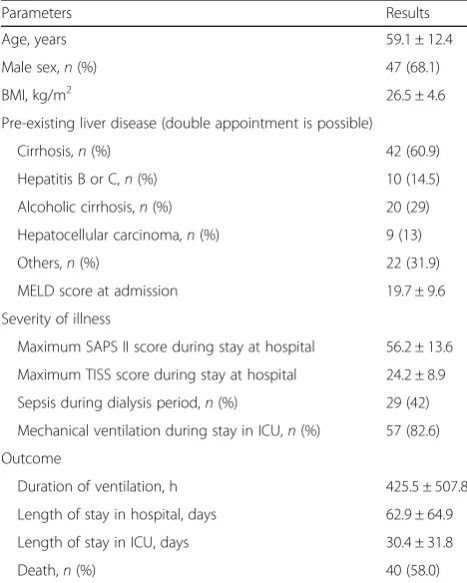
Between January 2009 and November 2012, a total of 378 patients underwent CRRT during the study period. Of these, 87 patients had acute or chronic liver dysfunc-tion. Because ICG-PDR was not determined systematic-ally, 69 patients were eligible for inclusion in this analysis (as shown in Fig. 1), resulting in a total of 1339 dialysis days of CRRT. The mean duration of CRRT was 19.4 days (SD, ±22.9; range, 1–105) (Table 1).
Most patients had pre-existing liver disease with a mean bilirubin at admission of 7.1 (SD, ±10.4; range, 0.2–41.6), mean ICG-PDR < 10% and mean Model for End-stage Liver Disease (MELD) score of 19.7. During the dialysis period, the average maximum serum level of bilirubin was 15.6 ± 11.4 mg/dl. Liver replacement ther-apy was performed in eight patients. Thirty patients re-ceived liver transplants. Because the aim of this study was to investigate the influence of liver function on the metabolism of citrate during long-term CRRT, the main focus was liver function at the beginning and during the course of dialysis, as shown in Table 2.
At admission, most patients showed impaired renal function, and three patients were on chronic dialysis be-fore admission (Table 2). The indications for dialysis were mainly hypervolaemia (46.4%), uraemia (43.5%) or hyperkalaemia (5.8%). The mean dialysis period was 19.4 days (SD, ±22.9).
Anticoagulation with citrate
without a need for change owing to metabolic disorders. In three of eight patients receiving MARS for liver replace-ment therapy, anticoagulation was performed with heparin and not with citrate during this treatment period.
The effective mean blood flow was 96 ml/minute (SD, ±9; range, 80–138), and the mean dialysate flow
was 2188 ml/h (SD, ±452; range, 1200–3600), result-ing in an effective dialysis dose of 28.9 ml/h/kg. Sufficient anticoagulation was achieved with a mean dose of citrate of 4.0 mmol/L blood (SD, ±0.3; range, 3.4–4.7), resulting in a mean iCa of 0.30 mmol/L (SD, ±0.03; range, 0.12–0.38) in the extracorporeal circuit. The effectiveness of anticoagulation yielded a mean longevity of circuit filters of 62.2 h (SD, ±11.2; range, 24–72). To restore physiological serum levels of calcium, mean calcium substitution of 1.6 mmol/L dialysate (SD, ±0.3; range, 0.6–2.2) was given.
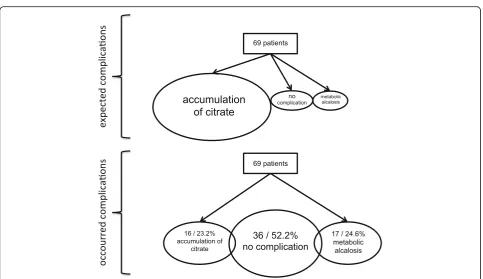
Metabolic disorder due to anticoagulation with citrate The occurrence of metabolic complications in this study compared with what would have been expected in pa-tients with impaired liver function undergoing CRRT with RCA is shown in Fig. 2. In 16 patients (23.2%), a ra-tio of tCa/iCa > 2.4 occurred during CRRT, indicating ac-cumulation of citrate. Mean tCa during the dialysis period was 2.54 ± 0.17 mmol/L. In nine patients, tCa was > 2.7 mmol/L. The highest serum calcium level of tCa measured was 3.7 mmol/L in one patient at 1 day. At any time clinical complications occurred due to hyper- or hypocalciemia. Hypercalcaemia or accumula-tion of citrate did not require that RCA be stopped in any patient.
Mean HCO3− was 25.8 ± 4.4 mmol/L during the dialysis period. Metabolic alkalosis occurred in 17 patients (24.6%). Maximal HCO3−ranged from 19 to 46 mmol/L, accompan-ied by a mean base excess of 7.7. Adequate modification of CRRT resolved hypercalcaemia or alkalosis.
Factors influencing accumulation of citrate
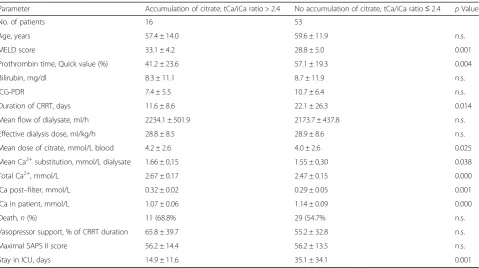
Comparing the 16 patients showing signs of citrate ac-cumulation with the remaining 53 patients, we found
[image:4.595.56.292.87.254.2]Fig. 1Flowchart displaying the study population
Table 1Basic characteristics and outcomes illustrating liver dysfunction, severity of illness and outcome
Parameters Results
Age, years 59.1 ± 12.4
Male sex,n(%) 47 (68.1)
BMI, kg/m2 26.5 ± 4.6
Pre-existing liver disease (double appointment is possible)
Cirrhosis,n(%) 42 (60.9)
Hepatitis B or C,n(%) 10 (14.5)
Alcoholic cirrhosis,n(%) 20 (29)
Hepatocellular carcinoma,n(%) 9 (13)
Others,n(%) 22 (31.9)
MELD score at admission 19.7 ± 9.6
Severity of illness
Maximum SAPS II score during stay at hospital 56.2 ± 13.6
Maximum TISS score during stay at hospital 24.2 ± 8.9
Sepsis during dialysis period,n(%) 29 (42)
Mechanical ventilation during stay in ICU,n(%) 57 (82.6)
Outcome
Duration of ventilation, h 425.5 ± 507.8
Length of stay in hospital, days 62.9 ± 64.9
Length of stay in ICU, days 30.4 ± 31.8
Death,n(%) 40 (58.0)
Abbreviations: BMIBody mass index,ICUIntensive care unit,MELDModel for End-stage Liver Disease,SAPS IISimplified Acute Physiology Score II, TISSTherapeutic Intervention Scoring System
[image:4.595.305.538.109.249.2]Results are shown as mean ± SD or as the number of patients and corresponding percentage with respect to all 69 patients
Table 2Parameters of renal and liver function at start of CRRT and mean liver function during dialysis period
Parameters At start of CRRT During dialysis period
Creatinine, mg/dl 2.7 ± 1.3
eGFR, CKD-EPI 24.7 ml/minute
Cystatin C, mg/dl 3.2 ± 1.1
GFR, cystatin C 17.7 ml/minute
Bilirubin, mg/dl 9.5 ± 10.6 7.9 ± 6.8
Albumin, g/L 24.7 ± 7.0 25.0 ± 4.1
Cholinesterase, ×1000 IE/L 2.8 ± 1.7 2.6 ± 1.2
ICG-PDR 7.6 ± 5.8 9.9 ± 6.3
MELD score 29.8 ± 5.1
Abbreviations: CKD-EPIChronic Kidney Disease Epidemiology Collaboration equation,CRRTContinuous renal replacement therapy,eGFREstimated glomerular filtration rate,GFRGlomerular filtration rate,ICG-PDRIndocyanine green plasma disappearance rate,MELDModel for End-stage Liver Disease,IE/ LInternational Units per L
[image:4.595.56.290.396.688.2]that MELD score at the start of dialysis was higher (33.1 ± 4.2 versus 28.8 ± 5.0; p= 0.001), Quick value was lower (41.2 ± 23.6 versus 57.1 ± 19.3;p= 0.004), dur-ation of dialysis was shorter (11.6 ± 8.6 versus 22.1 ± 26.3;
p= 0.014) and dose of citrate per litre of blood was higher (4.2 ± 0.6 versus 4.0 ± 0.6; p= 0.025). MARS for liver replacement therapy had no impact on accumulation of citrate, as shown in Table 3.
In correlation analysis only MELD score and pro-thrombin time (Quick value) at the start of dialysis showed a weak correlation (0.303 and −0.387, respect-ively; p= 0.001). In a binary logistic regression model only prothrombin time showed a small impact on the accumulation of citrate. A reduction of 1% in Quick value resulted in an elevation of 0.004 of the tCa/iCa ra-tio. In ROC analysis the predictive capacity of hepatic parameters (bilirubin, CHE, prothrombin time [Quick value] and ICG-PDR), the dose of citrate and the ICU length of stay for the accumulation of citrate were tested. The resulting AUCs were 0.253 to 0.662, respectively.
Factors influencing development of alkalosis
Comparing the 17 patients showing signs of alkalosis with the remaining 52 patients, the Quick value was higher (74.0 ± 11.7 versus 56.4 ± 18.8; p= 0.000), the ICG-PDR
was higher (13.4 ± 5.6 versus 9.0 ± 6.2; p= 0.029), the dose of citrate per litre of blood was lower (3.8 ± 0.2 versus 4.1 ± 0.3; p= 0.000), the flow of dialysate was lower (1935 ± 267 versus 2270 ± 470 ml/h; p= 0.001) and mortality was lower (35.3% versus 65.4%;p= 0.029).
In correlation analysis ICG-PDR and prothrombin time (Quick value) showed a weak correlation with the development of alkalosis (0.348 and 0.427;p= 0.029 and 0.000, respectively). In a binary logistic regression model only prothrombin time (Quick value) and ICG-PDR showed a weak impact on the development of alkalosis (0.072 and −0.003, respectively). In ROC analysis the predictive capacity of hepatic parameters (bilirubin, CHE, prothrombin time [Quick value] and ICG-PDR) for the development of alkalosis was tested. Only pro-thrombin time and ICG-PCR showed AUCs above 0.70 (0.785 and 0.736, respectively).
Discussion
In this retrospective evaluation, we demonstrate that in critically ill patients with severe hepatic dysfunction, re-gional anticoagulation with citrate for CRRT is possible, even for long-term dialysis. Although patients showed pronounced impaired liver function, citrate accumula-tion occurred in only one of four patients and was far less dramatic than expected.
Fig. 2The occurrence of metabolic complications in this study compared with what would have been expected in patients with impaired liver function undergoing continuous renal replacement therapy with regional citrate anticoagulation.CVVHDContinuous venovenous haemodialysis;
[image:5.595.57.541.82.361.2]Under physiological conditions, citrate is metabolised by the liver and to a lesser extent by the skeletal muscle [5]. Therefore, RCA is considered as contraindicated in cases of impaired liver function resulting in accumula-tion of citrate [6, 15–18]. Increased citrate plasma levels are indirectly detected, as described by Hetzel and colleagues [14], through an increasing ratio of total serum calcium (tCa/iCa). The limit of this ratio varies in the literature from 2.1 to≥2.5 [19–21]. Under physiological conditions, tCa ranges from 2.2 to 2.6 mmol/L and iCa ranges from 0.90 to 1.20 mmol/L. The resulting ratio (tCa/iCa) ranges from 1.8 to 2.4. Thus, a tCa/iCa ratio > 2.4 was considered a sign of accumula-tion of citrate. This threshold was also previously chosen by Link and colleagues [21]. Although all pa-tients included showed pronounced impaired liver function, in almost half of these patients any aspect of metabolic or electrolyte disturbance occurred, and only one of four had signs of citrate accumulation. Further-more, slight changes in the dialysate and blood flows mostly allowed correction of looming signs of metabolic disorders. These results are in contrast to the conventional wisdom in the literature. However, there is anecdotal evidence that the use of citrate in patients with impaired liver function would be possible [3, 22, 23]. Of note, some studies have reported RCA after liver
transplant [8, 24]. However, liver function normally im-proves after transplant. Furthermore, the described mean dialysis periods were quite short at 5–8 days [8, 24].
In assessing metabolic complications of citrate antic-oagulation, in particular the duration of dialysis is of central importance because in prolonged CRRT high cumulative doses of citrate are administered. However, in the literature, only short dialysis periods are de-scribed [3, 8, 23–26]. The recently published liver citrate anticoagulation threshold (L-CAT) trial convin-cingly showed the safety of CRRT-RCA in patients with severely impaired liver function [9]. Of note, the re-ported observation period included the first 72 h of CRRT-RCA treatment. In contrast, we report the whole duration of CRRT-RCA; the mean duration of the dialy-sis period was 19 days, resulting in high cumulative doses of citrate.
[image:6.595.59.539.97.365.2]Taken together, hepatic function seems not to be exclusively or predominantly responsible for citrate metabolism. We therefore hypothesise that in critic-ally ill patients with impaired liver function a part of citrate metabolism is shifted into muscle cells or any other cells. This also would explain why the duration of dialysis with consecutive high cumulative doses of citrate does not result in accumulation and meta-bolic disorder.
Table 3Patients with and without citrate accumulation, hepatic function at start of continuous renal replacement therapy
Parameter Accumulation of citrate; tCa/iCa ratio > 2.4 No accumulation of citrate; tCa/iCa ratio≤2.4 pValue
No. of patients 16 53
Age, years 57.4 ± 14.0 59.6 ± 11.9 n.s.
MELD score 33.1 ± 4.2 28.8 ± 5.0 0.001
Prothrombin time, Quick value (%) 41.2 ± 23.6 57.1 ± 19.3 0.004
Bilirubin, mg/dl 8.3 ± 11.1 8.7 ± 11.9 n.s.
ICG-PDR 7.4 ± 5.5 10.7 ± 6.4 n.s.
Duration of CRRT, days 11.6 ± 8.6 22.1 ± 26.3 0.014
Mean flow of dialysate, ml/h 2234.1 ± 501.9 2173.7 ± 437.8 n.s.
Effective dialysis dose, ml/kg/h 28.8 ± 8.5 28.9 ± 8.6 n.s.
Mean dose of citrate, mmol/L blood 4.2 ± 2.6 4.0 ± 2.6 0.025
Mean Ca2+substitution, mmol/L dialysate 1.66 ± 0,15 1.55 ± 0,30 0.038
Total Ca2+, mmol/L 2.67 ± 0.17 2.47 ± 0.15 0.000
iCa post–filter, mmol/L 0.32 ± 0.02 0.29 ± 0.05 0.001
iCa in patient, mmol/L 1.07 ± 0.06 1.14 ± 0.09 0.000
Death,n(%) 11 (68.8% 29 (54.7% n.s.
Vasopressor support, % of CRRT duration 65.8 ± 39.7 55.2 ± 32.8 n.s.
Maximal SAPS II score 56.2 ± 14.4 56.2 ± 13.5 n.s.
Stay in ICU, days 14.9 ± 11.6 35.1 ± 34.1 0.001
Theoretically, smaller doses of citrate would also re-duce the cumulative dose during long-term dialysis and RCA with citrate. However, adequate anticoagulation is an essential requirement to ensure the patency of the dialysis circuit. Therefore, mean circuit lifespan is an in-direct indicator of the effectiveness of anticoagulation. RCA circuit lifespans up to 48 h and more have been re-ported [14, 25, 27, 28]. In our study mean circuit pa-tency was 62.2 h, confirming adequate anticoagulation over time. Thus, despite high cumulative doses of citrate during a mean dialysis period of 19 days, citrate accu-mulation occurred in only 23% of patients.
Metabolism of administrated citrate can induce meta-bolic alkalosis. Under physiological conditions citrate is cleared by the citric acid cycle (tricarboxylic acid cycle), resulting in 3 mmol of NaHCO3− per 1 mmol of triso-dium citrate [29]. In the literature the incidence of alkal-osis during RCA with citrate is reported in 23–55% of patients [30, 31]. Different citrate formulations and HCO3−concentrations of the dialysate or replacement so-lutions may partially explain these different incidences of alkalosis. However, the occurrence of alkalosis also depends on rapid metabolism of citrate. This is thought to be dependent mainly on liver function [8]. In one-fourth of patients in our study, metabolic alkalosis oc-curred, in line with other reported incidences. Of note, in contrast to studies reporting on alkalosis, all of our included patients had severely impaired liver function. We interpret this fact as a further indication of our former described hypothesis that an adequate citrate metabolism must be possible also outside the liver.
In the literature, citrate metabolism is primarily associ-ated with hepatic function. Therefore, baseline liver func-tion parameters should be predictive regarding citrate accumulation during CRRT with RCA. However, most standard laboratory liver function parameters showed poor predictive capabilities [3, 6, 26]. This raises the ques-tion whether impaired hepatic funcques-tion is really the main reason for accumulation of citrate. This poor prediction of citrate accumulation by parameters of liver function ap-pears to be a further indication that an effective extrahe-patic metabolism of citrate seems to exist. Our results are consistent with the recently published study by Slowinski and colleagues [9]. However, the reported observation period of CRRT was 3 days (first 72 h of CRRT). Thus, comparability with our study is limited.
Because in all cells citrate can be metabolised within the Cori cycle (tricarboxylic acid cycle), we hypothesise that an impaired perfusion on the microvascular and cellular levels is critical to the metabolism of citrate. This hypothesis is supported by the observations of Schultheiss and colleagues, who described a baseline serum lactate level≥3.4 mmol/L as a predictor of cit-rate accumulation [3], and of Link and colleagues, who
showed that in patients with signs of citrate accumula-tion, mean arterial blood pressure was lower and dose of norepinephrine was higher than in those without cit-rate accumulation [21]. This hypothesis has also been suggested by recent studies, some of them pointing at hyperlactataemia [32] or, more specifically, at lactate kinetics during treatment [33] as a useful predictor for citrate accumulation. Disturbed microvascular circula-tion could also cause altered hepatic funccircula-tion, resulting in an association of impaired liver function and citrate accumulation. This hypothesis would also explain why in the literature inconsistent results exist concerning liver function and accumulation of citrate. Moreover, a correlation was described between the tCa/iCa ratio and hepatic clearance measured by the ICG-PDR and multi-organ dysfunction measured by SAPS II score during CRRT-RCA [21]. On the basis of our data, we cannot prove the hypothesis that shock and disturbed microcirculation are mainly responsible for disturbed citrate metabolism. However, patients developing cit-rate accumulation had a higher need for vasopressor therapy and showed lower ICG-PDR. In addition, re-duced ICG-PDR is not only a sign of impaired liver function but also was recently shown to be correlated with impaired hepatic perfusion [34].
Limitations
The retrospective design of this study limits the mean-ingfulness of our hypothesis. The number of included patients is quite small. This could result in bias despite the long dialysis period and the high number of dialysis. Furthermore, ICG-PDR is not available in all centres and was not performed in all patients in our centre. Because the duration of MARS results in discontinuity of the load with citrate, this may have an impact on metabolic complications. Not all laboratory data are available in all patients at all time points desired for this evaluation.
Conclusions
Our findings may serve to somewhat dispel the notions that RCA is contraindicated in critically ill patients with impaired liver function. Citrate metabolism seems not to be restricted to the liver. Therefore, liver failure in pa-tients treated by CRRT with RCA does not automatically result in accumulation of citrate. However, caution and close monitoring of metabolic disorders are needed because wrong management of RCA can result in serious adverse effects in critically ill patients with impaired liver function. Further studies are warranted to confirm our findings.
Abbreviations
citrate anticoagulation; CVVHD: Continuous venovenous haemodialysis; eGFR: Estimated glomerular filtration rate; HCO3−: Bicarbonate;
ICG-PDR: Indocyanine green plasma disappearance rate; ICU: Intensive care unit; L-CAT: Liver citrate anticoagulation threshold; MARS: Molecular Adsorbents Recirculation System; MELD: Model for End-stage Liver Disease; n.s.: Not significant; RCA: Regional citrate anticoagulation; RRT: Renal replacement therapy; SAPS II: Simplified Acute Physiology Score II; tCa/iCa: Total serum calcium/ionised serum calcium; TISS: Therapeutic Intervention Scoring System
Acknowledgements
None
Funding
No financial support was received for this study.
Availability of data and materials
Not applicable in this retrospective evaluation of clinical data.
Authors’contributions
MK designed the study. MK, TSp, DF, HVG and AR were responsible for medical care. TSt, MK and TSp performed analysis of clinical data and interpreted the data. TSt and MK wrote the manuscript. All authors discussed the results and implications and commented on the manuscript at all stages. All authors read and approved the final manuscript.
Ethics approval and consent to participate
Not applicable;seethe Methods section of the main text.
Consent for publication
Not applicable;seethe Methods section of the main text.
Competing interests
MK received speaker fees from Baxter, Fresenius Medical Care and Cytosorbents, DF received honoraria from Fresenius Medical Care. The other authors declare that they have no competing interests.
Publisher’s Note
Springer Nature remains neutral with regard to jurisdictional claims in published maps and institutional affiliations.
Author details
1Department of Internal Medicine–Nephrology and Hypertension, Saarland University Medical Centre, Homburg/Saar, Germany.2Departments of Nephrology and Internal Medicine, Hochtaunus-Kliniken, Zeppelinstrasse 20, D-61352 Bad Homburg, Germany.3Departments of Nephrology and Internal Medicine, Hochtaunus-Kliniken, 61250 Usingen, Germany.4Department of Anaesthesiology, Intensive Care Medicine and Pain Medicine, Saarland University Medical Centre, Homburg/Saar, Germany.
Received: 24 July 2017 Accepted: 23 October 2017
References
1. Hoste EA, Schurgers M. Epidemiology of acute kidney injury: how big is the problem? Crit Care Med. 2008;36(4 Suppl):S146–51.
2. Ostermann M, Dickie H, Tovey L, Treacher D. Heparin algorithm for anticoagulation during continuous renal replacement therapy. Crit Care. 2010;14(3):419.
3. Schultheiss C, Saugel B, Phillip V, Thies P, Noe S, Mayr U, Haller B, Einwachter H, Schmid RM, Huber W. Continuous venovenous hemodialysis with regional citrate anticoagulation in patients with liver failure: a prospective observational study. Crit Care. 2012;16(4):R162.
4. Chappell JB. The oxidation of citrate, isocitrate and cis-aconitate by isolated mitochondria. Biochem J. 1964;90(2):225–37.
5. Wexler IB, Pincus JB, Natelson S, Lugovoy JK. The fate of citrate in erythroblastotic infants treated with exchange transfusion. J Clin Invest. 1949;28(3):474–81.
6. Kramer L, Bauer E, Joukhadar C, Strobl W, Gendo A, Madl C, Gangl A. Citrate pharmacokinetics and metabolism in cirrhotic and noncirrhotic critically ill patients. Crit Care Med. 2003;31(10):2450–5.
7. Leung AK, Shum HP, Chan KC, Chan SC, Lai KY, Yan WW. A retrospective review of the use of regional citrate anticoagulation in continuous venovenous hemofiltration for critically ill patients. Crit Care Res Pract. 2013;2013:349512. 8. Saner FH, Treckmann JW, Geis A, Losch C, Witzke O, Canbay A,
Herget-Rosenthal S, Kribben A, Paul A, Feldkamp T. Efficacy and safety of regional citrate anticoagulation in liver transplant patients requiring post-operative renal replacement therapy. Nephrol Dial Transplant. 2012;27(4):1651–7. 9. Slowinski T, Morgera S, Joannidis M, Henneberg T, Stocker R, Helset E,
Andersson K, Wehner M, Kozik-Jaromin J, Brett S, et al. Safety and efficacy of regional citrate anticoagulation in continuous venovenous hemodialysis in the presence of liver failure: the Liver Citrate Anticoagulation Threshold (L-CAT) observational study. Crit Care. 2015;19:349.
10. Halle BM, Poulsen TD, Pedersen HP. Indocyanine green plasma disappearance rate as dynamic liver function test in critically ill patients. Acta Anaesthesiol Scand. 2014;58(10):1214–9.
11. Sakka SG, Reinhart K, Meier-Hellmann A. Prognostic value of the indocyanine green plasma disappearance rate in critically ill patients. Chest. 2002;122(5):1715–20.
12. Stauber RE, Wagner D, Stadlbauer V, Palma S, Gurakuqi G, Kniepeiss D, Iberer F, Smolle KH, Haas J, Trauner M. Evaluation of indocyanine green clearance and model for end-stage liver disease for estimation of short-term prognosis in decompensated cirrhosis. Liver Int. 2009;29(10):1516–20. 13. Calatzis A, Toepfer M, Schramm W, Spannagl M, Schiffl H. Citrate
anticoagulation for extracorporeal circuits: effects on whole blood coagulation activation and clot formation. Nephron. 2001;89(2):233–6. 14. Hetzel GR, Taskaya G, Sucker C, Hennersdorf M, Grabensee B, Schmitz M.
Citrate plasma levels in patients under regional anticoagulation in continuous venovenous hemofiltration. Am J Kidney Dis. 2006;48(5):806–11. 15. Apsner R, Schwarzenhofer M, Derfler K, Zauner C, Ratheiser K, Kranz A.
Impairment of citrate metabolism in acute hepatic failure. Wien Klin Wochenschr. 1997;109(4):123–7.
16. Meier-Kriesche HU, Finkel KW, Gitomer JJ, DuBose Jr TD. Unexpected severe hypocalcemia during continuous venovenous hemodialysis with regional citrate anticoagulation. Am J Kidney Dis. 1999;33(4), e8.
17. Diaz J, Acosta F, Parrilla P, Sansano T, Bento M, Cura S, Contreras RF, Belmonte JG, Bueno FS, Robles R, et al. Citrate intoxication and blood concentration of ionized calcium in liver transplantation. Transplant Proc. 1994;26(6):3669–70.
18. Marquez J, Martin D, Virji MA, Kang YG, Warty VS, Shaw Jr B, Sassano JJ, Waterman P, Winter PM, Pinsky MR. Cardiovascular depression secondary to ionic hypocalcemia during hepatic transplantation in humans.
Anesthesiology. 1986;65(5):457–61.
19. Bakker AJ, Boerma EC, Keidel H, Kingma P, van der Voort PH. Detection of citrate overdose in critically ill patients on citrate-anticoagulated venovenous haemofiltration: use of ionised and total/ionised calcium. Clin Chem Lab Med. 2006;44(8):962–6.
20. Meier-Kriesche HU, Gitomer J, Finkel K, DuBose T. Increased total to ionized calcium ratio during continuous venovenous hemodialysis with regional citrate anticoagulation. Crit Care Med. 2001;29(4):748–52.
21. Link A, Klingele M, Speer T, Rbah R, Poss J, Lerner-Graber A, Fliser D, Bohm M. Total-to-ionized calcium ratio predicts mortality in continuous renal replacement therapy with citrate anticoagulation in critically ill patients. Crit Care. 2012;16(3):R97.
22. Faybik P, Hetz H, Mitterer G, Krenn CG, Schiefer J, Funk GC, Bacher A. Regional citrate anticoagulation in patients with liver failure supported by a molecular adsorbent recirculating system. Crit Care Med. 2011;39(2):273–9. 23. Meijers B, Laleman W, Vermeersch P, Nevens F, Wilmer A, Evenepoel P. A
prospective randomized open-label crossover trial of regional citrate anticoagulation vs. anticoagulation free liver dialysis by the Molecular Adsorbents Recirculating System. Crit Care. 2012;16(1):R20. 24. Sponholz C, Settmacher U, Bauer M, Kortgen A. Regional citrate
anticoagulation for continuous renal replacement therapy in the perioperative care of liver transplant recipients: a single center experience. Ther Apher Dial. 2015;19(1):8–15.
25. Oudemans-van Straaten HM, Bosman RJ, Koopmans M, van der Voort PH, Wester JP, van der Spoel JI, Dijksman LM, Zandstra DF. Citrate anticoagulation for continuous venovenous hemofiltration. Crit Care Med. 2009;37(2):545–52. 26. Lahmer T, Messer M, Rasch S, Beitz A, Schnappauf C, Schmid RM, Huber W.
27. Monchi M, Berghmans D, Ledoux D, Canivet JL, Dubois B, Damas P. Citrate vs. heparin for anticoagulation in continuous venovenous hemofiltration: a prospective randomized study. Intensive Care Med. 2004;30(2):260–5. 28. Brophy PD, Somers MJ, Baum MA, Symons JM, McAfee N, Fortenberry JD,
Rogers K, Barnett J, Blowey D, Baker C, et al. Multi-centre evaluation of anticoagulation in patients receiving continuous renal replacement therapy (CRRT). Nephrol Dial Transplant. 2005;20(7):1416–21.
29. Davenport A, Tolwani A. Citrate anticoagulation for continuous renal replacement therapy (CRRT) in patients with acute kidney injury admitted to the intensive care unit. NDT Plus. 2009;2(6):439–47.
30. Morgera S, Scholle C, Voss G, Haase M, Vargas-Hein O, Krausch D, Melzer C, Rosseau S, Zuckermann-Becker H, Neumayer HH. Metabolic complications during regional citrate anticoagulation in continuous venovenous hemodialysis: single-center experience. Nephron Clin Pract. 2004;97(4):c131–6. 31. Mehta RL, McDonald BR, Aguilar MM, Ward DM. Regional citrate
anticoagulation for continuous arteriovenous hemodialysis in critically ill patients. Kidney Int. 1990;38(5):976–81.
32. Tan JN, Haroon SW, Mukhopadhyay A, Lau T, Murali TM, Phua J, Tan ZY, Lee N, Chua HR. Hyperlactatemia Predicts Citrate Intolerance With Regional Citrate Anticoagulation During Continuous Renal Replacement Therapy. J Intensive Care Med. 2017. doi:10.1177/0885066617701068.
33. Khadzhynov D, Dahlinger A, Schelter C, Peters H, Kindgen-Milles D, Budde K, Lehner LJ, Halleck F, Staeck O, Slowinski T. Hyperlactatemia, lactate kinetics and prediction of citrate accumulation in critically ill patients undergoing continuous renal replacement therapy with regional citrate anticoagulation. Crit Care Med. 2017;45(9):e941–6.
34. Malbrain ML, Viaene D, Kortgen A, De Laet I, Dits H, Van Regenmortel N, Schoonheydt K, Bauer M. Relationship between intra-abdominal pressure and indocyanine green plasma disappearance rate: hepatic perfusion may be impaired in critically ill patients with intra-abdominal hypertension. Ann Intensive Care. 2012;2 Suppl 1:S19.
• We accept pre-submission inquiries
• Our selector tool helps you to find the most relevant journal
• We provide round the clock customer support
• Convenient online submission
• Thorough peer review
• Inclusion in PubMed and all major indexing services
• Maximum visibility for your research
Submit your manuscript at www.biomedcentral.com/submit