Open Access
Research article
Association of SARS susceptibility with single nucleic acid
polymorphisms of OAS1 and MxA genes: a case-control study
Jing He
†1, Dan Feng
†1, Sake J de Vlas
2, Hongwei Wang
1, Arnaud Fontanet
3,
Panhe Zhang
1, Sabine Plancoulaine
4, Fang Tang
1, Lin Zhan
1, Hong Yang
1,
Tianbao Wang
5, Jan H Richardus
2, J Dik F Habbema
2and Wuchun Cao*
1Address: 1Beijing Institute of Microbiology and Epidemiology, State Key Laboratory of Pathogen and Biosecurity, Beijing, China, 2Department of
Public Health, Erasmus MC, University Medical Center, Rotterdam, The Netherlands, 3Emerging Diseases Epidemiology Unit, Institut Pasteur,
Paris, France, 4Université René Descartes, INSERM U.550, Faculté de Médecine Necker, Paris, France and 5Beijing General Hospital of Armed
Police, Beijing, China
Email: Jing He - [email protected]; Dan Feng - [email protected]; Sake J de Vlas - [email protected];
Hongwei Wang - [email protected]; Arnaud Fontanet - [email protected]; Panhe Zhang - [email protected]; Sabine Plancoulaine - [email protected]; Fang Tang - [email protected]; Lin Zhan - [email protected];
Hong Yang - [email protected]; Tianbao Wang - [email protected]; Jan H Richardus - [email protected]; J Dik F Habbema - [email protected]; Wuchun Cao* - [email protected]
* Corresponding author †Equal contributors
Abstract
Background: Host genetic factors may play a role in susceptibility and resistance to SARS associated coronavirus (SARS-CoV) infection. The study was carried out to investigate the association between the genetic polymorphisms of 2',5'-oligoadenylate synthetase 1 (OAS1) gene as well as myxovirus resistance 1 (MxA) gene and susceptibility to SARS in Chinese Han population.
Methods: A hospital-based case-control study was conducted. A collective of 66 SARS cases and 64 close contact uninfected controls were enrolled in this study. End point real time polymerase chain reaction (PCR) and PCR-based Restriction Fragment Length Polymorphism (RFLP) analysis were used to detect the single nucleic polymorphisms (SNPs) in OAS1 and MxA genes. Information on other factors associated with SARS infection was collected using a pre-tested questionnaire. Univariate and multivariate logistic analyses were conducted.
Results: One polymorphism in the 3'-untranslated region (3'-UTR) of the OAS1 gene was associated with SARS infection. Compared to AA genotype, AG and GG genotypes were found associated with a protective effect on SARS infection with ORs (95% CI) of 0.42 (0.20~0.89) and 0.30 (0.09~0.97), respectively. Also, a GT genotype at position 88 in the MxA gene promoter was associated with increased susceptibility to SARS infection compared to a GG genotype (OR = 3.06, 95% CI: 1.25~7.50). The associations of AG genotype in OAS1 and GT genotype in MxA remained significant in multivariate analyses after adjusting for SARS protective measures (OR = 0.38, 95% CI: 0.14~0.98 and OR = 3.22, 95% CI: 1.13~9.18, respectively).
Conclusion: SNPs in the OAS1 3'-UTR and MxA promoter region appear associated with host susceptibility to SARS in Chinese Han population.
Published: 06 July 2006
BMC Infectious Diseases 2006, 6:106 doi:10.1186/1471-2334-6-106
Received: 15 November 2005 Accepted: 06 July 2006
This article is available from: http://www.biomedcentral.com/1471-2334/6/106
© 2006 He et al; licensee BioMed Central Ltd.
Background
Severe acute respiratory syndrome (SARS) is an emerging infectious disease caused by a novel positive-stranded RNA virus, termed SARS-CoV [1]. The global outbreak of SARS has killed 774 and infected more than 8098 people in 29 countries and regions, as reported by WHO [2]. In Beijing, more than 2523 cases and 181 deaths occurred including health care workers and family members who had closely contacted with SARS patients [3]. It was noticed that despite similar levels of exposure to the SARS-CoV some people were infected while others were still free from infection, suggesting a role of host genetic factors in susceptibility to SARS-CoV infection [4]. Human-Leuko-cyte-Antigen Class I and Class II Genotypes were previ-ously reported to be associated with the development of SARS [5,6]. The polymorphism of angiotensin converting enzyme 1 gene was supposed to be involved in the pro-gression of the disease [7].
Resent study showed that type I interferons (IFN-c/d) could inhibit SARS-CoV replication both in vivo and in
vitro [8-10]. Type I interferons induce numerous proteins with antiviral activities, including 2'-5' oligoadenylate synthetase 1 (OAS1) and myxovirus resistance 1 (MxA). OAS1 protein can bind double-stranded RNA and polym-erize ATP into PPP (A2'P5'A) N oligomers, which activate the latent RNAse L that, when activated, cleave single-stranded RNAs [11]. MxA protein belongs to the dynamin family and shows activity against several viruses [12-14]. However, the precise mechanism of antiviral action has not been elucidated. Host genetic factors that influence antiviral effects of interferons were well demonstrated in viral hepatitis, especially of hepatitis C virus infection [15]. It was reported that the polymorphisms at position 347 in the 3'-untranslated region (3'-UTR) of the OAS1 gene and at position 88 in the MxA gene promoter region seemed associated with hepatitis C virus infection [16]. The polymorphisms of these two genes that might affect the susceptibility to SARS were reported in Vietnamese population [17]. The G allele frequencies of OAS1 at the position 347 in the 3'-UTR were estimated to be 41.7% among European-Americans, 10.9% among African-Americans, 18.2% among Japanese and 36.4% among Chinese. The T allele frequencies of MxA at position 88 in the promoter region were estimated to be 19.6% among Caucasian and 33% among Vietnamese population. The objective of the study was to investigate if single nucleic acid polymorphisms (SNPs) of OAS1 and MxA genes were associated with the development of SARS in Chinese Han Population.
Methods
Cases and controls
A total of 66 confirmed SARS cases were included in the study. All cases were Chinese Hans from a designated
hos-pital for SARS in Beijing. They were diagnosed according to the criteria published by Chinese Ministry of Public Health, and subsequently confirmed by serological test.
All the controls were also Chinese Han people. They were healthy doctors and nurses working in the same hospital, with a history of close contact with SARS patients. If a per-son had shared a meal, utensil, residence, ward, vehicle etc. with a SARS patient or visited a patient, a contact his-tory of the person was realized. In addition, contagium was also considered as close contact. All the controls were negative for IgG antibody against SARS-CoV. Any controls who are consanguineous with any cases were excluded.
Information collected using a questionnaire
A questionnaire was developed to collect information from both cases and controls on demographic characteris-tics (age, gender, region of origin, etc.), habits and medi-cal history (smoking and drinking habit, diet, exercise, medical history, history of operations, etc.), and protec-tive measures (wearing masks, gowns and goggles when in contact with SARS patients). All the cases and controls filled in the questionnaire before providing 5 ml anti-coagulated blood with EDTA. All participants signed an informed consent. The study protocol was approved by the ethical committee at National Center for AIDS Preven-tion and Control.
DNA extraction
Leucocytes were isolated within 12 h of blood collection using Percoll reagent. Then genomic DNA was extracted using cell DNA extraction kit (BioDEV Inc. Beijing, China) according to the manufacturer's instructions.
sig-nals was AA genotype, the sample with high green fluores-cent signals was GG genotype, the sample with both high fluorescent signals was AG genotype. Each sample was detected two or three times.
The allelic G/T polymorphism in the promoter region of MxA at position 88 from the transcription start site was genotyped by PCR-restriction fragment length polymor-phism (RFLP) method as previously described [16]. Amplification was carried out in a volume of 20 μl, con-taining 10 – 100 ng DNA, 2.5 mM MgCl2, 500 nM of each primer, 500 mM dNTP's, 1 × PCR buffer, 2 U Taq DNA polymerase (Shanghai Sangon Biological engineering technology and service Ltd., China). The cycling condi-tions in an Applied Biosystems 2400 machine were: dena-turation at 94°C for 5 min, subsequently 35 cycles of denaturation at 94°C for 30 s; annealing at 58°C for 30 s; and extension at 72°C for 1 min. This was followed by a final extension at 72°C for 7 min. A total of 8 μl of the PCR product was digested for 4 h in a volume of 20 μl with 5 U HhaI according to the manufacturer's instruc-tion. A volume of 10 μl digested PCR product was sepa-rated on 2% agarose gels and visualized under ultraviolet light. In the presence of the G allele, the 351-bp PCR prod-uct was cut into 4 fragments (261, 51, 23 and 16 bp, respectively), and in the presence of the T allele into 3 fragments (312, 23 and 16 bp, respectively).
Statistical analysis
Data were analyzed using the SPSS software (version 10.0, SPSS Inc, Chicago, IL, USA). Unconditional logistic regression was performed to estimate odds ratios (ORs) and their 95% confidence intervals (CI). Univariate anal-yses were conducted to determine the effect of each varia-ble separately. Multivariate analyses were then performed using genetic polymorphisms as independent variables and all the significant variables in univariate analyses as covariables. For all the analyses, statistical tests were based on two-tailed probability. A P value <0.05 was considered statistically significant.
Results
Demographic characteristics of cases and controls A total of 66 cases and 64 controls were included in the study. The mean age was 28.3 years for cases and 29.4 years for controls (P > 0.05). The proportion of males was 48.5% in cases and 68.8% in controls (P > 0.05).
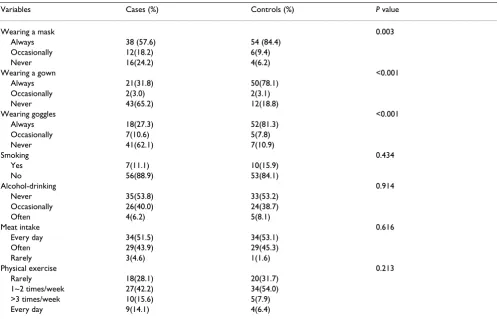
Univariate analysis results of factors related to SARS Several protection measures including wearing masks, gowns and goggles were found to be significantly associ-ated with decreased risk of SARS-CoV infection (P < 0.05). No significant difference between cases and controls was observed for the other factors, including smoking,
alco-hol-drinking, nutrition status and physical activities (Table 1).
Univariate analysis results of OAS1 and MxA gene SNPs in relation to SARS
Allele frequencies of OAS1 and MxA genes in cases and controls were compared (Table 2). The AG and GG geno-types in the 3'UTR of the OAS1 gene were significantly less frequent in case group (33.3% and 7.6%, respectively) than in control group (48.4% and 15.6%, respectively). Compared to AA genotype, AG and GG genotypes were found associated with a protective effect on SARS with ORs (95% CI) of 0.42 (0.20~0.89) and 0.30 (0.09~0.97), respectively. Also, a GT genotype at position 88 in the MxA gene promoter was associated with increased suscep-tibility to SARS infection compared to a GG genotype (OR
= 3.06, 95% CI: 1.25~7.50).
Multivariate analysis results of OAS1 and MxA gene SNPs in relation to SARS
A multivariate analysis was conducted with disease status as the dependent variable, each genotype as an independ-ent variable, and wearing masks, gowns and goggle as cov-ariables. It was indicated that the individuals with OAS1 AG genotype were at decreased risk, and those with MxA genotype GT were at increased risk of contracting SARS infection, as compared to AA and GG for OAS1 gene, and to GG and TT for MxA gene, respectively (Table 3 and 4).
Discussion
Many factors may influence the outcome and clinical manifestations of SARS infection, such as exposure levels, differences in SARS-CoV strain virulence, host health sta-tus, smoking, other virus co-infection, and host genetic patterns. In order to study the association between gene polymorphisms and SARS-CoV infection, we took several measures to control for possible confounders. Firstly, cases and controls were selected from the same hospital to minimize the impact of virulence differences in SARS-CoV strains. Secondly, each control had to have close contact history with SARS patients to reduce differences in expo-sure levels between cases and controls. Thirdly, multivari-ate analyses were conducted to adjust the factors which were statistically significant in univariate analyses. In fact, mask-, gown- and goggles-wearing were found to be pro-tective against SARS-CoV infection in this study as previ-ously reported [18-20].
was associated with the outcome of HCV infection, OAS1 playing a greater role in mediating self-limiting versus per-sistent HCV infection, rather than when viral persistence is established [16]. A nonsense mutation described in the gene encoding the mouse 2'-5' OAS1 isoform was associ-ated with West Nile virus susceptibility in laboratory mice
[image:4.612.58.557.99.418.2][21,22]. There are two isoforms in human OAS1 gene (E16 and E18), which share identical N-terminal sequence but diverge at exon 7 [23]. Isoform E16 contains 7 exons and a hydrophobic C-terminus. Isoform E18 con-tains an additional exon and is very hydrophilic as com-pared to transcript variant E16. Production of the two
Table 2: Univariate analysis results of OAS1 AND MxA gene SNPs in cases and controls
Cases (%) Controls (%) OR (95% CI) P value
OAS1 3'-UTR
genotype 0.026
AA 39 (59.1) 23 (36.0) 1.00
AG 22 (33.3) 31 (48.4) 0.42 (0.20~0.89) 0.022 GG 5 (7.6) 10 (15.6) 0.30 (0.09~0.97) 0.038 allele
A 75.8 60.2
G 24.2 39.8
MxA -88
genotype 0.006
GG 13(19.7) 24(37.5) 1.00
GT 48(72.7) 29(45.3) 3.06(1.25~7.53) 0.006 TT 5(7.6) 11(17.2) 0.84(0.20~3.44) 0.784 allele
G 56.1 61.1
[image:4.612.55.557.533.730.2]T 43.9 38.9
Table 1: Distribution of SARS-related factors in cases and controls
Variables Cases (%) Controls (%) P value
Wearing a mask 0.003
Always 38 (57.6) 54 (84.4) Occasionally 12(18.2) 6(9.4)
Never 16(24.2) 4(6.2)
Wearing a gown <0.001
Always 21(31.8) 50(78.1)
Occasionally 2(3.0) 2(3.1)
Never 43(65.2) 12(18.8)
Wearing goggles <0.001
Always 18(27.3) 52(81.3)
Occasionally 7(10.6) 5(7.8)
Never 41(62.1) 7(10.9)
Smoking 0.434
Yes 7(11.1) 10(15.9)
No 56(88.9) 53(84.1)
Alcohol-drinking 0.914
Never 35(53.8) 33(53.2)
Occasionally 26(40.0) 24(38.7)
Often 4(6.2) 5(8.1)
Meat intake 0.616
Every day 34(51.5) 34(53.1)
Often 29(43.9) 29(45.3)
Rarely 3(4.6) 1(1.6)
Physical exercise 0.213
Rarely 18(28.1) 20(31.7)
mRNAs isoforms of OAS1 depends on processing that involves the recognition site located within the 3'-termi-nal exon [24]. The polymorphisms in the 3'UTR may be related with the expression of the two isoforms. The mechanisms of the protective effect of G allele need to be elucidated.
Regarding the G/T polymorphism at position 88 in pro-moter region of MxA gene, the GT genotype was found to be more frequent in patients than in controls. Other researchers found no difference in SARS-CoV replication in Vero cells that were stably expressing MxA [25,26]. The patients with GT genotype may express more MxA protein when induced by IFNs. Consequently, the MxA protein can promote the establishment of persistent SARS-CoV infection. MxA protein may have dual functions in reac-tion to virus infecreac-tion. Torisu reported that T allele with a
[image:5.612.55.553.98.296.2]high MxA-producing capability was more frequently seen in subacute sclerosing panencephalitis (SSPE) patients [27]. A luciferase reporter assay revealed that the MxA pro-moter sequence of T haplotype had higher propro-moter activ-ity than that of G haplotype [28]. Arcas et al. reported that GT and TT genotype expressed higher amount of MxA mRNA than GG genotype in IFN-treated peripheral blood mononuclear cells in vitro [29]. In our study, 88 SNP in MxA was related to disease susceptibility. The mechanism of the MxA gene with SARS susceptibility needs to be fur-ther investigated. Since the polymorphisms in the two genes were associated with the SARS-CoV infection, we tried to find out if combined action between mutations could affect the susceptibility to SARS-CoV infection. But the sample size of this study is not sufficient to do the interaction analysis. More SARS cases and controls are required to do so.
Table 4: Association between MxA genotypes and SARS infection after adjusting other related factors in multivariate analysis
Variable OR (95% CI) P value
Wearing a mask 0.100
Always 1.00
Occasionally 1.64(0.41~6.60) 0.486
Never 4.41(1.12~17.34) 0.034
Wearing a gown 0.753
Always 1.00
Occasionally 1.03 (0.10~10.75) 0.460
Never 1.63(0.45~6.01) 0.983
Wearing goggles 0.004
Always 1.00
Occasionally 3.48(0.77~15.80) 0.106
Never 9.51(2.34~38.73) 0.002
genotype 0.061
GG 1.00
GT 3.22 (1.13~9.18) 0.029
[image:5.612.55.553.531.729.2]TT 1.17 (0.25~5.60) 0.843
Table 3: Association between OAS1 genotypes and SARS infection after adjusting other related factors in multivariate analysis
Variable OR (95% CI) P value
Wearing a mask 0.230
Always 1.00
Occasionally 1.70(0.42~6.86) 0.102
Never 3.11 (0.80~12.11) 0.456
Wearing a gown 0.490
Always 1.00
Occasionally 1.23 (0.13~11.62) 0.234
Never 2.19 (0.60~8.00) 0.857
Wearing goggles 0.006
Always 1.00
Occasionally 2.92(0.64~13.23) 0.002
Never 8.53 (2.16~33.73) 0.166
genotype 0.125
AA 1.00
AG 0.38(0.14~0.98) 0.047
Conclusion
In conclusion, we showed that the SNPs in OAS1 and MxA genes were associated with SARS-CoV infection in Chi-nese Han population. These findings may lead to a better understanding of IFN-induced antiviral response to SARS infection.
Competing interests
The author(s) declare that they have no competing inter-ests.
Authors' contributions
HJ carried out the study design, OAS1 genotyping and drafted the manuscript. DF carried out study design and statistical analysis. SJDV participated in the study design, statistical analysis and helped to draft the manuscript. HW carried out the genotyping of MxA gene. PZ, FT, LZ and HY participated in the blood sample and information collec-tion in the field, and carried out the DNA extraccollec-tion. AF participated in the study design and helped to draft the manuscript. SP wrote the genotyping protocol. TW coor-dinated the blood sample and information collection. JHR and JDFH participate in the study design and refined the manuscript. WC conceived the study and coordinated all the activities.
Acknowledgements
This study was carried out as part of "SARSControl: Effective and accepta-ble strategies for the control of SARS and other emerging infections in China and Europe", a European Commission project funded within the Sixth Framework Program, Thematic Priority Scientific Support to Policies, Contract number: SP22-CT-2004-003824. This study was also partially sup-ported by EPISARS (SP22-CT-2004-511063), Programme de Recherche en Réseaux Franco-Chinois (P2R: Épidémie du SRAS: de l'émergence au con-trôle), and the National "863" Program of China (2003AA208412C).
References
1. Rota PA, Oberste MS, Monroe SS, Nix WA, Campagnoli R, Icenogle JP, Penaranda S, Bankamp B, Maher K, Chen MH, Tong S, Tamin A, Lowe L, Frace M, DeRisi JL, Chen Q, Wang D, Erdman DD, Peret TC, Burns C, Ksiazek TG, Rollin PE, Sanchez A, Liffick S, Holloway B, Limor J, McCaustland K, Olsen-Rasmussen M, Fouchier R, Gunther S, Osterhaus AD, Drosten C, Pallansch MA, Anderson LJ, Bellini WJ: Characterization of a novel coronavirus associated with severe acute respiratory syndrome. Science 2003, 300:1394-1399.
2. World Health Organization: Summary of probable SARS cases with onset of illness from 1 November 2002 to 31 July. [http:/ /www.who.int/csr/sars/].
3. Ashraf H: WHO declares Beijing to be free of SARS. Lancet
2003, 361:2212.
4. Lee A: Host and environment are key factors. J Epidemiol Com-munity Health 2003, 57:770.
5. Ng MH, Lau KM, Li L, Cheng SH, Chan WY, Hui PK, Zee B, Leung CB, Sung JJ: Association of human-leukocyte-antigen class I (B*0703) and class II (DRB1*0301) genotypes with suscepti-bility and resistance to the development of severe acute res-piratory syndrome. J Infect Dis 2004, 190:515-518.
6. Lin M, Tseng HK, Trejaut JA, Lee HL, Loo JH, Chu CC, Chen PJ, Su YW, Lim KH, Tsai ZU, Lin RY, Lin RS, Huang CH: Association of HLA class I with severe acute respiratory syndrome corona-virus infection. BMC Med Genet 2003, 4:9.
7. Itoyama S, Keicho N, Quy T, Phi NC, Long HT, Ha le D, Ban VV, Ohashi J, Hijikata M, Matsushita I, Kawana A, Yanai H, Kirikae T,
Kuratsuji T, Sasazuki T: ACE1 polymorphism and progression of SARS. Biochem Biophys Res Commun 2004, 323:1124-1129. 8. Cinatl J, Morgenstern B, Bauer G, Chandra P, Rabenau H, Doerr HW:
Treatment of SARS with human interferons. Lancet 2003, 362:293-294.
9. Enserink M: SARS treatment: Interferon shows promise in monkeys. Science 2004, 303:1273-1275.
10. Stroher U, DiCaro A, Li Y, Strong JE, Aoki F, Plummer F, Jones SM, Feldmann H: Severe acute respiratory syndrome-related coro-navirus is inhibited by interferon-alpha. J Infect Dis 2004, 189:1164-1167.
11. Rebouillat D, Hovanessian AG: The human 2',5'-oligoadenylate synthetase family: interferon-induced proteins with unique enzymatic properties. J Interferon Cytokine Res 1999, 19:295-308. 12. Schwemmle M, Weining KC, Richter MF, Schumacher B, Staeheli P: Vesicular stomatitis virus transcription inhibited by purified MxA protein. Virology 1995, 206:545-554.
13. Landis H, Simon-Jodicke A, Kloti A, Di Paolo C, Schnorr JJ, Schneider-Schaulies S, Hefti HP, Pavlovic J: Human MxA protein confers resistance to Semliki Forest virus and inhibits the amplifica-tion of a Semliki Forest virus-based replicon in the absence of viral structural proteins. J Virol 1998, 72:1516-1522. 14. Hefti HP, Frese M, Landis H, Di Paolo C, Aguzzi A, Haller O, Pavlovic
J: Human MxA protein protects mice lacking a functional alpha/beta interferon system against La crosse virus and other lethal viral infections. J Virol 1999, 73:6984-6991. 15. Suzuki F, Arase Y, Suzuki Y, Tsubota A, Akuta N, Hosaka T, Someya
T, Kobayashi M, Saitoh S, Ikeda K, Kobayashi M, Matsuda M, Takagi K, Satoh J, Kumada H: Single nucleotide polymorphism of the MxA gene promoter influences the response to interferon monotherapy in patients with hepatitis C viral infection. J Viral Hepat 2004, 11:271-276.
16. Knapp S, Yee LJ, Frodsham AJ, Hennig BJ, Hellier S, Zhang L, Wright M, Chiaramonte M, Graves M, Thomas HC, Hill AV, Thursz MR: Pol-ymorphisms in interferon-induced genes and the outcome of hepatitis C virus infection: roles of MxA, OAS-1 and PKR.
Genes Immun 2003, 4:411-419.
17. Hamano E, Hijikata M, Itoyama S, Quy T, Phi NC, Long HT, Ha le D, Ban VV, Matsushita I, Yanai H, Kirikae F, Kirikae T, Kuratsuji T, Sasa-zuki T, Keicho N: Polymorphisms of interferon-inducible genes OAS-1 and MxA associated with SARS in the Vietnamese population. Biochem Biophys Res Commun 2005, 329:1234-1239. 18. Ma HJ, Wang HW, Fang LQ, Jiang JF, Wei MT, Liu W, Zhao QM, Ma
J, Cao WC: A case-control study on the risk factor s of sever e acute respiratory syndromes among health care workers.
Chin J Epidemiol 2004, 25:741-744.
19. Pang XH, Liu DL, Gong XH, Xu FJ, Liu ZJ, Zhang Z, Wang XH, Jiao XR, Su LY, Gao GH: Study on the risk factors related to severe acute respiratory syndrome among close contactors in Bei-jing. Chin J Epidemiol 2004, 25:674-676.
20. Wang M, Du L, Zhou DH, Di B, Liu YF, Qin PZ, Wu XW, Chen XS, Qiu JC, Li ZR: Study on the epidemiology and measures for control on severe acute respiratory syndrome in Guangzhou city. Chin J Epidemiol 2003, 24:353-3757.
21. Mashimo T, Lucas M, Simon-Chazottes D, Frenkiel MP, Montagutelli X, Ceccaldi PE, Deubel V, Guenet JL, Despres P: A nonsense muta-tion in the gene encoding 2'-5'-oligoadenylate synthetase/L1 isoform is associated with West Nile virus susceptibility in laboratory mice. Proc Natl Acad Sci U S A 2002, 99:11311-11316. 22. Lucas M, Mashimo T, Frenkiel MP, Simon-Chazottes D, Montagutelli
X, Ceccaldi PE, Guenet JL, Despres P: Infection of mouse neu-rones by West Nile virus is modulated by the interferon-inducible 2'-5' oligoadenylate synthetase 1b protein. Immunol Cell Biol 2003, 81:230-236.
23. Benech P, Mory Y, Revel M, Chebath J: Structure of two forms of the interferon-induced (2'-5') oligo A synthetase of human cells based on cDNAs and gene sequences. EMBO J 1985, 4:2249-2256.
24. Aissouni Y, Perez C, Calmels B, Benech PD: The cleavage/polya-denylation activity tr igger ed by a U-rich motif sequence is differently required depending on the poly(A) site location at either the fir st or last 3'-terminal exon of the 2'-5' oligo(A) synthetase gene. J Biol Chem 2002, 277:35808-35814.
Publish with BioMed Central and every scientist can read your work free of charge
"BioMed Central will be the most significant development for disseminating the results of biomedical researc h in our lifetime."
Sir Paul Nurse, Cancer Research UK
Your research papers will be:
available free of charge to the entire biomedical community
peer reviewed and published immediately upon acceptance
cited in PubMed and archived on PubMed Central
yours — you keep the copyright
Submit your manuscript here:
http://www.biomedcentral.com/info/publishing_adv.asp
BioMedcentral 26. Scagnolari C, Vicenzi E, Bellomi F, Stillitano MG, Pinna D, Poli G,
Clementi M, Dianzani F, Antonelli G: Increased sensitivity of SARS-coronavirus to a combination of human type I and type II interferons. Antivir Ther 2004, 9:1003-1011.
27. Torisu H, Kusuhara K, Kira R, Bassuny WM, Sakai Y, Sanefuji M, Take-moto M, Hara T: Functional MxA promoter polymorphism associated with subacute sclerosing panencephalitis. Neurol-ogy 2004, 62:457-460.
28. Hijikata M, Mishiro S, Miyamoto C, Furuichi Y, Hashimoto M, Ohta Y: Genetic polymorphism of the MxA gene promoter and inter-feron responsiveness of hepatitis C patients: revisited by analyzing two SNP sites (-123 and -88) in vivo and in vitro.
Intervirology 2001, 44:379-382.
29. Fernandez-Arcas N, Blanco A, Gaitan MJ, Nyqvist M, Alonso A, Reyes-Engel A: Differential transcriptional expresion of the polymorphic myxovirus resistance protein A in response to interferon-alpha treatment. Pharmacogenetics 2004, 14:189-193.
Pre-publication history
The pre-publication history for this paper can be accessed here: