R E S E A R C H A R T I C L E
Open Access
A sham case-control study of effectiveness of
DTP-Hib-hepatitis B vaccine against rotavirus
acute gastroenteritis in Kenya
Sammy Khagayi
1*, Jacqueline E Tate
2, Reuben Onkoba
1, Umesh Parashar
2, Frank Odhiambo
1, Deron Burton
1,3,
Kayla Laserson
1,4and Daniel R Feikin
1,3,5Abstract
Background:In many GAVI-eligible countries, effectiveness of new vaccines will be evaluated by case-control methodology. To inform the design and assess selection bias of a future case-control study of rotavirus vaccine effectiveness (VE) in western Kenya, we performed a sham case-control study evaluating VE of pentavalent vaccine (DTP-Hib-HepB) against rotavirus acute gastroenteritis (AGE).
Methods:From ongoing rotavirus surveillance, we defined cases as children 12 weeks to 23 months old with EIA-confirmed rotavirus AGE. We enrolled one community-based and two hospital-based control groups. We collected vaccination status from cards at enrollment, or later in homes, and evaluated VE by logistic regression. Results:We enrolled 91 cases (64 inpatient, 27 outpatient), 252 non-rotavirus AGE facility-based controls (unmatched), 203 non-AGE facility-based controls (age-matched) and 271 community controls (age-matched). Documented receipt of 3 pentavalent doses was 77% among cases and ranged from 81-86% among controls. One percent of cases and 0-2% of controls had no pentavalent doses. The adjusted odds ratio of three versus zero doses for being a case was 3.27 (95% CI 0.01-1010) for community controls and 0.69 (95% CI 0.06-7.75) for non-rotavirus hospital-based AGE controls, translating to VE of−227% and 31%, respectively, with wide confidence intervals. (No facility-based non-AGE controls were unvaccinated.) Similar results were found for≥2 pentavalent doses and for severe rotavirus AGE. Conclusions:The study showed that it is feasible to carry out a real case control in the study area, but this needs to be done as soon as the vaccine is introduced to capture the real impact. Sham case-control or pilot studies before vaccine introduction can be useful in designing case-control VE studies.
Keywords:Rotavirus, Case-control, Vaccine effectiveness
Background
Rotavirus causes approximately 453,000 deaths annually in children, most of them occurring in sub-Saharan Africa and Asia [1]. By December 2012, 13 of 73 coun-tries eligible for funding through the Global Alliances for Vaccines and Immunizations (GAVI) had introduced rotavirus vaccines into their national immunization programs and 20 more countries, including Kenya, had been approved to receive GAVI funding for rotavirus vaccine [2,3].
As more developing countries introduce rotavirus vac-cines, there is growing interest in evaluating their impact to support decisions for continued and augmented country-level financing. In many countries with on-going rotavirus surveillance, rotavirus vaccine effectiveness (VE) will be evaluated by case-control methodology [4-6]. Case-control studies for evaluation of VE have the advan-tage of being relatively quick, not requiring pre-vaccine data or a well-defined denominator population, and being efficient in the setting of rare diseases [6,7]. Case-control studies have been utilized to evaluate rotavirus VE in Nicaragua and El Salvador [8-10], as well as other vaccines in various settings [7,11-13]. While having advantages, case-control studies are inherently at risk of selection bias * Correspondence:[email protected]
1
Kenya Medical Research Institute (KEMRI)/Centers for Disease Control and Prevention (CDC) Research and Public Health Collaboration, Kisumu, Kenya Full list of author information is available at the end of the article
due to the challenges of selecting a sample of controls representative of the population from which the cases arose [7,14,15]. If controls differ in their propensity to be vaccinated or to seek medical care from the source population of cases, then the association between vaccine and disease can be distorted, leading to biased estimates of VE [7,16]. Besides selection bias, case-control studies can suffer from misclassification of exposure (i.e. vac-cination status).
We used ongoing surveillance for rotavirus gastroenteritis in rural western Kenya to perform a case-control study evaluating effectiveness of pentavalent vaccine (diphtheria, pertussis, tetanusHaemophilus influenzae type b (Hib), and hepatitis B) on rotavirus gastroenteritis. Since pentavalent vaccine should have no protection against rotavirus disease, we refer to this study as a “sham” case-control study, and as such, after adjusting for potential confounders, any
“vaccine effectiveness” could be ascribed to residual selection bias, and could be useful in interpreting results of a real case-control study of rotavirus VE undertaken after the vaccine’s introduction into Kenya. Besides assessing selection bias, our study aimed to define char-acteristics of the population (e.g. vaccine coverage and timeliness) and the design (e.g. ability to document vaccine status) that would inform the design and execu-tion of a real case-control study of rotavirus vaccine after its introduction into Kenya.
Methods
Rotavirus surveillance
The study was conducted in Siaya County, western Kenya, in the setting of a long-standing Health and Demographic Surveillance System (HDSS) [17]. The area is rural, poor, has high malaria and HIV prevalence, and a high under-5 mortality ratio [17-19].
Surveillance for acute gastroenteritis (AGE) among children <5 years of age was conducted among inpatients at a district hospital and outpatients at two health centers located in the HDSS area. AGE was defined as≥3 looser than normal stools and/or >1 episode of unexplained vomiting followed by loose stool within a 24-hour period beginning within seven days before seeking healthcare. Stool was collected in a plastic diaper from which at least 2 ml of stool was scooped into a specimen container. In the outpatient facilities, if the child was unable to pro-vide stool during the visit, a field worker would follow-up at the child’s home to collect stool. All stool samples were collected within 48 hours after presentation, stored and transported in cool boxes on the same day of collection to KEMRI/CDC laboratories, approxi-mately 60 kilometers away. Batch testing for rotavirus using enzyme-immunoassay (EIA, Rotaclone™ Kit) was done.
Case-control study
The case-control study was embedded in ongoing rota-virus surveillance system. Eligible children were 12 weeks (i.e. 2 weeks after the second scheduled Expanded Program for Immunization visit) to 23 months of age who presented with AGE, as these children are eligible to have received pentavalent vaccine. Among these, cases were defined as those with an EIA-confirmed rotavirus-positive stool sample. Severe AGE was defined using the 20-point numerical Vesikari scoring system with scores of ≥11 [20]. Case selection at the sites was consecutive until the desired sample size was reached. Inpatients were enrolled continuously, including during nights and weekends. Outpatients were enrolled during weekday daytime hours.
We enrolled two hospital and one community-based control groups. The first hospital control group was unmatched, consisting of children presenting to the same facility as the cases, who had AGE not caused by rotavirus, as determined by a negative rotavirus EIA test. The second hospital control group was children presenting with a non-AGE illness, excluding those who had other EPI-vaccine-preventable diseases (i.e. measles, pneumonia, meningitis, sepsis, otitis media, bacteraemia, epiglottitis, hepatitis and pertussis). In a 3:1 ratio, controls were age-matched to cases within −15 to +60 days of the case-patient’s birthday. Eligible controls were enrolled starting from the admission closest in date to the case’s admission date, until three controls were enrolled. The third control group was selected from the same villages as the case-patients, but not living in the same compound. Starting at the case’s compound, we went to the nearest compound on either side of the case’s compound to check for eligible children. If no children met eligibility criteria in that compound, we went to the adjacent compound in the same direction until we enrolled a control. After the first control, we skipped the next compound and inquired about eligible controls at the following compound. We repeated this process until we enrolled three controls.
HIV testing
HIV testing was done using parallel rapid test kits on whole blood obtained from finger-prick –Determine HIV-1/2 (Abbott Diagnostic Division, Hoofdorp, Netherlands) and Bioline® (Standard Diagnostics Inc, Korea) - with tie-breaking of discordant results using Unigold™(Trinitiy Biotech PLC, Ireland). PCR testing confirmed HIV status for children <18 months old who were antibody-positive on at least one rapid test.
Data collection
without their vaccination card, we visited their home and collected the immunization history from available cards. If the card was not available, a verbal report of the child’s vaccination status was collected. Other data collected included history, symptoms and signs of illness for cases, parent’s education level, household characteristics and possessions, and distance to the nearest health facility.
Sample size
For the sham case-control study, we did not expect to find statistically significant“effectiveness”of the pentava-lent vaccine against rotavirus AGE, but rather to deter-mine if the study found a point estimate that gave an indication of potential bias (i.e. the odds ratio was significantly different from 1.0). To estimate enrollment duration for a real case-control study, we determined the sample size based on a rotavirus VE evaluation. While coverage with two Pentavalent doses is 94% in the area [21], we assumed that in the first year of rotavirus
vaccine introduction, coverage among infants would be lower due to obstacles of rolling out the vaccine. We therefore estimated 50% coverage. Using these parameters, we needed 61 cases and183 controls in each of the three control groups (3:1 control to case ratio) to detect a VE of 60% in the first year of life. To account for missing data, we increased the sample size by 10%, to 67 cases and 201 controls per control group.
Data analysis
A dose of pentavalent was considered valid (i.e. immuno-logically protective) if it was administered≥14 days before the date of admission for the case, 14 days before the date of admission for the case for the matched controls and 14 days before the control child’s admission for the unmatched hospital controls.
To evaluate socioeconomic status (SES), we constructed quintiles based on eight indicator variables of asset ownership which were scored and reduced to a single score through principal component analysis [22]. We
19 Number of children <5 yrs admitted at
the Inpatient facility
N=2,254
Number of children <5yrs seen at the Outpatient facilities
N=1986
n (%) AGE <5 yrs admitted at facility
504 (22)
n (%) AGE <5 yrs seen at the outpatient
232 (12)
n (%) AGE 3-23 months admitted
409 (81)
n (%) AGE 3-23 months seen
176 (76)
n (%) AGE 3-23 months admitted with stool collected
289 (71)
n (%) AGE 3-23 months seen with stool collected
118 (67)
n (%) rotavirus positive and had been screened for case-control study
80 (28)
n (%) rotavirus positive and had been screened for case-control study
32 (27)
n (%) enrolled
64 (80)
n (%) enrolled
27 (84)
16 (20%) refusal 5 (16%) refusal
n (%)Stool not collected
120(29)
Reasons for not collecting Died=6 Transferred/Absconded=2
Refusal=6 Unable to produce/collect
stool=106
n (%)Stool not collected
58(33)
Reasons for not collecting Transferred/Absconded=4
Refusal=4 Unable to produce/collect
[image:3.595.58.539.344.715.2]stool=50
considered risk factors for rotavirus AGE using commu-nity controls only because comparison between cases and the two hospital control groups evaluated rotavirus AGE risk against other diagnoses, which has less meaningful epidemiologic interpretation. Comparison between rota-virus AGE cases and hospital controls was done only to identify variables for adjustment in logistic regression.
The primary analysis included only documented reports of vaccine status; having zero doses was determined from either vaccination card or verbal report as it was expected that unvaccinated children may be less likely to have cards, which are usually given at the first vaccination in the clinic. The main analysis compared children who had received three doses versus zero doses. Secondary analyses included children who had received at least two docu-mented doses versus zero doses. For the analysis of the matched control groups, conditional logistic regression was used; all variables with a p value of <0.10 in univariate analysis were incorporated in multivariable analysis using backwards elimination. Variables with more than 5% unknown responses were included in the model with
“unknown”coded as a category of a dummy variable. Chil-dren with unknown vaccine status were always excluded from the model. VE was calculated as ((1-Odds Ratio) X 100). We also did an unmatched analysis of cases and non-rotavirus facility-based AGE controls, controlling for age in months and seasonality (4 quarters of the year) using unconditional logistic regression. We reran the analysis for only severe cases. Lastly, we evaluated timely vaccination, defined as having received the vaccine be-tween one week before and two weeks after the scheduled
date of vaccination, which in Kenya is 6, 10 and 14 weeks for the primary EPI series.
Ethical considerations
This study was approved by the Kenya Medical Research Institute’s ethics review committee (SSC#1836). Written informed consents were obtained from all participants or their legal guardians prior to enrolment.
Results
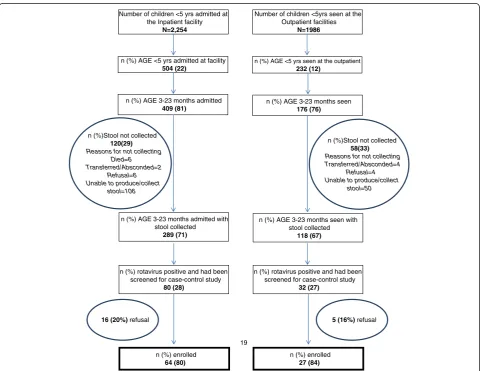
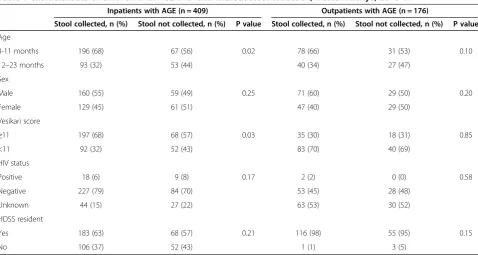
Case enrollment occurred from December 1, 2010 through November 30, 2011. There were 507 AGE hos-pitalizations among children <5 years old and 232 AGE sick visits in the outpatient facilities, of which, 409 (81%) and 176 (76%) were among children 3–23 months of age, respectively (Figure 1). We obtained stool speci-mens from 289 (71%) age-eligible inpatients and 118 (67%) age-eligible outpatients. Severe AGE occurred in 197 (68%) inpatients and 35 (30%) outpatients (Table 1). Among inpatients, stool samples were more likely to be collected from children <12 months of age and with severe AGE (Table 1). No difference in stool collection was seen among outpatients. Among the 3–23 month old inpatients and outpatients with AGE who had stool collected, 80 (28%) and 32 (27%), respectively, were positive for rotavirus (Figure 1). Five (6%) hospitalized rotavirus-positive cases died during their admission.
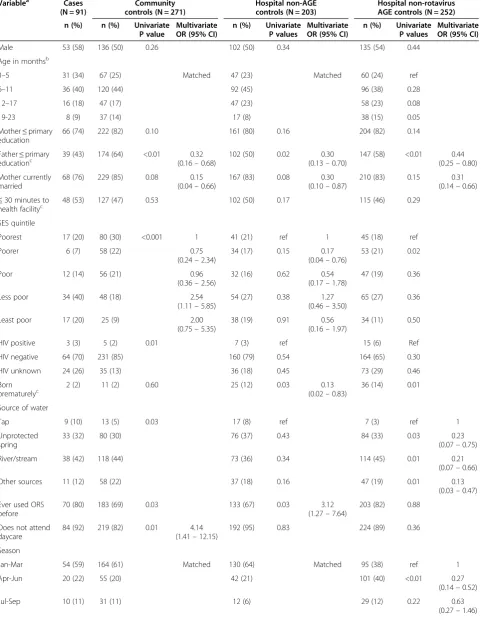
[image:4.595.59.538.478.733.2]Among age-eligible rotavirus AGE cases, 64 (80%) inpa-tients and 27 (84%) outpainpa-tients were enrolled (Figure 1). We enrolled 252 AGE hospital controls without rota-virus detected, 203 non-AGE hospital controls and 271
Table 1 Characteristics of children with AGE with and without stool collection, western Kenya, 2010-11
Inpatients with AGE (n = 409) Outpatients with AGE (n = 176)
Stool collected, n (%) Stool not collected, n (%) P value Stool collected, n (%) Stool not collected, n (%) P value
Age
3-11 months 196 (68) 67 (56) 0.02 78 (66) 31 (53) 0.10
12–23 months 93 (32) 53 (44) 40 (34) 27 (47)
Sex
Male 160 (55) 59 (49) 0.25 71 (60) 29 (50) 0.20
Female 129 (45) 61 (51) 47 (40) 29 (50)
Vesikari score
≥11 197 (68) 68 (57) 0.03 35 (30) 18 (31) 0.85
<11 92 (32) 52 (43) 83 (70) 40 (69)
HIV status
Positive 18 (6) 9 (8) 0.17 2 (2) 0 (0) 0.58
Negative 227 (79) 84 (70) 53 (45) 28 (48)
Unknown 44 (15) 27 (22) 63 (53) 30 (52)
HDSS resident
Yes 183 (63) 68 (57) 0.21 116 (98) 55 (95) 0.15
Table 2 Univariate analysis comparing risk factors among rotavirus AGE cases and controls, western Kenya, 2010-11
Variablea Cases
(N = 91)
Community controls (N = 271)
Hospital non-AGE controls (N = 203)
Hospital non-rotavirus AGE controls (N = 252)
n (%) n (%) Univariate P value
Multivariate OR (95% CI)
n (%) Univariate P values
Multivariate OR (95% CI)
n (%) Univariate P values
Multivariate OR (95% CI)
Male 53 (58) 136 (50) 0.26 102 (50) 0.34 135 (54) 0.44
Age in monthsb
3–5 31 (34) 67 (25) Matched 47 (23) Matched 60 (24) ref
6–11 36 (40) 120 (44) 92 (45) 96 (38) 0.28
12–17 16 (18) 47 (17) 47 (23) 58 (23) 0.08
19-23 8 (9) 37 (14) 17 (8) 38 (15) 0.05
Mother≤primary education
66 (74) 222 (82) 0.10 161 (80) 0.16 204 (82) 0.14
Father≤primary
educationc 39 (43) 174 (64) <0.01 (0.160.32
–0.68)
102 (50) 0.02 0.30
(0.13–0.70)
147 (58) <0.01 0.44
(0.25–0.80)
Mother currently married
68 (76) 229 (85) 0.08 0.15
(0.04–0.66)
167 (83) 0.08 0.30
(0.10–0.87)
210 (83) 0.15 0.31
(0.14–0.66)
≤30 minutes to
health facilityc 48 (53) 127 (47) 0.53 102 (50) 0.17 115 (46) 0.29
SES quintile
Poorest 17 (20) 80 (30) <0.001 1 41 (21) ref 1 45 (18) ref
Poorer 6 (7) 58 (22) 0.75
(0.24–2.34)
34 (17) 0.15 0.17
(0.04–0.76)
53 (21) 0.02
Poor 12 (14) 56 (21) 0.96
(0.36–2.56)
32 (16) 0.62 0.54
(0.17–1.78)
47 (19) 0.36
Less poor 34 (40) 48 (18) 2.54
(1.11–5.85)
54 (27) 0.38 1.27
(0.46–3.50)
65 (27) 0.36
Least poor 17 (20) 25 (9) 2.00
(0.75–5.35)
38 (19) 0.91 0.56
(0.16–1.97)
34 (11) 0.50
HIV positive 3 (3) 5 (2) 0.01 7 (3) ref 15 (6) Ref
HIV negative 64 (70) 231 (85) 160 (79) 0.54 164 (65) 0.30
HIV unknown 24 (26) 35 (13) 36 (18) 0.45 73 (29) 0.46
Born prematurelyc
2 (2) 11 (2) 0.60 25 (12) 0.03 0.13
(0.02–0.83)
36 (14) 0.01
Source of water
Tap 9 (10) 13 (5) 0.03 17 (8) ref 7 (3) ref 1
Unprotected spring
33 (32) 80 (30) 76 (37) 0.43 84 (33) 0.03 0.23
(0.07–0.75)
River/stream 38 (42) 118 (44) 73 (36) 0.34 114 (45) 0.01 0.21
(0.07–0.66)
Other sources 11 (12) 58 (22) 37 (18) 0.16 47 (19) 0.01 0.13
(0.03–0.47)
Ever used ORS before
70 (80) 183 (69) 0.03 133 (67) 0.03 3.12
(1.27–7.64)
203 (82) 0.88
Does not attend daycare
84 (92) 219 (82) 0.01 4.14
(1.41–12.15)
192 (95) 0.83 224 (89) 0.36
Season
Jan-Mar 54 (59) 164 (61) Matched 130 (64) Matched 95 (38) ref 1
Apr-Jun 20 (22) 55 (20) 42 (21) 101 (40) <0.01 0.27
(0.14–0.52)
Jul-Sep 10 (11) 31 (11) 12 (6) 29 (12) 0.22 0.63
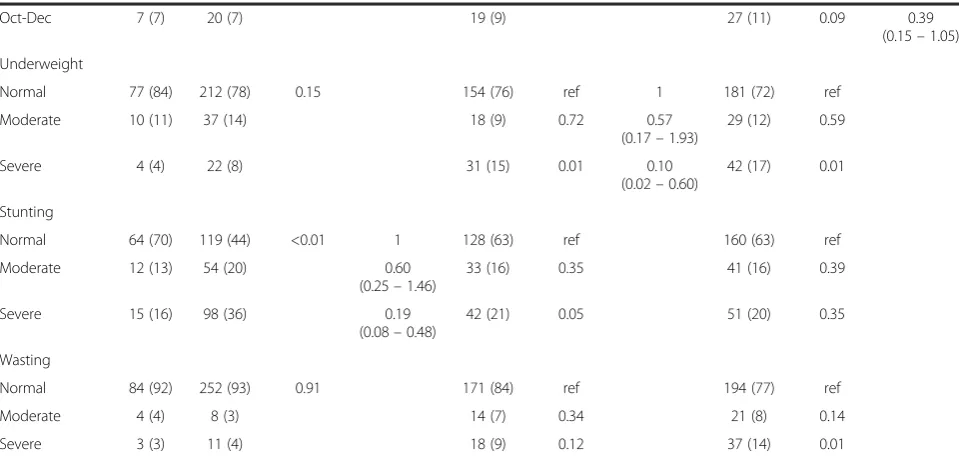
community controls. In multivariable analysis, comparing rotavirus AGE cases to community controls having a father with less education , a mother currently married, and being moderately-to-severely stunted were protective against being a case, while being in the least poor SES quintiles and not attending daycare were significant risk factors (Table 2).
The percentage of cases with documented vaccination status was 83%, which was lower than among community controls (90%) and higher than hospital controls (74-77%). Among cases, 77% had received 3 doses of pentavalent by documented report and only 1% were unvaccinated (Table 3). Among control groups, this proportion with 3 doses varied slightly –86% for community controls, 81% for facility-based non-AGE controls, and 83% for un-matched facility-based AGE controls, according to the vaccine card with only 0% - 2% unvaccinated.
The adjusted odds ratio of three doses versus zero doses was 3.27 (95% CI 0.01-1010) for community con-trols and 0.69 (95% CI 0.06-7.75) for facility-based AGE controls; this translates to VE of −227% and 31%, re-spectively, with very wide confidence intervals (Table 4). (No facility-based non-AGE controls were unvaccinated, thus this analysis could not be performed.) Similar results were found when evaluating≥2 doses of pentavalent vac-cine versus zero doses and when restricting cases to severe rotavirus AGE (Table 4).
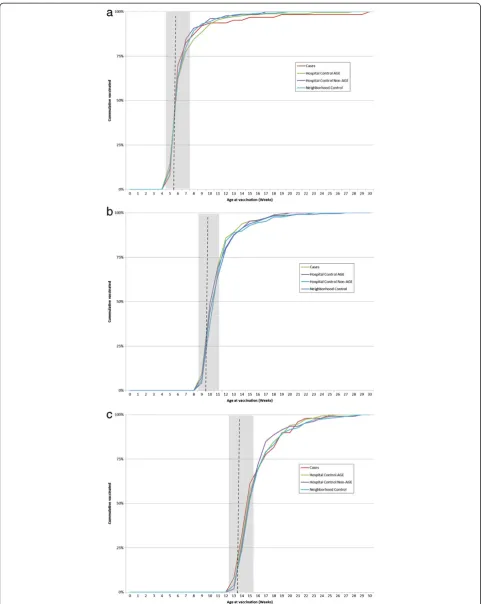
Among cases with documented timing of pentavalent immunization, 83%, 70% and 69% received timely vac-cination for pentavalent doses 1, 2 and 3, respectively (Figure 2). Similar timing of vaccination was seen among all control groups.
Discussion
Our sham case-control study provided several important lessons that can be applied to a case-control study of rotavirus VE in the same setting after vaccine introduc-tion, expected in 2014 [2]. First and foremost, a major challenge was finding very few unvaccinated children, which limited the study’s power to make any conclusions about bias. Given the high coverage levels of routine immunizations in Kenya, unvaccinated children may not be epidemiologically representative of children in this population. An evaluation of rotavirus VE in Nicaragua found that small differences in vaccine coverage resulted in substantially disparate estimates of VE when coverage was high (≥95% vaccinated), but not when coverage was lower (~91% vaccinated) [23]. To avoid this problem in Kenya, we plan to perform the case-control study of rotavirus vaccine during the roll-out phase before full coverage is achieved.
[image:6.595.57.537.112.341.2]Although case-control studies often employ multiple control groups in an attempt to understand bias, multiple control groups often yield varying effectiveness estimates, Table 2 Univariate analysis comparing risk factors among rotavirus AGE cases and controls, western Kenya, 2010-11
(Continued)
Oct-Dec 7 (7) 20 (7) 19 (9) 27 (11) 0.09 0.39
(0.15–1.05)
Underweight
Normal 77 (84) 212 (78) 0.15 154 (76) ref 1 181 (72) ref
Moderate 10 (11) 37 (14) 18 (9) 0.72 0.57
(0.17–1.93)
29 (12) 0.59
Severe 4 (4) 22 (8) 31 (15) 0.01 0.10
(0.02–0.60)
42 (17) 0.01
Stunting
Normal 64 (70) 119 (44) <0.01 1 128 (63) ref 160 (63) ref
Moderate 12 (13) 54 (20) 0.60
(0.25–1.46)
33 (16) 0.35 41 (16) 0.39
Severe 15 (16) 98 (36) 0.19
(0.08–0.48)
42 (21) 0.05 51 (20) 0.35
Wasting
Normal 84 (92) 252 (93) 0.91 171 (84) ref 194 (77) ref
Moderate 4 (4) 8 (3) 14 (7) 0.34 21 (8) 0.14
Severe 3 (3) 11 (4) 18 (9) 0.12 37 (14) 0.01
a
Only variables that were significantly different between cases and controls, or of particular epidemiologic interest, are listed in tables. The following variables were not significantly associated with case status: maternal age, number of children in household, fare to nearest facility, history of an AGE hospitalization, enrollment in the HDSS, treats drinking water, and mother knows about ORS.
b
Two controls that were < 3 months old and three that were >23 months old, due to range of allowable matching ages were included in the 3–5 and 19–23 age groups respectively.
c
leaving researchers with challenges in interpretation of the results. We explored three different source populations for enrolling controls. Children in all three control groups were largely similar to case-patients with regard to poten-tially confounding socio-demographic characteristics. One exception was that the hospitalized control groups tended to have more severe malnutrition, suggesting children hospitalized with non-rotavirus illnesses tend to be dif-ferent in their nutritional status, which can potentially confound VE estimates.
The ease of enrollment differed between the three control groups. Matched non-AGE facility-based controls were easy to enroll, but difficult to find sufficient numbers to meet matching criteria and harder to collect vaccin-ation data. Community control enrollment achieved sufficient numbers, but required additional expense and logistical coordination. Children hospitalized for AGE who tested negative for rotavirus offered a time and resource-efficient alternative to the other two more
traditional control groups, because they were already being tested through the diarrheal surveillance plat-form. These children had the same healthcare seeking behavior for diarrheal illness as individuals with rota-virus diarrhea, and had the most similar demographic profile to rotavirus AGE cases, particularly SES which can be related to health-seeking and vaccination. Add-itionally, study staff were blinded to the child’s case or control status at time of enrollment and during vaccine verification, which occurred before EIA results were available. The rotavirus EIA is highly sensitive and specific and thereby minimizes the misclassification of cases and controls [24-26]. Based on these reasons, we believe in this setting the use of test-negative controls will provide the most resource efficient and epidemio-logically unbiased control group, and should be the only control group for the real case-control study.
[image:7.595.57.539.100.290.2]Another challenge was documenting vaccination status and dates of vaccination. The proportion of children for
Table 4 Univariate and multivariable analysis comparing immunization status for rotavirus AGE cases versus controls, western Kenya, 2010–11 (documented immunization status only)
Variablesa Community controls OR
(95% CI)
Hospital non-AGE controls OR 95% CI
Hospital AGE controlsc(unmatched)
OR 95% CI
Unadjusted OR Adjusted ORa Unadjusted OR Adjusted ORb Unadjusted OR Adjusted ORc
3 versus 0 pentavalent doses 1.00 (0.08–11.93) 3.27 (0.01–1010) Undefined Undefined 1.09 (0.11–10.66) 0.69 (0.06–7.75)
≥2 versus 0 pentavalent doses 0.77 (0.07–8.55) 2.26 (0.06–865) Undefined Undefined 1.15 (0.12–11.22) 0.64 (0.06–6.79)
Missing and unknown responses for variables were excluded in the regression.
a
Regression with community controls adjusted for father’s education, mother’s marital status, socioeconomic status of household, child attends daycare and stunting.
b
Regression with hospital non-AGE controls adjusted for father’s education, mother’s marital status, socioeconomic status of household, child born prematurely, child ever treated with ORS and underweight.
c
[image:7.595.56.541.620.682.2]Regression with hospital AGE controls adjusted for father’s education, mother’s marital status, season of the year and source of water.
Table 3 Table comparing immunization status among rotavirus AGE cases and controls, western Kenya, 2010–11
Variablea Cases
(N = 91)
Community controls (N = 271)
Hospital Non-AGE controls (N = 203)
Hospital AGE controls unmatched (N = 252)
n (%) n (%) n (%) n (%)
Number of pentavalent doses receivedb
0 doses 1 (1) 3 (1) 0 (0) 3 (2)
1 dose 4 (5) 5 (2) 7 (5) 7 (4)
2 doses 12 (16) 25 (10) 20 (14) 23 (12)
3 doses 58 (77) 210 (86) 118 (81) 160 (83)
Of those with 2 doses of pentavalentc
Dose 2 received on time 47 (67) 152 (65) 89 (64) 121 (66)
Dose 2 not received on time 23 (33) 83 (35) 49 (36) 61 (34)
Of those with 3 doses of pentavalentc
Dose 3 received on time 30 (52) 117 (56) 61 (52) 90 (56)
Dose 3 not received on time 28 (48) 93 (44) 57 (48) 70 (44)
a
First response to each variable was referent category in conditional logistic regression.
b
A dose was considered given if it was given at least 14 days before the date of admission of the cases for cases and matched controls while for the unmatched controls it was 14 days before their date of admission. Timely vaccination considered vaccination <1 before or >2 weeks after scheduled date of pentavalent2 pentavalent3 at 10 weeks and 14 weeks of age respectively.
c
whom we were unable to document vaccination status ranged from 10% in community controls to 29% in the non-AGE hospital controls. High levels of undocumented vaccination status could bias VE estimates particularly if vaccination status is differentially missing by number of doses received. For the real case-control study, efforts will be made to seek documentation of vaccination for all cases and controls in the home or the immunization clinics, when unavailable in the hospital.
We did not find any significant associations of penta-valent vaccination on rotavirus gastroenteritis in children. There are several possible explanations. First, a lack of association in the absence of selection bias is expected as pentavalent vaccine should confer no immunologic pro-tection against rotavirus disease. Therefore, it is possible that there was no selection bias. Second, as mentioned, our study had very limited power due to the low numbers of both case and control children who received no penta-valent doses. Confidence intervals around VE estimates were very wide and included 1 for all evaluable control groups. Sham case-control studies, like real ones of vac-cine effectiveness, are not useful in settings of extremely high vaccine coverage. Third, our study might have been biased because many children were excluded from the analysis because they did not have their vaccination cards available and/or had unknown vaccination status and this percentage varied between cases and controls. If these children systematically tended to be more or less vacci-nated, we might have missed an association between pentavalent vaccine and rotavirus AGE.
A similar approach to quantifying bias in case-control studies is the so-called “bias-indicator” study in which the cases are children hospitalized with non-rotavirus AGE, a syndrome for which rotavirus vaccine should have no protective efficacy so that any association between the vaccine and case-status is likely due to selection bias [6,27]. Bias-indicator studies are a different type of sham case-control study than we performed, in that the sham is not the exposure (i.e. vaccine) but rather the outcome (i.e. type of gastroenteritis). This approach was taken in evaluations of effectiveness of oral cholera vaccine in Mozambique and rotavirus vaccine in the U.S., both indi-cating no measurable selection bias [27,28]. The advantage of the bias-indicator approach is that it can be done contemporaneously with an actual case-control study of rotavirus AGE cases, which cannot be done for a sham case-control study like ours due to the co-administration of most EPI vaccines.
We found almost a third of children received the sec-ond and third pentavalent doses late. Late vaccination could have implications for rotavirus vaccine, as young infants who are unvaccinated are at the greatest risk of severe dehydration from rotavirus, particularly early in introduction of vaccine before herd protection occurs
[23]. In addition, concerns persist about increased abso-lute risk of intussusception among children given late rotavirus vaccination, although WHO acknowledges that the risk of severe rotavirus disease outweighs any poten-tial increased risk of intussusception among late vaccines [29-31]. Emphasis not just on vaccination, but on timely vaccination, is important in developing countries, where median ages of vaccination tend to be weeks to months behind schedule [32]. Moreover, for the case-control study, late vaccination could bias towards increased like-lihood of vaccination among controls if the age-matching window is too wide. In this study, we allowed children to be matched who were up to 60 days older than the case, which is probably too wide; we will decrease that window for age-matching in the real case-control study.
Conclusions
Monitoring the impact and performance of new vaccines, like rotavirus vaccine, in routine immunization programs is important for countries and can be used to advocate fur-ther support for the immunization program. Case-control studies remain one of the more accessible methods for such evaluations, despite their limitations. The findings from this sham case-control study will enable future rotavirus vaccine case-control studies in Kenya to be designed more efficiently. Sham case-control studies of VE or pilot studies of existing vaccination patterns in communities should be considered prior to the start of other case-control studies of the target vaccine to assess the existence of selection bias and improve the study design and efficiency.
Abbreviations
AGE:Acute gastroenteritis; EIA: Enzyme immunoassay; GAVI: Global alliance for vaccines and immunization; HDSS: Health and demographic surveillance system; HIV: Human immunodeficiency virus; OR: Odds ratio;
PCR: Polymerase chain reaction; VE: Vaccine effectiveness.
Competing interests
The authors declare that they have no competing interests.
Authors’contributions
SK, JT, UP, FO, KL and DF designed the study. SK, RO and FO collected and managed the data. SK, JT, KL and DF analyzed data and drafted the manuscript. DB and UP revised the manuscript. All authors read and approved the final manuscript.
Acknowledgements
We would like to acknowledge the HDSS and hospital community where we carry out the surveillance activities. We also acknowledge the support offered by Dr. Omoto, Dr. Onditi and other staff at the Siaya District Hospital. We acknowledge the support received from the Division of Disease Surveillance and Response (DDSR) of the Kenya Ministry of Public Health and Sanitation (MoPHS), staff in the field and data room at KEMRI/CDC and the World Health Organization Regional Office for Africa (WHO/AFRO). This manuscript is published with the approval of the Director of KEMRI. KEMRI/ CDC is a member of the INDEPTH Network.
Funding
Disclaimer
The findings and conclusions of this report are those of the authors and do not necessarily represent the views of the Centers for Disease Control and Prevention (CDC).
Author details
1Kenya Medical Research Institute (KEMRI)/Centers for Disease Control and
Prevention (CDC) Research and Public Health Collaboration, Kisumu, Kenya. 2National Center for Immunizations and Respiratory Diseases, Centers for
Disease Control and Prevention, Atlanta, GA, USA.3International Emerging Infections Program, Global Disease Detection Division, Center for Global Health, Centers for Disease Control and Prevention, Nairobi, Kenya.4Center for Global Health, Centers for Disease Control and Prevention, Atlanta, GA, USA.5Division of Preparedness and Emerging Infections, Centers for Disease Control and Prevention, Atlanta, GA, USA.
Received: 4 September 2013 Accepted: 3 February 2014 Published: 11 February 2014
References
1. Tate JE, Burton AH, Boschi-Pinto C, Steele AD, Duque J, Parashar UD:2008 estimates of worldwide rotavirus-associated mortality in children younger than 5 years before the introduction of universal rotavirus vaccination programmes: a systematic review and meta-analysis.Lancet Infect Dis 2012,12(2):136–141.
2. International Vaccine Access Center:VIMS Report: Global vaccine introduction. 2012. [cited 2013 January 2013]; Available from: http://www.jhsph.edu/research/ centers-and-institutes/ivac/vims/IVAC-VIMS-Report-2012-12.pdf.
3. Global Alliance for Vaccines and Immunization:Rotavirus vaccine support. [cited 2013 21/01/2013]; Available from: http://www.gavialliance.org/ support/nvs/rotavirus/#.
4. Mwenda JM, Ntoto KM, Abebe A, Enweronu-Laryea C, Amina I, McHomvu J, Kisakye A, Mpabalwani EM, Pazvakavambwa I, Armah GE, Seheri LM, Kiulia NM, Page N, Widdowson M-A, Duncan Steele A:Burden and epidemiology of rotavirus diarrhea in selected African countries: preliminary results from the African Rotavirus Surveillance Network.J Infect Dis2010, 202(Supplement 1):S5–S11.
5. Nelson EAS, Widdowson M-A, Kilgore PE, Steele D, Parashar UD:A decade of the Asian rotavirus surveillance network: achievements and future directions.Vaccine2009,27(Supplement 5):F1–F3.
6. WHO:Generic protocol for monitoring impact of rotavirus vaccination on gastroenteritis disease burden and viral strains.2008. [cited 2012 October 1st]; WHO/IVB/08.16: [Available from: http://whqlibdoc.who.int/hq/ 2008/WHO_IVB_08.16_eng.pdf.
7. Rodrigues LC, Smith PG:Use of case-control approach in vaccine evaluation: efficacy and adverse effects.Epidemiol Rev1999,21(1):57–72. 8. De Palma O, Cruz L, Ramos H, de Baires A, Villatoro N, Pastor D, de Oliveira
LH, Kerin T, Bowen M, Gentsch J:Effectiveness of rotavirus vaccination against childhood diarrhoea in El Salvador: case-control study.BMJ2010, 340:c2825.
9. Mast TC, Khawaja S, Espinoza FM, Paniagua M, Palacio Del Carmen L, Cardellino A, Sanchez E:Case-control study of the effectiveness of vaccination with pentavalent rotavirus vaccine in Nicaragua.
Pediatr Infect Dis J2011,30(11):e209–e215.
10. Patel M, Pedreira C, De Oliveira LH:Association between pentavalent rotavirus vaccine and severe rotavirus diarrhea among children in Nicaragua.JAMA2009,301(21):2243–2251.
11. Lee EH-J, Lewis RF, Makumbi I, Kekitiinwa A, Ediamu TD, Bazibu M, Braka F, Flannery B, Zuber PL, Feikin DR:Haemophilus influenzatype b conjugate vaccine is highly effective in the Ugandan routine immunization program: a case-control study.Trop Med Int Health2008,13(4):1–8. 12. Baqui AH, El Arifeen S, Saha SK, Persson L, Zaman K, Gessner BD, Moulton
LH, Black RE, Santosham M:Effectiveness ofHaemophilus influenzatype B conjugate vaccine on prevention of pneumonia and meningitis in Bangladeshi children: a case-control study.Pediatr Infect Dis J2007, 26(7):565–571.
13. Whitney CG, Pilishvili T, Farley MM, Schaffner W, Craig AS, Lynfield R, Nyquist A-C, Gershman KA, Vazquez M, Bennett NM, Reingold A, Thomas A, Glode MP, Zell ER, Jorgensen JH, Beall B, Schuchat A:Effectiveness of seven-valent pneumococcal conjugate vaccine against invasive pneumococcal disease: a matched case-control study.Lancet2006,368(9546):1495–1502.
14. Rothman KJ:Modern Epidemiology.Firstth editionBoston: Little, Brown and Company; 1986.
15. Kleinbaum DG, Kupper LL, Morgenstern H:Epidemiologic Research: Principles and Quantitative methods.New York: John Wiley and Sons; 1982.
16. Orenstein WA, Bernier RH, Dondero TJ, Hinman AR, Marks JS, Bart KJ, Sirotkin B:Field evaluation of vaccine efficacy.Bull World Health Organ 1985,63(6):1055–1068.
17. Odhiambo FO, Laserson KF, Sewe M, Hamel MJ, Feikin DR, Adazu K, Ogwang S, Obor D, Amek N, Bayoh N, Ombok M, Lindblade K, Desai M, Kuile F, Phillips-Howard P, Eijk AM, Rosen D, Hightower A, Ofware P, Muttai H, Nahlen B, DeCock K, Slutsker L, Breiman RF, Vulule JM: Profile: The KEMRI/CDC health and demographic surveillance system—western Kenya.Int J Epidemiol2012,41:977–987.
18. Adazu K, Lindblade KA, Rosen DH, Odhiambo F, Ofware P, Kwach J, DK M, Van Eijk AM, Pauli A, Diana K, VJ M, Slutsker L:Health and demographic surveillance in rural western Kenya: a platform for evaluating interventions to reduce morbidity and mortality from infectious diseases.Am J Trop Med Hygiene2005,76(6):1151–1158.
19. Hamel MJ, Adazu K, Obor D, Sewe M, Vulule J, Williamson JM, Slutsker L, Feikin DR, Laserson KF:A reversal in reductions of child mortality in western Kenya, 2003–2009.Am J Trop Med Hyg2011,85(4):597–605. 20. Ruuska T, Vesikari T:Rotavirus disease in Finnish children: use of
numerical scores for clinical severity of diarrhoeal episodes.
Scand J Infect Dis1990,22(3):259–267.
21. Kenya National Bureau of Statistics (KNBS) and ICF Macro: Kenya demographic and health survey 2008–09.2010.
22. Vyas S, Kumaranayake L:Constructing socio-economic status indices: how to use principal components analysis.Health Pol Plan2006,21(6):459–468. 23. Lopman BA, Payne DC, Tate JE, Patel MM, Cortese MM, Parashar UD:
Post-licensure experience with rotavirus vaccination in high and middle income countries; 2006 to 2011.Curr Opin Virol2012,2(4):434–442. 24. Payne DC, Staat MA, Edwards KM, Szilagyi PG, Gentsch JR, Stockman LJ,
Curns AT, Griffin M, Weinberg GA, Hall CB, Fairbrother G, Alexander J, Parashar UD:Active, population-based surveillance for severe rotavirus gastroenteritis in children in the United States.Pediatrics2008, 122(6):1235–1243.
25. Phillips G, Lopman B, Tam CC, Iturriza-Gomara M, Brown D, Gray J: Diagnosing rotavirus associated IID: using ELISA to identify a cut-off for real time RT-PCR.J Clin Virol2009,44(3):242–245.
26. Amar CF, East CL, Gray J, Iturriza-Gomara M, Maclure EA, McLauchlin J:Detection by PCR of eight groups of enteric pathogens in 4,627 faecal samples: re-examination of the English case-control Infectious Intestinal Disease Study (1993–1996).Eur J Clin Microbiol Infect Dis2007,26(5):311–323.
27. Lucas MES, Deen JL, von Seidlein L, Wang X-Y, Ampuero J, Puri M, Ali M, Ansaruzzaman M, Amos J, Macuamule A, Cavailler P, Guerin PJ, Mahoudeau C, Kahozi-Sangwa P, Chaignat C-L, Barreto A, Songane FF, Clemens JD: Effectiveness of mass oral cholera vaccination in Beira, Mozambique.
N Engl J Med2005,352(8):757–767.
28. Boom JA, Tate JE, Sahni LC, Rench MA, Hull JJ, Gentsch JR, Patel MM, Baker CJ, Parashar UD:Effectiveness of pentavalent rotavirus vaccine in a large urban population in the United States.Pediatrics2010,125(2):e199–e207. 29. Velazquez FR, Colindres R, Grajales C, Hernandez MT, Mercadillo MG,
Torres FJ, Cervantes-Apolinar M, DeAntonio-Suarez R, Ortega-Barria E, Blum M, Breuer T, Verstraeten T:Post marketing surveillance of intussusception following mass introduction of the attenuated human rotavirus vaccine in Mexico.Pediatr Infect Dis J2012,31(7):736–744.
30. WHO:Rotavirus vaccine: an update.Wkly Epidemiol Rec2009, 84(51–52):533–540.
31. WHO:Global advisory committee on vaccine safety, December 2011.
Wkly Epidemiol Rec2012,87:53–60.
32. Clark A, Sanderson C:Timing of children's vaccinations in 45 low-income and middle-income countries: an analysis of survey data.Lancet2009, 373(9674):1543–1549.
doi:10.1186/1471-2334-14-77