This is a repository copy of
Ionic Switch Induced by a Rectangular-Hexagonal Phase
Transition in Benzenammonium Columnar Liquid Crystals.
.
White Rose Research Online URL for this paper:
http://eprints.whiterose.ac.uk/97478/
Version: Accepted Version
Article:
Soberats, B., Yoshio, M., Ichikawa, T. et al. (4 more authors) (2015) Ionic Switch Induced
by a Rectangular-Hexagonal Phase Transition in Benzenammonium Columnar Liquid
Crystals. Journal of the American Chemical Society, 137 (41). pp. 13212-13215. ISSN
0002-7863
https://doi.org/10.1021/jacs.5b09076
[email protected]
https://eprints.whiterose.ac.uk/
Reuse
Unless indicated otherwise, fulltext items are protected by copyright with all rights reserved. The copyright
exception in section 29 of the Copyright, Designs and Patents Act 1988 allows the making of a single copy
solely for the purpose of non-commercial research or private study within the limits of fair dealing. The
publisher or other rights-holder may allow further reproduction and re-use of this version - refer to the White
Rose Research Online record for this item. Where records identify the publisher as the copyright holder,
users can verify any specific terms of use on the publisher’s website.
Takedown
If you consider content in White Rose Research Online to be in breach of UK law, please notify us by
Ionic Switch Induced by a Rectangular-Hexagonal Phase Transition
in Benzenammonium Columnar Liquid Crystals
Bartolome Soberats,
†,§Masafumi Yoshio,*
,†Takahiro Ichikawa, Xiangbing Zeng,
‡,Hiroyuki
Ohno, Goran Ungar*
,,‡and Takashi Kato*
,†,§† Department of Chemistry and Biotechnology, School of Engineering, The University of Tokyo, 7-3-1 Hongo,
Bunkyo-ku, Tokyo 113-8656, Japan
§ CREST, JST, 4-1-8, Honcho, Kawaguchi, Saitama, 332-0012, Japan
Department of Biotechnology, Faculty of Engineering, Tokyo University of Agriculture and Technology, Nakacho, Koganei, Tokyo 184-8588, Japan
Department of Physics, Zheijiang Sci-Tech University, Hangzhou, 310018, China
‡ Department of Materials Science and Engineering, University of Sheffield, Sheffield S13JD, United Kingdom
Supporting Information Placeholder
ABSTRACT: We demonstrate switching of ionic conductivi-ties in wedge-shaped liquid-crystalline (LC) ammonium salts. A thermoreversible phase transition between the rectangular columnar (Colr) and hexagonal columnar (Colh) phases is used for the switch. The ionic conductivities in the Colh phase are about four orders of magnitude higher than those in the Colr phase. The switching behavior of conductivity can be ascribed to the structural change of assembled ionic channels. X-ray experiments reveal a highly ordered packing of the ions in the Colr phase which prevent the ion transport.
The use of self-assembly of liquid-crystalline (LC)
mole-cules1 possessing ionic,2 electronic,3 and photonic4 functions
is a promising approach to the development of soft functional materials with dynamic functions. The fluid LC assembled structures can be changed in response to external stimuli such
as light irradiation,5 the addition of chemicals,6 application of
mechanical pressure7 and application of an electric field.8 The
switch of functions using induced structural changes is an
emerging research area.5-9 Switching of electric current and
photoluminescence has been studied for π-conjugated LC
ma-terials.3,4,9 However, achieving switching of ionic conductivity
is a challenging task because of the difficulty in the design of nanostructured materials forming ion-channels with stimuli
responsiveness.10 Percec and coworkers systematically studied
a series of tapered crown ether-salt and oligo(ethylene
oxide)-salt complexes exhibiting columnar LC phases.2a-f They first
demonstrated a large amplitude change in the ionic
conduc-tivities from 10-12 to 10-8 S cm-1, which was driven by the
ther-mal phase transition from the crystal to LC columnar phase.2a
Our intention here is to design columnar ionic liquid crystals
exhibiting a large difference on the ionic conductivities
[image:2.612.317.534.318.499.2]ac-companied by the change in the packing of the ionic species upon the thermal LC-LC phase transitions, which could lead to the development of new ion-based sensors and actuators.
[image:2.612.330.563.563.656.2]Figure 2. Ionic conductivity (red dots) of 1 and temperature (solid black line) as functions of time. Higher conductivities are recorded at 150 °C in the hexagonal columnar (Colh) phase and lower conductivities at 120 °C in the rectangular colum-nar (Colr) phase. The heating and cooling rate were 2 °C min– 1.
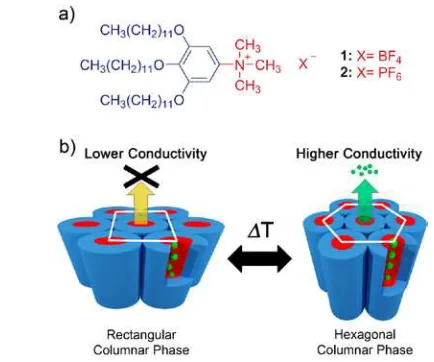
Herein we report on a thermal switch of ionic conductivities
based on columnar LC assemblies of ammonium salts 1 and 2
(Figure 1). The change in ionic conductivities by four orders of magnitude is driven by the thermotropic rectangular
colum-nar (Colr)-hexagonal columnar (Colh) LC phase transition
(Figure 1b). The Colr phases of compounds 1 and 2 exhibit
re-markably lower conductivities than those in the Colh phases
(Figure 1b). Figure 2 demonstrates reversible switching of
ionic conductivities for compound 1 during temperature
cy-cling between 120 and 150 C. The Colr-Colh and Colh-Colr
phase transitions occur at 140 C and 139 C on heating and cooling, respectively. During the four successive
heating-cool-ing cycles lastheating-cool-ing 120 minutes, compound 1 exhibits a low
con-ductivity state (ca. 10–8 S cm–1) in the Col
r phase at 120 °C and
a high conductivity state (ca. 10–4 S cm–1) in the Colh phase at
[image:3.612.316.555.38.259.2]150 °C.
Table 1. Thermal properties of compounds 1 and 2.
Compound Phase Transition Behavior a
1 Cr 43 Colr1 87 Colr2 140 Colh 196 Iso
(20.6) (0.2) (8.1) (2.0)
2 Cr1 53 Cr2 89 Colr2 122 Colh 168 Iso
(12.9) (3.2) (5.5) (1.4)
a Phase transition temperatures (°C) and enthalpies (kJ mol–1, given in
parentheses) determined by differential scanning calorimetry (second heating, scan rate: 10 °C min–1) and supported by polarizing optical
microscope observation. Cr: crystal; Colr1, Colr2: columnar rectangular;
Colh: columnar hexagonal; Iso: isotropic. b
We previously reported on the development of 3,4,5-trial-koxybenzyl-ammonium, -phosphonium and -imidazolium LC ionic conductors forming columnar and bicontinuous cubic
LC assemblies.2j,k,11 Based on this research, we expected that
the direct link between the fan-shaped phenyl ring and qua-ternary ammonium moiety would lead to a change in
molec-ular packing and hence ionic conductivity.12 Our current
mo-lecular design is a wedge-shaped trimethylbenzenammonium
cation with BF4 (1) and PF6 (2) counteranions, respectively
(Figure 1a and Supporting Information). The phase transition
behavior of compounds 1 and 2 was determined by differential
scanning calorimetry (DSC) and polarizing optical micro-scope observations (Supporting Information) together with X-ray diffraction (XRD) measurements (Supporting
Infor-mation). We found that derivative 1 exhibits two rectangular
columnar LC phases (Colr1 and Colr2) at lower temperatures,
and a Colh phase at higher temperatures (Table 1 and
Support-ing Information). On the other hand, compound 2 shows one
Colr (Colr2) and a Colh LC phases (Table 1 and Supporting
In-formation). The DSC thermogram of 1 shows four transition
peaks on heating, which correspond to the crystal–Colr1, Colr1–
Colr2, Colr2–Colh, and Colh–isotropic phase transitions,
respec-tively (Table 1 and Supporting Information). It should be
noted that compound 1 exhibited higher stability than the
benzylammonium derivatives.
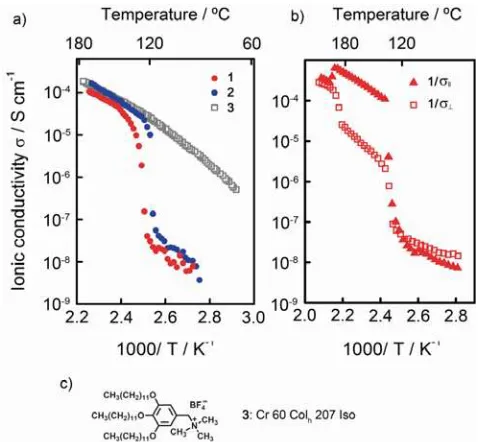
The ionic conductivities of compounds 1 and 2 were
exam-ined as a function of temperature and compared to those of
previously reported benzyltrimethylammonium salt 3 (Figure
3).11a It is significant that an abrupt conductivity jump, from
10–8 S cm–1 to 10–4 S cm–1, is triggered by the Col
r2–Colh transi-tion for compounds 1 and 2 (Figure 3a). Between 120 and
144 °C the ionic conductivity of 1 increases 1800 times, while between 114 and 128 °C the conductivity of 2 increases 1200 times. In contrast, benzyltrimethylammonium derivative 3,
which exhibits only Colh phase from 60 to 207 °C (Figure 3c),
shows only a gradual increase in conductivity with increasing
temperature (Figure 3a).11a For example, the value of
conduc-tivity for 3 changes from 2 x 10⁻⁵ to 7 x 10⁻⁵ S cm–1 when heated from 120 to 150 °C (Figure 3a and Supporting Information).
The conductivities of 1 change from 10–8 to 10–4 S cm–1in the
same temperature range (Figures 2 and 3a). It is noteworthy
that the ionic conductivities of compounds 1-3 in the Colh
phases have similar values (Figure 3a).
Anisotropic ionic conductivities were measured for the
macroscopically aligned samples of 1 in the columnar phases
on heating (Figure 3b and Supporting Information). The hex-agonally ordered columns were oriented in two directions parallel and perpendicular to the comb-shaped gold
elec-trodes by applying shear force. In the Colh phase, the
conduc-tivities parallel to the columnar axis (σll) are one order of
mag-nitude higher than those of perpendicular to the columnar
axis (σ⊥). In contrast, no anisotropy of conductivities is
ob-served in the Colr phase nevertheless the two uniaxial
colum-nar orientations achieved in the Colh phase are maintained in
the Colr phase (Figure 3b). These results suggest that the
ani-sotropic ion-transport pathways formed in the Colh phase
could be deformed and lost in the Colr phase.
Previously we reported on the ion conduction behavior of wedge-shape ionic liquid crystals in columnar and
bicontinuous cubic phases.2j,k,11 The formation of ion transport
channels was observed in the bicontinuous cubic phases of
benzyltriethylammonium based liquid crystals.11a,13
Com-pounds 1 and 2 were examined by powder XRD and grazing
[image:3.612.57.294.236.310.2]incidence small and wide angle X-ray scattering (GISAXS and
Figure 3. a) Ionic conductivities as a function of temperature of compounds 1-3 in the columnar phases with polydomain orientations. b) Ionic conductivities parallel (σll) and
GIWAXS) measurements (Figure 4 and Supporting
Infor-mation). The XRD pattern of compound 1 at 160 °C shows one
strong and two weak peaks corresponding to the (10), (11) and
(20) reflections of the Colh phase (Supporting Information).
In contrast, the XRD pattern of compound 1 at 100 °C shows
two intense and eight weak peaks in the small angle region
(Supporting Information) corresponding to a Colr phase.
Elec-tron density maps (EDM) ρ(x,y) were reconstructed from the
powder XRD intensities for compounds 1 and 2 in their Colr
and Colh phases (Figure 4a-4c and Supporting Information).
Figures 4a and 4b display the 2D representation of the
recon-structed EDM of compound 1 at 100 (Colr2) and 160 °C (Colh),
respectively. The 3D representations of the EDMs are shown in Figure 4c and the Supporting Information. The EDM in the Colr and Colh phases show that the higher electron densities are concentrated in the center of the columns while lower density areas occupy the columnar periphery. This observa-tion suggests that the aromatic cores and anions of 1 and 2 are localized in the center of the columns, which is consistent with previous reports on LC nanosegregated ion transport materials.11a The map of the Colr2 phase of 1 shows an oval shape of the electron rich area of the columns while the shape becomes circular in the Colh phase (Figures 4a-4c). The num-ber of molecules per columnar cross-section (4.9 Å) was esti-mated to be around four for both Colr2 and Colh phases (Sup-porting Information). These results indicate that the arrange-ment of the molecules inside the columns significantly changes by the Colr-Colh phase transition.
All grazing incidence patterns show planar alignment of the columns on silicon substrate (Figure 4d-4g and Supporting
Information). The GIWAXS and GISAXS patterns of 1 at 160 °C
(Figures 4e and 4g) confirm the Colh structure with the lattice
parameter a = 3.4 nm (Supporting Information), while the
Colr2 phase at 100 °C has the centered rectangular c2mm
sym-metry (all reflections with h+k = odd are missing) (Figures 4d,
4f and Supporting Information). Significantly, in the Colr2
phase of compounds 1 and 2, the GIWAXS patterns show a
strong vertical streak on the horizon corresponding to a reg-ular intracolumnar periodicity of 0.48 and 0.50 nm for
com-pounds 1 and 2, respectively (Figure 4f and Supporting
Infor-mation). Had the columns been aligned homeotropically, i.e. normal to the film plane, all intensity distributed around the equatorial circle in reciprocal space would have been con-densed near the pole, i.e. on the meridian, and the streak would have appeared much stronger. Such intensity can only be due to regular stacking of the electron-rich counteranions along the column axis. We assume that cations and anions oc-cupy a fixed position inside the rectangular columnar struc-ture and therefore they are not mobile. Such regular stacking of the ions is consistent with a low mobility and hence low conductivity. In contrast, only diffuse liquid-like scattering is
observed in the GIWAXS patterns in the Colh phase of 1
(Fig-ure 4g). These results are consistent with those on our
previ-ous Colh LC materials.11a Detailed characterization of the
or-ganized structure of ions in the Colr phase is currently under
way and will be reported in the future.
In summary, the new design of ammonium-based ionic liq-uid crystals led to an unprecedented conductivity switch
be-tween the low-conductivity "OFF" state in the Colr phase and
a high-conductivity "ON' state in the Colh phase. This
switch-ing relies on the transition between the Colr phase, preventing
ion transport, and the conductive Colh phase. The additional
advantage of this system as a potential thermal switch is the
high reversibility of the Colr-Colh phase transition and the
preservation of the orientation of the columns. We expect that switchable ion-conductive materials could be used in molecular-based ionic devices.
ASSOCIATED CONTENT
Supporting Information
Figure 4. Electron density maps (EDM) ρ(x,y) of compound 1
reconstructed from the powder XRD intensities at 100 °C (Colr2
phase) (a) and at 160 °C (Colh phase) (b). 3D representation of
the EDM of the Colh phase of 1 at 160 °C (c).Grazing incidence
small (GISAXS) and wide (GIWAXS) angle X-ray scattering
patterns of a thin film of 1 on silicon: GISAXS recorded at
100 °C (Colr2 phase) (d) and at 160 °C (Colh phase) (e). GIWAXS
recorded at 100 °C (Colr2 phase) (f) and at 160 °C (Colh phase)
Detailed experimental procedures and materials characteriza-tion. This material is available free of charge via the Internet at http://pubs.acs.org.
AUTHOR INFORMATION
Corresponding Author [email protected] [email protected] [email protected] NotesThe authors declare no competing financial interest
ACKNOWLEDGMENT
This study was partially supported by the Funding Program for World-Leading Innovative R&D on Science and Technol-ogy (FIRST) from the Cabinet Office, Government of Japan. This work was also partially supported by a Grant-in-Aid for Scientific Research (No. 22107003) in the Innovative Area of “Fusion Materials” (Area No. 2206) and Grant-in-Aid for The Global COE Program “Chemistry Innovation through Cooper-ation of Science and Engineering” from The Ministry of Edu-cation, Culture, Sports, Science and Technology (MEXT). Sup-port is also acknowledged from the “1000 Talents” program of the Government of China and the Joint NSF-EPSRC PIRE pro-ject “RENEW” (EPSRC grant EP_K034308). We thank Dr. G. Nisbet and Prof. S. Collins of I16 at Diamond Light Source for help with setting up the synchrotron experiments.
REFERENCES
(1) (a) Goodby, J. W.; Collings, P. J.; Kato, T.; Tschierske, C.; Gleeson, H.; Raynes, P. Handbook of Liquid Crystals 2nd Ed.;
Wiley-VCH, Weinheim, 2014. (b) Kato, T.; Mizoshita, N.; Kishimoto, K.
Angew. Chem., Int. Ed. 2006, 45, 38–68. (c) Tschierske, C. J. Mater. Chem. 1998, 8, 1485–1508. (d) Tschierske, C. Chem. Soc. Rev. 2007, 36, 1930–1970. (e) Kato, T. Science2002, 295, 2414–2418. (f) Ungar, G.; Liu, Y.; Zeng, X.; Percec, V.; Cho, W. D. Science 2003, 299, 1208–1211; (g)
Deschenaux, R.; Donnio, B.; Guillon, D. New J. Chem. 2007, 31, 1064– 1073. (h) Gin, D. L.; Pecinovsky, C. S.; Bara, J. E.; Kerr, R. L. Struct. Bonding(Berlin)2008, 128, 181–222. (i) B. M. Rosen, C. J. Wilson, D. A. Wilson, M. Peterca, M. R. Imam, V. Percec, Chem. Rev. 2009,109, 6275–6540.
(2) (a) Percec, V.; Johansson, G.; Heck, J.; Ungar, G.; Batty, S. J. Chem. Soc. Perkin Trans. 11993, 1411–1420. (b) Ungar, G.; Batty, S. V.; Percec, V.; Heck, J.; Johansson, G. Adv. Mater. Opt. Electro. 1994, 4, 303–313. (c) Tomazos, D.; Out, G.; Heck, J. A.; Johansson, G.; Percec, V. Liq. Cryst. 1994, 16, 509–527. (d) Percec, V.; Heck, J. A.; Tomazos, D.; Ungar, G. J. Chem. Soc. Perkin Trans. 21993, 2381–2388. (e) Percec, V.; Heck, J.; Tomazos, D.; Falkenberg, F.; Blackwell, H.; Ungar, G. J. Chem. Soc. Perkin Trans. 11993, 2799–2811. (f) Percec, V.; Johansson, G.; Ungar, G.; Zhou, J. J. Am. Chem. Soc. 1996, 118, 9855–9866. (g) Kato, T. Angew. Chem., Int. Ed. 2010, 122, 8019–8021. (h) Kerr, R. L.; Miller, S. A.; Shoemaker, R. K.; Elliott, B. J.; Gin, D. L. J. Am. Chem. Soc.2009, 131, 15972–15973. (i) Yoshio, M.; Mukai, T.; Kanie, K.; Yoshizawa, M.; Ohno, H.; Kato, T. Adv. Mater.2002, 14, 351–354. (j) Ichikawa, T.; Yoshio, M.; Hamasaki, A.; Mukai, T.; Ohno, H.; Kato, T. J. Am. Chem. Soc.2007,
129, 10662–10663. (k) Yoshio, M.; Kagata, T.; Hoshino, K.; Mukai, T.;
Ohno, H.; Kato, T. J. Am. Chem. Soc. 2006, 128, 5570–5577. (l) Binnemans, K. Chem. Rev. 2005, 105, 4148–4204. (m) Cho, B.-K.; Jain, A.; Gruner, S. M.; Wiesner, U. Science 2004, 305, 1598–1601. (n) Imam, M. R.; Peterca, M.; Edlund, U.; Balagurusamy, V. S. K.; Percec, V. J. Polym. Sci. Part A, Polym. Chem.2009, 47, 4165–4193. (o) Högberg, D.; Soberats, B.; Uchida, S.; Yoshio, M.; Kloo, L.; Segawa, H.; Kato, T.
Chem. Mater.2014, 26, 6496–6502. (p) Sakuda, J.; Hosono, E.; Yoshio, M.; Ichikawa, T.; Matsumoto, T.; Ohno, H.; Zhou, H. S.; Kato, T. Adv. Funct. Mater.2015, 25, 1206–1212. (q) Yamanaka, N.; Kawano, R.; Kubo, W.; Kitamura, T.; Wada, Y.; Watanabe, M.; Yanagida, S. Chem. Commun. 2005, 740–742.
(3) (a) Tsao, H. N.; Räder, H. J.; Pisula, W.; Rouhanipour, A.; Müllen, K. Phys. Status Solidi A2008, 205, 421–429. (b) Sergeyev, S.; Pisula, W.; Geerts, Y. H. Chem. Soc. Rev.2007, 36, 1902–1929. (c) Bushby, R. J.; Lozman, O. R. Curr. Opin. Solid State Mater. Sci.2002,
6, 569–578. (d) Boden, N.; Bushby, R. J.; Clements, J. J. Chem. Phys.
1993, 98, 5920–5931. (e) Percec, V.; Gloddle, M.; Bera, T. K.; Miura, Y.; Shiyanovskaya, I.; Singer, K. D.; Balagurusamy, V. S. K.; Heiney, P. A.; Schnell, I.; Rapp, A.; Spiess, H.-W.; Hudson, S. D.; Duan, H. Nature
2002, 419, 384–387. (f) Yazaki, S.; Funahashi, M.; Kagimoto, J.; Ohno, H.; Kato, T. J. Am. Chem. Soc., 2010, 132, 7702–7708. (g) Yasuda, T.; Shimizu, T.; Liu, F.; Ungar, G.; Kato, T. J. Am. Chem. Soc.2011, 133, 13437–13444. (h) Kumar, S. Isr. J. Chem. 2012, 52, 820–829. (i) Pisula, W.; Zorn, M.; Chang, J. Y.; Müllen, K.; Zentel, R. Macromol. Rapid Commun.2009, 30, 1179–1202. (j) Hoeben, F. J. M.; Jonkheijm, P.; Meijer, E. W.; Schenning, A. P. H. J. Chem. Rev.2005, 105, 1491–1546. (k) Bisoyi, H. K.; Kumar, S. Chem. Soc. Rev.2011, 40, 306–319.
(4) (a) Sagara, Y.; Kato, T. Nat. Chem.2009, 1, 605–610. (b) Hong, Y.; Lam, J. W. Y.; Tang, B. Z. Chem. Soc. Rev.2011, 40, 5361–5388.
(5) (a) Ikeda, T. J. Mater. Chem.2003, 13, 2037–2057. (b) Kawatsuki, N. Chem. Lett.2011, 40, 548–554. (c) Soberats, B.; Uchida, E.; Yoshio, M.; Kagimoto, J.; Ohno, H.; Kato, T. J. Am. Chem. Soc.2014, 136, 9552– 9555. (c) Kosa, T.; Sukhomlinova, L.; Su, L.; Taheri, B.; White, T. J.; Bunning, T. J. Nature2012, 485, 347–349. (d) Zakrevskyy, Y.; Stumpe, J.; Faul, C. F. J. Adv. Mater.2006, 18, 2133–2136.
(6) (a) Soberats, B.; Yoshio, M.; Ichikawa, T.; Taguchi, S.; Ohno, H.; Kato, T. J. Am. Chem. Soc. 2013, 135, 15286–15289. (b) Tan, B. H.; Yoshio, M.; Kato, T. Chem. Asian J. 2008, 3, 534–541. (c) Su, X.; Voskian, S.; Hughes, R. P.; Aprahamian, I. Angew. Chem., Int. Ed. 2013,
52, 10734–10739. (d) Lowe, A. M.; Abbott, N. L. Chem. Mater.2011, 24, 746–758.
(7) Sagara, Y.; Kato, T. Angew. Chem., Int. Ed.2011, 50, 9128–9132. (8) Beneduci, A.; Cospito, S.; La Deda, M.; Veltri, L.; Chidichimo, G.
Nat. Commun.2014, 5, 1–8.
(9) Funahashi, M.; Zhang, F. P.; Tamaoki, N. Adv. Mater. 2007, 19, 353–358.
(10) (a) Peterca, M.; Percec, V.; Dulcey, A. E.; Nummelin, S.; Korey, S.; Ilies, M.; Heiney, P. A. J. Am. Chem. Soc.2006, 128, 6713–6720. (b) Pecinovsky, C. S.; Hatakeyama, E. S.; Gin, D. L. Adv. Mater.2008, 20, 174–178.
(11) (a) Ichikawa, T.; Yoshio, M.; Hamasaki, A.; Taguchi, S.; Liu, F.; Zeng, X. B.; Ungar, G.; Ohno, H.; Kato, T. J. Am. Chem. Soc.2012, 134, 2634–2643. (b) Yoshio, M.; Ichikawa, T.; Shimura, H.; Kagata, T.; Hamasaki, A.; Mukai, T.; Ohno, H.; Kato, T. Bull. Chem. Soc. Jpn.2007,
80, 1836–1841.
(12) Kouwer, P. H. J.; Swager, T. M. J. Am. Chem. Soc.2007, 129, 14042–14052.