Copyright © 2000, American Society for Microbiology. All Rights Reserved.
Herpes Simplex Virus Type 1 ICP4 Promotes Transcription
Preinitiation Complex Formation by Enhancing the Binding of
TFIID to DNA
BENOIT GRONDIN
ANDNEAL D
ELUCA*
Department of Molecular Genetics and Biochemistry, University of Pittsburgh School of Medicine,
Pittsburgh, Pennsylvania 15261
Received 18 July 2000/Accepted 20 September 2000
Infected-cell polypeptide 4 (ICP4) of herpes simplex virus type 1 (HSV-1) activates the expression of many
HSV genes during infection. It functions along with the cellular general transcription factors to increase the
transcription rates of genes. In this study, an HSV late promoter consisting of only a TATA box and an INR
element was immobilized on a magnetic resin and incubated with nuclear extracts or purified TFIID in the
presence and absence of ICP4. Analysis of the complexes formed on these promoters revealed that ICP4
increased the formation of transcription preinitiation complexes (PICs) in a TATA box-dependent manner, as
determined by the presence of ICP4, TFIID, TFIIB, and polymerase II on the promoter. With both nuclear
extract and purified TFIID, it was determined that ICP4 helped TFIID bind to the promoter and the TATA box.
These observations differed from those for the activator VP16. As previously observed by others,
Gal4-VP16 also increased the formation of PICs without helping TFIID bind to the promoter, suggesting that ICP4
and VP16 differ in their mechanism of activation and that ICP4 functions to facilitate PIC formation at an
earlier step in the formation of PICs. We also observed that the DNA binding activity of ICP4 was not sufficient
to help TFIID bind to the promoter and that the region of ICP4 that was responsible for this activity is located
between residues 30 and 274. Taken together these results demonstrate that a specific region of ICP4 helps
TFIID bind to the TATA box and that this in turn facilitates the formation of transcription PICs.
Infected-cell polypeptide 4 (ICP4) of herpes simplex virus
type 1 (HSV-1) is one of five immediate-early proteins
synthe-sized during productive infection (27). ICP4 is required for the
efficient transcription of viral early and late genes (55) and is
therefore required for viral growth (12, 17, 42). ICP4 functions
to increase the rates of transcription of viral genes in the
context of viral infection (23) and activates gene expression in
transient assays (13, 20, 22, 39) and transcription in
reconsti-tuted in vitro transcription reactions (24). In vitro, it has been
shown that ICP4 increases the rate of formation of
tion initiation complexes (24) and that it can activate
transcrip-tion with a relatively simple set of general transcriptranscrip-tion factors
(GTFs) (6, 7). However, it is not known how ICP4 affects the
formation of transcription initiation complexes.
Several studies have shown that transcriptional activators
can physically promote the formation of transcription
preini-tiation complexes (PICs) in vitro by facilitating the recruitment
of one or more GTFs to target promoters (2, 11, 34). The
transcription of protein-encoding genes into pre-mRNAs
ne-cessitates the formation of a transcription PIC on promoters
before elongation by RNA polymerase II (Pol II) can proceed.
Therefore, the formation of PICs is a major control point for
gene expression. PICs can be formed on promoter templates in
vitro from the individual assembly of the GTFs TFIIA, TFIIB,
TFIID, TFIIE, TFIIF, TFIIH, and RNA Pol II (3) or from the
assembly of preformed complexes containing these factors (30,
33). In most cases, the recognition of promoters is mediated by
TFIID through the binding of the TATA binding protein
(TBP) subunit to TATA box elements and/or recognition of
non-TATA box
cis
elements by TBP-associated factors (TAFs)
(4, 18, 19, 29, 35, 36, 38, 43, 49, 52–54, 58). Once a competent
TFIID-promoter complex is formed, then the remainder of
PIC components can be assembled.
In an attempt to elucidate the mechanism(s) by which
tran-scription factors help in the formation of PICs, a number of
studies have reported that activators can physically interact
with GTFs or Pol II-associated factors. In several cases it has
been shown that a single activator can interact with more than
one GTF or with more than one subunit of a single GTF (21,
26, 44). The ability of activators to physically interact with
GTFs has been suggested to be part of the mechanistic basis
that allows them to recruit or stabilize GTFs on promoters or
on PIC subcomplexes (10, 11, 34, 51).
One well-studied activator is the HSV protein VP16, which
functions in the viral life cycle to activate viral immediate-early
genes (5). The acidic activation domain of VP16 has been
postulated to enhance PIC formation by a number of
mecha-nisms. One mechanism involves interaction with TFIIB (11,
34). In these studies, VP16 did not facilitate TFIID binding to
the TATA box but rather enhanced TFIIB binding to the
complex, which in turn promoted greater recruitment of Pol II.
Another study reported that VP16 interacts with TFIIA and
that this interaction facilitated PIC formation (31, 32). It has
been proposed that ICP4 facilitates PIC formation (24), but,
unlike many activators studied thus far, ICP4 does not require
TFIIA or cofactors found in the USA fraction (6, 24) to
acti-vate transcription. Therefore, it is likely that ICP4 and VP16
affect the formation of PICs in different ways. In this study, we
have used promoters immobilized on a magnetic resin to
di-rectly show that ICP4 can physically promote PIC formation
and that it does so by enhancing the binding of TFIID to the
TATA box.
* Corresponding author. Mailing address: E1257 Biomedical
Sci-ence Tower, Department of Molecular Genetics and Biochemistry,
University of Pittsburgh School of Medicine, Pittsburgh, PA 15261.
Phone: (412) 648-9947. Fax: (412) 624-0298. E-mail: ndeluca⫹@pitt
.edu.
11504
on November 9, 2019 by guest
http://jvi.asm.org/
MATERIALS AND METHODS
Transcription factors and proteins.Human GTFs were extracted from HeLa cell nuclei as described previously (16). Wild-type (wt) and mutant ICP4 mole-cules were purified from nuclei of Vero cells infected with wt HSV-1 or HSV-1 mutated in the ICP4 locus as previously described (28, 45). The viral and cellular sources of the mutant ICP4 molecules n208, d8-10, and X25 have been previously described (15, 48, 57). Hemagglutinin (HA) epitope-tagged human TFIID (HA-TFIID) was purified from an Hela cell line expressing HA-tagged TBP as de-scribed previously (58). Recombinant Gal4-VP16 expressed inEscherichia coli was purified as described previously (9).
Construction of promoter plasmids.A PCR fragment containing the HSV-1 glycoprotein C (gC) late gene promoter from nucleotide⫺35 to⫹70 relative to the mRNA start site that contained a BglII restriction site at its 3⬘end was subcloned into theEcoR1 site of pUC18. This subcloned promoter fragment is referred to as gC-wt. The TATA box in the gC-wt fragment was deleted by digestion with restriction enzymes BamH1 and BspE1, which surround the TATA box, followed by filling in with T4 polymerase and religation. This muta-tion (gC-⌬TA) results in a 12-bp deletion from⫺35 to⫺26 of the gC promoter. The INR element in gC-wt was mutated by PCR mutagenesis using sense and antisense oligonucleotides each of which contained aSacI restriction site in place of the⫺2 to⫹4 region. The resulting mutant is referred to as gC-⌬INR. The adenovirus E4 promoter fragment containing five DNA binding sites for the GAL4 transcription factor subcloned in pGEM was described previously (34). This promoter fragment is referred to as G5E4T-wt.
Preparation of immobilized promoters.Plasmids containing the HSV-1 gC promoter fragments or the adenovirus E4T promoter fragment were cut with HindIII, and the ends were filled in with Klenow polymerase (New England Biolabs) in the presence of either deoxyadenosine or deoxycytosine-14-biotin derivatives (Gibco-BRL). After biotinylation of the 5⬘end, the gC promoter templates were cut at their 3⬘ends withBglII, whereas the G5E4T template was
cut withPvuII. The promoter fragments were resolved from the vector fragments by polyacrylamide gel electrophoresis (PAGE). The approximately 200-bp gC and 500-bp G5E4T promoter fragments (for a schematic representation, see Fig.
1) were excised from the gels, electroeluted, ethanol precipitated, and resolubi-lized in water. The purified biotinylated promoters were than immobiresolubi-lized on a magnetic resin conjugated with streptavidin according to the manufacturer in-structions (Dynal) at 100 fmol of fragment per 25g of beads. The immobilized promoter templates were kept in Tris-EDTA buffer, pH 7.4, at 4°C for 2 to 3 months.
Assembly of transcription PICs on immobilized promoters.HeLa cell nuclear extract (150g of total protein as estimated by the Bradford assay) was added to 300 fmol of immobilized promoters, in the presence or absence of purified ICP4 (approximately 900 fmol or 300 ng, as estimated by Coomassie blue staining) in 75 to 300l of binding buffer (20 mM HEPES [pH 7.9], 10% glycerol, 60 mM KCl, 6 mM MgCl2, 1.0 mM dithiothreitol [DTT], 0.1 mM EDTA, 0.01% NP-40).
PIC assembly in the absence or presence of Gal4-VP16 was always done in 300-l volumes with approximately 7,200 fmol of Gal4-VP16 (180 ng as esti-mated by Coomassie blue staining). The samples were then incubated for 90 min at 30°C on a rotating sample mixer (Dynal). After incubation, the immobilized templates were concentrated with a magnetic concentrator (Dynal), resuspended in 0.5 ml of binding buffer containing 0.04% Sarkosyl, reconcentrated, resus-pended in 0.5 ml of binding buffer supplemented to 100 mM KCl and 10 mM MgCl2, and finally reconcentrated. Proteins bound to gC templates were eluted
glycerol, 60 mM KCl, 6 mM MgCl2, 1.0 mM DTT, 0.1 mM EDTA, 0.01%
NP-40). After incubation at 30°C for 90 min, the samples were washed twice with 0.5 ml of binding buffer. Bound proteins were directly eluted in 20l of SDS-PAGE sample buffer, resolved on 4 to 15% gradient gels, and transferred to PVDF (Hybond-P) for Western blot analysis.
Western blot analysis.Proteins in SDS-PAGE gels were electrophoretically transferred to PVDF membranes and visualized using the SuperSignal West Pico chemiluminescent substrate as described by the manufacturer (Pierce, Rockford, Ill.). The following primary antibody preparations were used to detect the pro-teins examined in this study. RNA Pol II was detected using the monoclonal 8WG16 antibody (Babco, Richmond, Calif.), which recognizes the large subunit of RNA Pol II. TFIIB was detected using a rabbit polyclonal antibody (C18; Santa Cruz Biotechnology, Santa Cruz, Calif.). HA-tagged TFIID was detected using either monoclonal antibody 12CA5 (Babco), which recognizes the HA epitope-tagged TBP subunit, or a monoclonal antibody that recognizes the TBP subunit (Babco). The TBP-associated factors (TAFs) hCIF150/hTAF150 and hTAF250 were detected using a rabbit polyclonal antibody (generously provided by S. T. Smale) and a monoclonal antibody that recognizes hTAF250 (6B3; Santa Cruz Biotechnology), respectively. Gal4-VP16 was detected using a monoclonal antibody that recognizes the Gal4 DNA binding domain (RKSC1; Santa Cruz Biotechnology). ICP4 was detected using two different rabbit polyclonal anti-bodies, N15 (45) and an antibody generously provided by Richard Courtney (The Pennsylvania State University Medical Center, Hershey, Pa.). ICP4 and Gal4-VP16 proteins were revealed with antirabbit and antimouse secondary antibodies conjugated to horseradish peroxidase (Sigma), followed by chemiluminescence. Following a reaction with the primary antibodies, GTFs were detected by incu-bation with either antimouse of antirabbit secondary antibodies conjugated to biotin followed by incubation of avidin-conjugated horseradish peroxidase com-plexes (Vector; Vectastain ABC kit) prior to chemiluminescence.
RESULTS
Effect of the ICP4 protein on the formation of transcription
PICs.
In order to assess the potential role of ICP4 in PIC
formation, we examined the interaction of the GTFs with a
promoter template immobilized on a magnetic solid support
(1, 11, 34) in the presence and absence of ICP4. This
proce-dure allows the rapid isolation and analysis of nucleoprotein
complexes formed on immobilized DNA promoter fragments.
To assess the role of ICP4 in PIC formation, we used the
HSV-1 gC promoter (Fig. 1A), which has been shown to be
activated by ICP4 both in vivo and in vitro (24). The only
cis
-acting elements that affect the level of in vitro transcription
of the gC promoter in the presence of ICP4 are a TATA box
and an INR element (24) (Fig. 1A). The immobilized gC
pro-moter template was incubated with HeLa nuclear extract in the
absence or presence of purified ICP4. Nucleoprotein
com-plexes formed during the incubation were then purified by
sequential magnetic separation and washing. Western blot
analysis of the proteins bound to the template showed that in
the presence of ICP4 a much greater quantity of Pol II was
bound to the promoter than when ICP4 was absent from the
reaction (Fig. 2A; compare lane 2 with lane 1), suggesting that
ICP4 can physically help in the formation of PICs on the gC
promoter fragment. The ICP4-mediated increase in Pol II
binding was greatly reduced when a gC promoter fragment
with a mutated TATA box element was used (Fig. 2A, lane 4).
transcription start site (gC wt). Black box, gC TATA box (TATAAATT);hatched box, gC initiator element (CCCTCACTACC). TwoPstI sites (p) used to elute protein complexes bound to gC promoter fragments are shown. TATA box-deleted (gC⌬TA) and INR-mutated (gC⌬INR) versions of gC-wt are also shown, as is the adenovirus E4 promoter [(G)5E4T] with five 5⬘DNA binding sites for the yeast GAL4 transcription factor (gray boxes) and with its TATA box (black box; TATATATA) as described previously (34). Black circles, added biotin moieties.
on November 9, 2019 by guest
http://jvi.asm.org/
The binding of Pol II was less affected when the gC template
containing a mutated INR element was used (Fig. 2A, lane 6).
The effects of ICP4 on the binding of TFIID and TFIIB were
also monitored in the same reactions. Western blot analysis
with anti-TBP and anti-TFIIB antibodies showed that the
TATA box-dependent increase of Pol II binding observed in
the presence of ICP4 was also observed for TBP and TFIIB
(Fig. 2A). Western blots performed in similar experiments also
revealed that another component of TFIID, CIF/TAF150, was
also recruited by ICP4 (data not shown). The observed TATA
box-dependent increase in the binding of Pol II, TFIID, and
TFIIB in the presence of ICP4 strongly suggests that ICP4 can
promote the formation of PICs on the promoter.
For comparison the effects of the VP16 activation domain on
the formation of PICs was determined using nuclear extract, a
purified Gal4-VP16 protein, and an immobilized promoter
that contains Gal4 binding sites upstream of the adenovirus E4
TATA box. The results depicted in Fig. 2B are consistent with
those previously published (34) and show that the VP16
acti-vation domain promotes Pol II and TFIIB binding with little or
no effect on the binding of TFIID. This is different from the
effects of ICP4 on the binding of these factors in that ICP4 also
promoted the binding of TFIID to the gC promoter.
Effect of ICP4 on the formation of TFIID-gC promoter
com-plexes.
The experiments described above suggest that ICP4
facilitates the formation of PICs by directly helping TFIID to
bind to the promoter. To examine this possibility more
thor-oughly, we determined the effects of ICP4 on the binding of
purified TFIID using this system. For this purpose, a HA
epitope-tagged TFIID (HA-TFIID) was purified to near
ho-mogeneity from an HeLa cell line expressing an HA-tagged
TBP (58). Figure 3A depicts a silver-stained SDS-PAGE gel of
the TFIID used in these experiments showing TBP and a
number of the TAFs known to be associated with TFIID.
In order to assess if the level of HA-TFIID recruitment can
be influenced by the amount of ICP4 bound to immobilized gC
promoters, we examined the binding capacity of HA-TFIID
[image:3.612.337.521.66.370.2]from a fixed concentration in the absence or presence of
in-creasing concentrations of ICP4. HA-TFIID (10 fmol) was
incubated with 100 fmol of immobilized gC promoter in the
presence of 75 to 1,200 fmol of purified ICP4 protein
(approx-imately 25 to 400 ng of ICP4) or in the absence of ICP4.
Western blot analysis of the proteins bound to the immobilized
templates was performed to detect the ICP4 and HA-TFIID
complexes (Fig. 3B). The results of this experiment show that
the amount of recruited HA-TFIID increased as a function of
increased amounts of bound ICP4. An overexposure from the
filter used for this experiment allows the visualization of bound
ICP4 protein at the lowest concentration used (Fig. 3B, lane 2,
and data not shown). It is interesting to note that the
immo-bilized promoters became saturated when about three ICP4
molecules were added per template molecule. When
addi-tional ICP4 was added, there was no addiaddi-tional increase in the
amount of bound TFIID, suggesting that the saturating levels
of ICP4 precluded the recruitment of TFIID or that all of the
TFIID binding sites were occupied. Interestingly, the same
FIG. 2. Effects of ICP4 and Gal4-VP16 on the formation of PICs. (A) Effectof ICP4 on PIC formation on immobilized HSV-1 gC promoter templates. Immobilized wt, TATA box-deleted (⌬TA), and INR-mutated (⌬INR) gC promoters (300 fmol) were incubated with HeLa nuclear extract (NE; 150g of total protein) in the absence or presence of purified ICP4 (300 ng) in a total volume of 75l for 90 min at 30°C. After incubation at 30°C, nucleoprotein complexes bound to immobilized promoters were isolated as described in Ma-terials and Methods. The presence of ICP4, TFIIB, TFIID, and RNA Pol II was assessed by Western blot analysis. (B) Effect of Gal4-VP16 on PIC formation on immobilized G5E4T promoter templates. Approximately 7,200 fmol of purified
Gal4-VP16 (180 ng) and 300 fmol of immobilized G5E4T were used as described
for panel A but in a 300-l volume and with direct elution of the promoter-bound proteins in SDS-PAGE sample buffer. The presence of Gal4-VP16, TFIIB, TFIID, and RNA Pol II was assessed by Western blot analysis.
FIG. 3. Effect of ICP4 on the binding of purified HA-TFIID to immobilized gC promoters. (A) Silver-stained SDS-PAGE gel of HA-tagged TFIID purified from Hela cells expressing HA-tagged TBP. TAF subunits, according to their estimated molecular weights, and TBP are shown on the left side of the gel. (B) Effect of ICP4 concentration on the binding of HA-TFIID to immobilized gC promoter templates. HA-TFIID (4l; (approximately 10 fmol) was incubated with 100 fmol of immobilized gC promoter in the presence of 75 to 1,200 fmol of purified ICP4 protein or in the absence of ICP4 in a total volume of 300l. After incubation at 30°C, nucleoprotein complexes bound to immobilized promoter templates were isolated and analyzed as described in Materials and Methods. (C) Effect of the HA-TFIID concentration on its recruitment to immobilized gC promoter templates in the presence of ICP4. HA-TFIID (from 2 to 8l) was incubated with 100 fmol of immobilized gC templates in the presence of approx-imately 300 fmol of ICP4 or in the absence of ICP4 in a total volume of 300l. gC-bound ICP4, TAF250, TAF150, and HA-TFIID were isolated and analyzed as described in Materials and Methods.
on November 9, 2019 by guest
http://jvi.asm.org/
[image:3.612.55.293.69.215.2]nents of TFIID. This experiment shows that gC promoter
templates bound with ICP4 (Fig. 3C, lanes 2, 4, and 6)
con-tained many more HA-TFIID complexes than templates not
bound by ICP4. In addition, the amount of bound TFIID in the
sample containing the lowest concentration of TFIID in the
presence of ICP4 was considerably greater than the amount of
bound TFIID in the sample containing the highest
concentra-tion of TFIID in the absence of ICP4 (compare lanes 5 and 2).
Thus, the presence of ICP4 allowed more TFIID to bind to the
promoter from a solution of lower TFIID concentration. The
same effects were observed for the known components of
TFIID that do not directly bind to the TATA box.
The previous experiments demonstrated that ICP4 can
re-cruit TFIID to the promoter in the absence of other proteins.
The activation domain of VP16 has been reported to recruit
TFIID-TFIIA complexes and TFIIB to the promoter. It has
not been reported to recruit TFIID on its own. Therefore, it
serves as a good factor to contrast ICP4 to in the same
exper-iment. Accordingly, we compared the abilities of ICP4 and
Gal4-VP16 (VP16 amino acids 413 to 490) to recruit TFIID to
immobilized G
5E4T promoter fragments. This promoter
con-sists of an adenovirus E4 TATA box and five tandem Gal4
binding sites upstream of the TATA box. HA-TFIID (4
l) was
incubated with 100 fmol of immobilized G
5E4T template in the
absence of ICP4 or in the presence of approximately 25 to 100
ng (75 to 300 fmol) of purified ICP4 protein or with
approxi-mately 7.5 to 60 ng of purified Gal4-VP16 protein (300 to 2,400
fmol). Bound ICP4, Gal4-VP16, and TFIID were detected by
Western blot analysis using ICP4, Gal4, and TBP antibodies,
respectively. The results of this experiment show that ICP4 can
efficiently recruit TFIID (Fig. 4, lanes 1 to 4) to the G
5E4T
promoter template, as well as to the gC promoter template
(Fig. 4, lanes 9 to 13), while the transcriptional activator
Gal4-VP16 was not effective in recruiting TFIID (Fig. 5, lanes 1 and
5 to 8).
Effect of wt and mutant ICP4 proteins on TFIID
recruit-ment.
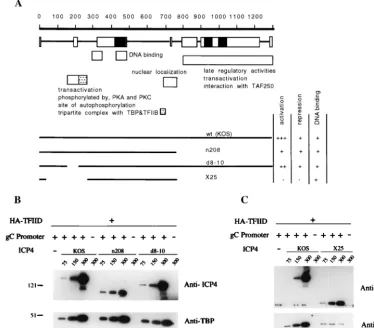
In order to map the domain(s) of the ICP4 protein
responsible for the recruitment of TFIID, we compared the
abilities of different ICP4 mutants (Fig. 5A) to that of wt ICP4
to recruit HA-TFIID to immobilized gC promoter templates.
HA-TFIID (4
l) was incubated with 100 fmol of immobilized
template in the absence of ICP4 or in the presence of 25 to 100
ng (75 to 300 fmol) of purified ICP4 or with the approximate
molar equivalent of purified ICP4 mutant proteins. As a
con-trol, wt and mutant ICP4 proteins (at the highest concentration
used only) were incubated with HA-TFIID and magnetic resin
alone. Consistent with the known properties of the ICP4
pro-teins (15, 47, 48), all of the ICP4 molecules used in this
exper-iment bound to the immobilized template (Fig. 5). In addition,
all of the proteins tested, with the exception of X25, were able
to recruit TFIID to the template. Therefore, the DNA binding
property of ICP4 is not sufficient to recruit TFIID. Consistent
with this result are our previous observations that X25 is the
only ICP4 protein used in this experiment that completely
lacks the ability to activate transcription (7, 15, 46, 47).
Specificity of TFIID-ICP4 promoter interactions.
Both ICP4
and TFIID are site-specific DNA binding proteins that will also
bind nonspecifically to DNA. The promoter used in these
ex-periments contains a TFIID binding site, the TATA box, but
does not contain a recognized ICP4 binding site. It is presumed
that the observed binding of ICP4 in these experiments is a
function of nonspecific DNA-protein interactions. Therefore,
it is important to determine if ICP4 can promote TFIID on the
TATA box from where gC transcription is initiated.
Accord-ingly, we conducted an experiment to challenge bound
com-plexes with an excess of nonspecific competitor DNA. Four
microliters of HA-TFIID and 100 fmol of immobilized
pro-moter were incubated in the presence and absence of ICP4
(300 fmol) for the indicated times (Fig. 6). In some of the
reactions a 300-fold mass excess (4.5
g) of double-stranded
poly(dG-dC) was added at the indicated times.
Following a 30-min incubation, ICP4 greatly enhanced the
binding of TFIID (Fig. 6, lanes 1 and 2). Both TFIID and ICP4
binding was completely competed when the poly(dG-dC) was
added for the duration of the 30-min incubation (lane 3).
Following a 90-min incubation, ICP4 also enhanced TFIID
binding, and there was only a marginal increase in the amount
of TFIID bound relative to that for the 30-min incubation
(lanes 4 and 5), suggesting that most of the binding occurred in
the first 30 min. However, there was only a marginal decrease
in the amount of TFIID binding in the presence and absence of
ICP4 when the template with the mutated TATA box was used
(lanes 6 and 7), suggesting that much of the TFIID binding and
recruitment under these condition was not to the TATA box.
When the excess poly(dG-dC) was added after a 30-min
incu-bation and incuincu-bation was continued for an additional hour,
the amounts of bound ICP4 and TFIID declined; however
there was a significant enhancement of TFIID binding in the
presence of ICP4 (lanes 8 and 9). This enhancement was not
seen under these conditions when the TATA box was mutated
(lanes 10 and 11). Taken together, these results demonstrate
that ICP4 promotes the formation of TFIID-ICP4 complexes
FIG. 4. Comparison of the effect of ICP4 and Gal4-VP16 on the recruitment of HA-TFIID to immobilized promoters. HA-TFIID (4l) was incubated with 100 fmol of immobilized G5E4T or gC promoter templates in the presence of 75to 300 fmol of purified ICP4 (approximately 25 to 100 ng) on in the absence of ICP4 or with 300 to 2,400 fmol of purified Gal4-VP16 (approximately 7.5 to 60 ng) in a total volume of 300l. As a control for the DNA binding specificity of the Gal4-VP16 protein, this protein (at the highest concentration used only) was incubated with HA-TFIID and immobilized gC promoters (lane 13). After in-cubation at 30°C, nucleoprotein complexes bound to immobilized promoters were isolated and analyzed as described in Materials and Methods.
on November 9, 2019 by guest
http://jvi.asm.org/
on TATA boxes. Therefore, this experiment suggests that ICP4
can recruit TFIID to DNA templates independently of
cis
-acting sites and that some of the recruited complexes require
the presence of the TATA box; these complexes are resistant
to competitive challenge by a 300-fold mass excess of
nonspe-cific DNA.
DISCUSSION
[image:5.612.116.491.78.406.2]In order to help understand the mechanism(s) by which the
HSV-1 ICP4 protein activates transcription, we have assessed
if this protein can physically promote the formation of
tran-scriptional PICs on an immobilized HSV-1 promoter.
Pro-moter elements that were immobilized on magnetic resin were
used to assemble and isolate PICs formed from the GTFs
present in HeLa nuclear extracts in the absence or presence of
purified ICP4 proteins. We show in this study that the ICP4
protein can facilitate the formation of transcription PICs on
immobilized gC promoters in a manner that is dependent on
the presence of the TATA box. This facilitation appears to
involve the recruitment of the TFIID complex to the promoter.
The recruitment of TFIID is particularly interesting since it
FIG. 5. Effect of wt and mutant ICP4 proteins on the recruitment of HA-TFIID complexes to gC promoters. (A) Primary structures of wt and mutant ICP4 proteins. The primary sequence of ICP4 is shown along with a summary of the regions of ICP4 that are similar to those of varicella-zoster virus IE140, with the rectangles indicating similarity (solid rectangles indicate the greatest amount of similarity) (37). Also shown are some of the regions of ICP4 that contribute to various activities, as deduced from genetic and biochemical studies (7, 14, 15, 25, 40, 41, 47, 50, 57). (B) Effect of wt (KOS), n208, and d8-10 ICP4 proteins on HA-TFIID recruitment. HA-TFIID (4l) was incubated with 100 fmol of immobilized gC templates in the presence of 75 to 300 fmol (approximately 25 to 75 ng) of purified wt, n208, and d8-10 ICP4 proteins or in the absence of ICP4 in a total volume of 300l. As a control for nonspecific binding, HA-TFIID and ICP4 (300 fmol only) were incubated with magnetic resin devoid of immobilized promoter (lanes 5, 9, and 13). After incubation at 30°C, nucleoprotein complexes bound to immobilized promoters were isolated and analyzed as described in Materials and Methods. The presence of ICP4 and HA-TFIID was assessed by Western blot analysis with anti-ICP4 (N15) and anti-HA (anti-HA-TBP) antibodies, respectively. (C) Same as panel B, except that wt and X25 ICP4 proteins were used. The anti-ICP4 antibody used in this experiment (provided by Richard Courtney) allows the detection of the X25 protein.FIG. 6. Effect of the gC TATA box on ICP4-mediated recruitment of HA-TFIID to immobilized gC promoter templates. HA-HA-TFIID (4l) was incubated with 100 fmol of immobilized wt or TATA box-mutated (⌬TA) gC promoter in the absence or presence of purified ICP4 (300 fmol) and in the absence or presence of poly(dG-dC) (30 ng/l) in a total volume of 150l. Poly(dG-dC) was added either at time zero (lane 3) or following 30 min of incubation at 30°C (lanes 8 to 11). After incubation at 30°C for 30 min (lanes 1 to 3) or for 90 min (lanes 4 to 11), nucleoprotein complexes bound to immobilized promoters were isolated and analyzed as described in Materials and Methods.
on November 9, 2019 by guest
http://jvi.asm.org/
to preformed TFIID-promoter complexes followed by a
post-TFIIB recruitment step that is as yet uncharacterized (11, 34,
56). Another mechanism involves the recruitment of
TFIIA-TFIID complexes (31). Neither of these mechanisms involves
the sole recruitment of TFIID to the TATA box. Our
experi-ments examining PIC formation as a function of the VP16
activation domain were performed in parallel with ICP4 and
showed that, relative to ICP4, VP16 very poorly, if at all,
helped recruit TFIID, despite its ability to recruit TFIIB and
RNA Pol II. These studies further suggest that ICP4 intervenes
at a very early step in the formation of the transcription
initi-ation complex and that its mechanism of recruitment is
funda-mentally different from that of other activators such as VP16.
It is also important to note that our studies with ICP4 utilize
the intact protein isolated from HSV-infected cells undergoing
a productive infection. The studies with VP16 (ours included)
utilized a chimeric Gal4 construct produced in bacteria.
There-fore, it is possible that there are subtle differences between the
effects of bona fide VP16 isolated from HSV-infected cells and
Gal4-VP16 on the formation of PICs.
Another observation of note in our study is that the
facili-tation of TFIID binding is a function of amino acid sequences
from residues 30 to 274. The ICP4 protein purified from n208
(15)-infected cells contains residues 1 to 774. The X25 mutant
was derived from the n208 allele and lacks residues 30 to 274
(47, 48). X25 binds to DNA but does not repress or activate
transcription in vivo or in vitro (7, 25, 47, 48). Therefore, the
DNA binding activity of ICP4 is not sufficient to facilitate
TFIID binding. The requirement for residues 30 to 274 is
interesting in that these are the residues previously found to be
required for ICP4 to form a tripartite complex on DNA with
TBP and TFIIB (50).
The n208 mutant (residues 1 to 774) molecule activates
transcription in virus infection (15), transient assays (14), and
in vitro (7). However, the magnitude of activation is
consider-ably less than that observed for wt (residues 1 to 1298) ICP4.
The carboxy-terminal residues from 775 to 1298 are required
for efficient activation and viral growth (7, 15). These residues
are also required for ICP4 to interact with TFIID in solution
through interaction with TAF250 (7), a component of TFIID
(58). More recently we have also found that the residues from
774 to 1298 are also involved in the multimerization of ICP4 on
DNA (R. Kuddus and N. DeLuca, unpublished data). These
later interactions, while not crucial for the recruitment of
TFIID in our present studies, may have significant effects on
the level of activation by ICP4. This carboxy-terminal region
may affect the ability of ICP4 to bind to DNA in a complex
mixture of proteins. Consistent with this is the observation that
the n208 protein bound less efficiently to the immobilized
tem-plate than wt ICP4 in the presence of nuclear extract (data not
shown). Additionally the carboxy-terminal region of ICP4 may
help stabilize PICs. This could occur simply as a manifestation
ICP4 can activate the transcription of relatively simple
pro-moters in vitro with a relatively simple set of transcription
factors (6). However, it is a large and structurally complex
protein, and it would not be surprising if multiple activities and
interactions work in concert to produce the high transcription
rates seen in HSV infection, and hence the abundant and rapid
synthesis of HSV proteins and virions. This study demonstrates
that one activity of ICP4 which is consistent with its role in the
activation of transcription is the facilitation of TFIID binding
to the TATA box and possibly the recruitment of the
remain-der of the transcription PIC, as suggested by the increase in
TFIIB and Pol II binding.
ACKNOWLEDGMENTS
We thank Michael Carrozza and Dool-Bboon Kim for helpful
dis-cussions and technical assistance. We also acknowledge The National
Cell Culture Center in Minneapolis, Minnesota, as a source of grown
HeLa cells.
This work was supported by NIH grant AI30612 to N.D. and by a
postdoctoral fellowship from the Medical Research Council of Canada
to B.G.
REFERENCES
1.Arias, J. A., and W. S. Dynan.1989. Promoter-dependent transcription by RNA polymerase II using immobilized enzyme complexes. J. Biol. Chem. 264:3223–3229.
2.Arnosti, D. N., A. Merino, D. Reinberg, and W. Schaffner.1993. Oct-2 facilitates functional preinitiation complex assembly and is continuously re-quired at the promoter for multiple rounds of transcription. EMBO J.12: 157–166.
3.Buratowski, S., S. Hahn, L. Guarente, and P. A. Sharp.1989. Five interme-diate complexes in transcription initiation by RNA polymerase II. Cell56: 549–561.
4.Burley, S. K., and R. G. Roeder.1996. Biochemistry and structural biology of transcription factor IID (TFIID). Annu. Rev. Biochem.65:769–799. 5.Campbell, M. E., J. W. Palfreyman, and C. M. Preston.1984. Identification
of herpes simplex virus DNA sequences which encode a trans-acting polypeptide responsible for stimulation of immediate early transcription. J. Mol. Biol.180:1–19.
6.Carrozza, M. J., and N. DeLuca.1998. The high mobility group protein 1 is a coactivator of herpes simplex virus ICP4 in vitro. J. Virol.72:6752–6757. 7.Carrozza, M. J., and N. A. DeLuca.1996. Interaction of the viral activator protein ICP4 with TFIID through TAF250. Mol. Cell. Biol.16:3085–3093. 8.Caswell, R., L. Bryant, and J. Sinclair.1996. Human cytomegalovirus
im-mediate-early 2 (IE2) protein can transactivate the humanhsp70promoter by alleviation of Dr1-mediated repression. J. Virol.70:4028–4037. 9.Chasman, D. I., J. Leatherwood, M. Carey, M. Ptashne, and R. D. Kornberg.
1989. Activation of yeast polymerase II transcription by herpesvirus VP16 and GAL4 derivatives in vitro. Mol. Cell. Biol.9:4746–4749.
10. Chi, T., and M. Carey.1996. Assembly of the isomerized TFIIA-TFIID-TATA ternary complex is necessary and sufficient for gene activation. Genes Dev.10:2540–2550.
11. Choy, B., and M. R. Green.1993. Eukaryotic activators function during multiple steps of preinitiation complex assembly. Nature366:531–536. 12. DeLuca, N. A., A. M. McCarthy, and P. A. Schaffer.1985. Isolation and
characterization of deletion mutants of herpes simplex virus type 1 in the gene encoding immediate-early regulatory protein ICP4. J. Virol.56:558– 570.
13. DeLuca, N. A., and P. A. Schaffer.1985. Activation of immediate-early, early,
on November 9, 2019 by guest
http://jvi.asm.org/
and late promoters by temperature-sensitive and wild-type forms of herpes simplex virus type 1 protein ICP4. Mol. Cell. Biol.5:1997–2008.
14.DeLuca, N. A., and P. A. Schaffer.1987. Activities of herpes simplex virus type 1 (HSV-1) ICP4 genes specifying nonsense peptides. Nucleic Acids Res. 15:4491–4511.
15.DeLuca, N. A., and P. A. Schaffer.1988. Physical and functional domains of the herpes simplex virus transcriptional regulatory protein ICP4. J. Virol. 62:732–743.
16. Dignam, J. D., R. M. Lebovitz, and R. G. Roeder.1983. Accurate transcrip-tion initiatranscrip-tion by RNA polymerase II in a soluble extract from isolated mammalian nuclei. Nucleic Acids Res.11:1475–1489.
17. Dixon, R. A., and P. A. Schaffer.1980. Fine-structure mapping and functional analysis of temperature-sensitive mutants in the gene encoding the herpes simplex virus type 1 immediate early protein VP175. J. Virol.36:189–203. 18. Emami, K. H., A. Jain, and S. T. Smale. 1997. Mechanism of synergy
between TATA and initiator: synergistic binding of TFIID following a pu-tative TFIIA-induced isomerization. Genes Dev.11:3007–3019.
19. Emanuel, P. A., and D. S. Gilmour.1993. Transcription factor TFIID rec-ognizes DNA sequences downstream of the TATA element in the Hsp70 heat shock gene. Proc. Natl. Acad. Sci. USA90:8449–8453.
20. Everett, R. D.1984. Trans activation of transcription by herpes virus prod-ucts: requirement for two HSV-1 immediate-early polypeptides for maxi-mum activity. EMBO J.3:3135–3141.
21. Geisberg, J. V., J. L. Chen, and R. P. Ricciardi.1995. Subregions of the adenovirus E1A transactivation domain target multiple components of the TFIID complex. Mol. Cell. Biol.15:6283–6290.
22. Gelman, I. H., and S. Silverstein.1985. Identification of immediate early genes from herpes simplex virus that transactivate the virus thymidine kinase gene. Proc. Natl. Acad. Sci. USA82:5265–5269.
23. Godowski, P. J., and D. M. Knipe.1986. Transcriptional control of herpes-virus gene expression: gene functions required for positive and negative regulation. Proc. Natl. Acad. Sci. USA83:256–260.
24. Gu, B., and N. DeLuca.1994. Requirements for activation of the herpes simplex virus glycoprotein C promoter in vitro by the viral regulatory protein ICP4. J. Virol.68:7953–7965.
25. Gu, B., R. Kuddus, and N. A. DeLuca.1995. Repression of activator-medi-ated transcription by herpes simplex virus ICP4 via a mechanism involving interactions with the basal transcription factors TATA-binding protein and TFIIB. Mol. Cell. Biol.15:3618–3626.
26. Guermah, M., S. Malik, and R. G. Roeder.1998. Involvement of TFIID and USA components in transcriptional activation of the human immunodefi-ciency virus promoter by NF-B and Sp1. Mol. Cell. Biol.18:3234–3244. 27. Honess, R. W., and B. Roizman.1974. Regulation of herpesvirus
macromo-lecular synthesis. I. Cascade regulation of the synthesis of three groups of viral proteins. J. Virol.14:8–19.
28. Imbalzano, A. N., A. A. Shepard, and N. A. DeLuca.1990. Functional rele-vance of specific interactions between herpes simplex virus type 1 ICP4 and sequences from the promoter-regulatory domain of the viral thymidine ki-nase gene. J. Virol.64:2620–2631.
29. Kaufmann, J., and S. T. Smale.1994. Direct recognition of initiator elements by a component of the transcription factor IID complex. Genes Dev.8:821– 829.
30. Kim, Y. J., S. Bjorklund, Y. Li, M. H. Sayre, and R. D. Kornberg.1994. A multiprotein mediator of transcriptional activation and its interaction with the C-terminal repeat domain of RNA polymerase II. Cell77:599–608. 31. Kobayashi, N., T. G. Boyer, and A. J. Berk.1995. A class of activation
domains interacts directly with TFIIA and stimulates TFIIA-TFIID-pro-moter complex assembly. Mol. Cell. Biol.15:6465–6473.
32. Kobayashi, N., P. J. Horn, S. M. Sullivan, S. J. Triezenberg, T. G. Boyer, and A. J. Berk.1998. DA-complex assembly activity required for VP16C tran-scriptional activation. Mol. Cell. Biol.18:4023–4031.
33. Koleske, A. J., and R. A. Young.1994. An RNA polymerase II holoenzyme responsive to activators. Nature368:466–469.
34. Lin, Y. S., and M. R. Green.1991. Mechanism of action of an acidic tran-scriptional activator in vitro. Cell64:971–981.
35. Martinez, E., C. M. Chiang, H. Ge, and R. G. Roeder.1994. TATA-binding protein-associated factor(s) in TFIID function through the initiator to direct basal transcription from a TATA-less class II promoter. EMBO J.13:3115– 3126.
36. Martinez, E., Q. Zhou, N. D. L’Etoile, T. Oelgeschlager, A. J. Berk, and R. G. Roeder.1995. Core promoter-specific function of a mutant transcription
factor TFIID defective in TATA-box binding. Proc. Natl. Acad. Sci. USA 92:11864–11868.
37. McGeoch, D. J., A. Dolan, S. Donald, and D. H. Brauer.1986. Complete DNA sequence of the short repeat region in the genome of herpes simplex virus type 1. Nucleic Acids Res.14:1727–1745.
38. Oelgeschlager, T., C. M. Chiang, and R. G. Roeder.1996. Topology and reorganization of a human TFIID-promoter complex. Nature382:735–738. 39. O’Hare, P., and G. S. Hayward.1985. Evidence for a direct role for both the 175,000- and 110,000-molecular-weight immediate-early proteins of herpes simplex virus in the transactivation of delayed-early promoters. J. Virol. 53:751–760.
40. Paterson, T., and R. D. Everett.1988. Mutational dissection of the HSV-1 immediate-early protein Vmw175 involved in transcriptional transactivation and repression. Virology166:186–196.
41. Paterson, T., and R. D. Everett.1988. The regions of the herpes simplex virus type 1 immediate early protein Vmw175 required for site specific DNA binding closely correspond to those involved in transcriptional regulation. Nucleic Acids Res.16:11005–11025.
42. Preston, C. M.1979. Control of herpes simplex virus type 1 mRNA synthesis in cells infected with wild-type virus or the temperature-sensitive mutanttsK. J. Virol.29:275–284.
43. Purnell, B. A., P. A. Emanuel, and D. S. Gilmour.1994. TFIID sequence recognition of the initiator and sequences farther downstream in Drosophila class II genes. Genes Dev.8:830–842.
44. Sauer, F., S. K. Hansen, and R. Tjian.1995. DNA template and activator-coactivator requirements for transcriptional synergism by Drosophila bicoid. Science270:1825–1828.
45. Shepard, A. A., and N. A. DeLuca.1991. Activities of heterodimers com-posed of DNA-binding- and transactivation-deficient subunits of the herpes simplex virus regulatory protein ICP4. J. Virol.65:299–307.
46. Shepard, A. A., and N. A. DeLuca.1989. Intragenic complementation among partial peptides of herpes simplex virus regulatory protein ICP4. J. Virol. 63:1203–1211.
47. Shepard, A. A., A. N. Imbalzano, and N. A. DeLuca.1989. Separation of primary structural components conferring autoregulation, transactivation, and DNA-binding properties to the herpes simplex virus transcriptional regulatory protein ICP4. J. Virol.63:3714–3728.
48. Shepard, A. A., P. Tolentino, and N. A. DeLuca. 1990.trans-Dominant inhibition of herpes simplex virus transcriptional regulatory protein ICP4 by heterodimer formation. J. Virol.64:3916–3926.
49. Smale, S. T.1997. Transcription initiation from TATA-less promoters within eukaryotic protein-coding genes. Biochim. Biophys. Acta1351:73–88. 50. Smith, C. A., P. Bates, R. Rivera-Gonzalez, B. Gu, and N. A. DeLuca.1993.
ICP4, the major transcriptional regulatory protein of herpes simplex virus type 1, forms a tripartite complex with TATA-binding protein and TFIIB. J. Virol.67:4676–4687.
51. Steger, G., J. Ham, O. Lefebvre, and M. Yaniv.1995. The bovine papillo-mavirus 1 E2 protein contains two activation domains: one that interacts with TBP and another that functions after TBP binding. EMBO J.14:329–340. 52. Sypes, M. A., and D. S. Gilmour.1994. Protein/DNA crosslinking of a TFIID
complex reveals novel interactions downstream of the transcription start. Nucleic Acids Res.22:807–814.
53. Verrijzer, C. P., J. L. Chen, K. Yokomori, and R. Tjian.1995. Binding of TAFs to core elements directs promoter selectivity by RNA polymerase II. Cell81:1115–1125.
54. Verrijzer, C. P., K. Yokomori, J. L. Chen, and R. Tjian.1994. Drosophila TAFII150: similarity to yeast gene TSM-1 and specific binding to core pro-moter DNA. Science264:933–941.
55. Watson, R. J., and J. B. Clements.1980. A herpes simplex virus type 1 function continuously required for early and late virus RNA synthesis. Na-ture285:329–330.
56. White, J., C. Brou, J. Wu, Y. Lutz, V. Moncollin, and P. Chambon.1992. The acidic transcriptional activator GAL-VP16 acts on preformed template-com-mitted complexes. EMBO J.11:2229–2240.
57. Xia, K., D. M. Knipe, and N. A. DeLuca.1996. Role of protein kinase A and the serine-rich region of herpes simplex virus type 1 ICP4 in viral replication. J. Virol.70:1050–1060.
58. Zhou, Q., P. M. Lieberman, T. G. Boyer, and A. J. Berk.1992. Holo-TFIID supports transcriptional stimulation by diverse activators and from a TATA-less promoter. Genes Dev.6:1964–1974.
on November 9, 2019 by guest
http://jvi.asm.org/