R E S E A R C H A R T I C L E
Open Access
Impact of data source and time reference of
functional status on hospital mortality prediction
Woan Shin Tan
1*, Yew Yoong Ding
1,2, Wai Fung Chong
1, Jam Chin Tay
3and Jackie Yu-Ling Tan
3Abstract
Background:The study objective was to compare physical function documented in the medical records with interview data, and also to evaluate hospital mortality predictions using pre-admission and on-admission functional status derived from these two data sources.
Methods:A prospective cohort study of 1402 subjects aged 65 years and older to the general medicine
department of an acute care hospital was conducted. Patient-reported pre-admission and on-admission functional status for impairment in any of the five activities of daily living (ADLs) items (feeding, dressing, grooming, toileting and bathing), transferring and walking, were compared with those extracted from the medical records. For the purpose of mortality prediction, pre-admission and on-admission impairment in transferring from the two data sources were included in separate multivariable logistic regression models. We used a variable selection method that combines bootstrap resampling with stepwise backward elimination.
Results:For all ADL categories, the agreement between the data sources was good for pre-admission functional status (k: 0.53–0.75) but poor for on-admission status (k: 0.18–0.31). On-admission impairment was higher in the medical records than at interview for all basic ADLs. Using interview data as the gold standard, although sensitivity for pre- and on-admission ADLs was high (59–93%), specificity for on-admission status was poor (30–37%). The pre-admission models using interview data predicted mortality better than the model using medical records (c-statistic: 0.83 versus 0.82). Similar results were found for models incorporating on-admission functional status (c-statistic: 0.84 versus 0.81). However, the differences between the four models were not statistically significant. Conclusion:Medical records can be a good source for pre-admission functional status but on-admission functional impairment was over-reported in the medical records. The discriminatory power of the hospital mortality prediction model was significantly improved with the incorporation of functional status information but it was not significantly affected by their time reference or source of data.
Background
Functional status has been found in many studies to be a key predictor of hospital mortality for older patients [1-3]. Reflecting the impact of illness severity on the whole person and on the individual's ability to negotiate the external environment, it may contain more import-ant information about prognosis than admitting diagno-sis, comorbid illness burden or routine physiologic measures [4-6]. Functional status is determined by the ability to perform activities of daily living (ADL). Mea-sured prior to hospital admission, it is a sign of past
health status and can indicate risk of further functional decline. During acute illness, the elderly are at higher risk of impairment in function. On admission to the hos-pital, functional status reflects the impact of recent ill-ness on the patient superimposed on pre-admission functioning.
While recent studies [7-10] have examined the impact of functional trajectories on post-discharge mortality of between 3 and 6 months, there is little consensus in lit-erature regarding whether a static or time-dependent measure should be used for mortality prediction. While functional status at the point of hospitalization [4,7,11] is a widely used static measure, it has been found to be a weaker predictor of 1-year mortality in acutely ill patients than functional status before the onset of acute * Correspondence:[email protected]
1
Health Services and Outcomes Research Department, National Healthcare Group, Singapore, Singapore
Full list of author information is available at the end of the article
illness [12]. For shorter term mortality such as inpatient death, there is little information in literature regarding the appropriate time reference.
To derive functional status information, studies have relied on either prospective interviewing of patients or documentation in medical records. However, different data sources can have possible biasing effects. Patient-reported outcomes have been found to better reflect observed function than physician report [6,13,14]. Like-wise, compared with data derived from interviews, med-ical records have been reported to be a poor source for functional status measures [6,15]. This dissonance could be a result of differences in the purpose and method of data collection and the treatment of the marginally impaired patient.
Studies have highlighted the importance of gathering functional status data to facilitate its use as a prognostic or risk-adjustment variable. However, few studies [15] have assessed the relationship between data source and data quality, and its ensuing impact on the prediction of health-related events. Since timing and sources may have a joint impact on the quality of functional status infor-mation, it will be insightful to examine this. Therefore, the goal of this study was to compare medical record documentation against information derived from a pro-spective interview pertaining to physical function prior to, and at the time of hospitalization. In addition, we will investigate the joint impact of data sources and timing of functional status measurement on hospital mortality prediction.
Methods Study participants
The study was carried out at the Tan Tock Seng Hos-pital. The 1200-bedded hospital is a public sector facil-ity with 390 general medicine beds. It is the second largest acute care general hospital in Singapore. Sub-jects aged 65 years and older, admitted consecutively on weekdays between 6th April and 29th October 2008 to the general medicine department were included. There were 2,171 potential subjects. Patients were excluded if they could not be interviewed for reasons including intubation, coma, severe aphasia, or terminal condition (n = 326); if they were discharged or trans-ferred or died within 48-hours (n = 53); if they declined participation (n = 90); or others (patient was asleep, not in the ward) (n = 282). Medical notes for 18 subjects were not available. The final sample included 1402 participants. Informed consent was obtained from all participants.
The study was approved by the Institutional Re-view Board of the National Healthcare Group, Singapore.
Data collection
Trained research assistants carried out structured interviews with the patients or their proxies within 48 hours of admission. The interview included infor-mation pertaining to socio-demographics, level of so-cial support, pre-admission and on-admission basic ADLs. Data on primary diagnosis and hospital mor-tality were extracted from the hospital’s administra-tive database.
Another research assistant, blinded to the study aims and the results of the patient interviews, abstracted data on co-morbid conditions and pre-admission and on-admission functional status of patients from the medical records. The nurse-trained abstractor reviewed the med-ical record, including notes of medmed-ical and nursing staff.
Study variables
Based on clinical judgment and predictors found to sig-nificantly predict mortality in older patients in literature [1,16-19], we collected the following variables: demo-graphics (age, sex, ethnic group), marital status, housing type, primary diagnosis, co-morbid disease burden and functional status.
The baseline interview included questions regarding basic ADLs. Patients or their proxies were asked if they experienced difficulty in the performance of each of the ADLs (feeding, bathing, grooming, dressing, toi-leting, transferring and walking) 2-weeks prior to being hospitalized, and at the point of admission. All items were rated either yes or no. Patients who used an adaptive device for an ADL function were not consid-ered impaired if assistance from another person was not required.
Pre-admission function is routinely assessed by doc-tors as part of history taking and documented in the medical records. There are three checkboxes allowing doctors to indicate whether the patient is“independent”,
“needs assistance”or“totally dependent”for the different functional aspects. Impairment in feeding, bathing, grooming, dressing, or toileting was captured as a whole whereas walking was a separate category. Information on transferring was obtained from documentation by doctors or therapists. On the other hand, assessment and documentation of on-admission function was done by ward nurses regarding patients’level of nursing care needs. The checklist used asked whether patients require assistance in the following ADL categories: feeding, dres-sing or grooming, toileting or bathing, transferring, and walking. All items were rated either yes or no in the medical records.
dressing, toileting), transferring, and walking. We also examined impairment in at least 1 of these 7 ADLs.
There were a total of 165 different primary diagnoses in the study sample. Only primary diagnoses, which are highly predictive of mortality in older hospitalized patients, were coded. This was based on the High-Risk Diagnoses for the Elderly Scale [18], which comprises 22 diagnostic groups. They include: Bone marrow failure, cancer (metastatic), cancer (solid tumour, localised), cirrhosis/end-stage liver disease, congestive heart failure, decubitus ulcer, delirium, dementia, lymphoma/ leukaemia, major depression, malnutrition, renal failure (acute), renal failure (chronic), respiratory failure, chronic obstructive pulmonary disease, diabetes mellitus with end-organ damage, major stroke, multiple trauma, myo-cardial infarction, pneumonia and severe peripheral vascular disease. In our study, the International Classifi-cation of Disease, ninth version was used to identify, and group the diagnoses. Diagnoses with a prevalence of less than 1% in the sample were excluded from further anal-ysis to avoid having too few observations per cell for analysis [20].
The Charlson Comorbidity Index (CCI) is a weighted prognostic index based on the number and severity of 19 comorbid conditions [21]. It was computed by the re-search team for the purpose of this study based on med-ical history in the medmed-ical records and diagnoses listed at admission. The medical conditions are weighted 1–6 with total scores ranging from 0–37. It was developed originally to predict 1-year mortality of internal medi-cine patients. Data abstracted from the medical record were used to compute the score. We have coded the score into four categories 0, 1, 2 and≥3.
Statistical analysis
Comparison of data sources
Pre-admission and on-admission functional status obtained from the interview was compared with results extracted from the medical notes. Cohen's kappa coeffi-cientκwas computed to measure the level of agreement between the sources of data. Excellent agreement beyond chance is indicated by κvalues above 0.75, 0.40 through 0.75 represent fair to good agreement and values below 0.40 indicate poor agreement [22]. Using data from the patient or proxy interviews as the reference standard [23], we computed the sensitivity, specificity, negative and positive agreement values. Since we cannot assume non-documentation to be equivalent to functional inde-pendence [6], we have excluded cases with missing documentation when comparing between data sources.
Development of hospital mortality prediction models Katzet al. suggested that functional abilities are lost in the opposite order to which they were gained during
childhood (first, feeding and transfer; later toileting and dressing; last bathing) [24]. Therefore, in the prediction of mortality, we have defined “ADL impairment” as needing physical assistance in transferring rather than as impairment in one of the seven basic care skills. Due to the hierarchy of impairment in basic ADLs, the latter measure would have categorised patients requiring as-sistance in bathing as functionally impaired, which may not sufficiently discriminate the survivors from those who died.
Bivariate analyses were conducted to examine the rela-tionship between inpatient mortality and each variable including pre- and on-admission functional status drawn from the medical records and from the patient inter-views. We used the Chi-square test or the Kruskal-Wallis test to assess differences among or between groups. Variables statistically significant atP<0.25 were selected for possible inclusion in multivariable logistic regression models to predict hospital mortality. We chose P= 0.25 as the threshold for including variables in the multivariable model because this has been suggested elsewhere as an appropriate threshold [25].
The following four functional status variables were included in separate multivariable logistic regression models: “pre-admission ADL impairment” based on interview, “pre-admission ADL impairment” based on medical records,“on-admission ADL impairment”based on interview and “on-admission ADL impairment” based on medical records. For missing pre- and on-admission functional status data in the medical records, the median value adjusted for mortality and diagnosis, was used.
We adopted a model selection method that combines bootstrap resampling with automated variable selection methods [26]. Since the use of automated variable selec-tion methods with logistic regression has been found to result in the identification of nonreproducible models, this approach allowed us to determine with greater con-fidence that a variable is indeed an independent pre-dictor from its empirical distribution [27]. Our model selection method was based upon drawing 1000 repeated bootstrap samples (the Stata userwritten “swboot” com-mand) from the original dataset. Within each bootstrap sample, backwards elimination was applied with removal criteria set atP<0.10. For each variable, the proportion of bootstrap samples in which that variable was identi-fied as an independent predictor of the outcome is determined. Variables that were significant in at least 60% of the bootstrap samples were included in the model [26]. Results were considered significant at P<0.05.
[28]. Paired comparisons of the AUC based on different sources of data were conducted using the Hanley and McNeil method [29]. The Hosmer-Lemeshow test was used to examine the models’ goodness of fit [25]. The different models were ranked according to the Akaike's information criterion (AIC), with the one having the lowest AIC being the best. Analyses of the data were performed using STATA version 9.2 (Stata Corp, College Station, Texas).
Results
Comparison of data sources
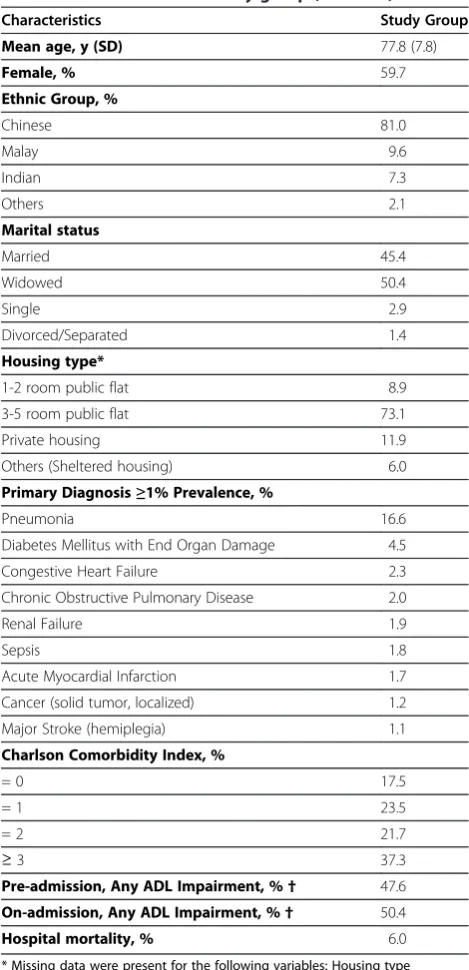
Patient characteristics are shown in Table 1. The preva-lence and agreement between interview and medical records data as well as sensitivity and specificity of basic ADL impairment in the medical records are can be found in Table 2. The overall prevalence of missing documentation ranged between 1.4% and 12.7%.
The medical records prevalence of pre-admission ADL impairment was higher for impairment in at least 1 of the 5-item ADL but lower for impairment in transferring and walking (Table 2). For impairment in at least 1 of the 7-item ADL, the medical records prevalence of pre-admission ADL impairment was within a 10% range of that recorded in the patient interview. For pre-admission functional status, the agreement between the data sources was good with kappa ranging between 0.53 and 0.75. Using interview data as the gold standard, sensitiv-ity and specificsensitiv-ity were high for pre-admission ADLs (72-93%) except for ambulation. Only 57% of patients who reported to require assistance in walking were reflected as such in the medical records.
For on-admission functional status, compared with interview data, the prevalence of impairment based on medical records data was consistently higher across all ADL categories. The agreement between the two data sources was poor with kappa ranging between 0.18 and 0.31 (Table 2). Although the sensitivity of medical records was high, specificity was consistently below 40%. The proportion of subjects with documented impair-ment in transferring who responded similarly during the interview was low (34%).
Regardless of time reference of the data, the agreement between patient interview and medical records was higher in proxy respondents than patient respondents (Additional file 1). The prevalence of impairment was also consistently higher in the medical records for both respondent groups.
Hospital mortality prediction models
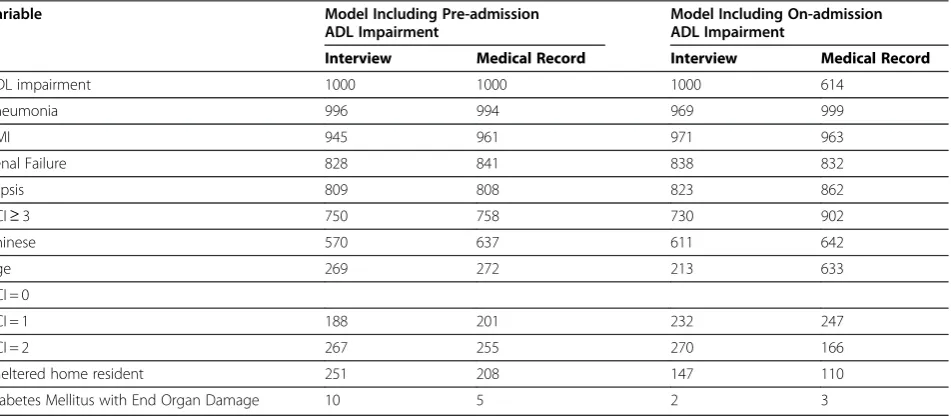
In the 1000 bootstrap samples, the number of times that each variable was identified as a significant predictor in each of the four iterations of the multivariate logistic regression model is summarised in Table 3. Overall,
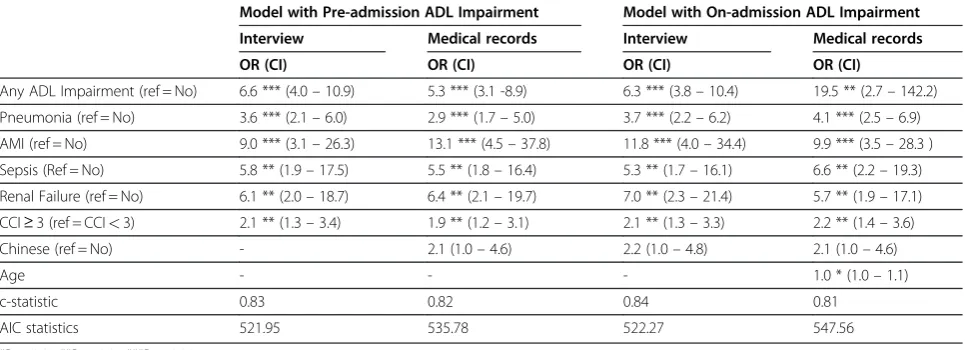
impairment in transferring, Charlson Co-morbidity Index scores (≥3); and primary diagnoses of pneumonia, acute myocardial infarction, sepsis, and renal failure were consistently selected in more than 60% of the samples across models. The results of the final regression mod-els, which incorporated variables found to be significant in 60% of the bootstrap sample are shown in Table 4.
[image:4.595.304.539.97.583.2]Before the inclusion of any functional status measure-ment, the c-statistics of the baseline models ranged
Table 1 Characteristics of study group (N = 1402)
Characteristics Study Group
Mean age, y (SD) 77.8 (7.8)
Female, % 59.7
Ethnic Group, %
Chinese 81.0
Malay 9.6
Indian 7.3
Others 2.1
Marital status
Married 45.4
Widowed 50.4
Single 2.9
Divorced/Separated 1.4
Housing type*
1-2 room public flat 8.9
3-5 room public flat 73.1
Private housing 11.9
Others (Sheltered housing) 6.0
Primary Diagnosis≥1% Prevalence, %
Pneumonia 16.6
Diabetes Mellitus with End Organ Damage 4.5
Congestive Heart Failure 2.3
Chronic Obstructive Pulmonary Disease 2.0
Renal Failure 1.9
Sepsis 1.8
Acute Myocardial Infarction 1.7
Cancer (solid tumor, localized) 1.2
Major Stroke (hemiplegia) 1.1
Charlson Comorbidity Index, %
= 0 17.5
= 1 23.5
= 2 21.7
≥3 37.3
Pre-admission, Any ADL Impairment, %† 47.6
On-admission, Any ADL Impairment, %† 50.4
Hospital mortality, % 6.0
* Missing data were present for the following variables: Housing type (9 subjects).
between 0.75 and 0.77. After the incorporation of func-tional status, the discriminatory power of each of the four models improved. Model discrimination improved the most when pre-admission (from 0.75 to 0.83) and on-admission (from 0.76 to 0.84) ADL impairment based on interview were added.
The admission models using interview data pre-dicted mortality better than the model using medical record. Similar results were found for models incorpor-ating on-admission functional status. However, the dif-ference in the discriminatory power was not statistically significant. Overall, when we compared the models using AIC scores, the model incorporating pre-admission interview data performed better because it is more parsi-monious. ThePvalue of the Hosmer-Lemeshow statistic
ranged between 0.34 and 0.81 across the four models, indicating a good fit for the original data set.
Discussion
[image:5.595.56.541.102.262.2]The results of the study indicated that the medical rec-ord is a good source of information on functional status prior to admission. The level of agreement in the diffi-culty experienced by the patient in performing at least 1 of 7 basic care skills (feeding, bathing, grooming, dres-sing, toileting, transferring and walking) was found to be higher than that reported by Bogardus et al. [6]. (к= 0.64 versus 0.48). Variations in institutional em-phasis on documentation could have influenced the dif-ference in the extent of missing documentation, and in turn, the level of agreement between the two data
Table 2 Comparison of interview and medical record data for basic ADL impairments (N = 1402)
Measure Valid Prevalence of Impairment (%)
Interview Medical Records κ Sensitivity* (%) Specificity* (%) PPV* (%) NPV* (%)
Pre-admission
Any of 5-item ADL† 1,383 33 38 0.71 87 87 77 93
Transferring 1,224 36 31 0.75 93 89 73 97
Walking 1,382 46 29 0.53 57 95 90 72
Any of 7-item ADL† 1,387 48 39 0.64 72 91 88 78
On-admission
Any of 5-item ADL† 1,375 36 78 0.24 97 33 45 95
Transferring 1,376 27 78 0.18 98 30 34 98
Walking 1,375 49 78 0.31 94 37 59 88
Any of 7-item ADL† 1,374 50 83 0.28 97 31 59 91
* Interview data used as reference standard for sensitivity, specificity, positive predictive value (PPV) and negative predictive value (NPV).
†Includes feeding, bathing, grooming, dressing, and toileting. ADL: Activities of Daily Living.
Table 3 Frequency with which each candidate variable was selected using backwards model selection in 1000 bootstrap samples
Variable Model Including Pre-admission
ADL Impairment
Model Including On-admission ADL Impairment
Interview Medical Record Interview Medical Record
ADL impairment 1000 1000 1000 614
Pneumonia 996 994 969 999
AMI 945 961 971 963
Renal Failure 828 841 838 832
Sepsis 809 808 823 862
CCI≥3 750 758 730 902
Chinese 570 637 611 642
Age 269 272 213 633
CCI = 0
CCI = 1 188 201 232 247
CCI = 2 267 255 270 166
Sheltered home resident 251 208 147 110
Diabetes Mellitus with End Organ Damage 10 5 2 3
[image:5.595.64.540.517.725.2]sources. The inclusion of specific functional status checkboxes for history taking in the medical records at the study hospital resulted in missing documentation of only 1.1%, compared to 9% reported by Bogardus et al. [6].
In contrast to pre-admission information, the extent of concordance between interview and documented impair-ment in at least 1 of the 7 ADLs on-admission was low (к= 0.28). While other authors [6,15] have similarly found health care professionals to not document func-tional status accurately, most highlighted the tendency to under-document. However, our study found the prevalence of on-admission ADL impairment to be sys-temically higher when medical records were used.
Potentially, patients could have under-reported their on-admission functional deficits [30] or health care pro-fessionals may have overstated the degree of assistance required. As the share of patients requiring assistance in at least 1 of the 7 ADLs recorded in the prospective interview (50%) is similar to rates reported in studies conducted on comparable patient populations [7,31], the likelihood of over-documentation in the medical records is higher. Contextual factors may have contributed to this. In our local setting, the strong emphasis on falls prevention in the hospital may have created a cautious atmosphere with regards to allowing physically activity in the wards. Patients may be observed and documented to require assistance in bathing, toileting, transferring or walking even though self-report may indicate otherwise. Secondly, with an average bed occupancy rate of 90% and above at our study site, staff are afforded little time in the conduct of a precise functional assessment at ad-mission. Hence, although functional status data were systematically documented through the use of checklist, it is still insufficient to help ensure good data quality.
In addition, across all ADL categories, the agreement between the two sources of data was consistently higher for proxy rather than patient respondents. We postulate that data in the medical records reflected the functional history obtained more frequently from proxies than patients themselves, which is likely for an acutely ill eld-erly population. This could have contributed to a higher level of concordance between proxy response and med-ical records.
Several studies have examined and ascertained the im-portance of functional measures in predicting hospital mortality [4,7,11]. Similarly, our study found that in addition to comorbid disease burden and specific diag-noses of acute myocardial infarction, sepsis, pneumonia and renal failure, the discriminatory power of the hos-pital mortality model is higher when functional status information was incorporated. Although Covinsky et al. [12]. found that ADL impairment prior to admission is a stronger predictor of survival at 1-year than ADL func-tion on admission, we found that the lack of funcfunc-tional reserve in an elderly person before hospitalization pre-dicts survival probability as well as function on admis-sion. One possible reason was that many subjects who died were functionally impaired both before and at hospitalization. In fact, both pre-admission and on-admission functional status are strongly correlated with each other, given that the latter is a composite of the former and the effect of acute illnesses.
[image:6.595.57.540.101.276.2]Regardless of the data source from which functional status information was derived, the performance of the mortality prediction model did not differ in a statistically significant manner. This is expected when comparing models incorporating pre-admission functional status due to the high level of agreement between the two sources pertaining to impairment in transferring.
Table 4 Multiple regression analysis predicting hospital mortality using interview and medical records data (N = 1402)
Model with Pre-admission ADL Impairment Model with On-admission ADL Impairment
Interview Medical records Interview Medical records
OR (CI) OR (CI) OR (CI) OR (CI)
Any ADL Impairment (ref = No) 6.6 *** (4.0–10.9) 5.3 *** (3.1 -8.9) 6.3 *** (3.8–10.4) 19.5 ** (2.7–142.2)
Pneumonia (ref = No) 3.6 *** (2.1–6.0) 2.9 *** (1.7–5.0) 3.7 *** (2.2–6.2) 4.1 *** (2.5–6.9)
AMI (ref = No) 9.0 *** (3.1–26.3) 13.1 *** (4.5–37.8) 11.8 *** (4.0–34.4) 9.9 *** (3.5–28.3 )
Sepsis (Ref = No) 5.8 ** (1.9–17.5) 5.5 ** (1.8–16.4) 5.3 ** (1.7–16.1) 6.6 ** (2.2–19.3)
Renal Failure (ref = No) 6.1 ** (2.0–18.7) 6.4 ** (2.1–19.7) 7.0 ** (2.3–21.4) 5.7 ** (1.9–17.1)
CCI≥3 (ref = CCI<3) 2.1 ** (1.3–3.4) 1.9 ** (1.2–3.1) 2.1 ** (1.3–3.3) 2.2 ** (1.4–3.6)
Chinese (ref = No) - 2.1 (1.0–4.6) 2.2 (1.0–4.8) 2.1 (1.0–4.6)
Age - - - 1.0 * (1.0–1.1)
c-statistic 0.83 0.82 0.84 0.81
AIC statistics 521.95 535.78 522.27 547.56
*P<0.05 **P<0.01 ***P<0.001.
Although the agreement between on-admission data from the two sources was poor, we found that documen-ted and repordocumen-ted impairment in transferring still suffi-ciently discriminated between patients with poor prognosis and those who are likely to be discharged alive. A higher share of patients requiring assistance in transferring died in hospital compared to those who are functionally independent.
In interpreting our findings, it is important to consider several limitations. Firstly, as this is a single site study, the generalizability of the results may be restricted. This applies in particular to the agreement between the med-ical records and patients’self-report as both data sources might be influenced by institutional norms prevalent in different settings. Nevertheless, our finding of the im-portance of functional status information in predicting mortality is likely to be generalizable to other settings. Secondly, we did not consider the impact of the patients’ severity of illness on the prediction of hospital mortality. However, as function reflects the impact of the illness on the whole person beyond the extent of organ system de-rangement or physiologic decompensation [4], it could also account for part of the variability in mortality due to severity of illness.
For researchers, the accuracy of medical records per-taining to patients’functional status varies depending on whether pre-admission or on-admission information is required. Our results suggest that for studies utilising pre-admission ADL impairment, the medical records is a good source but caution needs to be exercised for on-admission information due to systematic misclassifi-cation, which may create subsequent problems in inter-preting the parameter estimates when it is used as a candidate predictor.
For policymakers, our study confirmed the need for an accurate assessment and documentation of patients’ functional status. Other authors [6] advocated the aug-mentation of medical records with functional assessment during nursing admission assessment. As pointed out by Covinskyet al.[12], such data may still not be complete. Our findings point out that in a busy hospital environ-ment, beyond functional ability reported by patients, documented data can also reflect care practices. There-fore, even with systematic collection of physical status information, understanding of the primary purpose for the data collection is pertinent in the assessment of its suitability as a risk-adjustor or predictor for evaluating the quality of care and health-related outcomes.
Conclusion
We conclude that the medical records can be a good source for pre-admission functional status measure but on-admission information was not documented accur-ately. The discriminatory power of the hospital mortality
prediction model was significantly improved with the incorporation of functional status information but it was not affected by their time reference or source of data.
Additional file
Additional file 1:Detailed comparison of interview and medical record data for basic ADL impairments by respondent type (N = 1402).
Competing interests
The authors declare that they have no competing interests.
Acknowledgements
We thank Anusha Govinda Raj, and Dr Yan Sun for helpful comments on this manuscript; and Charis Ng and Shariffah Mohd. Khalid for research assistance.
This work was funded by a research grant from the National Healthcare Group (SIG/08001).
Author details
1
Health Services and Outcomes Research Department, National Healthcare Group, Singapore, Singapore.2Department of Geriatric Medicine, Tan Tock Seng Hospital, Singapore, Singapore.3Department of General Medicine, Tan Tock Seng Hospital, Singapore, Singapore.
Authors’contributions
WST conceived of the study, participated in design of the study, performed the statistical analysis and drafted the manuscript. YYD supervised the study design, participated in analysis of data, assisted in drafting and editing of the manuscript. WFC, JCT, and JYT participated in study design, drafting and editing of the manuscript. All authors read and approved the final manuscript.
Received: 6 September 2011 Accepted: 14 May 2012 Published: 14 May 2012
References
1. Campbell SE, Seymour DG, Primrose WR:A systematic literature review of factors affecting outcome in older medical patients admitted to hospital. Age Ageing2004,33:110–115.
2. Covinsky KE, Martin GE, Beyth RJ, Justice AC, Sehgal AR, Landefeld CS:The relationship between clinical assessments of nutritional status and adverse outcomes in older hospitalized medical patients.J Am Geriatr Soc1999,47:532–538.
3. Schupf N, Tang MX, Albert SM, Costa R, Andrews H, Lee JH, Mayeux R: Decline in cognitive and functional skills increases mortality risk in nondemented elderly.Neurology2005,65:1218–1226.
4. Covinsky KE, Justice AC, Rosenthal GE, Palmer RM, Landefeld CS:Measuring prognosis and case mix in hospitalized elders: the importance of functional status.J Gen Intern Med1997,12:203–208.
5. Inouye SK, Peduzzi PN, Robison JT, Hughes JS, Horwitz RI, Concato J: Importance of functional measures in predicting mortality among older hospitalized patients.JAMA1998,279:1187–1193.
6. Bogardus ST Jr, Towle V, Williams CS, Desai MM, Inouye SK:What does the medical record reveal about functional status? A comparison of medical record and interview data.J Gen Intern Med2001,16:728–736.
7. Ponzetto M, Maero B, Maina P, Rosato R, Ciccone G, Merletti F, Rubenstein LZ, Fabris F:Risk factors for early and late mortality in hospitalized older patients: the continuing importance of functional status.J Gerontol A Biol Sci Med Sci2003,58:1049–1054.
8. Rozzini R, Sabatini T, Cassinadri A, Boffelli S, Ferri M, Barbisoni P, Frisoni GB, Trabucchi M:Relationship between functional loss before hospital admission and mortality in elderly persons with medical illness. J Gerontol A Biol Sci Med Sci2005,60:1180–1183.
10. Espaulella J, Arnau A, Cubí D, Amblàs J, Yánez A:Time-dependent prognostic factors of 6-month mortality in frail elderly patients admitted to post-acute care.Age Ageing2007,36(4):407–413.
11. Davis RB, Iezzoni L, Phillips RS, Reiley P, Coffman GA, Safran C:Predicting in-hospital mortality. The importance of functional status information.Med Care1995,33:906–921.
12. Covinsky KE, Palmer RM, Counsell SR, Pine ZM, Walter LC, Chren MM: Functional Status Before Hospitalization in Acutely Ill Older Adults: Validity and Clinical Importance of Retrospective Reports.J Am Geriatr Soc2000,48:164–169.
13. Wartman SA, Morlock LL, Malitz FE, Palm E:Impact of divergent evaluations by physicians and patients of patients' complaints.Public Health Rep1983,98:141–145.
14. Pinholt EM, Kroenke K, Hanley JF, Kussman MJ, Twyman PL, Carpenter JL: Functional assessment of the elderly. A comparison of standard instruments with clinical judgment.Arch Intern Med1987,147(3):484–488. 15. Burns RB, Moskowitz MA, Ash A, Kane RL, Finch MD, Bak SM:Self-report
versus medical record functional status.Med Care1992,30:MS85–MS95. 16. Pine M, Norusis M, Jones B, Rosenthal GE:Predictions of hospital mortality
rates: a comparison of data sources.Ann Intern Med1997,126:347–354. 17. Gordon HS, Rosenthal GE:Impact of marital status on outcomes in
hospitalized patients: evidence from an academic medical center.Arch Intern Med1995,155:2465–2471.
18. Desai MM, Bogardus ST Jr, Williams CS, Vitagliano G, Inouye SK: Development and validation of a risk-adjustment index for older patients: the high-risk diagnoses for the elderly scale.J Am Geriatr Soc 2002,50:474–481.
19. Ang YH, Wong SF, Chan KM:Predictive factors of post-discharge mortality in the hospitalised elderly.Singapore Med J2000,41:98–102.
20. Tu JV, Austin PC, Walld R, Roos L, Agras J, McDonald KM:Development and validation of the Ontario acute myocardial infarction mortality prediction rules.J Am Coll Cardiol2001,37:992–997.
21. Charlson ME, Frederic LS, MacKenzie CR, Fields SD, Braham RL, Douglas RG: Assessing illness severity: does clinical judgment work?J Chronic Dis 1986,39:439–452.
22. Fleiss JL:Statistical Methods for Rates and Proportions. New York: Wiley; 1981. 23. Elam JT, Graney MJ, Beaver T, el Derwi D, Applegate WB, Miller ST:
Comparison of subjective ratings of function with observed functional ability of frail older persons.Am J Public Health1991,81:1127–1130. 24. Katz S, Ford AB, Moskowitz RW, Jackson BA, Jaffe MW, Cleveland MA:
Studies of illness in the aged. The index of ADL: a standardized measure of biological and psychosocial function.JAMA1963,185:914–919. 25. Hosmer DW, Lemeshow S:Applied logistic regression. New York:
Wiley; 1989.
26. Austin PC, Tu JV:Bootstrap methods for developing predictive models. Am Stat2004,58:131–137.
27. Austin PC, Tu JV:Automated variable selection methods for logistic regression produced unstable models for predicting acute myocardial infarction mortality.J Clin Epidemiol2004,57:1138–1146.
28. Harrell FE, Lee KL, Mark DB:Multivariable prognostic models: issues in developing models, evaluating assumptions and adequacy, and measuring and reducing errors.Stat Med1996,15:361–388.
29. Hanley JA, McNeil BJ:The meaning and use of the area under a receiver operating characteristic curve.Radiology1982,143:29–36.
30. Rubenstein LZ, Schairer C, Wieland GD, Kane R:Systematic biases in functional status assessment of elderly adults: effects of different data sources.J Gerontol1984,39:686–691.
31. Sahadevan S, Earnest A, Koh YL, Lee KM, Soh CH, Ding YY:Improving the diagnosis related grouping model's ability to explain length of stay of elderly medical inpatients by incorporating function-linked variables. Ann Acad Med Singapore2004,33:614–622.
doi:10.1186/1472-6963-12-115
Cite this article as:Tanet al.:Impact of data source and time reference of functional status on hospital mortality prediction.BMC Health Services Research201212:115.
Submit your next manuscript to BioMed Central and take full advantage of:
• Convenient online submission
• Thorough peer review
• No space constraints or color figure charges
• Immediate publication on acceptance
• Inclusion in PubMed, CAS, Scopus and Google Scholar
• Research which is freely available for redistribution