
EEG-BASED EMOTION CLASSIFICATION BY USING CONVOLUTIONAL NEURAL NETWORK (CNN)
TONG SIAU KHEE
i
EEG-BASED EMOTION CLASSIFICATION BY USING CONVOLUTIONAL NEURAL NETWORK (CNN)
TONG SIAU KHEE
This Report Is Submitted In Partial Fulfilment Of Requirements For The Bachelor Degree Of Electronic Engineering (Telecommunication Electronics) with Honours
Fakulti Kejuruteraan Electronic dan Kejuruteraan Computer Universiti Teknikal Malaysia Melaka
iv
“I acknowledge that I have read this report and in my opinion, this report is sufficient in term of scope and quality for the award of Bachelor of Electronic Engineering
(Electronic Telecommunication) with Honours.”
Signature : ...
Supervisor’s Name : DR LOW YIN FEN
v
vi
ACKNOWLEDGEMENT
On the very outset of this report, I would like to express my sincere gratitude to all the people who helped me in completing this final year project. Firstly, I would like to give a special thanks to my supervisor Dr. Low Yin Fen for the support and encouragement throughout this year. Thank you for spending your precious time to guide me in this project and the thesis writing. Next, I would like to express my appreciation to my co-supervisor Dr. Lim Kim Chuan who always give me comments and ideas on solving the problem I faced. Thank you for your patients to guide me in this project and thank you for giving me a chance to get touch in Convolutional Neural Network.
vii
ABSTRACT
viii
ABSTRAK
ix
TABLE OF CONTENTS
CHAPTER ITEM PAGES
PROJECT TITLE i
VERIFICATION FORM ii
DECLARATION iii
APPROVAL iv
DEDICATION v
ACKNOWLEDGEMENT VI
ABSTRACT VII
ABSTRAK VIII
TABLE OF CONTENTS IX
LIST OF TABLES XII
LIST OF FIGURES XIII
LIST OF ABRREVIATIONS AND ACRONYMS XV
I INTRODUCTION 1
1.1 Project Overview 1
1.2 Objective 2
1.3 Problem Statements 3
Scope of Work 3
Structure of Thesis 4
II LITERATURE REVIEW 6
2.1 Emotion and Emotion Model 6
2.2 Electroencephalogram (EEG) 8
2.2.1 International 10-20 system 9
2.2.2 Event Related Potentials (ERP) 10
2.2.3 EEG and Other Neuroimaging Method 12
x
2.3.1 Convolutional Layers 14
2.3.2 Activation Function Layer 15
2.3.3 Pooling Layer 16
2.3.4 Fully Connected Network Layer 16
2.3.5 Comparison of CNN with Conventional Method 17
2.4 Related Works 17
III METHODOLOGY 20
3.1 Block Diagram and Flow Chart for The Emotion Classification System3.1
20
3.2 Self-conducted Dataset (Dataset A) 22
3.2.1 Material Selection and Stimuli Design 22
3.2.1.1 IAPS 23
3.2.2 Stimuli Design 24
3.2.3 Experiment Design 25
3.2.4 Participants 26
3.2.5 Experiment Location and Instrument Setup 26
3.2.6 Data Collection Process 30
3.2.7 Pre-processing Step 32
3.2.8 Data Arrangement and Labelling 33
3.3 SEED Dataset 35
3.3.1 Pre-processing 37
3.3.2 Data Arrangement 37
3.4 CNN Architecture 38
3.4.1 CNN-1 38
3.4.2 CNN-2 39
IV RESULT AND DISCUSSION 42
4.1 CNN-1 with Dataset A (collected dataset in the lab) 42 4.1.1 CNN-1 with Data-1 (Dataset A: 0-1000ms, 22
channels)
42
4.1.2 CNN-1 with Data-2 (Dataset A: 80-120ms, 22 channels)
xi
4.1.3 CNN-1 with Data-3 (Dataset A: 200 – 400ms, 9 channels, 2 emotions)
47
4.2 CNN-1 with Dataset B (SEED online dataset) 49 4.3 CNN-2 with Dataset B (SEED online dataset) 50 4.3.1 Comparison between Application of Dropout 52 4.3.2 Comparison between Confusion Matrix for Each
Subject
53
V CONCLUSION AND FUTURE WORK 55
5.1 Conclusion 55
5.2 Recommendation 55
5.3 Sustainability and Commercialization 56
REFERENCES 58
Appendix A 62
Appendix B 64
xii
LIST OF TABLES
NO TITLE PAGES
1.1 Summary of data used in this project 4
2.1 Frequency band of EEG signal 9
2.2 Label of different letter in International 10-20 system [20] 10
2.3 Different ERP components 11
2.4 Comparison of CNN with conventional method 17
2.5 Related works for classification of EEG signal using CNN 19 2.6 Related works for EEG-based emotion classification 19 3.1 Specification of the computers used during signal acquisition 27
3.2 Label for each emotion 34
3.3 Comparison between difference configuration of EEG data 34 3.4 Function and parameters used in this network 41
4.1 Average accuracy get from SEED data set 50
xiii
LIST OF FIGURES
NO TITLE PAGES
2.1 Wheel of emotions [12] 7
2.2 Bi-polar model of emotion [14] 8
2.3 International 10-20 system [19] 9
2.4 ERP waveforms [21] 10
2.5 Spatial-temporal resolution of different neuroimaging method [16] 13
2.6 Architecture of LeNet-5 [25] 14
2.7 The element-wise multiplication during the convolution [25] 15
2.8 Idea of the convolution process [25] 15
2.9 Three commonly used activation function [27] 16
2.10 (a) Average pooling (b) Maximum pooling 16
3.1 Block diagram for the emotion classification system 21
3.2 Flowchart for design methodology 21
3.3 Distribution of pictures in IAPS database 23
3.4 Scatter plot of selected pictures 24
3.5 The designed trial 25
3.6 Description of the designed stimuli presentation 25
3.7 TMSi head cap with electrodes 27
3.8 Electrode’s position used in experiment 28
3.9 Instrument used in data acquisition 29
3.10 TTL pulse generated 29
3.11 Subject registration 30
3.12 Interface for TMSi Polybench 30
3.13 Interface for visualise EEG recording session 31
xiv
3.15 Segmentation process 33
3.16 Flowchart for segmentation and labelling 33
3.17 EEG electrode arrangement for SEED dataset 36
3.18 Experiment protocol for SEED dataset 36
3.19 Selected frontal channels 38
3.20 Architecture of CNN-1 38
3.21 Architecture of CNN-2 39
3.22 Code to calculate the accuracy 40
4.1 Training result from Data-1 (relu) for the classification of 4 emotions 43 4.2 Training result after adding one convolutional layer (relu) for the classification
of 4 emotions 44
4.3 Training result with tanh activation function for the classification of 4 emotions 44 4.4 Result get from Data-2 for the classification of 4 emotions 46 4.5 Results get from Data-2 after adding one convolutional layer for the classification
of 4 emotions 46
4.6 Results after adding 0.5 dropouts for the classification of 4 emotions 47
4.7 Confusion matrix for Data-1 47
4.8 Accuracy graph of Data-3 (Dataset A: 200 – 400ms, 9 channels) for 2-class of
emotions 48
4.9 Accuracy graph of SEED dataset (1000ms, 23 channels) with CNN-1 for 3-class
of emotions 49
4.10 Accuracy graph of SEED dataset (0-1000ms, 23 channels) with CNN-1 for
3-class of emotions with batch normalisation 50
4.11 Before applied dropout 52
4.12 After applied 0.5 dropout 52
xv
LIST OF ABRREVIATIONS AND ACRONYMS
CNN - Convolutional neural network ECG - Electrocardiogram
EEG - Electroencephalograms
fMRI - Functional magnetic resonance imaging HVHA - High valence high arousal
HVLA - High valence low arousal
IAPS - International Affective Picture System KNN - K-nearest neighbors
LVHA - Low valence high arousal LVLA - Low valence low arousal MEG - Magnetoencephalography PET - Positron Emission Tomography PSD - Power spectrum density
SEED - SJTU emotion EEG dataset SNR - Signal to noise ratio
SVM - Support vector machine
TMSi - Twente Medical Systems International Porti system TTL - Transistor-transistor logic pulse
1
CHAPTER I
INTRODUCTION
1
This chapter portrays the overview of this project. It starts with a general introduction to this project and follows by the problem statement, objective and scope of work. The structures of this dissertation are listed at the last section of this chapter.
1.1 Project Overview
Emotion is a reaction to stimuli that last for seconds or minutes, it also defined as the projection of a feeling [1]. As the technology of emotion is advancing, the demands of emotion recognition have been increasing in this few years. It was believed that emotion recognition system can help to bridge the gap between human and machine interaction. Besides, a machine with emotion recognition will become more intuitive and vivid. “Pepper”, a humanoid robot invented by Aldebaran Robotics and Softbank is a good example to show the significant to deploy emotion classification in a robot [2].
2
Machine learning is a field of study that provides computer with the ability to learn without being explicitly programmed. Conventionally, researchers are working on feature extraction to extract the important feature of the EEG signal using methods such as power spectrum density (PSD), wavelet analysis and correlation analysis. Next, the resulting features are classified using different classifiers such as support vector machine(SVM), K-nearest neighbors (KNN) and regression method. However, EEG signals contain low signal to noise ratio which lead to difficulty in analysing process by using the conventional method. Hence, deep learning technique that allows automated feature extraction is introduced in recent year to eliminate the complex and expensive hand-crafted feature process.
Based on research, deep learning works well in different classification problem especially in image and speech domain [4][5]. It arises as one of the powerful neural network techniques which having at least an additional convolutional layer in the neural network architecture with the weight sharing scheme that helps to reduce the overfitting issue. Recently, deep learning technique was successfully applied in physiological signal and get a good result compared to conventional shallow models.
Therefore, in the project, deep learning technique is implemented to classify EEG signal from different subjects into different emotions. First, an experiment is designed and carried out to collect the EEG signal with different emotion states. Next, the pre-processed signal is feed into the designed CNN architecture to perform feature extraction and classification. By analysing the weight distribution learned from the Convolutional Neural Network, different setup of frequency bands and channels have been done and the performance for each set up are compared. Besides, the constructed CNN architecture is tested with an open source EEG dataset (SEED) to verified its performance.
1.2 Objective
The objectives of this project are listed as below:
3
ii. To validate the developed classifier by using open sources database iii. To design and develop an emotion classification system based on EEG
signal by using Convolutional Neural Network (CNN)
1.3 Problem Statements
Emotion detection through speech, audio and facial expression elements are not persuasive enough because human can fake their own expression and vocal intonation anytime. Other neuroimaging methods such as functional magnetic resonance imaging (fMRI) are not suitable for practical emotion classification system due to the cost and immobility. Therefore, EEG signal with high temporal resolution and able to change according to emotion state becoming interesting due to higher accuracy compare to the external appearance that can be altered [6].
EEG is a non-invasive neuroimaging method to record the oscillation of brain electric potentials resulting from ionic current flow between brain neurons. It is ubiquitous, non-invasive and having excellent temporal resolution compare to other neuroimaging method. However, working with EEG signal poses some challenges, the spatial resolution for EEG signal is low and it contains low signal to noise ratio (SNR) which lead to complexity in traditional hand feature extraction. Therefore, a deep learning technique, Convolutional Neural Network (CNN) is introduced as a classification method in this project due to it can generalise well and able to extract important feature automatically through the operation inside.
The available benchmark databases of EEG signal labelled with emotions is less. However, there are labelled databases for emotion induction, hence, an experiment is carried out to collect the EEG signal with emotion by using the standardised picture databases, IAPS.
1.4 Scope of Work
4
emotions in offline mode. The pre-process of EEG signal is done by using MATLAB program whereas the training and classification algorithms are developed by using Tensorflow with python environment.
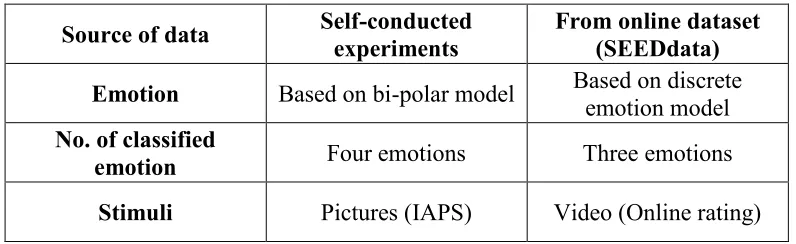
[image:20.612.129.527.457.579.2]This system is trained with EEG data that get from self-conducted experiment and open source EEG library (SEED). For self-conducted experiments, it is based on the bi-polar model of emotion, total four emotions are included (Happy, Sad, Afraid, Relax). The stimuli that used to evoke the emotion during the data collection experiment is selected from a standardized database, IAPS and signals are collected from 32 voluntary students in Universiti Teknikal Malaysia Melaka (UTeM). TMSi is used as the EEG recording devices and the total channels included are 22 which based on the International 10-20 system. For online data set, the emotion model is based on discrete emotion model rated by subjects through survey. Three emotions (positive, negative and neutral) are included in this study and the stimuli to evoke the emotion are film clips that related to different emotion state. There are 15 subjects involved in this dataset collection, ESI NeuroScan system is used as the recording device and total of 62 channels based on International 10-20 system are included in this study. The summary of the data used is shown in Table 1.1.
Table 1.1: Summary of data used in this project
Source of data Self-conducted experiments From online dataset (SEEDdata)
Emotion Based on bi-polar model Based on discrete emotion model No. of classified
emotion Four emotions Three emotions Stimuli Pictures (IAPS) Video (Online rating)
1.5 Structure of Thesis
5
6
CHAPTER II
LITERATURE REVIEW
2
This chapter covers the related theory and related work for this project. Firstly, the theory of emotion is discussed and different emotion models are reviewed. For classifying emotion from EEG signal, information about the relationship between brain activity and emotions is needed. Therefore, part two of this chapter reviews about the EEG signal and how EEG signal related to emotion. Part three of this chapter discusses the working principle of machine learning and Convolutional Neural Network (CNN). Related research on EEG signal by using CNN is compared and analysed.
2.1 Emotion and Emotion Model
Emotion can be defined as the feeling that involves thoughts, physiological changes and expression [7]. Different theories state different sequences for the thoughts and physiological change. From James-Lange theory, emotion is the experience of some change in the human body, it occurs due to physiological reaction to certain event, for example, a human can be stated he is feeling afraid due to his body was trembling after he saw a cockroach. Later, Cannon-Bard theory of emotion argues that human will experience the emotion and physiological reactions simultaneously [8]. No matter how the sequences are, scientists agreed that the origin of emotion is from human brain [9].
7
[image:23.612.216.469.260.505.2]anger, fear, disgust, happiness, sadness and surprise and all these emotions are associated with facial expression. Later, he strengthens his previous writing [10] by adding amusement, anger, contempt, contentment, disgust, embarrassment, excitement, fear, guilt, pride in achievement, relied, sadness/distress, satisfaction, sensory pleasure and shame [11]. In 1980, a psychologist name Robert Plutchik proposed eight basic emotion states: anger, fear, sadness, disgust, surprise, anticipation, acceptance and joy. He developed the wheel of emotion (Figure 2.1) to show how a new emotion state creates by combining multiple emotion states.
Figure 2.1: Wheel of emotions [12]
8
Figure 2.2: Bi-polar model of emotion [14]
Most of the researches applied this model to differentiate emotion due to its simplicity and universality. Besides that, dimensional model is preferable compared to discrete model because it is easier to compare the findings between two different studies with valence and arousal dimension. Moreover, it can be used to locate discrete emotion based on the person point of view [11].
![Figure 2.1: Wheel of emotions [12]](https://thumb-us.123doks.com/thumbv2/123dok_us/73564.6929/23.612.216.469.260.505/figure-wheel-of-emotions.webp)
![Figure 2.2: Bi-polar model of emotion [14]](https://thumb-us.123doks.com/thumbv2/123dok_us/73564.6929/24.612.186.506.72.286/figure-bi-polar-model-of-emotion.webp)
