Social media and efficient computer
infra-structure in smart city
Jerzy Balicki1, *, Honorata Balicka2, Piotr Dryja3, and Maciej Tyszka3
1Warsaw University of Technology, Faculty of Mathematics and Information Sciences, 75 Koszykowa St., 00-662 Warsaw, Poland
2Gdynia Maritime University, Faculty of Management and Commodity, 81-87 Morska St., 81-225 Gdynia, Poland
3Gdańsk University of Technology, Faculty of Electronics, Telecommunication and Informatics, 11/12 Narutowicza St., 82-230 Gdańsk, Poland
Abstract. Social media require an efficient infrastructures of computer and communication systems to support a smart city. In a big city, there are several crucial dilemmas with a home and public space planning, a growing population, a global warming, carbon emissions, a lack of key resources like water and energy, and a traffic congestion. In a smart city, we expect an efficient and sustainable transportation, efficient management of resources and a better urban planning. In this paper, social media are proposed to support smart city with efficient computer infrastructure. Moreover, some methods are described to increase the availability and efficiency of an information infrastructure. Two criteria have been formulated to assign some key resources in a smart city system. The process of finding some compromise solutions from Pareto-optimal solutions has been illustrated. Metaheuristics of collective intelligence, including particle swarm optimization PSO, ant colony optimization ACO, an algorithm of bee colony ABC, and differential evolution DE have been described due to smart city infrastructure improving. Other application of above metaheuristics in smart city have been also presented.
1 Introduction
Social media and an efficient city cloud are important for improving a live environment in a smart city by solving several crucial problems related to a traffic congestion, an urban planning, pollution emissions, warnings about bacteria in water or a lack of energy [1]. In the case of seaports, there is a dilemma of shortening the loading of containers. In turn, telemedicine can be very helpful in immediate treatment and even operation of seafarers and passengers on ships at sea [2]. To balance several infrastructure services in the smart city some criteria can be maximized. The first is the reliability of the city infrastructure of a computer distributed system. The second one is the probability that all critical tasks meet their deadlines.
Improving the quality of life and the required level of the economy can be achieved by means of more effective computerization of key processes related to the lives of residents of intelligent cities [3]. It is necessary to develop a new, more efficient infrastructure that we will use in a few years. At this time, however, you should efficiently revise existing infrastructure in order to improve its operation, including increasing the availability of 24 hours a day and 7 days a week. This involves taking into account the necessary upgrades, technical maintenance and software updates [4]. In addition, attacks on servers offering city services are, and probably will, unfortunately, become more intensive. What is more, the weakest element is always a user, an employee or an official who can provide sensitive data or passwords and, in a worse case, use their rights for their own purposes. A remedy for a number of the above dilemmas is a reliable IT system supporting the functioning of the city.
This paper is organized as follows. Section 2 discusses the urban tasks related to social media. Section 3 is dedicated for study a role of computer infrastructure in a smart city. In section 4, reliability of computer infrastructure in a smart city is characterized. Section 5 is devoted to the presentation of the time restrictions for city tasks. In section 6, some applications of metaheuristics for smart city are presented.
2 City tasks in social media
Social media and the Internet of Things can support a smart city to integrate a number of computers, sensors, actuators, software and data that are dedicated to manage information, give education, and improve safety [5]. Tasks can be related to labor, business, and commerce, too. Ten years ago, it was proved that departments of a city hall can use Facebook, Twitter, Instagram or Flickr for efficient communication between local government and citizens. Especially, some crisis situations like heavy snowstorm hits motivate citizens to frequent use the city’s Facebook page to get information about a situation [6]. Moreover, photos can be viewed to analyze some cases. Social media sites are supposed to be connected to all city departments via an integrated social media center. Getting and sharing information
from all the city’s departments is very easy and some departments can receive feedback from citizens. Social media centers work in more effective way than a city phone hotline.
Social media can give an economic increase regarding an enlarged tourism traffic. Publicity generated by photos and advertising may attract tourists. Moreover, health care can be discussed via social media and some medical programs can be announced. Also, Twitter can be applied to gather data from some energy consumption sensors. Information about quality of city water can be presented, too. In crisis situation, some rescue operation can be supported during flood [7].
Social media is a new information channel between residents and departments of hall office about the current situation. Citizens can receive knowledge about the city, and they can communicate about each other. In results, decision making can be developed in many problems. A scale is large because in many countries over 70% population lives in cities [8]. Social media can be used to better understanding citizens by an identification some expectations of them. Moreover, social media can integrate several IT systems as well as real urban systems to share data with millions of citizens [9]. Balance between quality of many different systems is important. The network of connections between the domain systems and new ones is more important than the analysis of separately functioning urban systems. An advanced energy distribution system and a poor water system are not some good indicators of a smart city [10].
cooperating between government, local government, education and business. Decisions should be the result of understanding the needs of residents, take into account their needs and preferences for decision-making criteria [11].
On the other hand, social media introduce some new tasks and some rules have to be prepared because some citizens can create many antagonistic remarks. Moreover, administrators of social media in a city department are supposed to cooperate with some experts to improve some social media sites [12]. Moreover, some additional meetings are required to study the effectiveness of social media, to apply new tools, to develop some brainstorming activity. However, social media has to be supported by Internet of Things as well as a cloud of computer resources [13].
3 Computer infrastructure in a smart city
From year to year, the number of projects related to smart cities is growing and extends. Also, the leading cities in Europe, such as Dublin or Amsterdam, have been implementing modern solutions in many seemingly unrelated spheres of urban life [14]. The smart city uses available information and communication solutions to improve the quality of life of residents. These can be infrastructure improvements, as an elastic traffic management system, and even electronic boards at bus stops. In such cases, the "intelligence" of the city is noticeable by the residents, because it directly affects the comfort of their lives [15].
In smart city, advanced ICT solutions (Information and Communication Technology) are used to protect the natural environment like monitoring the state of air pollution. Sometimes the definition of smart city takes into account aspects related to the operation of e-offices, which allows residents to efficiently perform administrative tasks over WWW and social media. The role of smart cities is to support sustainable development, improve the quality of life of their residents and improve administrative processes. An adequate example is Dublin, which is often considered a leader in smart city solutions. Few years ago, a mobile application for residents informing about important events in the area was introduced. These may include interruptions in water supply, road closures or events in the life of local community. Another solution is "intelligent dustbins" that send e-mails using a wireless connection to the Internet, as soon as the level of their use reaches 85% [16].
Smart city is based on the Internet of Things (IoT), which is a system that includes a set of devices that produce data and communicate with each other. IoT combines smartphones, cameras, sensors, motion sensors in clothes, as well as home devices like refrigerators informing you when stocks last. The range of IoT applications is almost unlimited, and one of them can be used to support communication in smart city systems. It is assumed that by 2020, approximately 50 billion devices will be active under the IoT.
The amount of data necessary for processing is growing, and current technological solutions are no longer sufficient. It became necessary to redefine the methods that allow for the processing of huge data volumes in a satisfactory time. An important infrastructure from this point of view is an efficient infrastructure that enables fast, reliable data processing or provision of specific IT services for residents. It seems that this infrastructure should have minimal interruptions in work and be resistant to failures of its individual components. These, however, are inevitable for large-scale projects. In a city infrastructure, we can meet thousands of components.
Designing high availability city computer systems means one has to minimize the total time when the system is not accessible or unable to perform its tasks. The most popular technique to measure the availability is calculating the percent of time when system is fully operational (1).
𝑎𝑣𝑎𝑖𝑙𝑎𝑏𝑖𝑙𝑖𝑡𝑦 =𝑡𝑜𝑡𝑎𝑙_𝑡𝑖𝑚𝑒 −𝑓𝑎𝑖𝑙𝑢𝑟𝑒_𝑡𝑖𝑚𝑒
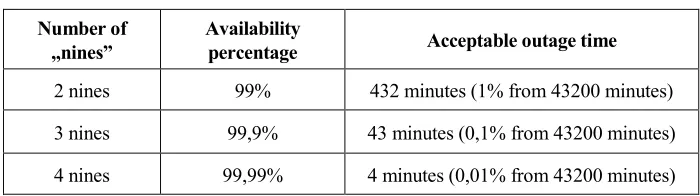
The value of 100% means that a system is failure proof. In practice, availability is sometimes described as “nines”. Table 1 shows the availability values calculated for a smart
[image:4.482.62.412.121.219.2]city infrastructure for a 30 days period.
Table 1. Smart city infrastructure availability described as “nines”.
Number of „nines”
Availability
percentage Acceptable outage time 2 nines 99% 432 minutes (1% from 43200 minutes)
3 nines 99,9% 43 minutes (0,1% from 43200 minutes)
4 nines 99,99% 4 minutes (0,01% from 43200 minutes)
4 Reliability of computer infrastructure in a smart city
High available smart city system are designed by accommodating failure tolerance techniques to avoid the whole system downtime. One of most popular is to make a single component in a system redundant. In case of failure, a master component will be replaced by a secondary one and will take all responsibilities of its predecessor. For example, a power supply component or Internet provider may be redundant making the total failure more likely. The self-repairing system is a crucial technique when dealing with high-availability systems. Self-repairing system can diagnose and fix itself automatically without human
intervention. Given a “five nines” smart city system, it’s often necessary to make it self-repairing as a total acceptable time of failure is only 26 seconds in a month. It far too short time for a human to perform repair activities, but citizens require such wide access to some city services.
There are several methods which help to create a high available, self-repairing system. One of the most popular is a load-balancer service, which works as a proxy for requests coming to the system. A load-balancer redirects requests to only those components which are available. It helps to reduce the number of failed requests due to one of the components malfunctioning. Authors used this technique in the experimental Comcute PG grid at Gdańsk University of Technology. Comcute PG was designed to support crisis situations in the smart city agglomeration model.
Using virtualization machines VMW is another example of an applied method. It’s
responsible for monitoring nodes in a city cloud. Those nodes host virtual machines and when the failure occurs the supervised module is expected to perform necessary virtual machine’s migrations. A virtual machine’s downtime is significantly reduced when such a module is
enabled for a city cloud.
Higher reliability usually means the system becomes more complex which in turn results in higher development and maintenance costs. Not all systems require the highest level of failure-tolerance. The hypothesis that 99,999% reliability is better than 99% reliability may be true only in a specified environment with a set of constraints applied. The decision about a level of reliability required for a system should be always made with respect to a particular system requirements.
),
exp(
)
(
1 1 1
= = =−
=
V v I i J j ij m vi vj jt
x
x
x
R
(2)where
= 10ifin thecomputer other case.j isassigned towi , xij
= 10ifin thetaskother Tviscase.assigned towi, xm
vi
In order to maximize the reliability, it is essential to find some values of decision variables which is used to assign resources in the smart city nodes. Decision variables are presented as a pair of matrixes, as below:
𝑥 = (𝑋𝑚, 𝑋𝜋), (3)
where 𝑋𝑚= [𝑥
𝑣𝑖𝑚]𝑉×𝐼, 𝑋𝜋= [𝑥𝑖𝑗𝜋]𝐼×𝐽.
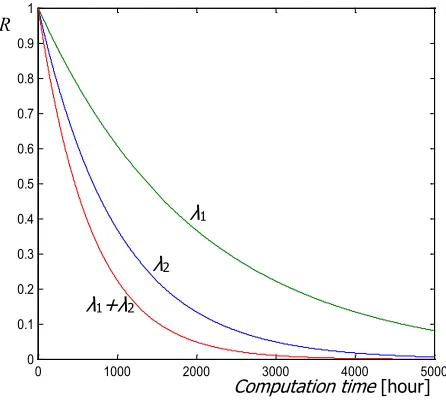
It’s a very challenging task to build a highly reliable smart city system. Figure 1 shows some reliability characteristics of two systems. The measure of reliability R decreases exponentially over time expressed in hours accordingly to formula (2). Let the first computer be failed once in a thousand hours on average. Then λ1=0.001 [hour-1]. On the other hand,
the average time without failure for the second computer is five hundred hours, so the
λ2=0.002 [hour-1]. When two computers are connected with the unfailing data transmission
[image:5.482.117.340.369.569.2]channel, the reliability of the system decreases much faster. A failure occurs three times in thousand hours in such a system.
Fig. 1. Dependency between the availability and the computation time for two smart city systems.
There are thousands of components, including computers, sensors and actuators, in a system supporting a smart city computer infrastructure. For instance, the SmartSantander system, with over 20 000 sensors is located in cities like Santander, Belgrade, Guildford and
Lübeck. British project FixMyStreet, created to support citizen’s complaints filing process has a similar complexity. In this system, citizens may file a complaint regarding noise,
0 1000 2000 3000 4000 5000
0 0.1 0.2 0.3 0.4 0.5 0.6 0.7 0.8 0.9 1 R
Computation time [hour]
λ1
pollution, traffic jams etc. If this system is not accessible, frustration and disappointment become deeper and deeper.
A city with a highly available IT infrastructure was built in Japan. Smart city model in Tsukuba Science City permits on a deep analysis and a prediction of processes happening in such an intelligent agglomeration. The key findings from the experiment point to the role of citizens, quality of life, environmental research, education, economy, and health care, possibility of employment, mobility, infrastructure and technology. Those are the key areas which should be embraced and supported by well educated people, local communities and an unreliable ICT infrastructure.
5 Time restrictions for city tasks
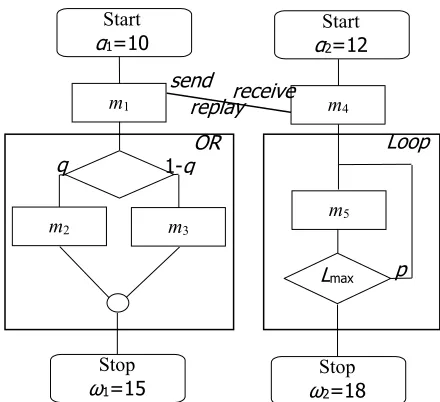
In the smart city, there are several tasks that have to meet their deadlines. Delay of one task can cause delays of many tasks. Let N city tasks in the 24-hour cycle be carried out in the smart city system. The task Tn starts at αn and should end at ωn. Figure 2 shows an example of dependency between two tasks. The first task performs calculations supporting the regulation of lights at intersections, and the second task - calculations for monitoring air pollution. In task T1, after
completing the procedure m1, the m2 operation is performed with the probability q (serious
accident at the intersection) in the OR decision subgroup (Fig. 2.) or operation m3 - with the
probability (1-q). However, in the task T2, the procedure m4 can be performed at most Lmax times
in the subgraph of the LOOP, where each iteration of the procedure is carried out with the probability p (detection of pollution exceeding the safe level by the sensor).
It is easy to show that 2Lmax of the instances are possible (Fig. 2.). The instance in which the
m2 procedure is executed once, and the procedure m5 - k times, occurs with the following
probability:
pi=q(1- p) p k-1. (4)
Based on the decisions of allocation of procedures to computers
(
x
m,
x
)
, it is possible to estimate the completion times for calculations of procedures C1,...,Cv,...,CV according to theadopted algorithm of task scheduling. Let dv represents the required deadline of the vth procedure. If Cv dv, the deadline is not exceeded and the state of fulfillment of this restriction is set as (dv−Cv)=1. The states of constraints related to the deadlines of the procedures included in the ith instance of the task execution diagram with the set of Mi procedures can be written as follows:
− =
i v M
m
v v
i d C x
S
( ( )). (5)As a consequence, we determine the probability of deadlines not being exceeded by procedures for all K instances of the task implementation diagram in the smart city system, as follows:
=
−
=
Ki im M v v
D
i v
x
C
d
p
x
P
1
))
(
(
)
Fig. 2. An exemplary diagram of the implementation of two tasks in the smart city system Fig. 3. shows a multi-criteria area of smart city infrastructure assessment. Marks were marked as pairs of values (PD, R) and restrictions were imposed on the optimization criteria. In addition, a compromise infrastructure was presented for the deployment of 14 procedures on 2 computers, which corresponds to the yk rating nearest to the distance of Euclid to the ideal point
yinf. It was assumed that P
D≥ 0.6 and R≥ 0.3.
[image:7.482.65.409.371.539.2]
Fig. 3. Multicriteria space for assessing smart city IT infrastructures: a) ratings with restrictions on optimization criteria, b) compromise infrastructure
It is worth emphasizing that the values of imposed restrictions on criteria can be changed, and the stakeholders that have an impact on above decisions are: system administrators, designers, officials, local government, or even residents. On the basis of these restrictions, the set of admissible structures is narrowed, from which Pareto-optimal solutions can be chosen, and in particular the compromise infrastructure. It is worth emphasizing, however, that the problem is NP-hard due to computational complexity and metaheuristics are required to solve it.
yinf
Start α1=10
m1
m3 m2
Stop ω1=15
q 1-q
Start α2=12
m4
Lmax m5
Stop ω2=18
p send receive
replay
OR Loop
limit D
P =0.6
Rlimit=0.3
P
D(x)
R(x)
a) b)
6 Metaheuristics for smart city
Metaheuristics are often very useful for IT infrastructure evaluation. Some of them such as Particle Swarm Optimization, Ant Colony Optimization and Artificial Bee Colony can be together referred to as swarm intelligence. Those algorithms share high-level characteristics. They usually consist of decentralized, self-organizing agent with a common operational knowledge. The ideas behind of all the three mentioned algorithms were heavily inspired by the nature: PSO – birds flock behavior, ACO – ant colony behavior, ABC – bee colony behavior.
The differential evolution DE algorithm is also worth mentioning. This algorithm was introduced as an optimization algorithm with a small number of parameters. The population consists of a certain number of vectors that contain variances to solve a problem. A characteristic feature of this algorithm is the crossing method which uses three vectors drawn from the population of parents. The selection of the best vector for the descendant population occurs between the vectors from the parent population and the vectors from the population created by using the crossing and mutation methods. In many optimization problems, the algorithm proved to be better compared to other evolutionary algorithms.
Bubal and Lee proposed planning of transport and communication connections in such a way that they are optimally adapted to the needs of people in large urban agglomerations, using the differential evolution algorithm [17]. The developed algorithm takes into account not only passengers' satisfaction, but also the costs incurred by bus, tram and train managers, so that the connections are profitable.
The Particle Swarm Optimization algorithm was constructed in 1995. Inspiration was the observation of social behaviors of flaps in the herd during their search for food. If a member of the herd senses the smell of food, it uses the sounds to inform others about its location. Then the rest of the herd tries to change the direction of the flight so as to get closer to it. If the next birds sense an even stronger smell of food, they again inform the remaining birds through even louder sounds. In this way they affect the direction of the flight of the rest of the herd.
Nikam and Mane have proposed using the PSO algorithm to optimize the wireless sensor network (WSN) connecting smart city infrastructure elements in the field of waste management [18]. WSN networks consist of many independent devices monitoring physical phenomena, such as temperature, movement or the presence of objects in space. Each node wirelessly transmits data to the central office where it is processed. The PSO algorithm has been used to improve network scalability, optimize energy consumption and resistance to damage.
ABC algorithm was introduced in 2005. Bees communicate and share information by so
called waggle dance. It’s a series of specific movements performed by a bee to share
information about direction and distance to a food source. There are three distinct types of reactive agents when considering ABC algorithm: employed bees, onlookers bees and artificial food sources (solutions found for a particular optimization problem). Artificial bees, just like the real ones tend to share information in order to explore neighbor solutions. Those are often worth exploring as they may lead to even better ones. ABC algorithm proved to be a good choice in the field of combinatorial optimization as well as multi-objective optimization problems.
decides which route is optimal in terms of travel time and energy consumption and minimize the risk of collisions. PRT was successfully introduced at the Heathrow airport in England as a partial replacement for bus transportation system.
Bello and Zeadally have proposed using the ACO algorithm to improve data transmission between IoT devices [20]. IoT networks can be characterized by a large variety of architectures, as well as significant dynamics of changes taking place, e.g. changing the topology of networks in the case of mobile devices. ACO can function as an important element to support routing in such a network. Thanks to the use of the algorithm, issues such as self-organization, self-configuration of the network, frequent change in the position of devices in the space or damage to damage can be solved [21].
7 Remarks and conclusions
The paper discusses the methods of increasing the availability and IT effectiveness of in-infrastructure in a smart city. Two criteria have been formulated to assess the distribution of key resources in the smart city system. The process of determining compromise solutions from Pareto-optimal solutions is illustrated. The metaheuristics of collective intelligence, including a swarm of particles, ants colonies, bee swarms and differential evolution with the help of which a smart city's compromise infrastructure can be defined, are discussed.
It is worth noting that the bee swarm algorithm was used to optimize the Personal Rapid Transit management system at Heathrow. In addition, the planning of transport and communication connections using the differential evolution algorithm takes into account not only the satisfaction of passengers, but also the costs borne by the managers of buses, trams and trains. In contrast, the particle swarm algorithm was used to optimize the wireless sensor network combining smart city infrastructure elements in the field of waste management. Ant colony algorithm is used to support routing in the Internet of Things, as well as self-organization and self-configuration IoT.
An interesting direction of further research is to construct a model and method including a broader perspective of resource optimization in a smart city.
References
1. R. Agarwal, A. Deo, S. Dasm, ACM SIGSOFT Softw. Eng. Notes 29, 2, 27-62 (2004) 2. J. Balicki, Robot Motion and Control, 217-222 (RoMoCo, Poznań, Poland 2002) 3. R. Kanter, S. Litow, Informed and interconnected: A manifesto for smarter cities.
Harvard Business School (2009)
4. J. Balicki, Computers, 417-422 (WSEAS, Rhodes, Greece, 2009)
5. A. Dukhanov, M. Karpova, K. Bochenina, Procedia Comput. Sc. 29, 2472-2482 (2014) 6. W. Gong, W. Wang, Cloud Computing and Intelligence Systems, 638-644 (IEEE,
Beijing, 2011)
7. C. Hsu, H. Chen, K. Huang, Y. Huang, Comput. & Math. Appl. 64, 5, 1506-1513 (2012) 8. S.V. Kolekar, S.G. Sanjeevi, D.S. Bormane, Computational Intelligence and
Computing Research, 1-5 (IEEE, 2010)
9. J. Balicki, Z. Kitowski, Lect. Notes Comput. Sc. 1993, 373-384 (2001)
10. T. Kurilovas, I. Zilinskiene, V. Dagiene, Comput. Hum. Behav. 30, 550-557 (2014) 11. N. Pawar, S.K. Sonkar, Int. J. Em. T. Ad. Eng. 3, 7, 315-322 (2013)
13. J. Balicki, W. Korlub, J. Szymański, M. Zakidalski, Lect. Notes Comput. Sc. 8467, 771-782 (2014)
14. M. Sayed, F. Baker, J. Softw. Eng. Appl. 8, 26-34 (2015)
15. J. Winiarski, Risk in business operations of enterprises(University of Gdańsk, 2014) 16. D. Xu, W. Huang, H. Wang, J. Heales, Inform. Manage. 51, 4, 430-440 (2014) 17. A.T. Bubal, L.S. Lee, J. Comput. Comm. 4, 12 – 14 (2016)
18. S. Nikam, P. Mane, Data Engineering and Communication Technology, 691-700 (2016)
19. E. Fatnassi, J. Chebbi, J. Siala, Evolutionary Computation (IEEE CEC, 2014) 20. O. Bello, S. Zeadally, IEEE Syst. J. 10, 3, 1172-1182 (2016)