New Zealand Journal of Forestry Science 33(3): 385–398 (2003)
* Paper presented at the 8th International Congress of Plant Pathology, 2–7 February 2003, Christchurch, New Zealand.
† Also: Co-operative Research Centre for Sustainable Production Forestry
INTERDISCIPLINARY APPROACH TO
THE STUDY AND MANAGEMENT
OF STEM DEFECT IN EUCALYPTS*
T. WARDLAW,
Forestry Tasmania, GPO Box 207, Hobart, Tasmania, 7001, Australia
C. MOHAMMED†,
CSIRO Forestry and Forest Products, GPO Box 252-12, Hobart, Tasmania, 7001, Australia
K. BARRY†, A. EYLES†, D. WISEMAN†, School of Agricultural Science, University of Tasmania,
GPO Box 252-54, Hobart, Tasmania, 7001, Australia
C. BEADLE†, M. BATTAGLIA†,
CSIRO Forestry and Forest Products, GPO Box 252-12, Hobart, Tasmania, 7001, Australia
E. PINKARD†,
School of Agricultural Science, University of Tasmania, GPO Box 252-54, Hobart, Tasmania, 7001, Australia
and P. KUBE
Carson Associates Ltd., 34 Parawai Rd., Rotorua 3202, New Zealand
(Received for publication 27 February 2004)
ABSTRACT
neither Eucalyptus nitens (Deane & Maiden) Maiden nor E. globulus Labill. shed branches efficiently. Retention of dead branches leads to defects in wood such as a large knotty core or loose knots, making the stem unsuitable for either veneer or sawlog. Pruning of green branches at canopy closure and in subsequent lifts shortly afterwards solves this problem. However, on the more productive warm and wet sites there is a high level of decay infections in E. nitens and E. globulus via pruning wounds. We are investigating the complex pathological, physiological, genetic, and silvicultural components dictating eucalypt susceptibility to decay infection and its long-term spread into clearwood including: crown characteristics prior to pruning; growth responses to pruning; growth responses to fertiliser; host resistance and antimicrobial defences; and the identity and pathogenicity of decay fungi. An interdisciplinary approach is fundamental to understanding such questions and also to the successful development of site productivity models that include predictions of risk and impact of biotic and abiotic damage.
Keywords: stem decay; wound rot; heart rot; wood-decay fungi; Eucalyptus nitens; Eucalyptus globulus.
INTRODUCTION
The last two decades have seen a shift in sentiment by society, demanding that larger areas of forest be preserved to protect their natural values. During this period, for example, there have been three major inquiries into forest use in Tasmania (Department of the Arts, Sport, the Environment, Tourism and Territories 1988; Forest and Forest Industries Council 1990; Commonwealth of Australia and State of Tasmania 1997). The net result of these inquiries was that the area of forest in reserves increased dramatically from 13% in 1982 to 40% in 2000. At the same time, however, there is a legislated requirement to maintain a supply of sawlogs from this reduced area of crown forest (Parliament of Tasmania 1990). Intensification of forest management through thinning of native forests and establishment of eucalypt plantations has been adopted as a strategy to increase the yield of sawlogs from this reduced area of crown forest (Forest and Forest Industries Council of Tasmania 1990).
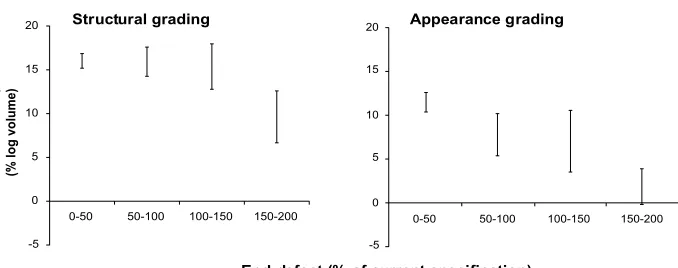
Markets have also been changing. Traditionally eucalypts have been sawn for uses in primarily structural applications such as house framing. However, over the last two to three decades softwoods, particularly Pinus radiata D.Don, have displaced eucalypts in structural applications (Ferguson & Dargavel 1978). Increasingly, the future of eucalypt timber is predicted to be in appearance applications such as furniture, panelling, flooring, and internal fittings (Beall 2000; Ye 2000). Sawmill studies (Wardlaw unpubl. data) have shown that the recovery of high-quality boards that meet specifications for appearance uses is more sensitive to log quality than if logs were being sawn for structural products (Fig. 1). Tighter log specifications targeting appearance products would decrease the volume of in-specification logs available for sawing (Fig. 2).
intensive management regimes. White & Kile (1991) examined the development of decay originating from stem wounds inflicted during thinning operations in natural forests and made predictions of rapid spread of the decay coinciding with the breaching of barrier zones (White & Kile 1994). Wardlaw (1996) reported a high incidence of stem decay originating from natural sources in stands identified for mid-rotation commercial thinning. In eucalypt
FIG. 1–Recovery (green) of sawn boards that meet either (a) Structural Grade 1 or (b) Select Grade (appearance grading) from regrowth eucalypt sawlogs grouped according to the amount of log end-defect (from Wardlaw unpubl. data). Error bars indicate 95% LSD limits.
-5 0 5 10 15 20
0-50 50-100 100-150 150-200 Board recovery (% log volume)
-5 0 5 10 15 20
0-50 50-100 100-150 150-200
End-defect (% of current specification)
Structural grading Appearance grading
FIG. 2–Percentage of potentially merchantable sawlog volume in each of four tree diameter quartile classes that meets either current specifications for allowable log end-defect or, more stringent, appearance specifications for allowable log end-defect (from Wardlaw 2003).
1
2
3
4 0
10 20 30 40 50 60 70 80 90
Merchantable sawlog volume
(% total)
Appearance specifications Current specifications
[image:3.595.104.395.278.514.2]plantations managed for solid-wood products, pruning is required to produce logs of sufficient quality for sawing or veneer production (Gerrand et al.1997). In the more humid sites of Tasmania, where growth rates are sufficiently high for plantations to be managed economically for solid-wood products, there is a high risk of decay entering through pruned branches (Mohammed et al. 1998; Wardlaw & Nielsen 1999).
These studies have formed the basis of prescriptions designed to minimise future losses from stem decay (Pinkard et al. 2001; Wardlaw 2003). However, research has continued, with the focus on better understanding the interactions between the host and the decay fungus. It is hoped that through a better understanding of these interactions we will be able to more confidently predict the outcomes of silvicultural intervention and incorporate mitigation measures that minimise the risk of future losses from stem decay. In this paper, we document the interdisciplinary research programme being carried out in Tasmania by the Co-operative Research Centre for Sustainable Production Forestry (CRC-SPF) and Forestry Tasmania into the management of stem decay in eucalypts.
DECAY IN INTENSIVELY MANAGED NATURAL FORESTS
The initial focus of decay research in native forests was on the development of decay originating from stem wounds inflicted during thinning operations. As part of the Young Eucalypt Program, studies by Don White and Glen Kile (White & Kile 1991) demonstrated that E. obliqua L’Herit and E. regnans F.Muell. carry a high risk of degrade from decay as a result of wounding. A key finding from their research was that the spread of decay accelerated rapidly about 14 years after wounding (White & Kile 1994). This coincided with a breaching of the barrier zone that was established after wounding. Old et al. (1993) extended wound-decay research into E. sieberi L.A.S.Johnson forests and, in particular, documented the establishment of defect arising from different types of stem wound (Dudzinski et al. 1992). These studies highlighted the importance of quality control in thinning programmes and particularly the imperative to minimise the incidence of stem wounds inflicted during thinning. The introduction of quality control and an emphasis on operator training have resulted in the incidence of stem wounding being consistently kept to low levels during thinning operations in Tasmania (Cunningham 1997).
DECAY IN PLANTATIONS
In the push for sustainable forestry there is a rapidly increasing estate of eucalypt plantations in Australia; most of these plantations are being grown for pulpwood but some are destined for veneer and sawlog production. Of approximately 130 000 ha of eucalypt plantations in Tasmania, 15 000 ha have been pruned for solid wood.
Eucalyptus globulus and E. nitens, the main commercial species in Tasmania, do not
shed branches in a plantation situation and require pruning to produce wood of sufficient quality for sawn timber and veneer production (Gerrand et al. 1997). As the first few experimental plantations reached 6–11 years of age, surveys by Wardlaw & Nielsen (1999) found decay in a substantial proportion of pruned trees. These surveys also showed that unacceptable defects develop from pruning dead branches.
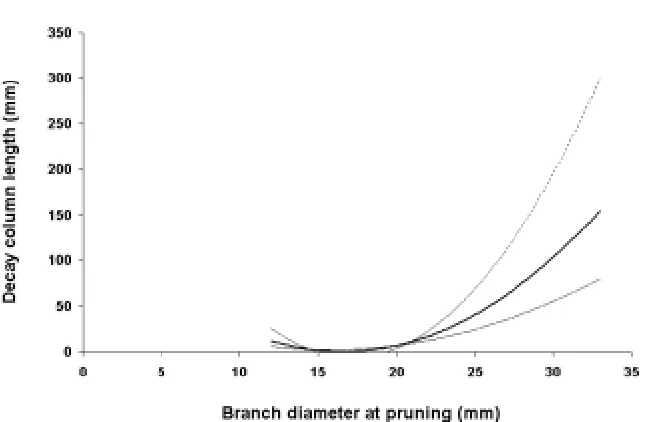
To examine more closely the influence of pruning treatments on the establishment of decay, Mohammed et al. (1998) established a trial in E. nitens plantations on five contrasting sites in 1996. Destructive sampling done 1 year after pruning showed that decay-risk was associated with pruning live branches. Branch size was confirmed to be a key risk factor: As the diameter of the branch increased above 2 cm, so did the predicted risk of decay (Fig. 4). The study also showed that poor-quality pruning techniques greatly increased the risk of decay. Significantly, highly productive sites, that are most favoured for pruning, carry the greatest risk of decay developing after pruning.
This research produced an immediate response by industry to change prescriptions so that trees selected for pruning had no or few dead branches, or large-diameter (> 3–4 cm) live branches. Since higher quality sites have more vigorous trees and therefore larger branches, pruning prescriptions can only reduce, not eliminate, the number of decay infections that become established after pruning.
value loss ✕❘ volume loss
Value loss ($/ha)
Volume loss (m
[image:5.595.87.439.85.286.2]3/ha)
DEVELOPMENT OF DECAY OVER TIME
[image:6.595.165.488.71.282.2]Barry et al. (2003) resampled the trial of Mohammed et al. (1998) nearly 6 years after pruning. Over that time they found that the incidence of decay in both the pruned and unpruned trees had increased by between two- and five-fold (Table 1). In the pruned trees the decay outbreaks were confined to the knotty core (they had arisen or escaped from branch traces infected at the time of pruning) and the amount of clearwood had increased over time. However, 6 years is only a short time in forestry: plantations managed for solid wood will not be harvested until age 20–35 years. Will the containment of decay in the knotty core observed in the first 6 years after pruning persist over the length of the rotation?
FIG. 4–Predicted length of a decay column (with 95% confidence intervals — dotted line) as a function of the diameter of the pruned branch in E. nitens (from Mohammed et al. 1998)
TABLE 1–Number of decay columns per tree (±SE) in E. nitens 1 and 5.5 years after pruning at two sites (from Barry et al. 2003).
–––––––––––––––––––––––––––––––––––––––––––––––––––––––––––––––––––––––––––––––
Time since Flowerdale Evercreech
pruning ---
(years) Pruned Control Pruned Control
––––––––––––––––––––––––––––––––––––––––––––––––––––––––––––––––––––––––––––––– 1 2.1 (±0.6) 0.8 (±0.3) 1.1 (±0.7) 0.4 (±0.3) 5.5 4.5 (±0.9) 4.1 (±0.8) 3.4 (±0.9) 1.4 (±0.5) –––––––––––––––––––––––––––––––––––––––––––––––––––––––––––––––––––––––––––––––
[image:6.595.154.510.478.542.2]HOST RESPONSE TO INFECTION AND THE SPREAD OF DECAY
Tree pathologists often refer to the CODIT model (sensu Shigo & Marx 1977) to explain the processes by which the spread of decay is limited within the tree. The difficulty with any model is to validate whether it applies for any particular tree species. Will the containing walls described by the CODIT model effectively restrict decay in eucalypts?
Reaction zones (comprising Walls 1, 2, and 3) are the defence response in trees associated with tissue present at the time of wounding and infection. In E. nitens there is sometimes a distinct purple/pink zone between the infected and healthy sapwood (Fig. 5). This zone has features characteristic of active host response: tyloses, a pH that is unfavourable for fungal growth, and antimicrobial compounds (Barry et al. 2000). Barry
et al. (2002) found that increases in the production of antimicrobial compounds in E. nitens
[image:7.595.87.440.286.554.2]corresponded with increased aggressiveness of the fungus colonising the wound. This indicates a dynamic response, which appears from our observations to be effective in restricting the spread of decay, at least in the short term (Barry et al. 2003; Barry, Pearce, Evans, Hall & Mohammed 2001).
FIG. 5–Transverse surface of an E. nitens stem 2 years after pruning, showing a purple reaction zone (arrows) within the heartwood (HTZ — heartwood transition zone is indicated) (from Barry et al. 2000).
In eucalypts, kino veins are often seen as a traumatic response to damage to the vascular cambium. This kind of response in new tissue formed after the stress event is often called a barrier zone. Eucalyptus nitens does not actually form kino veins, which sets it apart from
EFFECT OF SILVICULTURAL TREATMENTS Fertiliser Treatment and Decay
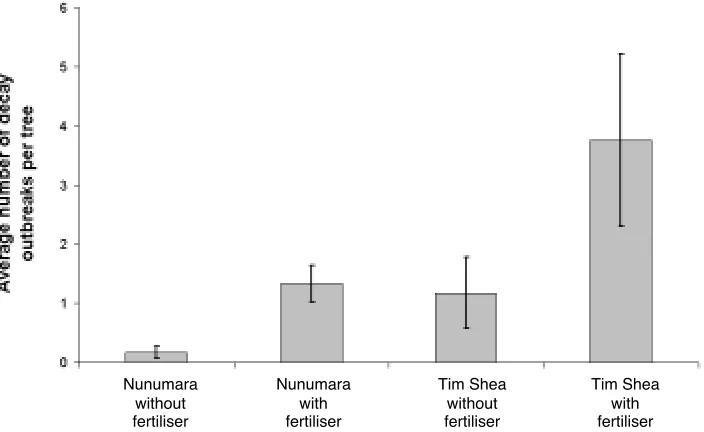
[image:8.595.158.512.251.506.2]Post-establishment fertiliser application is required on many plantation sites in Tasmania. Wiseman (2003) found that the application of nitrogen (900 kg N/ha) and phosphorus (150 kg P/ha) prior to pruning caused a three- to eight-fold increase in the number of decay infections in E. nitens (Fig. 7). This increase in decay infection was associated with an
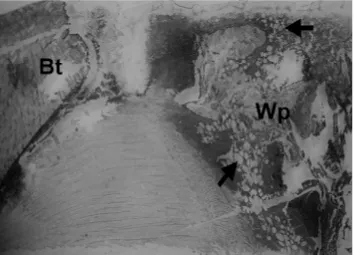
FIG. 6–Radial longitudinal section through a 2-year-old pruned branch wound (Bt) in E. globulus, showing wound-associated phloem (Wp) containing abundant oil glands (arrows) (from Eyles et al. in press (a)).
increased longevity of branches resulting in the branches growing to a greater diameter (Fig. 8). Both of these factors are known to increase the risk of decay infections. Similar studies are currently being done in E. globulus.
Nunumara Nunumara Tim Shea Tim Shea
without with without with
[image:9.595.87.439.131.347.2]fertiliser fertiliser fertiliser fertiliser
[image:9.595.110.416.386.512.2]FIG. 7–Average number of decay outbreaks per tree from pruned branches of untreated and fertiliser-treated E. nitens at two sites in Tasmania (from Wiseman 2003).
FIG. 8–Proportion of pruned branches in each of four diameter classes from untreated and fertiliser-treated E. nitens at Tim Shea (from Wiseman 2003).
Fertiliser treatment of E. nitens with nitrogen and phosphorus did not affect chemical properties (lignin, extractives, hydrolysable tannins) of the heartwood or sapwood (Wiseman 2003). The establishment and spread of decay appears not to be correlated with any of these wood properties (Wiseman 2003; P.D.Kube, T.J.Wardlaw & C.A.Raymond unpubl. data). However, we still do not know whether increases in photosynthesis, changes in tissue moisture, and improved carbon uptake after fertiliser treatment mean better resources to fight decay.
Breeding to Select for Greater Decay Resistance
White et al. (1999) found no differences in the spread of decay from stem wounds among provenances of E. regnans. In the same study, the spread of decay from stem wounds among open-pollinated families of E. nitens was much less than was found in E. regnans and showed only a modest heritability. However, Kube, Wardlaw & Raymond (unpubl. data) assessed the incidence of wound-rot and heart-rot in 13-year-old E. nitens progeny trials and found that they were under moderately strong genetic control with heritabilities of 0.60 and 0.40 respectively. They found no correlation between wound-rot and heart-rot, which suggested that they are separate traits. In addition, neither trait showed strong genetic correlations with diameter, basic density, cellulose content, methanol-soluble extractive content, or branching. These results suggest that deployment using a multi-trait selection strategy among E. nitens progeny is unlikely to yield marked increases in decay resistance. However, by selecting only for either wound-rot or heart-rot, significant increases in decay resistance may be achieved. Such a selection strategy may be appropriate for deploying on high decay-risk sites.
Pruning Intensity
The intensity of pruning in eucalypts has a marked effect on growth and the physiological processes contributing to those growth responses. Pinkard & Beadle (1998) found that the removal of up to 50% of the green crown had little effect on growth in E. nitens, but heavier pruning caused growth reductions. Similar studies have found that growth of E. globulus is more sensitive to the intensity of pruning (Pinkard et al. in prep.). Significant growth reductions were measured in E. globulus after 50% or more of the green crown was removed. The intensity of pruning also affects establishment of decay. Severe pruning (70% green crown removal) significantly increased the number of decay outbreaks in
E. globulus (Pinkard et al. in prep.). However, more work is needed to determine whether
this is simply the result of pruning the larger branches that occur further up the stem, or is the result of a reduced capacity of the tree to contain decay within the stubs of the pruned branches.
IDENTIFICATION OF FUNGI RESPONSIBLE FOR DECAY IN EUCALYPTS
We now have a collection in excess of 1500 wood-decay isolates from different sources in Tasmania — regrowth eucalypts, plantation trees, rotting logs, and fruit-bodies (identified if possible). We are attempting molecular grouping of these isolates: Even if we cannot ascribe a name to a group we can characterise it. This work is on-going and will probably take several years’ research by various people. We are seeing certain groups of isolates associated with a particular type of decay clustering together according to their DNA RFLP profiles (Mohammed et al. 2003).
CONCLUSIONS:
AN INTERDISCIPLINARY APPROACH TO DECAY RESEARCH
The study of stem decay is time-consuming, expensive, and difficult to conduct. The main imperative driving the decay studies being done in Tasmania is to identify the risks of economic damage and, if necessary, develop strategies to manage those risks. Although this does not preclude opportunities to conduct fundamental research, it does provide a focus for such research. Furthermore, it is neither practical nor sensible to manage decay in isolation from other risks or essential silvicultural treatments required in managing the crop. It is this environment that has shaped the interdisciplinary research programme, combining a mixture of fundamental and applied studies, that we report.
We have used decay surveys, involving the dissection of sample trees, to define the extent of the problem, identify risk factors, and develop interim prescriptions to manage the problem (Wardlaw 1996, 2003; Mohammed et al. 1998). More fundamental studies into the nature of the host response to infection have enabled us to make more general predictions of the spread of decay over time (Barry, Davies & Mohammed 2001; Barry, Pearce, Evans, Hall & Mohammed 2001). We are beginning to validate these predictions by assessing the development of decay along a time series (Barry et al. 2003).
These fundamental studies have also provided evidence of a more general response by the host to wounding (Eyles, Davies & Mohammed 2003; Eyles, Davies, Yuan & Mohammed 2003; Eyles et al. in press (a), (b)), which may also operate against a wider range of damage agents such as mammalian herbivores (O’Reilly-Wapstra et al. in prep.). This may offer opportunities to refine selection strategies in breeding programmes to target traits that confer greater resistance to a wider range of damage agents.
Collaboration with tree physiologists has provided the opportunity to examine how the establishment and development of decay are affected by key silvicultural treatments such as pruning (Pinkard et al. in prep.) and fertiliser treatment (Wiseman 2003). Ongoing work in this area may us help to understand the physiological basis of the host response to silvicultural intervention and how that influences the establishment and development of decay.
REFERENCES
BARRY, K.M.; DAVIES, N.W.; MOHAMMED, C. 2001: Identification of hydrolyzable tannins in the reaction zone of Eucalyptus nitens wood, by high performance liquid chromatography / electron ionization mass spectrometry. Phytochemical Analysis 12: 120–127.
–––––2002: Effect of season and different fungi on phenolics in response to xylem wounding and inoculation in Eucalyptus nitens. Forest Pathology 32: 163–178.
BARRY, K.M.; HALL, M.F.; MOHAMMED, C.L. 2003: We learn as they grow: Monitoring decay incidence and spread from pruning wounds of Eucalyptus nitens. Poster presentation at 8th
International Congress of Plant Pathology. 3–7 February, Christchurch, New Zealand. BARRY, K.M.; PEARCE, R.B.; MOHAMMED, C. 2000: Properties of reaction zones associated
with decay from pruning wounds in plantation-grown Eucalyptus nitens. Forest Pathology 30: 233–245.
BARRY, K.M.; PEARCE, R.B.; EVANS, S.D.; HALL, L.D.; MOHAMMED, C. 2001: Initial defence responses in Eucalyptus nitens sapwood following wounding and inoculation, including NMR imaging. Physiological and Molecular Plant Pathology 58: 63–72.
BEALL, F.C. 2000: The market potential for eucalypts in North America. Pp. 6–11 in “The Future of Eucalypts for Wood Products”, Proceedings of the IUFRO Conference, 19–24 March, Launceston, Tasmania.
COMMONWEALTH OF AUSTRALIA AND STATE OF TASMANIA 1997: Tasmanian Regional Forest Agreement. 133 p.
CUNNINGHAM, J. 1997: Development of operational techniques for thinning eucalypt regeneration. Tasforests 9: 85–104.
DEPARTMENT OF THE ARTS, SPORT, THE ENVIRONMENT, TOURISM AND TERRITORIES 1988: “Report of the Commission of Inquiry into the Lemonthyme and Southern Forest”, Volume 1. AGPS, Canberra. 450 p.
DUDZINSKI, M.J.; OLD, K.M.; GIBBS, R.J. 1992: Minor damage to silvertop ash from thinning operations: Classification of wounds and early tree responses to damage. Report to Department of Conservation and Environment, Victoria. 33 p.
ELLIOTT, H.J.; BASHFORD, R. 1984: Incidence and effects of the dampwood termite, Porotermes adamsoni, in two Tasmanian east coast eucalypt forests. Australian Forestry 47: 11–15. EYLES, A.; MOHAMMED, C. 2002: Comparison of CEPA (2-chloroethyl phosphonic acid)
induced responses in juvenile Eucalyptus nitens, E. globulus and E. obliqua: a histochemical and anatomical study. International Association of Wood Anatomists Journal 23(4): 419–430. EYLES, A.; DAVIES, N.W.; MOHAMMED, C. 2003: Novel detection of formylated phloroglucinol compounds (FPCs) in the wound-associated wood of Eucalyptus globulus and E. nitens. Journal of Chemical Ecology 29: 881–898.
–––––: Traumatic oil glands induced in the wound-associated phloem of Eucalyptus globulus: chemistry and histology. Trees: Structure and Function (in press (a))
–––––: Tannins, flavonoids and terpenes detected in the wound wood of Eucalyptus globulus and E. nitens. Canadian Journal of Forest Research (in press (b))
EYLES, A.; DAVIES, N.W.; YUAN, Z.Q.; MOHAMMED, C. 2003: Host responses to natural infection by a stem canker (Cytonaema sp.) in the aerial bark of Eucalyptus globulus. Forest Pathology 33: 1–16.
FERGUSON, I.S.; DARGAVEL, J.B. 1978: Economic considerations. In Hillis, W.E.; Brown, A.G. (Ed.) “Eucalypts for Wood Production”. CSIRO, Australia.
FOREST AND FOREST INDUSTRIES COUNCIL OF TASMANIA 1990: “Secure Future for Forests and People”. Forest and Forest Industries Council of Tasmania, Hobart. 127 p. GERRAND, A.M.; NEILSEN, W.A.; MEDHURST, J.L. 1997: Thinning and pruning eucalypt
GREAVES, T.; McINNES, R.S.; DOWSE, J.E. 1965: Timber losses caused by termites, decay and fires in an alpine forest in New South Wales. Australian Forestry 29: 161–174.
MOHAMMED, C.; HALL, M.; SAVVA, M. 1998: Reduction of loss from pruning-associated-decay in Eucalyptus nitens plantations grown for sawlog and veneer. Report to the Forest and Forest Industries Council of Tasmania. 39 p. + appendices.
MOHAMMED, C.; BARRY, K.; HARRISON, K.; WISEMAN, D.; ZI-QING, Y.; YEE, M.; HOPKINS, A.; WARDLAW, T.; BOUGHER, N.; TOMMERUP, I. 2003: Decay fungi in eucalypts slowly reveal their true identity! Co-operative Research Centre for Sustainable Production Forestry, Resource Protection Program, Pest off 18.
OLD, K.M.; DUDZINSKI, M.J.; GIBBS, R.J.; KUBONO, T. 1993: Stem degrade following harvesting damage. Second progress report on collaborative research in regrowth forests between CSIRO and the Victorian Department of Conservation and Natural Resources. CSIRO, Canberra. 48 p.
O’REILLY-WAPSTRA, J.M.; McARTHUR, C.; POTTS, B.M.: Linking plant genotype, plant defensive chemistry and mammal browsing (in prep.).
PARLIAMENT OF TASMANIA 1999: “Forestry Act (1920)”. Parliament of Tasmania, Hobart, Tasmania.
PINKARD, E.A.; BEADLE, C.L. 1998: Effects of green pruning on growth and stem shape of Eucalyptus nitens (Deane and Maiden) Maiden. New Forests 15: 107–126.
PINKARD, E.A.; MOHAMMED, C.; BEADLE, C.L.; HALL, M.F.; WORLEDGE, D.; MOLLON, A.: Growth responses, physiology and decay associated with pruning plantation-grown blue gums (in prep.).
PINKARD, L.; CUNNINGHAM, J.; WILSON, L.; WARDLAW, T.; NEILSEN, B. 2001: Pruning and thinning cool temperate eucalypt plantations for clearwood production. Forestry Tasmania, Hobart, Internal Report. 69 p.
SCHWARZE, F.W.M.R.; ENGELS, J.; MATTHECK, C. 1999: “Fungal Strategies of Wood Decay in Trees”. Springer-Verlag, Berlin. 185 p.
SHIGO, A.L.; MARX, H.G. 1977: Compartmentalization of decay in trees. USDA Forest Service Agricultural Information Bulletin 405. 73 p.
WARDLAW, T.J. 1996: The origin and extent of discolouration and decay in stems of young regrowth eucalypts in southern Tasmania. Canadian Journal of Forest Research 26: 1–8. –––––2003: The extent, impact and management of stem decay in young regrowth eucalypt forests
scheduled for thinning in Tasmania. Ph.D. thesis, University of Tasmania. 244 p.
WARDLAW, T.J.; NEILSEN, W.A. 1999: Decay and other defects associated with pruned branches of Eucalyptus nitens. Tasforests 11: 49–57.
WARDLAW, T.J.; SAVVA, M.H.; WALSH, A.M. 1997: Stem decay in final-crop eucalypts from regrowth forests identified for intensive management. Tasforests 9: 123–138.
WHITE, D.A.; KILE, G.A. 1991: Thinning damage and defect in eucalypts. Pp. 152–177 in Kerruish, C.M.; Rawlins, W.H.M. (Ed.) “The Young Eucalypt Report”. CSIRO, Melbourne. –––––1994: Breakdown of barrier zones and prediction of the spread of discolouration and decay
resulting from stem wounds in Eucalyptus regnans and E. obliqua. European Journal of Forest Pathology 24: 71–78.
WHITE, D.A.; RAYMOND, C.A.; KILE, G.A.; HALL, M.F. 1999: Are there genetic differences in susceptibility of Eucalyptus nitens and E. regnans stems to defect and decay. Australian Forestry 62(4): 368–374.
WILKES, J. 1985: Host attributes affecting patterns of decay in a regrowth eucalypt forest. I. Patterns of natural decay. Holzforschung 39(1): 17–22.
YANG, J.L.; WAUGH, G. 1996: Potential of plantation-grown eucalypts for structural sawn products. II. Eucalyptus nitens (Dean & Maiden) Maiden and E. regnans F. Muell. Australian Forestry 59(2): 99–107.