Versioning RLOs as ‘Study Skills Toolkits’ for Different User Groups and
Developing Community Tools to Support Sharing and Customisation
Julie Watson Kate Dickens Centre for Language Study University of Southampton
United Kingdom [email protected]
Abstract:
As patterns of need in twenty-first century higher education change so must the solutions. E-learning solutions, in particular, need to be adaptive to fit a range of teaching and E-learning situations. eLanguages, a research and development unit at the University of Southampton, develops online toolkits of reusable learning objects (RLOs) in Study Skills that can be versioned for different student user groups. Underpinning them is an approach which seeks to deliver high quality content and be cost-effective. Reusability and versatility are central to this. With the creation of a large base of RLOs has come recognition of the need to manage and customise these resources easily and a suite of tools enabling such actions has been developed. This paper will present the toolkits and the pedagogic design of the RLOs. The web-based tools to support management and customisation of RLOs, and potentially facilitate new toolkit creation, will also be introduced.
Introduction
With the embedding of more and more e-learning in higher education and the increasing cost of developing specialised courseware and the technical infra-structures to support this, there is a recognised need for both versatile and adaptable courseware, and associated tools that will allow teachers themselves to manage, develop and
customise e-learning resources as simply and quickly as possible to serve their own needs. eLanguages, a research and development unit at the University of Southampton in the UK, has been developing online toolkits of reusable learning objects (RLOs) in Study Skills for Higher Education since 2004. These toolkits and their contents are designed in such a way as to allow for re-versioning for different student user groups. Currently these include an EAP (English for Academic Purposes) Toolkit designed for international /non native speaker students; a generic Study Skills toolkit designed for British or native speaker students and a discipline-specific Study Skills Toolkit for students of Nursing and midwifery. The versioning of different toolkits has resulted in a rapid expansion in the bank of available RLOs and has raised several management issues, among them, the need for effective means of storing, retrieving and customising items. eLanguages has, therefore, embarked on the development of a number of prototype web-based tools to address these needs and, in addition, to test the customising and sharing of RLOs created by a community of practising language and study skills teachers. This paper will outline the approach taken in order to produce a series of toolkits with high quality content in the form of RLOs but in a cost-effective manner. Different ways in which toolkits have been used will be illustrated and the suite of web-based tools, which are being developed to address the issue of how to effectively manage such resources and support customised RLO, or potentially toolkit creation, will also be introduced.
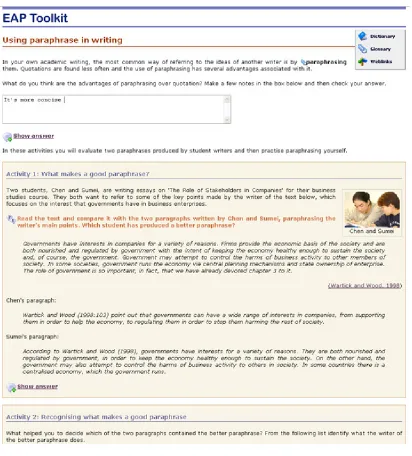
The online learning materials produced by the eLanguages unit are developed in the form of reusable learning objects (RLOs). These are self-contained learning objects (LOs) of similar size or granularity, offering activity-based learning, and comprising a series of interactive linked tasks and their associated digital resources or ‘pedagogic assets’ (PAs) such as audio and video files or texts. An important design feature is that they are separable from individual contexts of use and so selected learning objects can be grouped together to serve as the ‘building blocks’ for online course or resource set (toolkit) creation. The ‘standalone’ quality of RLOs and the fact that many of the component parts of an LO such as the task types, instruction rubrics and various presentational features also have a reusable dimension, results in significant savings on both time and cost. As well as facilitating the generation of more LOs with a different content focus, this reusability also permits multi-versioning of skill-based toolkits. A number of customised study skills toolkits for specific user groups in Higher Education have been developed. Currently these include toolkits customised for international students (see Figure 1); and others for home or native speaker students with subject-specific or generic content. The RLOs forming each toolkit are created as content packages and are interoperable on typical delivery platforms such as Moodle, Blackboard and Web CT.
RLOs share a pedagogic design. In simple terms, each RLO focuses on a learning point, which, if it is complex, is presented through several staged activities, allowing for reflective, productive and practice-type activities to be combined. An activity-led approach is employed, combining multi-media assets and aiming to engage the student in a ‘learning by doing’ type of interaction and active reflection, as they also listen, view, read or write. Interactive examples of RLOs can be viewed on the eLanguages homepage. (http://www.elanguages.ac.uk/activities/) The activities are enhanced with feedback, which includes comments and explanations as well as answers, in order to support learning. Hints and examples are also available to help students engage effectively with tasks and there are links to a glossary, online dictionaries and weblinks providing further practice or reference material associated with the learning point. Productive tasks are personalised where possible and all feedback is student-activated.
As well as being designed for reusability, the pedagogic basis for the learning objects has sought to draw on key elements and processes identified in Laurillard’s model for teaching and learning (Laurillard, 2002). Her ‘Conversational Framework’ provides a model for using learning technologies effectively as part of the learning process in Higher Education. At a micro level, the design of the RLOs has sought to reflect the various elements identified by Laurillard’s model including scope for:
• task ‘interaction’
• ‘reflection’ about the learning concepts involved
• ‘discussion’, which in the RLOs is an internalised process through engagement with the activities and their feedback
• ‘adaptation’ of (students’) understanding through their engagement with a sequence of increasingly challenging activities centred around a complex learning point.
While the design of the RLOs endeavours to take into account Laurillard’s model at a micro level for the purpose of supporting student learning, realisation of the full iterative process underpinning higher-level learning is made possible when tutor presence can be included in the framework. In the context of an online course, this might take place through the use of course tutoring tools such as the discussion forum or other VLE-supported communication channels, allowing online tutoring to become the dynamic driver for the learning process In the setting of a conventional university course, the face-to-face teacher would assume a similar role.
Toolkits and their modes of use
A typical toolkit, and the first to have been developed by eLanguages, is the EAP (English for Academic Purposes) Toolkit. Focussing on academic study skills and language development and designed for international or non-native speaker students between the levels of 525 and 600 TOEFL (5.5 and 7.0 IELTS). This toolkit contains 100 LOs providing more than 80 hours of student learning. The LOs are divided into a number of skill areas. These are Learning to study (e.g. Managing your study time; Using tutor feedback effectively); Academic writing; Academic reading and critical thinking; Vocabulary for academic purpose; Grammar for academic purposes; Academic listening and note-taking skills; Academic communication skills; and Subject-specific needs (e.g. Law assignments: answering the problem question; Business studies: reading part of a case study).
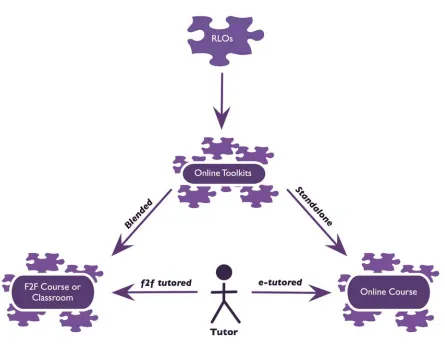
Figure 2: Diagram showing how RLOs can be used in tutored and untutored learning and teaching contexts
The development of tools for managing and customising RLOs
With the development of a large and expanding bank of reusable learning objects, several management issues have arisen. These are: the need for effective means of storing, retrieving and customising items. Thus, it was recognised that tools to assist in the management, handling and customising of RLOs needed to be added. Several research projects funded by the JISC, Eduserv and the Higher Education Academy Subject Centre for Languages, Linguistics and Area Studies have fostered a community of practice and enabled us to embark on the development and trialling of community tools in parallel with the versioning of new toolkits of RLOs.
This UK-based community of practice involving both teachers, students and learning technologist has been engaged at each step of the way from project inception through development and trialling of each of these tools. Their valuable contribution has ensured that the tools have been developed with the close involvement of the practitioners for whom they are intended.
One such project is the L2O: Sharing Language Learning Objects,
learning and study skills. As well as the RLOs, this repository also stores their associated ‘pedagogic assets’ (PAs) and catalogues or ‘tags’ these separately, recognising their pedagogic potential as discreet items. Cataloguing of RLOs and PAs involves tagging them with metadata, allowing storage, search and retrieval of RLO or PA by online course designers, classroom teachers and students. Particular attention has been given to creating suitable contextual metadata (relating to the learning and teaching context), providing an appropriate interface for typical end-users of the repository, namely, online course developers, teachers and students themselves and enabling resources to be found and shared easily.
Alongside this project, the Eduserv-funded MURLLO Project (Management Use and Repurposing of Language Learning Objects) (http://www.elanguages.ac.uk/researchcommunity/projects/murllo.html) has developed a number of important web-based tools to facilitate the management, handling and editing of shared reusable learning objects in an envisaged high-tech educational arena of the future. Three tools have been developed and are undergoing usability testing. One is the ‘LO shopper’, a shopping trolley-type tool facilitating online selection and retrieval of a self-customised toolkit of RLOs from a large repository. Another is a wiki-type ‘LO editing tool’ (Wang et al, 2007) allowing quick and easy repurposing of an RLO by teachers for their own contexts of use, and removing the need to use the original LO authoring tool. Thirdly, an ‘LO tagging tool’ has been created to allow teacher-developers to tag newly created RLOs with useful contextual metadata prior to uploading them to a shared repository. A set of teacher-designed metadata relating to the learning and teaching context and including information concerning level, intended student user, suggestions for use etc enables like users to locate what they need quickly and effectively. In addition, the metadata templates exploit features characteristic of Web 2.0 social networking practices. For example, users can expand original metadata by adding their own feedback about resources they have downloaded and used.
Most recently, the CLARET (CLARe Tools) project
(http://www.elanguages.ac.uk/researchcommunity/projects/claret.html) has developed a domain interface for a language teaching and learning community repository. This has involved the collaborative creation of a concept map based on terminology deriving from the community’s shared language and understanding of the teaching and learning context. Using Web 2.0 features and social networking practices, this folksonomy for resource (RLO or PA) discovery is being tested as a domain interface, mapping onto content stored in the CLARe repository.
Conclusions
Through their design and their scope for ease of repurposing, RLOs have enabled eLanguages to version a number of off-the-shelf Study Skills Toolkits for different student user groups. As courseware, research has shown the toolkits to be versatile in terms of how both students and teachers choose to use and blend them in conventional face-to-face teaching and learning settings. In the educational arena of the future, however, teachers too will want to be equipped with the tools to share, manage and adapt online learning materials to suit their own course and classroom needs, and students will expect to have access to large ‘libraries’ of such online learning resources to support their learning. With this in mind, the development and testing of a suite of web-based tools and services for managing , sharing and customising RLOs has aimed to take some first tentative steps towards enabling such a future.
References
eLanguages (2007) Retrieved August 14th 2007, from http;//www.elanguages.ac.uk/ /activities/
eLanguages (2007) CLARE Tools. Retrieved August 14th 2007, from http://www.elanguages.ac.uk/researchcommunity/projects/claret.html
eLanguages (2007) L2O: Sharing Language Learning Objects. Retrieved August 14th 2007, from
http://www.elanguages.ac.uk/researchcommunity/projects/l2o.html
Eprints for Digital Repositories (n.d.) Retrieved August 14th 2007, fromE-prints http://www.eprints.org/
Laurillard ,D. (2002) Rethinking University Teaching: A Conversational Framework for the Effective Use of Learning Technologies. 2nd edition. London: Routledge Falmer
Watson, J. (2007) Developing a pedagogically-driven process model for L2O. Retrieved August 14th 2007, from
elanguages Website: http://www.elanguages.ac.uk/researchcommunity/projects/l2o/jw_l2ocasestudy.pdf