UNIVERSITI TEKNIKAL MALAYSIA MELAKA
STUDY OF PUYUH FARM ENVIRONMENT CONTROL
SYSTEM USING PLC APPLICATION
This report is submitted in accordance with the requirement of Universiti Teknikal Malaysia Melaka (UTeM) for the Bachelor of Electronic Engineering
Technology (Industry Electronics) with Honours
By
NURUL SAZWANI BINTI SALEH B071310486
930309125508
i
UNIVERSITI TEKNIKAL MALAYSIA MELAKA
BORANG PENGESAHAN STATUS LAPORAN PROJEK SARJANA MUDA
TAJUK: Study of Puyuh Farm Environment Control System Using PLC
Application
SESI PENGAJIAN: 2016/17 Semester 1
Saya NURUL SAZWANI BINTI SALEH
mengaku membenarkan Laporan PSM ini disimpan di Perpustakaan Universiti
Teknikal Malaysia Melaka (UTeM) dengan syarat-syarat kegunaan seperti berikut:
1. Laporan PSM adalah hak milik Universiti Teknikal Malaysia Melaka dan penulis. 2. Perpustakaan Universiti Teknikal Malaysia Melaka dibenarkan membuat salinan
untuk tujuan pengajian sahaja dengan izin penulis.
3. Perpustakaan dibenarkan membuat salinan laporan PSM ini sebagai bahan pertukaran antara institusi pengajian tinggi.
4. **Sila tandakan ( )
SULIT
TERHAD
TIDAK TERHAD
(Mengandungi maklumat yang berdarjah keselamatan atau kepentingan Malaysia sebagaimana yang termaktub dalam AKTA RAHSIA RASMI 1972)
(Mengandungi maklumat TERHAD yang telah ditentukan oleh organisasi/badan di mana penyelidikan dijalankan)
(TANDATANGAN PENULIS)
Alamat Tetap:
Lot 5696, Jln Hj Khalid,
Kg Baru Si Rusa,
71050 Port Dickson, Negeri Sembilan
Tarikh: 13 December 2016
Disahkan oleh:
(TANDATANGAN PENYELIA)
Cop Rasmi:
** Jika Laporan PSM ini SULIT atau TERHAD, sila lampirkan surat daripada pihak berkuasa/organisasi
berkenaan dengan menyatakan sekali sebab dan tempoh laporan PSM ini perlu dikelaskan sebagai SULIT
ii
DECLARATION
I declare that this thesis entitled “Puyuh Farm Environment Control System using PLC application” is the result of my own research except as cited in the references. The thesis has not been accepted for any degree and is not concurrently submitted in candidature of any other degree.
Signature :
Name : Nurul Sazwani Binti Saleh
iii
APPROVAL
This report is submitted to the Faculty of Engineering Technology of UTeM as a partial fulfillment of the requirements for the degree of Bachelor of Engineering Technology (Industrial Electronic) (Hons). The member of the supervisory is as follow :
iv
ABSTRACT
v
ABSTRAK
vi
DEDICATION
vii
ACKNOWLEDGEMENT
Firstly, I want express gratitude to my father Mr Saleh Omar and my mother Ms Sarinah Mustafa for their unconditional support and encouragement in whatever I do.
I would like to thank my supervisor, Mr Saifullah Salam for his invaluable advice and contributions to this project. His insights and high standards have definitely helped to shape this project. It is a pleasure to have an advisor being so joyful in his work.
My thank goes to my co-supervisor Mr Mohd Fauzi Ab Rahman and my lecturers for giving me guidance in completing this thesis. Special thank goes to laboratory owner, Mr Shukri for your guidance, assistance and ideas.
viii
TABLE OF CONTENTS
Chapter Page
DECLARATION ... ii
APPROVAL ... iii
ABSTRACT ... iv
ABSTRAK ... v
DEDICATION ... vi
ACKNOWLEDGEMENT ... vii
TABLE OF CONTENTS ... viii
LIST OF TABLES ... x
LIST OF FIGURES ... xi
LIST OF ABBREVIATIONS, SYMBOLS AND NOMENCLATURE ... xii
CHAPTER 1 ... 1
INTRODUCTION ... 1
1.1 Project Background... 1
1.2 Project Objective... 2
1.3 Problem Statement ... 2
1.4 Project Scope ... 2
1.5 Report Outline... 3
1.6 Conclusion ... 3
CHAPTER 2 ... 4
LITERATURE REVIEW... 4
2.1 Puyuh Farmbest ... 4
2.2 Quail Breeding Requirement ... 6
2.3 Housing and equipment ... 8
2.4 Light Requirements... 9
2.5 PLC Operation ... 9
2.6 Temperature Control System ... 13
2.7 Humidity Control System ... 16
2.8 Conclusion ... 17
CHAPTER 3 ... 18
METHODOLOGY ... 18
3.1 Hardware Design ... 18
3.2 Software Design ... 23
3.3 Associate of Components ... 23
3.4 Conclusion ... 26
CHAPTER 4 ... 27
RESULT & DISCUSSION ... 27
4.1 Result ... 27
ix
CHAPTER 5 ... 39
CONCLUSION ... 39
5.1 Conclusion ... 39
5.2 Future Work ... 40
REFERENCES ... 1
x
LIST OF TABLES
Table Page
Table 2.1: Air Flow Rates and Exhaust Air Temperatures ... 15
Table 4.1: Timer (s) with Temperature (℃) ... 32
Table 4.2: Timer (s) with Humidity (%) ... 34
Table 4.3: Temperature (℃) and Response of System ... 36
xi
LIST OF FIGURES
Figure Page
Figure 2.1: Quail Poultry House ... 5
Figure 2.2: Open Poultry House and Close Poultry House ... 6
Figure 2.3: Quails ... 6
Figure 2.4: PLC System ... 10
Figure 2.5: Simple PLC ... 12
Figure 2.6: Recommended Temperature for Quails ... 14
Figure 2.7: Temperature Control System ... 15
Figure 2.8: Humidity Control System ... 17
Figure 3.1: Block Diagram ... 18
Figure 3.2: Flow Chart Methodology ... 20
Figure 3.3: Flow Chart of Control System ... 21
Figure 3.4: Instalment of Equipment in the Poultry House ... 22
Figure 3.5: OMRON PLC CJ21 ... 24
Figure 3.6: DHT 11 Temperature & Humidity Sensor ... 24
Figure 3.7: Relay Module Arduino ... 25
Figure 3.8: MY2 Relay Omron ... 26
Figure 4.1: Grafcet of Control System ... 28
Figure 4.2: Ladder Diagram of Control System ... 30
Figure 4.3: The Output LAMP Activate for 5 Seconds ... 31
Figure 4.4: The Output FAN Activate for 5 Seconds ... 31
Figure 4.5: Graph of Analysis of Timer (s) vs Temperature (℃) ... 33
xii
LIST OF ABBREVIATIONS, SYMBOLS AND
NOMENCLATURE
PLC – Programmable Logic Controller
DC – Direct Current
AC – Alternate Current
LCD – Liquid Crystal Display
% - Percentage
℃ - Degree Celcius
NRC – National Research Council
PC – Personal Computer
s – Second
RH – Relative Humidity
1
CHAPTER 1
INTRODUCTION
In this chapter, introduction of the “Puyuh Farm Environment Control System using PLC application” that include the project background, project objectives, problem statement, project scope and the report outline is presented.
1.1 Project Background
The Puyuh Farm Environment Control System project is using PLC application. The unpredictable temperatures in Malaysia today have greatly influence the puyuh’s performance. Subsequently, there are a lot of demands from the industry to keep good environmental conditions by installing temperature and humidity controlling system. In view of this, a temperature and humidity controlling system based on PLC that can control fans and lamps will be developed.
2 of the builder-up prototype dealing with temperature and humidity to control the environment of the poultry house.
1.2 Project Objective
The main objectives of this project can be described as follows.
i. To design the environment control system of Puyuh Farm using PLC application. ii. To analyze and evaluate the performance of “Environment control system of
Puyuh Farm using PLC application” prototype.
1.3 Problem Statement
Quails need good environment which are good control system for their breeding and growing rate in order to be optimized. This good environment can be achieves with a very good ventilation that able to control the level of temperature and humidity level in the poultry house. Moreover, quails are very sensitive to cold temperatures and high humidity too. Thus, making controlling of these parameters are significant. By having a reliable and cost efficient poultry house environment controlling system, the breeding of health quails can be alleviated. Hence, Programmable Logic Controller (PLC) is broadly utilized as a primary board controller while it is normally difficult to program. There is another option technique other than PLC to control the factors with a simple to program feature.
1.4 Project Scope
3 from the sensors. Then, for the prototype part, a prototype of the poultry house will be designed taking into account similarity with the actual environment.
1.5 Report Outline
This report is outlines as follow:
Chapter 1 explains the introduction that includes concept of temperature and humidity controlling system based on PLC for poultry house application. It also outlines the objectives, problem statement and scopes of this system.
Chapter 2 describes the literature review of recent records, circuits and problem statement with regard to the project.
Chapter 3 provides description about the methodology in order to implement this project from the start until the end. The methodology is illustrated using the flow chart and each of the contents of the flow chart is described in this part.
1.6 Conclusion
4
CHAPTER 2
LITERATURE REVIEW
This chapter cover in brief, information about the Puyuh Farmbest, one of the quails breeding company located in Melaka, Malaysia, where the actual study and deployment of the controlling system will be studied. In overall, this chapter will explain some of the important findings related to poultry house, research existing controlling system project, some references circuit modifications and project contributions which creates novelty as compared to existing controlling systems.
2.1 Puyuh Farmbest
Puyuh Farmbest Sdn. Bhd. was established in 2003 to conduct research ( R & D ) on the management of the breed, breeding management and management of indoor farming, processing and grading in addition to management attempts to apply the technology in cattle rearing quail specifically, it then was incorporated in Malaysia in 2008.
5 information about the market outlook derived from livestock towards the main food-based businesses that are competitive in the country's economic sector.
Figure 2.1: Quail Poultry House
6 Figure 2.2: Open Poultry House and Close Poultry House
2.2 Quail Breeding Requirement
Figure 2.3: Quails
[image:19.612.180.473.395.571.2]7 producing eggs or meat with smallholders and back patio nursery poultry keepers. Quail can be extremely productive laying around 230 eggs for every year so are an ideal solution for individuals with small back gardens that are unsuitable for quails. They are however more anxious than other poultry and do not like being handled, so care must be taken when catching them since they can fly vertically upwards to escape catch.
Quail can be kept with or without a keep running as long as they are provided with a little grass or other greens in their eating regimen. It is most likely best to begin by converting housing that is already have, guaranteeing it has sufficient ventilation, or to purchase a rabbit hutch. Rabbit hutches are generally big enough for about half a dozen quails and provide satisfactory ventilation and a spot for them to hide to lay eggs. Quails require more protection during the colder winter months which when the temperature is drawing nearer solidifying or underneath. Some individuals will move their accommodation into a garden shed or garage. Likewise with any animals, wet and draughts will cause issues so in spite of the fact that they require good ventilation, it might be important to cover these if there are strong winds.
Young quail can be sustained a high protein starter crumb. From 5-6 weeks of age they ought to be changed over to a grower/finisher ration, a turkey feed comes to the rescue in providing the right protein level for quail. By 10 weeks of age, quail that are being kept for their eggs or rearing require a reproducers encourage which contains 18-20% protein. A few specialist quail feeds contain seeds and in addition pellets. Grown-up quail eat around 15g of sustenance for every day.
8 Research indicates that grouping a single male with two or three females will generally give high fertility. When quail are kept in colony pens, one male to three females is sufficient and reduces fighting among males. Pair mating in individual cages also give good fertility. Fertility decreases markedly in older birds. Avoid mating closely related individuals, because inbreeding increases the incidence of abnormalities and can greatly reduce reproductive performance. For this reason, it is desirable to record quail numbers on the eggs, incubate them in groups, and permanently mark the quails at hatch time. Pedigree records can be kept by using commercially available wing bands or leg bands to identify quail of all ages. Quails can be identified temporarily by a little oil paint on the back feathers (not on the skin) or fingernail polish on the toes.
Alberto Gilberto Bertechini in the paper quail production stated that the phases of rearing birds in the system occur in the floor or in cages, from 1 to 21 days and rearing from 22 to 42 days (Murakami and Garcia, 2010) [2] . The birds start egg creation at 42 weeks of age, and the length of this stage relies on upon the quality of the bird at the beginning of production and management. He also stated that Quail birds are highly sensitive to any anxiety factor. The temperature and relative humidity are deciding elements for increased mortality in the flock. Quail chicks require a warm environment from 1-7 days of age at 38 °C and birds are exceedingly affectability for temperature with a warmth stress reaction for only 0.5 °C variation. In the next two weeks, 34 and 28 C respectively, are the required temperature. The relative humidity ought not to surpass 60% amid these development phases.
2.3 Housing and equipment
9 require regular removal of droppings. For cage or pen construction, 7 mm square welded wire mesh is recommended to provide secure footing, prevent leg injuries and prevent quails escaping through side walls. Adult quail will live and produce successfully if they are allowed 145 cm2 of floor space per bird (125 cm2 per bird on wire floors). Often, in community pens, they will not build a nest but will hide their eggs in the litter. For this reason quail egg producers usually prefer to house their birds in cages. A cage 13 × 20 cm is large enough for two birds. The cage should have a solid metal or plywood roof to minimize head injuries if the birds take fright. Adult quail need 1.25–2.5 cm of feeder space per bird. Ample feed should be present, but if the trough is too full, excessive wastage will occur. Clean, fresh water should be provided at all times with a minimum of 0.6 cm of trough space per quail. Nipple drinkers and cups are suitable for adult quail. One nipple or cup should be provided for every 5 quails.
2.4 Light Requirements
Quails require 14–18 hours of light per day to maintain maximum egg production and fertility. This means that supplementary lighting must be provided in the autumn, winter and spring months to maintain production. Males not required for breeding, or any quail being grown for meat production, can be given only about 8 hours of low-intensity light per day. This is not enough to initiate sexual maturity; therefore, the birds do not expend energy on fighting and mating and will tend to fatten more quickly.
2.5 PLC Operation
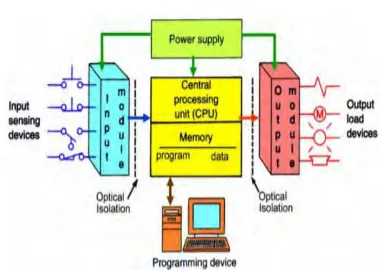
10 different setups. Relays switching under load can bring about undesired arcing between contacts. Arcing forms high temperatures that weld contacts close and cause degradation of the contacts in the relays, bringing in device failure. Substituting relays with PLCs avoids high temperature of contacts. PLCs do have disadvantages. They do not implement well when taking care of difficult data. At the point when dealing data that requires C++ or Visual Basic, computers are the controllers of decision. PLCs also cannot display data well, so external monitors are frequently required. Figure 2.4 illustrates the PLC System.
Figure 2.4: PLC System
11 inputs just conduct power in one direction. Every input has its own return line, and a few inputs connect to one return line rather than a few separate return lines. These common lines are named "COMM." Sensor outputs check the size of the signal given.
A PLC has many “input” terminals, through which it interprets “high” and “low” logical states from sensors and switches. It also has many output terminals, through which it outputs “high” and “low” signals to power lights, solenoids, contactors, small motors, and other devices lending themselves to on/off control. In an effort to make PLCs easy to program, their programming language was designed to resemble ladder logic diagrams. Thus, an industrial electrician or electrical engineer accustomed to reading ladder logic schematics would feel comfortable programming a PLC to perform the same control functions.
PLCs are industrial computers, and as such their input and output signals are typically 120 volts AC, just like the electromechanical control relays they were designed to replace. Although some PLCs have the ability to input and output low-level DC voltage signals of the magnitude used in logic gate circuits, this is the exception and not the rule.