Stability Analysis of the Model-Based Networked
Control System with Unreliable Links
Lanzhi TENG and Peng WEN
Faculty of Engineering and Surveying University of Southern Queensland West Street, Toowoomba, QLD 4350, Australia
{teng,wen}@usq.edu.au
Abstract. This paper studies the system stability of a Model-Based Networked Control System (MB-NCS). In the MS-NCS, the sensors send information through the network to update the model state. The system estimation error is reset when the packets are received. We define the maximum interval between the received packets as the maximum update time (MUT) while assuming the update frequency is constant. In practice, packet drops randomly. In this work, we assume that intervals between the received packets follow Poisson Distribution. The result shows that the system is stable if the expected interval is less than MUT. This result is verified in simulations.
Keywords: Packet Loss Distribution, Model-Based Networked Control System, System Stability, Poisson Packet Drop
1 Introduction
Yook et al [4] used state estimator techniques to reduce the communication volume in a networked control system.
It is important to develop the understanding of how much loss the control system can tolerate before the system becomes unstable. Spencer et al [5] stated that by experiments the assumption of Poisson statistics for the distribution of packet loss is a good approximation. Packet loss should be kept to less than certain rates to avoid loss of synchronization. Montestruque [6] proposed a Model-based NCS, and provided the necessary and sufficient conditions for stability in terms of the update time and the parameters of the plant and its model, assuming that the frequency at which the network updates the state in the controller is constant. Teng et al [7] modeled the unreliable nature of the network links as a stochastic process, and assume that this stochastic process is independent of the system initial condition and the plant model state is updated with the plant state at the time when packet arrives. A model for the model-based NCS is built up and a new system matrix is obtained regarding the intervals between the arrived packets following random distributions. The result shows that the system is stable as long as the system error is reset within the maximum update time. Apparently, it is very conservative.
If the statistical description of the link failure process is given a priori, a problem of interest is to determine the optimal control and estimation policies under the link failure constrains. In the authors’ best knowledge, the packet drop distribution has not been fully investigated. In NCS, we consider the communication between the sensor and the controller or estimator is subject to unpredictable packet loss. We assume that packet drops obey Poisson distribution. This work studied how the packet drops affect on the system stability in terms of random distribution.
This paper is organized as follows. In section 2, system stability is analyzed in the cases where packet drops follow Poisson distribution. In section 3, example is provided to verify our conclusion. Conclusion is drawn in section 4.
2 Paper Preparation
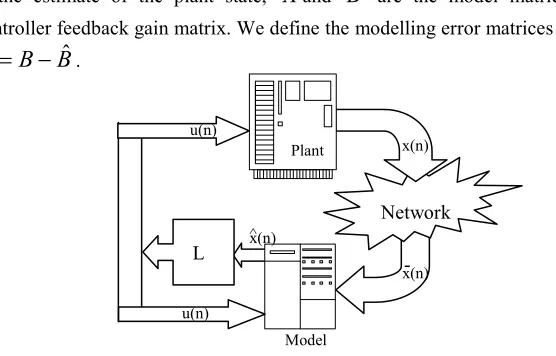
A model-based control system in Fig. 1 is considered. The system dynamics are given by:
Plant:
)
(
)
(
)
1
(
n
Ax
n
Bu
n
x
+
=
+
. (1)Model:
)
(
ˆ
)
(
ˆ
ˆ
)
1
(
ˆ
n
A
x
n
B
u
n
x
+
=
+
. (2)Controller:
)
(
ˆ
)
(
n
L
x
n
where x(n) is the plant state vector, A and B are system parameter matrices,
x
ˆ
(
n
)
is the estimate of the plant state,
A
ˆ
andB
ˆ
are the model matrices, L is thecontroller feedback gain matrix. We define the modelling error matrices
A
~
=
A
−
A
ˆ
,B
B
B
~
=
−
ˆ
.The stochastic process
{ }
γ
n models the unreliable nature of the network links.0
=
n
γ
, when the packet is not received.γ
n=
1
, otherwise.γ
n takes value 0 with small probabilityα
, andγ
n takes value 1 with big probability1
−
α
.α
is aknown constant. We assume that
γ
n is independent of the initial condition, x(0).The vector
x
(
n
)
is current state x(n) if a packet is received.x
(
n
)
=
0
,otherwise. That gives us the following equation:
)
(
)
(
n
x
n
x
=
γ
n . (4)We define the state error as:
)
(
ˆ
)
(
)
(
n
x
n
x
n
e
=
−
. (5)The frequency at which the network updates the state is not constant. We assume that the intervals obey Poisson distribution. The plant model state
x
ˆ
(
n
)
be updatedwith plant’s state
x
(
n
)
, at everyn
k, wheren
k−
n
k=
h
k−1 ,
h
k is the interval between the received packets, k=0, 1, 2, ... Then,e
(
n
k)
=
0
.Now we can write the evolution of the closed loop NCS,
=
+
+
)
(
)
(
)
(
)
1
(
)
1
(
n
e
n
x
A
n
e
n
x
n
γ
. (6)where
Network
L
x(n)
x(n) - Plant
Model u(n)
u(n)
[image:3.595.138.416.176.354.2]x(n) ^
= − + − + = = + − = = 1 , ~ ˆ ~ ~ 0 , ˆ ˆ 0 ) ( 1 0 n n n L B A L B A BL BL A A L B A BL A A A
γ
γ
γ
.(7)
We modeled the system as a set of linear systems, in which the system jumps from one mode representing by
A
0 to another representing by1
A
. We define matrixΛ
as the function of
A
0,1
A
andα
:1
0
(
1
)
A
A
α
α
+
−
=
Λ
. (8)We define
=
)
(
)
(
)
(
n
e
n
x
n
z
, (6) can be represented by)
(
)
1
(
n
z
n
z
+
=
Λ
. (9)Theorem 1: The system described by (8) is globally exponentially stable around
the solution, if the eigenvalues of
Λ
0
0
0
0
0
0
I
I
τare inside the unit circle.
τ
represents the expected interval between the received packets.3 Simulation
To verify our conclusion, a simple control system is used to estimate the system response and test the system stability in case of Poisson packet drops. A full state feedback is given by:
)
(
1
0
)
(
1
0
1
1
)
1
(
n
x
n
u
n
x
+
=
+
.(
1
2
)
ˆ
(
)
)
(
n
x
n
u
=
−
−
.)
(
8578
.
0
4189
.
0
)
(
ˆ
0056
.
1
2410
.
0
6636
.
1
3626
.
1
)
1
(
ˆ
n
x
n
u
n
x
+
−
=
+
. − − = 7100 . 0 0988 . 1 0 0 8258 . 0 9437 . 0 0 0 2 1 1 0 0 0 1 1 0 A and . − − − − = 2900 . 1 0988 . 0 2900 . 0 0988 . 0 8258 . 0 9437 . 0 1742 . 0 0563 . 0 2 1 1 1 0 0 1 1 1 A .
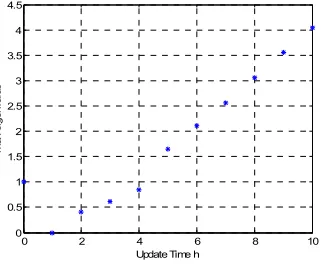
Based on [6-7], assuming that there is no packet dropout and the frequency at which the network updates the state is constant, the magnitude of the maximum
eigenvalues of
Λ
0
0
0
0
0
0
I
I
hagainst update time h as shown in Figure 2. We
define the maximum interval between the received packets as maximum update time (MUT). From Fig. 2 it can be seen that MUT is 4.
0 2 4 6 8 10 0 0.5 1 1.5 2 2.5 3 3.5 4 4.5
Update Time h
M a x e ig e n v a lu e
In this work, we use the same system and assume that packet drops obey Poisson distribution. The system jumps from one mode with h≥MUT, representing by
A
0to another mode with h<MUT, representing by
A
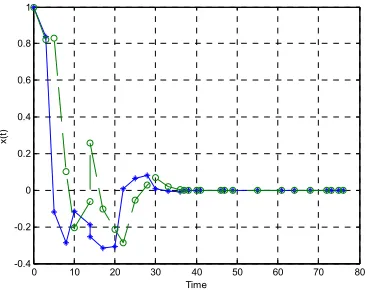
1. [image:5.595.210.371.411.543.2]Fig. 3 shows the plots of the system responses with initial condition
=
0
0
1
1
)
0
(
z
in case the packet intervals are attributed to Poisson Distribution with mean values of
MUT
<
τ
. Using Matlab function poissrnd to generate Poisson random numbers with meanτ
=
3
as follows: 4, 3, 4, 3, 5, 1, 4, 4, 3, 4, 4, 3, 4, 4, 2, 2, 3, 2, 6, 2, 3, 7, 7, 4, 5, 5, 2, 3, 1, 2. From the graphics in Figure 3, it can be seen the system is stable.0 10 20 30 40 50 60 70 80 -0.4
-0.2 0 0.2 0.4 0.6 0.8 1
x
(t
)
Time
4. Conclusion
In this paper, the stability problem in Model-Based Networked Control System (MB-NCS) with unpredictable packet drops has been investigated. In MB-NCS, the sensors send information through the network to update the model state. The system estimation error is reset when the packets are received. We define the maximum interval between the received packets as the maximum update time (MUT) while assuming the update frequency of the model is constant. If the frequency at which the network updates the model state is constant, and the update time is less than MUT, the system is stable. In practice, packet drops randomly. We modeled the unreliable nature of network links as a stochastic process. In our previous work, the system is stable if the model state is updated within MUT. In this work, we assume that packet losses follow Poisson Distribution. The result shows that the system is stable if the expected interval between the received packets is under MUT. This conclusion is demonstrated in examples at the end.
[image:6.595.203.386.289.434.2]References
1. Minrui Fei, Jun Yi, and Huosheng Hu: Robust Stability Analysis of an Uncertain Nonlinear Networked Control System Category. International Journal of Control, Automation, and Systems. Vol. 4, No. 2, pp. 172-177 (Apr. 2006).
2. Johan Nilsson: Real-Time Control Systems with Delays. PhD Thesis, University of Toronto, Canada (2003).
3. Vijay Gupta, Babak Hassibi and Richard M. Murry: Optimal LQG Control across Packet dropping Links. System & Control Letters. Vol 56, pp. 439-446 (June 2007).
4. John K. Yook, Dawn M. Tilbury and Nandit R. Soparkar: Trading Computation for Bandwidth: Reducing Communication in Distributed Control Systems Using State Estimators. IEEE Transactions on Control Systems Technology. Vol 10, No. 4, pp. 503-518 (July 2002).
5. R. Spencer, R. Hughes-jones, A. Mathews and S. O’Toole: Packet Loss in High Data Rate internet Data Transfer for eVLBI. Proceedings of the 7th European VLBI Network Symposium. pp. 261-264 (October 12-15 2004).
6. Luis A. Montestruque: Model-Based Networked Control Systems. PhD Thesis, University of Notre Dame (November 2004).