This is a repository copy of
The role of structure and complexity on Reservoir Computing
quality
.
White Rose Research Online URL for this paper:
http://eprints.whiterose.ac.uk/147383/
Version: Accepted Version
Conference or Workshop Item:
Dale, Matthew, Dewhirst, Jack Daniel, O'Keefe, Simon Edward Marius
orcid.org/0000-0001-5957-2474 et al. (3 more authors) (2019) The role of structure and
complexity on Reservoir Computing quality. In: UCNC 2019, Tokyo, Japan, June 2019,
03-07 Jun 2019.
https://doi.org/10.1007/978-3-030-19311-9_6
[email protected] https://eprints.whiterose.ac.uk/
Reuse
Items deposited in White Rose Research Online are protected by copyright, with all rights reserved unless indicated otherwise. They may be downloaded and/or printed for private study, or other acts as permitted by national copyright laws. The publisher or other rights holders may allow further reproduction and re-use of the full text version. This is indicated by the licence information on the White Rose Research Online record for the item.
Takedown
If you consider content in White Rose Research Online to be in breach of UK law, please notify us by
Reservoir Computing Quality
Matthew Dale1,4, Jack Dewhirst1,4, Simon O’Keefe1,4, Angelika Sebald2,4,
Susan Stepney1,4
, Martin A. Trefzer3,4
1
Department of Computer Science, University of York, UK 3
Department of Chemistry, University of York, UK 3
Department of Electronic Engineering, University of York, UK 4
York Cross-disciplinary Centre for Systems Analysis [email protected]
Abstract. We explore the effect of structure and connection complexity on the dynamical behaviour of Reservoir Computers (RC). At present, considerable effort is taken to design and hand-craft physical reservoir computers. Both structure and physical complexity are often pivotal to task performance, however, assessing their overall importance is challeng-ing. Using a recently proposed framework, we evaluate and compare the dynamical freedom (referring to quality) of neural network structures, as an analogy for physical systems. The results quantify how structure affects the range of behaviours exhibited by these networks. It high-lights that high quality reached by more complex structures is often also achievable in simpler structures with greater network size. Alterna-tively, quality is often improved in smaller networks by adding greater connection complexity. This work demonstrates the benefits of using ab-stract behaviour representation, rather than evaluation through bench-mark tasks, to assess the quality of computing substrates, as the latter typically has biases, and often provides little insight into the complete computing quality of physical systems.
Keywords: Reservoir Computing, Unconventional Computing, Echo State Networks, Structure, Complexity
1
Introduction
Reservoir Computing (RC) [26, 29] is a computational model used to train and exploit an increasingly rich variety of dynamical systems, ranging from virtual neural networks to novel physical systems, such as quantum, electrical, chemical, optical and mechanical (see reviews [20, 28]). Every reservoir system is designed
to harness the underlying dynamics of the substrate it is implemented with,
whether that be a physical device or material, a simulated network, or a set of system equations. However, finding a suitable substrate, or designing one, with sufficient dynamics to compute specific tasks is challenging.
through trial and error. This makes for a long and laborious exercise to determine how best to configure, perturb and alter the low-level design of substrates to improve performance.
In [10] we present an alternative method to assess and compare computing systems based on abstract behaviours of dynamical properties. The idea is to map and explore the full dynamical range of substrates and use this to deter-mine the effects of configuration, perturbation and design alteration on substrate “quality”.
Here we use that method to investigate how topology and structural com-plexity in simulated recurrent networks affect dynamical range and quality. Our hypothesis is that, when implementing these networks, compromises in size and structure lead to similar qualities, e.g., larger networks with simple structure are equivalent to smaller networks with complex structures; therefore, simple structures still exhibit complex behaviours, but require larger network size to do so.
In the reservoir computing literature, simple network topologies and regular structures produce competitive performances to complex networks [24, 25, 30]. Simple structures made from multiple processing units are easy to implement and control in hardware. However, complex structures are more abundant in physical systems, but harder to manipulate. Knowing how structure and size affect quality will provide a useful guide to future substrate designers.
2
Reservoir Computing
Embracing the intrinsic properties of physical systems has the potential to offer improvements in performance, efficiency and/or computational power compared with conventional computing systems [5, 18]. However, to do so requires a model of computation that naturally fits the substrate rather than imposing an inap-propriate model that fights its implementation [27].
The reservoir computing model’s simplicity means that it naturally aligns with many physical systems. However, its simplicity also has drawbacks, for example, it struggles to solve complex tasks requiring high-order abstractions [11, 20].
An input-driven reservoir computer is typically represented and divided into
three layers: the input, thereservoir, and the readout. The reservoir is the
dy-namical system, and perturbed and observed as a black-box. The input and readout depend on the chosen method of encoding and decoding of information to and from the reservoir, and the material instantiation of the encoded infor-mation. Depending on the implementation, this could be discrete or continuous values encoded in electrical, optical, chemical or other signals.
be optimised and configured independently of the input and readout layer. Many techniques have been used to optimise virtual reservoirs [1], and more recently, physical reservoirs [7–9].
To interpret a substrate as a reservoir, we define that the observed
reser-voir statesx(n) form a combination of the substrate’s implicit function and its
discrete observation:
x(n) =Ω(E(Winu(t), uconf ig(t))) (1)
where Ω(n) is the observation of the substrate’s macroscopic behaviour and
E(t) the continuous microscopic substrate function, when driven by the input
u(t). Here, Win symbolises a set of input weights common to all reservoir
sys-tems; this is typically random (see [19], a guide for creating reservoir weights).
The variable uconf ig(t) represents the substrate’s configuration, whether that
be through external control, an input-output mapping, or other method of
con-figuration. Typically, uconf ig(t) is not a function of time, but only of a given
problem. However, switching between different configurations in time could add additional dynamical complexity.
This formalisation of the reservoir states separates the system into contribut-ing parts, includcontribut-ing the observation and configuration method, which as a whole represents the overall reservoir system.
The final output signaly(n) is determined by the readout functiong, on the
observation x(n):
y(n) =g(x(n)) (2)
In Eq.1, we give a simple case where no feedback is applied. To add feedback,
the input variablesy andWf b are added toE(.), whereWf b represents feedback
weights.
Note that E, the intrinsic substrate function, is described as being fixed,
clamped, or set by uconf ig; only g is adapted. However, depending on the
sys-tem, E may change when interacted with or observed, and therefore be
non-deterministic.
3
CHARC Framework
The CHARC (CHAracterisation of Reservoir Computers) framework [10] is used to map and compare the computational expressiveness of computing substrates. In this process, the applied computational model, e.g., encoding, decoding and abstract representation of the system, is also assessed, suggesting whether the chosen model is a suitable fit to the physical implementation.
To characterise the computingquality of substrates, the framework searches
property measure 1 property
measure 2
property
measure 3 abstract behaviour /substrate configuration dynamical boundary P(1) P(2) P(3) assess novelty w.r.t. k-nearest neighbours
P(1) P(2) P(3) voxels generations co ve rag e
1. define behaviour space 2. search the space 3. divide the space 4. measure the space
[image:5.595.138.469.95.212.2](quality)
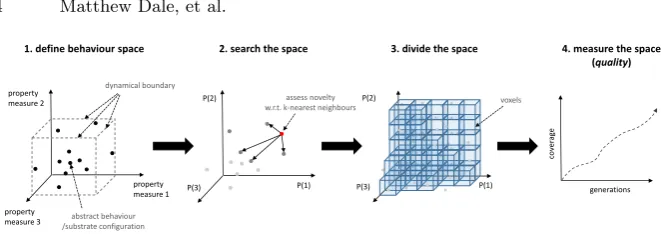
Fig. 1: CHARC framework basic workflow.
In addition to the quality measure, the framework can also be used to model relationships between dynamical behaviour and task performance, which can be used to predict performance across the different substrates, without the need to assess directly [10].
The basic framework is defined in terms of various levels to define and mea-sure quality. The output of lower levels are used by higher levels to model rela-tionships between parameters, dynamics and task performance.
At the base level, the computational model is chosen. The reservoir comput-ing model is applied here: input-driven dynamics recorded as system states and extracted through a trained weighted readout layer. However, other models are
possible. In the context of a model, an abstractbehaviour space is defined. This
space represents the dynamical behaviour of the substrate when configured. This space is typically different from the configuration space, where small changes in parameters result in large changes in behaviour, and vice versa.
To define then-dimensional behaviour space,n independent property
mea-sures are used. Here, we define the same three-dimensional space used in [10], using three metrics measuring basic properties required for reservoir computing:
Kernel Rank (separation property), Generalisation Rank (generalisation
prop-erty), and Memory Capacity (echo state property). An example 3-dimensional
space is shown in step 1 of the CHARC workflow, fig. 1.
Kernel rank (KR) measures the reservoir’s ability to produce a rich
non-linear representation of the input uand its history u(t−1), u(t−2), . . .. This
measures the linear separation property, outlined by Legenstein & Maass [16].
The generalisation rank (GR), proposed at the same time, is a measure of the reservoir’s capability to generalise given similar input streams. Reservoirs in ordered regimes typically have low ranking values in both measures, and in chaotic regimes both are high. In general, a good reservoir should possess a high kernel quality rank and a low generalisation rank [4]. However, in terms of matching reservoir dynamics to tasks, the right balance is less clear.
input driven reservoir must asymptotically wash out any information resulting from initial conditions, i.e., produce a fading memory.
For an outline of how to implement these measures consult [10]. As mentioned there, these three measures by themselves do not capture all the information about the reservoir’s dynamical properties. To improve the accuracy of the model and the quality measure, more independent property measures are required. However, these three measures suffice to demonstrate the use of the framework to evaluate various substrates here.
TheExploration&Mappinglevel defines the search method used to construct the mapping between abstract reservoir and substrate configuration. This is shown as step 2 in fig. 1.
Exploration of the space is done using an adapted implementation of novelty search [17]. Novelty search is an open-ended genetic algorithm that navigates the behaviour space searching for novel solutions, until some user-defined ter-mination criterion is met. Novelty search discovers a wider range of behaviours than does random search; it explores the behaviour space until it reaches the dynamical boundaries of the system. The mapping process can therefore deter-mine the practical use of the substrate, or whether the computational model and configuration method is appropriate.
TheEvaluation level defines the mechanisms to evaluate quality. This con-stitutes the final level for measuring quality. To assess quality, the behaviour
space – representing abstract reservoirx, given configurationy – is divided into
voxels/cells. Step 3 in fig. 1, demonstrates how the behaviour space is divided. Counting how many voxels are occupied by behaviours builds an approxima-tion of the dynamical freedom: how many distinct reservoirs the substrate can instantiate. This acts as the measure of quality to compare across systems.
The maximum quality of a substrate measured in this way is bounded by
number of search evaluations: quality ≤ number of evaluations. For example,
given a 1000 iterations of the evolutionary search, the maximum number of voxels occupied is 1000. The method therefore requires a sufficiently large number of evaluations to get a good measure of quality.
4
Simulated Network Topologies
In [23, 24], it was shown that simple and deterministic connection topologies tend to perform as well as, or better than, standard (fully-connected) randomly-generated reservoir networks on a number of benchmark tasks.
In the experiments described below, we use the CHARC framework to in-vestigate the effect of network topology, by evaluating three simulated recurrent
network topologies:ring,lattice, andfully-connected networks.
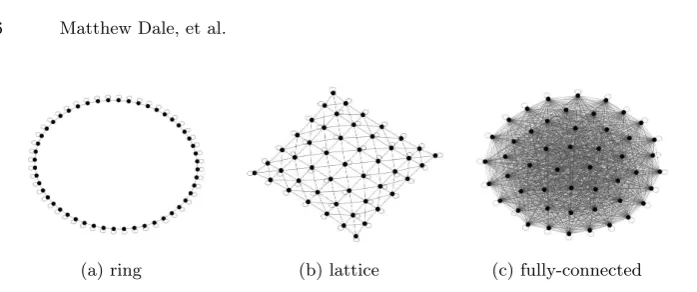
The ring topology (fig.2a) has the least complexity. Each node has a single self-connection and one connection to each of its neighbours to its left and right, resulting in every node having three connections.
(a) ring (b) lattice (c) fully-connected
Fig. 2: Network structures investigated here.
connection types have been applied to reservoir computing systems, including minimum complexity echo state networks (ESN) [24], DNA reservoirs (deoxyri-bozyme oscillators) [12], Cycle reservoirs with regular jumps (CRJ) [23], and delay-based reservoirs using a single non-linear node with a delay line [3, 21].
The lattice topology(fig.2b) has greater connection complexity. Here, we de-fine a square grid of neurons with each connected to its Moore neighbourhood (as commonly used in cellular automata like Conway’s Game of Life [2]). So each node (except for the perimeter nodes) has eight connections to neighbours and one self-connection, resulting in each node having a maximum of nine connec-tions.
Lattice networks/models are common in computational physics, condensed matter physics and beyond, modelling physical interactions, phase transitions and structure [15]. Examples include: discrete lattices like the Ising model with variables representing magnetic dipole moments of atomic spins, and the Gray-Scott reaction-diffusion model to simulate chemical systems [22]. Also, physical substrates often have a regular grid of connections. Lattice networks are therefore more realistic representations of many physical systems that would be considered for reservoir computing.
The fully-connected topology (fig.2c) has the most connections and is con-sidered the most complex. This type of network is challenging to implement in physical hardware. It is typically used in recurrent neural network models, such as echo state networks [13]; however, its biological plausibility is debatable.
In early work on echo state networks (ESN) it was believed these networks of-ten work best when sparsely connected [13, 19], decoupling dynamics into smaller subsystems. However, the reservoir community is still undecided on the actual benefits of sparsity on performance.
Fully-connected networks possess the most parameters (weights) and degrees-of-freedom in the configuration space, but how this translates to dynamical be-haviour is undeveloped.
In the following experiments, each network’s dynamics is given by the state update equation:
where xis the internal state, f is the neuron activation function (a tanh
func-tion),uis the input signal,WinandW are weight matrices giving the connection
weights to inputs and internal neurons respectively. The parameterαis theleak
rate, controlling the time-scale mismatch between the input and reservoir
dy-namics; whenα= 1, the previous states do not leak into the current states.
The final trained output y(t) is given when the reservoir states x(t) are
combined with the trained readout weight matrixWout:
y(t) =Woutx(t) (4)
5
Experiment Parameter Settings
To quantify how network structure affects dynamical behaviour, that is, reservoir
quality, we investigate the three topologies over multiple network sizes and two internal connection types.
These two connection types define whether a connection in the reservoir is
undirected – the weights on a link are the same in both directions, and so the
weight matrix W is symmetric – ordirected – the weight wij from node xi to
xj may be different from the weightwji from nodexj to xi, and so the weight
matrix W is not symmetric. Considering these two connection types provides
additional limits on the complexity of each network. For the fully-connected topology, we investigate only the directed type, making them equivalent to echo state networks.
The network sizes assessed for each topology are: 25, 50, 100, 200 nodes. For
the lattice, these are networks with the nearest square values: 25 (5×5), 49 (7×7),
100 (10×10) and 196 (14×14). By comparing different sizes, we can determine
what relationships exist between network structure and quality independent of size, and therefore whether relationships scale with network size.
Each network has many local (weight) and global (scaling) parameters under manipulation in the novelty search process. Individual weights in the input layer
matrix Win and the reservoir matrix W are mutated between [−1,1]. Global
weight scaling parameters of both matrices are also evolved. ForW scaling this
is a value between [0,2], and for Win scaling between [−1,1]. The leak rate
parameter α, controlling the “leakiness” of past states into current states, is
restricted between [0,1]. Input and internal connectivity, the weight
distribu-tion and sparseness ofWinandW, are evolved by mutating between zero-value
weights and non-zero weights.
The output weight matrixWoutfor each network is used only for the memory
capacity measure, as both KR and GR are calculated using only the reservoir
states. When the readout layerWoutis in use, training is carried out using ridge
regression (see [19] for training details) to minimise the difference between the
network outputy and the target signalyt.
The parameters used for the novelty search algorithm are those used in [10]:
population size= 200,deme= 40,recombination rate = 1,mutation rate = 0.2,
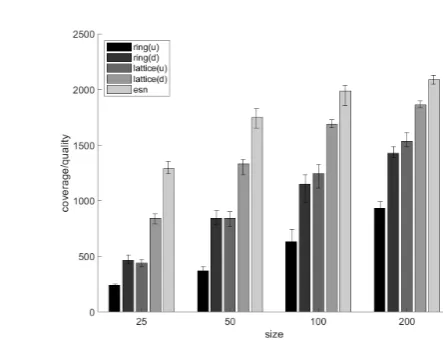
Fig. 3: Behaviour space coverage of all networks.
10 runs are conducted for each network topology, size and connection type, with 2000 generations for each run. In our implementation of novelty search (see [10]), only one new behaviour is possible every generation.
6
Results
6.1 Size and Structure
Here we compare total coverage of the behaviour space, how many voxels are occupied, by each topology. The argument in [10] is that this number represents a measure of substrate quality. The maximum size of the behaviour space in this work is bound by the largest network size to the power of total number of
measures, i.e., total behaviours = 2003
. However, a maximum of 2200 behaviours are possible in a single run here, set by the number of generations and initial population size. Hence the maximum possibly quality is 2200.
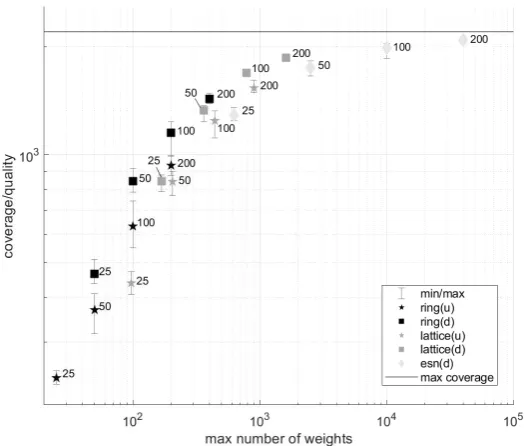
The coverage results (fig. 3) show that the fully-connected (directed) topol-ogy, the ESN network, occupies a greater area of the behaviour space, possessing a higher quality than the others, independent of size. This suggests that access to more adjustable parameters typically leads to more dynamical behaviours.
The larger ESN networks reach close to the maximum possible coverage in every run, suggesting more generations are required to better outline their limits. The others, however, struggle to reach the maximum coverage. This suggests that either new behaviours are more difficult to find, requiring additional search time, or the behavioural limits of the networks are nearly reached. A common pattern across all types is each network tends to improve in quality when increased in size. How many new behaviours are discovered by increasing in size, depends on topology and connection type.
con-(a) 50-neuron
[image:10.595.157.473.124.377.2](b) 200-neuron
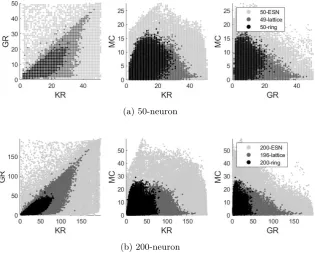
Fig. 4: Superimposed behaviour space of: a) 50-neuron network, b) 200 neuron network. Directed topologies only. Showing all 10 runs of 2000 generations each.
nectivity is more demanding, requiring greater complexity (up to 9 connections per node versus 3 per node), this result suggests a way to get similar dynamical behaviour to an undirected lattice with less connection complexity.
A visualisation of how two network sizes (50 and 200-neuron) cover the be-haviour space using each network topology is given in fig. 4. Here, only the directed topologies are shown; for undirected results, see next section. The plot shows that ESNs tend to occupy regions the others cannot, such as chaotic regions, e.g., with high KR and high GR, and regions with larger memory ca-pacities.
The ring and the lattice topologies have similar maximum memory capacities as each other; however, lattices typically exhibit greater non-linearity and chaotic behaviour (higher KR and GR values) than rings.
6.2 Directed vs. Undirected Networks
(a) 100-neuron ring
[image:11.595.146.476.117.377.2](b) 100-neuron lattice
Fig. 5: Directed vs. Undirected: Superimposed behaviour space of: 100-neuron ring and lattice network. Showing all 10 runs of 2000 generations each.
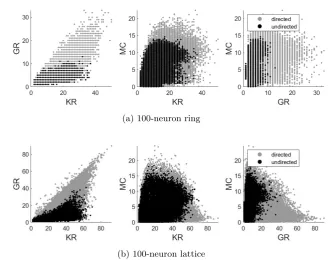
To visualise this, the behaviour space coverage of a 100-neuron ring and lat-tice is shown in fig. 5. Each plot shows the directed connection type (grey) and undirected type (black). Here, directed connections typically result in broader dynamical behaviour, producing more “challenging” behaviours (high KR and high MC). The difficulty in producing such behaviours exists because non-linearity (KR) and ordered dynamics (MC) are often conflicting. The additional freedom of a non-symmetric weight matrix allows a broader set of behaviours to be realised.
6.3 Parameters vs. Quality
The results show the quality of each topology and connection type tends to scale linearly with the maximum number of weights available in each network configuration (fig. 6). Here, the maximum number of weights is used to represent the total freedom in the network’s configuration space. In reality, the actual number of connections – with non-zero weights – required to occupy different regions of the behaviour space may differ significantly.
Fig. 6: The quality (coverage) of all network sizes and structures compare to maximum number of weights available by each network.
(undirected), 100-neuron ring (undirected) and 50-neuron ring (directed) are each limited to roughly 100 weights, yet differ significantly in quality/coverage. The 50-neuron ring (directed), with simpler structure, produces many more be-haviours than the more complex 25-neuron lattice (undirected). This pattern also continues as both increase in network size.
It is also seen that adding more parameters (weights) does not always lead to more dynamical behaviours, e.g., the 50-neuron ring (directed) and 50-neuron lattice (undirected) produce similar qualities despite the lattice having many more available connections. It then becomes clear that how weights are
struc-tured and directed, controlling information flow, has a greater affect on quality
of the network. This supports similar results using hierarchical networks, where structure and number of parameters also significantly impact performance [6].
7
Conclusion
Assessing and comparing how structure affects dynamical behaviour is often challenging. For unconventional substrates, determining what predefined struc-ture and channels of information exist is even more challenging. Even if strucstruc-ture can be decided at creation, what is a suitable or ideal structure is often limited by physical constraints.
recur-rent networks as a model of physical reservoir systems. Our experiments show that networks with low structural complexity can exhibit similar quality and behaviours to more complex structures. However, in almost every case, this is only possible when network size is increased, resulting in a trade-off between size and structure. This result therefore acts as useful guide to the design of new unconventional reservoir computing substrates, where more complex structures tend to be more challenging to implement than simple structures like the ring topology.
Overall, this work showcases one undeveloped area within a much wider chal-lenge: how to better understand the computing properties of substrates. The work demonstrates how the CHARC framework can be used to evaluate changes in design, configuration and representation of unconventional substrates and re-late it to a task-independent measure of computing quality. In future work, we intend to further develop the framework to improve the design and fit of compu-tational models, and even substrate design directly. For example, moving beyond the reservoir computing model, leading to a more generic CHARC framework; using the framework as a test-bed to assess unconventional program constructs; and, using quality as an objective to optimise within the substrate design pro-cess.
Acknowledgments
This work is part of the SpInspired project, funded by EPSRC grant EP/R032823/1. Jack Dewhirst is funded by an EPSRC DTP PhD studentship.
References
1. R. I. Abubakar Bala and, Idris Ismail and and S. M. S. . Applications of
meta-heuristics in reservoir computing techniques: A review. IEEE Access, 2018.
2. A. Adamatzky. Game of life cellular automata, volume 1. Springer, 2010.
3. L. Appeltant, M. C. Soriano, G. Van der Sande, J. Danckaert, S. Massar, J. Dambre, B. Schrauwen, C. R. Mirasso, and I. Fischer. Information
process-ing usprocess-ing a sprocess-ingle dynamical node as complex system. Nature Communications,
2:468, 2011.
4. L. B¨using, B. Schrauwen, and R. Legenstein. Connectivity, dynamics, and memory
in reservoir computing with binary and analog neurons. Neural Computation,
22(5):1272–1311, 2010.
5. J. P. Crutchfield. The calculi of emergence. Physica D, 75(1-3):11–54, 1994.
6. M. Dale. Neuroevolution of hierarchical reservoir computers. InProceedings of the
Genetic and Evolutionary Computation Conference, pages 410–417. ACM, 2018. 7. M. Dale, J. F. Miller, S. Stepney, and M. A. Trefzer. Evolving carbon nanotube
reservoir computers. InInternational Conference on Unconventional Computation
and Natural Computation, pages 49–61. Springer, 2016.
8. M. Dale, J. F. Miller, S. Stepney, and M. A. Trefzer. Reservoir computing in
ma-terio: An evaluation of configuration through evolution. In2016 IEEE Symposium
9. M. Dale, J. F. Miller, S. Stepney, and M. A. Trefzer. Reservoir computing in
mate-rio: A computational framework for in materio computing. In 2017 International
Joint Conference on Neural Networks (IJCNN), pages 2178–2185, May 2017. 10. M. Dale, J. F. Miller, S. Stepney, and M. A. Trefzer. A substrate-independent
framework to characterise reservoir computers. arXiv preprint arXiv:1810.07135,
2018.
11. C. Gallicchio, A. Micheli, and L. Pedrelli. Deep reservoir computing: a critical
experimental analysis. Neurocomputing, 2017.
12. A. Goudarzi, M. R. Lakin, and D. Stefanovic. Dna reservoir computing: A novel
molecular computing approach. InDNA Computing and Molecular Programming,
pages 76–89. Springer, 2013.
13. H. Jaeger. The “echo state” approach to analysing and training recurrent
neu-ral networks-with an erratum note. Bonn, Germany: German National Research
Center for Information Technology GMD Technical Report, 148:34, 2001.
14. H. Jaeger. Short term memory in echo state networks. GMD-Forschungszentrum
Informationstechnik, 2001.
15. D. A. Lavis. Equilibrium statistical mechanics of lattice models. Springer, 2015.
16. R. Legenstein and W. Maass. Edge of chaos and prediction of computational
performance for neural circuit models. Neural Networks, 20(3):323–334, 2007.
17. J. Lehman and K. O. Stanley. Exploiting open-endedness to solve problems through
the search for novelty. InALIFE, pages 329–336, 2008.
18. S. Lloyd. Ultimate physical limits to computation. Nature, 406(6799):1047, 2000.
19. M. Lukoˇseviˇcius. A practical guide to applying echo state networks. In Neural
Networks: Tricks of the Trade, pages 659–686. Springer, 2012.
20. M. Lukoˇseviˇcius and H. Jaeger. Reservoir computing approaches to recurrent
neural network training. Computer Science Review, 3(3):127–149, 2009.
21. Y. Paquot, F. Duport, A. Smerieri, J. Dambre, B. Schrauwen, M. Haelterman, and
S. Massar. Optoelectronic reservoir computing. Scientific Reports, 2, 2012.
22. J. E. Pearson. Complex patterns in a simple system. Science, 261(5118):189–192,
1993.
23. A. Rodan and P. Tiˇno. Simple deterministically constructed recurrent neural
net-works. InInternational Conference on Intelligent Data Engineering and Automated
Learning, pages 267–274. Springer, 2010.
24. A. Rodan and P. Tino. Minimum complexity echo state network. IEEE
Transac-tions on Neural Networks, 22(1):131–144, 2011.
25. A. Rodan and P. Tiˇno. Simple deterministically constructed cycle reservoirs with
regular jumps. Neural computation, 24(7):1822–1852, 2012.
26. B. Schrauwen, D. Verstraeten, and J. Van Campenhout. An overview of reservoir
computing: theory, applications and implementations. In Proceedings of the 15th
European symposium on artificial neural networks. Citeseer, 2007.
27. S. Stepney. The neglected pillar of material computation. Physica D: Nonlinear
Phenomena, 237(9):1157–1164, 2008.
28. G. Tanaka, T. Yamane, J. B. H´eroux, R. Nakane, N. Kanazawa, S. Takeda, H. Nu-mata, D. Nakano, and A. Hirose. Recent advances in physical reservoir computing:
A review. arXiv preprint arXiv:1808.04962, 2018.
29. D. Verstraeten, B. Schrauwen, M. D’Haene, and D. Stroobandt. An experimental
unification of reservoir computing methods.Neural Networks, 20(3):391–403, 2007.
30. Y. Xue, L. Yang, and S. Haykin. Decoupled echo state networks with lateral