Health Economics and
Decision Science
(HEDS)
Discussion Paper
This series is intended to promote discussion and to provide information about work in progress. The views expressed are those of the authors, and therefore should not be quoted without their permission. However, comments are welcome and we ask that they be sent direct to the corresponding author.
of DP of DP
Are we over-estimating the
value of further research? A
review of methods used to
estimate uptake in population
expected value of information
analyses
Sabine Grimm, Simon Dixon, John W Stevens
DP 13/15
School Of
Health
And
Related
HEDS Discussion Paper
No. 13.15
Are we over-estimating the value of further research? A review
of methods used to estimate uptake in population expected
value of information analyses
Sabine Grimm*
,
Simon Dixon*
,
John W Stevens*
*Health Economics and Decision Science, School of Health And Related Research
(ScHARR), University of Sheffield
Disclaimer:
This series is intended to promote discussion and to provide information about work in progress. The views expressed in this series are those of the authors, and should not be quoted without their permission. Comments are welcome, and should be sent to the corresponding author.
Are we over-estimating the value of further research? A review of methods used to
estimate uptake in population expected value of information analyses
Sabine Grimm*, Simon Dixon*, John W Stevens*
*Health Economics and Decision Science, School of Health And Related Research (ScHARR),
University of Sheffield
Corresponding author:
Sabine Grimm
School of Health And Related Research (ScHARR)
University of Sheffield
Room 1.02, Innovation Centre
217 Portobello Rd
Sheffield S1 4DP
Email: [email protected] Phone: 0114 222 6382
Number of tables: 1
Abstract
Background: There is a lack of guidance on how population estimates should be obtained for expected
value of information (EVI) analysis. We argue that disregarding uptake may lead to over-estimation
of the population EVI (PEVI).
Aims: To investigate how population estimates for PEVI analyses were obtained, whether they were
adjusted by uptake and what methods were employed to obtain the uptake estimates.
Methods: A literature search and review was conducted using the NHS Economic Evaluation
Database (EED) and prior knowledge of relevant publications. Publications were excluded when they
did not report PEVI estimates or were duplicates.
Results: Out of 43 records resulting from the CRD search and 3 relevant publications that were known
to us prior to this study, 29 studies were included. Out of these, 27 had not adjusted their population
estimate by uptake levels. The remaining 2 studies had obtained their uptake estimates from uptake
levels reported in trials and based on assumption. Only 5 studies acknowledged uncertainty associated
with the population estimate used.
Conclusion: Based on the result that very few PEVI studies had adjusted their population estimate by
uptake and taking into account the large downward effect that uptake adjustments could have on the
value of PEVI estimates, there is a need for discussion and further research around uptake adjustments
in PEVI analyses.
Keywords
Expected Value of Information, EVI, VOI, Uptake, Implementation, Health Technology Assessment
Background
There is a lack of guidance on how population estimates should be obtained for expected value of
information (EVI) analysis. The EVI is used in economic evaluations to assess the value of reducing
decision uncertainty through further research. To obtain the overall value that can be derived from
research in a health system or society, the EVI is then often aggregated over the population that may
potentially benefit and the time horizon that research may be relevant to, resulting in the population
EVI (PEVI). While there has been some discussion on what time horizon to apply in EVI analyses
(Philips, Claxton et al. 2008), methods of obtaining population estimates are less clear.
We argue here that disregarding uptake may lead to over-estimation of PEVIs. Not all patients will
benefit from research on a new intervention as technology uptake may be low. This has previously
been acknowledged by Fenwick, Claxton et al. (2008). Furthermore, technology implementation is
rarely an instantaneous process resulting in 100% of uptake in the period after research results became
available. A variety of NICE implementation uptake reports suggest that health technologies in the
British National Health Service diffuse gradually over time (see for instance NICE (2010) or NICE
(2009)). Adjusting the PEVI by uptake estimates of static or, ideally, dynamic nature would therefore
result in more realistic estimates of the value of further research.
Complexity is added through the potential inter-dependence between uptake and information. Uptake
may be dependent on the level of information available to adopters and therefore be larger (or
smaller) with perfect information than with less than perfect information. This has been discussed
previously by Hoomans, Fenwick et al. (2009). In such a setting, two uptake estimates or curves
would be needed for current and perfect information.
With this background, the objective of this research was to investigate how population estimates for
EVI analyses were obtained and whether uptake estimates or dynamics were used and what methods
of obtaining them were employed. We therefore conducted a review of PEVI analyses with the
following research questions in mind: how was the population estimate obtained? Was the population
estimate adjusted by uptake? How was the estimate of uptake obtained? Was the issue of uncertainty
associated with the population estimate discussed?
Methods
The search was conducted using the NHS Economic Evaluation Database (EED). Search terms were:
((Value of Information) OR EVI OR VOI). Titles and abstracts were screened and publications
excluded when they did not report PEVI analyses or in the event of duplicates. Full texts of the
included publications were then reviewed according to the research questions. Additional PEVI
analyses that were known to us but did not come up through this small-scale search were also
included.
Results
The NHS CRD search resulted in 43 hits. The titles and abstracts of all results were screened and 10
publications were excluded as no EVI analysis had been performed and another 4 were excluded as no
population EVI had been reported. Another publication was excluded because it resulted from an
analysis already described in another included publication. One publication stated that EVI analysis
had been conducted but did not detail methods or results and instead referenced another publication.
Hence, the former was excluded and the latter included. For 2 other publications, full texts could not
be obtained and they were therefore excluded. Three additional publications with EVI analyses that
had not come up through this search but were known to us from elsewhere were included.
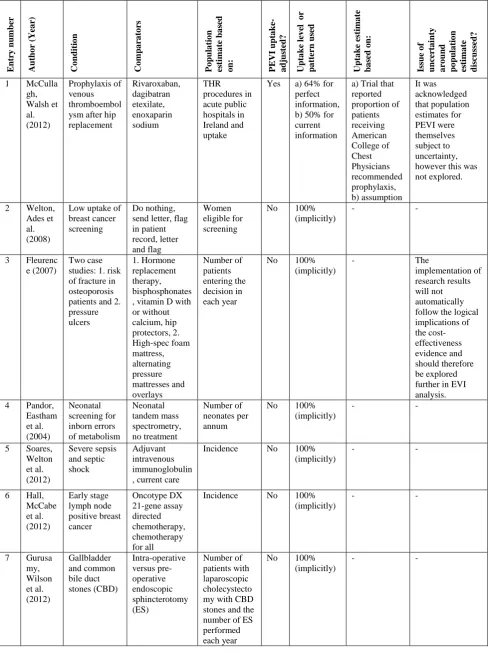
We therefore included a total of 29 publications and examined them with regards to the research
questions. Results are shown in detail in Table 1 in the appendix and are described below.
In 27 out of the included 29 publications, the population size was not adjusted by uptake of the
intervention. In those analyses, the population estimate was mainly obtained through the incidence
and prevalence of the condition or the number of annual procedures. An uptake level of 100% was
implicitly assumed in those cases.
Only 2 studies had adjusted the population estimate by uptake. One of these, on thrombo-prophylaxis
in post-hip replacement patients, acknowledged the dependence of uptake on information and reported
2 different estimates of uptake: one conditional on perfect information and one for current information
(McCullagh, Walsh et al. 2012). The uptake estimate for perfect information was obtained from a trial
that had reported the proportion of patients receiving American College of Chest Physicians
recommended prophylaxis and, for the current information scenario, an assumption was made.
The second study used an uptake estimate which was obtained from a trial that had reported the use of
trastuzumab adjuvant to chemotherapy in early stage breast cancer (Hall, Hulme et al. 2011). Neither
of the two studies had used a dynamic estimate of uptake or accounted for uncertainty associated with
it.
Five studies mentioned the issue of uncertainty associated with the population estimates in their PEVI
analysis; four in their discussion and one implicitly by reporting different PEVI results with varying
population estimates. In 1 of the 5 studies, it was stated that implementation of research results may
not automatically happen after they became available and further exploration of this topic was
recommended. None of the 5 studies, however, fully accounted for uncertainty by modelling the
population estimate probabilistically.
Discussion
Our review has shown that the majority of EVI analyses do not consider uptake adjustments in their
population estimates. The implication is that most reported values for the PEVI are likely to be an
over-estimate of the actual value of further research as low uptake causes the population benefitting
from further research to be smaller than the potentially eligible population.
As the PEVI is viewed as an upper ceiling to the value of further research, assuming an uptake level
of 100% is not wrong per se. It could simply be argued that this reflects the value of further research
in a best-case and full uptake scenario. It should, however, be highlighted that this value might never
be reached due to barriers to implementation. In cases where an uptake level of 100% is unachievable,
potentially due to strong competition or other barriers, ignoring uptake from the PEVI estimate would
result in a drastic over-statement of the value of further research and therefore have the potential to
mislead decision-makers.
With this study, we would like to spark a discussion on the need for adjusting population estimates by
uptake. In the case that research is technology-specific and the level of uptake of that technology is
foreseen to be below 100%, we think it essential to acknowledge this in the development of PEVI
estimates. We also think that further research is needed on how uptake estimates can be obtained to
inform such analyses.
Limitations of this study include the small scope of the search. It is improbable that all PEVI analyses
in health technologies have been captured with the adopted search strategy and there may be further
examples out there that incorporated uptake estimates in their analysis. We do think, however, that
with 27 out of 29 analyses estimating the population without an uptake adjustment and none including
uptake dynamics, our findings are fairly representative of common practice and can be used as the
basis for this discussion.
Further research could include, firstly, a broadening of the review and secondly, exploring and
developing methods to include uptake estimates in PEVI analysis. The former could be achieved by
broadening the search to other databases which would likely lead to inclusion of more EVI analyses.
The inclusion of related methodology papers could also be considered. We do not, however, anticipate
a significant change in results.
As for exploring how to include uptake estimates in PEVI studies, we see two main areas of research.
One is to address the question of how uptake estimates of both, static and dynamic nature, can be
obtained. The two studies in this review that had used uptake estimates had obtained them from
available trials and assumed that this level of uptake would hold throughout the time horizon adopted.
Other ways of obtaining uptake estimates may include modelling future uptake probabilistically, with
probability distributions obtained from using elicitation of expert opinions. As technology
implementation is regarded as a dynamic process, there is further research potential on the way a
dynamic uptake model could be estimated.
More scope for further research is seen in the modelling implications of incorporating uptake into
PEVI analysis. As was highlighted above, uptake levels may depend on information and, for instance,
differ from current to perfect information. It is not unthinkable that, conversely, information may be
dependent on uptake in that further research would only be conducted if patients are using an
intervention. Exploring the modelling of such inter-dependencies between uptake and information
provides potential direction for further research.
In conclusion, we think that based on the result that very few PEVI studies had adjusted their
population estimate by uptake and taking into account the large downward effect that uptake
adjustments could have on the value of PEVI estimates, there is a need for discussion and further
research around uptake adjustments in PEVI analyses.
Appendix
Table 1. Review of PEVI analyses and the role of uptake in population estimates
E nt ry nu m be r A u th o r ( Y ea r) C o ndi ti o n C omp ar at or s P o pul a ti o n es ti m a te b a sed o n: P E V I upt a ke -a dj us te d? U p ta k e l ev el o r p a tt ern u sed U p ta k e es ti m a te ba se d o n: Issu e o f u n cert a in ty a ro un d po pu la ti o n es ti m a te d isc u sse d?
1 McCulla
gh, Walsh et al. (2012) Prophylaxis of venous thromboembol ysm after hip replacement Rivaroxaban, dagibatran etexilate, enoxaparin sodium THR procedures in acute public hospitals in Ireland and uptake
Yes a) 64% for
perfect information, b) 50% for current information
a) Trial that reported proportion of patients receiving American College of Chest Physicians recommended prophylaxis, b) assumption It was acknowledged that population estimates for PEVI were themselves subject to uncertainty, however this was not explored.
2 Welton,
Ades et al. (2008)
Low uptake of breast cancer screening
Do nothing, send letter, flag in patient record, letter and flag Women eligible for screening
No 100%
(implicitly)
- -
3 Fleurenc
e (2007)
Two case studies: 1. risk of fracture in osteoporosis patients and 2. pressure ulcers 1. Hormone replacement therapy, bisphosphonates , vitamin D with or without calcium, hip protectors, 2. High-spec foam mattress, alternating pressure mattresses and overlays Number of patients entering the decision in each year
No 100%
(implicitly)
- The
implementation of research results will not automatically follow the logical implications of the cost-effectiveness evidence and should therefore be explored further in EVI analysis.
4 Pandor,
Eastham et al. (2004) Neonatal screening for inborn errors of metabolism Neonatal tandem mass spectrometry, no treatment Number of neonates per annum
No 100%
(implicitly)
- -
5 Soares,
Welton et al. (2012) Severe sepsis and septic shock Adjuvant intravenous immunoglobulin , current care
Incidence No 100%
(implicitly)
- -
6 Hall,
McCabe et al. (2012) Early stage lymph node positive breast cancer Oncotype DX 21-gene assay directed chemotherapy, chemotherapy for all
Incidence No 100%
(implicitly)
- -
7 Gurusa
my, Wilson et al. (2012) Gallbladder and common bile duct stones (CBD) Intra-operative versus pre-operative endoscopic sphincterotomy (ES) Number of patients with laparoscopic cholecystecto my with CBD stones and the number of ES performed each year
No 100%
(implicitly)
- -
E nt ry nu m be r A u th o r ( Y ea r) C o ndi ti o n C omp ar at or s P o pul a ti o n es ti m a te b a sed o n: P E V I upt a ke -a dj us te d? U p ta k e l ev el o r p a tt ern u sed U p ta k e es ti m a te ba se d o n: Issu e o f u n cert a in ty a ro un d po pu la ti o n es ti m a te d isc u sse d?
8 Pham,
Teague et al. (2011) Pressure ulcers in elderly patients admitted through emergency departments Pressure re-distributing foam mattresses, standard hospital mattresses Elderly admitted emergency department patients in Ontario
No 100%
(implicitly)
- -
9 Purmon
en, Pankalai nen et al. (2011) Human epidermal growth factor Receptor 2 (HER2)-positive early breast cancer Adjuvant trastuzumab, conventional treatment after chemotherapy Number of HER2-positive breast cancer patients
No 100%
(implicitly)
- -
10 Nosyk,
Sharif et al. (2011) Influenza in patients with human immunodefici ency virus Three influenza vaccine dosing strategies, previous dosing strategy Prevalence of HIV positive individuals in Canada
No 100%
(implicitly)
- -
11 Hall, Hulme et al. (2011) Human epidermal growth factor Receptor 2 (HER2)-positive early breast cancer Adjuvant trastuzumab, conventional treatment after chemotherapy Annual incidence of breast cancer and rate of over-expression of HER2 and uptake
Yes 67% Estimates of
use of chemotherapy with adjuvant trastuzumab from a study
-
12 Petrou, Dakin et al. (2010) Otitis media with effusion Topical intranasal steroids, no treatment Number of children potentially eligible based on a trial
No 100%
(implicitly)
- -
13 Wilson,
Gurusa my et al. (2010) Acute cholecystitis Early versus delayed laparoscopic cholecystectom y Number of laparoscopic cholecystecto my per annum
No 100%
(implicitly)
- -
14 Eddama,
Petrou et al. (2010) Pre-term birth in twins Progesterone gel, no treatment Estimated number of twin pregnancies per annum
No 100%
(implicitly)
- -
15 Stevens
on, Scope et al. (2010) Post-natal depression (PND) Group Cognitive Behavioural Therapy, routine care Annual incidence of PND
No 100%
(implicitly)
- -
16 Genders
, Meijboo m et al. (2009) Suspected coronary artery disease Computer-tomographic coronary angiography prior to conventional angiography, conventional coronary angiography
Incidence No 100%
(implicitly)
- -
E nt ry nu m be r A u th o r ( Y ea r) C o ndi ti o n C omp ar at or s P o pul a ti o n es ti m a te b a sed o n: P E V I upt a ke -a dj us te d? U p ta k e l ev el o r p a tt ern u sed U p ta k e es ti m a te ba se d o n: Issu e o f u n cert a in ty a ro un d po pu la ti o n es ti m a te d isc u sse d?
17 Bansbac
k, Ara et al. (2009)
Rheumatoid arthritis (RA)
Statin therapy in addition to conventional treatment, conventional treatment Number of RA patients
No 100%
(implicitly)
- -
18 Ramsey,
Blough et al. (2008)
Emphysema Lung-volume
reduction surgery, medical treatment Number of procedures per annum
No 100%
(implicitly)
- Acknowledged
that there was uncertainty associated with the number of procedures but did not address this in the model.
19 Wailoo,
Sutton et al. (2008)
Influenza Amantadine,
zanamivir, oseltamivir
Influenza attack rate in healthy population and rate of influenza like illness
No 100%
(implicitly)
- Acknowledged
uncertainty associated with the population estimate but did not address this in the model.
20 Singh,
Nosyk et al. (2008) Patients with chest discomfort presenting to emergency department Early Disposition Prediction Rule, standard care Number of individuals presenting to emergency departments with chest discomfort each year
No 100%
(implicitly)
- EVPI was
reported with different levels of incidence; implementation was not discussed.
21 Griebsc
h, Knowle s et al. (2007) Newborn screening for congenital heart defects Clinical examination, pulse oximetry, echocardiograph y Number of newborns
No 100%
(implicitly)
- -
22 Girling, Freeman et al. (2007) End-stage heart failure Left-ventricular assist device implantation vs. optimal medical management Cases of ESHF per annum
No 100%
(implicitly)
- -
23 Colbour
n, Assebur g et al. (2007) Prevention of group B streptococcal and other bacterial infections in early infancy Prenatal screening and treatment strategies UK population
No 100%
(implicitly)
- -
24 Wight,
Chilcott et al. (2003) Preserving kidneys prior to transplantatio n Pulsatile machine perfusion, cold storage Transplant population
No 100%
(implicitly)
- -
25 Mahesw
aran and Barton (2012) Tuberculosis in HIV infected individuals 9 different screening strategies in combination with Isoniazid Preventative Therapy Annual HIV incidence
No 100%
(implicitly)
- -
E nt ry nu m be r A u th o r ( Y ea r) C o ndi ti o n C omp ar at or s P o pul a ti o n es ti m a te b a sed o n: P E V I upt a ke -a dj us te d? U p ta k e l ev el o r p a tt ern u sed U p ta k e es ti m a te ba se d o n: Issu e o f u n cert a in ty a ro un d po pu la ti o n es ti m a te d isc u sse d?
26 McKenn
a, Walker et al. (2012) Post-myocardial infarction (MI) heart failure Eplerenone, spironolactone Prevalence and incidence of post-MI heart failure
No 100%
(implicitly)
- -
27 Mohseni
nejad, van Baal et al. (2013) Prevention of depression Opportunistic screening and contact psychotherapy, no screening Prevalence of subthreshold depression
No 100%
(implicitly)
- -
28 Dallat, Hunter et al. (2013)
Quality of life and
absenteeism from work
Monitoring physical activity at work, not monitoring
All current Northern Ireland employees
No 100%
(implicitly)
- -
29 Murphy,
Fenwick et al. (2013) Severe aortic stenosis Transcatheter aortic valve implantation, medical management Annual number of patients ineligible for surgery
No 100%
(implicitly)
- -
References
Bansback, N., R. Ara, et al. (2009). "Statin Therapy in Rheumatoid Arthritis: A Cost-Effectiveness
and Value-of-Information Analysis." Pharmacoeconomics 27(1): 25-37.
Colbourn, T., C. Asseburg, et al. (2007). "Prenatal screening and treatment strategies to prevent group
B streptococcal and other bacterial infections in early infancy: cost-effectiveness and
expected value of information analyses." Health Technology Assessment 11(29).
Dallat, M., R. Hunter, et al. (2013). "A lesson in business: cost-effectiveness analysis of a novel
financial incentive intervention for increasing physical activity in the workplace." BMC
Public Health 13: 953.
Eddama, O., S. Petrou, et al. (2010). "Study of progesterone for the prevention of preterm birth in
twins (STOPPIT): Findings from a trial-based cost-effectiveness analysis." International
Journal of Technology Assessment in Health Care 26(2): 141-148.
Fenwick, E., K. Claxton, et al. (2008). "The value of implementation and the value of information:
combined and uneven development." Med Decision Making 28(1): 21-32.
Fleurence, R. (2007). "Setting priorities for research: a practical application of 'payback' and expected
value of information." HEALTH ECONOMICS 16(12): 1345-1357.
Genders, T., W. Meijboom, et al. (2009). "CT Coronary Angiography in Patients Suspected of Having
Coronary Artery Disease: Decision Making from Various Perspectives in the Face of
Uncertainty." Radiology 253(3): 734-744.
Girling, A., G. Freeman, et al. (2007). "Modeling payback from research into the efficacy of
left-ventricular assist devices as destination therapy." International Journal of Technology
Assessment in Health Care 23(2): 269-277.
Griebsch, I., R. Knowles, et al. (2007). "Comparing the clinical and economic effects of clinical
examination, pulse oximetry, and echocardiography in newborn screening for congenital heart
defects: A probabilistic cost-effectiveness model and value of information analysis."
International Journal of Technology Assessment in Health Care 23(2): 192-204.
Gurusamy, K., E. Wilson, et al. (2012). "Intra-Operative vs Pre-Operative Endoscopic
Sphincterotomy in Patients with Gallbladder and Common Bile Duct Stones - Cost-Utility
and Value-of-Information Analysis." Applied Health Economics & Health Policy 10(1):
15-29.
Hall, P., C. Hulme, et al. (2011). "Updated Cost-Effectiveness Analysis of Trastuzumab for Early
Breast Cancer: A UK Perspective Considering Duration of Benefit, Long-Term Toxicity and
Pattern of Recurrence." Pharmacoeconomics 29(5): 415-432.
Hall, P., C. McCabe, et al. (2012). "Economic evaluation of genomic test-directed chemotherapy for
early stage lymph-node positive breast cancer." Journal of the National Cancer Institute
104(1).
Hoomans, T., E. Fenwick, et al. (2009). "Value of Information and Value of Implementation:
Application of an Analytic Framework to Inform Resource Allocation Decisions in Metastatic
Hormone-Refractory Prostate Cancer." Value in Health 12(2): 315-324.
Maheswaran, H. and P. Barton (2012) "Intensive case finding and isoniazid preventative therapy in
HIV infected individuals in Africa: economic model and value of information analysis."
PLOS ONE 7.
McCullagh, L., C. Walsh, et al. (2012). "Value-of-information analysis to reduce decision uncertainty
associated with the choice of thromboprophylaxis after total hip replacement in the Irish
health care setting." Pharmacoeconomics 30(10): 941-959.
McKenna, C., S. Walker, et al. (2012). "Cost-effectiveness of aldosterone antagonists for the
treatment of post-myocardial infarction heart failure." Value in Health 15(3): 420-428. Mohseninejad, L., P. van Baal, et al. (2013). "Value of information analysis from a societal
perspective: a case study in prevention of major depression." Value in Health 16(4): 490-497.
Murphy, A., E. Fenwick, et al. (2013). "Transcatheter aortic valve implantation for severe aortic
stenosis: the cost-effectiveness case for inoperable patients in the United Kingdom."
International Journal of Technology Assessment in Health Care 29(1): 12-19.
NICE (2009). NICE implementation uptake report: Capecitabine and oxaliplatin in the adjuvant
treatment of stage III colon cancer, NICE.
NICE (2010). NICE implementation uptake report: Laparoscopic surgery for inguinal hernia repair,
NICE.
Nosyk, B., B. Sharif, et al. (2011). "The Cost-Effectiveness and Value of Information of Three
Influenza Vaccination Dosing Strategies for Individuals with Human Immunodeficiency
Virus." PLoS ONE [Electronic Resource] 6(12).
Pandor, A., J. Eastham, et al. (2004). "Clinical effectiveness and costeffectiveness of neonatal
screening for inborn errors of metabolism using tandem mass spectrometry: a systematic
review." Health Technology Assessment 8(12).
Petrou, S., H. Dakin, et al. (2010). "Cost–Utility Analysis of Topical Intranasal Steroids for Otitis
Media with Effusion Based on Evidence from the GNOMETrial." Value in Health 13(5):
543-551.
Pham, B., L. Teague, et al. (2011). "Early Prevention of Pressure Ulcers Among Elderly Patients
Admitted Through Emergency Departments: A Cost-effectiveness Analysis." Annals of
Emergency Medicine 58(5): 468-478.
Philips, Z., K. Claxton, et al. (2008). "The half-life of truth: What are appropriate time horizons for
research decisions?" Medical Decision Making 28: 287-299.
Purmonen, T., E. Pankalainen, et al. (2011). "Short-course adjuvant trastuzumab therapy in early stage
breast cancer in Finland: Cost-effectiveness and value of information analysis based on the
5-year follow-up results of the inHer Trial." Acta Oncologica 50: 344-352.
Ramsey, S., D. Blough, et al. (2008). "A Forensic Evaluation of the National Emphysema Treatment
Trial Using the Expected Value of Information Approach." Medical Care 46(5): 542-548.
Singh, S., B. Nosyk, et al. (2008). "Value of information of a clinical prediction rule: informing the
efficient use of healthcare and health research resources." International Journal of Technology
Assessment in Health Care 24(1): 112-119.
Soares, M., N. Welton, et al. (2012). An evaluation of the feasibility, cost and value of information of
a multicentre randomised controlled trial of intravenous immunoglobulin for sepsis (severe
sepsis and septic shock): incorporating a systematic review, meta-analysis and value of
information analysis. Health Technology Assessment. N. HTA. 16.
Stevenson, M., A. Scope, et al. (2010). "The Cost-Effectiveness of Group Cognitive Behavioral
Therapy Compared with Routine Primary Care forWomen with Postnatal Depression in the
UK." Value in Health 13(5): 580-584.
Wailoo, A., A. Sutton, et al. (2008). "Cost-Effectiveness and Value of Information Analyses of
Neuraminidase Inhibitors for the Treatment of Influenza." Value in Health 11(2): 160-171.
Welton, N., A. E. Ades, et al. (2008). "Research prioritization based on expected value interventions
to increase uptake of breast cancer screening." J R Statistical Society Series A 171(4): 1. Wight, J., J. Chilcott, et al. (2003). "The clinical and cost-effectiveness of pulsatile machine perfusion
versus cold storage of kidneys for transplantation retrieved from heartbeating and
non-heart-beating donors." Health Technology Assessment 7(25).
Wilson, E., K. Gurusamy, et al. (2010). "Cost–utility and value-of-information analysis of early
versus delayed laparoscopic cholecystectomy for acute cholecystitis." British Journal of
Surgery 97: 210-219.