^.^~ • ^ • i ^ · .
IMd:mn
European
Investment
Bank
In this issue
EIB GLOBAL LOANS FOR SMALL AND MEDIUM-SIZE VENTURES: MORE THAN 1 000 CREDITS TO DATE
— how the system works, who can benefit — breakdown of financing
by country, region and sector
ρ 1-6
HARNESSING GEOTHERMAL ENERGY — THE EIB LENDS FOR NEW POWER STATIONS IN ITALY
ρ 6-7
NEW COMMUNITY
BORROWING AND LENDING INSTRUMENT
NOW OPERATIONAL
Ρ 8
UNIT OF ACCOUNT
ρ 8
2 PLACE DE METZ - LUXEMBOURG
BEI-EIB
1117
JUNE 1979Financing small and medium-sized ventures
1000 credits under EIB global loans
scheme
Over 1 000 ventures have been helped under the European Investment Bank global loans scheme which Is designed principally to promote the establishment or expansion of small and medium-scale Industry in the Community's less-favoured regions.
Via this financing technique, the broadest span of activity has been assisted, ranging from a golf club manufacturer In Scotland and a mush room packer in Belgium to producers of high-technology medical equip ment In Southern Italy. One common denominator is their value In providing jobs in areas with unemployment problems — between them, the number of jobs created or safeguarded is put at roughly 65 000.
Global loans can be described as a partnership, bringing together the ElB's financial resources as an international body with access to the world's capital markets and the operational resources (in terms of man power and direct contacts) of various finance institutions working at regional or national levels.
The EIB makes available a block sum of finance to an institution which, acting as intermediary, then
splits the amount into smaller sub-loans (called "allocations" in the Bank's terminology) for investments chosen from among those submitted by its own clients. The intermediary is responsible for most of the de tailed negotiations and appraisals, but the EIB must give its agreement to each sub-loan.
In this way the EIB can provide finance in quite modest amounts — the bottom 'limit has been cut re cently to 25 000 units of account — which would not be a practical, eco
nomic proposition for the Bank to handle directly because of the groundwork involved.
Since its introduction in 1968 the global loan scheme has come to represent an important branch of EIB activities. By end-1978 a total of 56 global loans worth almost 600 million u.a. had been made to 25 different financing bodies in seven Community Member Countries. The Bank's firm intent is to see the
scheme develop further in the years ahead.
The ElB's broad task under the Treaty of Rome is to assist the Com munity's balanced economic growth and within this role the Bank has always given priority to regional development. These concerns lead directly to an awareness of the importance of smalJ and medium-sized industrial operations.
Balanced economic development depends on both large complexes and smaller-scale units, forming an industrial network made up of pro duction facilities of all sizes and serving different sectors.
Obviously many activities depend upon economy of scale and demand a level of resources — in terms of finance, manpower, technology and research — which only large enter prises can provide.
by smaller, independent firms — play a particularly valuable role as they tend to be engaged in more labour-intensive activities (i.e. creat-ing more jobs for a specific capital outlay — most important in the pre-sent circumstances of high unem-ployment), their diversity widens the spread of economic development, and in general they inject vigour into the economy by stimulating competition and opening up new markets (in some cases also playing a role In introducing new technolo-gies).
Statistics showing clearly the num-ber and relative importance of small and medium-sized enterprises are, nonetheless, difficult to verify. Even the definition of «small or medium-sized» differs considerably from one country to another, and also within the same country.
The Community, however, employs a basic yardstick of what constitutes a small or medium-sized firm, set-ting the top limit at 500 employees; the firm must also be legally and financially independent (siharehol-dings by larger groups not to ex-ceed one third).
* * *
In Its earliest years, the Bank pro-vided loans directly for small and medium-scale industrial ventures but after some time these opera-tions were growing to the point where it would have been difficult to cope with greater numbers in a reasonably economic fashion. It was principal'ly for this reason that the idea of global loans came about, but also in the belief that working in close cooperation with regional or national financing bo-dies, with the greater possibilities open to them through local offices, in terms of direct contacts, market knowledge etc., would enable the EIB to reach a much wider spread of investors, which has been the case. From 1968 (the first global loan) to end-1978, the amount of global loans granted — 595.2 million u.a. — ac-counted for roughly 26% of all EIB lending for production sectors within the Community. This propor-tion rises to roughly 30% for the period 1973-1978 (i.e. relating to the Community of Nine).
At this point it is necessary to make a distinction between the amount of global loans granted to intermediary bodies and the total sum on-lent by them, at any one time.
After a global loan contract has been signed, time is required to select and appraise ventures and to
disburse funds, although this is kept to a minimum.
As at 30 April 1979 the amount dis-bursed from global loans came to 447.9 million u.a., for a total of 975 ventures, (end-April is taken for
statistical convenience, but further credits have since been provided bringing the total number of ventu-res assisted to over 1 000 at time of publication, as mentioned in the Introduction). A further 56.8 million u.a. was outstanding at 30 April 1979 (much of it already earmarked for ventures under appraisal); also funds amounting to 75.4 million u.a. were cancelled from a few earlier global loans where the intermediaries con-cerned did not find the demand envisaged, for reasons beyond their control (e.g. sudden exchange rate movements which discouraged po-tential borrowers from contracting debts in foreign currencies provided by the EIB).
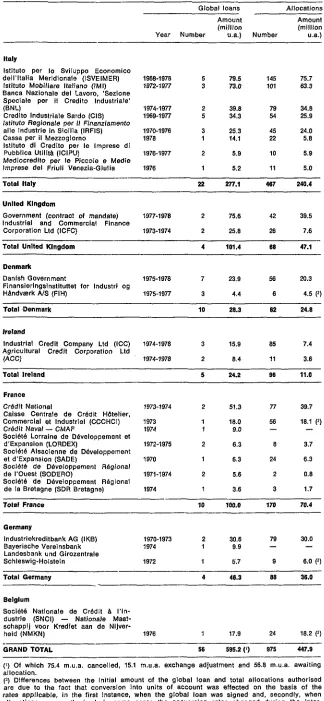
Table 1 shows financing bodies which have received global loans, and the number and amount of allo-cations up to 30 April 1979.
It will be noted that global loans — ranging from 1 million to 45 million u.a. — have been made to a wide variety of bodies. The EIB accepts as intermediaries banks and credit institutions, principally, but also re-gional development institutions and public agencies or, indeed. Member States themselves, which has been the case in Denmark and the United Kingdom.
Some of the intermediaries are large, with considerable assets, and work at a national level; others are somewhat more modest with tasks geared to a specific region or sec-tor. In all cases the EIB must be satisfied that the intermediary is not only sound from financial and mana-gerial points of view, but that it also has the capacity to carry out detail-ed project appraisals.
Eligibility, size of sub-loans In theory, any form of investment which corresponds to the European Investment Bank's tasks under the Treaty of Rome, i.e. financing: — regional development;
— industrial modernisation and con-version;
— projects of common interest to several Member States or the Community as a whole;
would be eligible for finance via global loans.
In practice, however, regional de-velopment acounts for virtually all
global loan financing (investment coming under the other headings normally involves higher amounts, for which there are direct loans). Over 95% by value of allocations from global loans has gone to indus-trial ventures, but under the terms of some global loans it is possible to extend finance to different sec-tors, such as agriculture, tourism and other services (see Table 2 for regional and sectoral breakdown). The possibility also exists for global loans to be made for financing a series of small infrastructure works carried out by public authorities. Applications for finance via global loans are made direct to the inter-mediary body, not to the EIB. The appraisals carried out by the 'intermediary must satisfy the ElB's normal lending criteria concerning e'ligibility, markets for the products in question, technical aspects (in-cluding environmental safeguards), economic benefits, profitability and the soundness of the overall finan-cing plan.
The delay involved in carrying out these appraisals varies case to case and according to the intermediary institutions concerned; for its part the EIB decides on a credit proposal within 30 days, usually much less, after receipt from the Intermediary. Sub-loans may be made for up to 50% of the fixed investment costs within limits (depending on the con-ditions of each global loan) of up to 4 million u.a. or down to 25 000 u.a.; the average amount since 1969 has been about 460 000 u.a.
The interest rate charged by the EIB to the intermediary is calculated according to the Bank's non-profit-making statute, but the rate to the final beneficiary (i.e. the interest charged by the intermediary itself) depends on a number of factors: — the funds are normally on-lent with a margin to compensate the intermediary for its handling costs and the lending risks which it assu-mes (it should be pointed out here that the intermediaries on-lend at their own risk);
— some intermediaries will cover exchange risks, on-lending to their own borrowers in national curren-cies, but the interest rate is calcu-lated to compensate them for pro-viding this facility;
bring down interest rates on credit provided by financial institutions; these may equally be applicable to credit provided from EIB global loans.
Global loans are reserved for assis-ting ventures where the new fixed investment costs for which finance is sought will not exceed 12 million u.a. and where the promoter's total fixed assets do not exceed 30 mil-lion u.a.
Within these general conditions, the EIB gives permanent priority to firms employing less than 500 people with no more than one third of the capital held by a larger company (i.e. com-ing within the Community definition of «small and medium sized», refer-red to earlier). From 1969 to end-1978 76% of global loan allocations by number and 66% by amount went to firms of this kind; their share has been increasing steadily and in 1978 the figures for that year were 90% and 77%, respectively.
The remainder is accounted for by investments Which for one reason or another faH outside the defini-tion (e.g. a modest scale project carried out by a large company or subsidiary). The EIB lends for such investment through global loans because in some regions a stn.<ctural feature is the lack of small local entrepreneurs; to ex-clude other projects by too strict an approach would serve no purpose and only reduce the help that the Bank can provide for regional de-velopment.
In most cases final beneficiaries of credits from global loans are firms which are already known, with a proven track record, but more than one allocation in five has gone to
new enterprises.
One particulariy interesting point, which bears out the importance for the EIB of providing finance of this kind, is the cost per job created: taking the period 1973 - end-1978 ventures financed via global loans provided employment at an invest-ment cost of about 30 000 u.a. per job as against 100 000 u.a. per job in larger scale projects assisted by the EIB with direct loans.
[image:3.584.194.518.67.768.2]Demand for global loans Given the clear value of this kind of financing In terms of balanced regional development and job crea-tion, why not do more? The question Is sometimes put as if it were only a matter of the EIB making available more funds.
Table 1: Global loans granted within the Community from 1968 to 30.4.1979 Breakdown by intermediary institution
Global loans Allocations
Year Number Amount (million U.a.)
Amount
(million
Number u.a.)
Italy
Istituto per lo Sviluppo Economico dell'Italia Meridionale (ISVEIMER)
Istituto Mobiliare Italiano (IMI) Banca Nazionale del Lavoro, 'Sezione Speciale per il Credito Industriale' (BNL)
Credito Industriale Sardo (CIS) Istituto Regionale per II Finanziamento alle Industrie in Sicilia (IRFIS) Cassa per il Mezzogiorno
Istituto dl Credito per le imprese di Pubblica Utilità (ICIPU)
Mediocredito per le Piccole e Medie Imprese del Friuli Venezia-Giulia
1968-1978 1972-1977
1974-1977 1969-1977
1970-1976 1978
1976-1977
1976
5 3
2 5
3 1
2
1
79.5 73.0
39.8 34.3
25.3 14.1
5.9
5.2
145 101
79 54
45 22
10
11
75.7 63.3
34.8 25.9
24.0 5.8
5.9
5.0
T o t a l Italy U n i t e d K i n g d o m
Government (contract ot mandate) Industriai and C o m m e r c i a l Finance C o r p o r a t i o n Ltd (ICFC)
T o t a l U n i t e d K i n g d o m Denmark
Danish Government
Finansieringsinstituttet for Industri og Hândvœrk A/S (FIH)
T o t a l Denmark I r e l a n d
Industrial Credit Company Ltd (ICC) A g r i c u l t u r a l Credit C o r p o r a t i o n Ltd (ACC)
T o t a l I r e l a n d France C r é d i t N a t i o n a l
Caisse Centrale de Crédit Hôtelier, C o m m e r c i a l et Industriel (CCCHCI) C r é d i t Naval — C M A F
S o c i é t é Lorraine de Développement et d ' E x p a n s i o n (LORDEX)
S o c i é t é A l s a c i e n n e de Développement et d ' E x p a n s i o n (SADE)
S o c i é t é d e D é v e l o p p e m e n t Régional de l'Ouest (SODERÒ)
Société de Développement Régional de la Bretagne (SDR Bretagne) T o t a l Frartce
Germany
I n d u s t r i e k r e d i t b a n k AG (1KB) Bayerisctie V e r e i n s b a n k Landesbank und G i r o z e n t r a l e S c h l e s w i g - H o l s t e i n
T o t a l Germany
1977-1978 1973-1974
1975-1978 1975-1977
1974-1978 1974-1978
1973-1974 1973 1974 1972-1975 1970 1971-1974 1974
1970-1973 1974 1972
22
2 2 4
7 3 10
3 2 5
2 1 1 2 1 2 1 10
2 1 1 4
277.1
75.6 25.8 101.4
23.9 4.4 28.3
15.9 8.4 24.2
51.3 18.0 9.0 6.3 6.3 5.6 3.6 100.0
30.6 9.9
ϋ.7
46.3
467
42 26
68
56 6
62
85 11
96
77
56
—
8 24
2 3
170
79
—
9
88
240.4
39.5 7.6
47.1
20.3 4.5 η
24.8
7.4 3.6
11.0
39.7
18.1 (2)
—
3.7 6.3
0.8 1.7
70.4
30.0
—
6.0 Ρ)
36.0
Belgium
Société Nationale de Crédit à l'In-dustrie (SNCI) — Nationale Maat-schappli voor Krediet aan de
Nijver-heid (NMKN) 1976 17.9 24
GRAND TOTAL 56 595.2 C) 975
18.2 (!)
447.9
(1) Of which 75.4 m.u.a. cancelled, 15.1 m.u.a. exchange adjustment and 56.8 m.u.a. awaiting allocation.
While the EIB wants to see the scheme expand, this all depends upon demand
a) from firms themselves, and b) from the intermediary bodies. Fluctuations in the amount of global loans granted (e.g. 109.6 million u.a. in 1973, down to 10.2 million u.a. in 1975 and up again to 99.9 million u.a. in 1978) do not reflect changes in EIB policy but the general econo mic conditions under which the Bank has to work.
Broadly speaking, intermediary ins titutions only come to the EIB when they have Insufficient funds to meet demands made upon them; their approaches will be influenced by a number of factors, such as the gene ral level of industrial investment, the liquidity position on national finan cial markets, interest rates and also by exchange-rate movements which may be a deterrent in seeking a loan paid at least in part in foreign cur rencies.
This said, there are ways in which Member States can and do promote EIB global loans. It is hardly a co incidence that the country where the Bank has most easily pushed for ward its lending in this sphere is Italy, essentially in the Mezzogiorno, where a range of aids exists such as cover for exchange risks and interest subsidies.
Measures have recently been taken in other countries — Ireland and the United Kingdom, for example —to protect borrowers from possible exchange losses, which have had a marked effect on demand for global loan finance.
Last year credit provided from glo bal loans within the Community rose by 25% compared with 1977 to over 72 million u.a, and went to 155 ven tures involvingover 5 000 new jobs and some 550 safeguarded.
In only the first four months of this year — I.e. up to 30 April 1979 — 57.9 million u.a. was on-lent for 139 ventures involving over 5 000 new jobs and the safeguarding of 2 000 more.
Examples of global loans φ Development of the Irish eco nomy calls for a particular effort in the direction of small and medium-sized ventures, which the EIB is doing much to support. Small under takings employing less than 100 people account for about 36% of industriaJ employment in Ireland and 90% of the country's manufacturing firms.
In 1974 the Bank provided a global loan to the Industrial Credit
Corn-Table 2: Allocations from global loans within the Community from 1969 to 30.4.1979
Breakdown by region and sector
REGION Belgium Antwerp Hainauit Liège Limbourg Namur Eastern Flanders Western Flanders Denmark
East of the Great Belt (excluding Copenhagen) West of the Great Belt
Germany
Baden-Württemberg Bavaria
Hessen Lower Saxony North Rhine Westphalia Rhineland Palatinate Schleswig-Holstein France Alsace Aquitaine Auvergne Lower Normandy Burgundy Brittany Centre Champagne-Ardennes Franche-Comté Languedoo-Roussillon Limousin Lorraine Midi-Pyrénées Nord
Pays de la Loire Picardy Poitou-Charentes Rhône-Alpes Ireland Italy Abruzzi Basilicata Calabria Campania Friuli-Venezia Giulia Latium The Marches Molise Apulia Sardinia Sicily Tuscany United Kingdom Scotland North North-West Wales Northern Ireland South-West
Yorkshire and Humberside TOTAL
SECTOR Agriculture Fishing
Mining and quarrying
Metal production and seml-prooessing Construction materials
Woodworking Glass and ceramics Chemicals
Metalworking and mechanical engineering Motor vehicles, transport equipment . Electrical engineering, electronics . . . . Foodstuffs
Textiles and leather Paper and pulp
Rubber and plastics processing . . . . Other industries
Building and civil engineering Tourism Other services TOTAL Number 24 1 5 7 1 1 2 7 62 5 57 88 2 16 15 19 18 8 10 170 27 9 4 2 3 28 2 2 2 2 7 24 18 6 20 2 5 7 96 467 52 5 20 89 11 91 14 10 66 57 49 3 68 18 23 3 17 1 4 2
A m o u n t of a l l o c a t i o n s ( m i l l i o n u.a.)
18.2 0.9 3.2 5.5 0.4 0.8 3.4 4.0 24.8 4.4 20.4 36.0 0.5 4.3 6.0 6.8 8.7 2.9 6.8 70.4 8.3 3.8 3.2 0.6 2.3 11.5 0.7 O.S 0.4 0.6 2.2 13.3 7.9 2.5 7.4 1.1 1.6 2.5 11.0 240.4 27.5 3.2 7.2 47.2 5.0 53.5 8.8 6.5 27.7 27.0 25.4 1.4 47.1 10.4 20.7 1.9 8.0 0.3 3.9 1.9 975 35 4 20 44 70 62 21 53 194 27 56 167 73 48 62 22 8 4 5 447.9 9.3 2.4 10.4 29.9 37.1 19.1 9.7 23.7 83.3 14.6 27.6 74.4 33.9 28.9 28.6 8.6 2.8 1.8 1.8 4.1 0.2 0.7 1.2 0.1 0.2 0.8 0.9 5.5 1.0 4.5 8.0 0.1 1.0 1.3 1.5 1.9 0.7 1.5 15.7 1.9 0.8 0.7 0.1 0.5 2.6 0.1 0.1 0.1 0.1 0.5 3.0 1.8 0.6 1.6 0.2 0.4 0.6 2.5 53.7 6.1 0.7 1.6 10.5 1.1 12.0 2.0 1.5 6.2 6.0 5.7 0.3 10.5 2.3 4.6 0.4 1.8 0.1 0.9 0.4 100.0 2.0 0.5 2.3 6.7 8.3 4.3 2.2 5.3 18.6 3.3 6.2 16.6 7.6 6.4 6.4 1.9 0.6 0.4 0.4
pany Ltd — ICC which was unsuc cessful principal'ly because of the falling exchange value of the Irish pound which made firms reluctant to contract debts in other currencies. Discussions were held with the Irish Government which last year intro duced a new scheme designed to remove this obstacle.
Enterprises with less than 100 employees and fixed assets not ex ceeding £lr 600 000 (approx. 900 000 u.a.) can obtain cover against fluctuations in exchange rates: in effect, the EIB provides funds to ICC in foreign currencies, but they are on-lent in Irish pounds, minimum amount £lr17 000 (25 000 u.a.). The scheme was very quick to take effect: a £lr 2.5 million (3.75 million u.a.) loan was made in June last year, followed by £lr5 million (7.5 million u.a.) in November, followed again by a further £lr5 miiiion (7.5 million u.a.) in May this year. The first two of these loans have already been used or earmarked for over 120 ventures, belonging to a wide variety of industrial sectors and expected to create close on
1 300 jobs.
φ Almost half the total amount of global loans granted within the Community concerns Italy, essen tially the Mezzogiorno, a reflection on the one hand of the extensive regional development problems in the South of Italy, where the EIB has always been very active, and on the other of the impact of state incentives (e.g. exchange risk cover, Interest subsidies) which help to promote the success of EIB global loans.
An example was a global loan for Lit 16 000 million (19.6 million u.a.) made in 1974 to the Sezione Spe ciale per il Credito alle Piccole e Medie Industrie (commonly known as BNL Mediocredito) of the Banca Nazionale del Lavoro. The funds were to be used for financing small and medium-scale ventures in all parts of the Mezzogiorno and in fact went to a total of 39 involving new fixed investment of around Lit 37 000 million (about 43 million u.a. at the time) and some 2 400 new jobs. The funds benefited ventures in most regions of the Mezzogiorno, but with a fairiy heavy concentration in Latium, Apulia, Calabria. Campa nia and Abruzzi. Main sectors were foodstuffs, beverages, and tobacco; metalworking and mechanical engi neering; woodworking; rubber pro cessing.
Outside the Community
Global loans have also come to represent an important sector of the ElB's development finance operations in countries which have signed association or cooperation agreements with the Community. Up to end-May 1979 the Bank had granted from its own resources 165.7 million u.a. in global loans to development banks in Greece, Portugal, Turkey, Jordan and Tunisia and in a number of the African,
Caribbean and Pacific (ACP) countries which have signed the Lomé
Convention: Kenya, Liberia, Malawi. Mauritius, Nigeria, Tanzania, Trinidad & Tobago, and Zambia as well as to a regional bank
cover-ing the Member Countries ofthe Caribbean Community.
In addition, acting as agent for the Member States and the Com-munity, using certain budgetary funds, the EIB has provided various forms of finance on specially soft conditions (total 23.5 million u.a. at end-May 1979) to support the work of development banks in Turkey, Jordan, the Caribbean region. Liberia. Seychelles. Tanzania, Zaire and Zambia.
In many of these countries the development of small and medium-scale enterprises is particulariy important, not only because of
relatively small markets and special needs, but also because they provide scope for development of skilled manpower and local entrepreneurial talent, the base for future growth.
The rationale behind global loans within the Community applies even more strongly to operations in distant countries. Locally establish-ed development finance agencies are the most in tune with market conditions and customs and also able quickly to appreciate the prospects of suitable investments likely to meet the Bank's criteria. One other important point: in providing funds to these development finance agencies the EIB is helping to reinforce the financial/banking sectors in the countries concerned, which is of central importance to their economic development.
When the earthquakes hit the Friuli region of Northern Italy In May and September 1976, one need was finance to help put small and me-dium-sized ventures back onto their feet again.
A number of firms, particularly in the industrial areas of Osoppo and Gemona, were seriously damaged and after the September quakes up to 6 000 people were jobless. Lit 5 000 million (5 mil'lion u.a. at the time) was lent to Mediocredito per le Piccole e Medie Imprese del Friuli - Venezia Giulia which used the funds to cover repairs and also minor extensions in 11 ventures, safeguarding over 820 jobs which existed before the tremors and creating a further 65.
Most of the firms were family busi-nesses. Metalworking and mecha-nical engineering accounted for about two-thirds of the funds.
φ Despite being a highly develop ed and industrialised country, Bel gium still has to cope with imbalan ces at regional level made much worse by structural problems. Provinces the most affected at pre
sent are Liège and Hainauit, where
restructuring of the Walloon iron and steel industry has led to sub-stantial unemployment, and Eastern
and Western Flanders, which de-pend to an appreciable extent on ihe textiles and clothing sectors, now facing difficult market condi-tions.
At the end of 1976 the EIB provided a Bfrs 750 million (17.9 million u.a.) global loan to the Société Nationale de Crédit à l'Industrie (SNCI) — Nationale Maatschappij voor Kre-dieet aan de Nijverheid (NMKN) for small and medium-scaJe ventures in less favoured areas.
The funds were drawn down to finance a total of 24 ventures ex-pected to give rise to 520 new jobs and safeguard a further 1 100 (19 of the ventures were in West Flan-ders, Liège and Hainauit) In a wide variety of industries, ranging from lemonade production to control me-chanisms for transformers.
φ The relatively iow investment cost per job, which generally speak ing is a feature of small and me dium-sized ventures, counts for a lot In trying to combat severe un employment in many regions of the United Kingdom.
to Industria] and Commercial Finan-ce Corporation Ltd — ICFC. The funds were drawn down to finance 24 ventures involving new fixed investment of around 21 million u.a., about 2 260 new jobs and the safe-guarding of over 400 more. Some 50% of the funds went to Scotland, about 30% to Northern England, but sub-loans were also made in South Wales and Northern Ireland.
The EIB provided a further global loan for £10 million (18.7 million u.a. at the time), but most of this credit was unallocated and cancel-led because of the sudden down-ward movement of steriing's ex-change value and reluctance among prospective borrowers to take on debts in foreign currencies; at the
same time there was a temporary slackening in domestic interest rates which further reduced the advantage of seeking EIB funds.
After discussion with the EIB, the UK Government introduced a new scheme in 1977 which has greatly promoted the scope for Bank activity by covering exchange risks.
Legally, this is not a global loan but an agency agreement, although the basic aim and end results are the same: the Department of In-dustry in England, the Scottish Eco-nomic Planning Department, the Welsh Office Industry Department and the Northern Ireland Depart-ment of Commerce act as agents of the EIB in providing loans in the
areas for which they are respon-sible.
The Government not only bears the exchange risks, but also provides the EIB with the necessary security on the loans, in the form of a
gua-rantee.
In December 1977 £20 million (30.6 million u.a. at the time) was made available for financing under this scheme, then a further £30 million (45 million u.a.) in December last year.
By end-April 1979 £26.55 million (39.5 million u.a.) had already been used for 42 sub-loans involving new fixed Investment of around £62.5 million (approx. 93 miiiion u.a.), about 4 350 new jobs and 1415 safeguarded.
EIB expanding finance for energy development ...
Harnessing geothermal energy
Since It began Investment Bank account by the various forms of in the European last three years alone. Financing
operations in 1958 the European had lent over 2 850 million units of end of last year for investment In energy production and transmission Community, half of this sum in the and more than 720 million in 1978 in the energy sector has come to
represent about 35% of the Bank's total operations within the Community since 1973.
Corresponding to the main roles given to the EIB under the Treaty of Rome, these loans have been made for investment furthering regional development or serving the common interest of several Member States or the Community as a whole.
Under the first heading the Bank has helped to finance a number of projects where improved energy supplies were essential as part of the infrastructure support needed to encourage economic growth in areas of the Community with dev-elopment problems (e.g. gas and electricity supply schemes in parts of Southern Italy, Scotland, Britanny, Berlin).
Most of the finance, however, for a total of some 2 400 million u.a.. has been provided either wholly or in part under the second heading (') where «common interest» is seen in terms of investment helping a) to reduce the Community's de-pendence upon oil imports by dev-eloping European energy resources; b) to save energy (e.g. industrial applications of energy-saving pro-cesses, production of insulation ma-terials);
c) to diversify the sources and na-ture of the Community's energy Im-ports to «spread» the dependence and so achieve better supply secu-rity.
Main branches for EIB lending have been gas and oii field development in the British and Danish sectors of the North Sea. the Adriatic and Ionian Seas and on the Italian
main-land; exploiting hydroelectric po-tential and expanding nuclear capa-city.
The Bank has also financed dev-elopment of coal mines in the United Kingdom, the opening up of peat bogs in Ireland (25% of the coun-try's electricity comes from burning peat) and a uranium mine in North-ern Italy.
At the same time, to help push the Community's import dependence away from oil, the Bank has lent substantial sums for construction of trans-European gaslines carrying Dutch natural gas to other Member Countries in the Community, gas-lines across Germany and Austria bringing supplies of Russian gas to the Community, part of the Algeria-Italy gasline and also for develop-ment of the United Kingdom trans-mission system to exploit the dis-coveries of North Sea gas. Loans have also been made for develop-ment of gas and oil resources in the Norwegian sector of the North Sea, again with the aim of achieving a wider spread in the Community's imports.
It has been estimated that, when all completed, the various projects should provide the Community with extra domestic energy production
capacity equivalent to some 55-60 million tons of oil per annum; in ad-dition projects aimed at diversifying energy consumption away from oil, should replace 50 million tons p.a.
* * *
One of the more recent projects financed by the EIB concerned dev-elopment of geothermal energy. A loan of Lit 31 500 million (29.1 mil-lion u.a.) was granted to the Italian electricity authority ENEL — Ente Nazionale per l'Energia Elettrica, to cover half the cost of building five geothermal power stations in Tuscany which will run on steam brought up through well holes drilled to depths down to 2^/2 kni below the earth's surface; they are designed for a net capacity increase of 45 MW, modest enough but equivalent nonetheless to an annual fuel saving of around 65 000 tons of oil.
The electricity will be generated at a cost cheaper than that of conven-tional thermal power stations and there are no adverse effects on the environment as geothermal energy is non-polluting.
known to man. The growing shor-tage of fossil fuels, coupled with the scarcity of untapped hydroelectric potential and uranium have focused renewed attention on this and other alternative energy sources.
Although the earth's geothermal energy resources are very substan-tial, they are readily accessible at relatively few places on the earth's surface — generally, at dislocations of the earth's crust and deep-sea trenches. Thermal energy is releas-ed in the form of hot or molten lava, hot gases of which the com-position varies, and hot water or steam. The amount of potential energy varies greatly according to local conditions, as does the scope for tapping it: although vulcanic magma sources have yet to be ex-ploited, the harnessing of hot water or sources of steam is within pre-sent technological capacities. Cur-rent uses of geothermal energy range from hot water supply and central heating to electricity gene-ration using natural steam.
The increase in temperature bet-ween the surface and the centre of the earth, referred to as the geother-mal gradient, averages 8 - 12° C per 100 m, but at sites where geothermal energy is released, this gradient may be many times greater. Wher-eas In the past, development of this form of energy was incidental to mining activities, interest today fo-cuses entirely on harnessing geo-thermal energy itself.
Particulariy active geothermal areas are known in:
Europe Iceland, Italy, France America California, Mexico Australasia New Zealand Asia Japan, USSR
Progress on tapping resources has so far varied widely, although utili-sation will doubtless be stepped up in the future. To date, only limited use has been made of geothermaJ energy for electricity generation purposes: worid-wide installed ca-pacity of geothermal power stations totals only 1 200 MW, equivalent to the capacity of a modern nuclear power station. Italy boasts over one third of this.
Geothermal sites in Italy are located south of Florence, in Tuscany, and have made a major contribution towards technical progress In gene-rating electricity from naturai steam over the past 60 years.
Geothermal resources in Tuscany
The two most Important sites are at Larderemo (36 km south-west of
Sienna) and Monte Amiate (50 km south-east of Sienna); both are lo-cated in hilly countryside rising to heights up to 1 700 m. The sites are characterised by the presence of natural steam at temperatures of up to 260° C and a maximum pressure of 60 bar.
In 1818, when mining of boron began in the Larderello area C) no use was made of the natural steam released from the earth. After 1903, there was an initial series of modest attempts to harness steam to gene-rate electricity and. In 1913, this led to the construction and commission-ing of the first 0.25 MW turbine set. This was a milestone in converting geothermal energy into electricity; next, the corrosive and abrasive effects of the sand in the steam were overcome; this was followed by further development of the two sites by drilling deep into the earth and, finally, the power stations were substantially uprated.
Over the years, and particulariy after the creation of ENEL in 1962, various types of geothermal power stations were designed, construc-ted, examined and compared, and from these a power station suitable for use under widely differing con-ditions was developed.
Whereas eariy geothermal power stations were built as near as pos-sible to the site of the natural steam emission, it has become current pratice to develop geothermal sites systematically, drilling down to 2 500 m( one test programme pro-vides for depths of 5 000 m). After
Inserting a steel casing, cementing it in place and attaching a slide valve, an overiand. heat-Insulated steam conduit is connected to the drill-hole and transmits steam to the power plant.
More recent power stations under construction have installed capaci-ties of 8 - 15 MW and are chiefly of the condensing type (as are the five financed by the EIB) which operate as follows:
Incoming natural steam (210° C. 8 -10 bar) passes through a 2-stage steam turbine and is condensed in a jet condenser; the condensate, at around 42° C, is pumped to a cooling tower, where the temperature falls to around 30° C, then returned to the condenser. Hence, a special feature of the system is a cooling circuit without recourse to external cooling water, allowing around 20% of the volume of water drawn from underground as steam to be re-turned directly to the earth's sur-face. The remainder escapes into
the atmosphere from the cooling tower.
A synchronous generator coupled to the turbine produces electricity. Where there are large quantities of non-condensable gases (5 - 20%) in the steam, these gases (CO2, H2 .CH4, etc.) can be separated and used for specific purposes. Power stations of this type are very often remote-controlled and conform Increasingly to a standard design; they can be transferred at acceptable cost to another site where this Is necessary to ensure uninterrupted supply of steam.
In assessing the viability of geo-thermal power stations, it is not suf-ficient simply to compare generating costs using natural steam available «free» and conventional fuels: account needs to be taken of the cost of ongoing exploration at the geothermal site concerned and of the overiand steam trasmission net-work.
However, a comparison between geothermal electricity production costs for the plants in Tuscany and the costs for a power station using fossil fueils shows clear advantages in favour of geothermal plant in view of today's fuel prices.
Further development of geothermal energy will depend on:
— tapping resources at greater depths (up to 5 000 m), using con-ventional deep drilling techniques; — greater return or reinjectlon of water at the geothermal sites; — wider use of residual heat for central and green-house heating and hot water supply;
— the introduction of new develop-ment techniques such as the crea-tion of artificial underground ca-verns which could serve as heat ex-changers, transferring heat to water pumped through them (hot dry rock process).
* * *
Being totally independent of the need for fuel, the harnessing of geothermal energy makes a valid contribution to reducing Europe's dependence upon oil imports. By the end of the year, the number of stations in operation at the two geothermal sites in Italy should rise to 20, offering a total installed capa-city of 465 MW, corresponding to some 1.5% of ENEL's overall install-ed capacity and saving fuel equi-valent to over half a million tons of oil per annum.
New Community Instrument
The New Community Borrowing and Lending Instrument (often referred to as NIC or the «Ortoli Facility») Is now operational.
On 14 May the Council of the European Communities gave the go-ahead to the Commission to borrow the equivalent of up to 500 million European units of account (E.U.A.) on national and international capital markets In the name of the European Economic Community; it specified that the funds should be used to make loans for priority investments in infrastructure and the energy sector in accordance with Community objectives.
The Council has determined that loans for infrastructure should cover, in particular, transport, telecommunications, agricultural improvement schemes, water supplies and environmental protection; energy projects should help the Community to attain greater,independence, security or diversification of its energy supplies — specific reference is made to energy-saving and development of alternative energy sources.
The proceeds of individual borrowings by the Commission will be trans-ferred to the EIB. which has been given a management mandate to make the loans on the Community's behalf. The Bank has done considerable preparatory work in anticipation of the Council's decision to enable a smooth start to lending operations.
Projects presented to the Bank for financing are subject to a ruling by the Commission on their eligibility. Otherwise, procedures are virtually iden-tical to those for loans from the ElB's own resources. The Bank will apply the same project appraisal criteria as for its ordinary loans; interest rates and currency conditions will also be generally similar.
It Is envisaged that projects which would justify exceptional Commu-nity support beyond the Bank's own ceiling of 50% of fixed asset costs may be co-financed by both Bank and New Instrument loans, made either at the same time or successively.
* * *
The New Community Borrowing and Lending Instruhient was proposed by the Commission in June 1977 and agreed to in principle by the Council of the European Communities in October last year, after deliberations with the European Pariiament.
It follows the call made by the European Council at its meeting In March 1977 for greater Community action to tackle unemployment, sluggish The idea is that the European Economic Community raise funds for invest-ment and insufficient convergence in national economic performances, ment financing additional to those obtained by the European Investment Bank, the European Coal and Steel Community and the European Atomic Energy Community, i.e. increasing the total capacity to foster economic growth.
The Commission has global authorization to raise up to the equivalent of 1 000 million E.U.A. (of which the 500 million for energy and infrastructure is the first tranche); the Council has decided that after two years, or when 800 million E.U.A. has been used, whichever comes earlier, the scheme's future will be examined.
Requests for New Community Instrument loans may be submitted to the EIB directly, which Is the usual practice for the Bank's operations, through the Commission or through the Government concerned.
Personalia
Mr Douglas J. FONTEIN has been appointed Manager of the ElB's Legal Department, with effect from 1 May 1979. He succeeds Mr J. Nicolaas van den HOUTEN, with the Bank since 1962, who has now reached retirement age; Mr van den Houten is to serve the Bank temporarily as Special Advi-ser to the Management Committee.
Aged 56, Mr Fontein was born at Rotterdam, took his law degree at the Rijksuniversiteit, Leiden, and pursued legal and economics studies in the USA at the Fletcher School of Law and Diplomacy, Massachussetts, and the Georgetown University Law School, Washington D.C.
He joined the Worid Bank in 1949 where he held a number of posts includ-ing Attorney in the Legal Department; Chief, Securities Division, Treasu-rer's Department; Assistant-Director, Europe, Africa and Australasia Depart-ment; Assistant-Director, East Asia and Pacific DepartDepart-ment; Senior Adviser, Legal Department. In November 1978 Mr Fontein came to the European Investment Bank as Deputy Manager of the Legal Department.
Unit of Account
Below are the values in national currencies of the Unit of Account used by the Bank, as at 30 March 1979; these rates are applied the present quarter in preparing financial statements and operational statistics of the Bank:
DM 2.52529 Bfrs 39.9434 £ 0.653132 Lfrs 39.9434 Ffrs 5.80903 Dkr 7.01814 Lit 1 135.45 £lr 0.656495 Fl 2.72291 US $ 1.35172 Statistics summarising Bank acti-vities in terms of units of account have been based on several dif-ferent conversion rates applied since 1958. This, coupled with the effects of price trends, would suggest prudence in interpret-ing the significance of figures which relate to operations ex-tending over many years.
The composition and hence value of the unit of account now used by the EIB is the same as that of the European Unit of Account.
EIB-INFORMATION is published periodically by the European Invest-ment Bank in six different languages (Danish, Dutch, English, French, German and Italian.)
Material which appears in EIB-INFORMATION may be freely repro-duced; an acknowledgement would be appreciated and also a clipping of any article published.
2, Place de Metz—Boîte postale 2005 Luxembourg
tel. 43 5011 — telex 3530 bankeu lu Department for Italy: 38, Via Sardegna, 00187 Rome tel. 4 8 3 6 5 1 - telex 61 11 30 bankeuro
Representative Office in Brussels: 227, Rue de la Loi
B-1040 Brussels
teL 7352138 — telex 21721 bankeu b Liaison Office for the United Kingdom:
23, Queen Anne's Gate, Westminster, London SWIH 9BU tel. 222 2933 — telex 919159 bankeu g Imprimerie de la Cour Victor Buck,
s. è r. /., Luxembourg