City, University of London Institutional Repository
Citation
:
Mamo, J., Farrugia, P., Borg, J., Wodehouse, A., Grierson, H. and Kovacevic, A. ORCID: 0000-0002-8732-2242 (2015). Using engineering design tools in multidisciplinary distributed student teams. In: Kovacevic, A. ORCID: 0000-0002-8732-2242, Bingham, G. and Parkinson, B. (Eds.), Proceedings of the 17th International Conference on Engineering and Product Design Education (E&PDE15), Great Expectations: Design Teaching, Research & Enterprise. (pp. 99-104). Glasgow: The Design Society. ISBN 9781904670629This is the published version of the paper.
This version of the publication may differ from the final published
version.
Permanent repository link:
http://openaccess.city.ac.uk/20578/Link to published version
:
Copyright and reuse:
City Research Online aims to make research
outputs of City, University of London available to a wider audience.
Copyright and Moral Rights remain with the author(s) and/or copyright
holders. URLs from City Research Online may be freely distributed and
linked to.
City Research Online: http://openaccess.city.ac.uk/ [email protected]
EPDE2015/306
1
INTERNATIONAL CONFERENCE ON ENGINEERING AND PRODUCT DESIGN EDUCATION
3 & 4 SEPTEMBER 2015, LOUGHBOROUGH UNIVERSITY, DESIGN SCHOOL, LOUGHBOROUGH, UK
AN APPROACH FOR THE EFFECTIVE UTILISATION OF
ENGINEERING DESIGN TOOLS BY MULTIDISCIPLINARY
STUDENT TEAMS
Mamo J.1, Farrugia P.1, Borg J.C.1, Wodehouse A.2 , Grierson H.2 and Kovacevic A3.
1Concurrent Engineering Research Unit (CERU), Department of Industrial & Manufacturing Engineering, University of Malta 2Department of Design, Manufacture & Engineering
Management, University of Strathclyde, Glasgow, United Kingdom 3School of Mathematics, Computer Science and Engineering, City University London, London, United Kingdom
ABSTRACT
Collaborative design practice is becoming more popular as technology makes it easier to communicate ideas with others that are geographically distant. However, there is a challenge as different engineers use design tools which are familiar to them. These design tools usually differ from each other, and that is where the problem arises. With different design tools, engineers may find it much more difficult to share their ideas as well as making the whole process longer, which is highly undesirable. Each year the University of Malta, City University of London and University of Strathclyde organize a joint collaborative design project, in which engineering with different background and cultures participate. In this paper, the patterns in the use of design tools by students to collaborate with each other are investigated. The main aim will be to suggest an approach, which can easily be utilised by engineering students during collaborative work. The final approach proposed aids in facilitating the collaboration work of the engineering students as well as in promoting collaboration between engineering students.
Keywords: design collaboration, social media, collaborative design, student projects
1 Problem Background
In engineering, collaborative design is usually a double-edged sword. While it is indispensable for engineers who must work together to complete a design problem, it can also be the main setback in the process. If the engineers select the improper design tool, the outcome can be very disappointing, as the desired goals will not be reached [1]. Another challenge that usually arises in design teams is the way that the work is distributed among the designers. To distribute the workload in the most efficient way possible, the project manager or team leader must have some previous experience with the team. Unfortunately, this is not always achievable and thus the project cannot be carried out in the most economical way [2].
It is widely accepted amongst engineering lecturers and educators that collaborative team exercises or projects greatly encourage innovative ideas [3,4]. Studies suggest that globalisation is progressing rapidly [3,4] and hence it is highly beneficial for engineering students to take part in collaborative exercises [5]. These types of exercises and projects are becoming more popular and students are being introduced to firsthand design projects at an early stage [5].
The advantage of online communication technology was highlighted in previous studies. For instance,
EPDE2015/306
2
objective of this paper is therefore to propose an effective design method which can be used in a dynamic design environment, as well as to suggest the most efficient use of online communication tools that can be utilised by engineering design students to collaborate with each other.
2 Methodology
In a multidisciplinary design project organised by the University of Malta, City University of London
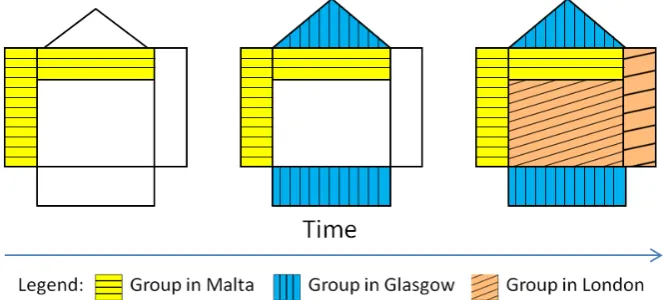
and University of Strathclyde groups of students were formed from each of these universities. This project is known as the Global Design Exercise (GDE). Every group consisted of students from at least two of the universities mentioned above. The students had the opportunity to get hands on experience of collaborative design in engineering, as this project simulated a real design environment with weekly deadlines and two presentations. The nationality of the students varied and thus each team had a mixture of different mentalities, cultures and ideas. The task given to the students was to design an innovative airplane tray table [9]. This exercise posed a challenge because not only had the students never worked together but also they had different working methods to tackle the design problem. After all the students finished the GDE successfully, a survey was conducted to investigate the preferred methods of collaboration, in particular to use and complete design tools relevant to different activities of the basic design cycle. A sample of students that participated in the GDE in previous years, were also included, to see if the preferred methods of collaboration changed in the past few years due to a constant increase of usage of social media and online communication [10]. The main aim of the survey was to find out which online means of communication were used by the students to complete the design tools and design activities as well as to investigate the procedure used by the students to complete each of these tools and activities. For instance, Figure 1 illustrates schematically one of the methods used by the distributed team members to complete the QFD. This was done in order to study which means of online communication the students found out to be most useful for each of the design tools and activities. The procedure used by the students to use each design tool was also examined, as this can vary from one design tool to another.
3 Results
From the forty-two surveys sent, fifteen replied. From these replies, seven were from the University of Malta, seven from the University of Strathclyde and one from City University London. Although not all the students responded, most of the replies were from different teams. In this section, the results of each question will be analysed both analytically as well as statistically by performing a Chi-Square
test for each set of data (a significance level of was taken for all Chi-Square calculations).
[image:3.595.128.461.439.589.2]The aim is to investigate the relationship, first between the means of communication and the design tools, and secondly between the procedures used by the students to complete the various design tools. The first set of questions asked the participants about the communication means used to complete the
EPDE2015/306
3
design tools. For the results collected in the first question (see Table 1) the p-value was 0.383, which means that that there is no significant relationship between the types of problem analysis tools (including the Quality Function Deployment and the Product Design Specification) and means of communication used. The most common means of communication used for the problem analysis tools were Facebook and Skype as they were used by over 60% of the students at this part of the design cycle. The reason for this may be due to the highly versatile nature of these online social media. Skype
is a very powerful and useful tool when it comes to collaboration as the students can interact with each other audio-visually [11]. By using this software, students can convey their ideas better through gesture and improved way of conversation, both of which are an essential part of a design process [5].
Facebook is also a very dynamic social media tool, where each team in the design exercise formed a
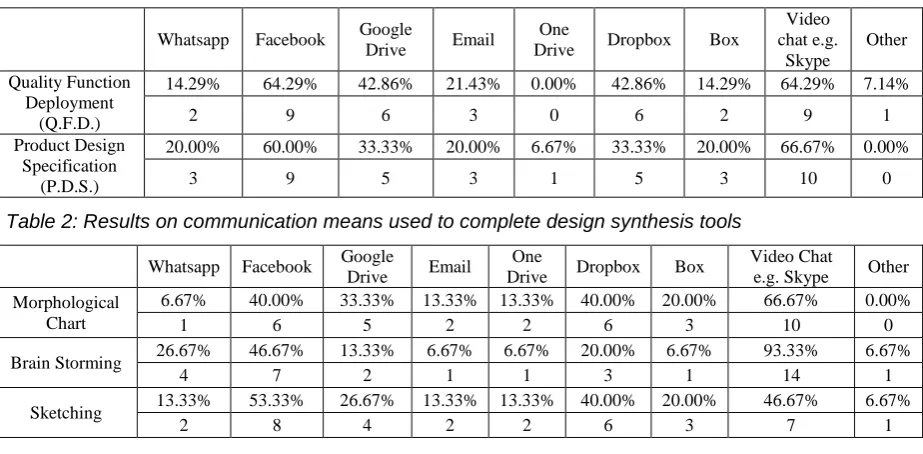
Facebook group and students could share their ideas there. It also facilitates messaging, as the participants could post an idea and receive feedback from the rest of the team. Instant messages are also appealing as they cater for the fast upload of photos, hence if a sketch was done, a photo can be taken and uploaded on the Facebook group or sent as a message to the members in a matter of seconds. The second question treated design synthesis tools (see results in Table 2, p-value = 0.86). For these design synthesis tools Facebook was used as well, but Skype was the most popular. For brainstorming 93.33% of the participants used Skype to communicate their ideas. Dropbox was also used significantly to complete the morphological chart and for sketching. Cloud storage (such as
Dropbox and Google Drive) was useful during this stage as the original chart can be uploaded on this cloud storage and each team member can edit and add ideas to the same chart, instead of having multiple files.
Table 1: Results on communication means used to complete problem analysis tools
Whatsapp Facebook Google
Drive Email
One
Drive Dropbox Box
Video chat e.g. Skype Other Quality Function Deployment (Q.F.D.)
14.29% 64.29% 42.86% 21.43% 0.00% 42.86% 14.29% 64.29% 7.14%
2 9 6 3 0 6 2 9 1
Product Design Specification
(P.D.S.)
20.00% 60.00% 33.33% 20.00% 6.67% 33.33% 20.00% 66.67% 0.00%
[image:4.595.68.530.382.609.2]3 9 5 3 1 5 3 10 0
Table 2: Results on communication means used to complete design synthesis tools
Whatsapp Facebook Google
Drive Email
One
Drive Dropbox Box
Video Chat
e.g. Skype Other Morphological
Chart
6.67% 40.00% 33.33% 13.33% 13.33% 40.00% 20.00% 66.67% 0.00%
1 6 5 2 2 6 3 10 0
Brain Storming 26.67% 46.67% 13.33% 6.67% 6.67% 20.00% 6.67% 93.33% 6.67%
4 7 2 1 1 3 1 14 1
Sketching 13.33% 53.33% 26.67% 13.33% 13.33% 40.00% 20.00% 46.67% 6.67%
2 8 4 2 2 6 3 7 1
EPDE2015/306
4
[image:5.595.151.452.711.836.2]a single person from the team to work on the CAD model. After an analytical approach to the gathered data, the Chi-Square test was carried out for each table. The p-values for the data gathered on the procedures used to complete problem analysis and problem synthesis tools was 0.716 and 0.161 respectively, hence no level of significance resulted between the procedure and the design tools being used. On the other hand, when the Chi-Square test was carried out for the results presented in Table 3, the p-value was found out to be . This means that there is a level of significance between the procedure used and the design tool. The two most common and widely used procedures were those that involved either the local team working together or else the whole team working simultaneously. The communication means used by the students in the 2014 project were compared with those used by the students in 2010. No significant difference was found, a very valid reason may be that online tools such as Skype and Facebook were already widely used by most stdents.
Table 3: Results on the procedures followed to complete evaluation tools
One member in a team does all
the work
Members in the same local team (e.g. Malta) work
together simultaneously
In steps, one person
at a time (same local
team)
In steps, one person at a time from the
distributed team (e.g. one
from Malta, one
from UK)
Members in the distributed team work together simultaneously Other CAD Modelling
60.00% 26.67% 13.33% 6.67% 6.67% 0.00%
9 4 2 1 1 0
DFX 8.33% 66.67% 16.67% 16.67% 8.33% 0.00%
1 8 2 2 1 0
Screening Matrix
0.00% 57.14% 0.00% 14.29% 50.00% 0.00%
0 8 0 2 7 0
Scoring Matrix 0.00% 57.14% 0.00% 14.29% 42.86% 0.00%
0 8 0 2 6 0
Decision Matrix
7.14% 50.00% 0.00% 21.43% 50.00% 0.00%
1 7 0 3 7 0
EPDE2015/306
5
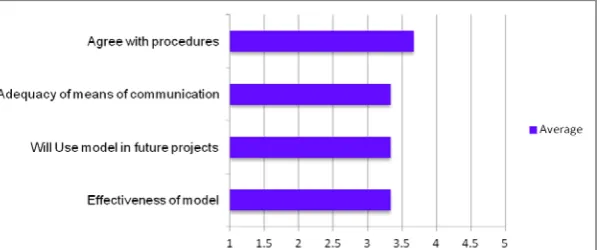
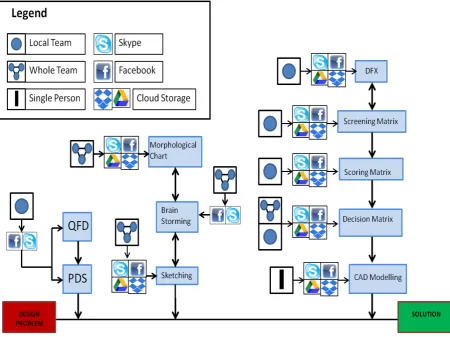
From the student’s feedback, these three stages are the most important stages that the whole group should meet together using online video calls (for the case of GDE) and decide on a final solution as a team. The bar graph in Figure 2 represents the rating given by the students to the pictorial model that was created. Overall, the average rating of the model for each criterion was 3.42. Based on the indicative results obtained in this study, an approach for the effective utilisation of engineering design tools by multidisciplinary student teams is proposed, as illustrated in Figure 3.
4 Conclusions
[image:6.595.72.523.268.605.2]This paper has investigated the patterns in the use of design tools by students in engineering design to collaborate with each other. The main contribution of this paper consists of the approach depicted in Figure 3. It provides a roadmap for engineering design students to use the design tools together with communication tools at different stages of the design process in a collaborative working environment.
EPDE2015/306
6
Such an approach contributes to facilitate collaborative design exercises between students. The usefulness of such an approach was further enhanced by including some of the suggestions made by the students in the focus group. Given the small sample size, future work is required to test the validity of the approach by conducting a comparative study.
References
[1] Lopez-Mesa B. , Thompson G. 2003. Exploring the need for an interactive software tool for the appropriate selection of design methods. In: ICED (International Conference on Engineering Design), 19-21 August 2003, Stockholm. Sweden: Luela University of Technology. ICED03-1118.
[2] Coates G. ,Duffy A.H.B. , Whitfield R.I. , Hills W. A Methodology for prospective operational design co-ordination. In: ICED (International Conference on Engineering Design), 19-21 August 2003, Stockholm. Newcastle: University of Newcastle, ICED03-1147.
[3] Siddique Z. 2012. Beyond hands-on-learning-fostering creativity in student competitive teams. In:
International Design Engineering Technical Conferences & Computers and Information in Engineering Conference IDET/CIE 2012, 12-15 August 2012, Chicago. Oklahoma: University of Oklahoma, DETC2012-71021.
[4] Hurdelbrink K. , Doyle B. , Collins D. , Evans N.N. , Hatch P.A. , Ingram T. , Kucinskas J.W. , Moorhead-Rosenberg Z. and Siddique,Z. 2011. Enhancing Experiential Learning in Collaborative-Competitive Student Design Teams. In: International Design Engineering Technical Conferences & Computers and Information in Engineering Conference IDET/CIE 2011, 28-31 August 2011,
Washington, DC. Oklahoma: University of Oklahoma. DETC2011-48648.
[5] Wodehouse A. , Farrugia P. and Grierson H. and Borg J.C. 2013. Sharing digital sketch work for distributed concept design. In: 19th International Conference on Engineering Design (ICED13), Seoul, South Korea, ICED13/132.
[6]
Moore J.P. , Williams C.B. , Paretti M.C. 2011.Using Wikis as a Formative Assessment
Tool for Student Engineering Design Teams. In: :
International Design Engineering
Technical Conferences & Computers and Information in Engineering Conference IDET/CIE
2011, 28-31 August 2011,
Washington, DC. Virginia: Virginia Polytechnic Institute & State
University. DETC2011-48310.
[7] Ernst Eder W. 2010. Case Study in Systematic Design Engineering – Trapeze
Demonstration Rig. In:
International Design Engineering Technical Conferences &
Computers and Information in Engineering Conference IDET/CIE 2010, 15-18 August 2010,
Quebec. Ontario: Royal Military College of Canada. DETC2010-28065.
[8]