This is a repository copy of Prioritisation of pharmaceuticals based on risks to aquatic environments in Kazakhstan.
White Rose Research Online URL for this paper: http://eprints.whiterose.ac.uk/112601/
Version: Accepted Version
Article:
Aubakirova, Bakhyt, Beisenova, Raikhan and Boxall, Alistair B A
orcid.org/0000-0003-3823-7516 (2017) Prioritisation of pharmaceuticals based on risks to aquatic environments in Kazakhstan. Integrated Environmental Assessment and
Management. ISSN 1551-3793 https://doi.org/10.1002/ieam.1895
[email protected] https://eprints.whiterose.ac.uk/
Reuse
Items deposited in White Rose Research Online are protected by copyright, with all rights reserved unless indicated otherwise. They may be downloaded and/or printed for private study, or other acts as permitted by national copyright laws. The publisher or other rights holders may allow further reproduction and re-use of the full text version. This is indicated by the licence information on the White Rose Research Online record for the item.
Takedown
If you consider content in White Rose Research Online to be in breach of UK law, please notify us by
Prioritisation of Pharmaceuticals Based on Risks to Aquatic Environments in
Kazakhstan
Running head: Prioritisation of Pharmaceuticals in Kazakhstan
Bakhyt Aubakirova†,‡, Raikhan Beisenova†, Alistair B A Boxall‡*
†
L.N. Gumilyov Eurasian National University, Astana, Kazakhstan
‡
Environment Department, University of York, Heslington, York, YO10 5NG,
UK, +44(0)1904 324791
* To whom correspondence may be addressed
Contact information:
ABSTRACT
1
Over the last 20 years, there has been increasing interest in the occurrence, fate,
2
effects and risk of pharmaceuticals in the natural environment. However, we still have
3
only limited or no data on ecotoxicological risks of many of the active pharmaceutical
4
ingredients (APIs) currently in use. This is partly due to the fact that the environmental
5
assessment of an API is an expensive, time-consuming and complicated process.
6
Prioritisation methodologies, that aim to identify APIs of most concern in a particular
7
situation, could therefore be invaluable in focusing experimental work on APIs that really
8
matter. The majority of approaches for prioritising APIs require annual pharmaceutical
9
usage data. These methods cannot therefore be applied to countries, such as Kazakhstan,
10
which have very limited data on API usage. This paper therefore presents an approach for
11
prioritising APIs in surface waters in information-poor regions such as Kazakhstan.
12
Initially data were collected on the number of products and active ingredients for different
13
therapeutic classes in use in Kazakhstan and on the typical doses. These data were then
14
used alongside simple exposure modelling approaches to estimate exposure indices for
15
active ingredients (about 240 APIs) in surface waters in the country. Ecotoxicological
16
effects data were obtained from the literature or predicted. Risk quotients were then
17
calculated for each pharmaceutical based on the exposure and the substances ranked in
18
order of risk quotient. Highest exposure indices were obtained for benzylpenicillin,
19
metronidazole, sulbactam, ceftriaxone and sulfamethoxazole. The highest risk was
20
estimated for amoxicillin, clarithromycin, azithromycin, ketoconazole and
21
benzylpenicillin. In the future, the approach could be employed in other regions where
22
usage information are limited.
23
Key words: active pharmaceutical ingredients, ecotoxicity, Kazakhstan, exposure,
24
environmental risk
INTRODUCTION
26
Active pharmaceuticals ingredients (APIs) can be released to the aquatic
27
environment during their manufacture, following use and as a result of disposal (Boxall et
28
al. 2003). The major pathway is thought to be through excretion to the sewage system
29
where they are then transported to wastewater treatment plants (WWTPs) (Boxall et al.
30
2012). As many APIs are resistant to treatment in WWTPs, they are ultimately released in
31
WWTP effluents into surface waters. A range of APIs has been detected in surface waters
32
and wastewater effluents in several regions of the globe, including the Arctic (Besse et al.
33
2008; Brausch and Rand 2011). Around 160 different APIs have been detected in the
34
aquatic environment with the most common classes being detected belonging to the
35
antibiotic, analgesic, painkiller and cardiovascular drug families (Kummerer 2010).
36
A wide range of effects of pharmaceuticals on aquatic organisms have been reported
37
(Hegelund et al. 2004; Porsbring et al. 2009; Shi et al. 2012). Chronic toxicity studies have
38
shown effects at low concentrations in fish, invertebrates, algae and bacteria. For example,
39
diclofenac has been reported to have adverse histological impacts on kidney and gills of
40
rainbow trout at concentrations of 5 µg/L in 28 days (Schwaiger et al. 2004).
41
Acetaminophen, venlafaxaine, carbamazepine and gemfibrozil at concentrations of 10
42
g/L 0,5 g/L and 10 g/L respectively, had an adverse reproductive impacts, inducing
43
reproduction and changing kidney proximal tubule morphology (Galus et al. 2013).
44
Concentrations of propranolol and fluoxetine seen in effluents have been shown to affect
45
reproduction in aquatic organisms and the nervous system in fish (Kummerer 2010).
46
While a wealth of data is now available on the occurrence, fate and effects of APIs
47
in the natural environment, the knowledge of the risk of pharmaceuticals in water is still
48
limited. One of the major challenges is that while over 1500 APIs are in use, we only have
49
data on the environmental risks of a few of these (Berninger et al. 2016). Therefore,
approaches are needed that cut down the number of pharmaceuticals to be studied in order
51
to focus on substances that are likely to pose the greatest risk and and for which
52
environmental risk should therefore be established using experimental testing (Besse et al.
53
2008; Guo et al. 2016).
54
Prioritization methods provide an approach to help to focus research on APIs that
55
really matter (Roos et al. 2012). A variety of approaches have therefore been proposed and
56
applied for ranking of activated pharmaceutical ingredients (APIs). Mostly these
57
approaches cover areas of Western Europe and North America (Besse et al. 2008; Roos et
58
al. 2012; Guo et al. 2016). Typically, these approaches use information on API usage to
59
assess likely exposure concentrations and compare these to predictions of potential
60
toxicity. However, only a few studies have prioritised APIs in other regions of the world
61
such as Eastern Europe, Africa and South America (e.g. Al-Khazrajy and Boxall 2016).
62
Prioritization of pharmaceuticals in these regions is more challenging as information on
63
API usage is either limited or non-existent for many of these regions.
64
It is however important to understand the risks of drugs in the environment in these
65
other unstudied regions. For example, in Kazakhstan, the focus of this study, the
66
pharmaceutical market in the country is rapidly growing, and in 2012 more than 500
67
million packages of drugs were sold in the country corresponding to an average of 32
68
packages per person per year (Tashenov and Cherednichenko 2013). Medical substances
69
are readily available in Kazakhstan with most of them being freely available for purchase
70
over the counter. According to the Ministry of Healthcare and Social Development of the
71
Republic of Kazakhstan, there are 7713 registered medications and approximately 24% of
72
these are available without a prescription (MHSD 2016). Wastewater treatment systems in
73
Kazakhstan are also old and employ old technologies so the treatment may not be as
74
effective in removing APIs as in western countries. Consequently, emissions of
pharmaceuticals to the natural environment in Kazakhstan are expected to be high and
76
impacts could be greater than elsewhere in the World.
77
The aim of this study was therefore to develop an approach for prioritizing
78
pharmaceuticals in surface water in regions with limited data and to apply the approach to
79
identify APIs in use in Kazakhstan that require further scrutiny in terms of the assessment
80
of their potential risks to the aquatic environment of Kazakhstan.
81
METHODS
82
The study aimed to identify those APIs most likely to lead to environmental impacts
83
in Kazakhstan. The overall approach to prioritisation is illustrated in Figure 1. The
84
approach was designed to consider potential for impacts of apical endpoints (mortality,
85
growth and reproduction) in aquatic systems in Kazakhstan as well as impacts on possible
86
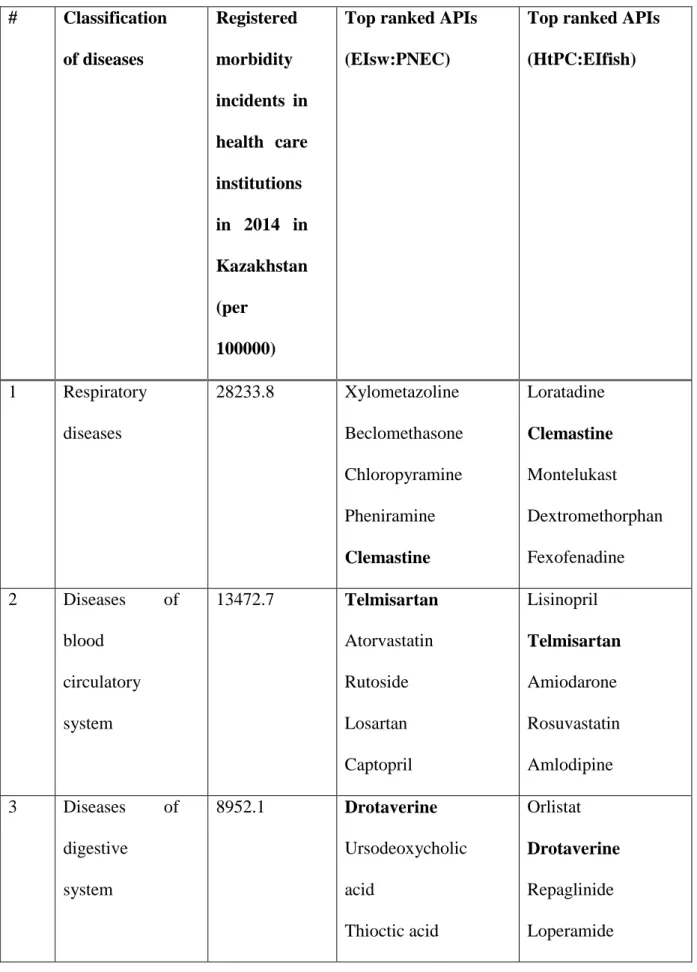
non-apical endpoints corresponding to the therapeutic mode of action of an API.
87
Identification of pharmaceuticals in use in Kazakhstan and selection APIs for detailed
88
assessment
89
A list of APIs in use in Kazakhstan was constructed using the online directory of
90
pharmaceutical products in use Kazakhstan (Vidal-Kazakhstan LLP 2015). For each API,
91
the number of products on the market was determined. Vitamins and vaccines were
92
excluded from the analysis. To make the prioritisation manageable, all compounds
93
contained in fewer than 3 products were not considered further as it was assumed that
94
exposure to these would be low, although in the future these compounds could also be
95
assessed. For the remaining compounds, data on the the recommended daily dose and
96
treatment duration was obtained (Supporting information, Table 1).
97
Environmental exposure
98
The relative exposure of those APIs in use in three or more products was
99
characterised by estimating an Exposure Index for surface water (EIsw). The EI was
calculated by multiplying the number of products containing an API available on the
101
market, the average daily dose and fraction of drug not-metabolised by the patient and the
102
fraction not removed by the WWTP. The fraction of unmetabolised API was obtained
103
from peer-reviewed papers and available online databases (Wishart et al. 2006; FASS
104
2011; Medsafe 2015; Drugs.com 2016) (Supporting information, Table 2). The
105
compounds without data were considered to be totally excreted from the body. The
106
fraction not removed by the WWTP was estimated using an equation proposed by the
107
Guideline on the Environmental Risk Assessment of Medicinal Products for Human Use
108
(ECA 2003), with slight modification (Eqn.1):
109
110
Fwwtp= 1 - (Eqn. 1)
111
112
Where, Fwwtp is the fraction of pharmaceutical released from the WWTP.
113
Wastewater parameters were obtained from the EU Technical Guidance Document for risk
114
assessment of chemicals (EC, 2003) as these are widely recognised for use in risk
115
assessment. WasteWinhhab is the amount of wastewater per inhabitant per day, that was
116
assumed to be 200 L/day (ECA 2003). Sludgeinhab was mass of waste sludge per
117
inhabitant per day which was assumed to be 0.074 kg inh/day (ECA 2003). The focsludge
118
(fraction of sludge organic carbon) was assumed to be 0.326 (Struijs et al. 1991). The soil
119
organic carbon-water partitioning coefficient (Koc) value was estimated with the model
120
established for ionizable organic chemicals proposed by Franco and Trapp (2008). This
121
model estimates sorption using information on the hydrophobicity and degree of
122
dissociation of a molecule using the following equations:
123
124
Log Koc= log ( nX + ion ) for acids (Eqn. 2)
Log Koc = log ( nX + ion10pKa0.65 Xf0.14) for bases (Eqn. 3)
126
127
An Exposure Index representing the internal exposure of APIs in fish plasma (EIfish)
128
was also determined by multiplying the EIsw by the fish blood-water partition coefficient
129
(Pbw) for each API. The calculation of Pbw was performed using the equation proposed
130
by Fick et al. (2010) (Eqn. 4):
131
132
LogPbw = 0.73 * LogKow – 0.88 (Eqn. 4)
133
134
Where Pbw was aqueous phase and fish arterial blood partition coefficient and Kow
135
was Octanol/water partition coefficient.
136
Apical effects assessment
137
Predicted no-effect concentrations (PNEC) were estimated for each API using
138
Equation 5. In order to estimate PNECs, we collected all available experimental
139
ecotoxicological data on the toxicity of APIs to apical endpoints in aquatic organisms from
140
peer-reviewed papers, using Google scholar, Web of Knowledge and SCOPUS, and online
141
datasets (FASS 2011) (Supporting information, Table 3). The data contained acute and
142
chronic ecotoxicity endpoints as LC/EC50 values and, as the aim of this work for
143
priotisation and not regulation, were not quality assessed. For substances that did not have
144
experimental ecotoxicity data, the quantitative structure activity relationships (QSAR)
145
toolbox was used in order to fill all gaps (OECD 2009). This software helped to define
146
potential analogues and construct a matrix of data based on them. Initially, we selected the
147
protein-binding profile. Then, on endpoints section we selected ecotoxicological
148
information, that included growth, immobilisation and mortality. After that, on the
149
category definition module we used the aquatic toxicity classification system by
ECOSAR. Finally, the toolbox processed data with a common structure (70-90%). Where
151
the toolbox identified predictions to not be accurate, these predictions were not included in
152
the priotization analysis.
153
154
PNEC = (Eqn. 5)
155
156
Where PNEC is the predicted no-effect concentration, EcoTox is the most sensitive
157
ecotoxicological data for the aquatic compartment and AF was the safety factor. The AF
158
was selected based on recommendations in the Technical guidance document on risk
159
assessment (ECA 2003).
160
Non-Apical Endpoints
161
In order to account for non-apical effects relating to the therapeutic mode of action
162
of each API, we used a similar approach to that proposed by Huggett et al. (2003) and
163
collated information on plasma therapeutic concentrations (HtPC) of each API in humans.
164
The information of HtPC was obtained from online databases (FASS 2011; Medsafe 2015;
165
Drugs.com 2016; Kim et al. 2016) (Supporting information, Table 4).
166
Ranking APIs
167
The final step in the study was prioritization of the APIs. Risk Scores were used to
168
rank compounds. Basically, the score was estimated by dividing the exposure indices for
169
water and fish by either the PNEC or the HtPC. APIs with the highest ranking score were
170
classified as the substances that should be in the list of concern.
171
RESULTS
172
In total, there are 7713 pharmaceutical products in use in Kazakhstan containing
173
1684 APIs. When complex mixtures as well as vaccines and vitamins are excluded, 841
174
APIs remained. The top 20 APIs, based on product number containing the ingredient, are
shown in Figure 2. Assuming product number is a surrogate for the extent of use, the most
176
widely used compound is paracetamol (an analgesic) followed by hydrochlorothiazide (a
177
diuretic used to treat high blood pressure, swelling and fluid build up) and metronidazole
178
(an antibiotic).
179
When APIs in use in fewer than three products were excluded, a list of 237 APIs
180
was obtained for further prioritisation. Exposure indices for these substances are provided
181
in the Supporting Information(Supporting information Tables 2 and 4). The highest
182
exposure indices in surface water were seen for benzylpenicillin, metronidazole,
183
sulbactam, ceftriaxone and sulfamethoxazole, whereas the highest exposure indices in fish
184
plasma were seen for lisinopril, orlistat, telmisartan, drotaverine and terbinafine.
185
Experimental ecotoxicity data for daphnia, fish and/or algae was available for 154 of
186
the 237 APIs and human plasma therapeutic concentration data were available for 201 of
187
these. Therefore, for the prioritisation, experimentally-based PNECs were used for 70% of
188
compounds and QSAR-based PNECs were used for 66 compounds. The most highly
189
ranked substances based on the apical ecotoxicological endpoints were amoxicillin,
190
clarithromycin, azythromycin, ketoconazole and benzylpenicillin, whereas the most highly
191
ranked compounds based on the non-apical assessment were lisinopril, orlistat, estradiol
192
valerate, drotaverine and estradiol. Table 1 shows the top five ranked compounds broken
193
down by classification of diseases. Classification of diseases was based on classes of
194
illness cases registrated in health care institutions in Kazakhstan in 2014 (MHSD 2015).
195
DISCUSSION
196
The objective of the present study was to develop a method for ranking
197
pharmaceuticals in data-poor regions. The approach built on previous studies but, as usage
198
amount data were not available for Kazakhstan, used information on product numbers as
199
the basis for the exposure characterisation. The assumption being that APIs which were
present in numerous products would be more widely used than APIs present in only a few
201
products. During the study we found the main drugs of concern, based on a combination of
202
risk to apical or non-apical endpoints, in Kazakhstan were amoxicillin, clarithromycin,
203
azithromycin, ketoconazole, benzylpenicillin, terbinafine, drotaverine, diclofenac,
204
benzathine benzylpenicillin and telmisartan as these had the highest risk scores.
205
Even though the ranking approach used a different approach from previous studies, the
206
results show that some of the top ranked compounds in our study are also ranked highly by
207
earlier prioritization research (Table 2). For example, amoxicillin, clarithromycin,
208
diclofenac and azithromycin, with the highest risk score, were defined as high priority
209
in an ecotoxicological risk-based prioritization study performed in the UK by Guo et al.
210
(2016). Moreover, amoxicillin was detected as a chemical with the highest hazard to
211
aquatic organisms in the United Kingdom, France, Italy, Iran, Korea and Spain (Table 2).
212
Cooper et al. (2008) concluded that sulfamethoxazole, diclofenac and clarithromycin were
213
the pharmaceuticals of high risk in a US study. Ketoconazole was identified as one of the
214
priority substance in a study by Roos et al. (2012) in Swedish aquatic systems. Lisinopril,
215
orlistat, estradiol valerate, cinnarizine, drotaverine, estradiol and clotrimazole were
216
identified as having the potential to elicit subtle effect in fish. Estradiol was identified by
217
Guo et al. (2016) as having the potential to cause subtle effects in fish.
218
Most of the pharmaceuticals ranked highly on our list are related to the treatment of
219
infectious and parasitic diseases, so the majority of them are antibiotics. Currently,
220
antibiotics are one of the most well investigated pharmaceutical classes in terms of acute
221
toxicity to aquatic organisms (Brausch and Rand 2011). Nevertheless, we still have a
222
limited dataset on chronic effects of many antibiotics to aquatic ecosystems. The majority
223
of ecotoxicology studies have been focusing on acute toxicity of antibiotics to algal
224
species and the EC50s vary from 0.002 mg/L to 1283 mg/L (Guo et al. 2015).
Most of drugs from our ranking list have been detected in monitoring studies around
226
the world. This provides a level of confidence in the approach. For instance, amoxicillin
227
was detected in concentrations of 28 g/L and 82.7 g/L in hospital wastewater in
228
Germany during the daytime (Kummerer 2001). Yasojima et al. (2006) showed
229
clarithromycin and azithromycin at concentrations 647 ng/L and 260 ng/L in the
230
wastewater effluents in Japan.
231
The majority of substances from the ranking list have been reported to cause toxicity
232
to aquatic organisms. For instance, Shi et al. (2012) showed that clotrimazole can affect
233
the development stage of X. tropiclalis larvae and can lead to mortality of X. tropiclalis
234
even at a low concentration (0.1 µg/L). In 2008 Porsbring et al. (2009) conducted a
235
toxicity assessment of clotrimazole to natural microalgal communities. The results of the
236
research showed that this compound causes growth inhibition of algal communities, it can
237
alter their pigment profiles and physiology (Porsbring et al. 2009). Hegelund et al. (2004)
238
investigated the response of fish to ketoconazole. Their results showed, that this
239
compound had effects to rainbow trout and killifish at 12 and 100 mg/kg, as it suppressed
240
cytochrome enzyme activity of fish (Hegelund et al. 2004). Halling-Sorensen (2000)
241
showed that benzylpenicillin was toxic to M.aeruginasa, with an EC50 value of 0.005
242
mg/L. There is a large volume of published studies describing the risk of clarithromycin to
243
the environment. For instance, Oguz and Mihciokur (2014) studied the environmental
244
risks of drugs in Turkey and concluded that clarithromycin can cause potential hazard to
245
living organisms because of its high bioconcentration factor. Furthermore, the substance
246
with the highest concentration in Italian rivers was clarithromycin at a concentration of
247
0.02 µg/L (Calamari et al. 2003). A considerable amount of literature has been published
248
on the toxicity and occurrence of diclofenac in the last decades. Recent research by Acuna
249
et al. (2015) has reported that the occurrence of diclofenac was mentioned in 142 papers,
which covered 38 countries. Moreover, there were 156 reports about the ecotoxicological
251
effects of this substance (Acuna et al. 2015).
252
LIMITATIONS
253
The prioritization results in the present study are based on information on the number
254
of products as we were not able to obtain information on annual mass usage data. The use of
255
consumption data of drugs could give us more precise results but simply is not available in
256
countries like Kazakhstan. In future, we recommend that more efforts are put into the
257
development of databases on annual usage of pharmaceuticals (and other) chemicals in
258
Kazakhstan and other regions with lack of data. In order to calculate PNEC, ecotoxicological
259
data were collected from different sources and were not rated for data quality. Moreover, the
260
majority of pharmaceuticals excreted to WWTPs would be in the form of metabolites. The
261
paper did not consider these for ranking even though in some instances they could pose a risk
262
to the environment.
263
CONCLUSION
264
The population of Kazakhstan is increasing so it is likely that consumption of
265
medicines in the country will grow too. Pharmaceuticals are readily available in Kazakhstan
266
with most of them being freely available for purchase over the counter. Wastewater treatment
267
systems in the country are also old and employ old technologies so the treatment may not be
268
as effective as in Western countries. Consequently, emissions of pharmaceuticals to the
269
natural environment in Kazakhstan are expected to be high and impacts could be greater than
270
elsewhere in the world. Overall, the present assessment prioritized the human prescription
271
APIs, that are most likely to be present in Kazakhstan surface waters and which could pose
272
the greatest risk to living organisms. We recommend that these compounds be considered in
273
future research to monitor concentrations of the APIs in the Kazakhstan environment and to
274
establish the level of risk to ecosystems in the country. It would be interesting to consider
about the effect mixture pharmaceuticals on surface water. While the paper has focused on
276
prioritisation of pharmaceuticals in use in Kazakhstan, the design of the approach means that
277
it can be applied in other countries with limited data on API usage. The approach could
278
therefore be invaluable in determining the wider impacts of APIs across the globe.
279
280
REFERENCE LIST 281
Acuna V, Ginebreda A, Mor JR, Petrovic M, Sabater S, Sumpter J, Barcelo D. 2015.
282
Balancing the health benefits and environmental risks of pharmaceuticals: Diclofenac as
283
an example. Environ Int. 85:327-333.
284
Al-Khazrajy OSA, Boxall ABA. 2016. Risk-based prioritization of pharmaceuticals in the
285
natural environment in iraq. Environ Sci Pollut R. 23(15):15712-15726.
286
Alighardashi A, Rashidi A, Neshat A, Folsefatan H. 2014. Environmental risk assessment of
287
selected antibiotics in Iran. IJHSE. 1(3):132-137.
288
Berninger JP, LaLone CA, Villeneuve DL, Ankley GT. 2016. Prioritization of
289
pharmaceuticals for potential environmental hazard through leveraging a large-scale
290
mammalian pharmacological dataset. Environ Toxicol Chem. 35(4):1007-1020.
291
Besse JP, Kausch-Barreto C, Garric J. 2008. Exposure assessment of pharmaceuticals and
292
their metabolites in the aquatic environment: Application to the french situation and
293
preliminary prioritization. Hum Ecol Risk Assess. 14(4):665-695.
294
Boxall ABA, Kolpin DW, Halling-Sorensen B, Tolls J. 2003. Are veterinary medicines
295
causing environmental risks? Environ Sci Technol. 37(15):286A-294A.
296
Boxall ABA, Rudd MA, Brooks BW, Caldwell DJ, Choi K, Hickmann S, Innes E, Ostapyk K,
297
Staveley JP, Verslycke T et al. 2012. Pharmaceuticals and personal care products in the
298
environment: What are the big questions? Environ Health Persp. 120(9):1221-1229.
Brausch JM, Rand GM. 2011. A review of personal care products in the aquatic environment:
300
Environmental concentrations and toxicity. Chemosphere. 82(11):1518-1532.
301
Calamari D, Zuccato E, Castiglioni S, Bagnati R, Fanelli R. 2003. Strategic survey of
302
therapeutic drugs in the rivers po and lambro in northern italy. Environ Sci Technol.
303
37(7):1241-1248.
304
Cooper ER, Siewicki TC, Phillips K. 2008. Preliminary risk assessment database and risk
305
ranking of pharmaceuticals in the environment. Sci Total Environ. 398(1-3):26-33.
306
Drugs.com. 2016. Database for Drugs. [accessed 2015 Nov 1]. Available from
307
https://www.drugs.com/
308
ECA. European Chemical Agency. 2003. Technical Guidance Document on Risk Assessment.
309
[accessed 2016 Feb 10].
310
https://echa.europa.eu/documents/10162/16960216/tgdpart2_2ed_en.pdf
311
FASS. 2011. Swedish Environmental Classification of Pharmaceuticals Database. [accessed
312
2015 Oct 1]. Available from http://www.fass.se/LIF/startpage
313
Fick J, Lindberg RH, Tysklind M, Larsson DGJ. 2010. Predicted critical environmental
314
concentrations for 500 pharmaceuticals. Regul Toxicol and Pharm. 58(3):516-523.
315
Franco A, Trapp S. 2008. Estimation of the soil-water partition coefficient normalized to
316
organic carbon for ionizable organic chemicals. Environ Toxicol and Chem.
317
27(10):1995-2004.
318
Galus M, Kirischian N, Higgins S, Purdy J, Chow J, Rangaranjan S, Li HX, Metcalfe C,
319
Wilson JY. 2013. Chronic, low concentration exposure to pharmaceuticals impacts
320
multiple organ systems in zebrafish. Aquat Toxicol. 132:200-211.
321
Guo JH, Boxall A, Selby K. 2015. Do pharmaceuticals pose a threat to primary producers?
322
Crit Rev Env Sci and Tec. 45(23):2565-2610.
Guo JH, Sinclair CJ, Selby K, Boxall ABA. 2016. Toxicological and ecotoxicological
risk-324
based prioritization of pharmaceuticals in the natural environment. Environ Toxicol and
325
Chem. 35(6):1550-1559.
326
Halling-Sorensen B. 2000. Algal toxicity of antibacterial agents used in intensive farming.
327
Chemosphere. 40(7):731-739.
328
Hegelund T, Ottosson K, Radinger M, Tomberg P, Celander M. 2004. Effects of the
329
antifungal imidazole ketoconazole on cyp1a and cyp3a in rainbow trout and killifish.
330
Environ Toxicol Chem. 23(5):1326-1334.
331
Huggett DB, Cook JC, Ericson JF, Williams RT. 2003. A theoretical model for utilizing
332
mammalian pharmacology and safety data to prioritize potential impacts of human
333
pharmaceuticals to fish. Hum Ecol Risk Assess. 9(7):1789-1799.
334
Kim S, Thiessen PA, Bolton EE, Chen J, Fu G, Gindulyte A, Han L, He J, He S, Shoemaker
335
BA, Wang J, Yu B, Zhang J, Bryant SH. 2016. PubChem Substance and Compound
336
databases. Nucleic Acids Res. 44(D1):D1202-13
337
Kim Y, Jung J, Kim M, Park J, Boxall ABA, Choi K. 2008. Prioritizing veterinary
338
pharmaceuticals for aquatic environment in korea. Environ Toxicol Phar.
26(2):167-339
176.
340
Kummerer K. 2001. Emission and biodegradability of pharmaceuticals, contrast media,
341
disinfectants and aox from hospitals. Pharmaceuticals in the Environment: Sources,
342
Fate, Effects, and Risks.29-41.
343
Kummerer K. 2010. Pharmaceuticals in the environment. In: Gadgil A, Liverman DM,
344
editors. Annual review of environment and resources, vol 35. Palo Alto: Annual
345
Reviews. p. 57-+.
346
Medsafe. 2015. Classification of Medicines - Classification Process. [accessed 2015 Oct 25].
347
Available from http://www.medsafe.govt.nz/
MHSD. The Ministry of Healthcare and Social Development of the Republic of Kazakhstan.
349
2016. Sale of medical drugs by prescription is no novelty. [accessed 2016 June 1].
350
Available from http://www.mzsr.gov.kz/en/node/335602
351
MHSD. The Ministry of Healthcare and Social Development of the Republic of Kazakhstan.
352
2015. Health Of The Republic Of Kazakhstan And The Activities Of The Healthcare
353
Organization in 2014. Statistical compilations. [accessed 2016 May 10]. Available from
354
https://pda.mzsr.gov.kz/sites/default/files/sbornik_2014.pdf
355
OECD. The Organisation for Economic Co-operation and Development. 2009. The Guidance
356
Document for Using the OECD (Q)SAR Application Toolbox to Develop Chemical
357
Categories According to the OECD Guidance on Grouping Chemicals. OECD Series on
358
Testing and Assessment. No. 102. [accessed 2016 Feb 20]. Available from
359
http://www.oecd.org/officialdocuments/publicdisplaydocumentpdf/?doclanguage=en&c
360
ote=env/jm/mono(2009)5
361
Oguz M, Mihciokur H. 2014. Environmental risk assessment of selected pharmaceuticals in
362
turkey. Environ Toxicol Phar. 38(1):79-83.
363
Porsbring T, Blanck H, Tjellstrom H, Backhaus T. 2009. Toxicity of the pharmaceutical
364
clotrimazole to marine microalgal communities. Aquat Toxicol. 91(3):203-211.
365
Roos V, Gunnarsson L, Fick J, Larsson DGJ, Ruden C. 2012. Prioritising pharmaceuticals for
366
environmental risk assessment: Towards adequate and feasible first-tier selection. Sci
367
Total Environ. 421:102-110.
368
Schwaiger J, Ferling H, Mallow U, Wintermayr H, Negele RD. 2004. Toxic effects of the
369
non-steroidal anti-inflammatory drug diclofenac part 1: Histopathological alterations
370
and bioaccumulation in rainbow trout. Aquat Toxicol. 68(2):141-150.
371
Shi HH, Sun Z, Liu Z, Xue YG. 2012. Effects of clotrimazole and amiodarone on early
372
development of amphibian (xenopus tropicalis). Toxicol Environ Chem. 94(1):128-135.
Struijs J, Stoltenkamp J, van de Meent D. 1991. A spreadsheet-based box model to predict the
374
fate of xenobiotics in a municipal wastewater treatment plant. Water Res.
25(7):891-375
900.
376
Tashenov A, Cherednichenko N. 2013. Development Prospects for the Pharmaceutical Market 377
of the Single Economic Space. Development Prospects for the Pharmaceutical Market 378
of the Single Economic Space. [accessed 2015 Sep 22]. Available from
379
http://www.eabr.org/general/upload/docs/AU/%D0%90%D0%A3%20-380
%20%D0%98%D0%B7%D0%B4%D0%B0%D0%BD%D0%B8%D1%8F%20-381
%202013/OBZOR_18_rus.pdf 382
Vidal-Kazakhstan LLP. 2015. Directory Vidal - Pharmaceuticals in Kazakhstan. [accessed
383
2015 Nov 1]. Available from http://www.vidal.kz/
384
Wishart DS, Knox C, Guo AC, Shrivastava S, Hassanali M, Stothard P, Chang Z, Woolsey J.
385
2006. DrugBank: a comprehensive resource for in silico drug discovery and exploration.
386
Nucleic Acids Res. 34(Database issue):D668-72. 16381955
387
Yasojima M, Nakada N, Komori K, Suzuki Y, Tanaka H. 2006. Occurrence of levofloxacin,
388
clarithromycin and azithromycin in wastewater treatment plant in japan. Water Sci
389
Technol. 53(11):227-233.
390
Zuccato E, Castiglioni S, Fanelli R. 2005. Identification of the pharmaceuticals for human use
391
contaminating the italian aquatic environment. J Hazard Mater. 122(3):205-209.
392
393
Figure captions
Figure 1. Outline of the prioritization approach for active pharmaceutical ingredients (APIs)
in surface waters in Kazakhstan. APIs – active pharmaceuticals ingredients; WWTP –
wasterwater treatment plant; EIsw – exposure index for surface water; PNEC – predicted
no-effect concentration; RCR – risk score ratio; EIfish – exposure index in fish plasma; HtPC –
human plasma therapeutic concentration.
Figure 2. Top 20 active pharmaceutical ingredients in use in Kazakhstan based on number
Table 1. Summary of top ranked APIs, by disease class, prioritised based on apical effects (EIsw:PNEC) and non-apical effects (HtPC:EIfish). Compounds in bold have been identified as priority using both methods.
# Classification
of diseases
Registered
morbidity
incidents in
health care
institutions
in 2014 in
Kazakhstan
(per
100000)
Top ranked APIs
(EIsw:PNEC)
Top ranked APIs
(HtPC:EIfish)
1 Respiratory
diseases
28233.8 Xylometazoline
Beclomethasone
Chloropyramine
Pheniramine
Clemastine
Loratadine
Clemastine
Montelukast
Dextromethorphan
Fexofenadine
2 Diseases of
blood
circulatory
system
13472.7 Telmisartan
Atorvastatin
Rutoside
Losartan
Captopril
Lisinopril
Telmisartan
Amiodarone
Rosuvastatin
Amlodipine
3 Diseases of
digestive
system
8952.1 Drotaverine
Ursodeoxycholic
acid
Thioctic acid
Orlistat
Drotaverine
Repaglinide
Bisacodyl
Pioglitazone
Hyoscine
butylbromide
4 Disease of
urino-genital
system
7250.8 Ketoconazole
Levonorgestrel
Nystatin
Miconazole
Drospirenone
Estradiol valerate
Estradiol
Miconazole
Ethinylestradiol
Ketoconazole
5 Diseases of the
eye and its
appendages
5516.3 Neomycin
Betaxolol
Tropicamide
Betaxolol
Neomycin
Tropicamide
6 Diseases of the
blood-forming
organs and
certain
4965.9 Clopidogrel Clopidogrel
7 Diseases of
nervous system
4471.6 Cinnarizine
Paracetamol
Betahistine
Carbamazepine
Gabapentin
Cinnarizine
Fentanyl
Acetylsalicylic
acid
Tramadol
Valproic acid
8 Diseases of the
musculoskeletal
system and
connective
tissue
4093.1 Diclofenac
Etofenamate
Ketoprofen
Clodronic acid
Naproxen
Methyl salicylate
Diclofenac
Indomethacin
Benzydamine
9 Infectious and
parasitic
diseases
2296 Amoxicillin
Clarithromycin
Azithromycin
Benzylpenicillin
Terbinafine
Clotrimazole
Isotretinoin
Disulfiram
Terbinafine
Azithromycin
10 Tumors 1657. Oxaliplatin
Cisplatin
Mycophenolic acid
Capecitabine
Paclitaxel
Paclitaxel
Mycophenolic
acid
Imatinib
Anastrozole
Topotecan
11 Mental and
behavioral
disorders
1270.6 Citicoline
Piracetam
Fluoxetine
Clozapine
Sertraline
Sertraline
Fluoxetine
Chlorpromazine
Risperidone
Clozapine
Note: Bold highlighted pharmaceuticals show their common appearance in top ranking of
drugs on both risk ratios. APIs – activated pharmaceuticals ingredients; EIsw – exposure
index for surface water; PNEC – predicted no-effect concentration; HtPC – human plasma
Table 2. Defined top priority APIs in surface water of Kazakhstan, UK, France, US, Sweden, Iran, Korea and Spain
Kazakhstan United
Kingdom (Guo
et al. 2016)
France (Besse
et al. 2008)
United States
(Cooper et al.
2008)
Sweden
(Roos et al. 2012)
Iran
(Alighardas
hi et al.
2014)
Korea
(Kim et al.
2008)
Italy (Zuccato
et al. 2005)
Amoxicillin Clarithromycin Azithromycin Ketoconazole Benzylpenicillin Terbinafine Drotaverine Diclofenac Benzathine benzylpenicillin Telmisartan Amitriptyline Amoxicillin Atorvastatin Azithromycin Carbamazepine Ciprofloxacin Clarithromycin Diclofenac Estradiol Metformin Mesalazine Amoxicillin
Acetyl salicylic
Disulfiram
Oxytetracycline
Omeprazole
Orlistat
Fenofibrate
Paroxetine
Fluvoxamine
Carvedilol
Metronidazole
Trimethoprim
Tetracycline
Propranolol
Gemfibrozil
Naproxen
Diazepam
Paroxetine
Clarithromycin
Acetaminophen
Amitriptyline
Fluoxetine
Dipyridamole
Chlorprothixene
Bromhexine
Entacapone
Fulvestrant
Galantamine
Erythromyc
in
Florfenicol
Fluvalinate
Ivermectin
Monensin
sodium
Norfloxacin
Oxytetracycline
Spiramycin