RESEARCH NOTE
Barriers to recruiting and retaining psychosis
carers: a case study on the lessons learned
from the Caring for Caregivers (C4C) trial
Cassie M. Hazell
1, Christina J. Jones
2, Aparajita Pandey
3and Helen E. Smith
4,5*Abstract
Objective: Carers play an important role within the UK mental health system. Those carers who support persons with psychosis can experience a reduction in their own physical and mental health. As part of the Caring for Caregivers (C4C) trial, we piloted a writing intervention (Positive Written Disclosure) that has been shown to improve wellbeing in other populations. Although we reached our recruitment target, we encountered several barriers that made recruit-ment slower than anticipated. This paper synthesises the process data collected during the C4C trial that relates to the barriers to recruiting and retaining psychosis carers.
Results: We encountered four main carer-specific barriers to the recruitment and retention of participants in our study. These were: (1) poor relationship with mental health clinicians, (2) conflicting with the care recipient’s (CR) needs, (3) lack of spare time, and (4) lack of services for mental health carers. The interventions to assist carers need to be informed by robust evidence and this requires trials that reach their recruitment targets. By sharing our practical experiences other researchers and clinicians can modify their practices to minimise recruitment difficulties and delay.
Trial registration ISRCTN79116352. Retrospectively registered (before the final participant was recruited) on 23rd Janu-ary 2017
Keywords: Recruitment, Retention, Barriers, Trial, Carer, Psychotic disorders
© The Author(s) 2019. This article is distributed under the terms of the Creative Commons Attribution 4.0 International License (http://creat iveco mmons .org/licen ses/by/4.0/), which permits unrestricted use, distribution, and reproduction in any medium, provided you give appropriate credit to the original author(s) and the source, provide a link to the Creative Commons license, and indicate if changes were made. The Creative Commons Public Domain Dedication waiver (http://creativecommons.org/ publicdomain/zero/1.0/) applies to the data made available in this article, unless otherwise stated.
Introduction
Difficulty recruiting participants for research is not uncommon. Almost half of clinical trials fail to achieve their original recruitment targets in the specified time [1]. Failure to reach recruitment targets can weaken the conclusions generated from the trial. Furthermore, there is evidence suggesting that recruiting carers may be particularly challenging [2, 3]. Our Caring for Car-egivers (C4C) trial of Positive Written Disclosure (a self-directed, time-limited writing therapy) required us to recruit 60 older adults caring for someone with psychosis [4]. Throughout the trial recruitment was difficult. We had originally planned to recruit sufficient numbers of carers from a single site, but in reality we had to extend
the recruitment period and add three additional sites to reach our recruitment target.
This paper offers an explanatory case study outlining the challenges to recruiting carers to a trial and ways to minimise these. This case study merges our learning, based on trial process data, with the existing literature on carers. By sharing our learning, other researchers can consider the potential barriers and proactively incorpo-rate potential solutions within their study design.
This case study paper aims to identify: (1) the barriers to recruiting and retaining psychosis carers; and (2) prac-tical ways to overcome these barriers.
Main text Method
We did not anticipate recruitment difficulties, and there-fore did not plan a proactive formal evaluation of recruit-ment methods. Instead, we offer a case study using the
Open Access
*Correspondence: [email protected]; [email protected] 4 Lee Kong Chian School of Medicine, Nanyang Technological University Singapore, Singapore 308232, Singapore
process data collected during the C4C trial. CH and AP reviewed the recruitment databases, contact logs, and the minutes from the research team, trial steering committee (TSC) and lived experience advisory panel (LEAP) meet-ings. They extracted the recruitment conversion rates (how many referrals went on to provide consent), reasons why participants declined to be contacted or consent (recruitment databases and contact logs), and examples of good practice where we had managed to successfully recruit participants (recruitment databases and meeting minutes). Finally, the data and its interpretation were dis-cussed with the core research team and our LEAP.
Results
We utilised a range of recruitment methods to reach our target, including promoting the study via community and inpatient mental health services, GPs, mental health and carer third sector organisations, recovery colleges, social media, and posters in community buildings (e.g. librar-ies, community centres)—full recruitment details can be found in the study protocol [4]. Of the 408 referrals we received, 63 (15%) carers consented to participate in the trial. In this paper we are able to share what we have learnt from the 345 cases where people were referred but
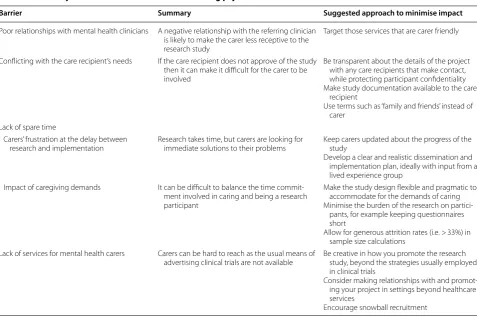
did not go on to participate. We have identified four bar-riers to recruiting psychosis carers (Table 1).
Barriers
1. Poor relationships with mental health clinicians:
Our initial plan was to recruit carers via mental health services, asking clinicians to pass on the C4C study information to the carers of their psychosis patients. Unfortunately, this strategy proved to be largely ineffective as all the participants who actively declined to participate in the trial (14; 4%) came via mental health clinicians. Many carers expressed their frustrations with mental health staff, and perceived discussion of the C4C study was being used as way of evading and deflecting enquiries of what help was available for the person they cared for.
2. Conflicting with the care recipient’s (CR) needs: Although the C4C study did not recruit CRs, their
influence was very much felt throughout the study. Carer participation in this project was frequently not supported by CRs for two reasons: unacceptability of the negative connotations of CR; and because some
Table 1 Summary of the four main barriers to recruiting psychosis carers
Barrier Summary Suggested approach to minimise impact
Poor relationships with mental health clinicians A negative relationship with the referring clinician is likely to make the carer less receptive to the research study
Target those services that are carer friendly
Conflicting with the care recipient’s needs If the care recipient does not approve of the study then it can make it difficult for the carer to be involved
Be transparent about the details of the project with any care recipients that make contact, while protecting participant confidentiality Make study documentation available to the care
recipient
Use terms such as ‘family and friends’ instead of carer
Lack of spare time
Carers’ frustration at the delay between
research and implementation Research takes time, but carers are looking for immediate solutions to their problems Keep carers updated about the progress of the study Develop a clear and realistic dissemination and implementation plan, ideally with input from a lived experience group
Impact of caregiving demands It can be difficult to balance the time commit-ment involved in caring and being a research participant
Make the study design flexible and pragmatic to accommodate for the demands of caring Minimise the burden of the research on
partici-pants, for example keeping questionnaires short
Allow for generous attrition rates (i.e. > 33%) in sample size calculations
Lack of services for mental health carers Carers can be hard to reach as the usual means of
advertising clinical trials are not available Be creative in how you promote the research study, beyond the strategies usually employed in clinical trials
Consider making relationships with and promot-ing your project in settpromot-ings beyond healthcare services
[image:2.595.58.536.408.725.2]carers feared their CR would become suspicious, or paranoid, about the research, and wished not to risk increased distress.
3. Lack of spare time:
Carers’ time is precious, so decisions to participate in a research study will be carefully considered. Short-age of time was contributory to two sub-barriers: (i) carers’ frustration at the delay between research and implementation, and the (ii) impact of caregiving demands.
i. Carers’ frustration at the delay between research and implementation:
Some carers expressed their frustration at the time it takes for research findings to be imple-mented in healthcare. Several people who were invited to participate in our study men-tioned their previous research engagement and their disappointment that they “never found out what happened in the end”. Furthermore, carers were surprised when they found out the C4C study would take more than 2 years. Understandably, if they had a CR who was cur-rently in “crisis”, their priority was to support their CR. Taking a longer-term perspective and addressing their own needs could not compete. ii. Impact of caregiving demands:
Changes in the intensity of the caring role can happen quickly. The C4C study assessed carers over 6 months. Only two carers formally with-drew from the trial; both of whom had initial capacity to participate but later were struggling with their CR’s “relapse”. Other carers cited CR relapse as a reason for not completing assess-ments on time: in our trial, 6 (10%) partici-pants required assessment packs to be re-sent for at least one of the time-points.
4. Lack of services for mental health carers:
All the barriers described above occurred after the researchers had met with psychosis carers, creating the initial encounter proved even more challenging. Carers are a hard to reach population, with a limited number of carer organisations who could act as allies in promoting research. We attended four generic carer events but met only one carer who was eligible for the study. However, where mental health carers’ groups were available, they were helpful. Unexpect-edly, our attempts to recruit via GPs returned very small numbers because of the incompleteness of their carer registers, and that even where registers existed they did not systematically record the condi-tion of the CR. We sent 114 study invitacondi-tions to peo-ple who identified as ‘carers’ from 10 GPs; only 7 (6%)
of these consented to participate in the trial. The dis-parity between the referral and consent rates could reflect a lack of interest, but is more likely because only a small percentage were providing care to some-one with psychosis and therefore eligible.
Strategies
1. Poor relationships with mental health clinicians:
To overcome this barrier requires mental health ser-vices to mend their relationships with carers. In the longer term this barrier may be diminished with the popularisation of initiatives such as the Trian-gle of Care [5] and the friends and family policies of Early Intervention in Psychosis (EIP) services [6]. In the interim, we recommend that researchers tar-get recruitment efforts on those services that have a tradition of involving carers, as indicated by the appointment of Carer Leads or Carer Liaison Offic-ers.
2. Conflicting with the care recipient (CR) needs: In attempt to reduce these barriers, we adopted
a position of openness and transparency, making explicit reference to our definition of the term carer on all participant-facing documentation (“any per-son who provides unpaid support to a partner, child, relative or friend who couldn’t manage to live inde-pendently or whose health or wellbeing would dete-riorate without this help” [7]). All of the study docu-ments were freely available online. On reflection we could have also developed study materials specifically for CRs too and offered CRs the opportunity to con-tact the research team (whilst of course upholding participant confidentiality). Additionally, we could have replaced the term ‘carer’ with less personally threatening terms such as ‘friends and family’. In doing so we would need to have acknowledged that being related to someone with psychosis does not automatically qualify the person as a carer; the trial inclusion/exclusion criteria would need to be crafted carefully to ensure the caring role was being under-taken.
3i. Carers’ frustration at the delay between research and implementation:
carers feeling exploited [8] and the likelihood of par-ticipating in another research study in the future is threatened.
When asked, all our sample requested copies of the study results, and even where carers were ineligible, they expressed an interest in hearing about the find-ings. Therefore, in our dissemination plan we demon-strated a willingness to share our findings as widely as possible, including dissemination via statutory and third sector organisations. The dissemination plan was summarised in the participant information sheet and we were always explicit that as a feasibility study further research would be needed before implemen-tation. Regular project newsletters updated partici-pants with study progress, changes to the protocol or study timeline, and reminded those participants who had completed their data collection that the study was still ongoing.
3ii. Impact of caregiving demands:
Attrition and delayed follow up assessments are una-voidable when working with carers and so wherever possible the research design should offer flexibility in processes and procedures. To facilitate involvement, we offered carers a choice in the method of assess-ment (in-person, phone, online, post), and we mini-mised travel time and costs by seeing participants in their homes. Carers took advantage of this flexible approach with 5 (8%) participants electing to com-plete at least one assessment online instead of via post, and all but one carer electing to complete the exit interview over the phone instead of in-person. Overall, our rates of retention were good (97%) as was data completion (84% at 6 months), demonstrat-ing that even busy carers can be retained if you do not ask too much from them.
4. Lack of services for mental health carers:
With the inadequacy of carers’ registers, we were largely reliant on GPs’ knowledge of their caseload. An alternative approach suggested by Sampson et al. [9] is to identify carers by searching patient records to find those cohabiting with a person experienc-ing the condition of interest. This approach assumes that the person living with someone with a health problem will be the person providing care, but as discussed previously this may not always be the case. For the C4C project this resource intensive approach to recruitment would have had limited utility as many people with psychosis tend to live in supported accommodation [10, 11]. Beyond conven-tional recruitment strategies, we would encourage researchers to be creative. We promoted the C4C study in a variety of locations that are not tradition-ally used for clinical trials, including community
cen-tres, libraries, pharmacies, recovery colleges, adult education organisations, emancipatory mental health groups and local authority premises. We also used snowball sampling, encouraging participants to rec-ommend the research to other carers they knew.
Discussion Barriers
The majority of trials recruiting carers of people with psychosis do so solely via mental health services (e.g. [12–14]). The quality of the recruitment processes used in such trials has improved in recent years but, according to trial quality assessment criteria, remains below stand-ard [15]. There is little published looking at the barriers to recruiting carers of people with psychosis, but of the few studies that exist there are some emerging patterns. For example, when recruiting siblings of Early Intervention in Psychosis Services (EIS) service-users, the researchers found recruitment was impeded by difficulties making contact with carers, problematic relationships between clinicians and carers, and the care recipients’ concerns about the research [16]. Motivated by the consistency of these two studies, we would encourage researchers to be attentive to our learning.
Strategies
We have identified specific strategies to overcome each of the barriers identified. However, our foremost recom-mendation is for researchers to integrate themselves with the local carer community by attending carer events, sup-porting and promoting third-sector organisations wher-ever possible, and becoming attuned to the day-to-day difficulties faced by carers in their locality. Dedicating time to such activities will help the research team to build rela-tionships and make contacts willing to go the ‘extra mile’ to support your study. Well-resourced public and patient involvement (PPI) is another way that researchers can start to get involved in the carers’ community. This has the addi-tional benefit of enhancing the relevance and impact of the research [17]. Our PPI consultants helped us to make sense of recruitment barriers as they arose and many of the suggestions we offer came from conversations with them.
Conclusion
Limitations
• The findings only reflect the carers who were willing to share their reasons for not taking part.
• The study used process data rather than primary research data.
• The study is observational, and therefore we do not have comparative data to formally evaluate each recruitment method.
• Our results are specific to older adult carers of peo-ple with psychosis, and it is therefore possible that different and/or additional barriers may be present amongst younger carers.
Abbreviations
C4C: Caring for Caregivers trial; PWD: Positive Written Disclosure; EIP: early intervention in psychosis; CR: care recipients; PPI: public and patient involve-ment; NHS: national health service; GP: general practice; LEAP: lived experi-ence advisory forum.
Acknowledgements
The authors would like to thank the members of our Lived Experience Advi-sory Panel, Jean, Rosemary, Pat, and Sam, for their support throughout the C4C trial. We would like to dedicate this paper to Ruth Chandler who is sadly no longer with us but was pivotal in the development of the PPI plan for this project.
Authors’ contributions
CH was responsible for developing the concept of the paper, with support from AP, and writing the initial draft. HE, CJ and AP edited the paper. All authors read and approved the final manuscript.
Funding
This work is supported by The Dunhill Medical Trust (Grant Number: R431/0715). The funding body had no involvement in the design of the study or collection, analysis, and interpretation of data.
Availability of data and materials
The datasets generated and/or analysed during the current study are not publicly available as this paper reports on process data for which we do not have permission to share publicly; but some data are available from the cor-responding author on reasonable request.
Ethics approval and consent to participate
Ethical approval was granted by the North-West Lancaster Research Ethics Committee on 24/11/2016 (REC reference: 16/NW/0757). The trial was spon-sored by the University of Sussex (BSMS/16/010/JON); with local governance approval granted by Sussex Partnership NHS Foundation Trust. Participants provided written informed consent to participate in the Caring for Caregivers (C4C) trial. The findings presented in this paper are exempt from participant consent at they are derived from the data relating to the organisation and management of the feasibility trial.
Consent for publication
Not applicable.
Competing interests
The authors declare that they have no competing interests.
Author details
1 School of Social Sciences, University of Westminster, London W1W 6UW, UK. 2 University of Surrey, Surrey, Guildford GU2 7XH, UK. 3 Sussex Partnership NHS Foundation Trust, Research and Development, Hove BN3 7HZ, UK. 4 Lee Kong Chian School of Medicine, Nanyang Technological University Singapore, Singa-pore 308232, SingaSinga-pore. 5 Division of Public Health and Primary Care, Brighton and Sussex Medical School, Falmer, Brighton BN1 9PH, UK.
Received: 20 May 2019 Accepted: 28 November 2019
References
1. Sully BGO, Julious SA, Nicholl J. A reinvestigation of recruitment to randomised, controlled, multicenter trials: a review of trials funded by two UK funding agencies. Trials. 2013;14:166. https ://doi. org/10.1186/1745-6215-14-166.
2. Hussainy SY, Marriott JL. Recruitment strategies for palliative cancer care patients and carers. Int J Pharm Pract. 2009;17:369–71. https ://doi. org/10.1211/ijpp/17.06.0009.
3. Hanratty B, Lowson E, Holmes L, Addington-Hall J, Arthur A, Grande G, et al. A comparison of strategies to recruit older patients and carers to end-of-life research in primary care. BMC Health Serv Res. 2012;12:342.
https ://doi.org/10.1186/1472-6963-12-342.
4. Hazell CM, Jones CJ, Hayward M, Bremner SA, O’Connor DB, Pinfold V, et al. Caring for Caregivers (C4C): study protocol for a pilot feasibility randomised control trial of Positive Written Disclosure for older adult caregivers of people with psychosis. Pilot Feasibility Stud. 2017;3:63. https ://doi.org/10.1186/s4081 4-017-0206-z.
5. Worthington A, Rooney P, Hannan R. The triangle of care. Carers included: a guide to best practice in acute mental health care, 2nd edn. London; 2016. http://www.carer s.org. Accessed 1 Aug 2016.
6. Bertolote J, McGorry PD. Early intervention and recovery for young people with early psychosis: consensus statement. Br J Psychiatry. 2005;187:s116–9.
7. Royal College of General Practitioners. The Princess Royal Trust for Carers. Supporting Carers: an action guide for general practitioners and their teams. 2nd ed. London: Royal College of General Practitioners; 2013.
https ://doi.org/10.1017/CBO97 81107 41532 4.004.
8. Fernandez C, Kodish E, Weijer C. Informing study participants of research results: an ethical imperative. IRB Ethics Hum Res. 2003;25:12–9. http:// www.jstor .org/stabl e/35643 00. Accessed 17 Oct 2017.
9. Sampson EL, Lodwick R, Rait G, Candy B, Low J, King M, et al. Living with an older person dying from cancer, lung disease, or dementia: health outcomes from a general practice cohort study. J Pain Symptom Manage. 2016;51:839–48. https ://doi.org/10.1016/j.jpain symma n.2015.12.319. 10. Macpherson R, Shepherd G, Thyarappa P. Supported accommodation for
peo-ple with severe mental illness: an update. Adv Psychiatr Treat. 2012;18:381–91. 11. Killaspy H. Supported accommodation for people with mental health
prob-lems. World Psychiatry. 2016;15:74–5. https ://doi.org/10.1002/wps.20278 . 12. Szmukler G, Kuipers E, Joyce J, Harris T, Leese M, Maphosa W, et al. An
exploratory randomised controlled trial of a support programme for carers of patients with a psychosis. Soc Psychiatry Psychiatr Epidemiol. 2003;38:411–8. https ://doi.org/10.1007/s0012 7-003-0652-1.
13. Leavey G, Gulamhussein S, Papadopoulos C, Johnson-Sabine E, Blizard B, King M. A randomized controlled trial of a brief intervention for families of patients with a first episode of psychosis. Psychol Med. 2004;34:423–31. 14. McCann TV, Lubman DI, Cotton SM, Murphy B, Crisp K, Catania L, et al. A
randomized controlled trial of bibliotherapy for carers of young people with first-episode psychosis. Schizophr Bull. 2013;39:1307–17.
15. Lobban F, Postlethwaite A, Glentworth D, Pinfold V, Wainwright L, Dunn G, et al. A systematic review of randomised controlled trials of interventions reporting outcomes for relatives of people with psychosis. Clin Psychol Rev. 2013;33:372–82. https ://doi.org/10.1016/j.cpr.2012.12.004. 16. Sin J, Henderson C, Spain D, Gamble C, Norman I. What factors
influ-ence successful recruitment of siblings of individuals with first episode psychosis to e-health interventions? A qualitative study. Heal Expect. 2017;20:696–704.
17. Minogue V, Girdlestone J. Building capacity for service user and carer involvement in research: the implications and impact of best research for best health. Int J Health Care Qual Assur. 2010;23:422–35. https ://doi. org/10.1108/09526 86101 10374 70.
Publisher’s Note