Abstract: Physically challenged people have certain difficulties that prevents a public from living a natural life. The main advantage or need for design smart wheel chair is mobility. There are products catering to disabled person to satisfy also assist them to overcome the issues they face in move from one place to another, in various ways. The proposed system allows a person in need to move a wheelchair using his/her brainwave signals. That will be achieved by using a NeuroSky TGAM1 module and Arduino Mega 2560 over a Bluetooth communication establishment. The ultimate outcome is to comfort and cater to a larger population of the physically challenged with a simpler, cheaper yet effective alternative.
Keywords: Neurosky TGAM, Bluetooth Module HC-05, Arduino Mega, L293D motor driver.
I. INTRODUCTION
Populace of handicapped individuals is expanding step by step. The elements for expanding the number of inhabitants in impaired individuals are suicide cases, premises fall, and catastrophic events like seismic tremor and so on. There ought to be a few methods for machine with the goal that individuals can move starting with one spot then onto the next. Along these lines, the proposed framework is called SMART WHEELCHAIR which encourages the impaired ones to move starting with one spot then onto the next without pushing the seat. The proposed system is a mechanized wheelchair where no compelling reason to push the wheelchair, it very well may be essentially constrained by the client utilizing joystick. The pushing wheelchair is the famous one which with the assistance of a client, it should be pushed around utilizing their hands. It gives trouble to the client when going for a long separation. Along these lines, with the assistance of innovation and designers, a thought of a "smart wheelchair utilizing IoT" is proposed. The keen wheelchair is constrained by an android application which offers contribution to the wheelchair engine. The android application and wheelchair can be associated through WIFI or Bluetooth innovation.
A manual joystick can be utilized to control left, ideal, forward, in reverse and stop developments. Additionally, with assistance of Infrared sensors this shrewd wheelchair can be utilized to recognize snags from all developments (left, ideal, forward, in reverse). Along these lines, with this keen wheelchair will move toward becoming easy to understand to client and patient. The Internet of things (IoT)
Revised Manuscript Received on September 06, 2019
Sivabalakrishnan. M, School of Computing Science and Engineering, VIT University, Chennai, Tamil Nadu, India. Email:
Jeeva S, department of Computer Science and Engineering, Brilliant institution of Engineering and Technology, Hyderabad, telugana, India. Email: [email protected]
is the mix of registering gadgets with the Internet foundation. IoT gives machine-to-machine correspondences (M2M) and gives an assortment of conventions, space and applications. The wheelchair has improved by concentrating following five things: going in reverse, swinging to left side, pushing ahead, swinging to right side, and Stop condition. To satisfy people with peculiar necessity to help them moving from one place to another for small distances without any other person’s assistance. To develop and provide a system to serve as common solution to the crowd of people with several district necessity in the form of a wheelchairs. To help more desirable the mobility means of the special crowd using their brain activity to regulate the wheelchairs
II. RELATEDWORK
The system available for brain wave signal processing has headset of single electrode which works on EEG sensor. The output of the system will monitor at meditation mode, eye blinks and attention mode. Sensor is transmits number of signals at different frequency levels and all the signals are not useful. The brain can emit more signals at different frequency levels. From that extracting and analysis of useful frequency are more difficult. Each person have different level of emotion, thoughts and feelings based on behavior of people that brain frequency has been varied. The data for emotion and thought can be gathered from the frontal forehead point. The issue is eye movement and blink will alter the value of sensor since it is in forehead. The people have more concentration while operating smart wheel chair because contraction of muscles and eye blink will produce electrical signal which will affect the results. The chart which is marked as "Extent of Disabled populace in India (2001-2011)" indicates populace of handicapped individuals [10] in India has significantly expanded both in provincial just as in urban zone additionally, over the range of ten years. Thus, we have made an endeavor to facilitate the expectation for everyday comforts of these individuals.
Methodology
The existing technologies use electroencephalogram based systems that carries with it several no of electrodes which is high pricey modals utilized in the hospitals which is so tough method, an enormous component maintains and connections are needed. The monitoring system and maintenance are also tough and mostly this EEG technique is used in hospitals and also is used to trace the patient’s brain wave conditions. Monitoring there brain waves and detecting there concentrating towards individual thoughts [5].
Utilising P300 via Non-Invasive Brain
Computer Interface to Control Wheelchair
Location of the sensor at FP1
[image:2.595.47.298.201.270.2]Sensor situation on particular region in body FP1 Fig.1. As this is a brow territory with diminished hairs, it offers clear EEG sign to adjust the right conveyance of crude and power band. In addition, this area is great to gauge high intellectual procedures just as Attention and reflection calculations. What's more, the vicinity is given to the eye, FP1 arrangement empowers Blink location. Instead of keeping electrode cap over entire head it’s enough monitor waves coming out from forehead, since to operate any simple devices like fan, TV, light which is readily used by elders at their homes.
Fig 1. Brain wave sensor headset in the forehead
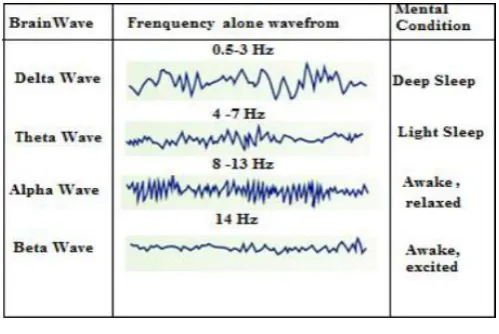
Brain waves frequency that detected in EEG sensor
Fig 2. Brain waves frequency
PURPOSE
Attractive of standard life for the matured and crippled people and produce them the correct consideration at the best possible recommendation is first indispensable jobs must coordinated by us for a responsible individual from the energetic. It's hard for the debilitated and matured people to versatile an automated wheelchair that few of them for the most part use for developments. Anyway there is need to thinking of a wheelchair that is keen and gives clear quality. Further, a shot may make to propose a mind controlled wheelchair that uses the held onto signals from the cerebrum along direct to deal with the wheelchair.
Electroencephalography (EEG) ability deploys an electrode cap kept on forehead for the acquisition of the EEG signals that are seized and covert into results of commands by the Arduino microcontroller which successively forward the wheelchairs. The smart wheelchair could be a wheelchair temporary by an electrical motor controlled with manual joystick. Few folks affected by severe motor disabilities cannot use the joystick, like paralysis and physically disable folks and locked-in syndrome. So that they produce advanced
analysis are created within the last years. During this analysis attempt not solely to present quality to unfit folks however, additional significantly, severally of different party facilitate. New varieties of management ways, will acquire users intention to manage the wheelchair. Even, every sort of different control has its restriction. Wheelchair users among the foremost seen person of the incapacity community; along expertise really huge stage of activity and useful restrictive and even has least instance of employing favourable time. Aged folks cluster with the very best duties of each guide and smart wheelchair use. Wheelchair clients depicting issue in fundamental life quality, and saw in limit. Perilous for the debilitated people and senior people to advance electric wheelchair. Past overview there are great fluctuate of advances that encourage help the crippled impeded people. These administration frameworks are structured help the debilitated people especially. Frameworks are substitution the conventional worked help frameworks. Wheelchair has abilities impressively with spread of direction frameworks close by like utilizing the joystick, contact screen, likewise frameworks dependent on voice acknowledgment. These frameworks anyway utilized with a particular amount of higher body portability. Experiencing bigger level of loss of motion may not utilize these frameworks since they need predictable control. Further increment the way of life of impeded people any, these investigation exertion targets building up a wheelchair framework that moves as per the sign acquired from the neurons inside mind through the therapeutic instrument conductor. EEG associate degree conductor remark won’t to notice electric state within brain. Detect, record, decoding “brain waves” proceed within late 1810s with the invention also exploration of electrical patterns within brains also additionally technology has evolved to alter applications starting from the medical detection of drugs disorders to enjoying amusement managed by brain.
III. PROPOSEDWORK
[image:2.595.46.296.325.492.2]Huge wave are controlling at that time we may active or attentive. Impulses given off by brain tissues is more complicate cast back dissimilar look when they take place in numerous activity within the central nervous system. Physically challenged folks will wear Brain sense headset sitting on a wheel chair. The raw EEG signals is
Fig 3. Architecture Diagram
[image:3.595.48.261.142.339.2]Acquired from the TGAM1 module and transmitted to the HC-05 Bluetooth module which is connected with Arduino. The Attention values Fig 3. is split into different ranges in the Arduino code,
Fig 4.Technical Description
Brainwave signal Fig 4 is measure by Hz and this is separate into bands of not quick, quality also quick signals.
IV. TECHNICALSPECIFICATION 4.1 ARDUINO MEGA
Arduino Mega 2560 has fifty four computerized input/yield pins sixteen simple sources of info, four UARTs , a sixteen Mega HertZ precious stone oscillator, a Universal Serial Bus association, a power jack, an ICSP header, and a reset catch. Fig 5. demonstrates the Arduino Microcontroller Board that utilized as the primary controller of the smart wheelchair.
Fig 5. Arudino Mega
4.2 BLUETOOTH MODULE
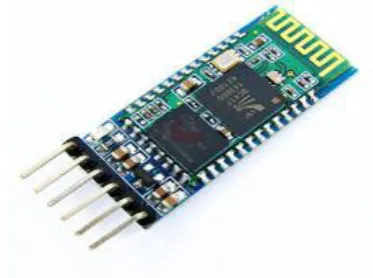
[image:3.595.337.524.350.489.2]Bluetooth module HC-05 is an SLAVE/MASTER separable component. In general factory setting mode is SLAVE. The work of the modules are often organized by Attention COMMANDS. The slave modules can’t begin to affiliation, different Bluetooth, however it will settle for connections. Master modules will originate affiliation with different devices. Person will use it merely for a port replacing to ascertain affiliation varies JY-MCU and Global Positioning System, laptop to our embedded project, etc. Fig 5 shows the HC-05 Bluetooth module.
Fig 6.Bluetooth Module HC-05
4.3 L293D MOTOR DRIVER
L293D Motor Driver could be module for motor are permits with working or operating performance with directing of two motors at same time .These Motor Driver is intended and developed primarily layed on L293D Integrated Circuit has shown in Fig 7..L293D is Sixteen Pin Motor Driver IC. Design may produce bifacial drive currents at voltages vary Five Volt - Thirty six Volt.
[image:3.595.46.296.430.605.2]4.4 TGAM 1 MODULE (NeuroSky)
TGAM1 has configuration pads that can be used to change two default settings that are applied at chip power up. Configuration pads are located on the backside of the TGAM1 has shown in Fig 8. BR0 and BR1 pads configure the output baud rate and data content, after the TGAM1 powers up. The M pad configures the notch alter frequency.
Fig 8. TGAM (Think Gear ASCII Module)
4.5 ARDUINO IDE (Software Specification)
Arduino is partner open supply, component and bundle organization, task, and client network that styles and fabricates microcontroller units for structure computerized gadgets and intuitive articles which will detect and the executive’s questions inside the regular society. The undertaking's product are appropriated as ASCII content document equipment and bundle, that are authorize beneath the wildebeest Lesser General Public License (LGPL) or the GNU General Public License (GPL), permitting the assembling of Arduino sheets and bundle circulation by anybody. Arduino sheets are offered industrially in preassembled type.
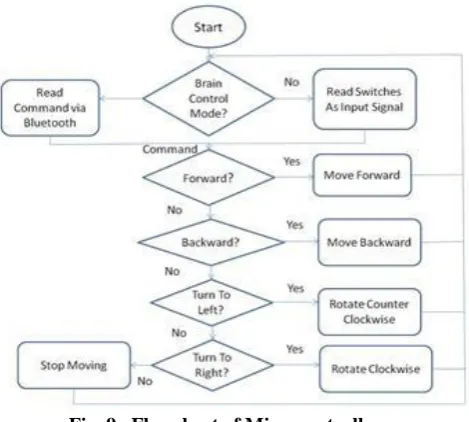
Fig 9 . Flowchart of Microcontroller
According to the range of values the person controls the wheelchair by moving forward, backward, turning left and right. Person can also stop the wheelchair intentionally by blinking the eyes 5-6 times which creates the disturbance to attention values. Fig 8 shows the Architecture Diagram. Arduino is open source software required for the aim of uploading code into Arduino. These can be downloaded and installed such a way it helps most of the operating system
computer is suggested. Eg: 2.6GHz CPU and minimum 8GB memory to be needed. If installation procedure is done the application proceed with algorithm and testing part. Coding part carry existing system into action by changing the design of the application into code in given software side. A massive programming style must be taken and further modification may essential, must be easily screwed with the system. Guideline program may attention on the natural structure and visual of the code. They create the program easy to browse, perceive also manage. The part of the system truly proceed with blueprint analyzed throughout the design section. Coding specification ought be in such a way that any engineer have necessary to perceive the code and may cause changes at any time felt essential.
V. RESULTANDDISCUSSION
[image:4.595.323.527.341.470.2]The EEG raw data is read through Brain sense headwear and the data are transferred to Arduino wirelessly via HC-05 Bluetooth. According to the Attention values from brain sense, the wheelchair moves forward, backward, turns left and right. The IR sensor is installed to stop the wheelchair when any obstacle come across the wheelchair Fig 10. The user can also stop the wheelchair intentionally by blinking the eyes 5-8 times which creates the
[image:4.595.55.290.439.650.2]disturbance to the attention values.
Fig 10. Wheelchair Model and Brain sense
VI. CONCLUSIONANDFUTUREWORK
It’s quite probable that in the future most of our appliances will be control directly through our wishes or the brain and this project stands as an affirmation to that vision. Brainwave from the brain can be further studied and the technology can be refined to bring about more specific results. The scope of the project was primarily to establish the motion through no physical motion on part of the user and it has been successful in doing so but it has also laid a foundation for many applications which would greatly improve the standard of life for all.
REFERENCE
1. EEG Wave Identification in Human Brain with Emotiv EPOC Muhammad N. Fakhruzzamana for Motor Imagery, Edwin R Riksakomara b ,Hatma Suryotrisongkoc.
2. Brainwave based user identification system: A pilot study in robotics environment.Pinki Kumari, Abhishek Vaish.
3. A low-power, wireless, 8-channel EEG monitoring headset Lini dsay Brown, Jef van de Molengraft, Refet Firat Yazicioglu, Tom Torfs, Julien Penders and Chris Van Hoof.
4. EEG Based Brain Controlled Wheelchair for Physically Challenged People. Nikhil R. Folane , R. M. Autee. Vol. 4, Issue 1, January 2016. 5. Design and implementation of brain controlled wheelchair Mehul patel,
Rishikesh Bhavsar, Volume: 04 Issue: 3 | Mar -2017, e-ISSN: 2395 -0056.
6. Smart brain controlled wheelchair and devices based on EEG in low cost for disabled person. M.Akila, K.SathiyaSekar, A.Suresh. Vol 1, Issue 1 April 2015.
7. EEG Controlled Wheelchair. Sim Kok Swee1,a, Kho Desmond Teck Kiang and Lim Zheng You.
8. Activation of a Mobile Robot through a Brain Computer Interface Alexandre O. G. Barbosa, David R. Achanccaray, and Marco A. Meggiolaro.
9. Synchronous EEG Brain-Actuated Wheelchair with Automated Navigation. I. Iturrate, J. Antelis and J. Minguez.
10. Archana Hule, Rekha Bandage, Pratik Shah, Rashmi Mahajan (2015) “android based application for wireless control of wheelchair”, International journal of research in Engineering and Technology (IJRET), Vol-4, Issue- Apr, 2015.
AUTHORSPROFILE
Dr. M. Sivabalakrishnan is currently working as Associate Professor in the School of Computing Science and Engineering at VIT University. He has served in academics sector for more than fifteen years. He received his Doctoral degree in image processing from Anna University. He has published over 25 research papers in various national and international journals & conferences. His areas of interest are image processing, video analytics, database, computer vision, neural networks and fuzzy logic. .