COMMISSION OF THE EUROPEAN COMMUNITIES SCIENCE
RESEARCH AND DEVELOPMENT
SPEAR
Evaluation of Economic Effects:
Relevance and Impacts
of EC-Programmes promoting Industrial R
&
D
with special emphasis on Small
and Medium sized Enterprises
(Pilot methodological study)
tjtf
3
I C>/ ~'-IL/
12; Sf. ~ (c.~~ ??Y )Commission of the European Communities
fvaluation of Economic Effects:
Relevance and Impacts
of EC-Programmes promoting Industrial R
&
D
with special emphasis on Small
and Medium sized Enterprises
,;
(Pilot methodological study)
~ ~
Authors : K. Hornschild F. Meyer-Krahmer Statistical Support : H. Steinke
SJUV·-~-o...6
f
MONITO~EA~
: C.E. de Ia Torre Coordinator-March 1992
Published by the
COMMISSION OF THE EUROPEAN COMMUNITIES Directorate-General
Telecommunications, Information Industries and Innovation L-2920
LUXEMBOURG
LEGAL NOTICE
Neither the Commission of the European Communities nor any person acting on behalf of the Commission is responsible for the use which might be made of the following
information
Cataloguing data can be found at the end of this publication
Luxembourg: Office for Official Publications of the European Communities, 1992 ISBN 92-826-3817-0 Catalogue number: CD-NA-14197-EN-C
© ECSC-EEC-EAEC Brussels • Luxembourg, 1992
CONTENT Page
I Summary and the Most Important Results of the Analyses 1
1.
Fundamentals1
2.
To The Selection of the Aeronautic Industry ?3.
To The Methods 34.
Written and Oral Surveys 75.
The Sub-Programme Aeronautics - Summarized Results of the Analysis 96.
Summary of the Main Results of the Written Survey 177.
Assessment of the Pre-Test 228.
Lessons to be drawn 25II Further Working Plans 31
III The Analyses 35
1.
Aims of the Study and Working Plan 352.
The Contribution of Small and Medium-sized Firmsto Innovation and Their Role in European Community Programmes
- Theoretical Framework 40
3.
Methods and Indicators 493.1
Methods of Evaluation with Special Emphasis tothe Control Group Approach 49
3.2
Indicators of Economic Effects of R&D 554.
BRITE/EURAM Sub-Programme "Aeronautics" 594.1
Aeronautics Industry in Europe 594.1.1
An Overview of the European Aerospace Industry 594.1.2
Peculiarities of the Branches and Effect Hypotheses 104.2
The Programme 734.3 Status of the Programme as at January 1990 78
5.
Empirical Results of the Pilot Phase5.1
Conception of the Survey5.2
Results of the Survey5.2.1
Written Survey5.2.2
Case Studies6.
Annex:6.1 References
6.2 Interviewguideline
1V
536 86
89
89
112
115
1. Summary and the Most Important Results of the Analysis
1. Fundamentals
The objectIves of thIs study are twofo I d. The fIrst objective Is a methodological one, Identification of appropriate methods to evaluate programmes relating to Industrial R&D and testing the feas~bl I lty of one se I ected method. The second objectIve Is to draw some
{pre I lm I nary) I essons on the ro 1 e of sma I I and medIum sized firms In EC-programmes, reasons for participation, expected effects, and the extent to whIch these fIrms take Into account the economic effect of R&D.
The methods for the evaluation of promotion programmes are Intended to be tested as a matter or priority with thIs pI I ot study. Hence, It Is necessary on the outset to give an overview of current evaluation methods. The methods of analysis which are most suitable wl I I then be chosen and tested on a concrete examp I e In the second part of this study.
In order to prec I ude mIsunderstandIngs, It shou I d be noted emphatlcal ly that though answers from the surveys are a I so to be commented on, nonethe I ess thIs served above all, the purpose of portrayal and examination of which prerequisites are needed so that concrete results can be achieved or not by the appl lcatlon of the selected methods. An evaluation of the BRITE/EURAM Sub-programme was neither planned nor Intended, because of
the small sample of firms Investigated. Nevertheless, we
2. Concerning the Selection of the Aeronautic Industry
To test the method, we have chosen the Aeronautic Industry. The rat i ona I e for thIs decIsion Is the fact that It concerns a sma I I and thus a reI at I ve I y easy, comprehensable branch. The hope we pinned on It Is that commendable results can be achieved despite the very low number of enterprises to be Interviewed.
A further aspect was that the Aeronautic Industry looks very suitable for the treatment of the formulation of the relevant questlon of European promotion programmes on technology transfer that involve a stronger participation of smal I and medium-sized enterprises from the "Sma I I Member States". DIfferent techno I ogy areas are being pushed up In this High-Tech-Sector. Thus, this branch meets a prerequisite In this respect: technical know-how f I ows In other areas of the economy of the respective country through the participating enterprises.
The genera I quest I on about the dIvIsIon of I abour In InnovatIon between bIgger and sma I I er enterprIses Is also relevant. Though In the analysed branch the bigger enterprises dominate, this does not mean that smal I and medium-sized enterprises were therefore meaningless. In contrast, It Is to be expected that the enterprises wl I I Increasingly make use of the division of labour for the I ntens If I cat I on of theIr compet it 1 veness. Th 1 s occurs through the expansion of their earnings on International markets and stronger usage of the services of smal 1 and medium-sized enterprises.
Objection to the choice of this branch could be that It portrays many pecul larl'tles and Is, to a certain degree, pol It leal ly Influenced. This Is obviously a significant
~spect On the other hand, It w I I I be InterestIng to know, particularly in view of the further Integration of Europe and European economIc poI Icy and promotIon, how far nat 1 ona 1 1 nterests w I I I be reduced In favour of
Europe~n Interest.
3. Concerning the Methods
It was the cent raJ duty of the study to test the most suitable methods for an evaluation of SME's promotion programmes. In Chapter I I I, the different methods In use wl I I be portrayed:
Control group approach; Econometric approach; Case study approach;
Science and technology Indicators approach; Before/After approach.
The weighing of the methods led to the conclusion that a methods' mix consisting of the control group concept and the app I I cat I on of case studIes shou I d be thorough I y tested In this pilot phase. In the course of this, It appears Important to us to point out clearly that the so I e app I I cat I on of such a concept Is not enough, but valid results can only be achieved when a corresponding work has been done In advance. Most Important I y, an Investigation of the environment In which the evaluation takes place Is needed.
If It Is about a branch of Industry, Its characterizing feature Is, at first, to be worked out. The branch Is to be described In Its national, European or International context. If a techno I ogy stands In the forefront, the expectations on the technology In view of Its Impacts on competItIveness and structure of the economy or enterprises as wei I as the diffusion breadth and velocity are to be described. Beyond the above, national and European promotIon progra'mmes are to be portrayed and- If previous analyses are already aval lable- these are to be commented on. In genera I , the task 1 s to process the aval lable data (both qual ltatlve and quantitative) In such a way that only the conception of the survey which Is essential In determining the aspects of the subject of the analysis are known.
Generally In trans-national analyses, there Is a problem
of compatlbt l l t y of Information. Even more, the
ava I I ab I e statIst I ca I InformatIon for Europe Is often not enough to produce detal led descriptions. This appl les also to the relatively smal I branch of the AeronautIc Industry. A I though bIg enterprIses and bIg projects are reI at I ve I y we I I known, never the I ess the total structure of the branch and the activities, most espec I a I I y of sma I I enterprIses can on I y be sketch I 1 y portrayed because of the missing Information. This means that It Is, as a rule, also necessary for evaluations of European promotion programmes to obtain original Information about the respective existing national areas and the pol lcles which are real I zed therein.
Despite such preparatory stages of the analysis, numerous and partly unremovable obstacles exist. In general, the results of surveys of enterprises are
largely dependent on the Individuals Questioned In the enterprises themselves. This problem Is not very sIgnIfIcant In sma I I enterprIses, because there one Is able to speak to the management. The division of labour Increases with the size of the enterprise. Cor respondIng I y, It w I I I be more d Iff I cuI t to receIve val ld statements for the entire enterprise through surveys. ThIs Is I ess app I I cab I e for the Quant I tat I ve Questions than for Qual ltatlve ones.
The appl lcatlon of the control group which Is so convincing as a theoretical concept Is, however, difficult to realize In practice. Basically, control group means that these enterprIses whIch are In the group have not taken advantage of the promotion programme but corresponds with the group of the promoted enterprises In other most Important variables which determIne the entrepreneur 1 a I behav 1 our. Just the very Question why an enterprise takes an advantage of promotIon and the other does not - shows the a I ready aforement loned problemat lc nature. In addItIon to the above is that, prior to the commencement of the analysis, the determining variables for the constitution of the groups are to be establ lshed without the existence of enough clarity about whether they are decisive for the action or not. Finally, of course, the success of the ana I ys Is depends on the w I 1 I 1 ngness of the enterprises to participate In the survey.
Despite these objections, the control groups• concept
has proved 1 ts usefu 1 ness In the ana I yses whIch the
InstItute for System Ana I ys Is and InnovatIon Research
( IS I ) and the German InstItute for Econom l c Research
(DIW) have executed using this method. Most especially
In the eva I uat Ions of R&D-promotion programmes of the
Feder a I Repub I i c of Germany, the centro I group showed
other behavioural pattern and development courses which
are statistically significant. Of course, these analyses
were based on a very large number of Interviewed
enterprIses. Approximate I y 1, 200 promoted and 800 non,~
promoted enterprises (In the control group) were
questioned.
In the scope of the pI lot study,
would not be expected. Rather,
such a c I ear resu I t
the goal of the
examination Is whether the control group concept Is an
adequate method of analysis by a larger number of
surveyed enterprises. For the choice of the control
group, the following criteria were thus taken Into
consideration:
The size of the enterprises according to the number
of the employees;
"National lty" of the enterprise;
Non-participation on the BRITE/EURAM-programme;
Performance of R&D In the aeronautics area.
The choIce of a def In I te method of ana I ys Is or of a
methods· mix Is dependent on the formulation of the main
underlying Questions, the subject of the analysis, and
finally, the statistical basis of the data or of the
possibility to receive correspondingly statistical
Information.
I'!
The success to be achieved with a method of analysis Is, on the other hand, dependent on the nature of the
execution. What matters very much Is that. most especially by the application of the preferred methods' mix In this context, the environment of the branch to be ana I yzed 1 s correspondIng I y prepared and there shou I d exist knowledge about the characteristics of the branch. Thus, the formu I at I on of the exact objectIves of the questions and the results of the survey can only then be Interpreted accurately on the basis of sound Information.
4. Written and Oral Surveys
The hypotheses are the first important stage towards the formulation of the questions to be asked In the written and oral Interviews. Pretests are Imperative before one Is to begin with an Intensive survey. This applies most especially to written surveys where a once wrongly placed question can no longer be corrected. The information lost can no longer be retrieved. The pretests served both the examination of the practlcabl I lty of the questions (are the questions going to be understandable ?) as wei I as also the examination
·'
of the contents of the questions.
The advantage of written surveys Is the possibility to be ab I e to dIrect standard I zed · questIons to a I arge number of those to be questioned. Compared with Interviews, they are - measured on the number of those questioned -·clearly less personal and time Intensive.
They offer the posslbl I lty of examining In advance the working hypotheses to be defined on a relatively broader basis. Important prerequisites for results which can be used are quest I ens whIch are easy to answer and whIch must a I so convey an Impress I on of goa I or I en tat I on to the enterprises. The enterprises must be aware that problems which are relevant to them are being examined.
The Multlple-Cholce~ethod where approprIate for wrItten surveys.
appl lcable. Is most An at tempt shou I d be made for written surveys to be answered according to the
Multlple-cholce~ethod. Whl le quantities are stl I I, as a ru 1 e, to be IndIcated, quest I ens whIch are open and provide qual ltatlve answers are rarely uti I lzed. In addition, they are very difficult to catalogue and correspondingly poor to Interpret because of their dlsslml larlty. The more varied the questioned enterprises are. the more difficult will. of course. be the standardization. This Is especially true In
I nternat I ona I studIes where the preparedness to of fer
Information and also the aval labl I lty of data Is often different from country to country.
Compared to the wrItten survey. the case studIes have
advantages with respect to complexity and
comprehensiveness. The enterprises are recorded In their tot a I I ty and the reI evant prob I em areas can be worked out. In addition, mistakes In the concept of the survey can at least be corrected partially during the analysis. These type of analyses are of course. very time consuming.
IH
This particularly applies when they take place In an International context. Difficulties In the coordination of appoIntment, I ong trave I I I ng routes and hIgh trave I expenses demand a very careful preparation. Where possible, Institutions close to the selected enterprises should be uti I I zed In undertaking the Interviews.
Those that come Into question In this context are the European Community, Chambers of Commerce, National Economic Promotion Establ lshments and Associations. The analysis which Is presented here had In Itself the support of the European Community and the already existing contacts of the German Institute for Economic Research (DIW), which were very helpful.
5. The Sub-Prograrnne AeronautIcs - Surnnar I zed Resu Its of the Analysis
Basis of Information
First of alI, available statistical Information and ana I yses for the characterIzatIon of the branch were evaluated. Together with the underlying assumptions of the promotion programme, they served the description and formulation of the working hypotheses. Original Information about the bahav I our a I patterns of enterprises and possible effects of the programme were the basis for written and oral surveys.
In the scope of this pi lot study, enterprises In Ire I and, Denmark and the Feder a 1 Repub I I c of Germany were questioned In a written and oral manner.
Twelve enterprises
te I ephone contacts.
located In Ireland,
were
From
two
sent a Questionnaire after
these enterprIses, fIve were
In Denmark and five In the
Federal Repubi lc of Germany.
The choIce was, amongst others, I nf I uenced by the fact
that, firstly, enterprises of a country that has Its own
aeronautic system Industry at Its disposal (Federal
Republ lc of Germany) were Questioned and secondly,
enterprises of the Smal I Member States (Denmark,
Ireland) were represented.
Our first Idea by which only enterprises with less than
500 employees were supposed to be included In the
InQuiry was adapted to include some bigger enterprises
of the eQuipment Industry. This was most especially
necessary for two case studies In the eQuipment
enterprises In the Federal Republ lc of Germany. Thus. I t
was a I so poss I b I e to receIve 1 nformat I on from b 1 gger
eQuipment enterprises about:
the dIvision of I abour between
Industry and the system Industry;
the eQuIpment
the necessary scale of an enterprise In order to be
competitive In the branch;
the dependence of the eQuipment Industry on the
nat i ona I avIatIon programmes and the poss I b I I It I es
to gain a foothold on the International market;
lH
the cooperation posslbl I ltles and forms between
bigger and smaller enterprises of the eQuipment
Industry- partly beyond the national boundaries;
the Importance of the BRITE/EURAM Sub-programme
Aeronautics for these enterprises In view of their
International competitive position.
The Aerospace Industry In Europe
The Aerospace Is a small Industry, measured In terms of
number of emp I oyees and the shares of theIr rea I net
output. However, Importance Is genera I I y attached to
this branch in the I ight of two significant functions It
performs, namely:
National autarchy: In the case of crises, the
Aerospace industry Is supposed to he I p secure the
particular defence capability of the country. The
agr I cuI ture or the energy economy has a sImI I ar
function which, In such a situatIon, Is supposed to
sustain the Independent supply of the country.
Industrial, pol itlcal and tech no I og I ca I : the
Aerospace Industry Is regarded as a techno I og I ca I
key area. This, in Itself, Is already portrayed on a
c I ose exam I nat I on of the research and deve I opment
expenditures (R&D Expenditures): 15% of the total
turnover Is a I 1 otted to R&D. No other IndustrIa I
sector has a similar high relation.
The Aerospace production takes place prlmarl ly In four countries within the European Community: Great Britain, France, Germany and Italy. Other countries Involved are the Netherlands, Belgium and Spain. Measured on the total production, activity In the remaining countries of the European Community Is not significant.
The European Aerospace Industry Is considerably determined by sixteen big system enterprises (prime contractors). The system enterpr 1 ses d I st I ngu I shed themselves through the fact that they developed and produced In theIr respectIve competencIes a I rcrafts or
the so~cal led sybsystems. Because the award of contracts
wIthIn the Aerospace Industry Is often traded on the principle of •buy national•, a very central role for the entIre European Aerospace Industry w I I I fa I I towards these enterprises.
Two exceptional features of the branch, amongst others, must, of course, be considered by an evaluation of the BRITE/EURAM Sub-programme Aeronautics:
EnterprIses be I ow the system I eve I have, In a very limited form, only the possibility to find markets wIth theIr respectIve product Ideas. Instead, they are dependent on the system enterprIses. ThIs, of course, also opens production posslbl I I ties for the supp I I ers through the a I rcrafts and power pI ants produced by them, whereby the product to be deve I oped or supp I I ed must conform wIth the gIven technical reQuirements of the system manufacturer.
(2)
The dependence of the eQuIpment Industry Is st I I I Increased by the relatively respective low multiple variants of the produced alrcrafts or power plants, the I lmlted number of the system enterprises as wei I
as the difficulty of the market entry. To be able to be active as a producer In the area of aerospace, an enterprise must not only acQuire the confidence of the customer, but must also be I lcenced as a producer.
Working Hypothesis
A set of hypotheses about possible effects of promotion and suspected weak poInts by the enterpr I ses must be placed In front of every evaluation of promotion programmes. The hypotheses arise from the goals of the programme
analyses branch.
Itself, as well
experiences as from the
from other pecu 1 I ar It I es
parallel of the
First of alI, a comprehensive description of the programme Itself Including the promotion conditions and Its utI I I zat I on were therefore gIven In the scope of this study. Secondly, a portrayal of the division of I abour In InnovatIon between bIg and sma I I enterprIses or the Innovation behaviour of SMEs took place through evaluation of available literature. Finally, the description of the branch Itself served this goal.
Before one Is to begin with an evaluation of an SME·s re 1 evant promotIon progranme. there must exIst Ideas about the division of roles between bigger and smaller
enterprises .. Results from analyses on Innovation
behaviour of SMEs show that they are, on the one hand, suppl ler of Ideas and they play, on the other hand, an Important role In the diffusion of technologies. Due to the I onger per I od of the • return on Investments • and because of the generally few possibilities to take great risks, small and medium-sized enterprises, In contrast. cannot perform extensive basic developments due to
financial reasons ..
In this connection, the (Neo-Schumpeterlan) Question Is often being asked, who Is more Innovative - bigger or smaller enterprises ? If one considers that smal I enterprises uti I lze market niches and perform often more Important functions as suppl lers to big enterprises, then the conclusion suggests that the Question of who Is more Innovative should be replaced by the thesis of a
size-specific division of labour In Innovation.
WIthIn. an economy, sma 1 I and medIum-s I zed enterprIses have Important functions. Usually, they are more flexible than bigger enterprises and serve smal fer segments of the market. Because they appear as competitors to big enterprises, they Increase the competitive Intensity of the market. They mostly undertake Important suppl ler functions for products which cannot be produced with the same profltabl I lty and
flexlbl I lty for the customers. Due to their spec I I I zat I on In the d I vI son of I abour, they I ncr ease the flexlbl I lty and the efficiency of the total economic system.
Hence, an eff 1 c I ent m 1 xture of sIzes 1 s an Important prerequisite for the Improvement of the competitiveness of the branch or the economy. Also, the Aeronautic Industry appears to us to be a suitable branch for the exam I nat I on of thIs hypothesIs because there an Increasing division of labour between the·enterprlses Is to be expected.
Thus, the developed:
followIng hypotheses are, In genera I ,
Funding of R&D Is a central bottleneck area In the concerned enterprises.
The enterprIses are dependent on cooperatIons wIth enterprises and Institutions which have their seats
In other European countries.
The financial support In the R&D area helps enterprIses In the executIon of the expensIve R&D plans and creates therewith Important prereQuisites
In order to be entrusted, as cooper at 1 on partner, with the solving of specific formulated Questions In
the scopes of bigger projects.
The entry prereQuisites aviation area.
Into for
a the
15
Through the promotion programmes (subJect to stronger engagement In technological superior areas of the aviation), the enterprises receive a supply of knowledge which wl I I generally contribute to the Improvement of the technological competitiveness of the enterprises.
Through the promotion programme, the cooperation within Europe wl I I be promoted beyond the boundaries and wl 11 enhance the fusing together of the national markets Into a European domestic market.
The market entry barrIers are very hIgh for sma I I enterprises In the aviation Industry. This Is especially val ld for enterprises of the "Smal I Member States".
Construction of the Questionnaire
The working hypotheses must be able to be converted Into the conception of the survey. The Questionnaire Is sub-divided Into the following topics:
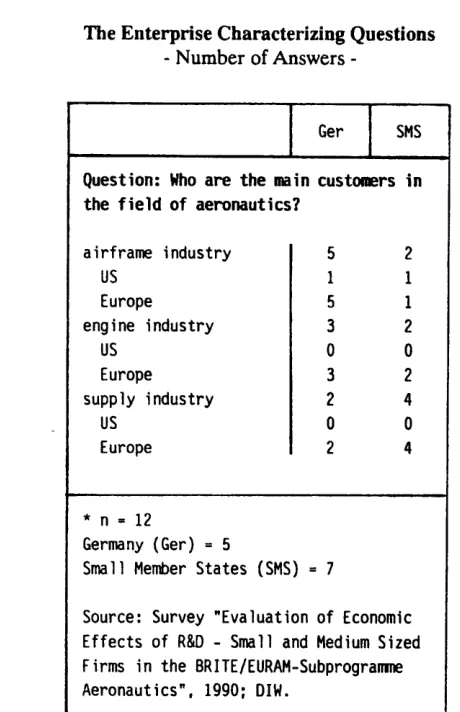
General situation of the fIrm wl th Quest Ions relating to turnover, employment, the most Important customers, the Importance of R&D, the expectation of the market according to production and market segments.
A set of Questions which are only directed to partIcIpants of the BR I TE/EURAM-Programme wIth Questions relating to the Importance of the programme, know I edge of the programme, effects on the strategy of the enterprIses, wIshes regardIng the administration and Improvements of the programme.
Main problems and proposals for Improvement.
In this part of the Questionnaire, alI enterprises were again Questioned about their cooperation behaviours, the difficulties to cooperate Internationally, the central R&D Impediments and the necessary Improvements In this connection.
European Community tasks.
In thIs Quest I on set, both surveyed groups, I . e. , promoted and non-promoted enterprIses were
IntervIewed about theIr vIewpoInts concernIng the most Important duties of the European Community.
6. Summary of the Main Results of the Written Survey
In genera I , the questIonnaIre and the survey concept which was developed here appeared to be suitable. On the one hand, this was obviously due to ~peclal knowledge of the branches whJch stood at the disposal of the DIW In the area of AeronautIcs. Wh I I e on the other hand, the support through the European CommunIty has a I so contributed significantly. Thus, It was possible to be ab I e to achIeve reI at I ve I y good I nterpretab I e resu Its despite the very small sample of the survey.
Compared to the Control group, the results were, however, amb 1 guous. UnambIguous structura I dIfferences could not be establ lshed by the findings of the survey.
1 f thIs Is due to the sma I I number of the surveyed enterprises or If actually there Is no difference, this can only then be answered by a broadening of the survey on a larger number of enterprises.
On the whole, the results of the written survey could be sunmar I zed as fo I I ows: The surveyed German enterprIses were on average more technology-Intensive than the enterprises of the Smal I Member States. They had obviously more leeway for Individual developments In the cooperatIons and had a I so, In hIgher proportIon,
Individual patents at their disposal.
The market entry was a great prob I em for a I I enterprises. Because the enterprises were more engaged In the ml I ltary area, where, of course, they anticipate decl lnlng demand, they had to deviate forcefully to other fIe Ids. The prob I em of armament conversIon Is a topIc whIch concerns many of the European AeronautIc enterprIses. In vIew of the genera I hIgher market entry barriers, It Is going to be difficult to deviate to the clvl I market. Obviously, the enterprises from countries wIthout I nd I vI dua I System Industry have, espec I a I I y In this context, a hard time.
The greatest number of enterprIses we I corned the progranme • s InformatIon of the European COI'IInun I ty and the progranme maintenance even though, measured on the enterprises• strategy, they attached less Importance to the promotion programme.
] ! r
-;i
:·I
I
However, In the area of R&D strategy and for the development of cooperation relationships, the programme
had more significance. Here, the statements corresponded to those of the executed analyses In the Federal Republ lc of Germany whereby the smal I and medium-sized enterprIses prosecutIng R&D sought IncreasIng contact to research establ lshments and other cooperation partners.
He I p was st I I I expected by the enterprIses for theIr problems and, at earliest, from the national governments. Support, above alI, was expected from the European Community by the Initiation of cooperations.
In the differentiation of programme participant and non-partIcIpant, the wrItten survey brought no s 1 gn If 1 cant results. The structure of the answers were almost eQual
In both groups. The reasons for this could be:
The aforementioned problems and behaviours are almost the same by the enterprises of both groups -promoted enterprises and control group. Hence, the utI I I zat I on of promotIon programmes cannot be
Inferred from the tested behavioural specimen.
The case numbers of both groups are too sma I I to enable significant divergences.
Results of the case Studies
On balance, the results of the oral surveys could thus be characterized; the surveyed equipment enterprises had, through the BRITE/EURAM Sub-programme Aeronautics, opened for themselves new cooperation posslbl I l~les.
Thus, support by the Initiation of cooperation was often more Important than the financial assistance. Hence, the support of the European CommunIty was, above a I I , of Importance because It concerned a branch which, In higher degree, was Influenced by the government and In most cases cooperations were entered Into on the basis of traditional business relationships.
The continuation of the programme was, of course, welcomed because the participants hope, on the one side, to be able to gain a stronger foothold on the clvl I area which Is Increasingly gaining Importance. On the other side, there existed the posslbl I lty that development works would be promoted In technologies for which there were no national programmes.
In this way, a specific competitive disadvantage which the enterprises of the Smal I Member States had, In contrast to the big Industrial countries, would be removed. To what extent technologies were also relevant to other areas of the enterprises was not answered through the case studies In the scope of this study.
li
The significant empirical results of the research could be summarized as follows:
The BRITE/EURAM Sub-programme Aeronautics supported the small and medium-sized enterprises In their efforts for trans-national cooperations. In view of the expected structura I a IteratIon In the demand coup I ed wIth the Increasing Importance of the clvl I area as wei I as the growing competitive pressure, such cooperations would
Increasingly be more Important.
As a rule, the small and medium-sized enterprises were not In a posIt I on to Jump the h 1 gher barrIers of the market entry. In the AeronautIc Industry, the dIrect governmental measures made possible the market entry of the enterprises.
In a market In which •buy national• was stl I I the centra I motto. enterprIses of the Sma I I Member States were espec I a I I y dIsadvantaged. ThIs was more va I I d In countrIes whIch have no I nd I vI dua I system Industry at the I r d I sposa I .
The relatively few final products were exclusively produced by enterprIses of the system Industry. Hence the EquIpment enterpr I ses had. on 1 y In a very sma 1 1 proportion. possibilities to open up markets with their own products. They were, In the ru I e, dependent on the cooper at I on wIth enterpr 1 ses of the system Industry.
There was a I so the fact that the market newcomer, Just because of the InadeQuate experience, could hardly be In the position to acQuire price or Qual ltatlve competitive advantage which would enable them to be considered as an
Inevitable cooperation partner.
Thus, the market entry could, In general, only be achieved through a corresponding special lzatlon In certain fields of responslbl I ltles coupled with a simultaneous pol ltlcal support.
EnterprIses of the eQuIpment Industry trIed to create, through more system competence, more freedom within the cooperations. Here, enterprises In countries which have
their own respective System Industry had advantage.
The condItIons of the progranme on whIch enterpr I ses from the Sma I I Member States were to be admItted Into the cooperations, had Increased the chances of the enterprIses of these countrIes to work In the area of aeronautics. The duration of this participation would, however, only be dependent on whether these enterprises were competItIve and If they were rea I I y prepared for cooperation.
7. Assessment of the Pre-Test
In general, numerous clear statements about the effect of BR I TE/EURAM Progranmes In the area of AeronautIcs were able to be made on the basis of a very small survey sample.
This was, of course, only possible because:
the branch .. Aeronautics .. has ana I yzed a I ready before the survey specific features;
22
been accurately
the Commission had supported the survey; and
It concerns a relatively smal I branch which, despite Its varied specifics, wl I I become transparent under the aforementioned prerequisites about the col lectlon of wei 1-almed original Information.
The concept which Is formed from written and oral surveys has. on the whole. portrayed Itself to be very practicable: the questionnaire was, In most cases, wei I answered. This was, at least, the case because the questioned enterprises had been Informed ahead about the goa I and purpose of the survey. A broad I y scattered, highly anonymous written survey would obviously require a questionnaire which would have to be tested In a pre-test. In the present case, thIs procedure Is rep I aced partly by the short telephone conversations with the enterprises as well as the Information from the Commission.
Experience from other Interviews have confirmed that the multiple-choice questions are not always workable. This appl les especially to the questions which are not directly related to the enterprises.
Because of the extensive wl I I lngness of the questioned persons to of fer InformatIon, the IntervIews have contributed towards a better understanding of the branches. IntervIews extended beyond the sItuatIon of the respective enterprise and Included Issues such as:
the basic problems of the branch In Europe; the specific role of the SMEs;
the possible effects of the promotion
of the programme to be evaluated, which were discussed wIth these persons, servIng as a pre-test. Thus, they gave the necessary InformatIon In depth for a better
Interpretation of the written Investigation.
From the pre I lm I nary ana I ys Is resu Its whIch are presented here, one can ascertain, with regard to the estab I I shed hypotheses, that R&D for the SMEs In the area of AeronautIcs has a hIgh cost factor, but thIs cannot be seen as the central bottleneck. In contrast,
the hypotheses have extensively been confirmed In view of
the Importance of International cooperations for the development posslbl I lty of the SMEs In the area of Aeronautics;
the higher market entry barriers;
the sIgnIfIcance of the system IndustrIes and the dependence of the SMEs on these enterprises;
the, at 1 east part I y, st I I I app I I ed pr Inc I pIe "buy national" which means an additional handicap for the enterprises of the Smal I Member States which have no system Industry at their disposal.
The results of the analysis can be summarized as follows: Although the financial support of the enterprIses In the area of R&D created an Important prerequisite for the creation of better cooperation posslbl I I ties for the SMEs, nonetheless, the assistance from the Commission In the Initiation of cooperation were, in general, stl I I assessed as more Important.
The hypotheses could stl 11 not be examined according to the real effects of the promotion programme In view of
the:
Improved technological competitiveness of the promoted enterprises In the area of Aeronautics; technological spl I l-over effects on other production areas 1 n the enterpr 1 ses or on other IndustrIes of the respective countries;
different development of the promoted and non-promoted enterprises;
Improved competitive situation of the branch and the effect on the total economy through the Increasing division of labour, most especially, through the
reinforced participation of SMEs.
In order to be able to achieve such results, the number of the enterprises to be Interviewed would firstly have to be clearly expanded and secondly the analysis' concept about the before/after comparison would have to
be widened.
8. Lessons to be Drawn
A convincing evaluation process which wl I I extensively suIt the theoret I ca I reQuIrements, and whIch Is a I so emp I rIca I I y workab I e, Is not ava I I ab I e. Entrepreneur I a I decisions result from an Interdependent operational network. Hence, the Isolated registration of the effects of promotion measures Is also a very difficult problem to solve empirically as wei I as theoretically.
The e I lm I nat I on of promotIon effects, In fact, of both the Intended as wei I as the non-Intended effects can, at best, be made through a methods' mix In which QUa I I tat I ve and Quant I tat I ve aspects are beIng taken
Into consideration.
The evaluation process has shown Itself to be baslcal ly suitable with the methods' mix:
before/after comparison; control group concept.
By these conceptions what has changed by the enterprises
through the promotIon measure Is beIng compared respectively. First, In the promoted enterprises themselves (before/after comparison), and secondly, through the comparison of promoted and non-promoted enterprises. It Is hereby being assumed from a theoret I ca I vI ewpo 1 nt that a 1 1 a IteratIons are to be traced exclusively to the promotion, and the clause of ceteris paribus Is appl lcable to other variables.
Never the I ess, because of the comp I ex I ty of I nf I uenc I ng var I abIes and pract I ca I reasons, It can be cone I uded that the rigid concept of control group should be .. weakened.. by usIng a comparIson group approach whIch controls only major variables such as size,
country etc. This study shows that Its Implementation Is feasible.
26
i:l
For the evaluation, several Innovation Indicators are to be constructed. Hereby, we Will
firm
be concentrating on level with special Innovation Indicators at
emphasis on economic effects of R&D (see Table).
Innovation Indicators
Input
Throughput
Output
Innovation Indicators at Firm Level
Quantitative
R&D personnel R&D expenses
contract research
innovation stages (costs, risks)
Qua I i tat i ve
impulses for innovation
level of organisation and planning of R&D
learning effects
barriers of innovation
competence for cooperation
patents applied for and granted
revenues by sel I ing patents, I icenses and know-how
innovation intensity
productivity
profits
employment
non-commercial benefits
27
new or improved products, processes and services
aims of innovation
competitive position
A clear empirical result of this study Is, that one should not emphasize too much the economic effects of the promoted R&D projects. The SMEs Investigated usually do not assess their participation In EC R&D projects In economic terms, such as expected rate of return or profit. The major benefit for these firms of an Involvement In EC-programmes are Qual ltatlve ones, such as learning effects {knowledge, management, language), becoming a visible and competent partner for I nternat I ona I cooperatIons, fIndIng new customers and business fields. Therefore we conclude that - at a firm I eve I It Is more va I uab I e and approprIate to assess carefully these Qual ltatlve effects of EC-programmes than using a strong orientation to Quantitative economic terms.
In practice, Information about the determining variables of the considered behaviour of the actors which are to be connected with the measure to be evaluated, have to be collected. Hereto, the following steps are
Imperative:
Analysis of the environment to which the promotion measure Is directed;
Analysis of the promotion measure Itself according to objective and form;
Construction of hypotheses In view of possible effects;
Concept I on of wrItten and ora I surveys {theme of Interview, questionnaire, selection process; construction of the control group);
i
I
(3) I
l
Execution of pre-tests; Feedback of pre-tests'
concept;
results with developed
Wr 1 tten and ora 1 ~ur veys of promoted enterpr· I ses and enterprises of the co"trol group;
Evaluation of the results.
Furthermore, In vIew of rare pract I ca I experIences, the
following additional recommendations for future
Implementation can be raised:
starting evaluation In the early beginning phase of the programme to be Investigated;
Intensive development of the theoretical base;
careful selection of promoted and non-promoted groups of research teams or R&D performing firms; carefu I InterpretatIon of Quant I tat I ve effects wIth special emphasis on Qual ltatlve
I earnIng effects, reasons of
government programmes).
aspects (such participation
as In
Bas I ca I I y, such eva I uat Ions are to be executed In two phases, or, If needed, three phases:
Phase I : It extends up to the eva I uat I on of pre-tests. ThIs report Is restrIcted only to phase I. The outputs of phase
I are:
o va 1 1 d QuestIonnaIres and lntervlew-guldel lnes for col lectlng necessary data for the before/after comparIsons (Annex) and a practical procedure of selection
groups of
and construction of promoted and non-promoted fIrms;
o a preliminary analysis on a smal I sample basis - on relevant effects of EC-programmes In promotIng Industria I R&D, especlall.y within SMEs (Chap. 4 and 5}.
Phase I I: ExtensIve wrItten ana I yses accordIng to the control groups concept.
Phase I I I: This follows when a promotion measure Is to be evaluated at the end. Executions hereto are to take Into account the tIme- I ags of the effects of the before/after comparison.
Experience evaluation execution analysis
shows that the Qual lty Is, In a special degree, of phase I. Hence, the of this evaluation Is
of the entIre dependent on the real preparatory given particular attention. Later corrections are hardly possible.
'',I
!
il
II Further Working Plans
For the execution of the first phase of the analysis of a feasible evaluation of the BRITE/EURAM programme, the choIce of the AeronautIc Industry has, on the who I e, proved to be suitable. However, this Industry Is relatively unsuitable for a second phase of the analysis
In which the control group concept to significant results. Hereto, promoted projects and enterprIses rather too small.
Is supposed to lead the number of the In the programme Is
For the effect of the BR 1 TE/EURAM sub-progranme Aeronautics, two Questions are, above all, of Interest
from the viewpoint of this research:
How the competItIveness of Industry changes Itself and cooperation;
the European EquIpment Its role within the
To what extent this programme contributes to upl 1ft the technological standard of the enterprises of the Smal I Member States and extends the same to the rest of the economy.
Such Investigations were supposed to be executed after the end of the promotion on the basis of the research approach utilised here on the written and oral survey.
In this case, the InQuiry about the end of the progranme should be broadened by the horizon of the findings In a before/after comparison.
If the goal of the second phase Is a general evaluation of BRITE/EURAM, then Industries such as the Mechanical Engineering or selected technologies such as •Materials• shou I d be ana I yzed. The popu I at I on Is I arger In these areas and the concept of the Contro I groups can be better app I I ed. In any case and pr I or to the begInnIng of the study, such as I t Is done here, the actua I
InQuiries, In which the necessary Information for a goal orientated conception of the survey are being processed, should be analyzed first.
The method of analysis In this context shouid be a methods' mix comprising written and oral InQuiries as wei I as the Control group concept. However, the definition of the Control group should thereby be acted on very carefully because It, at least partly, serves as a yardstick for the measurement of the effects of the promotion. A conclusive assessment of the effect of the promotion can, however, only follow after the expiration of the promotion. The evaluation would, thus, have to be supplamented with a before/after comparison.
In this respect, there Is also a very Interesting Question which should be acted upon In the scope of such further analyses. Bigger economies such as the Federal Repub I I c of Germany, In genera I , have at theIr d I sposa 1 a broad field of promotion programmes with which almost alI significant technologies can be promoted In the enterprises. The pre-reQuisite for this, of course, Is a corresponding size and differentiated Industry. Smaller economIes, due to the I ow number of I ndustr 1 a 1 enterprises alone, cannot bring out simi Jar differentiated promotion concepts.
This, however, means that enterprises with locations In bigger economies could have promotion conditioned competitive advantages In different technology areas amongst other,
for this Is Firstly, It since European Commission programmes,
encourage these contortla. The basis suppl led by the subsidiarity principle.
legitimatized the State (government) to Intervene In areas In whIch market fa I I ure exIsts; and second I y, It Is the duty of the European Community to see that the European programmes are subsidiary to the national programmes. For example, It was clear from BRITE/EURAM
that, enterprises In smaller countries would have,
promotion-conditioned, been disadvantaged without such a
Europe-wide promotion. To what extent
promotion-conditioned competitive distortions exist In Europe and to what extent these biases could be reduced through a European promotIon progranme, shou 1 d be exam I ned more Intensively. The enterprises In the Small Member States, above alI, would profit from this suggested adjustment.
1.1
I 1 I The Analysis
1. Alms of the Study and Working Plan This study has two purposes:
a. Analyzing the relevance and effects of EC R&D programmes especially for smal I and medium-sized enterprises. This contains reasons for (non-) partIcIpatIon In EC R&D prograrrmes, type of fIrms and co-operations reached, the effects on firms whIch partIcIpate In the programmes and the Identification of the existence of deficiencies In programme administration.
b. Implementation of new methods of evaluation of EC programmes promoting Industrial R&D. The before/after approach and the control group approach are Important methods In Identifying the Impacts of such pol leles, but both methods, especially the control group approach are difficult to Implement.
Methods such as peer review and blbl lometrlcs are approprIate eva I uat I on methods for bas I c or I ong-term appl led research. In the case of EC programmes promoting IndustrIa I R&D, espec I a I I y If sma I I and medIum-s I zed firms (SME) are Involved, other evaluation methods are needed such as the before/after comparison and the use of control groups. This wl I 1 be discussed In Chapter 3.
Evaluation, as It Is used within this project, means the exam I nat I on and assessment of the ef feet I veness of EC programmes.
The key elements of such an evaluation are analysis of the firms reached (size, sector, Innovational behaviour, the 1 r bott I enecks to co-operate, etc.), the I eve I of techn I ca I and economIc goa I attaInment of a programme and the actual effects achieved, both Intended and unIntended, as we I I as ana I yses of Imp I ementat I on and adm I n s t rat I on . I n v I ew of the t h I n emp I r I ca I back I n g of Impact hypotheses and the assumed bottlenecks of Innovation In Industry, analyses of the conditions underlying each programme are regarded as an Important add It I on a I e I ement of such Impact ana I yses. Verifications of the theoretical considerations of governments and ministerial bureaucracies on which the condItIons and admInIstratIve hand I I ng of promot I ona I Instruments are based, should also be Included In Impact analyses because they constitute the only way of ensurIng that not on I y scIentIsts, but a I so poI It I ca 1 administrators may learn from the results.
To analyze the participation of SMEs In EC R&D programmes and the effects caused by the promotion, the following questions are Important:
what are the reasons for the participation or non-partlclaptlon of SMEs In EC programmes ?
What are the effects on the SMEs which receive EC grants for their
o R&D patents,
0 Improved products,
royalties,
processes and
o competitiveness, sales and employment,
services,
o exports and Imports within EC countries, o abl I lty for cooperation ?
What are the specific surplus effects of an EC promotion?
o LearnIng effects for ( techn I ca I know I edge,
the cooperatIng partners thinking and planning In International dimensions, language etc.),
o Initiation and enforcement of existing relations between the cooperating partners, establ lshment of scientific community and working relations
(contacts, networks),
o Projects, which could only be real lzed on an EC level and are Initiated mainly by the EC programme.
Do SMEs of countrIes wIth a I ess deve I oped Industrial R&D base gain a significant part of EC R&D projects? Is there any decrease In the dIscrepancIes of the IndustrIa I R&D I eve Is In the different EC countries?
To which extent does the promoted EC programme meet the main bottlenecks of Innovation In the SMEs ?
Because of the difficulties to Implement the above-mentioned methods, It seems useful to divide the project
Into two parts: a pilot phase (Phase I) and a phase of more Intensive field research In terms of the numbers of SMEs and the countrIes Invest I gated (Phase I I). ThIs report Is restricted only to Phase I.
Within Phase I, It Is necessary - on the basis of a smal I sample of enterprises - to carefully construct a group of firms promoted and a comparable control group of firms which are non-promoted. Comparable means that these firms are similar with regard to size, product mixture or branch, markets and technological potential.
Furthermore, a careful col lectlon of data Is needed to descrIbe the sItuatIon of both groups of fIrms before
the EC programme started and during Its Implementation.
To ensure homogenlty, It Is useful to restrict the analysis to one EC programme or sub-programme. Because of Its high relevance for SMEs, the BRITE/EURAM I I programme Is an appropriate programme for analyzing the main questions underlying this project and for
Implementing the evaluation methods. To select an approprIate sub-programme the fo I I owIng crIterIa were used: an Industry whIch covers reI evant European perspectives and characteristics. The relation between large and smal I firms within this Industrial branch are a crucial Issue and because of methodological and pragmatic reasons, It should have a sufficient transparency and a low heterogenlty. Therefore, Phase I was restricted to the sub-programme Aeronautics. About 20 firms (promoted as wei I as non-promoted SMEs)
Including national and EC bodies were Interviewed.
Out of the selected countries one (FRG) was character I zed by IntensIve R&D, and a h 1 gh degree of participation within the selected sub-programme. The other se I ected countrIes are sma I I ( 1 reI and, Denmark) and/or represent the opposite case (Greece). The field research In Ire I and, Denmark and Greece receIved substantial help by the national delegates of these countries.
i ij
.I
.I Iii
Main Questions that related to the promoted SMEs were:
How did they learn of the existence of the programme
and Its context? What were the reasons whIch I ed
them to participate In the programme ?
How does the programme fit In with the objectives of
the companies which have appl led for It?
What positive results do they expect from the
research project to be promoted?
Is the International cooperation which Is a central
poInt of the programme a goa I In I tse If or mere I y a
means of attaining their specific objectives?
What progress w I I I be made due to thIs actIvIty:
fl I I lng technological gaps, Insuring competitive
advantage, keeping up with the state of the art?
What do they expect from this research (Qual lty
Improvements, cost reductions, new appl !cations,
better production performance, substitution, etc)?
What spl I l-over-effect do they expect from the
research?
How did they chose their research partners: from
prevIous cooper at I on, meetIngs, because they were
Industrial partners, following EC suggestions?
Have they encountered specific difficulties In
deal lng with their research partners due to the
sharIng of expertIse, I anguage, commmun I cat I on,
research programming or coordination, and their
anticipated sharing of the results?
Do they want to contInue the cooper at I on In thIs
field? Or In other fields?
What specific benefits do they expect from
International cooperation?
2. The Contribution of Small and Medium Sized Firms to Innovation and Their
Role in European Community Programmes • Theoretical Framework
Technological innovation processes comprise the development and· introduction of
process or product innovations. They differ from traditional used methods or products
offered on the market because they exhibit new functional characteristics. Until the
beginning of the 1970's, an overwhelming view was held that technological innovation
processes were executed primarily by big enterprises, while the technological innovation
capability of small and medium sized enterprises was neglected. This opinion is based on
the formulated thesis of Schumpeter on the size-specific difference of innovation
capability. His hypotheses relate to the interrelation between technical development and
the size of enterprises. This, of course, was changed to the so-called
Neo-Schumpeter-Hypotheses through the ensued discussion (see Tabbert, 1974). Thus, big enterprises and
monopolies are frequently been placed on equal level. A whole host of literature has up
to date dealt with the question - which influence the market structure has on innovation
capability? (see as overview Stoneman 1983, Gahlen, Stadler 1986, Dosi 1988). In this
discussion, the influence of the size of an enterprise as well as the role of the prevailing
market structure is often mixed herein. Because both factors are only connected loosely
with one another, it is, however, meaningful to analyse separately the connection of both
factors with the technical change (see Meyer-Krahmer 1989).
In the last years, many empirical studies on innovational behaviour of small and medium
sized enterprises have emerged. The importance of small and medium sized enterprises
in the phase of invention is almost undisputable. Sahal (1983), for example, has shown
in a comparative evaluation of different technical historical studies that a larger part of
discoveries on whose foundation the development of so-called major innovations are
based, were the result of research works of individual inventors or small and medium
sized enterprises. All classes of enterprises participated obviously by the generation of
the origin of major innovations. Up till now, big enterprises were, however, seen as
dominant in the further development of fundamental inventions up to their
commerciali-zation (Freeman et al, 1982).
r:
On the basis of ntany existing studtes (see as overview: Dosi 1988, Meyer~Kt<thmer 1989),
the folloWJng hypotheses on the specific roles of small and medium sJ.zed entc~rises in the innovation process are been established here: A general supenority of big or small enterprises in the invention and innovation process is not ascertainable 1n the course of
the discussion on the Neo-Schumpeter-Hypoche.;ses. However, It appears mo1e meaningful
to proceed from a division of labour between b1g and smaH enterpnses wtnch are, most especially, related to the market potential, the novelty of innovations and thc.ir doseness
to the available product programme, and the extent in which smaU and tne.dium sized
enterprises participated in inventions and incremental innovations, but not on ~'major
innovations".
Innovations in small and medium sized enterprises are determined to a great extent by
the market. Flexibility and swift reactions on demand are, at the same time, both
compulsion and comparative advantage for these enterprises. They operate or act
predominantly on market niches. Furthermore, they compete rather over quality than
over price competition on markets in which they stand in competition with big
enterprises. The priority area of R&D activities of small and medium sized enterprises
is in the area of development, while research, in a closer sense, is almost exclusively
executed by big enterprises. While all sizes of enterprises participated in the generation
of origin of major innovations, big enterprises dominate, however, in the further
development of fundamental inventions up to their commercialization.
Innovating small and medium sized enterprises play not only an important role in the
invention phase, but also by the diffusion of complex basic technologies. The diffusion
of such technologies portrays a permanent process of adaptation and further
develop-ments on different application areas and market segdevelop-ments in which small and medium
sized enterprises play individual roles. Innovating small and medium sized enterprises
depict, in this connection, an important target group when government policy wants not
only the emergence but the increase of the speed of the spread of complex basic
technologies.
The innovation activity is not only determined through the sizes of the enterprises, but
also through the phase of the life cycle of the products. In support of the product life
cycle-Model, Abernathy, Utterback (1978, 1982) try to link the dynamics of product and process innovations with the development histories of enterprises and product lines.
Product and process innovations take place in dependence on the respective stage of
development and the course of the life cycle of a product line in periodical shift. In
dependence on the increasing production volumes, Figure 2/1 depicts the typical ideal
frequency of product and process innovations per time unit. The depicted cycle varied
in duration according to the sector of the industry. It can last, for example, 70 years in
automobile industry and 20 years in the electronics industry.
The approach of Abernathy and Utterback is easily compatible with our hypothesis of
division of labour between big, small and medium sized enterprises in the innovation
area. SME play a special role in the formation phase of a product line and they show a
high innovation rate. They can either survive through niches strategies or can be
displaced by bigger enterprises in the further course of the product life cycle. Solution
strategies, therefore, remain the early change to other product lines or technologies.
Enterprises with many product lines can compensate the fluctuations through a skilled
product" portfolio-management. If one introduces size-specific considerations in the
product life cycle model, it can be shown that small and medium sized enterprises can
choose between different strategies. Due to a niche and delivery strategy, a relatively
stable position or a rather temporary state can be reached with a "First-Mover" or high
technology strategy (see Thierstein 1987). As long as governmental technology policy
restricts itself to an R&D-promotion, it will reach predominantly such small and medium
sized enterprises which move themselves on market niches for technology intensive plants
and investment goods or in new developed areas such as electronics, chemical, new
processing techniques, material, energy and environmental technique. Such a policy will
reach, to a less extent, small and medium sized enterprises in traditional industrial areas
or the group of delivery companies.