AAEE2017CONFERENCE
Manly, Sydney, Australia
Explicitly teaching teamwork and written communication
within a problem based curriculum: Development of a
generalised framework
David W Holmesa; Michelle Lasenb.
School of Chemistry, Physics and Mechanical Engineering, Queensland University of Technology, Brisbane, QLD, Australiaa, Learning, Teaching and Student Engagement, James Cook University, Cairns, QLD, Australiab
Corresponding Author Email:[email protected]
SESSION
C1: Integration of theory and practice in the learning and teaching process
CONTEXT
Recent years have seen the growing importance of employability skills for engineering graduate success. Beyond disciplinary specific capabilities, employers increasingly expect graduates to be proficient in skills that are transferable across employment contexts; specifically, “the ability to communicate, collaborate and operate effectively within an industry environment” (Deloitte Access Economics, 2014, p. 3). However, there are concerns that current undergraduate programs, both in Australia and internationally, are producing graduates without the requisite proficiency in employability skills to flourish in their profession. According to the European Commission (2015), “the successful development of [employability] skills requires an education system capable of preparing students through more active and problem-based learning approaches, using assignments from the ‘real world’ and including support for risk taking and creativity” (p. 4). Nonetheless, within a problem based curriculum, skills development must be explicit. In particular, teamwork skills are “not likely to emerge spontaneously” (Hughes and Jones, 2011, p. 60). Effective implementation of explicit skills
development within a problem based learning environment (PBL) remains an open research question.
PURPOSE
This paper reports on the development of a generalised pedagogical framework for explicitly scaffolding written communication and teamwork skills within a PBL curriculum.
APPROACH
Over several years, employability skills development within an Australian mechanical engineering degree program was evaluated using curriculum mapping, student performance, and staff and student feedback. This evaluation reviewed employability skills needs of graduates, and investigated why such skills were being underdeveloped within the curriculum, despite widespread application in learning and assessment tasks. Evaluation findings informed the development of a pedagogical framework,
designed to explicitly address the employability skills shortfall within a PBL curriculum.
RESULTS
The study highlighted that the development of written communication and teamwork skills were largely assumed within the engineering degree program. Learning modules or experiences devoted to
developing these skills were either rare (as with written communication) or largely absent (as with teamwork). Additionally, many large projects utilising these skills comprised a single, culminating assessment task, without opportunity for students to reflect on skills development or apply instructor feedback from one task to the next. Hence, a PBL subject structure was developed, integrating explicit instruction on written communication and teamwork, and allowing scaffolded reflection and
performance enhancement within a single teaching period to assure learning.
CONCLUSION
The PBL framework intentionally scaffolds written communication and teamwork skills within a single subject, making possible accelerated and contextualised employability skills development. This framework has applicability across subjects, year levels and disciplinary contexts.
KEYWORDS
Introduction
International trends in higher education have seen growing emphasis on embedding employability skills within curriculum (Arkoudis, Baik, Bexley, and Doughney, 2014; Scott, 2016; Yorke, 2006; Yorke and Knight, 2006). Beyond disciplinary-specific knowledge and skills, graduates are increasingly expected to be proficient in a range of skills that are widely applicable and transferable across employment contexts and suitable for life-long learning (Matthews and Mercer-Mapstone, 2016; Office of Parliamentary Counsel, 2015). Recent research into Australian employer perceptions revealed the critical role of employability skills for STEM graduates – in particular, “the ability to communicate, collaborate and operate effectively within an industry environment” (Deloitte Access Economics, 2014, p. 3). Nonetheless, there remain concerns both within Australia and worldwide that current undergraduate programs are producing graduates without the requisite proficiency in employability skills to be successful in their profession (Arkoudis and Doughney, 2014; Norton, Sonnemann, and Cherastidtham, 2013; Shah and Nair, 2011). The 2014 European Union (EU) Skills Panorama report highlighted findings from employer surveys, indicating that a proportion of STEM graduates exit universities under-skilled in communication, team-working and time management and organisational skills (European Commission, 2015, p. 4). The current shortfall in employability skills development has led to broad calls and legislative imperatives for curriculum reform (Office of Parliamentary Counsel, 2015). Systematic approaches to teaching and assessing such skills within the context of the discipline,
however, present challenges for academics (Arkoudis and Doughney, 2014; Arkoudis, 2014; Matthews and Mercer-Mapstone, 2016). Widening participation in higher education has meant that academics engage students with more diverse educational backgrounds and levels of preparedness for academic studies (Arkoudis and Doughney, 2014; Norton et al., 2013). While the research literature indicates that academics are concerned about their students’ communication skills, they do not believe they have the time and expertise to address explicit skills development within curriculum (Baik, 2010; O’Loughlin and Arkoudis, 2009). More holistic pedagogies appear to be needed but their implementation cannot come at the expense of the disciplinary-specific fundamentals that underpin any career in STEM. According to the European Commission (2015), “the successful development of
[employability] skills requires an education system capable of preparing students through more active and problem-based learning approaches, using assignments from the ‘real world’ and including support for risk taking and creativity” (p. 4). The implementation and benefits of active learning pedagogies for disciplinary-specific skills development in the STEM fields are well documented (de Graaff, 2004; Frank, Lavy, and Elata, 2003; Mills and Treagust, 2003). Active approaches like problem based learning (PBL) have been shown to improve student engagement, student achievement, and skills retention (Freeman et al., 2014; Prince, 2004). However, an intrinsic link between PBL and improved employability skills, such as communication and teamwork, is less well established.
Kashefi, Ismail, and Yusof (2012) investigated the effectiveness of blended learning strategies, including active group tasks, on developing communication and teamwork skills within a multivariable calculus engineering subject. While they identified a modest
improvement in students’ communication skills throughout the subject, they saw no
2013; Mort and Drury 2012) and teamwork skills (Hughes and Jones, 2011; Loughlin, 2013; Loughry, Ohland, and More, 2007; Page and Donelan, 2003; Riebe, Roepen, Santarelli, and Marchioro, 2010). While syllabus level frameworks like the CDIO (Crawley, Malmqvist, Lucas, and Brodeur, 2011) outline best practice with respect to a PBL focussed engineering curriculum, there remains a gap in the research on how to specifically structure effective employability skill development within a single PBL subject.
The development and evaluation of a pedagogical framework that specifically embeds formal written communication and teamwork skills development within a problem based curriculum will be the focus of this paper. The framework has been developed and implemented within a first-year introduction to engineering subject, but has applicability across university subjects, disciplines, and year levels. The remaining sections of this paper detail the curriculum evaluation that led to the development of the framework, outline the framework itself, and provide preliminary conclusions on the effectiveness of the approach.
Curriculum Evaluation
The pedagogical framework developed in this work emerged and evolved over several years in response to specific skills gaps identified within the curriculum of an Australian mechanical engineering degree program. The skills shortfall was highlighted by the significant challenges many later-year engineering students experienced when undertaking team-based project work, despite having completed numerous team-based learning tasks in preceding subjects. Challenges largely arose due to poor application of fundamental teamwork skills, including communication; time, task, and document management; and meeting organisation protocols. It became apparent that the requirement for students to work in teams throughout their degree was not sufficiently building their capacity for effective teamwork.
Upon further inspection, it was also apparent that elements of written communication skills development were implemented unsuccessfully throughout the curriculum. Unlike teamwork skills, modest improvements in written communication were evident during progression, but these improvements were considerably less than expected given the prevalence of written assessment throughout the program. It became clear that the strategies employed to develop key employability skills within the mechanical engineering program were either ineffective or inefficient, and further investigation was needed.
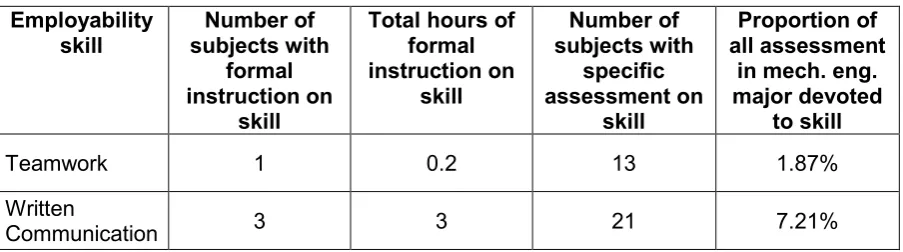
[image:3.595.74.526.638.764.2]As part of a whole-of-program review, a detailed mapping exercise was carried out following the process of Holmes, Sheehan, Birks, and Smithson (2017). Metrics relevant to teamwork and written communication skills development are highlighted in Table 1. A significant disconnect between instruction and assessment is evident. In addition, it was found that assessment of teamwork and written communication occurred through many small tasks or elements of larger tasks, with limited opportunity for deep and authentic evaluation of skills development. The mapping exercise highlighted a clear need to better align instruction and assessment within subjects, and to develop and assure skills in a progressive and coherent way across the whole-of-program (Nightingale, Carew, and Fung, 2007; Orey, 2010).
Table 1: Curriculum mapping results specific to teamwork and written communication skills development (based on evaluation of the 28 subjects in the mechanical engineering major).
Employability
skill subjects with Number of formal instruction on
skill
Total hours of formal instruction on
skill
Number of subjects with
specific assessment on
skill
Proportion of all assessment
in mech. eng. major devoted
to skill
Teamwork 1 0.2 13 1.87%
Written
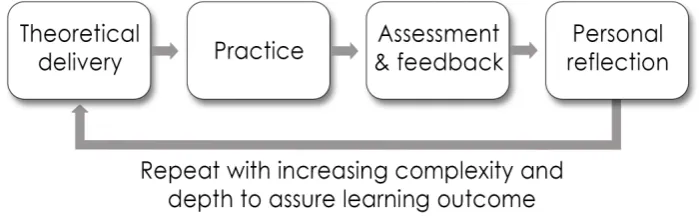
Learning experiences typically unfold in stages. Hughes and Jones (2011) identified teaching, practice, and feedback stages. Fink (2013) outlined an holistic view of active learning, involving three aspects: i) information and ideas, ii) experiences, and iii) reflection. Combining these elements, we propose the recursive four-stage process of Figure 1. Here, theory, practice, assessment and feedback, and reflection are identified as key elements of learning. Notably, the repetition of the learning process realises increasing complexity and depth. In this way, scaffolding of a skill or competence is achieved.
Figure 1. Flowchart representing an effectively staged and scaffolded learning process. Importantly, within many subjects in the focal mechanical engineering program, assessment of skills was observed to occur through a single culminating assessment task (such as a project). While the full recursive learning cycle was assumed by academic staff to be occurring over a sequence of multiple subjects, there was little evidence to support this assumption. Both the findings of the curriculum review (Table 1), and the skills gap
demonstrated by later-year students suggested to the contrary. As such, it was determined that curriculum changes were necessary to ensure appropriate skills development, and that intentional and effective scaffolding should feature as a key aspect of the redevelopment. While comprehensive, program-wide redevelopment was attractive, it was infeasible in the context. Instead, improvement of key subjects was chosen as the most effective solution. In the first instance, the first-year introduction to engineering subject was chosen for
redevelopment to address the skills shortfall and better prepare students to successfully engage with subsequent program work. Problem based learning (PBL) (Mills and Treagust, 2003) was chosen as the primary pedagogical approach for the subject. In the process, a generic framework for scaffolding teamwork and written communication skills within any single PBL subject emerged; the framework is presented in the following section.
Pedagogical Framework
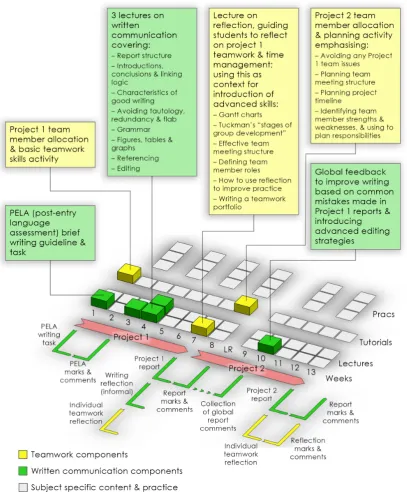
The proposed pedagogical framework intentionally scaffolds teamwork and written communication skills development alongside the disciplinary-specific content of a PBL
Figure 2. PBL subject structure for explicit scaffolding of written communication and teamwork skills (note LR refers to lecture recess and is a mid-semester break from formal teaching). The two projects are intentionally staged in terms of the level of instructor guidance provided, and the complexity of the tasks. Classes are used to guide students through each project phase explicitly. In the case of a first-year implementation of the framework, a diagnostic post-entry language assessment (Arkoudis, 2014) is a valuable starting point to identify students that need additional writing assistance at the outset. Throughout the first project, an introduction to basic teamwork skills session is provided, and a set of written communication skill lectures is given in the middle of the timeline, as students are beginning to write their project report. Upon completion of project 1, a dedicated lecture instructs students on how to reflect on their performance, particularly in terms of teamwork, as well as to provide tools to improve the effectiveness of team meetings, management, and distribution of labour (see Loughry et al. 2007; Page and Donelan, 2003; Riebe et al. 2010; Woods et al. 2000). The students must also write an individual teamwork reflection focussing on their own
For project 2, students are assigned new teams and given an opportunity to formally plan with their new team members how to capitalise on teamwork successes, and avoid the mistakes, of the first project. Project 2 focusses on a more complex and demanding task but may follow a similar procedure to project 1. Students are expected to demonstrate a higher level of creativity and independence compared to the first project and, as such, classes focus on advanced topics and skills. Importantly, feedback on the first project report is used as a mechanism to improve students’ written communication skills in the second report. In addition to marks and comments provided for the first project report, a global feedback lecture is given identifying common mistakes and areas for improvement. Advanced editing skills are also outlined at this point (note, editing is generally observed as the area needing the greatest improvement after the first report). Again, this lecture is provided as students enter the writing phase of project 2. Upon project completion, students again submit a team report and a formal individual reflection on their personal teamwork performance. In this case, both the group report and individual reflection are marked and comments provided. Assigning individual marks for group-based activities is a major challenge for academics and a cause of anxiety and animosity among students (Colthorpe et al. 2013; Riebe et al. 2010). In the proposed framework, marks are determined differently for the two projects. Given that the first project is heavily guided, and students complete much of the work during class time, each student in a team is assigned the same report grade (assuming sufficient class
attendance). For the second project, which is conducted predominantly outside of class time, students complete a weekly timesheet detailing their project-related work hours. Each
student must have their timesheets signed-off by all other team members on a weekly basis. Individual marks are calculated by scaling the group report mark based on individual
contributions. This scaling sees hard working students receive higher marks, and less committed students, lower marks. Scaling can be simple and based on cumulative hours alone, or complex and based on hours contributed to an aspect of the project and the weighting assigned to that aspect. The introduction of a mechanism to identify and manage relative commitment and investment on the part of individual team members, and to provide assurances that those who complete the most work will achieve the best mark, ameliorates underlying animosities that accompany teamwork, or at least identifies and addresses tensions early. Timesheets also mirror how work is often measured in professional practice, adding a further ‘real-world’ feature to project activities.
The distinguishing feature of the proposed framework is the embedding of two complete cycles of the learning process, depicted in Figure 1, within a single subject. All four learning elements (i.e. theoretical delivery, practice, assessment and feedback, and reflection) are contained within each project cycle. So too, the enhanced complexity of project 2 ensures a scaffolding of targeted employability skills. Similar scaffolding and impact on student learning and achievement can be realised for the discipline-specific dimensions of the project work.
Conclusions
Implemented within a first-year introduction to engineering subject, initial evaluation of the developed PBL framework has seen it accelerate development of both employability and disciplinary-specific skills. While student consultations to address group issues had been common in the past, the improvement in student team skills has resulted in far less need for instructor intervention. In terms of written communication skills, clear improvements in quality, editing, and conciseness have been observed, with an evident increase in the class average mark for project 2. Quality of design work also consistently exceeds expectations. An enhanced student experience has also been observed with significant improvement in formal student survey scores, and excellent informal feedback on teamwork and the group projects generally. Formal evaluation of the effectiveness of the proposed pedagogical framework is presently underway and will be published in the future.
outcomes. While currently in pilot implementation among the authors, the framework has also been packaged as an institutional exemplar of good practice within JCU professional development activities [link]. In this context, the approach has been positively received by academics from across the university, and enthusiasm is frequently expressed for a PBL structure that is conceptually simple and effective in employability skill development. The framework developed in this work has been found to be a powerful way to deliver employability and discipline-specific skills development within a single PBL subject.
References
Arkoudis, S. (2014). Integrating English language communication skills into disciplinary curricula: Options and strategies. Office for Learning and Teaching. Retrieved from
http://www.cshe.unimelb.edu.au/arkoudis_fellowship
Arkoudis, S., Baik, C., Bexley, E., & Doughney, L. (2014). English Language Proficiency and Employability: Framework For Australian higher education institutions.
Arkoudis, S., & Doughney, L. (2014). Good practice report - English language proficiency. Office for Learning and Teaching. Retrieved from
http://melbourne-cshe.unimelb.edu.au/__data/assets/pdf_file/0004/1489162/GPR_English_language_2014.pdf Baik, C. (2010). Assessing linguistically diverse students in higher education: A study of academics
beliefs and practices. University of Melbourne.
Colthorpe, K., Rowland, S., & Leach, J. (2013). Good practice guide (science): Threshold learning outcome 4 - Communication. Office for Learning and Teaching. Retrieved from
http://www.biosecurity.govt.nz/files/regs/animal-welfare/pubs/naeac/guide-for-animals-use.pdf Crawley, E. F., Malmqvist, J., Lucas, W. A., & Brodeur, D. R. (2011). The CDIO syllabus v2.0. An
updated statement of goals for engineering education. In Proceedings of 7th International CDIO Conference. Copenhagen.
de Graaff, E. (2004). Active learning in engineering education. In U. Domínguez (Ed.), New methods and curricula in engineerng education in a new Europe: proceedings of the International Symposium (pp. 99–105). Valladolid.
Deloitte Access Economics. (2014). Australia’s STEM workforce: a survey of employers. Retrieved from http://www.chiefscientist.gov.au/wp-content/uploads/DAE_OCS-Australias-STEM-Workforce_FINAL-REPORT.pdf
European Commission. (2015). EU Skills Panorama (2014) STEM skills Analytical Highlight. Retrieved from http://skillspanorama.cedefop.europa.eu/sites/default/files/EUSP_AH_STEM_0.pdf
Fink, L. D. (2013). Creating significant learning experiences: An integrated approach to designing college courses. San Francisco, CA: Jossey-Bass.
Frank, M., Lavy, I., & Elata, D. (2003). Implementing the project-based learning approach in an academic engineering course. International Journal of Technology and Design Education, 13(3), 273–288. http://doi.org/10.1023/A:1026192113732
Freeman, S., Eddy, S. L., Mcdonough, M., Smith, M. K., Okoroafor, N., Jordt, H., & Pat, M. (2014). Active learning increases student performance in science, engineering, and mathematics. Proceedings of the National Academy of Sciences, 111(23), 8410–8415.
http://doi.org/10.1073/pnas.1319030111
Holmes, D. W., Sheehan, M., Birks, M., & Smithson, J. (2017). Development of a competency
mapping tool for undergraduate professional degree programmes, using mechanical engineering as a case study. European Journal of Engineering Education, 1–18.
http://doi.org/10.1080/03043797.2017.1324404
Hughes, R. L., & Jones, S. K. (2011). Developing and assessing college student teamwork skills. New Directions for Institutional Research, 2011(149), 53–64. http://doi.org/10.1002/ir.380
Loughlin, W. (2013). Good practice guide (Science): Threshold learning outcome 5 - Personal and professional responsibility. Office for Learning and Teaching.
Loughry, M. L., Ohland, M. W., & More, D. D. (2007). Development of a theory-based assessment of member effectiveness. Educational and Psychological Measurement, 67(3), 505–524.
http://doi.org/10.1177/0013164406292085
Matthews, K. E., & Mercer-Mapstone, L. D. (2016). Toward curriculum convergence for graduate learning outcomes: Academic intentions and student experiences. Studies in Higher Education, 1–16. http://doi.org/10.1080/03075079.2016.1190704
Mills, J. E., & Treagust, D. F. (2003). Engineering education - Is problem-based or project-based learning the answer? Australasian Journal of Engineering Education, 3(2), 2–16. Retrieved from http://www.aaee.com.au/journal/2003/mills_treagust03.pdf
Mort, P., & Drury, H. (2012). Supporting student academic literacy in the disciplines using genre-based online pedagogy. Journal of Academic Language and Learning, 6(3), 1–15. Retrieved from http://www.journal.aall.org.au/index.php/jall/article/view/173/151
Nightingale, S., Carew, A., & Fung, J. (2007). Application of constructive alignment principles to engineering education : Have we really changed?
Norton, A., Sonnemann, J., & Cherastidtham, I. (2013). Taking university teaching seriously. Grattan Institute. Retrieved from https://grattan.edu.au/wp-content/uploads/2013/07/191_Taking-Teaching-Seriously.pdf
O’Loughlin, K., & Arkoudis, S. (2009). Investigating IELTS exit score gains in higher education. International English Language Testing System (IELTS) Research Reports, 10, 1–86. Retrieved from http://search.informit.com.au/documentSummary;dn=103206472024767;res=IELHSS Office of Parliamentary Counsel. (2015). Tertiary Education Quality and Standards Agency Act 2011:
Higher Education Standards Framework (Threshold Standards) 2015, (73), 1–154. Retrieved from https://www.legislation.gov.au/Details/C2015C00622/Download
Orey, M. (2010). Emerging perspectives on learning, teaching, and technology. CreateSpace. Page, D., & Donelan, J. G. (2003). Team-building tools for students. Journal of Education for
Business, 78(3), 125–128. http://doi.org/10.1080/08832320309599708
Prince, M. (2004). Does active learning work? A review of the research. Journal of Engineering Education, 93(3), 223–231. http://doi.org/10.1002/j.2168-9830.2004.tb00809.x
Riebe, L., Roepen, D., Santarelli, B., & Marchioro, G. (2010). Teamwork: Effectively teaching an employability skill. Education + Training, 52(6/7), 528–539.
http://doi.org/10.1108/00400911011068478
Scott, G. (2016). Transforming graduate capabilities and achievement standards for a sustainable future. Office for Learning and Teaching. Retrieved from
https://akoaotearoa.ac.nz/mi/node/12865
Shah, M., & Nair, C. S. (2011). Engaging with quality: Quality assurance and capacity building in private higher education. In Australian Quality Forum (pp. 138–144). Melbourne, Australia: Australian Universities Quality Agenc.
Woods, D. R., Felder, R. M., Rugarcia, A., & Stice, J. E. (2000). The future of engineering education III. Developing critical skills. Chemical Engineering Education, 34(2), 108–117.
Yorke, M. (2006). Employability in higher education: What it is, what it is not. Learning and Employability Series, 1. Retrieved from http://hdl.voced.edu.au/10707/136159
Yorke, M., & Knight, P. T. (2006). Embedding employability into the curriculum. Learning and Employability Series, 1. Retrieved from http://hdl.voced.edu.au/10707/185821
Acknowledgements
AAEE2017CONFERENCE
Manly, Sydney, Australia
Student Expectations:
The effect of student background and experience
Brent Phillips1, Trudy Harris1, Lynette Johns-Boast2
1Waikato Institute of Technology; 2Australian National University
CONTEXT
The perspectives and previous experiences that students bring to their programs of study can affect their approaches to study and the depth of learning that they achieve (Prosser & Trigwell, 1999; Ramsden, 2003). Graduate outcomes assume the attainment of well-developed independent learning skills which can be transferred to the work-place.
PURPOSE
This 5-year longitudinal study investigates factors influencing students’ approaches to learning in the fields of Engineering, Software Engineering, and Computer Science, at two higher education institutes delivering programs of various levels in Australia and New
Zealand. The study aims to track the development of student approaches to learning as they progress through their program. Through increased understanding of students’ approaches, faculty will be better able to design teaching and learning strategies to meet the needs of an increasingly diverse student body. This paper reports on the first stage of the project.
APPROACH
In August 2017, we ran a pilot of our survey using the Revised Study Process Questionnaire (Biggs, Kember, & Leung, 2001) and including some additional questions related to student demographics and motivation for undertaking their current program of study. Data were analysed to evaluate the usefulness of data collected and to understand the demographics of the student cohort. Over the period of the research, data will be collected using the
questionnaire and through focus groups and interviews.
RESULTS
Participants provided a representative sample, and the data collected was reasonable, allowing the questionnaire design to be confirmed.
CONCLUSIONS
At this preliminary stage, the study has provided insight into the student demographics at both institutes and identified aspects of students’ modes of engagement with learning. Some areas for improvement of the questionnaire have been identified, which will be implemented for the main body of the study.