Turbo Decoding and Detection
for Wireless Applications
Future iterative receivers will be designed using EXIT charts for
near-capacity operation over dispersive wireless channels at
the lowest possible complexity and delay.
By
L a j o s H a n z o
,
J a s o n P . W o o d a r d , and P a t r i c k R o b e r t s o n
ABSTRACT
|
A historical perspective of turbo coding and turbo transceivers inspired by the generic turbo principles is provided, as it evolved from Shannon’s visionary predictions. More specifically, we commence by discussing the turbo principles, which have been shown to be capable of performing close to Shannon’s capacity limit. We continue by reviewing the classic maximum a posteriori probability decoder. These discussions are followed by studying the effect of a range of system parameters in a systematic fashion, in order to gauge their performance ramifications. In the second part of this treatise, we focus our attention on the family of iterative receivers designed for wireless communication systems, which were partly inspired by the invention of turbo codes. More specifically, the family of iteratively detected joint coding and modulation schemes, turbo equalization, concatenated space-time and channel coding arrangements, as well as multi-user detection and three-stage multimedia systems are highlighted.KEYWORDS
|
Maximuma posteriori Probability (MAP) algo-rithm; performance of turbo codes; turbo coding; turbo equalization; turbo multiuser detectionI .
I N T R O D U C T I O N
In his legendary contribution Shannon set out the performance limits of channel coding and modulation schemes as early as 1948 [1]. However, apart from Galleger’s radical idea of low density parity check
(LDPC) codes disseminated as early as 1962 [2], [3], no schemes were capable of approaching Shannon’s capacity limits until the genesis of turbo codes in 1993 [4], [5]. It remains a mystery, why the appealing concept of exploiting the so-called extrinsicinformation provided by the surrounding bits of a bit-stream for any bits in the stream remained largely unexploited before the invention of turbo codes.
The now classic turbo-coding scheme is based on a composite codec constituted by two parallel concatenated codecs. Since their invention, turbo codes have evolved at an unprecedented pace and have reached a state of maturity within just a few years due to the intensive research efforts of the turbo coding community [6]–[10]. As a result of this dramatic evolution, turbo coding has also found its way into standardized systems, such as, for example, the recently ratified third-generation (3G) mobile radio systems [11]. Even more impressive perfor-mance gains can be attained with the aid of turbo coding in the context of video broadcast systems [12], where the associated system delay is less critical than in delay-sensitive interactive systems.
Following the above brief introduction, let us now focus our attention on a more detailed discussion of turbo coding in Section II, considering the classic turbo encoding and iterative decoding scheme, leading on to a discussion on the effects of various codec parameters on the achievable codec performance. A range of sophisticated iteratively detected wireless communications systems is proposed in Section III. More specifically, amongst a range of other schemes, turbo trellis-coded modulation is used in many of the schemes considered, leading on to turbo equalization,1turbo multi-user detectors (MUDs) designed Manuscript received May 13, 2006; revised January 16, 2007. This work was
supported in part by the European Commission, in part by EPSRC, U.K., and in part by the Virtual Centre of Excellence in Mobile Communications, U.K.
L. Hanzois with the School of Electronics and Computer Science, University of Southampton, SO17 1BJ Southampton, U.K. (e-mail: [email protected]).
J. P. Woodardis with CSR, CB4 0WH Cambridge, U.K. (e-mail: jason.woodard@ csr.com).
P. Robertsonis with IKN, German Aerospace Center (DLR), 82234 Wessling, Germany (e-mail: [email protected]).
Digital Object Identifier: 10.1109/JPROC.2007.895195
1
The termBturbo equalization[suggests that as in classic noniterative equalizers, the effects of inter-symbol interference (ISI) are mitigated. However, in recent years the employment of iterative detection has often been used in parlance synonymously with turbo equalization.
for both multi-user code division multiple access (CDMA), and orthogonal frequency division multiplexing (OFDM), followed by a glimpse of a three-stage iterative receiver design. Finally, we offer our conclusions in Section IV.
I I .
T U R B O E N C O D I N G A N D D E C O D I N G
A. Turbo Encoder and Decoder Structure
The general structure used in turbo encoders is shown in Fig. 1. Two component codes are used for encoding the same input bits, but an interleaver is placed between the encoders. Generally, recursive systematic convolutional (RSC) codes are used as the component codes, but it is possible to achieve good performance using a structure like that seen in Fig. 1 with the aid of other component codes, such as for example block codes, as advocated by Hagenauer, Offer, and Papke [13] as well as by Pyndiah [14]. The resultant turbo Bose–Chaudhuri–Hocquenghem (BCH) codes have been characterized in substantial detail in [9]. Furthermore, it is also possible to employ different-rate constituent codes [9] as well as more than two component codes. However, in this treatise we will initially concentrate on the classic turbo encoder structure using two RSC codes.
Let us continue our discourse by considering the general structure of the iterative turbo decoder shown in Fig. 2. Two component decoders are linked by interleavers
[image:2.576.135.472.73.171.2]in a structure similar to that of the encoder. As seen in the figure, each decoder takes three inputs: the systematically encoded channel output bits, the parity bits transmitted from the associated component encoder, and the informa-tion from the other component decoder about the likely values of the bits concerned. This information from the other decoder is referred to as a priori information. The component decoders have to exploit both the inputs from the channel and thisa prioriinformation. They must also provide what are known as soft outputs for the decoded bits. This means that as well as providing the decoded output bit sequence, the component decoders must also give the associated probabilities for each bit that it has been correctly decoded. Two suitable decoders are the so-called soft output Viterbi algorithm (SOVA) proposed by Hagenauer and Hoeher [15], and the Maximuma posteriori
Probability (MAP) [16] algorithm of Bahl, Cocke, Jelinek and Raviv, which is hence often referred to as the BCJR algorithm.2 The MAP algorithm will be detailed in Section II-B [9].
[image:2.576.84.523.76.373.2]The soft outputs from the component decoders are typically represented in terms of the so-called log likelihood ratios (LLRs), the polarity of which gives the sign of the bit, and the amplitude the probability of a
Fig. 1.Turbo encoder schematic, Berrou et al.[4], [5].
Fig. 2.Turbo decoder schematic.
2In the literature, the BCJR decoder is often referred to as the MAP
[image:2.576.62.521.201.352.2]correct decision. The LLRs are simply, as their name implies, the logarithm of the ratio of two probabilities. For example, the LLRLðukÞfor the value of a decoded bitukis given by
LðukÞ ¼ln Pðuk¼ þ1Þ
Pðuk¼ 1Þ
(1)
wherePðuk¼ þ1Þis the probability that the bituk¼ þ1, and similarly forPðuk¼ 1Þ. Notice that the two possible values of the bit uk are taken to be þ1 and 1, rather than one and zero, as this simplifies the derivations that follow.
The decoder of Fig. 2 operates iteratively, and in the first iteration the first component decoder takes channel output values only and produces a soft output as its estimate of the data bits. The soft output from the first encoder is then used as additional information for the second decoder, which uses this information along with the channel outputs to calculate its estimate of the data bits. Now the second iteration can begin, and the first decoder decodes the channel outputs again, but now with additional information about the value of the input bits provided by the output of the second decoder in the first iteration. This additional information allows the first decoder to obtain a more accurate set of soft outputs, which are then used by the second decoder as a priori
information. This cycle is repeated and upon every further iteration the bit-error rate (BER) tends to decrease. However, typically a gradually diminishing incremental BER reduction is attained. Hence, a tradeoff between the complexity imposed and the BER attained must be struck. Due to the interleaving used at the encoder, care must be taken to properly interleave and de-interleave the LLRs which are used to represent the soft values of the bits, as seen in Fig. 2. Furthermore, because of the iterative nature of the decoding, care must be taken not to reuse the same information more than once at each decoding step. For this reason, the concepts of so-called extrinsic and intrinsic
information are essential when describing the iterative decoding of turbo codes [4]. These concepts, including the reason for using the subtraction circles shown in Fig. 2, are described in Section II-C. Having considered the basic decoder structure, let us now focus our attention on the MAP algorithm in the next section.
B. MaximumA posterioriAlgorithm
1) Introduction and Mathematical Preliminaries:In 1974, an algorithm, which has become known as the Maximum
A posteriori(MAP) algorithm, was proposed by Bahlet al.
[16] in order to estimate thea posteriori probabilities of the states and the transitions of a Markov source observed
in memoryless noise. Bahl et al. showed how the algorithm could be used to decode both block and convolutional codes. When used to decode convolutional codes, the algorithm is optimal in terms of minimizing the decoded BER, unlike the Viterbi algorithm (VA) [17], [18], which minimizes the probability of selecting an incorrect path through the trellis. Nevertheless, as stated by Bahl et al.in [16], in most applications the BER per-formance of the two algorithms will be almost identical. However, the MAP algorithm implicitly takes into consideration every possible path through the convolu-tional decoder’s trellis and is somewhat more complex than the VA. Hence, the MAP decoder was not widely used before the discovery of turbo codes, which required a soft-value for each bit.
The fact that the MAP algorithm provides the
a posteriori probabilities for each bit is essential for the iterative decoding of turbo codes proposed by Berrouet al.
[4], and so MAP decoding was used in this seminal paper. Since then, research efforts have been invested in re-ducing the complexity of the MAP algorithm to a rea-sonable level. In this section, we describe the theory behind the MAP algorithm as used for the soft output decoding of the component convolutional codes of turbo codes. It is assumed that binary codes are used.
The MAP algorithm gives, for each decoded bit uk, the probability that this bit was þ1 or 1, given the received symbol sequence y. This is equivalent to finding the a posteriori LLR LðukjyÞ, where
LðukjyÞ ¼ln
Pðuk¼ þ1jyÞ Pðuk¼ 1jyÞ
!
: (2)
If the previous stateSk1¼s0and the present stateSk¼s
are known in a trellis, then the input bit uk, which triggered the transition between these states becomes known. This, along with Bayes’ rule and the fact that the transitions between the previous stateSk1and the present
stateSkin a trellis are mutually exclusive (i.e., only one of them could have occurred at the encoder), allow us to rewrite (2) as
LðukjyÞ ¼ln P
ðs0;sÞ)
uk¼þ1
pðSk1¼s0^Sk¼s^yÞ
P
ðs0;sÞ)
uk¼1
pðSk1¼s0^Sk¼s^yÞ
0 B B B @
1 C C C A (3)
whereðs0;sÞ )uk¼ þ1 is the set of transitions from the previous state Sk1¼s0 to the present state Sk¼s that
can occur if the input bit uk¼ þ1 and similarly for
ðs0;sÞ )uk¼ 1. For brevity, we shall write pðSk1¼
s0^Sk¼s^yÞaspðs0^s^yÞ.
We now consider the individual joint densities
pðs0^s^yÞfrom the numerator and denominator of (3). The received sequenceycan be split into three sections: the received value associated with the present transition
y
k, the received sequence prior to the present transition y
jGk, and the received sequence after the present
tran-sition y
j9k. We can thus write for the individual joint
densitiespðs0^s^yÞ
pðs0^s^yÞ ¼pðs0^s^y
[image:4.576.53.282.72.225.2]jGk^yk^yj9kÞ: (4)
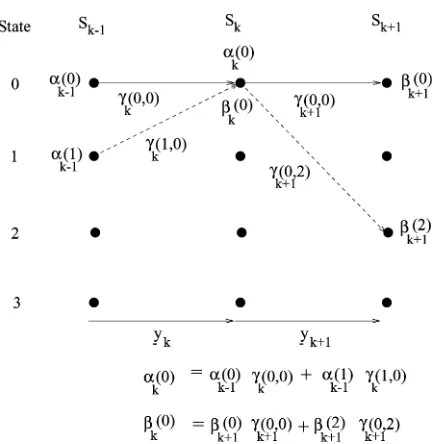
Fig. 3, which depicts a section of a four-state trellis for an RSC code having a constraint-length ofK¼3, shows this split of the received channel output sequence. In this figure, solid lines represent transitions as a result of a1 input bit, and dashed lines represent transistion resulting from a þ1 input bit. The k1ðs0Þ, kðs0;sÞ, and kðsÞ
symbols represent values, which will be defined shortly, calculated by the MAP algorithm.
Bayes’ rule suggests thatpða^bÞ ¼pðajbÞpðbÞ. If we exploit both Bayes’ rule and that the channel is memory-less, then the future received sequence y
j9kwill depend
only on the present states, but not on the previous states0
or on the present and previous received channel output sequencesy
kandyjGk. Hence, we can write
pðs0^s^yÞ ¼pðs0^s^y
jGk^yk^yj9kÞ
¼pðy
j9kjsÞ pðs
0^
s^y
jGk^ykÞ
¼pðy
j9kjsÞ p fyk^sgjs 0
pðs0^y jGkÞ
¼kðsÞ kðs0;sÞ k1ðs0Þ (5)
where
k1ðs0Þ ¼pðSk1¼s0^yjGkÞ (6)
is the joint probability density for the trellis at state s0at timek1 and for the received channel output sequence
y
jGk, as visualized in Fig. 3. Furthermore
kðsÞ ¼pðy
j9kjSk¼sÞ (7)
is the probability density of the future received channel output sequencey
j9k, given that the trellis is in statesat
time instantkand finally
kðs0;sÞ ¼p fyk^Sk¼sgjSk1¼s0
(8)
is the joint conditional density for the next statesand for the value y
k of the received channel output, given that
the trellis was in state s0 at time instantk1. Equation (5) shows that the joint density pðs0^s^yÞ of the en-coder’s trellis traversing from state Sk1 ¼s0 to state
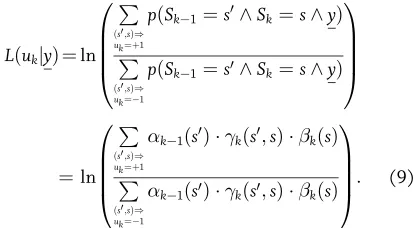
Sk¼s and that of encountering the sequence y can be represented as the product ofk1ðs0Þ,kðs0;sÞ, andkðsÞ.
The interpretation of these three probability density terms is shown in Fig. 3, where the transitionSk1¼s0to
Sk¼s is shown by the bold line. From (3) and (5), we
can write for the conditional LLR of uk, given the re-ceived value y
k
LðukjyÞ ¼ln P
ðs0;sÞ)
uk¼þ1
pðSk1¼s0^Sk¼s^yÞ
P
ðs0;sÞ)
uk¼1
pðSk1¼s0^Sk¼s^yÞ
0 B B B @
1 C C C A
¼ln P
ðs0;sÞ)
uk¼þ1
k1ðs0Þ kðs0;sÞ kðsÞ
P
ðs0;sÞ)
uk¼1
k1ðs0Þ kðs0;sÞ kðsÞ
0 B B B @
1 C C C A: (9)
The MAP algorithm finds kðsÞandkðsÞfor all states s
throughout the trellis, i.e., for k¼0;1 N1, and kðs0;sÞfor all possible transitions from stateSk1¼s0to
state Sk¼s, and again for k¼0;1 N1. These
values are then used in (9) to give the conditional LLRs LðukjyÞ that the MAP decoder delivers. We now describe how the valueskðsÞ,kðsÞ, andkðs0;sÞcan be
[image:4.576.319.526.510.624.2]calculated.
2) Forward Recursive Calculation ofkðsÞ: Consider first
kðsÞ. From the definition of k1ðs0Þ in (6), we can
write
kðsÞ ¼pðSk¼s^yjGkþ1Þ
¼pðs^y
jGk^ykÞ
¼X
alls0
pðs^s0^y
jGk^ykÞ (10)
where in the last line we split the densitypðs^y yGkþ1Þ
into the sum of joint densitiespðs^s0^y
jGkþ1Þover all
possible previous states s0. Using Bayes’ rule and the assumption that the channel is memoryless again, we can proceed as follows:
kðsÞ ¼X alls0
pðs^s0^y
jGk^ykÞ
¼X
alls0
p fs^y kgjfs
0^
y jGkg
pðs0^y jGkÞ
¼X
alls0
p fs^y kgjs
0
pðs0^y jGkÞ
¼X
alls0
k1ðs0Þ kðs0;sÞ: (11)
Thus, once thekðs0;sÞvalues are known, thekðsÞvalues can be calculated recursively. Assuming that the trellis has the initial state S0¼0, the initial conditions for this
recursion are
0ðS0 ¼0Þ ¼1
[image:5.576.299.516.69.291.2]0ðS0¼sÞ ¼0 for all s6¼0: (12)
Fig. 4 shows an example of how onekðsÞvalue, fors¼0,
is calculated recursively using values of k1ðs0Þ and
kðs0;sÞ for our K¼3 RSC code. Notice that, as we are
considering a binary trellis, only two previous states,
Sk¼1 ¼0 and Sk1 ¼1, have paths to the state Sk¼0.
Therefore, the summation in (11) is over only two terms.
3) Backward Recursive Calculation ofkðsÞ: The values of kðsÞ can similarly be calculated recursively. Using a similar derivation to that for (11), it can be shown that
k1ðs0Þ ¼pðyj9k1js0Þ ¼
X
alls
kðsÞ kðs0;sÞ: (13)
Thus, once the values kðs0;sÞ are known, a backward
recursion can be used to calculate the values ofk1ðs0Þ
from the values of kðsÞ using (13). Fig. 4 again shows an example of how the kð0Þ value is calculated recur-sively using values of kþ1ðsÞ and kþ1ð0;sÞ for our
K¼3 RSC code.
4) Calculation of kðs0;sÞ: We now consider how the
transition densitieskðs0;sÞin (5) can be calculated from
the received channel sequence and anya prioriinformation that is available. Using the definition ofkðs0;sÞfrom (8)
and the derivation from Bayes’ rule we have
kðs0;sÞ ¼p fy k^sgjs
0
¼p y kjfs
0^
sg
Pðsjs0Þ
¼p y kjfs
0^
sg
PðukÞ
¼pðy
kjxkÞ PðukÞ (14)
whereukis the input bit necessary to cause the transition from state Sk1¼s0 to state Sk¼s,PðukÞ is the a priori
probability of this bit, andxkis the transmitted codeword associated with this transition. Hence, the transition probability densitykðs0;sÞis given by the product of the
a priori probability of the input bit uk necessary for the transition and the conditional density of the received channel sequence for the value y
k given that the
codeword xk associated with the transition was trans-mitted. The a priori probability PðukÞ is derived in an
[image:5.576.48.255.296.399.2]iterative decoder from the output of the previous com-ponent decoder, andVassuming a memoryless additive white Gaussian noise (AWGN) channel and BPSK
Fig. 4.Recursive calculation ofkð0Þandkð0Þ.
modulationVthe conditional received sequence probabil-ity densprobabil-itypðy
kjxkÞis given by
pðy kjxkÞ ¼
Yn
l¼1
pðykljxklÞ
¼Y
n
l¼1
1 ffiffiffiffiffiffi 2
p
e
EbR
22ðyklaxklÞ2
ð Þ (15)
where xkl and ykl are the individual bits within the transmitted and received codewords y
k and xk, n is the
number of these bits in each codeword, Eb is the trans-mitted energy per bit,2is the noise variance, andais the
channel gain and we havea¼1 for the nonfading AWGN channel used in this paper. When considering fading channels, the value ofarepresents the fading magnitude.
5) Summary of MAP Algorithm: From the description
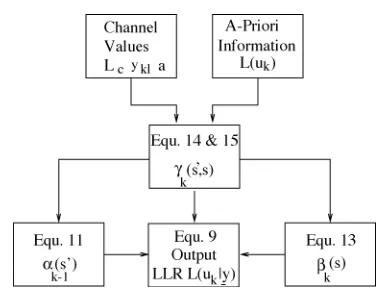
given above, we see that the MAP decoding of a received sequence y to give the a posteriori LLR LðukjyÞ can be carried out as follows. As the channel values ykl are received, they and the a priori LLRs LðukÞ,3 which are provided in an iterative turbo decoder by the other component decoder as described in Section II-C, are used to calculate kðs0;sÞ according to (14) and (15). As the channel valuesykl are received and thekðs0;sÞvalues are calculated, the forward recursion from (11) can be used to calculatekðs0;sÞ. Once all the channel values have been received, and kðs0;sÞ has been calculated for all
k¼1;2 N, the backward recursion from (13) can be used to calculate the kðs0;sÞ values. Finally, all the calculated values ofkðs0;sÞ,kðs0;sÞ, andkðs0;sÞare used
in (9) to calculate the values ofLðukjyÞ. These operations are summarized in the flowchart of Fig. 5.
The MAP algorithm is, in the form described in this section, extremely complex due to the multiplications needed in (11) and (13) for the recursive calculation of kðs0;sÞandkðs0;sÞ, the multiplications and exponential operations required to calculate kðs0;sÞ using (15), and the multiplication and natural logarithm operations required to calculate LðukjyÞ using (9). However, much
work has been done to reduce this complexity, and the Log-MAP algorithm [19], which will be described in Section II-D, gives the same performance as the MAP algorithm, but at a significantly reduced complexity and without the numerical problems encountered by the latter. In the next section, we will first describe the principles behind the iterative decoding of turbo codes and how the MAP algorithm described in this section can be used in such a scheme, before detailing the Log-MAP algorithm.
C. Iterative Turbo Decoding Principles
1) Turbo Decoding Mathematical Preliminaries: In this section, we explain the concepts of extrinsic and intrinsic information as used by Berrouet al.[4] and highlight how the MAP algorithm described in the previous section, and other soft-input soft-output (SISO) decoders, can be used in the iterative decoding of turbo codes.
It can be shown [4] that, for a systematic code such as a RSC code, the output from the MAP decoder, given by (9), can be rewritten as
LðukjyÞ ¼ln P
ðs0;sÞ)
uk¼þ1
k1ðs0Þ kðs0;sÞ kðsÞ
P
ðs0;sÞ)
uk¼1
k1ðs0Þkðs0;sÞ kðsÞ
0 B B B @
1 C C C A
¼LðukÞ þLcyksþLeðukÞ (16)
where
LeðukÞ ¼ln P
ðs0;sÞ)
uk¼þ1
k1ðs0Þ kðs0;sÞ kðsÞ
P
ðs0;sÞ)
uk¼1
k1ðs0Þ kðs0;sÞ kðsÞ
0 B B B @
1 C C C
A: (17)
Here,LðukÞis thea prioriLLR given by (1),Lcis called the channel reliability measure and is given by
Lc¼ 4a
22 (18)
3
[image:6.576.70.264.69.216.2]Please note that in (14) the equivalent representation of PðukÞ was used.
yksis the received version of the transmitted systematic bit
xks¼uk, and
kðs0;sÞ ¼exp Lc 2
Xn
l¼2
yklxyl
!
: (19)
Thus, we can see that the a posteriori LLR LðukjyÞ
calculated with the MAP algorithm can be thought of as comprised of three terms, namelyLðukÞ,Lcyks, andLeðukÞ. The a priori LLR term LðukÞ comes from PðukÞ in the expression for the branch transition probability density kðs0;sÞ in (14). This probability should come from an
independent source. In most cases, we will have no independent ora prioriknowledge of the likely value of the bit uk and hence the a priori LLR LðukÞ will be zero, corresponding to an a priori probability PðukÞ ¼0:5. However, in the case of an iterative turbo decoder, each component decoder can provide the other decoder with an estimate of thea prioriLLRLðukÞ, as described later.
The second termLcyks in (16) is the soft output of the
channel for the systematic bit uk, which was directly
transmitted across the channel and received asyks. When the channel’s signal-to-noise ratio (SNR) is high, the channel reliability valueLc of (18) will be high and this systematic bit will have a large influence on thea posteriori
LLRLðukjyÞ. Conversely, when the channel is poor andLc
is low, the soft output of the channel for the received systematic bityks will have less impact on thea posteriori
LLR delivered by the MAP algorithm.
The final term in (16), LeðukÞ, is derived, using the constraints imposed by the code used, from the a priori
information sequence LðunÞ and the received channel information sequencey,excludingthe received systematic bit yks and thea priori information LðukÞ for the bit uk.
Hence, it is called theextrinsicLLR for the bituk. Equation
(16) shows that the extrinsic information from a MAP decoder can be obtained by subtracting the a priori
information LðukÞ and the received systematic channel inputLcyksfrom the soft outputLðukjyÞof the decoder. This is the reason for the subtraction paths shown in Fig. 2. Equations similar to (16) can be derived for the other component decoders which are used in iterative turbo decoding.
We summarize in the following what is meant by the terms a priori, a posteriori, and extrinsic information, which are central concepts behind the iterative decoding of turbo codes.
a priori The a prioriinformation concerning a bit is
information known before decoding com-mences, which accrues from a source other than the received sequence, for example from the other component decoder. It is also sometimes referred to as intrinsic
informa-tion for the sake of contrasting it with the extrinsic information to be described next. For random bits initially the a priori in-formation is 0.5, but after the first B half-iteration[ the first component decoder provides its estimate for the second decoder. extrinsic The extrinsic information concerning a bituk
is the information provided by a decoder based on both the received sequence and on the a priori information excluding both the received samples yks representing the sys-tematic bit uk and the a priori information
LðukÞfor the specific bit concerned, i.e.,uk. Typically, the component decoder provides this information using the constraints im-posed on the transmitted sequence by the RSC code used. It processes both the received bits as well as thea priori informa-tion surrounding the systematic bit uk and uses both sources of information as well as the code constraints to provide information about the value ofuk.
a posteriori Thea posterioriinformation about a bit is the information that the decoder gives taking into accountallavailable sources of informa-tion aboutuk. It is thea posterioriLLR, i.e.,
LðukjyÞ, that the MAP algorithm gives as its output.
2) Iterative Turbo Decoding:We now describe how the iterative decoding of turbo codes is carried out. Con-sider initially the first component decoder in the first iteration. This decoder receives the channel sequence
Lcyð1Þcontaining the received versions of the transmitted systematic bits, Lcyks, and the parity bits,Lcykl, from the
first encoder. Usually, to obtain a half rate code, half of these parity bits will have been punctured at the transmitter, and so the turbo decoder must insert zeros in the soft channel output Lcykl for these punctured bits. The first component decoder can then process the soft channel outputs and produce its estimateL11ðukjyÞof the
conditional LLRs of the data bits uk, k¼1;2 N. In this notation the subscriptB11[inL11ðukjyÞindicates that
this is thea posteriori LLR in the first iteration from the first component decoder. Note that in this first iteration the first component decoder will have no a priori in-formation about the bits, and hence PðukÞ in (14) giving kðs0;sÞ will be 0.5.
Next, the second component decoder comes into operation. It receives the channel sequenceyð2Þcontaining
theinterleavedversion of the received systematic bits and the parity bits from the second encoder. Again, the turbo decoder will need to insert zeroes into this sequence if the parity bits generated by the encoder are punctured before transmission. However, now, in addition to the received
channel sequenceyð2Þ, the decoder can use the conditional LLR L11ðukjyÞ provided by the first component decoder
to generate a priori LLRs LðukÞ to be used by the second component decoder. Metaphorically speaking, these a priori LLRs LðukÞ, which are related to bit uk, would be provided by an Bindependent conduit of in-formation, in order to have two independent channel-impaired opinions[concerning bituk. This would provide
aBsecond channel-impaired opinion[in regards to bituk.
In an iterative turbo decoder the extrinsic information
LeðukÞfrom the other component decoder is used as thea prioriLLRs, after being interleaved to arrange the decoded data bitsuin the same order as they were encoded by the second encoder. The second component decoder thus uses the received channel sequenceyð2Þ and the a prioriLLRs LðukÞ(derived by interleaving the extrinsic LLRsLeðukÞof
the first component decoder) to produce its a posteriori
LLRsL12ðukjyÞ. This is then the end of the first iteration.
For the second iteration the first component encoder again processes its received channel sequenceyð1Þ, but now
it also has a priori LLRs LðukÞprovided by the extrinsic portionLeðukÞof thea posterioriLLRsL12ðukjyÞcalculated
by the second component encoder; hence, it can produce an improved a posteriori LLR L21ðukjyÞ. The second
iteration then continues with the second component decoder using the improved a posteriori LLRs L21ðukjyÞ
from the first encoder to derive, through (16), improved
a prioriLLRsLðukÞ, which it uses in conjunction with its received channel sequenceyð2Þ to calculate L
22ðukjyÞ.
This iterative process continues, and with each iteration on average the BER of the decoded bits will fall. However, as seen in [20], Fig. 9, the improvement in performance for each additional iteration carried out falls as the number of iterations increases. Hence, for com-plexity reasons usually only around six to eight iterations are carried out, as no significant improvement in perform-ance is obtained with a higher number of iterations.
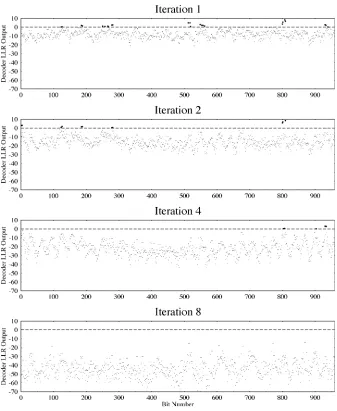
Fig. 6 shows how thea posterioriLLRsLðukjyÞoutput from the component decoders in an iterative decoder vary with the number of iterations used. The output from the second component decoder is shown after one, two, four, and eight iterations. The input sequence consisted entirely of 1 values, hence negative a posteriori LLR
LðukjyÞvalues correspond to a correct hard decision and positive values to an incorrect hard decision. The encoded bits were transmitted over an AWGN channel at a channel SNR of1 dB and then decoded using an iterative turbo decoder using the MAP algorithm. It can be seen that as the number of iterations used increases, the number of positive a posteriori LLR LðukjyÞ values, and hence the BER, decreases until after eight iterations there are no incorrectly decoded values. Furthermore, as the number of iterations increases, the decoders become more certain about the value of the bits and hence the magnitudes of the LLRs gradually become larger. The erroneous decisions in the figure appear in bursts, since deviating
from the error-free path trellis path typically inflicts several bit errors.
When the series of iterations is concluded, the turbo decoder’s output is given by the de-interleaveda posteriori
LLRs of the second component decoder, Li2ðukjyÞ,
where i is the number of iterations used. The sign of thesea posterioriLLRs gives the hard decision output, i.e., whether the decoder believes that the transmitted data bit
ukwasþ1 or1, and in some applications the magnitude of these LLRs, which quantifies the decoder’s confidence in its decision, may also be useful.
To elaborate a little further, it is recognized that iterative decoding performs well for turbo codes despite the fact that in reality thea prioriinformation used at the input of each component decoder during the consecutive iterations is not provided by a completely independent second source. The reason for this dependence is the presence of so-called undirected cycles in the Bayesian network associated with the turbo code. This relationship was first presented by McElieceet al.in [21], demonstrat-ing that iterative turbo decoddemonstrat-ing may be viewed as a form of belief propagationVan algorithm, which is also known in many other research communities such as artificial intelligence. For belief propagation to work efficiently, the specific graph used for visualizing the route of message passing in the decoder has to have no cycles or at least has to avoid having short cycles. Even though we have subtracted the a priori information from the a posteriori
LLR to be used by the other decoder at its input, this
a priori information affects not only the specific bit-position concerned, but also nearby bit bit-positions’ outputs due to the code’s memory. Hence, in the next B half-iteration[ this a priori information will be partly spread again by the finite-duration interleaver as well as by the other constituent decoder to the very bit position from which it originated, unless the interleaver length is suffi-ciently high for avoiding this event, as we will demonstrate in Section II-E4.
Another justification for using the iterative arrange-ment described above is how well it has been found to work. In the limited experiments that have been carried out with optimal decoding of turbo codes [22]–[24], it has been found that optimal decoding performs only a fraction of a decibel (around 0.35–0.5 dB) better than iterative decoding with the MAP algorithm. Furthermore, various turbo coding schemes have been found [24], [25] that approach the Shannonian limit, which gives the best performance theoretically available, to a similar fraction of a decibel. Therefore it seems that, for a variety of codes, the iterative decoding of turbo codes gives an almost optimal performance. Hence, it is this iterative decoding structure which is almost exclusively used with turbo codes.
complex and can be used instead of the MAP algorithm. In the forthcoming section, we first describe two related algorithms, the Max-MAP [26], [27] and the Log-MAP [19], which are derived from the Log-MAP algorithm. Alternatively, the lower complexity SOVA of [9], [15], [28], and [29] may be used, which was derived from the VA.
D. Reducing the Complexity of MAP Algorithm
1) Introduction: The MAP algorithm as described in
Section II-B is much more complex than the VA and with hard decision outputs performs almost identically to it. Therefore, for almost 20 years it was largely ignored. However, its application in turbo codes renewed interest in the algorithm, and it was realized
[image:9.576.117.454.71.482.2]that its complexity can be dramatically reduced without affecting its performance. Initially, the Max-Log-MAP algorithm was proposed by Koch and Baier [26] and Erfanian et al. [27]. This technique simplified the MAP algorithm by transferring the recursions into the log-arithmic domain without reducing its accuracy. How-ever, when invoking an approximation for implementing the algorithm for the sake of dramatically reducing its complexity, its performance becomes suboptimal com-pared to that of the MAP algorithm. As a remedy, in 1995, Robertson et al. [19] proposed the Log-MAP algo-rithm, which corrected the approximation used in the Max-Log-MAP algorithm and hence gave a performance close to that of the MAP algorithm, but at a fraction of its complexity. These two algorithms are described later in this section.
Fig. 6.Soft outputs from MAP decoder in iterative turbo decoder for transmitted stream of all1.
2) Max-Log-MAP Algorithm:The MAP algorithm calcu-lates thea posterioriLLRsLðukjyÞusing (9). To do this it requires the following values.
1) k1ðs0Þvalues, which are calculated in a forward
recursive manner using (11);
2) kðsÞvalues, which are calculated in a backward recursion using (13);
3) branch transition densities kðs0;sÞ, which are calculated using (14).
The Max-Log-MAP algorithm simplifies this by transfer-ring these equations into the logarithmetic domain and then using the approximation
ln X
i exi
!
max
i ðxiÞ (20)
where maxiðxiÞ means the maximum value of xi. Then,
withAkðsÞ,BkðsÞ, andkðs0;sÞdefined as follows:
AkðsÞ ¼ lnðkðsÞÞ (21)
BkðsÞ ¼
lnðkðsÞÞ (22)
and
kðs0;sÞ ¼lnðkðs0;sÞÞ (23)
we can rewrite (11) as
AkðsÞ ¼ lnðkðsÞÞ
¼ln X
alls0
k1ðs0Þkðs0;sÞ
!
¼ln X
alls0
exp½Ak1ðs0Þ þkðs0;sÞ
!
max
s0 Ak1ðs
0Þ þ
kðs0;sÞ
ð Þ: (24)
Equation (24) implies that for each path in Fig. 3 from the previous stage in the trellis to the state Sk¼s at the present stage, the algorithm adds a branch metric term
kðs0;sÞto the previous valueAk1ðs0Þto find a new value
~
AkðsÞfor that path. The new value of AkðsÞaccording to
(24) is then the maximum of theA~kðsÞvalues of the various
paths reaching the stateSk¼s. This can be thought of as
selecting one path as the Bsurvivor[ and discarding any other paths reaching the state. Because of the approxima-tion of (20) used to derive (24), only the maximum likelihood path through the state Sk¼s is considered when calculating this probability. Thus, the value ofAkin the Max-Log-MAP algorithm actually gives the probability
of the most likely path through the trellis to the state
Sk¼s, rather than the probability ofanypath through the trellis to state Sk¼s. This approximation is one of the reasons for the suboptimal performance of the Max-Log-MAP algorithm compared to the Max-Log-MAP algorithm.
We see from (24) that in the Max-Log-MAP algorithm the forward recursion used to calculateAkðsÞis exactly the
same as the forward recursion in the VAVfor each pair of merging paths the survivor is found using two additions and one comparison. Notice that for binary trellises the summation, and maximization, over all previous states
Sk1¼s0 in (24) will in fact be over only two states,
because there will be only two previous states Sk1¼s0
with paths to the present stateSk¼s. For all other values ofs0we will have kðs0;sÞ ¼0.
Similarly to (24), for the forward recursion used to calculate theAkðsÞ, we can rewrite (13) as
Bk1ðs0Þ ¼
lnðk1ðs0ÞÞ
max
s BkðsÞ þkðs 0;
sÞ
ð Þ (25)
giving the backward recursion used to calculate the
Bk1ðs0Þvalues. Again, this is equivalent to the recursion
used in the VA, except that it proceeds backwards rather than forwards through the trellis.
Using Equations (14) and (15), we can write the branch metricskðs0;sÞin the above recursive equations forAkðsÞ
andBk1ðs0Þas
kðs0;sÞ ¼ lnðkðs0;sÞÞ
¼Cþ1
2ukLðukÞ þ
Lc
2 Xn
l¼1
yklxkl (26)
where C does not depend on uk or on the transmitted codeword xk and so it can be considered a constant and
omitted. Hence, the branch metric is equivalent to that used in the VA, with the addition of thea prioriLLR term
ukLðukÞ. Furthermore, the correlation term Pnl¼1yklxkl is
weighted by the channel reliability valueLcof (18).
Finally, from (9), we can write for thea posterioriLLRs
LðukjyÞwhich the Max-Log-MAP algorithm calculates
LðukjyÞ ¼ln
P
ðs0;sÞ)
uk¼þ1
k1ðs0Þ kðs0;sÞ kðsÞ
P
ðs0;sÞ)
uk¼1
k1ðs0Þ kðs0;sÞ kðsÞ
0 B B B @
1 C C C A
max
ðs0;sÞ)
uk¼þ1
Ak1ðs0Þ þkðs0;sÞ þBkðsÞ
ð Þ
max
ðs0;sÞ)
uk¼1
Ak1ðs0Þ þkðs0;sÞ þBkðsÞ
This means that in the Max-Log-MAP algorithm for each bit uk the a posteriori LLR LðukjyÞ is calculated by con-sidering every transition from the trellis stageSk1 to the
stage Sk. These transitions are grouped into those that might have occurred ifuk¼ þ1 and those that might have occurred if uk¼ 1. For both of these groups the
transition giving the maximum value of Ak1ðs0Þ þ
ðs0;sÞ þBkðsÞ is found, and the a posteriori LLR is
calculated based on only these twoBbest[transitions. The Max-Log-MAP algorithm can be summarized as follows. Forward and backward recursionsVboth similar to the forward recursion used in the VAVare invoked for calculatingAkðsÞusing (24) andBkðsÞemploying (25). The branch metrickðs0;sÞis given by (26), where the constant
term C can be omitted. Once both the forward and backward recursions have been carried out, thea posteriori
LLRs can be calculated using (27). Thus, the complexity of the Max-Log-MAP algorithm is not significantly higher than that of the VA; instead of one recursion, two are carried out, the branch metric of (26) has the additional
a priori term ukLðukÞterm added to it, and for each bit
(27) must be used to give the a posteriori LLRs. Viterbi states [30] that the complexity of the Log-MAP-Max algorithm may be deemed to be less than three times that of a Viterbi decoder. Unfortunately, the storage require-ments are significantly higher due to the need to store both the forward and backward recursively calculated metrics AkðsÞand BkðsÞbefore the LðukjyÞ values can be calculated. However, Viterbi also states [30], [31] that by increasing the computational load slightly, to four times that of the VA, the memory requirements can be dramat-ically reduced to become essentially equal to those of the Viterbi decoder.
3) Correcting the ApproximationVLog-MAP Algorithm:
The Max-Log-MAP algorithm gives a slight degradation in performance compared to the MAP algorithm due to the approximation of (20). When used for the iterative decoding of turbo codes, Robertsonet al. [19] found this degradation to result in a drop in performance of about 0.35 dB. However, the approximation of (20) can be made exact by using the Jacobian logarithm
lnðex1þex2Þ ¼maxðx
1;x2Þ þln 1þejx1x2j
¼maxðx1;x2Þ þfcðjx1x2jÞ
¼gðx1;x2Þ (28)
wherefcðxÞcan be thought of as a correction term. This is
then the basis of the Log-MAP algorithm proposed by Robertson, Villebrun, and Ho¨eher [19]. Similarly to the Max-Log-MAP algorithm, values forAkðsÞ ¼lnðkðsÞÞand BkðsÞ ¼lnðkðsÞÞ are calculated using a forward and a
backward recursion. However, the maximization in (24)
and (25) is complemented by the correction term in (28). This means that the exact rather than approximate values ofAkðsÞandBkðsÞare calculated. The correction termfcð Þ
need not be computed for every value of , but instead can be stored in a look-up table. Robertson et al. [19] found that such a look-up table need contain only eight values for , ranging between zero and five. This means that the Log-MAP algorithm is only slightly more complex than the Max-Log-MAP algorithm, but it gives exactly the same performance as the MAP algorithm. Therefore, it is a very attractive algorithm to use in the component decoders of an iterative turbo decoder.
Before concluding our discourse on the choice of decoding techniques, it is worth mentioning that for the specific scenario of using a simple interleaver having a few columns only it was shown in [22], [32] that it is feasible to design an optimum noniterative decoder, although its performance is limited by the employment of a subopti-mum interleaver. Nonetheless, this schemes provides further insights into the so-called super-trellis structure of turbo codes and establishes their relationship with convolutional codes, since this scheme may be detected using a modified Viterbi decoder. The same philosophy was invoked also in the context of turbo equalization [33] in [34], but this topic will be detailed during our later discourse. A range of further important milestones in the development of turbo codes were created by Bendetto, Montorsi, and their team [35]–[40], which are addressed in other papers of this special issue.
Having described two techniques based on the MAP algorithm, which exhibited reduced complexity, in the next section we characterize their attainable performance.
E. Effect of Various Codec Parameters
In this section, we characterize the performance of turbo codes using binary phase shift keying (BPSK) over AWGN channels as a function of the following parameters:
1) the component decoding algorithm used; 2) the number of decoding iterations used; 3) the frame-length or latency of the input data; 4) the specific design of the interleaver used; 5) the generator polynomials and constraint-lengths
of the component codes.
The standard parameters that we have used in our simulations are shown in Table 1. The turbo encoder uses two component RSCs in parallel. The RSC component codes areK¼3 codes with generator polynomialsG0 ¼7
and G1¼5 in octal representation. These generator
polynomials are optimum in terms of maximizing the minimum free distance of the component codes [41]. The effects of changing these parameters are examined in Section II-E5. The standard interleaver used between the two component RSC codes is a 1000-bit random inter-leaver with odd–even separation [42]. The effects of changing the length of the interleaver, and its structure, are examined in Section II-E4. Unless otherwise stated, the
results in this section are for half-rate codes, where half the parity bits generated by each of the two component RSC codes are punctured. However, for comparison, we also include some results for turbo codes where all the parity bits from both component encoders are transmitted, leading to a one-third rate code. At the decoder two SISO component decoders are used in parallel, as shown in Fig. 2. In most of our simulations we use the Log-MAP decoder, but the effect of using other component decoders is investigated in Section II-E3. Usually eight component decoder iterations are used, but in the next section we also consider the effect of different number of iterations.
1) Effect of Number of Iterations Used:Fig. 7 shows the performance of a turbo decoder using the MAP algorithm
versus the number of decoding iterations which were used. For comparison, the uncoded BER and the BER obtained using convolutional coding with a standard (2,1,3) nonrecursive convolutional code are also shown. Like the component codes in the turbo encoder, the convolutional encoder uses the optimum octal generator polynomials of seven and five. It can be seen that the performance of the turbo code after one iteration is roughly similar to that of the convolutional code at low SNRs, but improves more rapidly than that of the convolutional coding as the SNR is increased. As the number of iterations used by the turbo decoder increases, the turbo decoder’s performance gradually improves, although the improvements become marginal for more than eight iterations.
2) Effect of Puncturing: In our investigations we have used two RSC component encoders, and this is the ar-rangement most commonly used for turbo codes having code rates belowR¼2=3. Typically, in order to give a half-rate code, half the parity bits from each component encoder are punctured. This was the arrangement used in their original paper by Berrou et al. on turbo codes [4]. However, it is of course possible to omit the puncturing and transmit all the parity information from both com-ponent encoders, which gives a one-third rate code. The performance of such a code, compared to the corre-sponding half-rate code, is shown in Fig. 8, which provides anEb=N0 gain of about 0.6 dB at a BER of 104.
[image:12.576.51.284.88.228.2]3) Effect of Component Decoder: Fig. 9 shows a com-parison between turbo decoders using the parameters
[image:12.576.139.438.484.722.2]Table 1Standard Turbo Encoder and Decoder Parameters Used
described above. In this figure, the BLog MAP (exact)[
curve refers to a decoder which calculates the correction termfcðxÞin (28) of Section II-D exactly, i.e., using
fcðxÞ ¼lnð1þexÞ (29)
[image:13.576.136.434.75.313.2]rather than using a look-up table as described in [19]. The Log MAP curve refers to a decoder which does use a look-up table with eight values of fcðxÞ stored and hence introduces an approximation to the calculation of the LLRs. It can be seen that, as expected, the MAP and the Log-MAP (exact) algorithms give identical performances.
Fig. 9.BER performance comparison between different component decoders for a random interleaver with L¼1000. Other parameters
[image:13.576.135.438.470.713.2]as in Table 1.
Fig. 8.BER performance comparison between one-third and half-rate turbo codes using parameters of Table 1.
Furthermore, as Robertson found [19], the look-up procedure for the values of the fcðxÞ correction terms imposes no degradation on the performance of the de-coder. It can also be seen from Fig. 9 that the Max Log MAP and the SOVA algorithms both give a degradation in performance compared to the MAP and Log MAP algorithms. At a BER of 104, this degradation is about 0.1 dB for the Max Log MAP algorithm and about 0.6 dB for the SOVA algorithm.
4) Effect of Frame Length of Code:In the original paper on turbo coding by Berrou et al. [4], and many of the subsequent papers, impressive results have been presented for coding with very large frame lengths. Dolinar et al.
analyzed the associated theoretical performance limits as a function of the coded frame length in [43] and demon-strated the benefits of turbo codes even for modest interleaver lengths.
However, for many applications, such as, for example, speech transmission systems, the large delays inherent in using high frame lengths are unacceptable. Therefore, an important area of turbo coding research is achieving as impressive results with short frame lengths as have been demonstrated for long frame-length systems. Fig. 10 shows how dramatically the performance of turbo codes depends on the frame lengthLused in the encoder, which is a consequence of the code’s free distance being de-pendent on the interleaver length used. The achievable performance is comparable to or better than that of a constraint lengthK¼9 convolutional code, which has a
similar complexity, as argued in [9]. In Fig. 10, a non-recursive (2, 1, 9) convolutional code using the octal generator polynomials G0¼561 and G1¼753 was
em-ployed, which maximizes the free distance of the code [41]. These generator polynomials provide the best per-formance in the AWGN channels considered. A total turbo-coded frame length of 169 bits is used and the code is terminated. It can be seen that even for the short frame-length of 169 bits, turbo codes outperform similar com-plexity convolutional codes.
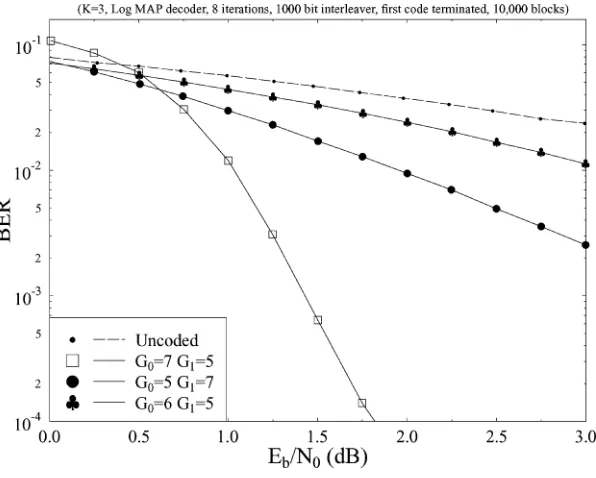
5) Effect of Component Codes:Both the constraint length and the generator polynomials used in the component codes of turbo codes are important parameters. Often, in turbo codes the generator polynomials which lead to the largest minimum free distance for ordinary convolutional codes are used, although when the effect of interleaving is considered these generator polynomials do not neces-sarily lead to the best minimum free distance for turbo codes. Fig. 11 shows the huge difference in performance that can result from different generator polynomials being used in the component codes. The other param-eters used in these simulations were the same as detailed in Table 1.
[image:14.576.138.440.78.310.2]Most of the results provided in this paper were ob-tained using constraint-length-3 component codes. For these codes we have used the optimum generator polyno-mials in terms of maximizing the minimum free distance of the component convolutional codes, i.e., seven and five in octal representation. These generator polynomials were
Fig. 10.Effect of frame length on BER performance of turbo coding. All interleavers except L¼169 block interleaver use random separated
also used for constraint-length-3 turbo coding by Hagenaueret al.in [13] and Jung in [44]. It can be seen from Fig. 11 that the order of these generator polynomials is importantVthe octal value seven should be used for the feedback generator polynomial of the encoder (denoted here byG0). IfG0andG1are swapped, the performance of a
convolutional code (both regular and recursive systematic codes) would be unaffected, but for turbo codes this gives a significant degradation in performance.
The effect of increasing the constraint length of the component codes used in turbo codes is shown in Fig. 12. For the constraint-length four turbo code we again used the optimum minimum free distance generator polyno-mials for the component codes (15 and 17 in octal, 13 and 15 in decimal representations). The resulting turbo code gives an improvement of about 0.25 dB at a BER of 104
over theK¼3 curve.
For the constraint-length-5 turbo code we used the octal generator polynomials 37 and 21 (31 and 17 in decimal), which were the polynomials used by Berrouet al.
[4] in the original paper on turbo coding. We also tried using the octal generator polynomials 23 and 35 (19 and 29), which are again the optimum minimum free distance generator polynomials for the component codes, as suggested by Hagenaueret al.in [13]. We found that these generator polynomials gave almost identical results to those used by Berrouet al.
6) Effect of Interleaver: It is well known that the interleaver used in turbo codes has a vital influence on the
performance of the code. The interleaver design together with the generator polynomials used in the component codes, and the puncturing used at the encoder, have a dramatic effect on the free distance of the resultant turbo code. Several algorithms have been proposed, for example in [45] and [46], that attempt to choose good interleavers based on maximizing the minimum free distance of the code. However, this process is complex, and the resultant interleavers are not necessarily optimum. For example, in [47] random interleavers designed using the technique given in [46] are compared to a 12 16-dimensional block interleaver,4 and the Boptimized[ interleavers are found to perform worse than the block interleaver.
In [42], a simple technique for designing good interleavers, which is referred to asBodd–even separation[
is proposed. With alternate puncturing of the parity bits from each of the component codes, which is the puncturing most often used, if an interleaver is designed so that the odd and even input bits are kept separate, then it can be shown that one (and only one) parity bit associated with each information bit will be left unpunc-tured. This is preferable to the more general situation, where some information bits will have their parity bits from both component codes transmitted; whereas, others will have neither of their parity bits transmitted. A convenient way of achieving odd–even separation in the interleaver is to use a block interleaver with an odd
4
[image:15.576.137.435.74.313.2]A block interleaver simply writes into a rectangular memory matrix on a row-by-row basis and transmits the bits on a column-by-column basis.
Fig. 11.Effect of generator polynomials on BER performance of turbo coding. Other parameters as in Table 1.
number of rows and columns, which has a near-quadratic shape [42].
We also attempted using random interleavers of various frame lengths. The effect of the interleaver choice for a turbo coding system with a frame-length of approximately 960 bits is shown in Fig. 13. It can be seen from this figure that the block interleaver having an odd number of rows and columns (the 3131 interleaver) performs significantly better than the interleaver with an even number of rows and columns (the 30 32 interleaver). However, both of these interleavers are outperformed by the two random interleavers. In the
Brandom separated[ interleaver odd–even separation, as proposed by Barbulescu and Pietrobon [42], is used. This interleaver performs very slightly better than the other random interleaver, which does not use odd–even separation. However, the effect of odd–even separation is much less significant for the random interleavers than it is for the block interleavers, but in general the employ-ment of random interleavers is not conducive to maximiz-ing the Hammmaximiz-ing distance (HD). Hence, Berrouet al. in [48] proposed a generic model for maximizing the HD.
Having investigated the decoding algorithms as well as the achievable performance of turbo codes in conjunction with BPSK transmissions over AWGN channels, in the forthcoming section we will briefly highlight a host of related research topics motivated by the success of turbo coding. Let us commence by considering iteratively detected joint coding and multilevel modulation in the next section.
I I I .
I T E R A T I V E T R A N S C E I V E R D E S I G N
F O R W I R E L E S S C H A N N E L S
A. Joint Coding and ModulationVTTCM
[image:16.576.139.441.71.310.2]The invention of turbo trellis coded modulation (TTCM) by Robertson and Wo¨erz [49] was inspired by the joint benefits of trellis coded modulation (TCM) and turbo coding. More explicitly, incorporating the parity bits within the original bandwidth by increasing the number of bits per modulated symbol was shown to achieve a substantial coding gain, despite reducing the Eucledian distance of the modulated phasor points. Furthermore, TTCM avoids the potential disadvantage of effective throughput loss that would be incurred upon the parallel concatenation of two TCM components without invoking puncturing. Specifically, this is achieved by puncturing the parity information as proposed by Robertson and Woerz [49], so that all information bits are sent only once, and the parity bits are provided alternatively by the two component TCM encoders. The TTCM encoder mimics the structure of the turbo encoder, as seen in Fig. 14, except that it comprises two identical TCM encoders linked by a symbol interleaver, rather than two RSC encoders linked by a bit interleaver. The decoder’s structure is also reminiscent of the turbo decoder, although it invokes the purely symbol-based MAP decoder detailed in [9], rather than the previously discussed bit-based MAP decoder. Since TCM was designed for AWGN channels by maximizing the Euclidean distance of the modulation constellation points, it does not perform well, when communicating over fading
channels. By contrast, bit interleaved coded modulation (BICM) [50] along with its iteratively decoded (ID) version known as BICM (BICM-ID) [51] was designed for fading channels. For an in-depth tutorial treatment and comparative performance study of the family of joint coding modulation schemes, such as TCM, TTCM, BICM, and BICM-ID, please refer to [9]. It is explicitly de-monstrated in [9] that the iteratively detected TTCM scheme has a definite edge over both BICM-ID and its identical-complexity noniterative counterparts, where the complexity was quantified in terms of the total number of decoder trellis states, which in turn determines the number of add-compare-select (ACS) operations, i.e., the integrated circuit area. A range of further richly illustrated coded modulation (CM) aided examples applicable to the adaptive coding and modulation (ACM) aided high-speed
downlink access (HSDPA) mode of the third-generation (3G) wireless systems and various other wireless local area networks (WLAN) can be found in [52]–[54]. Some of these CM-aided turbo transceivers will be detailed during our further discourse.
B. Turbo Equalization of Time-Variant Wireless Channels
[image:17.576.136.434.77.313.2]The philosophy of turbo equalizers (TEQs) [33] is similar to that of turbo decoders, except that the extrinsic information is typically extracted from a serially concat-enated, rather than from a parallel concatconcat-enated, compo-nent. More explicitly, both the channel equalizer and the channel decoder refrain from making a hard decision until they have exchanged extrinsic information in a number of iterations. The reason for this philosophy to work is,
Fig. 14.Schematic of TTCM encoder. Selector enables transmission of information bits only once and selects alternative parity bits from the
[image:17.576.100.495.603.714.2]constituent encoders seen at the top and bottom [49] (IEEE, 1998, Robertson and Wo¨rz).
Fig. 13.Effect of interleaver choice for L961 frame-length turbo codes. Other parameters as in Table 1.
because a dispersive channel has a channel impulse sponse (CIR), which is reminiscent of the impulse re-sponse of a convolutional encoder, the dispersive channel is often referred to as the inner encoder [9], [52]. Hence, TEQs have been shown to be successful in mitigating the effects of inter-symbol interference (ISI) introduced by both partial response modems as well as by dispersive channels and therefore they are capable of attaining a performance near that over nondispersive channels [9], [52]. Furthermore, they have the potential of mitigating the effects of channel estimation errors.
TEQs have typically been designed using a code rate of
R ð1=2Þ. However, it was shown in [9], [52], and [55] that near-capacity performance may be attained also at higher code rates, while maintaining a high effective throughput. More explicitly, the performance of a range of BPSK turbo equalizers employing turbo BCH codes, convolutional codes, and convolutional turbo codes having high code rates, such as R¼3=4 and R¼5=6, was quantified for transmission over both a dispersive five-path Gaussian channel and an equally weighted symbol-spaced five-path Rayleigh fading channel. These turbo equaliza-tion schemes were combined with an iterative channel estimation scheme in order to characterize a realistic sce-nario. The results demonstrated that the turbo-equalized system using convolutional turbo codes was the most robust system for all code rates investigated, when also considering the complexity of the various arrangements. A practical turbo-equalized wireless videophone design [12] was provided in [56] in the context of the Global System of Mobile communications known as GSM.
In [57], a TEQ scheme was proposed, which employs a radial basis function (RBF)-based equalizer [52], [58], [59] instead of the classic trellis-based equalizer of Douillard et al. [33]. It was shown with the aid of plau-sible graphical examples in [52] that at the output of a dispersive fading channel the phasor constellation points may become linearly nonseparable even in the absence of noise and in this scenario only nonlinear receivers, such as the RBF-based TEQ, are capable of operating without an error floor. A novel TEQ computational complexity reduction technique was proposed, where symbol equal-ization was activated at any iteration, if and only if the decoded symbol had a high error probability. Otherwise, the iterations were curtailed, since a reliable decision was made. This technique provided a 37% and 54% compu-tational complexity reduction compared to the B full-complexity[ RBF TEQ for the BPSK RBF TEQ and 16QAM RBF TEQ, respectively, when communicating over dispersive Rayleigh fading channels.
In [60], 16QAM-based TCM, TTCM, BICM, and BICM-ID were amalgamated with an RBF-based TEQ scheme, which were then used as benchmarkers for a reduced complexity RBF-based TEQ scheme using sepa-rate in-phase/quadrature-phase (I/Q) TEQs. The philoso-phy of reduced complexity separate I/Q TEQ was first
proposed in [61], where the plausible thought was capitalized on the fact that the number of channel output states to be considered is substantially reduced, if the I and Q components are considered separately. Although the following argument is somewhat simplistic, when for example 16QAM signals are transmitted over a two-path channel, 162¼256 possible phasor constellation points
may be observed at the channel’s output. By contrast, if we considered equalization of the quarternary I and Q components separately, we would have only 422¼32
legitimate channel outputs, which results in a commen-surate reduction of the number of trellis states.
To eliminate the above-mentioned flaw in this simplistic argument, when convolving the complex-valued transmitted signal with the complex-valued CIR of the channel, we are no longer at liberty to handle the I and Q components separately, since both the I and Q components contribute to both the real and imaginary channel output. Nonetheless, with the advent of the solution proposed in [61] their independent treatment is facilitated, provided that an iterative TEQ is used. To clarify this statement a little further, it is possible to estimate and compensate for theBcrosstalk[between the I and Q components. In fact, even if the crosstalk were to be ignored during the first TEQ iteration, in consecutive iterations the TEQ would eliminate the crosstalk-related error at the cost of a slightly higher number of inherently less complex TEQ iterations operating on quarternary signals than that required by the 16QAM classic TEQ. This attractive complexity reduction principle is widely applicable to diverse iterative receivers and, as an example, it was extended to the reduced-complexity I/Q turbo detection of space-time trellis coded systems in [9] and [62].
Returning to [60], the least mean square (LMS) algorithm was employed for channel estimation and it was shown that both the channel estimation errors and the IQ corsstalk effects are virtually eliminated by the TEQ. As an additional benefit, the reduced-complexity RBF-I/Q-TEQ-CM achieved a similar performance to the full-complexity RBF-TEQ-CM while attaining a significant complexity reduction. The overall best performer was the RBF-I/Q-TEQ-TTCM scheme, which exhibited a coding gain of 16.78 dB. Further TEQ-related advances were reported in [63] in the context of RBF-aided space-time trellis codes designed for diversive wireless channels.
C. Concatenated FEC and Space-Time Codes
trellis codes (STTCs) were concatenated with FEC codes for the sake of mitigating the effects of fading, hence virtually eliminating the effects of fading and therefore rendering the employment of designs contrived for the Gaussian channel an attractive proposition. More explic-itly, the space-time codecs were concatenated with a range of channel codecs, such as convolutional and block-based turbo codes as well as with both conventional and turbo trellis-coded modulation. The associated estimated com-plexity issues and memory requirements were also con-sidered: identify various space-time code, channel code combinations constituting a good engineering tradeoff in terms of their effective throughput, BER performance, and estimated complexity. It was concluded that over nondis-persive fading channels the best performance versus complexity tradeoff was constituted by Alamouti’s unity-rate twin-antenna block space-time code concatenated with turbo convolutional codes, while over dispersive channels space-time trellis codes had the edge. While these STTC and STBC multiple-input multiple-output (MIMO) schemes were designed for maximizing the diversity gain, the family of space division multiple access (SDMA) MIMOs [64] aims for maximizing the attainable multiplexing gain. A radical iteratively decoded variable length space time coded modulation (VL-STCM-ID) scheme capable of simultaneously providing both coding and iteration gain as well as multiplexing and diversity gain was proposed in [65], while sphere-packing modulation was employed in [66].
As a further potential system design improvement, STBC-aided inphase-quadrature phase (IQ)-interleaved TCM and TTCM schemes were proposed in [67], which are capable of quadrupling the diversity order of conven-tional symbol-interleaved TCM and TTCM. The increased diversity order of the proposed schemes provides signif-icant coding gains, when communicating over nondisper-sive Rayleigh fading channels without compromising the coding gain achievable over Gaussian channels and without increasing the interleaving delay of the system.
D. Concatenated FEC and Iterative MUD for CDMA The benefits of iterative wireless transceivers have also been exploited in the context of code division multiple access (CDMA) systems [68]–[70]. More specifically, a whole host of fixed-complexity channel-coded CDMA iterative parallel interference cancellation (PIC)-aided transceivers were proposed and comparatively studied in [70], which included TCM, TTCM, turbo codes, and LDPC codes. The complexity of the various schemes was quantified in terms of the total number of trellis states encountered, since this typically determines the number of ACS arithmetic operations imposed, ultimately also predetermining the required integrated circuit area. The total number of trellis states was the product of the number of states in a single decoder, the number of constituent decoders, the number of inner iterations, and
the number of outer iterations. A benefit of these in-telligent transceivers was that regardless of the specific choice of the FEC codec, a high coding gain and a near-single-user CDMA performance was achieved.
A radical iterative guided random search type multi-user detection (MUD) principle using genetic algo-rithms (GAs) was proposed in [70] and in the treatises [71]–[73], initially considering idealized synchronous, as well as more realistic asynchronous and diversity-aided CDMA systems. The appealing underlying philosophy is that in case of supporting Knumber of users the search-space of finding the optimum K-bit vector in the vast search space of 2K is typically excessive, but this vector
may be found with a high probability by searching only a tiny fraction of the entire search space using the GAs outlined in [70]–[73],
Nonetheless, there is a slight chance that the GA-aided MUD does not find the optimum K-bit vector, in which case an efficient FEC decoder is required for cleaning up the residual errors. Furthermore, provided that indeed, the MUD’s output is protected by an FEC decoder, the search-complexity may be substantially re-duced, so that the MUD’s BER becomes Bjust[ suffi-ciently low for the FEC decoder to clean up the residual errors. This was demonstrated in quantitative terms in the TTCM-aided system of [74], where a complexity reduction by several orders of magnitude was achieved for the specific example of K¼10 users and 16QAM transmission. These concepts were further developed by finding the so-called population-based soft-output GA MUD in [75].
E. Iterative Spreading-Sequence Acquisition in Multi-User CDMA
A pivotal task during the initial synchronization of mobile stations (MS) with the BS is the acquisition of the correct initial phase of the MS, before data detection may ensue. As argued previously, a TEQ is capable of elim-xinating any phase error, regardless of whether it was imposed by noise, channel-induced dispersion, or CIR estimation errors. Since time-domain synchronization errors may also be deemed to impose a phase error, they can also be mitigated by appropriate iterative detectors.
In [76] and [77], a novel sequential estimation method was proposed for the acquisition of so-calledm-sequences [70] that are often used as spreading sequences in CDMA systems. This sequential estimation method exploited the principle of iterative SISO decoding for enhancing the spreading sequence acquisition performance, and that of differential preprocessing for the sake of achieving an enhanced acquisition performance, when communicating in various propagation environments. Hence, the advocat-ed acquisition arrangement was referradvocat-ed to as the differential recursive soft sequential estimation (DRSSE) acquisition scheme. The DRSSE acquisition scheme exhibited a low complexity, which is similar to that of an