BMC Health Services Research
Open Access
Research article
Doctor and practice characteristics associated with differences in
patient evaluations of general practice
Hanne N Heje*
1, Peter Vedsted
2, Ineta Sokolowski
2and Frede Olesen
2Address: 1The Department and Research Unit for General Practice, The University of Aarhus, Aarhus, Denmark and 2The Research Unit for General
Practice, The University of Aarhus, Aarhus, Denmark
Email: Hanne N Heje* - [email protected]; Peter Vedsted - [email protected]; Ineta Sokolowski - [email protected]; Frede Olesen - [email protected]
* Corresponding author
Abstract
Background: Variation in patients' evaluation due to general practitioner (GP) and practice factors may provide information useful in a quality improvement context. However, the extent to which differences in patients' evaluation of the GPs are associated with differences in GP and practice characteristics must also be ascertained in order to facilitate comparison of adjusted patient evaluations between GPs. The aim of this study was to determine such associations in a setting where GPs serve a list of patients and act as gatekeepers.
Methods: We carried out a patient evaluation survey among voluntarily participating GPs using the EUROPEP questionnaire, which produced 28,260 patient evaluations (response rate 77.3%) of 365 GPs. In our analyses we compared the prevalence of positive evaluations in groups of GPs.
Results: Our principal finding was a negative association between the GP's age and the evaluation of all aspects, except accessibility. We also found an association between the way the practice was organised and the patients' evaluation of accessibility, with GPs in single-handed practices getting far the most positive evaluations. Long weekly working hours were associated with more positive evaluations of all dimensions except accessibility, whereas more than 0.5 full-time employees per GP, a higher number of listed patients per GP and working in a training practice were associated with negative evaluation of accessibility.
Conclusion: GP characteristics are mainly associated with patients' experience of interpersonal aspects of care, while practice characteristics are associated with evaluation of accessibility. These differences need to be accounted for when comparing patient evaluations of different practices.
Background
Ongoing efforts to improve the quality of general practice care increasingly include patients' evaluation of various aspects of care [1-3]. Variation in patient evaluation of general practice reflects differences in performance, which, to some extent, may be associated with GP and practice characteristics, and differences in the patients'
perception of performance. Crude unadjusted results, though, may serve best for quality improvement at a prac-tice level as they reflect the extent to which the GPs suc-ceed in meeting the patients' individual needs and dealing with different working conditions [4].
Published: 3 April 2007
BMC Health Services Research 2007, 7:46 doi:10.1186/1472-6963-7-46
Received: 23 February 2006 Accepted: 3 April 2007
This article is available from: http://www.biomedcentral.com/1472-6963/7/46
© 2007 Heje et al; licensee BioMed Central Ltd.
When comparing practices and when holding practices against standards comparability is obtained through standardisation – that is adjustment for systematic varia-tion in patient, GP and practice characteristics between the compared groups. Studies of associations between patient evaluations and patient, GP and practice charac-teristics are needed to determine which characcharac-teristics to adjust for. Knowledge of such associations may also serve quality improvement purposes at regional and national levels.
Earlier studies report a positive association between patients' evaluation and the GP's age [5], but a negative association between the evaluation and the GP's age and seniority has also been found [6,7]. Baker [5,6] and Campbell [8] found an inverse relation between assess-ment and total list size as well as list size per GP. Lin [9] found better evaluations of group practices than of single-handed practices, while Hombergh [10] found the oppo-site, which was also supported by Wensing [11], who found better ratings of practices with fewer and full-time working GPs. This supports the general finding that patients prefer personal, continuous care [10,12,13]. In addition, Baker [5,6] found that being a training practice produced less positive evaluations.
These results derive from studies in different settings and with different degrees of adjustment for differences in patient characteristics. Hence, there seems to be a need for a sufficiently powered comprehensive study of associa-tions between patient evaluaassocia-tions and GP and practice characteristics adjusted for systematic variation in patient characteristics. Such a study will provide us with informa-tion about GP and practice factors of significance to the quality of general practice and information on how to standardize patient evaluation results for comparison between (groups of) practices.
On this background the aim of the present study is to determine to which extent variation in patient evaluations of the GPs are associated with GP and practice character-istics.
Methods
Study population
This study was carried out in a general practice setting where self-employed GPs work as gatekeepers for the pub-lic health services on a contract basis serving patients on their list (a brief introduction to the Danish general prac-tice is given in Additional file 1). During 2002–4 all 2181 GPs from ten Danish counties received an invitation to carry out patient evaluations of their practices. A total of 365 GPs (16%–34% of all GPs in these counties) entered the project and undertook an evaluation. This was part of the national project on patient evaluations, the DanPEP.
The participating GPs handed out questionnaires to 100 successive patients seen by the GP in the surgery or at home visits. The patients were at least 18 years of age, were listed in the practice and accepted a Danish language questionnaire. They were informed that their replies were anonymous to the doctor. Each questionnaire was identi-fied by a serial number connecting it with the GP who handed it out and with the patient. All questionnaires not distributed within two weeks could be returned to the research office. All GPs filled in a form with information about the GP and the practice. Practice information from GPs working in the same practice was cross-checked.
The questionnaire
The questionnaire contained the 23 items forming the EUROPEP instrument, which is a European validated instrument for patient evaluation of general practice care based on literature analysis and surveys of patients' expec-tations and opinions on good care [14,15]. The 23 items are displayed in Additional file 2.
These questions covered specific aspects of general prac-tice and were grouped into five dimensions: doctor-patient relationship, medical care, information and sup-port, organisation of care and accessibility. The answers were marked on a 5-point scale ranging from "poor" to "excellent", with "acceptable" as the middle value. Alter-natively, the patients could choose a sixth category "not able to answer/not relevant". The questionnaire also included questions about the patient's gender, age, educa-tional level, frequency of attendance to a general practice, time listed with the GP, self-rated health [16] and chronic conditions.
The patients were asked to assess the GP they considered to be their personal GP (and his practice when assessing aspects of accessibility) based on their contact experience over the past 12 months. They were also asked to write the GP's name on the questionnaire to confirm which GP was assessed and to allow individual assessment of GPs in partnership practices. The questionnaires were returned by the patients in prepaid envelopes to the research office.
Assessments
For each dimension, a patient's evaluation was included in the calculations only if 50% or more of the items had been answered in one of the six categories. An answer was considered positive if it fell into one of the two most favourable categories. An assessment of a dimension was categorised as 100%, 50–99% or 0–49% positive depend-ing on the proportion of positively evaluated items in that dimension. In the analyses we compared the prevalence of assessments in the 100% category between strata and the prevalence in the 0–49% category, respectively.
General practitioners
The gender and age of the GPs, their seniority in present practice, number of weekly working hours (out-of-hours-duties, teaching away from practice and consultative serv-ices were not included), number of listed patients and full-time working staff per GP were categorised as dis-played in Table 1 (in shared single-handed practices we only counted one GP). Practices were registered as urban, rural or mixed. They were divided into categories of sin-gle-handed, shared sinsin-gle-handed, groups of single-handed or partnership practices with doctors working either full-time or part-time (practice types are explained in Additional file 1). Involvement in education was regis-tered as education given in the practice and/or in settings outside the practice or as no involvement.
Analyses
Associations between the GP and practice characteristics and the assessment scores for each of the five dimensions were estimated as prevalence ratios (PR). The PRs with 95% confidence intervals (95% CI) were chosen instead of odds ratios, which would tend to overestimate the asso-ciations owing to the high prevalence of the variables [18,19].
In the first model we estimated the crude PRs between the GP and practice characteristics and the proportion of 100% and 0–49% positive evaluations of each dimen-sion. Based on these univariate analyses we identified confounding GP and practice variables. Hence, we found statistically significant correlations between GP age, gen-der and seniority and between organisation of practice, list size per GP, weekly working hours, urbanity and staff per GP and a high collinearity between GPs' age and sen-iority. GP age was more closely associated with patient evaluation than seniority and was therefore chosen as the adjusting variable. List size and urbanity were not associ-ated with assessment and, hence, despite correlation with other variables, did not act as confounders.
In the next model we estimated the association between the GP and practice characteristics and the evaluation adjusted for patient characteristics (patient-adjusted PR).
The confounding patient variables (patients' age and gen-der, frequency of attending a GP and self-rated health) were identified from analyses of associations between patient characteristics and their GP evaluation performed on the data set also used in the present study (Heje et al., submitted).
In the last model we included the confounding GP and practice variables resulting from the analyses in the first model, which were GP gender, age and weekly working hours, organisation of practice and staff (number of employees converted into full-time) per GP, along with the patient variables used in the former model and calcu-lated the fully adjusted PRs for the associations between GP and practice characteristics and the patients' evalua-tions.
Dependent variable
We did two sets of analyses. In the first set the dependent variable was the prevalence of assessments in the 100% category. In the second set it was the prevalence of assess-ments in the 0–49% category.
Independent variables
Depending of the model (crude, patient adjusted or fully adjusted), our independent variables were GP gender, age and weekly working hours, organisation of practice and staff per GP and patient age, gender, frequency of attend-ing a GP and self-rated health.
Modelling data
We used generalised linear models (GLM) with log link for Bernoulli family, i.e. modelling the PRs. Due to the high prevalences, some of the adjusted GLM analyses could not converge using the Bernoulli family. In these sit-uations, we used the Poisson regression [20,21]. Model fit for each multivariate model was tested using the Hosmer-Lemeshow test for goodness of fit [22] developed for test-ing logistic modelltest-ing. However, where the Poisson regression was used, the high prevalences could produce estimated probabilities greater than one which would hamper the Hosmer-Lemeshow goodness of fit test very much. In such situations, we therefore used the post-esti-mation goodness of fit test for Poisson regression based on deviance statistics [23].
adjusting for more variables. We used Stata 9.1 for data processing [26].
Results
A total of 36,561 questionnaires were distributed by the 365 GPs. After a reminder procedure and exclusion of
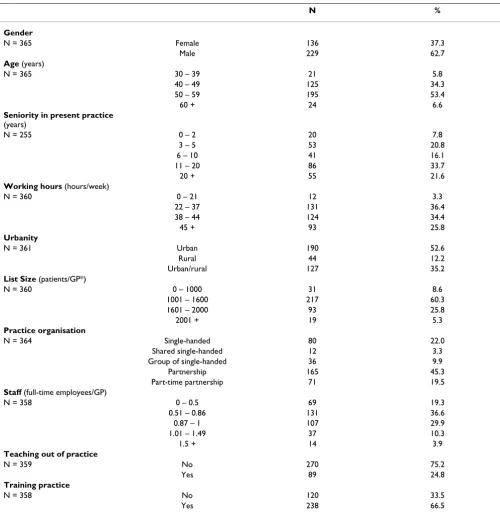
responses from patients not indicating which GP they assessed or assessing non-participating GPs, we had 28,260 (77.3%) valid responses. Characteristics of the evaluated GPs and their practices are displayed in Table 1. Respondent characteristics are shown in Table 2. There were more than twice as many female as male respond-Table 1: Distribution of characteristics among participating general practitioners.
N %
Gender
N = 365 Female 136 37.3
Male 229 62.7
Age (years)
N = 365 30 – 39 21 5.8
40 – 49 125 34.3
50 – 59 195 53.4
60 + 24 6.6
Seniority in present practice
(years)
N = 255 0 – 2 20 7.8
3 – 5 53 20.8
6 – 10 41 16.1
11 – 20 86 33.7
20 + 55 21.6
Working hours (hours/week)
N = 360 0 – 21 12 3.3
22 – 37 131 36.4
38 – 44 124 34.4
45 + 93 25.8
Urbanity
N = 361 Urban 190 52.6
Rural 44 12.2
Urban/rural 127 35.2
List Size (patients/GP*)
N = 360 0 – 1000 31 8.6
1001 – 1600 217 60.3
1601 – 2000 93 25.8
2001 + 19 5.3
Practice organisation
N = 364 Single-handed 80 22.0
Shared single-handed 12 3.3
Group of single-handed 36 9.9
Partnership 165 45.3
Part-time partnership 71 19.5
Staff (full-time employees/GP)
N = 358 0 – 0.5 69 19.3
0.51 – 0.86 131 36.6
0.87 – 1 107 29.9
1.01 – 1.49 37 10.3
1.5 + 14 3.9
Teaching out of practice
N = 359 No 270 75.2
Yes 89 24.8
Training practice
N = 358 No 120 33.5
Yes 238 66.5
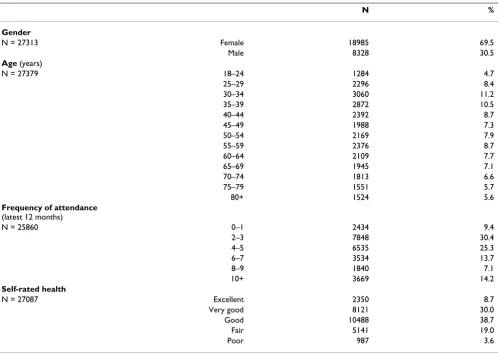
[image:4.612.55.555.98.612.2]ents (Table 2), which reflects that women are more inclined than men to attend a GP [27] and to respond to questionnaires (Heje et al., submitted).
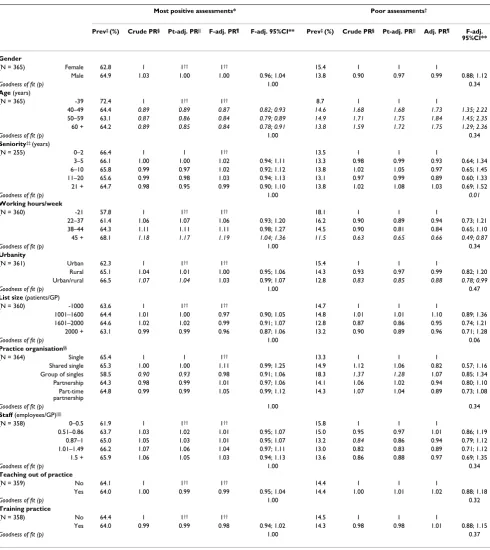
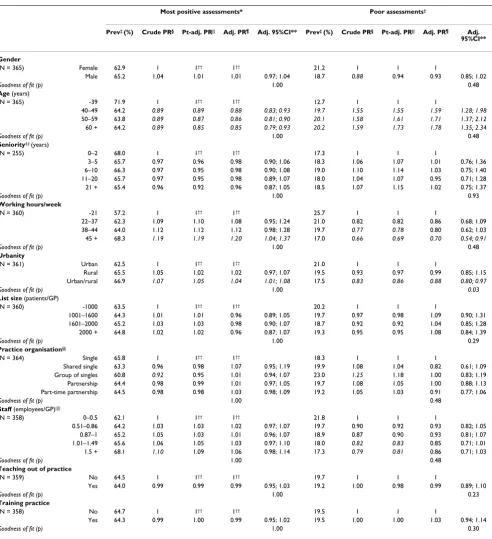
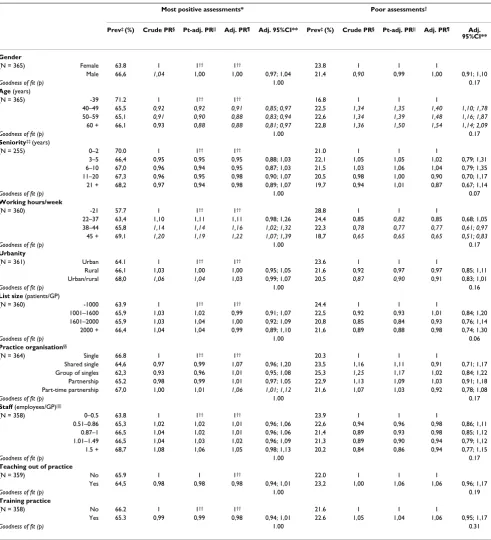
GP gender was not associated with evaluation outcome when we adjusted for patient, GP and practice confound-ers. However, adjustment did not neutralize the negative association found with GP age for all dimensions except accessibility. GPs aged 30–39 years received the most pos-itive evaluations, whereas there was no difference between the other age categories. There was no association with seniority, neither before nor after adjustment.
In the following the word "association" refers to the fully adjusted PR, i.e. the PR adjusted for confounding patient, GP and practice variables and for patent clustering.
For the first four dimensions ("GP-patient-relationship", "medical care", "information and support" and "organisa-tion of care"), we found a positive associa"organisa-tion between the evaluation and GP working hours in excess of 45 hours a week (Tables 3, 4, 5, 6). Patients' evaluation of the organ-isation of practice (e.g. continuity) was positively
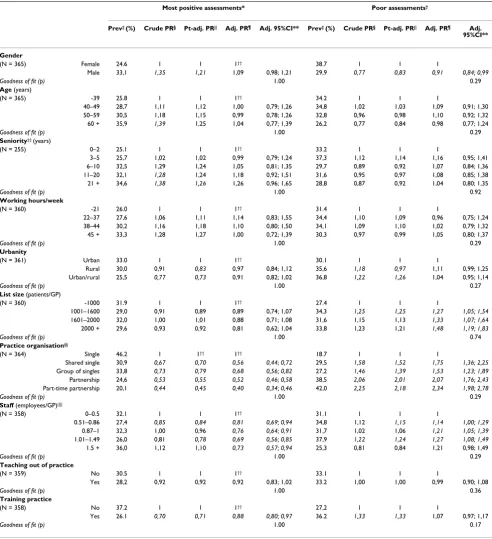
associ-ated with the GP's weekly working hours exceeding 37 hours. There was no association between weekly working hours and patients' assessment of accessibility (Table 7).
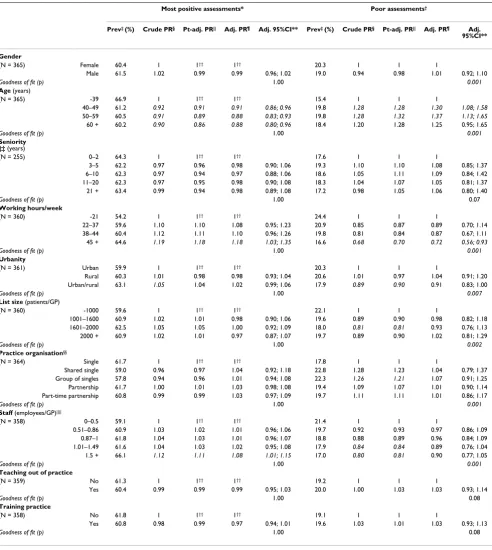
We saw practically no association with practice urbanisa-tion. The number of patients and the number of employ-ees per GP were negatively associated with the experienced accessibility (Table 7), but not with the eval-uation of the other dimensions (Tables 3, 4, 5, 6). The way the GPs had arranged themselves in practice played a minor role regarding the first four dimensions (Tables 3, 4, 5, 6), while there were major differences regarding accessibility. GPs in single-handed practices were assessed more positively than GPs in shared single-handed, groups of single-handed and partnership practices. Accessibility to GPs working part-time in partnership practices was assessed least favourably (Table 7).
[image:5.612.57.556.380.732.2]Working in a training practice was only associated with the assessment of accessibility aspects (Table 7), where we found a negative association, while the evaluations were not associated with teaching outside the practice.
Table 2: Distribution of characteristics among participating patients.
N %
Gender
N = 27313 Female 18985 69.5
Male 8328 30.5
Age (years)
N = 27379 18–24 1284 4.7
25–29 2296 8.4
30–34 3060 11.2
35–39 2872 10.5
40–44 2392 8.7
45–49 1988 7.3
50–54 2169 7.9
55–59 2376 8.7
60–64 2109 7.7
65–69 1945 7.1
70–74 1813 6.6
75–79 1551 5.7
80+ 1524 5.6
Frequency of attendance
(latest 12 months)
N = 25860 0–1 2434 9.4
2–3 7848 30.4
4–5 6535 25.3
6–7 3534 13.7
8–9 1840 7.1
10+ 3669 14.2
Self-rated health
N = 27087 Excellent 2350 8.7
Very good 8121 30.0
Good 10488 38.7
Fair 5141 19.0
Table 3: Dimension 1: Crude and adjusted associations between patients' evaluation of aspects of the doctor-patient-relationship.
Most positive assessments* Poor assessments†
Prev‡ (%) Crude PR§ Pt-adj. PR|| F-adj. PR¶ F-adj. 95%CI** Prev‡ (%) Crude PR§ Pt-adj. PR|| Adj. PR¶ F-adj. 95%CI**
Gender
(N = 365) Female 62.8 1 1†† 1†† 15.4 1 1 1
Male 64.9 1.03 1.00 1.00 0.96; 1.04 13.8 0.90 0.97 0.99 0.88; 1.12
Goodness of fit (p) 1.00 0.34
Age (years)
(N = 365) -39 72.4 1 1†† 1†† 8.7 1 1 1
40–49 64.4 0.89 0.89 0.87 0.82; 0.93 14.6 1.68 1.68 1.73 1.35; 2.22
50–59 63.1 0.87 0.86 0.84 0.79; 0.89 14.9 1.71 1.75 1.84 1.45; 2.35
60 + 64.2 0.89 0.85 0.84 0.78; 0.91 13.8 1.59 1.72 1.75 1.29; 2.36
Goodness of fit (p) 1.00 0.34
Seniority‡‡ (years)
(N = 255) 0–2 66.4 1 1 1†† 13.5 1 1 1
3–5 66.1 1.00 1.00 1.02 0.94; 1.11 13.3 0.98 0.99 0.93 0.64; 1.34
6–10 65.8 0.99 0.97 1.02 0.92; 1.12 13.8 1.02 1.05 0.97 0.65; 1.45
11–20 65.6 0.99 0.98 1.03 0.94; 1.13 13.1 0.97 0.99 0.89 0.60; 1.33
21 + 64.7 0.98 0.95 0.99 0.90; 1.10 13.8 1.02 1.08 1.03 0.69; 1.52
Goodness of fit (p) 1.00 0.01
Working hours/week
(N = 360) -21 57.8 1 1†† 1†† 18.1 1 1 1
22–37 61.4 1.06 1.07 1.06 0.93; 1.20 16.2 0.90 0.89 0.94 0.73; 1.21
38–44 64.3 1.11 1.11 1.11 0.98; 1.27 14.5 0.90 0.81 0.84 0.65; 1.10
45 + 68.1 1.18 1.17 1.19 1.04; 1.36 11.5 0.63 0.65 0.66 0.49; 0.87
Goodness of fit (p) 1.00 0.34
Urbanity
(N = 361) Urban 62.3 1 1†† 1†† 15.4 1 1 1
Rural 65.1 1.04 1.01 1.00 0.95; 1.06 14.3 0.93 0.97 0.99 0.82; 1.20
Urban/rural 66.5 1.07 1.04 1.03 0.99; 1.07 12.8 0.83 0.85 0.88 0.78; 0.99
Goodness of fit (p) 1.00 0.47
List size (patients/GP)
(N = 360) -1000 63.6 1 1†† 1†† 14.7 1 1 1
1001–1600 64.4 1.01 1.00 0.97 0.90; 1.05 14.8 1.01 1.01 1.10 0.89; 1.36
1601–2000 64.6 1.02 1.02 0.99 0.91; 1.07 12.8 0.87 0.86 0.95 0.74; 1.21
2000 + 63.1 0.99 0.99 0.96 0.87; 1.06 13.2 0.90 0.89 0.96 0.71; 1.28
Goodness of fit (p) 1.00 0.06
Practice organisation§§
(N = 364) Single 65.4 1 1 1†† 13.3 1 1 1
Shared single 65.3 1.00 1.00 1.11 0.99; 1.25 14.9 1.12 1.06 0.82 0.57; 1.16
Group of singles 58.5 0.90 0.93 0.98 0.91; 1.06 18.3 1.37 1.28 1.07 0.85; 1.34
Partnership 64.3 0.98 0.99 1.01 0.97; 1.06 14.1 1.06 1.02 0.94 0.80; 1.10
Part-time partnership
64.8 0.99 0.99 1.05 0.99; 1.12 14.3 1.07 1.04 0.89 0.73; 1.08
Goodness of fit (p) 1.00 0.34
Staff (employees/GP)||||
(N = 358) 0–0.5 61.9 1 1†† 1†† 15.8 1 1 1
0.51–0.86 63.7 1.03 1.02 1.01 0.95; 1.07 15.0 0.95 0.97 1.01 0.86; 1.19
0.87–1 65.0 1.05 1.03 1.01 0.95; 1.07 13.2 0.84 0.86 0.94 0.79; 1.12
1.01–1.49 66.2 1.07 1.06 1.04 0.97; 1.11 13.0 0.82 0.83 0.89 0.71; 1.12
1.5 + 65.9 1.06 1.05 1.03 0.94; 1.13 13.6 0.86 0.88 0.97 0.69; 1.35
Goodness of fit (p) 1.00 0.34
Teaching out of practice
(N = 359) No 64.1 1 1†† 1†† 14.4 1 1 1
Yes 64.0 1.00 0.99 0.99 0.95; 1.04 14.4 1.00 1.01 1.02 0.88; 1.18
Goodness of fit (p) 1.00 0.32
Training practice
(N = 358) No 64.4 1 1†† 1†† 14.5 1 1 1
Yes 64.0 0.99 0.99 0.98 0.94; 1.02 14.3 0.98 0.98 1.01 0.88; 1.15
Goodness of fit (p) 1.00 0.37
Prevalence ratio (PR) for 100% positive assessments and for 0–49% positive assessments associated with different patient characteristics. Crude PRs are adjusted for patient clustering. Patient-adjusted PRs are adjusted for patients' gender, age, frequency of attending a general practitioner (GP) and self-rated health and patient clustering. Fully adjusted PRs are adjusted for GPs' gender, age, weekly working hours, organisation of practice and staff in addition to patients' gender, age, frequency of attending a GP, self-rated health and patient clustering. The goodness of model fitting is shown regarding the fully adjusted PRs (p-values).
* Patients who marked 100% of the answered questions in one of the two most positive answering categories.
† Patients who marked less than 50% (0–49%) of the answered questions in one of the two most positive answering categories. ‡ Prevalence
§ Crude prevalence ratio is the unadjusted prevalence ratio adjusted for patient clustering
|| Patient-adjusted prevalence ratio is the prevalence ratio adjusted for patients' gender, age, frequency of attending a GP and self-rated health and patient clustering.
¶ Fully adjusted prevalence ratio is the prevalence ratio adjusted for GPs' gender, age, weekly working hours, organisation of practice and staff in addition to patients' gender, age, frequency
of attending a GP, self-rated health and patient clustering. ** 95% confidence interval for the fully adjusted prevalence ratio.
†† Poisson regression with robust variance ‡‡ Seniority in present practice
§§ "Single" = single-haned, "Shared single" = two ore more GPs sharing a single-handed practice, "Group of singles" = single-handed GPs sharing premises and staff, "Partnership" = GPs
sharing patient-list, premises and staff, "Part-time partnership" = partnership practices with all GPs working part-time
Table 4: Dimension 2: Crude and adjusted associations between patients' evaluation of aspects of the medical care.
Most positive assessments* Poor assessments†
Prev‡ (%) Crude PR§ Pt-adj. PR|| Adj. PR¶ Adj. 95%CI** Prev‡ (%) Crude PR§ Pt-adj. PR|| Adj. PR¶ Adj. 95%CI**
Gender
(N = 365) Female 60.4 1 1†† 1†† 20.3 1 1 1
Male 61.5 1.02 0.99 0.99 0.96; 1.02 19.0 0.94 0.98 1.01 0.92; 1.10
Goodness of fit (p) 1.00 0.001
Age (years)
(N = 365) -39 66.9 1 1†† 1†† 15.4 1 1 1
40–49 61.2 0.92 0.91 0.91 0.86; 0.96 19.8 1.28 1.28 1.30 1.08; 1.58
50–59 60.5 0.91 0.89 0.88 0.83; 0.93 19.8 1.28 1.32 1.37 1.13; 1.65
60 + 60.2 0.90 0.86 0.88 0.80; 0.96 18.4 1.20 1.28 1.25 0.95; 1.65
Goodness of fit (p) 1.00 0.001
Seniority ‡‡ (years)
(N = 255) 0–2 64.3 1 1†† 1†† 17.6 1 1 1
3–5 62.2 0.97 0.96 0.98 0.90; 1.06 19.3 1.10 1.10 1.08 0.85; 1.37
6–10 62.3 0.97 0.94 0.97 0.88; 1.06 18.6 1.05 1.11 1.09 0.84; 1.42
11–20 62.3 0.97 0.95 0.98 0.90; 1.08 18.3 1.04 1.07 1.05 0.81; 1.37
21 + 63.4 0.99 0.94 0.98 0.89; 1.08 17.2 0.98 1.05 1.06 0.80; 1.40
Goodness of fit (p) 1.00 0.07
Working hours/week
(N = 360) -21 54.2 1 1†† 1†† 24.4 1 1 1
22–37 59.6 1.10 1.10 1.08 0.95; 1.23 20.9 0.85 0.87 0.89 0.70; 1.14
38–44 60.4 1.12 1.11 1.10 0.96; 1.26 19.8 0.81 0.84 0.87 0.67; 1.11
45 + 64.6 1.19 1.18 1.18 1.03; 1.35 16.6 0.68 0.70 0.72 0.56; 0.93
Goodness of fit (p) 1.00 0.001
Urbanity
(N = 361) Urban 59.9 1 1†† 1†† 20.3 1 1 1
Rural 60.3 1.01 0.98 0.98 0.93; 1.04 20.6 1.01 0.97 1.04 0.91; 1.20
Urban/rural 63.1 1.05 1.04 1.02 0.99; 1.06 17.9 0.89 0.90 0.91 0.83; 1.00
Goodness of fit (p) 1.00 0.007
List size (patients/GP)
(N = 360) -1000 59.6 1 1†† 1†† 22.1 1 1 1
1001–1600 60.9 1.02 1.01 0.98 0.90; 1.06 19.6 0.89 0.90 0.98 0.82; 1.18
1601–2000 62.5 1.05 1.05 1.00 0.92; 1.09 18.0 0.81 0.81 0.93 0.76; 1.13
2000 + 60.9 1.02 1.01 0.97 0.87; 1.07 19.7 0.89 0.90 1.02 0.81; 1.29
Goodness of fit (p) 1.00 0.002
Practice organisation§§
(N = 364) Single 61.7 1 1†† 1†† 17.8 1 1 1
Shared single 59.0 0.96 0.97 1.04 0.92; 1.18 22.8 1.28 1.23 1.04 0.79; 1.37 Group of singles 57.8 0.94 0.96 1.01 0.94; 1.08 22.3 1.26 1.21 1.07 0.91; 1.25 Partnership 61.7 1.00 1.01 1.03 0.98; 1.08 19.4 1.09 1.07 1.01 0.90; 1.14 Part-time partnership 60.8 0.99 0.99 1.03 0.97; 1.09 19.7 1.11 1.11 1.01 0.86; 1.17
Goodness of fit (p) 1.00 0.001
Staff (employees/GP)||||
(N = 358) 0–0.5 59.1 1 1†† 1†† 21.4 1 1 1
0.51–0.86 60.9 1.03 1.02 1.01 0.96; 1.06 19.7 0.92 0.93 0.97 0.86; 1.09
0.87–1 61.8 1.04 1.03 1.01 0.96; 1.07 18.8 0.88 0.89 0.96 0.84; 1.09
1.01–1.49 61.6 1.04 1.03 1.02 0.95; 1.08 17.9 0.84 0.84 0.89 0.76; 1.04
1.5 + 66.1 1.12 1.11 1.08 1.01; 1.15 17.0 0.80 0.81 0.90 0.77; 1.05
Goodness of fit (p) 1.00 0.001
Teaching out of practice
(N = 359) No 61.3 1 1†† 1†† 19.2 1 1 1
Yes 60.4 0.99 0.99 0.99 0.95; 1.03 20.0 1.00 1.03 1.03 0.93; 1.14
Goodness of fit (p) 1.00 0.08
Training practice
(N = 358) No 61.8 1 1†† 1†† 19.1 1 1 1
Yes 60.8 0.98 0.99 0.97 0.94; 1.01 19.6 1.03 1.01 1.03 0.93; 1.13
Goodness of fit (p) 1.00 0.08
Prevalence ratio (PR) for 100% positive assessments and for 0–49% positive assessments associated with different patient characteristics. Crude PRs are adjusted for patient clustering. Patient-adjusted PRs are adjusted for patients' gender, age, frequency of attending a general practitioner (GP) and self-rated health and patient clustering. Fully adjusted PRs are adjusted for GPs' gender, age, weekly working hours, organisation of practice and staff in addition to patients' gender, age, frequency of attending a GP, self-rated health and patient clustering. The goodness of model fitting is shown regarding the fully adjusted PRs (p-values).
* Patients who marked 100% of the answered questions in one of the two most positive answering categories.
† Patients who marked less than 50% (0–49%) of the answered questions in one of the two most positive answering categories. ‡ Prevalence
§ Crude prevalence ratio is the unadjusted prevalence ratio adjusted for patient clustering
|| Patient-adjusted prevalence ratio is the prevalence ratio adjusted for patients' gender, age, frequency of attending a GP and self-rated health and patient clustering.
¶ Fully adjusted prevalence ratio is the prevalence ratio adjusted for GPs' gender, age, weekly working hours, organisation of practice and staff in addition to patients' gender, age, frequency
of attending a GP, self-rated health and patient clustering. ** 95% confidence interval for the fully adjusted prevalence ratio.
†† Poisson regression with robust variance ‡‡ Seniority in present practice
§§ "Single" = single-haned, "Shared single" = two ore more GPs sharing a single-handed practice, "Group of singles" = single-handed GPs sharing premises and staff, "Partnership" = GPs
sharing patient-list, premises and staff, "Part-time partnership" = partnership practices with all GPs working part-time
Table 5: Dimension 3: Crude and adjusted associations between patients' evaluation of aspects of the information and support.
Most positive assessments* Poor assessments†
Prev‡ (%) Crude PR§ Pt-adj. PR|| Adj. PR¶ Adj. 95%CI** Prev‡ (%) Crude PR§ Pt-adj. PR|| Adj. PR¶ Adj. 95%CI**
Gender
(N = 365) Female 62.9 1 1†† 1†† 21.2 1 1 1
Male 65.2 1.04 1.01 1.01 0.97; 1.04 18.7 0.88 0.94 0.93 0.85; 1.02
Goodness of fit (p) 1.00 0.48
Age (years)
(N = 365) -39 71.9 1 1†† 1†† 12.7 1 1 1
40–49 64.2 0.89 0.89 0.88 0.83; 0.93 19.7 1.55 1.55 1.59 1.28; 1.98
50–59 63.8 0.89 0.87 0.86 0.81; 0.90 20.1 1.58 1.61 1.71 1.37; 2.12
60 + 64.2 0.89 0.85 0.85 0.79; 0.93 20.2 1.59 1.73 1.78 1.35; 2.34
Goodness of fit (p) 1.00 0.48
Seniority‡‡ (years)
(N = 255) 0–2 68.0 1 1†† 1†† 17.3 1 1 1
3–5 65.7 0.97 0.96 0.98 0.90; 1.06 18.3 1.06 1.07 1.01 0.76; 1.36
6–10 66.3 0.97 0.95 0.98 0.90; 1.08 19.0 1.10 1.14 1.03 0.75; 1.40
11–20 65.7 0.97 0.95 0.98 0.89; 1.07 18.0 1.04 1.07 0.95 0.71; 1.28
21 + 65.4 0.96 0.92 0.96 0.87; 1.05 18.5 1.07 1.15 1.02 0.75; 1.37
Goodness of fit (p) 1.00 0.93
Working hours/week
(N = 360) -21 57.2 1 1†† 1†† 25.7 1 1 1
22–37 62.3 1.09 1.10 1.08 0.95; 1.24 21.0 0.82 0.82 0.86 0.68; 1.09
38–44 64.0 1.12 1.12 1.12 0.98; 1.28 19.7 0.77 0.78 0.80 0.62; 1.03
45 + 68.3 1.19 1.19 1.20 1.04; 1.37 17.0 0.66 0.69 0.70 0.54; 0.91
Goodness of fit (p) 1.00 0.48
Urbanity
(N = 361) Urban 62.5 1 1†† 1†† 21.0 1 1 1
Rural 65.5 1.05 1.02 1.02 0.97; 1.07 19.5 0.93 0.97 0.99 0.85; 1.15
Urban/rural 66.9 1.07 1.05 1.04 1.01; 1.08 17.5 0.83 0.86 0.88 0.80; 0.97
Goodness of fit (p) 1.00 0.03
List size (patients/GP)
(N = 360) -1000 63.5 1 1†† 1†† 20.2 1 1 1
1001–1600 64.3 1.01 1.01 0.96 0.89; 1.05 19.7 0.97 0.98 1.09 0.90; 1.31
1601–2000 65.2 1.03 1.03 0.98 0.90; 1.07 18.7 0.92 0.92 1.04 0.85; 1.28
2000 + 64.8 1.02 1.02 0.96 0.87; 1.07 19.3 0.95 0.95 1.08 0.84; 1.39
Goodness of fit (p) 1.00 0.29
Practice organisation§§
(N = 364) Single 65.8 1 1†† 1†† 18.3 1 1 1
Shared single 63.3 0.96 0.98 1.07 0.95; 1.19 19.9 1.08 1.04 0.82 0.61; 1.09 Group of singles 60.8 0.92 0.95 1.01 0.94; 1.07 23.0 1.25 1.18 1.00 0.83; 1.19 Partnership 64.4 0.98 0.99 1.01 0.97; 1.05 19.7 1.08 1.05 1.00 0.88; 1.13 Part-time partnership 64.5 0.98 0.98 1.03 0.98; 1.09 19.2 1.05 1.03 0.91 0.77; 1.06
Goodness of fit (p) 1.00 0.48
Staff (employees/GP)||||
(N = 358) 0–0.5 62.1 1 1†† 1†† 21.8 1 1 1
0.51–0.86 64.2 1.03 1.03 1.02 0.97; 1.07 19.7 0.90 0.92 0.93 0.82; 1.05
0.87–1 65.2 1.05 1.03 1.01 0.96; 1.07 18.9 0.87 0.90 0.93 0.81; 1.07
1.01–1.49 65.6 1.06 1.05 1.03 0.97; 1.10 18.0 0.82 0.83 0.85 0.71; 1.01
1.5 + 68.1 1.10 1.09 1.06 0.98; 1.14 17.3 0.79 0.81 0.86 0.71; 1.03
Goodness of fit (p) 1.00 0.48
Teaching out of practice
(N = 359) No 64.5 1 1†† 1†† 19.7 1 1 1
Yes 64.0 0.99 0.99 0.99 0.95; 1.03 19.2 1.00 0.98 0.99 0.89; 1.10
Goodness of fit (p) 1.00 0.23
Training practice
(N = 358) No 64.7 1 1†† 1†† 19.5 1 1 1
Yes 64.3 0.99 1.00 0.99 0.95; 1.02 19.5 1.00 1.00 1.03 0.94; 1.14
Goodness of fit (p) 1.00 0.30
Prevalence ratio (PR) for 100% positive assessments and for 0–49% positive assessments associated with different patient characteristics. Crude PRs are adjusted for patient clustering. Patient-adjusted PRs are adjusted for patients' gender, age, frequency of attending a general practitioner (GP) and self-rated health and patient clustering. Fully adjusted PRs are adjusted for GPs' gender, age, weekly working hours, organisation of practice and staff in addition to patients' gender, age, frequency of attending a GP, self-rated health and patient clustering. The goodness of model fitting is shown regarding the fully adjusted PRs (p-values).
* Patients who marked 100% of the answered questions in one of the two most positive answering categories.
† Patients who marked less than 50% (0–49%) of the answered questions in one of the two most positive answering categories. ‡ Prevalence
§ Crude prevalence ratio is the unadjusted prevalence ratio adjusted for patient clustering
|| Patient-adjusted prevalence ratio is the prevalence ratio adjusted for patients' gender, age, frequency of attending a GP and self-rated health and patient clustering.
¶ Fully adjusted prevalence ratio is the prevalence ratio adjusted for GPs' gender, age, weekly working hours, organisation of practice and staff in addition to patients' gender, age, frequency
of attending a GP, self-rated health and patient clustering. ** 95% confidence interval for the fully adjusted prevalence ratio.
†† Poisson regression with robust variance ‡‡ Seniority in present practice
§§ "Single" = single-haned, "Shared single" = two ore more GPs sharing a single-handed practice, "Group of singles" = single-handed GPs sharing premises and staff, "Partnership" = GPs
sharing patient-list, premises and staff, "Part-time partnership" = partnership practices with all GPs working part-time
Table 6: Dimension 4: Crude and adjusted associations between patients' evaluation of aspects of the organisation of care.
Most positive assessments* Poor assessments†
Prev‡ (%) Crude PR§ Pt-adj. PR|| Adj. PR¶ Adj. 95%CI** Prev‡ (%) Crude PR§ Pt-adj. PR|| Adj. PR¶ Adj. 95%CI**
Gender
(N = 365) Female 63.8 1 1†† 1†† 23.8 1 1 1
Male 66,6 1,04 1,00 1,00 0,97; 1,04 21,4 0,90 0,99 1,00 0,91; 1,10
Goodness of fit (p) 1.00 0.17
Age (years)
(N = 365) -39 71.2 1 1†† 1†† 16.8 1 1 1
40–49 65,5 0,92 0,92 0,91 0,85; 0,97 22,5 1,34 1,35 1,40 1,10; 1,78
50–59 65,1 0,91 0,90 0,88 0,83; 0,94 22,6 1,34 1,39 1,48 1,16; 1,87
60 + 66,1 0,93 0,88 0,88 0,81; 0,97 22,8 1,36 1,50 1,54 1,14; 2,09
Goodness of fit (p) 1.00 0.17
Seniority‡‡ (years)
(N = 255) 0–2 70.0 1 1†† 1†† 21.0 1 1 1
3–5 66,4 0,95 0,95 0,95 0,88; 1,03 22,1 1,05 1,05 1,02 0,79; 1,31
6–10 67,0 0,96 0,94 0,95 0,87; 1,03 21,5 1,03 1,06 1,04 0,79; 1,35
11–20 67,3 0,96 0,95 0,98 0,90; 1,07 20,5 0,98 1,00 0,90 0,70; 1,17
21 + 68,2 0,97 0,94 0,98 0,89; 1,07 19,7 0,94 1,01 0,87 0,67; 1,14
Goodness of fit (p) 1.00 0.07
Working hours/week
(N = 360) -21 57.7 1 1†† 1†† 28.8 1 1 1
22–37 63,4 1,10 1,11 1,11 0,98; 1,26 24,4 0,85 0,82 0,85 0,68; 1,05
38–44 65,8 1,14 1,14 1,16 1,02; 1,32 22,3 0,78 0,77 0,77 0,61; 0,97
45 + 69,1 1,20 1,19 1,22 1,07; 1,39 18,7 0,65 0,65 0,65 0,51; 0,83
Goodness of fit (p) 1.00 0.17
Urbanity
(N = 361) Urban 64.1 1 1†† 1†† 23.6 1 1 1
Rural 66,1 1,03 1,00 1,00 0,95; 1,05 21,6 0,92 0,97 0,97 0,85; 1,11
Urban/rural 68,0 1,06 1,04 1,03 0,99; 1,07 20,5 0,87 0,90 0,91 0,83; 1,01
Goodness of fit (p) 1.00 0.16
List size (patients/GP)
(N = 360) -1000 63.9 1 1†† 1†† 24.4 1 1 1
1001–1600 65,9 1,03 1,02 0,99 0,91; 1,07 22,5 0,92 0,93 1,01 0,84; 1,20
1601–2000 65,9 1,03 1,04 1,00 0,92; 1,09 20,8 0,85 0,84 0,93 0,76; 1,14
2000 + 66,4 1,04 1,04 0,99 0,89; 1,10 21,6 0,89 0,88 0,98 0,74; 1,30
Goodness of fit (p) 1.00 0.06
Practice organisation§§
(N = 364) Single 66.8 1 1†† 1†† 20.3 1 1 1
Shared single 64,6 0,97 0,99 1,07 0,96; 1,20 23,5 1,16 1,11 0,91 0,71; 1,17 Group of singles 62,3 0,93 0,96 1,01 0,95; 1,08 25,3 1,25 1,17 1,02 0,84; 1,22 Partnership 65,2 0,98 0,99 1,01 0,97; 1,05 22,9 1,13 1,09 1,03 0,91; 1,18 Part-time partnership 67,0 1,00 1,01 1,06 1,01; 1,12 21,6 1,07 1,03 0,92 0,78; 1,08
Goodness of fit (p) 1.00 0.17
Staff (employees/GP)||||
(N = 358) 0–0.5 63.8 1 1†† 1†† 23.9 1 1 1
0.51–0.86 65,3 1,02 1,02 1,01 0,96; 1,06 22,6 0,94 0,96 0,98 0,86; 1,11
0.87–1 66,5 1,04 1,02 1,01 0,96; 1,06 21,4 0,89 0,93 0,98 0,85; 1,12
1.01–1.49 66,5 1,04 1,03 1,02 0,96; 1,09 21,3 0,89 0,90 0,94 0,79; 1,12
1.5 + 68,7 1,08 1,06 1,05 0,98; 1,13 20,2 0,84 0,86 0,94 0,77; 1,15
Goodness of fit (p) 1.00 0.17
Teaching out of practice
(N = 359) No 65.9 1 1 1†† 22.0 1 1 1
Yes 64,5 0,98 0,98 0,98 0,94; 1,01 23,2 1,00 1,06 1,06 0,96; 1,17
Goodness of fit (p) 1.00 0.19
Training practice
(N = 358) No 66.2 1 1†† 1†† 21.6 1 1 1
Yes 65.3 0,99 0,99 0,98 0,94; 1,01 22.6 1,05 1,04 1,06 0,95; 1,17
Goodness of fit (p) 1.00 0.31
Prevalence ratio (PR) for 100% positive assessments and for 0–49% positive assessments associated with different patient characteristics. Crude PRs are adjusted for patient clustering. Patient-adjusted PRs are adjusted for patients' gender, age, frequency of attending a general practitioner (GP) and self-rated health and patient clustering. Fully adjusted PRs are adjusted for GPs' gender, age, weekly working hours, organisation of practice and staff in addition to patients' gender, age, frequency of attending a GP, self-rated health and patient clustering. The goodness of model fitting is shown regarding the fully adjusted PRs (p-values).
* Patients who marked 100% of the answered questions in one of the two most positive answering categories.
† Patients who marked less than 50% (0–49%) of the answered questions in one of the two most positive answering categories. ‡ Prevalence
§ Crude prevalence ratio is the unadjusted prevalence ratio adjusted for patient clustering
|| Patient-adjusted prevalence ratio is the prevalence ratio adjusted for patients' gender, age, frequency of attending a GP and self-rated health and patient clustering.
¶ Fully adjusted prevalence ratio is the prevalence ratio adjusted for GPs' gender, age, weekly working hours, organisation of practice and staff in addition to patients' gender, age, frequency
of attending a GP, self-rated health and patient clustering. ** 95% confidence interval for the fully adjusted prevalence ratio.
†† Poisson regression with robust variance ‡‡ Seniority in present practice
§§ "Single" = single-haned, "Shared single" = two ore more GPs sharing a single-handed practice, "Group of singles" = single-handed GPs sharing premises and staff, "Partnership" = GPs
sharing patient-list, premises and staff, "Part-time partnership" = partnership practices with all GPs working part-time
Table 7: Dimension 5: Crude and adjusted associations between patients' evaluation of aspects of the accessibility.
Most positive assessments* Poor assessments†
Prev‡ (%) Crude PR§ Pt-adj. PR|| Adj. PR¶ Adj. 95%CI** Prev‡ (%) Crude PR§ Pt-adj. PR|| Adj. PR¶ Adj. 95%CI**
Gender
(N = 365) Female 24.6 1 1 1†† 38.7 1 1 1
Male 33,1 1,35 1,21 1,09 0,98; 1,21 29,9 0,77 0,83 0,91 0,84; 0,99
Goodness of fit (p) 1.00 0.29
Age (years)
(N = 365) -39 25.8 1 1 1†† 34.2 1 1 1
40–49 28,7 1,11 1,12 1,00 0,79; 1,26 34,8 1,02 1,03 1,09 0,91; 1,30
50–59 30,5 1,18 1,15 0,99 0,78; 1,26 32,8 0,96 0,98 1,10 0,92; 1,32
60 + 35,9 1,39 1,25 1,04 0,77; 1,39 26,2 0,77 0,84 0,98 0,77; 1,24
Goodness of fit (p) 1.00 0.29
Seniority‡‡ (years)
(N = 255) 0–2 25.1 1 1 1†† 33.2 1 1 1
3–5 25,7 1,02 1,02 0,99 0,79; 1,24 37,3 1,12 1,14 1,16 0,95; 1,41
6–10 32,5 1,29 1,24 1,05 0,81; 1,35 29,7 0,89 0,92 1,07 0,84; 1,36
11–20 32,1 1,28 1,24 1,18 0,92; 1,51 31,6 0,95 0,97 1,08 0,85; 1,38
21 + 34,6 1,38 1,26 1,26 0,96; 1,65 28,8 0,87 0,92 1,04 0,80; 1,35
Goodness of fit (p) 1.00 0.92
Working hours/week
(N = 360) -21 26.0 1 1 1†† 31.4 1 1 1
22–37 27,6 1,06 1,11 1,14 0,83; 1,55 34,4 1,10 1,09 0,96 0,75; 1,24
38–44 30,2 1,16 1,18 1,10 0,80; 1,50 34,1 1,09 1,10 1,02 0,79; 1,32
45 + 33,3 1,28 1,27 1,00 0,72; 1,39 30,3 0,97 0,99 1,05 0,80; 1,37
Goodness of fit (p) 1.00 0.29
Urbanity
(N = 361) Urban 33.0 1 1 1†† 30.1 1 1 1
Rural 30,0 0,91 0,83 0,97 0,84; 1,12 35,6 1,18 0,97 1,11 0,99; 1,25
Urban/rural 25,5 0,77 0,73 0,91 0,82; 1,02 36,8 1,22 1,26 1,04 0,95; 1,14
Goodness of fit (p) 1.00 0.27
List size (patients/GP)
(N = 360) -1000 31.9 1 1 1†† 27.4 1 1 1
1001–1600 29,0 0,91 0,89 0,89 0,74; 1,07 34,3 1,25 1,25 1,27 1,05; 1,54
1601–2000 32,0 1,00 1,01 0,88 0,71; 1,08 31,6 1,15 1,13 1,33 1,07; 1,64
2000 + 29,6 0,93 0,92 0,81 0,62; 1,04 33,8 1,23 1,21 1,48 1,19; 1,83
Goodness of fit (p) 1.00 0.74
Practice organisation§§
(N = 364) Single 46.2 1 1†† 1†† 18.7 1 1 1
Shared single 30,9 0,67 0,70 0,56 0,44; 0,72 29,5 1,58 1,52 1,75 1,36; 2,25
Group of singles 33,8 0,73 0,79 0,68 0,56; 0,82 27,2 1,46 1,39 1,53 1,23; 1,89
Partnership 24,6 0,53 0,55 0,52 0,46; 0,58 38,5 2,06 2,01 2,07 1,76; 2,43
Part-time partnership 20,1 0,44 0,45 0,40 0,34; 0,46 42,0 2,25 2,18 2,34 1,98; 2,78
Goodness of fit (p) 1.00 0.29
Staff (employees/GP)||||
(N = 358) 0–0.5 32.1 1 1 1†† 31.1 1 1 1
0.51–0.86 27,4 0,85 0,84 0,81 0,69; 0,94 34,8 1,12 1,15 1,14 1,00; 1,29
0.87–1 32,3 1,00 0,96 0,76 0,64; 0,91 31,7 1,02 1,06 1,21 1,05; 1,39
1.01–1.49 26,0 0,81 0,78 0,69 0,56; 0,85 37,9 1,22 1,24 1,27 1,08; 1,49
1.5 + 36,0 1,12 1,10 0,73 0,57; 0,94 25,3 0,81 0,84 1,21 0,98; 1,49
Goodness of fit (p) 1.00 0.29
Teaching out of practice
(N = 359) No 30.5 1 1 1†† 33.1 1 1 1
Yes 28,2 0,92 0,92 0,92 0,83; 1,02 33.2 1,00 1,00 0,99 0,90; 1,08
Goodness of fit (p) 1.00 0.36
Training practice
(N = 358) No 37.2 1 1 1†† 27,2 1 1 1
Yes 26.1 0,70 0,71 0,88 0,80; 0,97 36.2 1,33 1,33 1,07 0,97; 1,17
Goodness of fit (p) 1.00 0.17
Prevalence ratio (PR) for 100% positive assessments and for 0–49% positive assessments associated with different patient characteristics. Crude PRs are adjusted for patient clustering. Patient-adjusted PRs are adjusted for patients' gender, age, frequency of attending a general practitioner (GP) and self-rated health and patient clustering. Fully adjusted PRs are adjusted for GPs' gender, age, weekly working hours, organisation of practice and staff in addition to patients' gender, age, frequency of attending a GP, self-rated health and patient clustering. The goodness of model fitting is shown regarding the fully adjusted PRs (p-values).
* Patients who marked 100% of the answered questions in one of the two most positive answering categories.
† Patients who marked less than 50% (0–49%) of the answered questions in one of the two most positive answering categories. ‡ Prevalence
§ Crude prevalence ratio is the unadjusted prevalence ratio adjusted for patient clustering
|| Patient-adjusted prevalence ratio is the prevalence ratio adjusted for patients' gender, age, frequency of attending a GP and self-rated health and patient clustering.
¶ Fully adjusted prevalence ratio is the prevalence ratio adjusted for GPs' gender, age, weekly working hours, organisation of practice and staff in addition to patients' gender, age, frequency
of attending a GP, self-rated health and patient clustering. ** 95% confidence interval for the fully adjusted prevalence ratio.
†† Poisson regression with robust variance ‡‡ Seniority in present practice
§§ "Single" = single-haned, "Shared single" = two ore more GPs sharing a single-handed practice, "Group of singles" = single-handed GPs sharing premises and staff, "Partnership" = GPs
sharing patient-list, premises and staff, "Part-time partnership" = partnership practices with all GPs working part-time
Discussion
Principal findings
We found a strong negative association between the GP's age and the evaluation of all aspects, except accessibility. We also found a strong association between the way the practice was organised and the patients' evaluation of accessibility, with GPs in single-handed practices getting far the most positive evaluations. Long weekly working hours were associated with more positive evaluations of all dimensions, except accessibility, whereas more than 0.5 full-time employees per GP, a comparatively high number of listed patients per GP and working in a training practice were associated with negative evaluation of acces-sibility.
Discussion of methods
We chose to include the GPs' age as ten-year categories, and weekly working hours were categorised into two cate-gories above and two catecate-gories below standard Danish full-time hours. For both variables we found general trends in their associations with assessments, which indi-cates that more narrow ranges would hardly have revealed additional patterns of associations. Seniority in present practice was preferred to seniority as a GP as the latter to some extent would correlate with the GP's age, while the former indicates the GP's opportunity to provide continu-ity.
We did not include locums and vocational trainees in the variable "number of GPs sharing premises", even though they may have influenced the total practice resources and the number of staff needed.
We chose a one-level model to account for patient cluster-ing. However, GPs were also clustered in practices and a two-level model may therefore have been more applica-ble. Due to difficulties in converging the two-level model, we tested the differences between one- and two-level models and found that the variances between GPs were small, and differences in PR estimates were therefore neg-ligible (below 2%).
Overall, the model fit showed to be good using the Ber-noulli family and in the situations where the Poisson regression was used. As earlier explained in the methods section, the high prevalences forced us to use Poisson regression in some instances to enable the model to con-verge, which in this study did not change the estimates [20,21].
Strengths
The study enjoyed a very high statistical precision, which meant that we were able to detect quite small statistically significant associations and one might question their clin-ical relevance. However, the precision was, indeed,
con-siderable, so the risk of overlooking associations (type II-error) was accordingly extremely low.
In several cases, we found that GP and practice character-istics were differently associated with the evaluation of various aspects of care. Such differences may be blurred in measures of general satisfaction, which makes it difficult to compare our results with results from studies using this kind of measure [28,29].
Weaknesses
The project was a part of a large national patient evalua-tion project. This may have introduced some methodo-logical weaknesses in relation to the aim of this particular study. All GPs in the involved counties were invited, but those who entered the project were not necessarily a rep-resentative fraction. The method of patient inclusion should ideally secure a random draw from the attending part of the listed patients, well knowing that frequently attending patients would be overrepresented. We do not know to which extent GPs forgot to hand out question-naires or more systematically left some patients out. We focused on adjusted associations between evaluations and GP and practice characteristics. Selection of GPs and patients therefore did not have the same impact as if the aim had been to investigate actual evaluation levels.
Discussion of results
be that the association originated in a cohort effect, reflecting improvement in the CME of GPs, including both technical and inter-personal competencies.
The GP's weekly working hours were not associated with the patients' perception of accessibility, but were posi-tively associated with aspects of care organisation, includ-ing continuity, presumably because continuity is closely related to the GP personally, whereas lack of accessibility may be compensated for by the colleagues or managed otherwise.
The geographical location of the practice was not associ-ated with the evaluation. It is surprising, though, to see that practising in rural districts was not negatively associ-ated with the evaluation of accessibility, even though regions with shortage of GPs were included in this study. This may possibly be explained by an adjustment of patient expectations due to public discussion of the prob-lem.
Like in earlier studies [5,6,8,30], the number of patients per GP was not consistently associated with the evaluation in the first four dimensions, but we were not surprised to see that it was negatively associated with the patients' per-ception of accessibility. Inversely, the number of staff was also negatively associated with accessibility. In Denmark, practice nurses and laboratory assistants can conduct con-sultations on their own if supervised by the GP. Delegat-ing certain services to practice staff may induce a sense of limited access to the GP, which is supported by the fact that we found that GPs with more employees served larger lists of patients.
In concordance with earlier findings [8,31], there was a slight tendency towards more positive evaluation of the GP's technical care in part-time partnership practices, but otherwise practice organisation mainly influenced the patients' experience of accessibility. GPs in single-handed practices got, by far, the most positive assessments of all, while part-time partnership practices obtained the most negative assessments. This supports results from earlier studies [8,10,11]. More modest patient expectations of the single-handed GP's accessibility may explain this, or the explanation may be concealed by other factors regard-ing organisation, service and priorities that we have not been able to adjust for.
Baker [5,6] found training practices to obtain less favour-able assessments than non-training practices. Being involved with teaching and training out of practice was not associated with the evaluation in our study and work-ing in a trainwork-ing practice was only associated with a com-paratively lower evaluation of accessibility.
Policy and practice implications
Our results suggest adjustment for GP age whenever eval-uation results are compared between practices. On the other hand, both the GPs themselves and policy makers must be aware of correctable consequences of increasing GP age. Depending on the situation, adjustment for prac-tice organisation may also be appropriate, but as pracprac-tice organisation may be closely interwoven with other organ-isational aspects, this may blur important differences between practices that ought to be addressed.
We found single-handed practice, a short patient list, only a few employees, and not being a training practice to be associated with a better patient-experienced accessibility to care. This is contradictory to the finding of better tech-nical performance of GPs in larger partnerships [8,31], to the current trend in society that favours larger primary care units and that younger doctors wish to work part-time hours in partnership practices. Further studies are therefore needed to discover what lies behind these results and how practice may be organised in order to secure high professional standards and at the same time satisfy the patients' needs for personal continuity and accessibility. As this is in some way a general paradox concerning all practices, policy makers and GPs should come together to seek for possible solutions to this problem.
It cannot be concluded that patient evaluation results should always or never be adjusted for differences between practices. Adjustment may be appropriate when comparing results between (groups of) practices, but in the perspective of individual practices, one may claim that every GP must strive to satisfy his patients disregarding that his working conditions may be different from those of his colleagues.
Conclusion
Competing interests
The author(s) declare that they have no competing inter-ests.
Authors' contributions
HH, PV and FO planned the study, and HH carried out the patient evaluation survey assisted by the research secretar-iat. IS, PV and HH planned the statistical analyses, which were performed by IS. HH drafted the manuscript, which was rewritten by HH, PV, FO and IS. All authors read and approved the final manuscript.
Additional material
Acknowledgements
This study was carried out as part of the national project on patient evalu-ations, the DanPEP. In the DanPEP project, the local committees for quality improvement in general practice in each county were approached in order to gain their support prior to the individual invitation of GPs to enter the project. The project served as a pilot study prior to the decision on how to conduct future systematic quality assessment of general practice in the patients' perspective.
We wish to thank all the GPs and patients who through their evaluation provided this project with valuable data and Ms. Gitte Hove, cand. scient. bibl., for her competent management of the data. The DanPEP study was supported by grants from the Central Committee on Quality Development and Informatics in General Practice and the Danish Ministry of the Interior and Health. Direct expenses incurred by the participating GPs were refunded by the local Committees for Quality Improvement in General Practice in the counties of Aarhus, Frederiksborg, Funen, Ribe, Southern Jutland, Vejle and Western Zealand and the municipalities of Bornholm, Copenhagen and Frederiksberg.
References
1. Measurement of patients' satisfaction with their care 1st edition. London: Royal College of Physicians of London; 1993.
2. Jung HP: Quality of care in general practice. The patient perspective [the-sis] Nijmegen: University of Nijmegen, University of Maastricht; 1999. 3. O'Riordan M, Seuntjens L, Grol R, (editors): Improving patient care in
primary care in Europe 1st edition. Netherland: EQuiP; 2004. 4. Perneger TV: Adjustment for patient characteristics in
satis-faction surveys. Int J Qual Health Care 2004, 16:433-435. 5. Baker R, Streatfield J: What type of general practice do patients
prefer? Exploration of practice characteristics influencing patient satisfaction. Br J Gen Pract 1995, 45:654-659.
6. Baker R: Characteristics of practices, general practitioners and patients related to levels of patients' satisfaction with consultations. Br J Gen Pract 1996, 46:601-605.
7. Kvamme OJ, Sandvik L, Hjortdahl P: [Practice patterns, physi-cians' characteristics and patient-evaluated quality of gen-eral practice in Norway] (in Norwegian). Tidsskr Nor Laegeforen
2000, 120:2499-2502.
8. Campbell JL, Ramsay J, Green J: Practice size: impact on consul-tation length, workload, and patient assessment of care. Br J Gen Pract 2001, 51:644-650.
9. Lin HC, Xirasagar S, Laditka JN: Patient perceptions of service quality in group versus solo practice clinics. Int J Qual Health Care 2004, 16:437-445.
10. van den Hombergh P, Engels Y, van den Hoogen H, van Doremalen J, van den Bosch W, Grol R: Saying 'goodbye' to single-handed practices; what do patients and staff lose or gain? Fam Pract
2005, 22:20-27.
11. Wensing M, Vedsted P, Kersnik J, Peersman W, Klingenberg A, Hearnshaw H, Hjortdahl P, Paulus D, Künzi B, Mendive J, Grol R:
Patient satisfaction with availability of general practice: an international comparison. Int J Qual Health Care 2002,
14:111-118.
12. Hjortdahl P, Laerum E: Continuity of care in general practice: effect on patient satisfaction. BMJ 1992, 304:1287-1290. 13. Baker R, Mainous AG III, Gray DP, Love MM: Exploration of the
relationship between continuity, trust in regular doctors and patient satisfaction with consultations with family doctors.
Scand J Prim Health Care 2003, 21:27-32.
14. Grol R, Wensing M: Patients evaluate general/family practice. The EUROPEP instrument EQuiP, WONCA Region Europe; 2000. 15. Grol R, Wensing M, Mainz J, Jung HP, Ferreira P, Hearnshaw H,
Hjort-dahl P, Olesen F, Reis S, Ribacke M, Szecsenyi J: Patients in Europe evaluate general practice care: an international comparison.
Br J Gen Pract 2000, 50:882-887.
16. Bjørner JB, Damsgaard MT, Watt T, Bech P, Rasmussen NK, Kris-tensen TS, Modvig J, Thunedborg K: [The Danish manual for SF-36. A health status questionnaire] Copenhagen: Lif; 1997. (in Danish) 17. Lamberts H, Wood M: ICPC. [International Classification for Primary
Care] (Danish version) Oxford Medical Publications; 1990.
18. Clayton D, Hills M: Statistical Models in Epidemiology Oxford: Oxford University Press; 1993.
19. Modern Epidemiology Second edition. Philadelphia: Lippicott-Raven Publishers; 1998.
20. Barros AJ, Hirakata VN: Alternatives for logistic regression in cross-sectional studies: an empirical comparison of models that directly estimate the prevalence ratio. BMC Med Res Methodol 2003, 3:21.
21. Zou G: A modified poisson regression approach to prospec-tive studies with binary data. Am J Epidemiol 2004, 159:702-706. 22. Hosmer DW Jr, Lemeshow S: Applied Logistic Regression 1st edition.
New York: WILEY; 1989.
23. Armitage P, Berry G, Matthews JNS: Statistical Methods in Medical Research Fourth edition. Oxford: Blackwell Science; 2005.
24. Donner A, Klar N: Design and Analysis of Cluster Randomisation Trials in Health Research London: Hodder Arnold; 2000.
25. Stata Statistical Software: Release 8.0 College Station, TX: Stata Corpo-ration; 2003.
26. Stata Statistical Software: Release 9.0 College Station, TX: StataCorp LP; 2005.
27. Statistics Denmark, Statbank Denmark [http://www.stat bank.dk]. (Accessed November 2005)
28. Cleary PD, McNeil BJ: Patient satisfaction as an indicator of quality care. Inq 1988, 25:25-36.
29. Sitzia J, Wood N: Patient satisfaction: a review of issues and concepts. Soc Sci Med 1997, 45:1829-1843.
30. Campbell SM, Hann M, Hacker J, Burns C, Oliver D, Thapar A, Mead N, Safran DG, Roland MO: Identifying predictors of high quality care in English general practice: observational study. BMJ
2001, 323:784-787.
31. Baker R: General practice in Gloucestershire, Avon and Som-erset: explaining variations in standards. Br J Gen Pract 1992,
42:415-418.
Additional File 1
Danish general practice.
Click here for file
[http://www.biomedcentral.com/content/supplementary/1472-6963-7-46-S1.doc]
Additional File 2
The EUROPEP questionnaire.
Click here for file
Publish with BioMed Central and every scientist can read your work free of charge "BioMed Central will be the most significant development for disseminating the results of biomedical researc h in our lifetime."
Sir Paul Nurse, Cancer Research UK
Your research papers will be:
available free of charge to the entire biomedical community
peer reviewed and published immediately upon acceptance
cited in PubMed and archived on PubMed Central
yours — you keep the copyright
Submit your manuscript here:
http://www.biomedcentral.com/info/publishing_adv.asp
BioMedcentral
Pre-publication history
The pre-publication history for this paper can be accessed here: