Copyright © 2002, American Society for Microbiology. All Rights Reserved.
Overcoming the Phage Replication Threshold: a Mathematical Model
with Implications for Phage Therapy
Laura M. Kasman,
1* Alex Kasman,
2Caroline Westwater,
1Joseph Dolan,
1Michael G. Schmidt,
1and
James S. Norris
1Department of Microbiology and Immunology, Medical University of South Carolina,1and Department of Mathematics,
College of Charleston,2Charleston, South Carolina Received 2 November 2001/Accepted 17 February 2002
Prior observations of phage-host systems in vitro have led to the conclusion that susceptible host cell populations must reach a critical density before phage replication can occur. Such a replication threshold density would have broad implications for the therapeutic use of phage. In this report, we demonstrate experimentally that no such replication threshold exists and explain the previous data used to support the existence of the threshold in terms of a classical model of the kinetics of colloidal particle interactions in solution. This result leads us to conclude that the frequently used measure of multiplicity of infection (MOI), computed as the ratio of the number of phage to the number of cells, is generally inappropriate for situations
in which cell concentrations are less than 107/ml. In its place, we propose an alternative measure, MOI
actual,
that takes into account the cell concentration and adsorption time. Properties of this function are elucidated that explain the demonstrated usefulness of MOI at high cell densities, as well as some unexpected
conse-quences at low concentrations. In addition, the concept of MOIactualallows us to write simple formulas for
computing practical quantities, such as the number of phage sufficient to infect 99.99% of host cells at arbitrary concentrations.
It has long been observed that when bacteriophage are mixed with susceptible host bacteria, the number of phage in the culture supernatant does not increase until after an eclipse
period of, generally, 30 to 40 min at 37°C has passed. This
period of time is explained as the time the phage requires to inject its genome into the host, express its genes, and assemble progeny phage and release them into the environment. Addi-tionally, when host cell densities are very low, it has been observed that there is a longer delay before phage numbers increase over the numbers of input phage. This period has been explained as the time needed for the host cells to reach a “replication threshold” (16) or “proliferation threshold” (7, 8) density. This density has been reported to be approximately
104 cells per ml for the multiple phage-host combinations
tested (16) and has been said to have broad implications for the propagation of phages in natural environments and in terms of their use as antimicrobial therapies (7, 8). The mech-anism of this delay in phage replication has not been widely investigated or discussed.
One explanation for the apparent threshold density would be a requirement on the part of the phage for the host cell to be in a particular metabolic state and that this state is only
reached when the cell density is 104CFU/ml or more. Small
molecules called autoinducers or quorum factors are known to be secreted into the environment by bacteria and, by their accumulation as the number of cells increases, to allow the bacteria to monitor their local population density (3). These soluble signaling molecules alter the expression of dozens of
genes and thereby regulate the metabolic state when the sens-ing bacteria are exposed to them at a sufficient concentration. Quorum factors could therefore explain the dependence of phage replication on cell density if, for example, molecules that serve as phage receptors are expressed in response to quorum factors. However, the data to be presented below demonstrate no detectable quorum factor effect on the ability of phage to infect bacteria.
Here we propose an alternative explanation for the phenom-enon that has been interpreted as a replication threshold den-sity that can be extracted from the mathematical model of Schlesinger (12) and Stent (13). This model makes the assump-tion that phage rely entirely on chance encounters with their hosts, and so, in liquid culture at least, their ability to infect and reproduce can be entirely predicted by the equations that de-scribe the movements and coagulation (irreversible binding) of inert colloidal particles under the influence of Brownian mo-tion (12). In this model, one finds that
lnPP
o ⫽ ⫺kCt, alternatively written as
P
Po ⫽e
⫺kCt (1)
where P/Pois the fraction of phage that remains unbound at
timet (in minutes); C is the concentration of host cells per
cubic centimeter, which remains constant over timet; andkis
an adsorption rate constant (in cubic centimeters per minute) that can be determined experimentally for a given phage-host combination. Variations between phage-host systems in the number of phage binding sites per cell, the diffusion rate con-stant of the virus, and the efficiency with which collisions be-tween cells and phage result in infection are accounted for by
empirical determination of the adsoption rate constant,k, for
each system (see references 12 and 13 for a description of the
* Corresponding author. Mailing address: Department of Microbiology and Immunology, Medical University of South Carolina, BSB-Rm. 201, P.O. Box 250504, 173 Ashley Ave., Charleston, SC 29403. Phone: (843) 792-2074. Fax: (843) 792-2464. E-mail: [email protected].
5557
on November 8, 2019 by guest
http://jvi.asm.org/
method). For example, T-even phages, which can utilize up to 300 binding sites per host cell, have an adsorption rate constant of 2.4⫻10⫺9cm3/min (13) while the adsorption rate constant
for filamentous phage M13, which has only 2 or 3 binding sites per cell, is 3⫻10⫺11cm3/min (2, 14).
It follows from equation 1 that, if the concentration of host cells, C, is lower, all else being equal, a larger fraction of the
phage will remain unbound at timet. This has important
con-sequences for the utility of the common term multiplicity of infection (MOI), which will be discussed in detail. To our knowledge, verification of Schlesinger’s model of phage-host interactions over a range of host cell concentrations has never been carried out, no doubt in part because of the difficulty in quantitating the number of host cells infected by a lytic phage. We report here a series of experiments designed to rigorously test the model by using transducing phages M13K07 and P1 in which phage injection of reporter phagemids served as a sur-rogate marker for phage infection. As a result of these exper-iments, it will be demonstrated that, as predicted by the model, the rate of phage infection is dependent solely on host cell density and follows very closely the theoretical expectations given for interactions of two types of colloidal particles. In addition, it will be shown that at phage densities sufficient to ensure infection, low host cell density does not affect phage replication rates. In light of the significant impact host cell density has on infection rates, we propose that the term MOI with regard to bacteriophage be further refined so that MOIinputindicates MOI in its traditional sense, i.e., the simple
ratio of input phage to input cells. The designation MOIactual
would indicate the number of phage calculated to be bound per host cell at the end of the adsorption period according to Schlesinger’s model and therefore the effective MOI in a given
experiment. Finally, a simple method for calculating MOIactual
is given and the implications for phage therapy applications are discussed.
MATERIALS AND METHODS
M13 phagemid system.The pBluescript II KS⫹phagemid was purchased from Stratagene. The pBlue-GFPuv phagemid was constructed by ligating the smaller
EcoRI/KpnI fragment of plasmid pGFPuv (Clontech) into pBluescript II KS⫹,
which was also digested withEcoRI/KpnI. The pBlue-GFPuv phagemid was
transformed into and maintained in NovaBlue (Novagen) host cells.Escherichia
coliER2738 and M13K07 helper phage were purchased from New England
Biolabs (Beverly, Mass.). ER2738 cells were grown in Luria broth (LB) with 20
g of tetracycline/ml (Sigma) to maintain the F⬘episome. Both M13 phagemids
were maintained and selected with 80g of carbenicillin (Novagen) per ml.
M13K07 phage lysates were made by infecting cells carrying either pBluescript or pBlue-GFPuv with M13K07 in accordance with standard methods (11) at an
approximate MOIactualof 0.1, except without kanamycin in the medium. Lysates
were cleared of cell debris by centrifugation and cleared of any remaining
bacteria by filtration with a 0.2-m-pore-size filter. Infectious phage titers were
determined by plaque formation on ER2738 cells by the agar overlay technique. Transducing phage titers were determined by incubation of diluted lysates with log phase ER2738 cells that had been concentrated by centrifugation to
approx-imately 109CFU/ml. After 30 min of incubation at 37°C, the entire mixture was
plated on LB agar containing 5-bromo-4-chloro-3-indolyl--D-galactopyranoside
(X-Gal), isopropyl--D-thiogalactopyranoside (IPTG), and carbenicillin (80g/
ml) and incubated at 37°C until blue colonies could be quantitated (16 to 20 h). Each phagemid delivery event produces a carbenicillin-resistant blue colony or a blue and green fluorescent protein-positive colony on this medium. M13 phage do not kill their host, and therefore no immunity in the target cells is necessary (10). Since the helper phage M13K07 packaged the phagemid pBluescript 500 times more efficiently than its own genome, the M13 lysates contained 99.8% transducing phage. X-Gal and IPTG were obtained from Gold Biotechnology
and used at 1.7 and 330M, respectively. Serial dilutions of cells and phage were
carried out with LB and aerosol barrier tips (Fisher Scientific).
P1 phagemid system.A P1 phagemid was constructed with the pBBR122 vector (MoBiTec, Düsseldorf, Germany), which carries a kanamycin resistance gene for transfer detection, a broad-host-range origin of replication, and
essen-tial elements for P1 packaging.E. coliC600 host cells (Stratagene) susceptible to
P1 infection were transformed with this phagemid and then infected with the
wild-type phage P1kcto produce a P1 phage lysate containing approximately
90% infectious phage and 10% transducing phage carrying the phagemid.E. coli
C600 cells lysogenized with the P1 mutant P1CmC1.100 (9) are referred to as P1C600 cells and are immune to infectious P1 phage but are ready acceptors of P1-delivered phagemid (C. Westwater, unpublished results). P1C600 cells were
grown in LB containing 17.5g of chloramphenicol/ml to maintain the lysogen.
Phagemid delivery into P1C600 cells results in a kanamycin- and
chloramphen-icol-resistant colony when the bacteria are plated on 50g of kanamycin/ml and
17.5g of chloramphenicol/ml (Sigma). Dilutions of cells and phage lysate were
performed with LB containing 10 mM MgSO4and 5 mM CaCl2with aerosol
barrier tips.
RESULTS
Host cell density, not quorum factors, determines the phage
infection rate.It seems reasonable that the metabolic state of
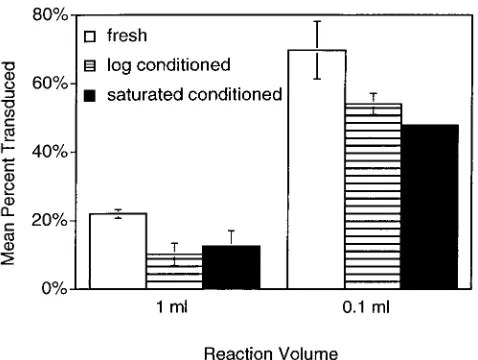
cells at low population densities may affect their susceptibility to phage infection. We addressed this hypothesis by comparing pBluescript phagemid delivery by M13K07 transducing phage to cells diluted from actively growing cultures into either fresh medium, conditioned medium from actively growing cultures, or conditioned medium from saturated cultures. Two final cell densities were also tested in each medium by placing the same number of cells and phage in either a 0.1- or a 1-ml final volume. Contrary to expectations if quorum factors were nec-essary for phage binding and infection, there was a small de-crease in phagemid delivery in the presence of either condi-tioned medium (Fig. 1). In contrast, concentrating identical mixtures of cells and virus into a smaller volume of the same respective media improved efficiency three- to fivefold (Fig. 1). Similar results (not shown) were obtained with P1 phage. This result indicated that cell density itself, rather than factors se-creted into the medium of densely populated cells, determines the phage-host interaction.
Definition of MOIactualand C.Traditionally, MOI is defined
as the average number of virus particles infecting each cell, calculated as the ratio of the number of infectious virus parti-cles divided by the number of host cells. When infection of all of the cells in a culture is desired, an MOI of 10 is often used. This is based on the fact that the virus particles are not dis-tributed exactly evenly among the cells, and it can be calculated that an MOI of 10 gives each cell a better than 99.99% chance of being bound and infected by at least one virus particle (see appendix A). However, a crucial assumption in the derivation of this rule is that all of the virus particles will find and infect a cell within the adsorption period allowed. It is important to ask under what conditions this assumption is valid. The colloi-dal particle model of phage-cell interactions (equation 1) pre-dicts that the number of phage that remain unbound even after an average adsorption period of 30 min can be quite high, depending primarily on the concentration of susceptible cells.
The traditional MOI in a particular experiment, the MOIinput,
can be more accurately thought of then as the maximum pos-sible MOI that will be experienced by the cells. If the actual average number of phage expected to bind per cell under the experimental conditions is written as MOIactual, then the
on November 8, 2019 by guest
http://jvi.asm.org/
tionship between MOIinputand MOIactualis given by the
fol-lowing equation:
MOIactual⫽(1⫺e⫺kCt)MOIinput (2)
since, from Schlesinger’s model, the fraction of phage bound at
timetequals 1⫺ P/Po⫽ 1⫺ e⫺kCtand it is therefore also
possible to calculate the number of phage bound at timetas
follows:
Pbound⫽(1⫺e⫺kCt)Po (3)
Note that, as with traditional calculations of MOI, the cal-culations are based on starting conditions and cell proliferation is not accounted for. Therefore, the model is only accurate
when the adsorption period,t, is sufficiently shorter than the
doubling time of the cells. (Our experiments all used 30 min for E. coli, and good agreement between expected and observed results was obtained.)
It follows from equation 2 that as C or tbecome larger,
MOIactualapproaches MOIinput.This is logical since when the
cell density is higher or more time is allowed for adsorption,
more phage would be expected to bind. It is because MOIinput
and MOIactualare essentially the same at high cell densities
that the need for MOIactual may not have been previously
apparent. The breakpoint at which MOIinput and MOIactual
diverge can be specifically defined by introducing the special concentration as follows:
C⫽9.2kt
Simply, C is the lowest cell density at which MOIinput is
equal to MOIactualfor a givenkandt. (For the derivation of C,
see appendix B.) In other words, if the host cell density is at
this concentration or a higher concentration (C ⱖ C), then
MOIinputis equal to MOIactualfor practical purposes and it is
reasonable to assume that every phage added will bind to a cell within the adsorption period,t. Conversely, if C is less than C,
then MOIactualis noticeably less than MOIinputand MOIactual
should be used. Note that C is dependent ontand decreases as
tincreases for a given phage-host system.
Predictive value of MOIactual.We claim that using the
tra-ditional MOI, MOIinput, will result in incorrect expectations of
infection rates in any case in which C is less than C and that
using MOIactualin its place will provide an accurate means of
estimating the infection rate at any cell density. These claims were tested by using phage transduction of reporter phagemids as a surrogate for phage infection.
In the first experiment, host cells and transducing P1 phage lysates were combined over a range of cell densities by mixing a fixed number of phage with an equal volume of one of several 10-fold dilutions of cells. After 30 min of incubation, half of each mixture was plated on agar selective for cells that received the phagemid and half was plated on nonselective agar to control for cell death and growth. To test the model against the data collected in this experiment, the following formula was used to convert the ratio of phage to cells into the number of
transduced cells: Expected fraction of cells infected ⫽ 1 ⫺
e⫺MOI(see appendix A). To obtain the expected results based
on the traditional MOI, the MOIinputfor a given incubation
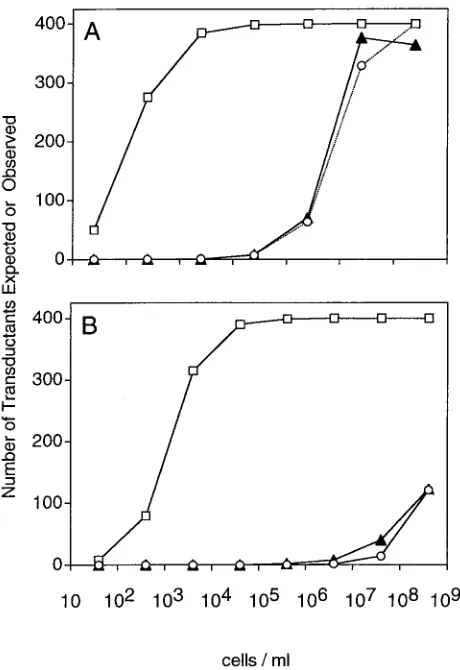
was used in the formula and the fraction obtained was multi-plied by the number of cells in that incubation mixture. To obtain the expected results predicted by the model presented in this report, the same computations were performed using MOIactualin place of the MOIinput. Figure 2A shows the
num-ber of infected cells found experimentally and the numnum-ber predicted by assuming that the ratio of bound phage to cells is given by the MOIactualor the MOIinput, respectively. Note that
predictions of the MOIactual fit the data better both
qualita-tively and quantitaqualita-tively. Also, as predicted, the graphs are essentially the same at cell densities higher than C. At low cell
densities, the expected results for the MOIinputdecrease
be-cause cell numbers are limiting.
For the phage-host system used in this experiment, the value
2.3⫻10⫺9cm3/min forkwas determined experimentally and
then used to compute the expected values predicted by the model. Note that there is no logical problem with assuming the
validity of the model in order to determine the value ofksince
the model simply claims that there exists some constant for which equation 2 is valid. If the model were not valid, one
would find that the value ofkmust depend on the
concentra-tion of cells. However, Fig. 2A demonstrates the validity of the
model with this fixed value of k for concentrations ranging
[image:3.587.44.283.74.254.2]from 102to 109cells/ml.
Figure 2B shows the same type of experiment performed with phage M13K07. Again, predictions based on the MOIactualmodeled actual results much more accurately than
those based on the MOIinput. Because of the very smallk(3⫻
FIG. 1. Effect of conditioned medium on transduction efficiency. Actively growingE. coli (ER2738) cells in LB containing 20g of tetracycline/ml, in order to maintain the F⬘ plasmid, were briefly chilled on ice before being diluted 10,000-fold in either fresh LB containing tetracycline or filter-sterilized conditioned medium isolated from logarithmic growth or saturated cultures of the same cells. Trans-ducing M13K07 phage carrying plasmid pBlue-GFPuv were added to the corresponding cell suspensions. Duplicate transduction mixtures were set up in parallel that contained the same number of cells and phage but in 1/10 of the volume. All mixtures were incubated at 37°C for 30 min, and then aliquots were plated on LB agar containing IPTG in triplicate. After overnight incubation, all colonies were counted and the number of transduced colonies was detected by expression of green fluorescent protein. The mean percentage of colonies transduced un-der each condition is shown.
on November 8, 2019 by guest
http://jvi.asm.org/
10⫺11cm3/min) and, consequently, the very large C for this
phage, it was not practical to achieve cell densities at which the MOIinputand MOIactualare essentially the same.
Universal infection at low cell densities.C for M13 phage,
based on akof 3⫻10⫺11(14) and a timetof 30 min, is 1010
cells/ml. C for P1 phage, based on akof 2.3⫻10⫺9and a time
tof 30 min, is 1.3⫻108cells/ml. Therefore, the model predicts
and the previous experiment confirmed that at any cell density
lower than these concentrations, an MOIinput of 10 will be
inadequate to achieve infection of 99.99% of the cells. How-ever, this does not necessarily imply that it is impossible to achieve universal infection at cell densities significantly lower than C. In fact, it is possible to explicitly determine the MOIinput
required to achieve an MOIactualof 10 for arbitrary cell
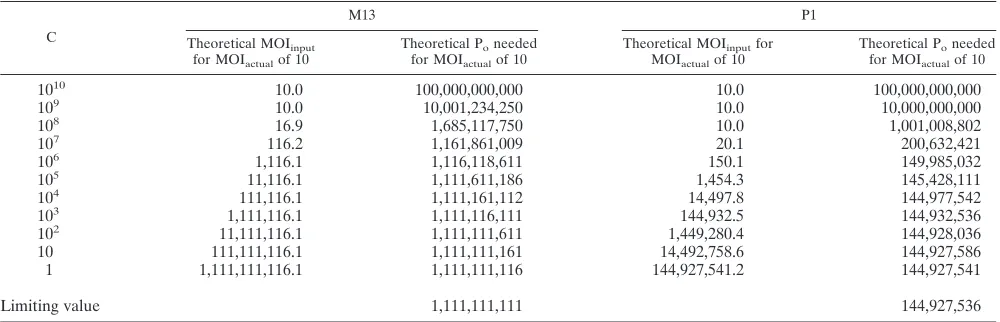
den-sities. By using equation 2, the necessary numbers of phage were calculated for phages P1 and M13 over a range of cell
densities (Table 1). Theoretically, using these values should result in the infection of nearly every cell in a given sample, regardless of cell density.
In order to test this hypothesis, an experiment was carried out in which the number of cells per cubic centimeter was held constant and the number of phage added was increased in 10-fold increments. After an incubation time of 30 min, each reaction mixture was plated on an indicator plate for
determi-nation of -galactosidase activity and the percentages of
in-fected (blue) colonies and uninin-fected (white) colonies were determined by direct counting. The results are plotted along with the expected values in Fig. 3. Again, there was very close agreement between the expected and observed results. Fur-thermore, note that 100% infection (100% transformation and
expression of the gene for-galactosidase [blue colonies]) was
achieved in the samples with the highest phage densities with-out loss of cell viability. This demonstrates that it is possible for phage to deliver a plasmid to all of the cells in a sample, even at low cell densities, provided that the number of phage used
is sufficient. The MOIinput in the case of the highest phage
concentration is 106, which previously might have been
consid-ered an unacceptable dose because of the likelihood of cell death by nonspecific lysis from without. However, no cell mor-tality was observed, and this is not surprising since we know
from equation 2 that the MOIactualexperienced by the cells was
less than 100.
Phage replication at low host cell densities.As mentioned
previously, a replication threshold density has been reported to exist in all of the phage-host systems tested, such that progeny phage are not produced when the host cell density is lower
than 104/ml. However, the data presented in the preceding
section suggest that phage infection, and therefore replication, would be expected to happen at any host cell density, provided that there are sufficient phage present to ensure that the cells present come into contact with and productively bind at least one phage. Proving this at low host cell densities, however, presents a practical problem for detection since unbound input phage will outnumber progeny phage to such an extent that the progeny phage will not be detectable as an increase in titer. This is because of both the high input phage numbers required and the low number of host cells producing progeny phage.
This problem of detection is overcome if the progeny phage are different from the input phage. The strategy utilized here was to make use of the M13K07 helper phage’s 500- to 1,000-fold preference for packaging phagemids over its own defective genome (4). If the host cells carry the phagemid pBluescript, then the majority of the progeny phage will produce blue, ampicillin-resistant colonies when the titer is determined on susceptible cells, whereas the input phage will produce only white, kanamycin-resistant colonies, easily allowing differenti-ation of the progeny phage from the input phage.
This experiment was set up such that actively growing pBlue-script-carrying host cells were diluted in 10-fold increments
and each dilution was mixed with 1010M13K07 phage, which is
an amount adequate to ensure infection of most of the cells
even at 10 CFU/cm3or a lower concentration (Table 1). Blue
colonies representing the output titer at each cell density after 60 min are plotted in Fig. 4. The experiment was performed twice with different host cell lines and with slightly different phagemids with very similar results. Most importantly, the
FIG. 2. A fixed number of phage with serial dilutions of host cells. (A) Approximately 400 PFU of P1 transducing phage were incubated with serial dilutions of P1C600 host cells at the cell densities indicated for 30 min and then plated on kanamycin to select for cells that had been transduced with the reporter phagemid. (B) Approximately 400 PFU of transducing phage M13K07 were incubated with serial dilu-tions of ER2738 host cells at the cell densities indicated for 30 min and then plated on carbenicillin and X-Gal to select for cells that had been transduced with reporter phagemid pBlue-GFPuv. The expected num-ber of transductants for each cell density was calculated as either
N(1⫺e⫺MOIactual) (䡬) orN(1⫺e⫺MOIinput) (䡺).Œ, observed numbers
of transductants.
on November 8, 2019 by guest
http://jvi.asm.org/
[image:4.587.47.277.76.411.2]straight lines evident on this log-log plot indicate that, on average, the same number of progeny phage are being pro-duced per host cell regardless of the cell density. This obser-vation is inconsistent with the existence of a replication thresh-old density.
The Pminfunction: the minimum number of phage needed to
achieve a given infection rate for any cell density, C.In the
preceding section, it was shown that it is possible to predict how many input phage are actually required to infect the input cells in a given adsorption time if the concentration of those
cells is known, as well as a suitable adsorption constant, k.
However, a more practical calculation is the following: givenk,
C, and the total volume of a reaction,V(in cubic centimeters),
find the number of phage needed (Po) to achieve a chosen
MOIactual. To answer this question, we define the function Pmin
(M,N) as the minimum total number of phage that needs to be
added (minimum Po) to result in an MOIactual of M for N
bacteria by timet. Substitution into equation 2 ofMfor the
desired MOIactual,N/Vfor C, and Po/Nfor the MOIinputand
solving for Poyields the following equation:
FIG. 3. A fixed number of cells with serial dilutions of phage. Nine dilutions of transducing phage M13K07 lysate carrying phagemid pBlue-GFPuv were used to infect nine aliquots of 200 CFU of ER2738 host cells at a cell density of 1,000 CFU/cm3. After 30 min of
incuba-tion at 37°C, each reacincuba-tion mixture was plated on nonselective LB agar containing IPTG and X-Gal. The percentages of blue colonies and green fluorescent protein-positive colonies were determined by direct counting and are plotted as the observed values (closed symbols). Expected values (open symbols) were calculated by finding the MOIactualfor each set of reaction conditions in the experiment and
multiplying the total number of colonies observed in each sample by its respective value for 1⫺e⫺MOIactual. The results of two independent dilution series are shown. (tu, transducing units.)
FIG. 4. Phage replication at low host cell densities. Actively grow-ing NovaBlueE. colibacteria carrying the pBlue-GFPuv phagemid ( ) or ER2738E. colibacteria carrying the pBluescript phagemid ( ) were serially diluted in fresh medium and then infected with 1010PFU of
[image:5.587.43.543.84.245.2]helper phage M13K07. Aliquots were removed at 30 and 60 min postinfection, the host cells were removed by centrifugation and fil-tered with a 0.2-m-pore-size filter, and in the resulting supernatants, the titers of the progeny phage that transduced ampicillin resistance and-galactosidase expression were determined. No progeny phage were detectable at 30 min. Titers at 60 min are plotted as a function of the initial cell concentration in each culture. The slopes of the lines were plotted by linear regression and were 1.103 and 0.904, respec-tively. (tu, transducing units.)
TABLE 1. Predicted number of input phage sufficient for infection of 99.99% of cells according to cell densitya
C
M13 P1
Theoretical MOIinput
for MOIactualof 10
Theoretical Poneeded
for MOIactualof 10
Theoretical MOIinputfor
MOIactualof 10
Theoretical Poneeded
for MOIactualof 10
1010 10.0 100,000,000,000 10.0 100,000,000,000
109 10.0 10,001,234,250 10.0 10,000,000,000
108 16.9 1,685,117,750 10.0 1,001,008,802
107 116.2 1,161,861,009 20.1 200,632,421
106 1,116.1 1,116,118,611 150.1 149,985,032
105 11,116.1 1,111,611,186 1,454.3 145,428,111
104 111,116.1 1,111,161,112 14,497.8 144,977,542
103 1,111,116.1 1,111,116,111 144,932.5 144,932,536
102 11,111,116.1 1,111,111,611 1,449,280.4 144,928,036
10 111,111,116.1 1,111,111,161 14,492,758.6 144,927,586
1 1,111,111,116.1 1,111,111,116 144,927,541.2 144,927,541
Limiting value 1,111,111,111 144,927,536
aThe theoretical MOI
inputneeded to realize an MOIactualof 10 for phages M13 and P1 was calculated for cell densities of 1 to 1010cells per cm3and an adsorption
time of 30 min by using equation 2. The theoretical minimum number of phage necessary to attain an MOIactualof 10 in 30 min at each cell density in a volume of
1 cm3was calculated by using equation 4 for P
min. Notice that the theoretical minimums slowly approach but never reach the limiting value, or lower bound, of Pmin
(from equation 5). In addition, note that Pminchanges very little for any cell concentration at or below 106/cm3for M13 or 105/cm3for P1.
on November 8, 2019 by guest
http://jvi.asm.org/
[image:5.587.47.278.436.606.2]Po⫽
MN 1⫺e⫺ktNV
⫽Pmin (4)
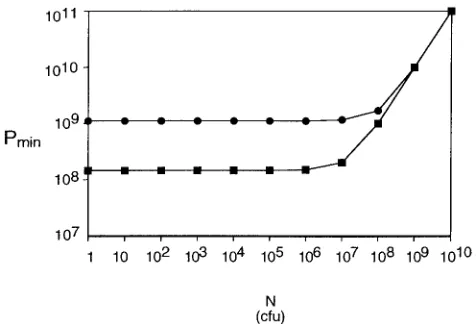
When Pmin was plotted over a range of N’s (Fig. 5) for
phages M13 and P1 withM⫽10,t⫽30 min, andV⫽1 cm3,
several interesting features of this function were observed.
First, when C is greater than C, the graph of the function is
essentially linear and indistinguishable from the functionMN.
However, at cell concentrations lower than C, Pmin behaves
very differently. As shown in Fig. 5, it has a lower bound and is
almost horizontal for mostN’s giving concentrations less than
C. This has the unexpected consequence that almost the same
number of phage are needed to infect 99.99% of 106cells as to
infect 10 cells. By using L’Hospital’s rule for computing limits of indeterminate forms, it can be deduced that no matter how small the number of cells (N) is,Mcannot be achieved with less than
lim
N¡0Pmin共M,N兲⫽
MV
tk phage (5)
In other words, Pminwill not be less thanMV/tkfor any cell
concentration less than C. This correlation is illustrated in
Table 1, where it is evident that the number of phage needed
to achieve an MOIactualof 10 decreases very little with large
decreases in cell density, approaching but not reachingMV/tk
for each phage. Moreover, although Pmin does increase for
largerN’s approaching the amount needed to get a
concentra-tion of C, it does not increase by much. Pminat C is only 5.31
times higher than the observed lower bound.
DISCUSSION
By using phagemid delivery and transduction as a surrogate marker for bacteriophage infection, we have been able to con-clusively demonstrate for filamentous phage M13 and tailed phage P1 that phage-host interactions in liquid culture follow the kinetics of colloidal particles subject to Brownian motion, as proposed by Schlesinger (12). Since phages P1 and M13
have very different morphologies and binding site specificities, it seems reasonable to expect that the model applies to any phage-host system until proven otherwise. Since Schlesinger’s model is based, in turn, on a mathematical model for the collisions of inert particles, this has several implications re-garding bacteriophage biology. First, although it is not gener-ally in question, it demonstrates beyond doubt that phage act as inert particles dependent on random Brownian motion in their interactions with bacteria and not as predators capable of active pursuit. Second, as the equations predict irreversible binding events and the predictions very closely match the ob-served number of infected host bacteria, nearly every such binding event must result in a successful transfer of phagemid or phage DNA into the host. This finding of the remarkable efficiency of phage-mediated delivery of DNA was arrived at previously by Stent by theoretical means (13). Third, the rate at which a phage infects a host cell is dependent solely on the density of the host cell population. Therefore, the concept of MOI, which, as currently defined, incorporates no indication of reaction volume or cell density, is inadequate in bacteriophage biology where a range of cell densities of greater than 10 orders of magnitude is possible and probable due to the small sizes of the particles involved. MOI is also often inadequate in the case of eukaryotic viruses, which is a problem that has been ad-dressed by Valentine and Allison (15) and more recently by Andreadis et al. (1) and Morgan et al. (5). Because of the larger relative size of the cells and infection of attached cell monolayers rather than cell suspensions, our method for cal-culating the MOIactualdoes not appear to be directly applicable
to eukaryotic systems.
Our finding that there is no detectable replication threshold for the M13 bacteriophage inE. coliis at odds with the findings of Wiggins and Alexander (16), who consistently saw a lag in phage production when host cell densities were lower than
104/ml. A partial explanation, as mentioned above, may lie in
the difficulty of detecting progeny phage against a background of input phage. In addition, since the three phages Wiggins and Alexander used to demonstrate a replication threshold density were all somatic phages, adsorption constants would be ex-pected to be similar in magnitude to that for phage P1, and so it is possible to reanalyze their data with our present mathe-matical model. Based on their graphs of phage and cell con-centrations over time, starting phage concon-centrations in their experiments ranged from approximately 200 to 1,100 PFU/ml in a volume of 50 ml for a total input phage population of 10,000 to 55,000 PFU. It can be easily deduced from equation 3 that at cell densities lower than 104/ml, these initial
condi-tions would result in an average of 0.7 to 4 phage binding cells within 30 min, respectively (the fraction of phage bound
mul-tiplied by the number of input phage equals 0.00007207 ⫻
10,000 or 55,000). This would result in insufficient progeny phage to be detected against the input phage population. At 104cells/ml, 7 to 40 phage will bind cells within 30 min, which
would produce a 7 to 9% increase in the phage population, respectively, after the latency period, assuming a burst size of 100. Since phage removal from solution by adsorption to cells is negligible at this cell density, this increase would be detect-able against the input phage population, resulting in the ap-parent existence of a replication threshold density of 104cells/
[image:6.587.44.282.72.234.2]ml. It should be clear from our results that an increase in the
FIG. 5. The Pmin(M,N) function as related to cell density. The Pmin
function (equation 4) for phages M13 (F) and P1 (■) is plotted as a function of host cell density for an adsorption time of 30 min, a volume of 1 cm3, and an MOI
actualof 10. Note that for all cell concentrations
less than C, Pminis essentially the same.
on November 8, 2019 by guest
http://jvi.asm.org/
number of input phage would have resulted in a decrease in the apparent replication threshold density. Likewise, a phage with a lower adsorption rate constant, such as M13, would have resulted in a higher apparent replication threshold density of
approximately 106cells per ml under the same conditions.
The confirmation of this mathematical model also has im-plications for the use of phage as antimicrobial therapeutic agents. Payne et al. (7, 8) developed a mathematical model of lytic phage therapy treatment of bacterial infections in vivo in which they argue that administration of therapeutic phage must be carefully timed to coincide with a sufficiently dense bacterial population to support phage proliferation in order to be effective, similar to the replication threshold. Our results confirm that host cell density is essential to estimating what percentage of administered phage will find target cells within a given period of time and that progeny phage will be detectable sooner at higher initial cell densities. However, our data dem-onstrate that there is no replication threshold density of host cells independent of the phage population and adsorption con-stant. In vivo bacterial infections are also complicated by non-uniform dispersal of the target bacteria in the body and the absence of any technique by which to rapidly enumerate and map the distribution of such populations. In addition, the larger the target bacterial population at the time that it is treated and killed, the larger the release of endotoxin and the chance that lethal septic shock will follow. Therefore, given that we have demonstrated that it is possible to infect every target cell in a given volume even when the cells are at very low densities and that it takes no more phage to do so than to infect all of the cells in a much denser population, it seems that the safest course of action in vivo is always to use as many phage as necessary to infect all of the target cells with the first dose. Then treatment can begin at the earliest possible time and replication of the phage is not necessary.
It has also been observed that many phages that proliferate on a given host in vitro fail to do so in vivo (7). This fact, as well as concerns that lytic phage may facilitate the transfer of toxic genes from pathogenic bacteria to commensal flora, has en-couraged the development of nonreplicating phage therapeu-tics. In the lethal agent delivery system (6), nonreplicating phage function as molecular syringes that inject phagemids expressing bacterial suicide genes resulting in cell death. Due to the inability of lethal agent delivery systems to proliferate in vivo, there is no question of the necessity of being able to deliver such a lethal phagemid to every bacterial cell in a given culture, or infected individual, for a therapeutic antimicrobial result. Our results showing transduction of every cell in ali-quots of bacteria in vitro suggest that delivery of bactericidal agents by nonreplicating phage may indeed be a viable anti-microbial strategy.
In conclusion, the rate at which phage bind to cells is very accurately predicted by Schlesinger’s equation (equation 1). Four factors determine how many bacteria will be infected or transduced by phage in a given situation: the density of host cells, the adsorption constant of the phage, the number of phage, and the length of time for which they interact. The simple ratio of virus particles to cells given by the MOI is meaningless in the absence of information about these other parameters. Furthermore, the virologist’s rule of thumb that an MOI of 10 be used in order to ensure that 99.99% of the host
cells are infected by at least one virus particle is dependent on the assumption that all of the virus added will be bound to cells by the end of the adsorption period. We have shown that this is only a valid assumption for bacteriophage when host cells are present at densities equal to or greater than concentration C, which is, in turn, dependent on the adsorption constant of the phage and the length of the adsorption period. We have also shown, however, that it is possible to accurately estimate the fraction of phage bound at any cell concentration and arbitrary
time. More generally, adoption of the value MOIactualin place
of the value MOI results in a rule of thumb in which the fraction of input phage bound in the time allowed is taken into account and reproducibility between experiments will be greatly enhanced.
APPENDIX A
Elementary probability states that, givenNcells andMbound phage per cell, the probability that a given cell will be infected is [1 ⫺
(1/N)]MN. The old rule of thumb thatM⫽10 is sufficient regardless of
Nfollows from the remarkable but well-established fact that lim
N¡⬁
冉
1⫺1
N
冊
MN
⫽e⫺M
and so, for a largeN, one needs MOIactual⫽ ⫺ln(0.0001)⫽9.21 to get
an expected infection rate of 99.99% (which has presumably been rounded up toM⫽ 10 for convenience). However, for lower cell numbers, an MOIactualof 10 is still more than sufficient. The observant
reader may notice that for extremely low cell numbers, one can get nearly 100% infection with an MOIactualnoticeably smaller than 10.
However, since the limit above converges quickly, forN⬎10, one can say thate⫺MOIactualis a good approximation of the expected percentage of uninfected cells. Consequently, the rule that an MOI of 10 is suffi-cient to ensure that nearly all of the cells are infected should remain true assuming that one now means an MOIactual, and not an MOIinput,
of at least 10.
APPENDIX B
In general, it is possible that the MOIactual is significantly less
than the MOIinput. If this is the case, then the ratio of MOIactualto
MOIinputwould be significantly smaller than 1. In contrast, we will
say that the two are essentially equal if this ratio has a value of greater than 0.9999. It is easily determined that this will be the case for any concentration C that is greater than C with the equation C⫽
[ln(10,000)/kt] ⬇ 9.2/kt. In fact, since ⫺kCt ⫽ [ln(10,000)kt]/kt ⫽ ⫺ln(10,000)⫽ln(0.0001), it follows that for any C that is greater than Cas defined above, MOIactual/MOIinput⫽(1⫺e⫺kCt)⬎(1⫺e⫺kCt)⫽
[1⫺eln(0.0001)]⫽1⫺0.0001⫽0.9999.
ACKNOWLEDGMENTS
This research was supported by Hexal Gentech Forschungs GmbH (Munich, Germany), except for A. Kasman, who was supported solely by the College of Charleston.
We thank M. B. Yarminlinsky for providing bacteriophage P1CmC1.100 and Phillip A. Werner for preparing the P1 phagemid-containing lysate.
REFERENCES
1.Andreadis, S., T. Lavery, H. E. Davis, J. M. Le Doux, M. L. Yarmush, and J. R. Morgan.2000. Toward a more accurate quantitation of the activity of recombinant retroviruses: alternatives to titer and multiplicity of infection.
J. Virol.74:1258–1266.
2.Caro, L. G., and M. Schnos.1966. The attachment of the male-specific
bacteriophage F1 to sensitive strains ofEscherichia coli. Proc. Natl. Acad.
Sci. USA56:126–132.
3.De Kievit, T. R., and B. H. Iglewski.2000. Bacterial quorum sensing in
pathogenic relationships. Infect. Immun.68:4839–4849.
on November 8, 2019 by guest
http://jvi.asm.org/
4.Messing, J., B. Gronenborn, B. Muller-Hill, and P. Hans Hopschneider.
1977. Filamentous coliphage M13 as a cloning vehicle: insertion of aHindIII
fragment of the lac regulatory region in M13 replicative form in vitro. Proc.
Natl. Acad. Sci. USA74:3642–3646.
5.Morgan, J. R., J. M. LeDoux, R. G. Snow, R. G. Tompkins, and M. L. Yarmush.1995. Retrovirus infection: effect of time and target cell number.
J. Virol.69:6994–7000.
6.Norris, J. S., C. Westwater, and D. Schofield.2000. Prokaryotic gene therapy
to combat multidrug resistant bacterial infection. Gene Ther.7:723–725.
7.Payne, R. J. H., D. Phil, and V. A. A. Jansen.2000. Phage therapy: the
peculiar kinetics of self-replicating pharmaceuticals. Clin. Pharm. Ther.68:
225–230.
8.Payne, R. J. H., and V. A. A. Jansen.2001. Understanding phage therapy as
a density dependent kinetic process. J. Theor. Biol.208:37–48.
9.Rosner, J. L.1972. Formation, induction, and curing of bacteriophage P1
lysogens. Virology48:679–680.
10.Salivar, W. O., H. Tzagoloff, and D. Pratt.1964. Some physical-chemical and
biological properties of the rod-shaped coliphage M13. Virology24:359–371.
11.Sambrook, J., E. F. Fritsch, and T. Maniatis.1989. Molecular cloning: a
laboratory manual, 2nd ed. Cold Spring Harbor Laboratory Press, Cold Spring Harbor, N.Y.
12.Schlesinger, M.1932. Adsorption of phages to homologous bacteria. II. Quantitative investigations of adsorption velocity and saturation. Estimation
of the particle size of the bacteriophage. Z. Hyg. Immunitaetsforsch.114:
149–160. Translated from German and reprintedinG. S. Stent (ed.), Papers
on bacterial viruses, 2nd ed., p. 26–36. Little Brown and Company, Boston, Mass., 1965.
13.Stent, G. S.1963. Molecular biology of bacterial viruses, p. 88–96. W. H. Freeman and Company, San Francisco, Calif.
14.Tzagoloff, H., and D. Pratt.1964. The initial steps in infection with coliphage
M13. Virology24:372–380.
15.Valentine, R. C., and A. C. Allison.1959. Virus particle adsorption. I. Theory of adsorption and experiments on the attachment of particles to
nonbiologi-cal surfaces. Biochim. Biophys. Acta34:10–23.
16.Wiggins, B. A., and M. Alexander. 1985. Minimum bacterial density for bacteriophage replication: implications for significance of bacteriophages in
natural ecosystems. Appl. Environ. Microbiol.49:19–23.