City, University of London Institutional Repository
Citation:
Lockerbie, J., Maiden, N., Engmann, J., Randall, D., Jones, S. and Bush, D. (2012). Exploring the impact of software requirements on system-wide goals: a method using satisfaction arguments and i* goal modelling. REQUIREMENTS ENGINEERING, 17(3), pp. 227-254. doi: 10.1007/s00766-011-0138-8This is the accepted version of the paper.
This version of the publication may differ from the final published
version.
Permanent repository link:
http://openaccess.city.ac.uk/8004/Link to published version:
http://dx.doi.org/10.1007/s00766-011-0138-8Copyright and reuse: City Research Online aims to make research
outputs of City, University of London available to a wider audience.
Copyright and Moral Rights remain with the author(s) and/or copyright
holders. URLs from City Research Online may be freely distributed and
linked to.
City Research Online: http://openaccess.city.ac.uk/ [email protected]
Exploring the Impact of Software Requirements on
System-Wide Goals: a Method using Satisfaction Arguments and
i*
Goal Modelling
James Lockerbie 1, Neil Maiden1, Jorgen Engmann2, Debbie Randall3, Sean Jones 3, David Bush 3
City University London1
Centre for Human-Computer Interaction Design London EC1V 0HB, UK
[email protected], +44 (0)20 7040 8326
Health Protection Agency2 Centre for Infections 61 Colindale Avenue London, NW9 5EQ, UK
NATS Corporate & Technical Centre3 4000 Parkway, Whiteley Fareham, Hants PO15 7FL, UK
[email protected], [email protected], [email protected]
Abstract
This paper describes the application of requirements engineering concepts to support the analysis of the impact of new software systems on system-wide goals. Requirements on a new or revised software component of a socio-technical system not only have implications on the goals of the subsystem itself, but they also impact upon the goals of the existing integrated system. In industries such as air traffic management and healthcare, impacts need to be identified and demonstrated in order to assess concerns such as risk, safety, and accuracy.
A method called PiLGRIM was developed which integrates means-end relationships within goal modelling with knowledge associated with the application domain. The relationship between domain knowledge and requirements, as described in a satisfaction argument, adds traceability rationale to help determine the impacts of new requirements across a network of heterogeneous actors. We report procedures that human analysts follow to use the concepts of satisfaction arguments in a software tool for i* goal modelling. Results were demonstrated using models and arguments developed in two case studies, each featuring a distinct socio-technical system – a new controlled airspace infringement detection tool for NATS (the UK's air navigation service provider), and a new version of the UK’s HIV/AIDS patient reporting system. Results provided evidence towards our claims that the conceptual integration of i* and satisfaction arguments is usable and useful to human analysts, and that the PiLGRIM impact analysis procedures and tool support are effective and scalable to model and analyse large and complex socio-technical systems.
Keywords
1.
Introduction
The ability of analysts to analyse change requirements in socio-technical systems has become increasingly important as projects and systems increase in size and complexity. There is a need to be able to demonstrate the impacts of new system requirements on existing and future system-wide goals, so that concerns such as safety, risk and accuracy can be assessed. In order to do this, we sought to develop a useful and usable method for analysts to follow that integrates research-based requirements techniques successfully into established industrial requirements processes.
Analysts are increasingly using i*, the strategic goal modelling approach [37], to model and analyse requirements on socio-technical systems. i* has been applied successfully to model requirements for air traffic management tools [22, 23] and decision support aids in agriculture [31] as well as to support individuals and groups in the work of charitable organizations [33]. Reported benefits to these projects have included automatic requirements generation from i* models [23] and detection of omissions from UML requirements specifications [22]. However, our experiences with i* in these projects also revealed two important weaknesses: (i) inadequate semantics to express the relationship between a means specification and an end goal, and: (ii) poor integration with in-house requirements processes. In this paper we report results from research that extended i* to overcome these two weaknesses.
The first research extension was to add concepts from rich traceability [3] and satisfaction arguments [9] to provide additional semantics for modelling means-end relationships. The second was to develop new manual procedures with which to exploit i* models more effectively in requirements processes. These procedures, and the tools developed to support analysts to follow the procedures, were designed to explore the impact of new software requirements on system-wide goals such as safety and accuracy. Proof of concept of both extensions was demonstrated with two requirements project case studies.
The first study was undertaken at NATS, the UK‟s national air traffic service. Requirements analysts used the extended version of i* to model safety-related goals associated with a new software tool called the Controlled Airspace Infringement Tool (CAIT). The new procedures were then applied by analysts to explore the impact of the new tool requirements on the safety-related goals of the wider air traffic management system. The second study was undertaken at the UK‟s Health Protection Agency (HPA). An analyst applied the same methods used in the first study to explore the wider impacts of implementing change request requirements on an HIV/AIDS Patient (HAP) reporting system.
We claim five contributions for the work that we report. The first is the conceptual integration of i* SR models and satisfaction arguments. The second is to extend reported procedures that build on this integration to exploit i* models so that analysts can analyse the impact of specified software systems on system-wide goals. The third is a set of novel software features that enable analysts to extend SR models with satisfaction arguments, and that support and exploit the new procedure. All are demonstrated using models and requirements developed to address complex requirements engineering problems in the areas of air traffic management and patient surveillance. Hence, our fourth claim is that our techniques and their support software tools scale to model large and complex socio-technical systems with i*. Finally, our fifth claim is that our methods are useable and useful to requirements analysts.
weaknesses. Section 3 presents the method, called PiLGRIM, in detail and Section 4 reports how the method was implemented in our i* modelling tool. Section 5 presents the first case study, the airspace infringement detection problem to which NATS applied our solutions. Section 6 presents the second case study, where an HPA analyst used our approach to investigate the impact of requirements changes on system-wide goals in the area of patient surveillance. Sections 7 and 8 summarize related work and review claims made for the reported research, then Section 9 outlines potential threats to its validity. The paper ends with our plans for future development of PiLGRIM and the REDEPEND tool.
2.
Previous Work
2.1
Using
i*
in Requirements Projects
i* is an approach with which to model information systems composed of heterogeneous actors with different, often competing goals that depend on each other to undertake their tasks and achieve these goals [37]. The strategic actor is the central concept of i*, and is viewed as having intentional goals, beliefs, abilities and commitments. The intentional aspects associated with any actor can be characterised by four process elements: (i) a goal represents a condition or state of the world that can be achieved or not, but does not describe how it can be achieved; (ii) a task
represents one particular way of attaining a goal, and can therefore be considered as a detailed description of how to accomplish a goal; (iii) a resource can be considered as an entity used in, or the product of, some process or a task; and (iv) a soft goal relates to the notion of a goal that cannot be so sharply defined, such as goals that describe properties or constraints of the system being modelled. i* is an established approach for goal modelling, and has given rise to different versions of syntax and semantics that support different styles and uses of i* modelling. Most versions support the development of two types of i* model.
The first type of i* model is the Strategic Dependency (SD) model. The SD model provides a network of dependency relationships among actors. The opportunities available to these actors can be explored by matching the depender who is the actor
who “wants” and the dependee who has the “ability”. Since the dependee‟s abilities can match the depender‟s wants, a high-level strategic model can be developed.
The second type of i* model is the Strategic Rationale (SR) model. The SR model provides an intentional description of goal and task elements and the relationships linking them. An element is included in the SR model only if it is considered important enough to affect the achievement of some goal. The SR model includes the SD model, and hence actors in the SR model either accomplish something by themselves or depend on other actors. The SR model has four main types of element:
goals, tasks, resources and soft goals. These four types can be linked using the four relationship links available within the SR modelling semantics: the dependency link, the task decomposition link, the means-end link and its specialization, the contributes-to soft goal link.
In our requirements projects we support i* modelling with a software tool called REDEPEND [21], which extends Microsoft Visio with features specific to i* to enable requirements analysts to model and analyse SD and SR models. It provides a graphical palette from which analysts can drag-and-drop then directly manipulate i*
models, and check features to highlight and shade-out model elements for partitioning and marking up models during analysis and review tasks. Indeed, both direct manipulation and automated model verification are seen as essential for scalable i*
modelling and tool-supported analysis procedures.
In the last 6 years we have applied i* and REDEPEND to model requirements for four major air traffic management systems, including a departure management system for major European airports [22] and a system that supports the scheduling of UK airspace [25]. Whilst i* provided important new capabilities in these projects that we have reported elsewhere [23], the projects also revealed the two weaknesses that, we argue, need to be overcome to ensure widespread industrial uptake of i*.
2.2
Encountered Weaknesses with
i*
The first encountered weakness is the i* means-end link. In i* a task specifies one way in which to achieve a desired state, and can be decomposed into sub-components by the task decomposition link. The means-end link is used to associate tasks, and their decompositions, with states that actors want to achieve or attain – goals and soft goals. The means-end link can also reduce goals to sub-goals where the end is the top-level goal. However, analysts in our previous projects, when expressing means-end links, reasoned about much more than just the means elements and the end. They also established a large number of assumptions that had to be true in order for the means to be a means to the end, and refined the degree to which means attained or achieved ends.
Whilst i* provides means-end contribution types (Some+, Some-, Help, Hurt, Make, Break, Unknown reported in [38]), these alone are not sufficient to explore impacts of system specifications on goal attainment. Although i* includes the concept of a belief, a form of claim applied to means-end links to express actors‟ different beliefs [38], the argumentation behind the association of these beliefs is unclear. Furthermore, in our projects, each means-end link was often associated with multiple assumptions. If all assumptions were modelled as beliefs using the i* notation, a cloud, the resulting model would be cumbersome to develop and unclear to read. Therefore we needed a method extension that would support previously observed analyst practices more effectively.
The second weakness is a lack of guidance for requirements analysts on how to embed research-based techniques such as i* in requirements processes. For example, NATS projects have characteristics common with requirements projects in many organisations. Analysts often write requirements on the new software system that is the focus of the project, rather than on the wider socio-technical system that the software is a part of. Analysts specify these requirements in text form using traditional
system shall statements. The requirements tend to be functional rather than non-functional. And the requirements are often difficult to link using existing traceability techniques to system-wide concerns such as safety and security. Organisations such as NATS and the HPA cannot overturn their established requirements processes to accommodate new i* modelling. Therefore we explored new ways of developing, documenting and using i* models and their extensions in processes that express software requirements in text form. We further explored this approach in our second study, analysing how the established method of change request requirements on the HAP system impact on actors in the wider HIV/AIDS reporting system.
2.3
First Extension: Satisfaction Arguments for
i*
traceability and satisfaction arguments from reported requirements methods to extend means-end link modelling in i*. Hammond et al. [9] explored the anatomy of a satisfaction argument based on Jackson‟s [17] distinction between the machine and the world. Jackson recognized the role of domain knowledge in the requirements process, and suggested a relationship that the REVEAL requirements process labelled a satisfaction argument to enhance the rich traceability of the process. This relationship defines domain knowledge as properties of the world that are known or assumed to be true, and requirements as properties of the world that are wished to be true. This combination of domain knowledge and system knowledge (specification) is the basis of the satisfaction argument: Using the relevant properties of the application domain D, when combined with the specification of the machine S to be constructed, it is possible to show that the requirements will hold [9].
This approach has led to the recognition that many problems with requirements arise as a result of problems with domain knowledge rather than problems with the system specifications or requirements statements. Furthermore, even if domain knowledge is accurately captured such that initial requirements hold, changes in the domain could result in requirements not being met anymore [9]. Likewise, new requirements may lead to the invalidation of domain assumptions.
Our use of satisfaction arguments, based on REVEAL, also draws upon Dick‟s [3] use of traceability rationale to enhance understanding. In rich traceability a satisfaction argument normally applies to a set of links associated with a requirement, which translate to all means-end links associated with an end in a i* model. Such satisfaction arguments can be applied for two purposes – sufficiency and necessity. According to Dick [3], sufficiency explores whether the set of design artefacts are sufficient to satisfy the customer requirement. Necessity explores whether each of the design artefacts are necessary to satisfy the customer requirement. When applied to i*
modelling, we can interpret sufficiency as exploring whether the means and associated domain properties are sufficient to lead to the end, and necessity as whether each of the means and associated domain properties are necessary to lead to the end.
2.4
Second Extension: Using
i*
Models to Explore How Software
Requirements Impact Important Organisational Goals
To address the second weakness, we sought to develop a new procedure that requirements analysts could follow to use i* models in traditional requirements processes that express software requirements in text form.
Linking i* models to text requirement specifications is not new. Indeed, in two previous air traffic management projects we generated candidate requirement statements from i* models using a pattern-based approach [23]. However, one limitation was that the i* models had to be generated first. This was not possible in many requirements processes such as those used in projects at NATS and the HPA, as requirements on a new or revised software component of the socio-technical system had already been expressed. As a result, there was a need for change management, and we proposed a process of rich traceability and impact analysis to address this. Dick [3] describes the benefits of such an approach as the increased understanding of the relationships between design layers, and the possibility for semi-automated impact analysis to assess the potential impact of change.
3.
The PiLGRIM Method
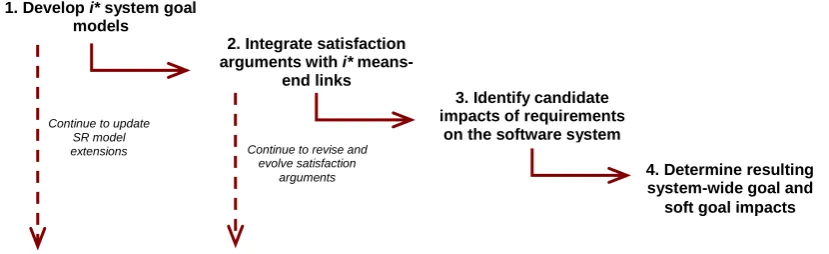
[image:8.595.98.513.262.389.2]i* modelling, satisfaction arguments, impact procedures and the REDEPEND tool were integrated into a method called PiLGRIM (Propagating i*-Led Goal-Requirement Impacts). The overview presented in Figure 1 shows the logical flow of the four stages of the method. The method starts with goal modelling in stage 1. The first and second stages take place in parallel throughout the method as analysts add and revise satisfaction arguments within the extended SR model to provide structured support for previously observed analyst behaviour. Once the underlying SR model is finalised, the matrix completion and propagation stages are required to run sequentially in order to generate a complete set of results. Each stage‟s procedure is described in turn in the following sections.
Figure 1: An overview of the 4 stages of the PiLGRIMmethod
3.1
Develop
i*
System Goal Models
For the first stage of the PiLGRIM method we took our existing approach to i*
modelling using REDEPEND as described earlier in Section 2.1. This approach supports version 5.0 of i* tailored to RESCUE, our requirements engineering process [19], based on recommendations to enhance the notation and tool features from analysts in previous projects. Whilst analysts were generally satisfied with the i*
syntax, they identified an absence of content and guidance to facilitate documentation and human reasoning with it – hence our method extension. Styles of modelling not supported in other i* versions includes means-end links across actor boundaries which enable the modelling of complex trade-offs in the development of socio-technical systems. This modelling variation is used in the integrated i*-satisfaction arguments described next.
3.2
Integrate
Satisfaction Arguments with
i*
Means-End Links
To extend i* semantics with satisfaction arguments we developed a conceptual model to link concepts of i* means-end links and satisfaction arguments defined across socio-technical system boundaries. For the PiLGRIM method we use the term
means-end link to define both a means-end link which has a goal as the end and its specialisation, a contributes-to soft goal link which has a soft goal as the end.
3.2.1 Satisfaction Arguments for Socio-technical Systems
Satisfaction arguments distinguish between specified properties of a new system and assumed properties of the domain. Jackson [40] originally assumed a single system and boundary so that properties were attributed simply to the system or domain. However socio-technical systems have multiple systems and actors whose
1. Develop i* system goal models
2. Integrate satisfaction arguments with i*
means-end links
3. Identify candidate impacts of requirements
on the software system
4. Determine resulting system-wide goal and
soft goal impacts
Continue to update SR model
extensions Continue to revise and evolve satisfaction
work is redesigned, for example redesigning the work of an air traffic controller who is using new airspace infringement software. Therefore arguments for the satisfaction of requirements of these systems and actors need to be based on both properties assumed about the domain and properties of other systems – i.e. whether known properties of current systems hold and requirements on these new systems and actors are satisfied.
As a consequence the PiLGRIM Method needs to support analysts to specify different satisfaction arguments for different boundaries in a socio-technical system. Analysts can specify requirements on new software system(s) and other systems and human work to change as specified in requirements. The result is that an end-element of one satisfaction argument can fulfil the role of a means-element in another – a goal to be achieved by one system is assumed achieved by the other.
To enable this to happen, REDEPEND supports analysts to tag each actor in an i*
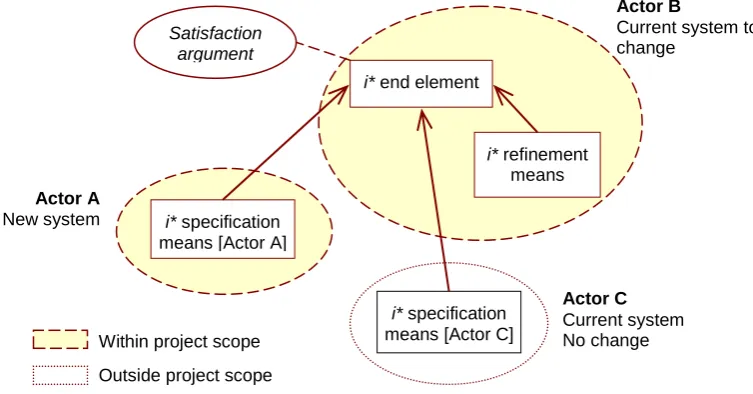
model as a new system, current actor or system required to change, or an actor outside of the project boundaries and therefore not within the redesign scope. This enables traceability between different system boundaries to be specified explicitly in a satisfaction argument. A means element contributing to an end element inside the same actor boundary is classified as a refinement, while a means contributing from outside the boundary is classified as a specification, and is qualified with the actor name. Figure 2 illustrates these features in a simple schema. The satisfaction argument specified in Actor B, an existing system to change, contains one refinement
means, a specification means from the new system, Actor A, and a specification
[image:9.595.107.484.409.606.2]means from Actor C which is outside of the redesign scope of the project.
Figure 2: An example showing how the PiLGRIM method uses actor types and refinement and specification means in satisfaction arguments
3.2.2 Model Concepts
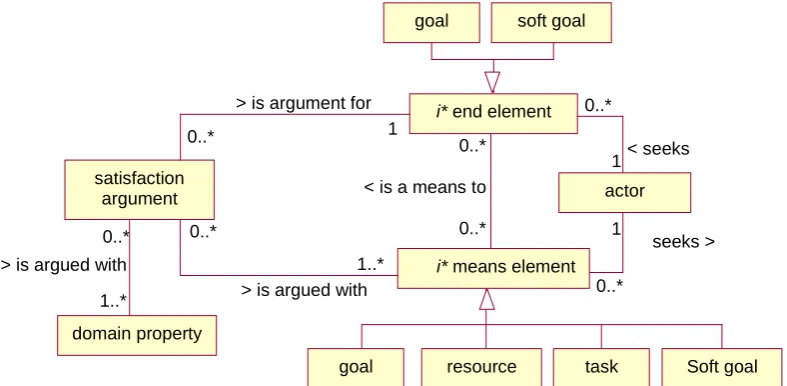
The PiLGRIM method is underpinned with a simple meta-model, depicted in Figure 3, that combines i* and satisfaction argument concepts. An actor seeks to achieve or attain an end-element, which in i* can be a soft goal or a goal. An actor also has the means to achieve or attain the end-element. In i* a means can be a goal, a task, a resource or a soft goal (the latter 2 only being valid for a soft goal end). The actor seeks to attain a goal (a means to attain something else) and undertake a task (so
i* specification means [Actor A]
i* refinement means
i* end element
i* specification means [Actor C]
Actor C
Current system No change Within project scope
Outside project scope
Actor B
Current system to change
Satisfaction argument
Actor A
that a goal might be attained). With soft goal contributes-to links, the achievement of one soft goal can contribute positively or negatively to achieving the other soft goal. The means-element and end-element are related using the i* means-end relationship. Where the end element is a soft goal, the relationship is attributed with values that specify the modality and type of contribution (Some+, Some-, Help, Hurt, Make, Break, Unknown) reported in [38] and supported in the RESCUE version of i*. This is depicted on the right-hand side of Figure 3.
Figure 3: Conceptual model that relates concepts from i* and satisfaction
arguments
Each satisfaction argument is developed for one and only one end-element of a means-end link. The argument is constructed using one or more properties of the domain, one or more means-elements linked to the end-element, and one attribute that explains the argument [9]. This is depicted on the left-hand side of Figure 3. Analysts then apply the principles of sufficiency and necessity from rich traceability in order to determine whether the means and associated properties are sufficient to lead to the end, and whether each of the means and associated properties are necessary to lead to the end. This helps to produce a complete argument, ensuring that the end goal is met whilst also protecting against over-engineering the solution [3].
For example, in VANTAGE, an earlier air traffic management project [29], we produced an i* SR model showing how enhanced airport operations could minimise the environmental impact of a regional airport. The model included a means-end link that showed that successful completion of the dispatch co-ordinator task maintain paper stats sheet contributed positively to the dispatch office achieving the soft goal
all flight/aircraft info accessed easily. The stats sheet fulfilled an important role in the functioning of the dispatch office, as it contained information such as passenger figures and estimated aircraft arrival times. However, this representation in i* alone did not contain enough information to justify the means being a means to the end, i.e. it was not possible to determine sufficiency and necessity without richer traceability of the relationship.
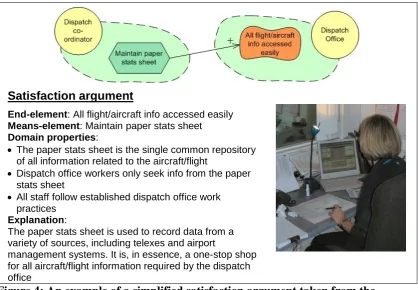
Figure 4 shows the means-end link and a simplified version of its accompanying satisfaction argument. The end-element is the soft goal all flight/aircraft info accessed easily and the means-element is maintain paper stats sheet, modelled as a task as it represents one particular way of attaining the soft goal (the other considered alternative being an electronic VANTAGE version). Three properties of the domain that must be true for the means to contribute to the end are: the paper stats sheet is the
i* end element
0..*
0..* < is a means to
i* means element
actor < seeks goal soft goal
goal resource task
domain property > is argued with
0..*
1..* satisfaction
argument
1 0..*
0..*
1..* > is argument for
> is argued with
seeks >
Soft goal 0..*
0..* 1
single common repository of all information related to the aircraft/flight, dispatch office workers only seek info from the paper stats sheet, and all staff follow established dispatch office work practices. The explanation part forms the argument by linking the domain properties and means-element to the end-element.
Satisfaction argument
End-element: All flight/aircraft info accessed easily
Means-element: Maintain paper stats sheet
Domain properties:
The paper stats sheet is the single common repository
of all information related to the aircraft/flight
Dispatch office workers only seek info from the paper
stats sheet
All staff follow established dispatch office work
practices
Explanation:
The paper stats sheet is used to record data from a variety of sources, including telexes and airport
[image:11.595.93.512.139.429.2]management systems. It is, in essence, a one-stop shop for all aircraft/flight information required by the dispatch office
Figure 4: An example of a simplified satisfaction argument taken from the VANTAGE socio-technical system model
This satisfaction argument is, we conjecture, more complete than the original i*
means-end link. It has the potential to support more naturalistic analyst reasoning observed in previous requirements projects using i*. Next, we report the new procedure that uses i* models extended with such arguments to explore the impact of software requirements on system-wide goals.
3.3
Identify Candidate Impacts of Requirements on the Software
System
The third stage of the PiLGRIM method uses the enhanced i* SR models as reference models from which to guide analysts to infer candidate impacts on the socio-technical system from functional requirements on the new, or updated, software system. The procedure maps functional rather than non-functional requirements, not only due to their predominance in software requirements, but also because they represent features that we aim to explore the impact of. Analysts are guided to cross-check each non-functional requirement with the soft goals in the SR model to ensure consistency and completeness for assessing the impacted goals and soft goals.
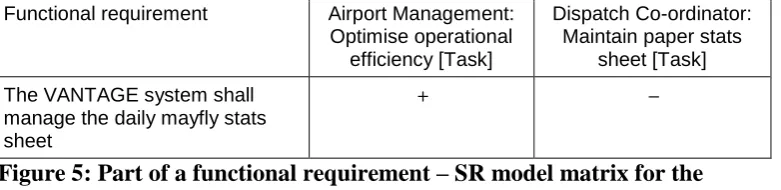
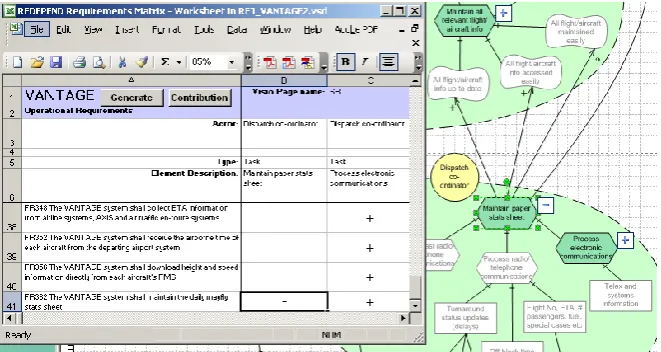
To identify the impacts, analysts map functional requirements to SR model tasks and resources using a matrix, as requirements and functional i* elements need not follow a one-to-one relationship. An example is depicted in Figure 5. Adding a simple + or – value to a cell indicates how the requirement, if satisfied, will impact on the task or resource. The tasks and resources are indicated to be either compliant (+) or
updated, software system.
To develop the matrix the requirements analysts were asked to consider each requirement in turn using the following method guidance:
1. Compliant task: If the requirement in the system specification, when satisfied by the new system, will enable the actor to complete the task successfully, compared with undertaking the task in the AS-IS system, then link the requirement to the task with a compliant (+) value.
2. Non-compliant task: If the requirement in the system specification, when satisfied by the new system, will detract from the actor‟s ability to complete the task successfully, compared with undertaking the task in the AS-IS system, then link the requirement to the task with a non-compliant (–) value.
3. Compliant resource: If the requirement in the system specification, when satisfied by the new system, will enable the actor to obtain the resource successfully, compared with obtaining the resource in the AS-IS system, then link the requirement to the resource with a compliant (+) value.
4. Non-compliant resource: If the requirement in the system specification, when satisfied by the new system, will detract from the actor‟s ability to obtain the resource successfully, compared with obtaining the resource in the AS-IS system, then link the requirement to the resource with a non-compliant (–) value.
Figure 5 presents a continuation of our example from the VANTAGE project. It shows that the requirement the VANTAGE system shall manage the daily mayfly stats sheet would, if satisfied, be compliant with the successful completion of the airport management task optimise operational efficiency. In contrast, the same requirement would, if satisfied, have been non-compliant with the successful completion of the current dispatch co-ordinator task maintain paper stats sheet.
Functional requirement Airport Management:
Optimise operational efficiency [Task]
Dispatch Co-ordinator: Maintain paper stats
sheet [Task]
The VANTAGE system shall manage the daily mayfly stats sheet
[image:12.595.91.482.467.562.2]+ –
Figure 5: Part of a functional requirement – SR model matrix for the VANTAGE system
Analysts complete the matrix manually. We explored techniques to automate at least part of the procedure, for example mapping terms in each functional requirement to terms describing each task and resource. However the terseness of the i* model element expressions and lack of context to determine word senses rendered such automation unreliable.
Matrix completion uses simple patterns. The first 2 patterns relate to requirements that do not map to SR model tasks and resources:
1. Unnecessary requirements: requirements that do not impact any tasks or resources in the model can indicate unnecessary requirements. Therefore analysts will need to determine whether these requirements should be removed from the specification.
impact goals, can indicate missing tasks and resources. Therefore analysts will need to revise the SR model in line with the specification.
The final 3 patterns then enable the analysts to detect potentially non-compliant
tasks and resources. A non-compliant element is any soft goal, goal, task or resource that, given the current software requirements, has the potential not to be achieved, attained, completed or made available:
3. Requirements omission: a task or resource that is not impacted by any requirement can indicate missing requirements. Therefore analysts will need to determine the degree and nature of the impact of each non-compliant task and resource arising from requirements omission on system-wide goals and soft goals;
4. Requirements detraction: satisfying requirements can have unforeseen consequences that can make tasks and resources non-compliant. Again, analysts will need to determine the degree and nature of the impact of each non-compliant
task and resource on system-wide goals and soft goals;
5. Weak requirements compliance: there are insufficient requirements to complete tasks or make resources available in all situations, thus making the tasks and resources potentially non-compliant.
3.4
Determine the Resulting System-Wide Goal and Soft Goal
Impacts
The final stage of the PiLGRIM method builds on the integrated i*-satisfaction arguments and impacted tasks and resources to explore the attainment of goals and achievement of soft goals in the SR model.
When the matrix is complete analysts use the final procedure to determine if the impact of non-compliant tasks and resources causes goals and soft goals to become
non-compliant. Whilst it is also possible to demonstrate compliance through the SR model, the method prioritises propagating non-compliance in order to make the most effective use of time and resources e.g. domain experts.
The procedure applies 6 propagation heuristics to all 4 types of i* model links reported in section 2. At the start of the procedure each non-compliant task and resource in the matrix is a non-compliant element:
For each non-compliant element:
For each model element linked to the non-compliant element: IF at least 1 propagation heuristic applies to model element THEN add model element to set{non-compliant elements}
ELSE consider next model element
The 6 propagation heuristics use i* semantics to determine whether each linked model element can become non-compliant. The first 2 heuristics, concerning propagation across dependency relationships and task decompositions, are deterministic and non-compliance can be computed automatically using tool support:
1. IF model element = depender element in dependency relationship AND is non-compliant
THEN add dependee element to set{non-compliant elements}
2. IF model element = decomposition of a task AND is non-compliant
THEN add task element to set{non-compliant elements}
computationally deterministic. An end element with one or more non-compliant means is automatically identified as having the potential to become non-compliant. Deciding if the contributed-to element becomes non-compliant is where the satisfaction arguments come in through the application of the next 4 heuristics. The introduction of the software system as specified by the requirements might change domain properties that, if no longer true, invalidate the argumentation and make goal or soft goal non-compliant:
3. IF model element = end-element of means-end link
AND at least 1 domain property in argument for means-end = invalid
THEN add end-element of means-end link to set{non-compliant elements}
4. IF model element = end-element of contributes-to soft goal link AND at least 1 domain property in argument for contributes-to soft goal = invalid
THEN add end-element of contributes-to soft goal link to set{non-compliant elements}
If analysts cannot rewrite the argument so that the goal is attained or soft goal is achieved, then the goal or soft goal is non-compliant. On the other hand the introduction of the software system that meets the specified requirements might not change domain properties but it might have specifications that invalidate the argument and make the goal or soft goal non-compliant:
5. IF model element = end-element of means-end link AND argument for means-end = invalid
THEN add end-element of means-end link to set{non-compliant elements}
6. IF model element = end-element of contributes-to soft goal link AND argument for contributes-to soft goal = invalid
THEN add end-element of contributes-to soft goal link to set{non-compliant elements}
Again if the analysts cannot rewrite the argument so that the goal is attained or soft goal achieved, then the goal or soft goal is non-compliant.
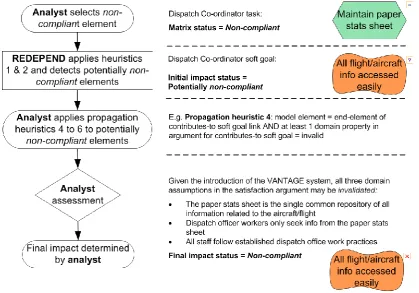
Returning to our earlier example, we took the non-compliant dispatch co-ordinator
task maintain paper stats sheet and explored whether its associated soft goals in the VANTAGE i* SR model were also non-compliant. Application of the heuristics revealed that dispatch office soft goals related to the affordances of the paper version of the stats sheet were potential non-compliant elements after the introduction of the new computerised VANTAGE system. We then used the propagation heuristics to determine whether these soft goals were now indeed non-compliant. Figure 6 demonstrates the process undertaken by a human analyst with automated support from the REDEPEND software tool for one of these soft goals – all flight/aircraft info accessed easily. Analysts needed to consider whether the domain assumptions would still hold true following the introduction of the new VANTAGE system. As the figure shows, the final assessment determined that all three domain properties were in fact invalidated by the new specification, and therefore the soft goal was deemed to be
Figure 6: An example application of the propagations heuristics to the maintain
4.
Supporting i* Models, Satisfaction Arguments and Impact
Analysis with a Tool
We implemented a new version of REDEPEND to support requirements analysts to specify satisfaction arguments for i* means-end links and analyse the impact of software requirements on system-wide goals and soft goals using the procedure. The tool provides automatic model analysis functions to help the analyst undertake human reasoning.
4.1 Specifying Satisfaction Arguments
To generate a new satisfaction argument an analyst selects a goal or soft goal in the
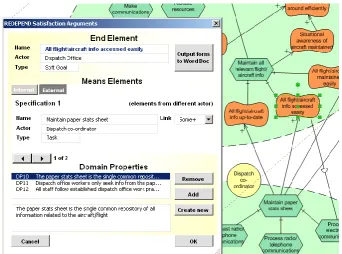
i* SR diagram. REDEPEND automatically generates a new satisfaction argument sheet for the selected goal or soft goal using elements and links in the model. Figure 7 shows the REDEPEND representation of the satisfaction argument for the soft goal
all flight/aircraft info accessed easily presented earlier in Figure 4. As can be seen, the selected goal or soft goal is the default end-element, and each element that is a means to the goal or soft goal is a means-element. Means-elements are documented using 2 tabs. The internal tab displays refinement means-elements from within the same actor boundary as the end-element, and the external tab displays specification means-elements from other actors.
Figure7: One satisfaction argument showing the maintain paper stats sheet
specification taken from the VANTAGE model, specified in REDEPEND
The analyst can change the link types directly in the form. Because REDEPEND generates each satisfaction argument automatically from the SR model, such changes made by the analyst to the satisfaction argument sheet and model are propagated automatically to both, thus keeping the model and its arguments consistent.
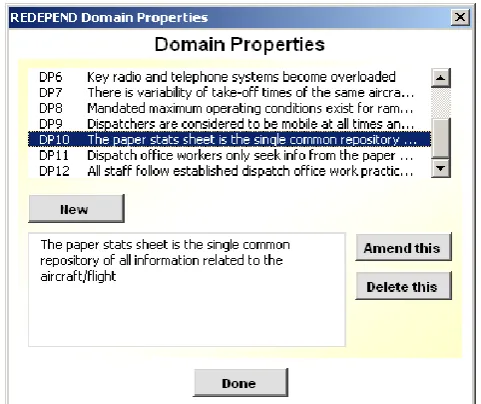
[image:16.595.133.476.360.614.2]arguments. For each domain property in an argument, the analyst selects an existing property from the database or adds a new one to it. Figure 8 shows the management of the VANTAGE domain properties in REDEPEND – the list includes domain properties DP10, DP11 and DP12 featured in the example above. Finally, the satisfaction argument sheet can be exported to Microsoft Word to provide a more widely used documentation format for sharing within the project.
Figure8: Domain property management in REDEPEND for all of the
satisfaction arguments contained in the VANTAGE system model
4.2 Completing the Functional Requirement-SR Model Matrix
[image:17.595.177.418.167.369.2]Figure 9: An example of mapping VANTAGE software requirements from the
matrix to i* model elements using REDEPEND
4.3 Supporting Impact Analysis
REDEPEND also has new features to support SR model walkthroughs for determining propagation impacts on goals and soft goals. The analyst can select a requirement in the matrix and run an automatic procedure to tag the impacts on affected tasks and resources in the SR model. Impacts are depicted on a model as a compliant “+” or non-compliant “–”, whilst non-impacted elements are greyed out. Having selected an element with a detraction, REDEPEND can then be used automatically to detect and tag other elements that are potentially non-compliant by using propagation heuristics to follow the i* links upwards, as reported in Section 3.4. Propagation impacts across task decomposition and dependency links are automatically determined in REDEPEND with non-compliant elements tagged with an “X”, but propagation across means-end links are tagged as undecided “?” as these need analyst input.
Figure 10: An example of exploring propagation impacts from a non-compliant
task in the VANTAGE model using REDEPEND
4.4 Evaluation of the Method and Tool
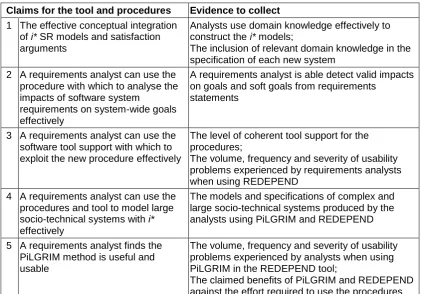
[image:19.595.73.498.463.757.2]Having developed the PiLGRIM method and implemented a new version of REDEPEND to support it, we sought to evaluate both. To do this we adopted a case study approach to explore the five claims summarized in Section 1.1. The claims were evaluated through two case studies, one in the area of air traffic management and the other in patient surveillance. Table 1 reports the claims and evidence we sought to collect to evaluate each of the claims.
Table 1: The five claims for the tool and procedures, and the evidence we sought to collect to evaluate these through the two case studies
Claims for the tool and procedures Evidence to collect
1 The effective conceptual integration
of i* SR models and satisfaction
arguments
Analysts use domain knowledge effectively to
construct the i* models;
The inclusion of relevant domain knowledge in the specification of each new system
2 A requirements analyst can use the procedure with which to analyse the impacts of software system
requirements on system-wide goals effectively
A requirements analyst is able detect valid impacts on goals and soft goals from requirements
statements
3 A requirements analyst can use the software tool support with which to exploit the new procedure effectively
The level of coherent tool support for the procedures;
The volume, frequency and severity of usability problems experienced by requirements analysts when using REDEPEND
4 A requirements analyst can use the procedures and tool to model large
socio-technical systems with i*
effectively
The models and specifications of complex and large socio-technical systems produced by the analysts using PiLGRIM and REDEPEND
5 A requirements analyst finds the
PiLGRIMmethod is useful and
usable
The volume, frequency and severity of usability problems experienced by analysts when using PiLGRIM in the REDEPEND tool;
and tool made by requirements analysts
Of particular interest to us were the fourth and fifth claims that the PiLGRIM method scales to large and complex socio-technical systems and is usable by requirements analysts. Proving that the PiLGRIM method scales and is usable would enable us to follow the next stage of our research – to investigate if our method provides wider benefits to an organisation.
5.
Case Study One: NATS
For our first case study, proof of concept of the process and tool extension was investigated using an airspace infringement detection solution. The study took place at NATS, the UK‟s national air traffic service, and applied our tool-based extension to existing NATS requirements processes to support safety-related requirements analysis and specification (reported in an earlier form in [24]). Safety-related requirements processes were extended with i* modelling supported with satisfaction arguments, embedded in an extended version of REDEPEND.
5.1 The Domain
The United Kingdom airspace is broadly divided into two types; controlled and un-controlled. Aircrew must obtain air traffic control clearance prior to entering controlled airspace. However, pilots are not always aware where they are, and at the time of the study the number of reports of aircraft entering controlled airspace without clearance was increasing.
Infringements of controlled airspace by unknown aircraft presented a significant risk to NATS. The safety need was to detect and bring to the controllers‟ attention infringements by unknown aircraft into controlled airspace. The system in place at the time relied on controllers noticing unknown aircraft entering controlled airspace when monitoring the radar display. For aircraft that transponded a Secondary Surveillance Radar (SSR) code, the Short Term Conflict Alert (STCA) system provided an alert about potential loss of separation (the safe distance between two aircraft operating in the same area) to the controller. However, because of the setting of the STCA parameters, separation may have already been lost and the airborne Traffic Alert and Collision Avoidance System (TCAS) may have already prompted the pilot to respond. The Controlled Airspace Infringement Tool (CAIT) was to be a new safety net tool to provide controllers with more timely warnings of controlled airspace infringements by aircraft. The intention was that CAIT would provide a solution to the safety need by improving the situational awareness for controllers, thus providing more time to plan actions to avoid a potential loss of separation and minimize the effects of the infringement.
5.2 The i* models
Table 2: Numerical summary of components in the CAIT i* SR model
SR actors 25 Of which Expanded actors 15
SR model elements
197 Of which Tasks 77
Goals 22
Soft goals 37
Resources 61
SR model links
299 Of which Dependencies 59
Contributes-to soft goal 48
Means-end 73
Task decomposition 119
The actor representing the new CAIT software system, a small safety net tool on which requirements were specified in text form, is shown (A) in the model in Figure 11. CAIT is a relatively small part of infringement detection and has dependencies with other actors in the NATS integrated air traffic control system. Actors include
aircraft (H) that transmit Secondary Surveillance Radar (SSR) data, ground-based
surveillance systems (D) that send data about aircraft positions and code, the RDP (B) that computes the accurate locations of aircraft from the data, and the Short-Term Conflict Alert (STCA) software system. The Controller Working Position (CWP) actor (C), which displays information to civil air traffic control officers (ATCOs), depends on the CAIT software system for the resource CAIT alerts. The actor with the largest number of model elements, in the centre of the diagram (E), was developed to describe the tasks, resources, goals and soft goals of civil ATCOs using expert input during the meetings and models of cognitive controller behaviour [14]. The right-hand side of the model depicts pilots of both controlled (F) and uncontrolled (G) aircraft
depending on the civil ATCO and each other to avoid collisions.
Figure 11: i* SR model of the CAIT system, developed using REDEPEND
A
B
C
D
E
G
F
5.3 The Satisfaction Arguments
Having signed off the SR model as complete, the NATS analysts followed the second stage of the PiLGRIMmethod to develop integrated i*-satisfaction arguments. The analysts elaborated 8 selected soft goal end-elements and their associated means-end links from the model based on their domain expertise. The authors generated the automatic elements of the satisfaction arguments using REDEPEND as described in Section 4.1. Basic training and instruction was then provided to the experts to manually complete the satisfaction arguments with domain properties. Each resulting argument contained, on average, 2 refinement means, 1 specification means and 3 domain properties. The database associated with the SR model contained a total of 22 domain properties, with no reuse of CAIT domain properties during the development of the satisfaction arguments. The lack of reuse was most likely due to the low number of satisfaction arguments developed during the NATS study – only eight due the limited availability of domain experts.
Figure 12 shows one of the selected means-end links and its associated satisfaction argument. In this instance the end-element represented current human work required to change due to requirements on CAIT, and the means-element represented a current system also required to change due to requirements on the introduced system. The double-headed arrow specified a MAKE contributes-to soft goal link – the contribution of the completed CWPdisplay picture task was positive and sufficient to satisfice the civil ATCO soft goal be aware of alerts. The argument was important for the introduction of CAIT even though CAIT did not form any element of the satisfaction argument. The domain properties the ATCO is monitoring the air picture
and alerts are only communicated through the air picture rely on specifications and work practices beyond the scope of the CAIT specification, and are therefore assumptions rather than goals that CAIT would be specified to achieve.
Satisfaction argument
Actor: Civil ATCO
End-element [type]: Be aware of alerts [Soft goal]
Specification means-element [type] [actor] [link]: Display picture [Task] [CWP] [Make]
Domain properties:
The ATCO is monitoring the air picture
Alerts are only communicated through the air picture
[image:23.595.88.510.413.688.2]Explanation: The alert is reported with the air picture that is displayed with the CWP, to provide a single information source. It is the only source of alert information for the civil ATCO.
Figure 12: An example of a means-end link and its associated satisfaction argument taken from the CAIT system model
5.4 Developing the Requirements-i* Model Element Matrix
requirements were developed independently by a CAIT software team, and were not accessed during the i* modelling to reduce the possibility of bias in assessing requirement impacts.
Two NATS requirements analysts applied the PiLGRIM method as described in Section 3.3, mapping the requirements to the tasks and resources using compliant/non-compliant values. Figure 13 reports the compliant and non-compliant values for two of the requirements. The requirement CAIT alerts shall be logged automatically by the system will, if satisfied, be compliant with the successful completion of the task record alerts, but will be non-compliant with the availability of the civil ATCO resource long-term memory of infringements – as ATCOs would no longer be involved in the conscious process of filing manual infringement reports. The requirement it shall be possible to set active regions for the CAS infringement alerts
will, if satisfied, be compliant with the successful completion of the engineering task
set active regions for CAIT.
Functional requirement CAIT:
Record alerts [T]
Civil ATCO: L-T Memory of infringements [R]
Engineering: Set active regions
for CAIT [T]
CAIT alerts shall be logged automatically by the system
+ –
It shall be possible to set active regions for the CAS infringement alerts
[image:24.595.89.509.284.397.2]+
Figure 13: A part of a functional requirement – SR model matrix for the CAIT system. NB: requirements are not original CAIT requirements for confidentiality reasons
Alas, due to finite resources and time the NATS case study ended before the matrix was completed, therefore the analysts were unable to follow the fourth stage of the PiLGRIM method to determine the impact of non-compliant tasks and resources on the goals and soft goals in the model. Although the final stage of our method was not attempted by the analysts in this case study, we were able to use the data from the first three stages for assessing claims 1, 3 and 4.
5.5 Other Observations
The NATS analysts were uncertain how to deal with means-end links contributing negatively to soft goals, as the PiLGRIM method and its rationale did not describe what to do. As a result, the analysts recorded the assumptions behind the negative contributions captured in the air traffic domain as a separate exercise. This led the analysts to consider assumptions concerned with the impact of new operational procedures, and effectiveness versus efficiency – assumptions of significance for the introduction of the new software system.
Whilst no major usability problems with REDEPEND were reported during the i*
5.6 Conclusions
[image:25.595.75.500.250.518.2]Despite the large scale of the infringement detection problem the NATS team used PiLGRIM and REDEPEND to develop i* models and satisfaction arguments successfully. The arguments described domain properties missing from the original SR model but deemed important by NATS analysts. However the impact analysis was not completed due to time constraints, with implications for evaluating claims 2 and 5. Table 4provides a summary of the evidence collected from this case study to evaluate the remaining three claims. Results provided some empirical evidence for our conceptual integration of i* modelling and satisfaction arguments, the usability of our tool, and the scalability of PiLGRIM.
Table 4: Three of our claims and a summary of the evidence we collected to evaluate these through our first case study
Claim Evidence
1 The effective conceptual integration
of i* SR models and satisfaction
arguments
The NATS analysts were successful in developing
and reasoning satisfaction arguments for i*
means-end links;
Domain properties that were not explicitly
represented in the i* semantics were added.
NATS analysts considered these domain
properties important to the model’s completeness for the specification of the CAIT system
3 A requirements analyst can use the software tool support with which to exploit the new procedure effectively
REDEPEND supported a consistent application of
the first 3 stages of the PiLGRIMmethod
successfully. The final stage of the method was not evaluated in this study;
No usability problems were reported during the i*
modelling, but the analysts recommended improvements to the usability of the requirements matrix
4 A requirements analyst can use the procedures and tool to model large
socio-technical systems with i*
effectively
The NATS project team were able to develop
large i* models of the CAIT system successfully
using REDEPEND
6.
Case Study Two: Health Protection Agency
We used our second case study to investigate the impact of requirements changes on system-wide goals using i* models and satisfaction arguments. The study took place at the Health Protection Agency (HPA) in the UK, where our approach was applied to analyse the impact of change request requirements raised for the HIV/AIDS Patients monitoring system (HAP). The same REDEPEND tool and procedures from the NATS case study were applied. The analysis in this case study was undertaken by an employee of the HPA who is also an author of this paper (full details of the study are available in [5]).
6.1 The Domain
The HAP system monitors the impact of HIV on public health in the UK by running a system originally designed in September 1982 following early reported cases of HIV infection [4]. This system has evolved and improved over the years, and now is widely regarded as one of the most comprehensive Public Health Surveillance (PHS) systems in the world, covering key features recommended by the Guidelines Working Group [6]. Evolution of HAP has been informed by feedback from HAP users, technological advances, updates in public health legislation and evolution of the HIV epidemic. Updates to the system are managed through change requests raised by users and implemented by the Centre for Infections Software Development Unit (SDU).
HAPv3, the latest version of HAP, was commissioned and built in 2003 to combine the functionalities of several peripheral applications previously developed to meet evolving requirements of HAPv2. These peripheral applications resulted in duplication of requirements (and therefore functionality), confusion amongst users (for example due to the number of different screens for the same process), as well as increasing the chances of conflicting requirements between applications.
In 2008, as with previous versions, HAPv3 was once again perceived to be complicated by the development of further peripheral applications. Although the change request procedure had been effective in solving individual problems, there was no method in place to monitor the impact of each change on the wider system goals. Lack of this middle ground resulted in users having difficulties explaining their underlying needs, and engineers having difficulty describing the impact of technical solutions. Hence we applied PiLGRIM to the problem, undertaking requirements change analysis on important goals and soft goals.
6.2 The i* Models
Table 5: Numerical summary of components in the HAP i* SR model
SR actors 12 Of which Expanded actors 5
SR model elements
102 Of which Tasks 55
Goals 18
Soft goals 19
Resources 10
SR model links
130 Of which Dependencies 19
Contributes-to soft goal 32
Means-end 18
Task decomposition 61
The actor representing the HAP software system, on which change request requirements were specified in text form, is shown (A) in the model in Figure 14. The software application is at the core of all UK HIV/AIDS patients monitoring and reporting, and validates links between databases and stores information on new HIV diagnosis records. It undertakes tasks such as merge linked records and validate data
to achieve soft goals such as patient record completeness maximised. HAP depends on resources produced by other actors and managed by the information officer (B), for example death reports from the ONS. Inputters (C) enter paper records into databases, and depend on HAP to display input errors and display notifications with similar patient IDs. Scientists (D) perform epidemiological analysis and interpret data to keep the public informed and up-to-date, and research nurses (E) meet with patients and clinicians to identify and classify probable infection routes and other patient information that is unclear on the reported form.
Scientist Exposure codes accurate Perform Specialist review of forms Perform
specialist review of deaths
Cause of death category accurate Trends in HIV spread identified Analysis dataset accurate Public informed Analyse data Inform public Data outputs accurate Perform specialist reviews Publish
reports websiteUpdate
Research Nurse FUP forms FUP data obtained from clinician FUP Data obtained from patient interview FUP data resolved Update FUP (paper) record Update FUP patient record Update FUP HAP (electronic) record FUP data accurate FUP data obtained quickly FUP list Identify clinician details All notification reports complete Identify FUP forms HAP Derived fields accurate Update input errors All data validated Link notifications from same patient Link notifications with exact PID
Notifications with similar PID displayed Patient record complete Identify typos Identify discrepancies
between1st and
2nd entry
Identify duplicate notifications Merge linked records Merge screen displayed All relevant report types generated Validate data Check data consistency Identify invalid ages Check for missing data
Record to be updated displayed Link Death reports to patient records Patient confidentiality preserved
Exclude deaths in those under 15 or
over 60 Death data representative of HIV population ONS FUP letters printed New patients identified Link notifications with similar PID Generate derived fields Generate Soundex codes Identify incomplete death reports Display input errors Produce
extract table Import
notifications
identify import fields
Generate list for FUP
Inputter Complete data entry Do second round data entry Data entered accurately All mandatory data entered Correct input errors Match notifications with similar PID
Create new patient records Pre-checked
forms
Match first and second entered data Check calculated fields Merge fields Duplicates identified
Do first round data entry Link reports from existing patients Patient data maximised Update AKA field Pre-check forms Flag incomplete forms for FUP
Stamp forms with unique ID Information Officer Data received accurate All missing identifiers obtained Death reports Identify HIV related deaths Import ONS data to HAP
Identification of new diagnosis maximised
All HIV related deaths identified Assign Cause of Death category Check cause of death Data received promptly Patient information accurate Patient exposures coded accurately Link external data Scottish data CD4 data Treatment data Child data Incidence data Ensure ONS data is complete
Patient linking maximised Match patient data Check for form completeness HIV dataset complete HIV notifications + + ,,,,,,,,,,,, ,,,,,,,,,,,, ,,,,,,,,,,,, + ,,,,,,,,,,,, ,,,,,,,,,,,, ,,,,,,,,,,,, ONS ,,,,,,,,,,,, + + + Reporter ,,,,,,,,,,,, -,,,,,,,,,,,, + + + + + + + + + Incidence ,,,,,,,,,,,, ICH ,,,,,,,,,,,, SOPHID ,,,,,,,,,,,, CD4 ,,,,,,,,,,,, SCIEH ,,,,,,,,,,,, ,,,,,,,,,,,, + + + + + ,,,,,,,,,,,, ,,,,,,,,,,,, + + + ,,,,,,,,,,,, ,,,,,,,,,,,, + ,,,,,,,,,,,, + - + + +
Figure 14: i* SR model of the HAP system, developed using REDEPEND
6.3 The Satisfaction Arguments
The HAP analyst specified satisfaction arguments for soft goals and goals in line with stage two of the PiLGRIM method. He also extended the method to apply satisfaction arguments to tasks and resources. However, the intention of PiLGRIM
A
B
C
was to assess the impacts on end goals by using the means specifications and associated domain properties as part of the complete end argument. So, for example, the satisfaction argument for the means task identify HIV related deaths should have been allocated to its end goal all HIV related deaths identified. Therefore, we include these results only as evidence of the analyst‟s ability to develop and reason satisfaction arguments for elements and associations in the i* model.
[image:28.595.87.512.607.755.2]Unlike in the NATS study, domain property specification was performed using the REDEPEND tool throughout the modelling and during impact analysis of change requests. In total, 22 satisfaction arguments were developed for the SR model – 13 for soft goals, 3 for goals, 5 for tasks and 1 for a resource. In contrast to the CAIT satisfaction arguments domain properties were reused. Of the 40 unique domain properties specified 15 were reused, leading to a total of 60 uses (1 domain property was used four times, 3 used three times and 11 used twice). The HPA analyst reported reuse of domain properties in REDEPEND to be both useful and straightforward. Table 6 summarises the make-up of the 22 satisfaction arguments.
Table 6: Cumulative total and average number of refinements, specifications and domain properties in the 22 HAP satisfaction arguments
Domain property specification was incremental, with 27 specified during the production of the SR model and another 13 added during the matrix completion and impact analysis. The analyst reported that applying the final two stages of the PiLGRIM method revealed additional domain properties that were overlooked during the initial modelling phase.
An example satisfaction argument developed for the information officer soft goal
patient information accurate is shown in Figure 15. The end-element and refinement means-element represented goals related to current human work, where the achievement of the information officer goal all HIV related deaths identified
contributed positively to the patient information accurate soft goal. The specification means-element represented a goal, all data validated, that was impacted on by change request requirements on the HAP system. The argument stated that validating records and checking for completeness enhanced information accuracy, given that certain domain properties held true, e.g. patients give accurate information to clinicians, an assumption as a database redesign would not able to achieve this as a goal.
Satisfaction argument
Actor: Information Officer
End-element [type]: Patient information accurate [Soft goal]
Refinement means-element [type] [link]: All HIV related deaths identified [Goal] [Some+]
Refinements Specifications Domain properties
Total 34 10 60