An Objective Comparison of Languages for
Teaching Introductory Programming
Linda Mannila
Turku Centre for Computer Science Åbo Akademi University Dept. of Information Technologies Joukahaisenkatu 3-5, 20520 Turku, Finland
Michael de Raadt
Department of Mathematics and Computing and Centre for Research in Transformational Pedagogies
University of Southern Queensland, Toowoomba Queensland, 4350, Australia
[email protected]
ABSTRACT
The question of which language to use in introductory pro-gramming has been cause for protracted debate, often based on emotive opinions. Several studies on the benefits of individual languages or comparisons between two languages have been conducted, but there is still a lack of objective data used to in-form these comparisons. This paper presents a list of criteria based on design decisions used by prominent teaching-language creators. The criteria, once justified, are then used to compare eleven languages which are currently used in introductory pro-gramming courses. Recommendations are made on how these criteria can be used or adapted for different situations.
Keywords
Programming languages, industry, teaching
1.
INTRODUCTION
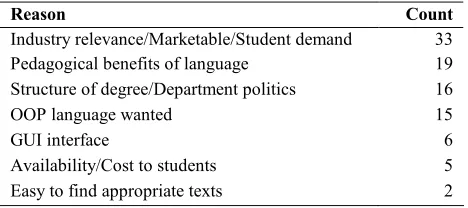
A census of introductory programming courses within Australia and New Zealand [5] revealed reasons why instructors chose their current teaching language (shown in Table 1). The most prominent reason was industry relevance, before even peda-gogical considerations. This suggests academics perceive pres-sure to choose a language that may be marketable to students, even if students themselves may not be aware of what is re-quired in industry.
The primary objective of introductory programming instruction must be to nurture novice programmers who can apply pro-gramming concepts equally well in any language. Yet many papers from literature argue that one language is superior for this task. Such research asserts a particular language is superior to another because, in isolation, it possesses desirable features [2, 3, 4, 9, 21] or because changing to the new language seemed to encourage better results from students [1, 11]. What is shown in literature is surely only a reflection of the innumerable de-bates that have undoubtedly taken place within teaching institu-tions.
While the authors of this paper do not believe that language choice is as critical as choice of course curriculum used to
de-liver teaching, it is important to choose a language that will best support an introductory programming curriculum.
1.1
Background
The choice of programming language to use in education has been a topical issue for some time. In the early 1980s, Tharp [22] made a language comparison of COBOL, FORTRAN, Pascal, PL-I, and Snobol, primarily focused on efficiency of compilation and speed of code implementation, in order to pro-vide educators with information needed to choose a suitable language. Today, considerations focus more on pedagogical concerns and the range of languages is even broader.
George Milbrandt suggests the following list of language fea-tures for languages used in high schools in [20].
• easy to use
• structured in design
• powerful in computing capacity
• simple syntax
• variable declaration
• easy input/output and output formatting
• meaningful keyword names
• allowing expressive variable names
• provide a one-entry/one-exit structure
• immediate feedback
• good diagnostic tools for testing and debugging
Many of the criteria in the list above are echoed by McIver and Conway [15] who list seven ways in which introductory pro-gramming languages make teaching of introductory program-ming difficult. They also put forward seven principles of pro-gramming language design aiming to assist in developing good pedagogical languages. Neither of these studies demonstrates application of these criteria to make comparison between lan-guages.
Instruments to facilitate the process of choosing a suitable lan-guage have also been suggested (e.g. [18]), but without present-ing any comparable results.
1.2
Goal
[image:1.595.54.288.667.771.2]This paper is intended to be an objective comparison of com-mon languages, based on design decisions used by prominent teaching-language creators, drawing conclusions that allow instructors to make informed decisions for their students. It is also intended to provide ammunition for those who are, for pedagogical reasons, seeking to make a language change, in an environment where industry relevance can be overvalued. The following section lists the criteria used to make a compari-son of languages in section 3. Finally conclusions are drawn in section 4.
Table 1: Reasons for instructors' language choice
Reason Count
Industry relevance/Marketable/Student demand 33 Pedagogical benefits of language 19 Structure of degree/Department politics 16 OOP language wanted 15
GUI interface 6
2.
CRITERIA
A list of seventeen criteria has been created and is presented in the following subsections. Each criterion has been suggested by creators of languages that are considered "teaching languages".
1. Seymour Papert (creator of LOGO) 1 2. Niklaus Wirth (creator of Pascal) 2 3. Guido van Rossum (creator of Python) 3
4. Bertrand Meyer (creator of Eiffel) 4
Each criterion is drawn from the design decisions made by each of these language creators as they describe their languages. The criteria refer to languages in general. There is no mention of paradigm within the criteria and this allows comparison of languages across paradigms.
Criteria are grouped into related subsections for ease of applica-tion. The criteria are shown in no particular order of priority.
2.1
Learning
The following criteria relate the programming language to as-pects of learning programming.
2.1.1
The language is suitable for teaching
This first criterion was suggested by Niklaus Wirth [25]. Wirth points out that widely used languages are not necessarily the best languages for teaching.The choice of a language for teaching, based on its widespread acceptance and availability, to-gether with the fact that the language most widely taught is therefore going to be the one most widely used, forms the safest recipe for stagnation in a subject of such profound pedagogical influ-ence. I consider it therefore well worth-while to make an effort to break this vicious circle.
It is interesting that Wirth was able to break this cycle for al-most twenty years, but how easily we have reverted to use of commercial languages for the same reasons.
This criterion is echoed by Guido van Rossum [23].
…code that is as understandable as plain English.
…reads like pseudo-code.
…easy to learn, read, and use, yet powerful enough to illustrate essential aspects of pro-gramming languages and software engineering.
Bertrand Meyer also suggests this criterion [16].
In some other languages, before you can produce any result, you must include some magic formula which you don’t understand, such as the famous public static void main (string [] args). A good teaching language should be unobtrusive, ena-bling students to devote their efforts to learning the concepts, not a syntax.
1
http://www.papert.org/
2
http://www.cs.inf.ethz.ch/~wirth/
3
http://www.python.org/~guido/
4
http://se.ethz.ch/~meyer/
To meet this criterion the language should have been designed with teaching in mind. The language will have a simple syntax and natural semantics, avoiding cryptic symbols, abbreviations and other sources of confusion. Associated tools should be easy to use.
2.1.2
The language can be used to apply physical
analogies
This criterion was suggested by Seymour Papert [17]. Papert believed physical analogies involve students in their learning.
Without this benefit [using students' physical skills], seeking to "motivate" a scientific idea by drawing an analogy with a physical activity could easily denigrate into another example of "teacher's double talk".
This idea is extended to "microworlds", a small, simple, bounded environment allowing exploration in a finite world.
To meet this criterion a language would need to pro-vide multimedia capabilities without extension. Per-haps more critical is the effort needed to get students to a stage where they could access this potential and how consistently it is applicable across environments (say between operating systems).
2.1.3
The language offers a general framework
The primary goal of any introductory programming course is to introduce students to programming. As such, the language itself is not the focus of instruction and any skills learned in one lan-guage should be transferable to other common lanlan-guages. Ber-trand Meyer suggests the following philosophy [16].A software engineer must be multi-lingual and in fact able to learn new languages regularly; but the first language you learn is critical since it can open or close your mind forever.
To meet this criterion the language should make it possible to learn the fundaments and principles of programming, which would serve as an excellent ba-sis for learning other programming languages later on.
2.1.4
The language promotes a new approach for
teaching software
In an introductory course, language is but one part of the learn-ing for a novice. It may be valuable where a language itself and associated tools can assist in learning to apply the language. Bertrand Meyer [16] suggests an introductory 'programming language' should be...
…not just a programming language but a method whose primary aim — beyond expressing algo-rithms for the computer — is [to] support thinking about problems and their solutions.
To meet this criterion the 'language' should not only be restricted to implementation, but cover many as-pects of the software development process. The 'lan-guage' should be designed as an entire methodology for constructing software based on 1) a language and 2) a set of principles, tools and libraries.
2.2
Design and Environment
2.2.1
The language is interactive and facilitates
rapid code development
The potential to apply new programming ideas without requir-ing the context of a full program is valuable to novices [17]. The possibility to quickly start writing (and understanding) simple programs motivates and inspires [23].
To meet this criterion the language and environments supporting its use should allow novices to implement newly acquired ideas, without having to establish the context of a full application. The language environ-ment should provide students with interactive and immediate feedback on their progress.
2.2.2
The language promotes writing correct
pro-grams
The language Eiffel implements "Design by Contract" – a set of concepts tied to both the language and the method [14]. The aim is to move away from the prevalent "trial and error" ap-proach to software construction.
By equipping classes with preconditions, postcon-ditions and class invariants, we let students use a much more systematic approach than is currently the norm, and prepare them to become successful professional developers able to deliver bug-free systems.
To meet this criterion, students should be given ways to ensure that the code they write is correct and does not contain bugs.
2.2.3
The language allows problems to be solved
in "bite-sized chunks"
It is desirable for any programmer to be able to focus on one aspect of a problem before moving onto the next. A language which supports problem decomposition is desirable as sug-gested by Papert [17].
It is possible to build a large intellectual system without ever making a step that cannot be com-prehended. And building a system with a hierar-chical structure makes it possible to grasp the sys-tem as a whole, that is to say, to see the syssys-tem "viewed from the top".
To meet this criterion the language should support modularization, in functions, procedures or equivalent divisions.
2.2.4
The language provides a seamless
devel-opment environment
When a novice begins to program it is valuable to understand the process that takes their program source to an executable program. Some Integrated Developments Environments can hide these details, obscuring this process for the sake of sim-plicity and rapidity which may be advantageous for an expert but less so for a novice. Other environments can assist in bridg-ing the gap between design and implementation by, for exam-ple, converting architectural diagrams to code, and possible also reversing this process. Meyer suggests a "seamless develop-ment" can aid novices [16]. Such a language…
…enables us to teach a seamless approach that extends across the software lifecycle, from analy-sis and design to implementation and mainte-nance.
To meet this criterion the development environment should have an intuitive GUI for design and imple-mentation which provides access to features and li-braries, both for basic and advanced programming.
2.3
Support and Availability
The following criteria describe the support community and availability of the language and resources to teach the language.
2.3.1
The language has a supportive user
com-munity
Whether a language is a commercial creation or an open source project, its longevity will depend on the support for that lan-guage in the wider programming community. Where support is limited, resources and support may be a restriction for instruc-tors and students. This criterion is suggested in [23].
To meet this criterion, there must be sufficient sup-port for students, faculty and others interested in learning and using the language. This support can come in different forms, such as web pages, course books, tutorials, exercises, documentation and mail-ing lists.
2.3.2
The language is open source, so anyone can
contribute to its development
One of the benefits of an open source software project is the reduction of cost. Another benefit of an open source project is interoperability – where a commercial venture may seek to avoid compatibility with other systems to create a reliance on their creation. Beyond requiring a standard on which the lan-guage is based, this criterion seeks to differentiate lanlan-guages whose development is the collaborative product of individuals. This criterion is suggested in [23] and continues over the fol-lowing two criteria, even though the folfol-lowing criteria may also be applicable to languages outside the open source world.
To meet this criterion the language should be the in-vention of a group who do not seek to create a com-mercial product and to which anyone can contribute if they wish.
2.3.3
The language is consistently supported
across environments
Programming is conducted within different operating systems and on different machines. It is useful to be able to offer tools to students, which can be used in many environments rather than just one. This gives access to students regardless of location or setting.
To meet this criterion the language should be avail-able under various platforms.
2.3.4
The language is freely and easily available
For students, cost can be a significant issue. Students who are unlikely to continue programming beyond an introductory ex-posure will see little return from an expensive language or IDE.To meet this criterion the language should be free from subscription or obligation and available world-wide without restriction.
2.3.5
The language is supported with good
teach-ing material
These can provide alternate perspectives and suggest appropri-ate curricula. This criterion was suggested by Meyer in [16].
To meet this criterion, current textbooks and other materials should be available for use in the classroom.
2.4
Beyond Introductory Programming
The following criteria describe considerations beyond an intro-ductory course. It is useful to consider how well a language can be used into various levels of a computing degree program as learning new languages, although valuable, can be a costly ex-ercise if every new course requires its own language. As such an introductory language should also be examined from the perspectives of advanced levels of undergraduate programming and the programming industry. Moreover, using a language which is applicable in other contexts beyond introductory pro-gramming allows students to explore real world application domains using a powerful language and environment. This is especially relevant to students who wish to learn more, or at a faster pace.
2.4.1
The language is not only used in education
Students may be more motivated by a language that is not sim-ply used within an educational setting. This criterion was sug-gested by van Rossum in [23].…suitable for teaching purposes, without being a "toy" language: it is very popular with computer professionals as a rapid application development language.
To meet this criterion the language should also be relevant in areas other than education, e.g. in indus-try, and be suitable for developing large real world applications.
2.4.2
The language is extensible
Novices may not be expected to write extension modules within an introductory programming course, but using existing lan-guage extensions has potential to make the learning experience more motivating and exciting. Using modules, teachers can tailor tuition according to the interests of the students, allowing them to accomplish more than with the base language alone. Extensibility also allows a language to be applied to a larger variety of problems later in learning and professional use. This criterion is suggested in [23].
To meet this criterion a language, which can be effec-tively used with only a small integral subset of fea-tures, should make it easy to access advanced func-tionality that is not directly accessible.
2.4.3
The language is reliable and efficient
Compilation speeds no longer seem to be as much of an issue as they were in 1971, when Wirth announced Pascal [25], however the ease with which a novice can take their source and produce an executable is still relevant.…dispelling the commonly accepted notion that useful languages must be either slow to compile
or slow to execute, and the belief that any nontriv-ial system is bound to contain mistakes forever.
This is balanced by the need to involve the novice in this proc-ess and facilitate debugging.
Speed of execution still differentiates some languages, for ex-ample a distinction can be made between the products of the procedural and functional paradigms because of how closely each relates to the model execution used by processors. It could be argued that novice programmers rarely use the potential for speed in a language; however it could equally be argued that an academic setting is the perfect place to explore such limits. It almost seems unforgivable that any compiler or environment for programming could be, in itself, flawed. Perhaps with mod-ern 'bloated' industry languages, complexity within monumental libraries can bewilder novices.
From a pedagogical perspective, this criterion has a low priority in relation to other criteria. However, the decisions made by instructors are never purely motivation by pedagogy.
To meet this criterion the language must be useful in creating high speed applications.
2.4.4
The language is not an example of the
QWERTY phenomena
Papert suggests some languages continue to be used because of historical reasons and the justification for this continuation is often manufactured [17]. He defines the QWERTY phenomena in relation to the QWERTY keyboard.
There is a tendency for the first usable, but still primitive, product of a new technology to dig it-self in.
To fulfill this criterion the language must show its usefulness now and into the future beyond its appli-cability in the past.
3.
LANGUAGE COMPARISON
With criteria given it is possible to compare languages in an objective fashion. It should be stated that construction of such criteria suggests the biases of the authors of this paper. By choosing other inspirational figures, another set of criteria could have emerged and even within the works of the prominent fig-ures chosen here, new criteria could have been promoted and others given less prominence. Also, any application of these criteria is subject to the authors' judgment.
The languages chosen in this comparison are chosen because they were in use during the most recent Census shown in [6] and are known to be in current use. This Australian/New Zea-land source is a comprehensive survey of languages currently used in introductory programming. The inclusion of other lan-guages could also be argued.
In this comparison all criteria are equally weighted, but the ordering presented here could easily be changed if criteria weightings were applied. All features are hardly equally impor-tant to all educators in all education situations.
Compared to the afore-mentioned feature lists given by Mil-brandt [20] and McIver and Conway [15], the enumeration presented in this paper is more extensive. Features related to learning, design and environments have been considered previ-ously, but including criteria concerning support, availability and possibilities beyond introductory programming seem to be unique to this study.
Some of the languages compared here can be regarded as “non-traditional” to introductory programming and might be avoided by some educators. Lack of strict typing in some languages (e.g. Python and JavaScript) is of concern to some educators. Some argue that teaching a language that is removed from a full in-dustry relevant language can disadvantage students. Introduc-ing programmIntroduc-ing usIntroduc-ing a simple language may cause students to run into a wall when having to deal with a more complex one later on.However, Mannila et al suggest students are not disad-vantaged by having learned to program in a simple language when moving on to a more complex one [13].
For many instructors the choice of paradigm is primary and the language used must fall into a paradigm. There is as much lit-erature discussing the value of teaching within one paradigm or another as literature discussing language choice (for example [7, 8, 9, 10, 12, 19, 24]). Certainly, if such an approach is nec-essary, then the results presented here must be qualified accord-ing to the instructor’s choice of paradigm.
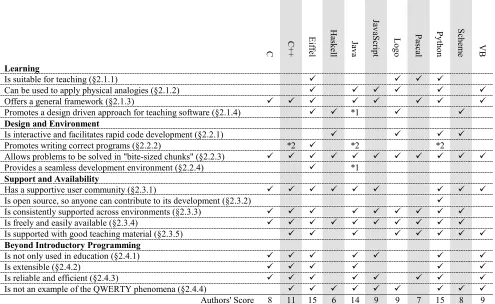
This given, a comparison has been attempted by the authors and the results are shown in Table 2. By this comparison, three lan-guages are arguably the most suitable lanlan-guages of those com-pared. Python and Eiffel rate highest which justifies their design as teaching languages. These are closely followed by Java, which is commonly associated with industrial applications. Other evaluated languages rated lower.
The comparison given is limited by the authors' experience with each language. The authors encourage all readers to consider how they would rate these languages, or perhaps others, accord-ing to the criteria.
4.
CONCLUSIONS AND
RECOMMEN-DATIONS
Not surprisingly, the authors' comparison suggests that the most suitable languages for teaching, Python and Eiffel, are lan-guages that have been designed with teaching in mind. However this study also showed that Java, which is designed primarily for commercial application, has merit when considered as a teaching language.
[image:5.595.55.550.418.722.2]By providing well founded criteria, this study has attempted to
Table 2: Languages Compared by Features
C
C+
+
E
iffe
l
H
as
k
el
l
Ja
v
a
Ja
v
aS
cri
p
t
L
o
g
o
P
as
ca
l
P
y
th
o
n
S
ch
em
e VB Learning
Is suitable for teaching (§2.1.1)
Can be used to apply physical analogies (§2.1.2)
Offers a general framework (§2.1.3)
Promotes a design driven approach for teaching software (§2.1.4) *1 Design and Environment
Is interactive and facilitates rapid code development (§2.2.1)
Promotes writing correct programs (§2.2.2) *2 *2 *2
Allows problems to be solved in "bite-sized chunks" (§2.2.3)
Provides a seamless development environment (§2.2.4) *1
Support and Availability
Has a supportive user community (§2.3.1)
Is open source, so anyone can contribute to its development (§2.3.2)
Is consistently supported across environments (§2.3.3)
Is freely and easily available (§2.3.4)
Is supported with good teaching material (§2.3.5) Beyond Introductory Programming
Is not only used in education (§2.4.1)
Is extensible (§2.4.2)
Is reliable and efficient (§2.4.3)
Is not an example of the QWERTY phenomena (§2.4.4)
Authors' Score 8 11 15 6 14 9 9 7 15 8 9
provide objectivity into what has been, up to now, frequently an emotive argument. The value of this work is to provide the potential for a strong argument to those who seek to promote a language change in an introductory course or perhaps over an entire undergraduate degree program.
This work may also be useful to communities of developers attempting to produce better programming languages for future novices and experts.
Extensions of this study in future work may attempt to clarify the criteria presented here, perhaps extending the criteria for specific purposes. Other languages may also be compared using this framework and it may be shown that other languages are useful for introductory languages according to these or other criteria.
5.
REFERENCES
[1] Andreae, P., Biddle, R., Dobbie, G., Gale, A., Miller, L., and Tempero, E., Surprises in Teaching CS1 with Java (School of Mathematical and Computing Sciences, Tech-nical Report CS-TR-98/9). 1998, Victoria University of Wellington: Wellington.
[2] Bergin, J. Java-- GOOD, BAD, and NOT C++. 2000 [cited 30th August, 2006]; Available from: http://csis.pace.edu/~bergin/Java/SomegoodthingsaboutJa va.html.
[3] Biddle, R. and Tempero, E., Java pitfalls for beginners.
ACM SIGCSE Bulletin, 30(2), 1998, 48 - 52.
[4] Chandra, S.S. and Chandra, K., A comparison of Java and C#. Journal of Computing Sciences in Colleges,
20(3), 2005, 238 - 254.
[5] de Raadt, M., Watson, R., and Toleman, M. Language Trends in Introductory Programming Courses. In The Proceedings of Informing Science and IT Education Con-ference. (Cork, Ireland, June 19-21, 2002). Inform-ingScience.org, 2002, 329 - 337.
[6] de Raadt, M., Watson, R., and Toleman, M., Introductory programming languages at Australian universities at the beginning of the twenty first century. Journal of Research and Practice in Information Technology, 35(3), 2003, 163-167.
[7] Decker, R. and Hirshfield, S. A case for, and an instance of, objects in CS1. In Addendum to the proceedings on Object-oriented programming systems, languages, and applications (Addendum). (Vancouver, B.C. Canada, Oc-tober 18 - 22, 1992), 1992, 309-312.
[8] Decker, R. and Hirshfield, S. The Top 10 Reasons Why Object-Oriented Programming Can't Be Taught in CS1. In Selected papers of the twenty-fifth annual SIGCSE symposium on Computer science education. (Phoenix, Arkansas, United States, March 10 - 12, 1994). ACM Press, New York, NY, USA, 1994, 51 - 55.
[9] Hadjerrouit, S., Java as first programming language: a critical evaluation. ACM SIGCSE Bulletin, 30(2), 1998, 43 - 47.
[10] Hadjerrouit, S. A constructivist approach to object-oriented design and programming. In Proceedings of the 4th annual SIGCSE/SIGCUE ITiCSE conference on In-novation and technology in computer science education. (Cracow, Poland, June 27 - July 1, 1999), 1999, 171 - 174.
[11] Hitz, M. and Hudec, M. Modula-2 versus C++ as a first programming language--some empirical results. In
Pa-pers of the 26th SISCSE technical symposium on Com-puter science education. (Nashville, TN USA, March 2 - 4, 1995). ACM Press, New York, NY, USA, 1995, 317-321.
[12] Kölling, M., Koch, B., and Rosenberg, J. Requirements for a first year object-oriented teaching language. In Pa-pers of the 26th SISCSE technical symposium on Com-puter science education. (Nashville, TN USA, March 2 - 4, 1995). ACM Press, New York, NY, USA, 1995, 173-177.
[13] Mannila, L., Peltomäki, M., and Salakoski, T., What About a Simple Language? Analyzing the Difficulties in Learning to Program. Computer Science Education,
16(3), 2006, 211 - 228.
[14] Mayer, R.E., Dyck, J.L., and Vilberg, W., Learning to Program and Learning to Think: What's the Connection?
Communications of the ACM, 29(7), 1986, 605-610. [15] McIver, L. and Conway, D. Seven Deadly Sins of
Intro-ductory Programming Language Design. In Proceedings of the 1996 international Conference on Software Engi-neering: Education and Practice (SE:EP '96). (Dunedin, New Zealand, January 24 - 27, 1996). IEEE Computer Society, 1996, 309 - 316.
[16] Meyer, B. Towards an Object-Oriented Curriculum. In
Proceedings of 11th international TOOLS conference. (Santa Barbara, United States, August 1993). Prentice Hall 1993, 1993, 585 - 594.
[17] Papert, S., Mindstorms: Children, Computers, and Pow-erful Ideas. Basic Books, Inc., USA, 1980.
[18] Parker, K.R., Chao, J.T., Ottaway, T.A., and J.Chang, A Formal Language Selection Process for Introductory Programming Courses. Journal of Information Technol-ogy Education, 5, 2006, 133 - 151.
[19] Ramalingam, V. and Wiedenbeck, S. An empirical study of novice program comprehension in the imperative and object-oriented styles. In Papers presented at the seventh workshop on Empirical studies of programmers. (October 24 - 26, 1997, Alexandria, VA USA). ACM Press, New York, NY, USA, 1997, 124-139.
[20] Stephenson, C. A report on high school computer science education in five U.S. states. 2000 [cited 31st August, 2006]; Available from: www.holtsoft.com/chris/HSSurveyArt.pdf.
[21] Stroustrup, B., Learning Standard C++ as a New Lan-guage. The C/C++ Users Journal, May, 1999.
[22] Tharp, A.L. Selecting the “right” programming language. In Proceedings of the thirteenth SIGCSE technical sym-posium on Computer science education. (Indianapolis, Indiana, United States). ACM Press, 1982, 151 - 155. [23] van Rossum, G. "Computer Programming for
Every-body." Proposal to the Corporation for National Re-search Initiatives. 1999 [cited 25th October, 2006];
Available from:
http://www.python.org/doc/essays/cp4e.html.
[24] Wallingford, E. Toward a first course based on object-oriented patterns. In Proceedings of the twenty-seventh SIGCSE technical symposium on Computer science edu-cation. (Philadelphia, PA USA, February 15 - 17, 1996). ACM Press, New York, NY, USA, 1996, 27-31.