
UNIVERSITY OF STRATHCLYDE
Department of Mechanical Engineering
ON-ORBIT MANOEUVRING USING SUPERQUADRIC
POTENTIAL FIELDS
Ahmed Badawy B.Sc., M.Sc.
A thesis presented in fulfilment to the requirements for the
degree of
D
OCTOR OFP
HILOSOPHYThe copyright of this thesis belongs to the author under the terms of the United
Kingdom Copyright Acts as qualified by University of Strathclyde Regulation 3.49.
Due acknowledgement must always be made of the use of any material contained in,
ACKNOWLEDGEMENT
This research could not have been conducted without help and
support of my parents who despite being away in Egypt, always
encourage me to complete this thesis as best as I can. So whatever I
express, my gratitude toward them, it is really less than what they
deserve.
I also wish to express my appreciation to my wife who left her parents
to be with me during these busy years. She was the one who suffered a
lot to help me conduct this research. Although she is yet to know what
is going around, my daughter plays a wonderful role in relieving
stresses accompanying this hard time.
A special appreciation and thanks to
who gave me a
wonderful example of cooperation and guidance throughout the
research. He devoted a lot of time and effort in discussion, revision,
and stimulating suggestions that greatly enhanced my scientific
knowledge.
A real help and support were offered by the Department of
Mechanical Engineering at the University of Strathclyde. Everyone
did their utmost to help and offer an ideal research environment for
researchers.
ABSTRACT
Onorbit manoeuvring represents an essential process in many space missions such
as orbital assembly, servicing and reconfiguration. A new methodology, based on
the potential field method along with superquadric repulsive potentials, is discussed
in this thesis. The methodology allows motion in a cluttered environment by
combining translation and rotation in order to avoid collisions. This combination
reduces the manoeuvring cost and duration, while allowing collision avoidance
through combinations of rotation and translation.
Different attractive potential fields are discussed: parabolic, conic, and a new
hyperbolic potential. The superquadric model is used to represent the repulsive
potential with several enhancements. These enhancements are: accuracy of
separation distance estimation, modifying the model to be suitable for moving
obstacles, and adding the effect of obstacle rotation through quaternions.
Adding dynamic parameters such as object translational velocity and angular
velocity to the potential field can lead to unbounded actuator control force. This
problem is overcome in this thesis through combining parabolic and conic functions
to form an attractive potential or through using a hyperbolic function. The global
stability and convergence of the solution is guaranteed through the appropriate
choice of the control laws based on Lyapunov's theorem.
Several onorbit manoeuvring problems are then conducted such as onorbit
assembly using impulsive and continuous strategies, structure disassembly and
reconfiguration and freeflyer manoeuvring near a space station. Such examples
demonstrate the accuracy and robustness of the method for onorbit motion
CONTENTS
ACKNOWLEDGEMENT III
ABSTRACT IV CONTENTS V
LIST OF FIGURES IX
LIST OF TABLES XV
NOMENCLATURE XVI
1. INTRODUCTION
1
1.1 Background 1
1.2 Motion Planning Classification 3
1.3 Configuration Space 5
1.4 Motion Planning Methods 6
1.4.1 Skeleton (Roadmap) 6
1.4.2 Cell decomposition 8
1.4.3 Other methods 9
1.5 Potential Field Methods 9
1.5.1 Force involving artificial repulsion (FIRAS) 12
1.5.2 Gaussian function 13
1.5.3 Power law function 15
1.5.4 Superquadric functions 16
1.5.5 Harmonic potential functions 17
1.5.6 Navigation functions 17
1.5.7 Fuzzy potential 18
1.6 Thesis Objectives 18
1.7 Thesis Organization 19
2. ATTRACTIVE POTENTIAL FUNCTIONS
22
2.1 Introduction 22
2.2 Lyapunov’s Stability Theorem 23
2.2.1 Definitions: 24
2.2.2 Lyapunov's second theorem 24
2.3 Translational Attractive Potential 25
2.3.1 Parabolicwell 26
2.3.2 Conicwell 28
2.3.3 Parabolicwell attractive potential with velocity term 29
2.3.4 Conicwell attractive potential with velocity term 30
2.3.5 Hyperbolic attractive potential 30
2.3.6 Hyperbolic attractive potential with velocity term 32
2.4 Rotational Attractive Potential 32
2.4.1 Orientation definition 32
2.4.2 Rotational potential function 34
2.4.3 Rotational potential function with angular velocity term 35
2.5 Global Attractive Potential 38
2.5.1 Example I 38
2.5.2 Example II 44
2.6 Conclusions 49
3. SUPERQUADRIC OBSTACLE REPRESENTATION
50
3.1 Introduction 50
3.2 Inside-Outside Function 52
3.3 Superquadrics and Motion Planning 53
3.4 Separation Distance 54
3.4.1 Approximate Euclidian distance 54
3.4.2 Pseudodistance 55
3.4.4 Rigid Body Radial Euclidian distance 57
3.5 Attitude-Distance Effect 59
3.6 Superquadric Obstacle Representation 61
3.6.1 Parallelepiped shape (cuboid) 61
3.6.2 Cylindrical obstacle (beam) 67
3.7 Conclusions 71
4. SUPERQUADRIC OBSTACLE POTENTIAL
73
4.1 Introduction 73
4.2 Types of Obstacle Potential 73
4.2.1 Avoidance potential 74
4.2.2 Approach potential 74
4.3 Obstacle Potential of Parallelepiped Element 78
4.3.1 Cuboid obstacle potential using the modified pseudo distance 78
4.3.2 Cuboid obstacle potential using the rigid body radial Euclidian distance 81
4.4 Obstacle Potential of a Cylindrical Element 85
4.5 Conclusions 86
5. GLOBAL POTENTIAL FUNCTION
88
5.1 Introduction 88
5.2 Continuous Control 89
5.3 Impulsive Control 96
5.4 Conclusions 103
6. ORBITAL ASSEMBLY
105
6.1 Introduction 105
6.2 Proximity Motion 106
6.4 On-Orbit Continuous Control 112
6.4.1 Continuous assembly using conic and parabolic potentials 112
6.4.2 Continuous assembly using hyperbolic potential 122
6.5 On-Orbit Impulsive Control 127
6.5.1 Example I 128
6.5.2 Example II 136
6.5.3 Complex structure assembly 139
6.6 Conclusions 147
7. ORBITAL RECONFIGURATION
148
7.1 Introduction 148
7.2 Free Flyer Manoeuvring Near a Space Station 149
7.3 Structure Reconfiguration 154
7.4 Conclusions 173
8. CONCLUSIONS
174
8.1 Review 174
8.2 Future Work 177
References 179
Appendix A: Quaternion Algebra
188
A.1 Introduction 188
LIST OF FIGURES
Fig. 1.1 Space exploration rovers 2
Fig. 1.2 Motion planning phases 2
Fig. 1.3 Motion planning levels of complexity 4
Fig. 1.4 Three link mechanism 5
Fig. 1.5 The visibility graph 7
Fig. 1.6 The Voronoi diagram 8
Fig. 1.7.a) Global potential with FIRAS rectangular obstacle representation 12
Fig. 1.7.b) Global potential with FIRAS circular obstacle representation 13
Fig. 1.8 Global potential with Gaussian obstacle representation 14
Fig. 1.9 Global potential with power law obstacle representation, N = 10 15
Fig. 1.10 Global potential with superquadric obstacle representation 16
Fig. 1.11 Thesis roadmap 20
Fig 2.1 Parabolicwell attractive potential 27
Fig 2.2 Conicwell attractive potential 28
Fig 2.3 Hyperbolicwell attractive potential 31
Fig. 2.4 Manoeuvring object motion in 3D 40
Fig. 2.5.a) Manoeuvring object total impulses 40
Fig. 2.5.b) Manoeuvring object impulses in the xdirection 41
Fig. 2.5.c) Manoeuvring object impulses in the ydirection 41
Fig. 2.5.d) Manoeuvring object impulses in the zdirection 42
Fig. 2.6.a) Manoeuvring object error quaternion 42
Fig. 2.6.b) Manoeuvring object angular velocities 43
Fig. 2.6.c) Manoeuvring object torques 43
Fig. 2.7 Manoeuvring object motion in 3D 45
Fig. 2.8.a) Manoeuvring object velocity 46
Fig. 2.8.b) Manoeuvring object acceleration 46
Fig. 2.9.a) Manoeuvring object error quaternions 47
Fig. 2.9.b) Manoeuvring object angular velocity 47
Fig. 2.9.c) Manoeuvring object angular acceleration 48
Fig. 2.9.d) Manoeuvring object control torque 48
Fig. 3.2 Superquadric shapes 52
Fig. 3.3 Radial Euclidian distance 57
Fig. 3.4 Possible collision configuration 58
Fig. 3.5 Orientation effect on separation distance 59
Fig. 3.6 Two object configuration 60
Fig. 3.7 Separation distance vs. quaternion parameter about zaxis 61
Fig. 3.8 Cuboid element representation using a superquadric function 63
Fig 3.9.a) Cuboid isodistance contours, modified pseudo distance method, Eq.
(3.7), ( = 1) 64
Fig. 3.9.b) Cuboid isodistance contours, modified pseudo distance method ( =
100) 64
Fig. 3.9.c) Cuboid isodistance contours radial distance method, Eq. (3.12), ( = 1)
65
Fig. 3.9.d) Cuboid isodistance contours radial distance method ( = 100) 65
Fig. 3.9.e) Cuboid isodistance contours, rigid body radial distance method, Eq.
(3.16), ( = 1) 66
Fig. 3.9.f) Cuboid isodistance contours, rigid body radial distance method ( =100)
66
Fig. 3.10 Cylindrical element representation using a superquadric function 67
Fig. 3.11.a) Beam isopotential contours, pseudo distance method, Eq. (3.7), (cross
section) 68
Fig. 3.11.b) Beam isopotential contours, pseudo distance method (longitudinal
section) 69
Fig. 3.11.c) Beam isodistance contours, radial distance method, Eq. (3.12), (cross
section) 69
Fig. 3.11.d) Beam isodistance contours, radial distance method (longitudinal
section) 70
Fig. 3.11.e) Beam isodistance contours, radial distance for rigid body method, Eq.
(3.16), (cross section) 70
Fig. 3.11.f) Beam isodistance contours, radial distance for rigid body method
(longitudinal section) 71
Fig. 4.1.b) Avoidance potential function ( = 10) 76
Fig. 4.1.c) Approach potential function ( = 1) 76
Fig. 4.1.d) Approach potential function ( = 10) 77
Fig. 4.2 Radial Euclidian distance 82
Fig. 5.1 Initial configuration 91
Fig. 5.2.a) Object configuration at t = 70 sec 91
Fig. 5.2.b) Object configuration at t = 93 sec 92
Fig. 5.2.c) Final object configuration at t = 130 sec 92
Fig. 5.3 Object trajectories 93
Fig 5.4.a) Object velocities in xdirection 93
Fig 5.4.b) Object velocities in zdirection 94
Fig 5.4.c) Object accelerations in xdirection 94
Fig 5.4.d) Object accelerations in zdirection 95
Fig 5.5.a) Object angular velocities about yaxis 95
Fig 5.5.b) Object angular accelerations about yaxis 96
Fig. 5.6 Initial object configuration 98
Fig. 5.7.a) Object configuration at t = 165 sec 98
Fig. 5.7.b) Object configuration at t = 220 sec 99
Fig. 5.7.c) Object configuration at t = 310 sec 99
Fig. 5.7.d) Final object configuration at t = 1000 sec 100
Fig. 5.8 Object trajectories 100
Fig. 5.9.a) Object impulses in xdirection 101
Fig. 5.9.b) Object impulses in zdirection 101
Fig. 5.10.a) Object error quaternion about yaxis 102
Fig. 5.10.b) Object angular velocities about yaxis 102
Fig. 5.10.c) Object torques about yaxis 103
Fig. 6.1 Inertial, local orbiting and body frames for the ith manoeuvring object 107
Fig. 6.2 Initial object configuration 113
Fig. 6.3.a) Object configuration t = 124 sec 114
Fig. 6.3.b) Object configuration t= 838 sec 114
Fig. 6.3.c) Object configuration t = 3470 sec 115
Fig. 6.4.a) Object velocities in the xdirection 116
Fig. 6.4.b) Object accelerations in the xdirection 116
Fig. 6.4.c) Object velocities in the ydirection 117
Fig. 6.4.d) Object accelerations in the ydirection 117
Fig. 6.4.e) Object velocities in the zdirection 118
Fig. 6.4.f) Object accelerations in the zdirection 118
Fig. 6.5.a) Error quaternions of Objects 1, 3, 9, and 11 119
Fig. 6.5.b) Angular velocity about xaxis of objects 1, 3, 9, and 11 119
Fig. 6.5.c) Error quaternions of objects 5, 6, 7, and 8 120
Fig. 6.5.d) Angular velocity about zaxis of objects 5, 6, 7, and 8 120
Fig. 6.5.e) Torque about xaxis of objects 1, 3, 9, and 11 121
Fig. 6.5.f) Torque about zaxis of objects 5, 6, 7, and 8 121
Fig. 6.6 Initial object configuration 123
Fig. 6.7.a) Object configuration (t = 37 sec) 124
Fig. 6.7.b) Object configuration (t = 120 sec) 124
Fig. 6.7.c) Object configuration (t = 180 sec) 125
Fig. 6.7.d) Final object configuration (t = 300 sec) 125
Fig. 6.8.a) Object velocities in xdirection 126
Fig. 6.8.b) Object velocities in zdirection 126
Fig. 6.8.c) Object angular velocities about yaxis 127
Fig. 6.9.a) Initial object configuration 129
Fig. 6.9.b) Object configuration at t = 5800 sec 130
Fig. 6.9.c) Object configuration at t = 6370 sec 130
Fig. 6.9.d) Object configuration at t = 8300 sec 131
Fig. 6.9.e) Object configuration at t = 8900 sec 131
Fig. 6.9.f) Assembled structure at t = 9800 sec 132
Fig. 6.10.a) Object trajectories 132
Fig. 6.10.b) Object error quaternions 133
Fig. 6.10.c) Object angular velocities 133
Fig. 6.11.a) Impulse in the xdirection (object 7) 134
Fig. 6.11.b) Impulse in the zdirection (object 7) 134
Fig. 6.11.d) Rate of change of the overall potential (object 7) 135
Fig. 6.12.a) Object trajectories 136
Fig. 6.12.b) Impulses in the xdirection (object 7) 137
Fig. 6.12.c) Impulses in the zdirection (object 7) 137
Fig. 6.12.d) Overall potential (object 7) 138
Fig. 6.12.e) Rate of change of the overall potential (object 7) 138
Fig. 6.13.a) Initial object configuration 139
Fig. 6.13.b) Object configuration at t = 760 sec 140
Fig. 6.13.c) Object configuration at t = 1630 sec 140
Fig. 6.13.d) Object configuration at t = 2670 sec 141
Fig. 6.13.e) Object configuration at t = 3725 sec 141
Fig. 6.13.f) Assembled structure at t = 4000 sec 142
Fig. 6.14.a) Object trajectories (object 1 to 7) 142
Fig. 6.14.b) Plate element trajectories (object 15 and 16) 143
Fig. 6.14.c) Impulse in xdirection (object 1) 143
Fig. 6.14.d) Impulse in ydirection (object 1) 144
Fig. 6.14.e) Impulse in zdirection (object 1) 144
Fig. 6.15.a) Error quaternions about the xaxis 145
Fig. 6.15.b) Error quaternions about the yaxis 145
Fig. 6.15.c) Error quaternions about the zaxis 146
Fig. 6.15.d) Continuous control torque about the yaxis 146
Fig. 7.1 International space station using superquadric model 149
Fig. 7.2 Freeflyer trajectory 152
Fig. 7.3 Freeflyer rotation 152
Fig. 7.4.a) Freeflyer thrust impulses in xdirection 153
Fig. 7.4.b) Freeflyer thrust impulses in zdirection 153
Fig. 7.5 Required control torque about yaxis 154
Fig. 7.6.a) Initial object configuration 155
Fig. 7.6.b) Object configuration (t = 20 sec) 156
Fig. 7.6.c) Object configuration (t = 40 sec) 156
Fig. 7.6.d) Object configuration (t = 145 sec) 157
Fig. 7.6.f) Object configuration (t = 260 sec) 158
Fig. 7.6.g) Final configuration (t = 400 sec) 158
Fig. 7.7.a) Impulse in the xdirection 159
Fig. 7.7.b) Impulse in the ydirection 159
Fig. 7.7.c) Impulse in the zdirection 160
Fig. 7.8.a) Error quaternions about the xaxis 160
Fig. 7.8.b) Error quaternions about the yaxis 161
Fig. 7.8.c) Error quaternions about the zaxis 161
Fig. 7.8.d) Angular velocity about the xaxis 162
Fig. 7.8.e) Angular velocity about the yaxis 162
Fig. 7.8.f) Angular velocity about the zaxis 163
Fig. 7.9.a) Control torque about the xaxis 163
Fig. 7.9.b) Control torque about the yaxis 164
Fig. 7.9.c) Control torque about the zaxis 164
Fig. 7.10.a) Object configuration (t = 15 sec) 165
Fig. 7.10.b) Object configuration (t = 42 sec) 166
Fig. 7.10.c) Object configuration (t = 7 sec) 166
Fig. 7.10.d) Object configuration (t = 200 sec) 167
Fig. 7.11.a) Impulse in the x-direction 167
Fig. 7.11.b) Impulse in the y-direction 168
Fig. 7.11.c) Impulse in the z-direction 168
Fig. 7.12.a) Error quaternion about the x-axis 169
Fig. 7.12.b) Error quaternion about the y-axis 169
Fig. 7.12.c) Error quaternion about the z-axis 170
Fig. 7.12.d) Angular velocity about the x-axis 170
Fig. 7.12.e) Angular velocity about the y-axis 171
Fig. 7.12.f) Angular velocity about the z-axis 171
Fig. 7.13.a) Control torque about the xaxis 172
Fig. 7.13.b) Control torque about the yaxis 172
LIST OF TABLES
Table 5.1 Element translation cost 103
Table 6.1 Element translation cost 129
Table 6.2 Element translation cost 136
Table 6.3 Element translation cost 147
Table 7.1 First phase translation cost 155
1. INTRODUCTION
1.1 Background
Mobile robots and manipulators are widely used for terrestrial, subsea, and space
applications. Terrestrial applications are vast, ranging from industrial to domestic
usage (Palacín et al., 2004). In industrial applications, combinations of mobile
robots and manipulators serve for mechanical assembly (Yuan, 2002), material
handling (Neuhaus and Kazerooni, 2001), and spot welding (Pires and Loureiro,
2003). Medical robot applications are a further success (and challenge) assisting
during microsurgeries and rehabilitation (Salcudean et al., 1999; Cepolina and
Michelini, 2004). Mobile robots also play a role in subsea and ocean operations
where they are able to reach extreme depth and perform assembly and maintenance
tasks (Antonelli et al., 2001). Well known space applications serve for assembly,
service, and repair (McQuade and McInnes, 1997; Roger, 2003). Other robotic
applications are in rough terrain such as mining and rescue (Lagnemma and
Dubowsky, 2004; Shimoda et al., 2005). Planetary exploration such as Lunar and
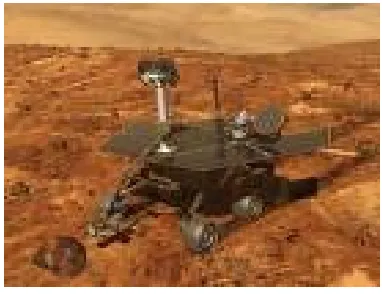
Mars rovers, Fig. 1.1, are well known applications which require highly automated,
unattended robotic motion planning (Hayati et al., 1996). Challenges for such
applications have been discussed (Weisbin et al., 1999; Schenker et al., 2000).
As robots are used to perform certain tasks they always require motion; motion is
an essential action without which a robot will lose its functionality. Since robots are
not the sole object in their workspace, robot motion planning research is a key area
of robot technology. Intelligent motion planning (MP) algorithms attempt to
advance from repetitive preprogrammed tasks to fully autonomous operations.
Research development has been undertaken in theory, computational capabilities
and sensors. Determining a collisionfree path between some start and goal
configuration, in addition to the required dynamic parameters, forces and moments,
(a) ESA EXOMARS Rover (b) NASA Mars Exploration Rover (MER)
Fig. 1.1 Space exploration rovers
Various aspects of MP problems have been investigated either through theoretical
or experimental analysis. Generally, the MP problem aims to find if a region of
space is reachable from another through a continuous path. It is therefore the process
of selecting a path and the associated set of input forces and torques from the set of
all possible motions and inputs, while ensuring that all constraints are satisfied.
Three closely linked problems constitute MP: path planning, trajectory planning,
and motion control, Fig. 1.2. The first phase aims to define the kinematic
parameters, position and orientation, of the manoeuvring object, whereas the second
phase aims to generate the required translational velocity and angular velocity
profile to generate motion to the goal. Path planning is therefore a subset of
trajectory planning. Finally, the motion control phase aims to drive the manoeuvring
object to follow the reference trajectory as closely as possible.
Path
Planning
Trajectory
Planning
Motion
Control
1.2 Motion Planning Classification
MP algorithms depend on the availability of sensed data such as obstacle shapes
and kinematics. MP methods based mainly on sensed data are normally termed local
methods, used when there is not enough global data about the workspace. Socalled
global methods are used otherwise, when complete knowledge of the workspace is
available. It is also possible to utilize local methods in the case of a well known
environment with either stationary or moving obstacles, but with an optimized path.
A combination of global and local methods can be used to generate a global optimal
plan, with the local sensory based approach reaching to unforeseen obstacles.
Ensuring global knowledge of the workspace is not simple due to limited sensing
capabilities and sensor range limitations. On the other hand, local MP may lead to
unfeasible trajectories as a complete world model is not available. Information
exchange between different manoeuvring objects through decentralized control
enhances the amount of world information available to each of them.
A second classification of MP depends on the obstacle kinematic properties, either
static or dynamic. In the static case, all obstacles are known as in case of robotic
assembly in a production process. On the other hand, in dynamic MP problems the
manoeuvring objects sense data whilst in motion. Consequently, new data is
continuously generated so online control is required. Generally, dynamic MP is the
norm whereas static MP is an exception as every MP problem can be solved as
dynamic one, while the inverse is not true.
Other issues in MP problems occur when dealing with articulated or linked bodies
or deformable problems, where objects shapes will change during motion. These
deformable MP problems are common as a wide range of robots are equipped with
manipulators or links. The level of complexity of MP problems with respect to
objects representations, object dynamic properties, the type of manoeuvring object
under control, and constraint types is illustrated in Fig. 1.3.
Objects in the environment can be represented as spherical shapes for simplicity,
although the real shape is required in cases where the spherical shape occupies
significantly more space than its actual size, or in case of the final docking phase
Poin
t Mass
S
ing
le Bo
dy
Multi
p
le Point Masses
Multiple Bodies Deformable Bodies
No
nh
olo
n
o
m
ic
Holonomic
Fig. 1.3 Motion planning levels of complexity
Manoeuvring objects range from point mass robots to deformable or articulated
ones. The more degrees of freedom (DOF) associated with manoeuvring objects, the
greater the complexity of the MP problem. Object dynamic properties have a large
influence on the degree of complexity of MP problem. Static objects are much easier
to handle as their positions are known, whereas moving objects add more variables
to the MP problem. Finally, the types of constraints, holonomic or nonholonomic,
affect the number of DOF required to represent the system. Holonomic constraints
reduce the number of DOF associates with the obstacles, whereas nonholonomic
constraints that depend on velocity and position do not affect the number of DOF
(Latombe, 1991). Lastly, bounded forces and torques are required and affect the
choice of MP algorithm as real actuators can saturate.
A general review of MP algorithms is discussed in the following sections. Motion
planning problem is solved within different spaces such as the Cartesian (physical or
task) space or configuration space. Motion parameters in the Cartesian space are
angles, direction cosines, or quaternions. Since the rest of the thesis deals with
Cartesian spaces, a brief discussion of the configuration space is introduced in the
following section.
1.3 Configuration Space
Like real physical space, Configuration space (CSpace) is defined by a set of
independent parameters or generalized coordinates, which describe the position of
every point on the manoeuvring object at any time based on classical mechanics. For
a point robot in three dimensions, the CSpace is identical to the physical space with
the same number of DOF in ℜ3 , while for N point robots the configuration space is
ℜ3N
. A rigid rod in 2D, for example, requires three parameters to represent the
CSpace: two coordinates for the position of a reference point, which could be any
point on the rod, and one angle representing the rod orientation about a
perpendicular axis.
As an example of a three link mechanism, Figure 1.4 shows a possible set of
generalized coordinates 1, 2 and 3. Each configuration in the workspace
corresponds to a point in the Cspace. Moreover, the motion of an articulated body
appears as a curve in the CSpace. After generation of the CSpace, all MP problems
are essentially identical.
Representing points of both manoeuvring objects and obstacles in CSpace
determines whether collisions will occur. If any manoeuvring object point in C
Space lies inside any obstacle or any other manoeuvring object, then collision will
occur. Furthermore, another case occurs when a point of any manoeuvring object
lies on the boundary of any other object, so that smooth contact will occur. Many
computational methods are able to search for CSpace collisions (Branicky and
Newman, 1990; Hwang and Ahuja, 1992).
1.4 Motion Planning Methods
Large numbers of methods exist to solve the MP problem. However a few key
methods are defined: skeleton, cell decomposition, potential field, mathematical
programming, and boundary following methods. Designing a high performance
motion planner usually requires the utilization of more than one MP approach such
as combining the potential field method along with the cell decomposition method
(Chiou et al., 1999). A brief discussion of key methods is provided before going on
to discuss the potential field method. These approaches are either complete or
incomplete. Completeness is defined as finding a path if it is exist, otherwise
returning a failure. Incomplete approaches may terminate in a position other than the
goal, such as a local minimum, but nevertheless the path exists. Complete
algorithms may fail to find a solution if the resolution of the algorithm is not good
enough to find a free path (Goldberg, 1994).
1.4.1 Skeleton (Roadmap)
All possible configurations are retracted into a network of onedimensional lines,
the roadmap, limiting the MP problem to graphsearching. Various methods are
constructed which depend on this basic idea. For 2D problems, the visibility graph
and the Voronoi diagram are commonly used.
The visibility graph, which is one of the earliest roadmap methods, was suggested
by Nilsson (Nilsson, 1969) as a collection of lines connecting all polygonal obstacles
shortest path will then be chosen as the optimum one between the start and goal
point, as shown in Fig. 1.5.
The Voronoi diagram is used when it is required to maintain some distance
between the manoeuvring object and obstacles. Constructing a Voronoi diagram is
done through defining a set of points called nodes. These nodes are the intersecting
points of equidistant contour lines surrounding the obstacles. The Voronoi diagram
divides the space into regions with only one edge or polygon inside, as shown in
Fig. 1.6.
More complexity arises when dealing with 3D MP problems using the visibility
graph or the Voronoi diagram. A general method of constructing a skeleton in higher
dimensions is constructed through a process called Silhouette. This process is based
on projecting an object from a higher dimensional space to a lower one, and then
tracing the boundaries. This operation could be repeated reaching a set of one
dimensional lines. A simpler Voronoi diagram for 3D objects has been discussed
(Dattasharma and Keerthi, 1995). After generating enough free configurations, the
roadmap is built by connecting them. This is a very efficient MP approach,
especially when high number of DOF exist (Kavraki and Latombe, 1998).
Start
Goal
Obstacle
Obstacle
Goal
Start
Obstacle
Obstacle
Fig. 1.6 The Voronoi diagram
The roadmap method has also been adapted to dynamic environments of both free
flying and articulated robots (Van den Berg and Overmars, 2005). A possible
combination of the visibility graph and the Voronoi diagram is achieved through
introducing the visibility graph into the Voronoi diagram (Wein et al., 2007).
1.4.2 Cell decomposition
In this method, the free CSpace is decomposed into simple adjacent regions,
called cells. A free path connecting start and goal points is obtained through
connecting the start and goal cells with continuous free cells, called a connectivity
graph. Two ways are used to perform cell decomposition: exact and approximate
cell decomposition.
Exact cell decomposition, object dependent, uses obstacles boundaries to form the
cells whose union is the free space. This produces a smaller number of cells with
In approximate cell decomposition, object independent, methods a small, simple
cell is chosen then tested whether it is a free cell or belongs to the configuration
obstacles. The free space representation is strictly inclusive in the union of these
small cells, however it does not represent the whole free space since the cells do not
tightly enclose obstacles. Some cells may contain both free space and configuration
obstacles; hence they could not be used to find a path (Brooks and LozanoPérez,
1982).
Cells lying entirely in the free space are used to construct the connectivity graph. If
no connectivity graph is found, higher cell decomposition resolution might be a
solution otherwise no free path exists between the initial and goal configurations
(Latombe, 1991). Approximate methods are used initially to solve the MP problem,
refining until a solution is found or no path is obtained. Cell decomposition is
guaranteed to find a free path if exists, otherwise the algorithm returns failure.
1.4.3 Other methods
Other methods are defined such as: mathematical programming and boundary
following methods. In mathematical programming, the free space is defined as a set
of inequalities, then an optimum curve connecting the start and the goal position is
found. Nonlinear programming is used to solve the motion planning problem by
minimizing path length subject to constraints (Henrich, 1997).
The objective of the boundary following method is to command the manoeuvring
object to move toward its goal in a straight line. In case of being obstructed by an
obstacle, the manoeuvring object traces the obstacle edges. This approach is adapted
to work with a scene filled with unknown obstacles of arbitrary shape and size. Data
about the environment are collected online with sensors (Lumelsky and Stepanov,
1987).
1.5 Potential Field Methods
Many physical systems relax their configuration to attain the lowest possible
energy state. This idea has been adopted and used in the motion planning algorithms
Each location in the workspace has some scalar potential associated with it. The
potential depends on the relative position between both goal and obstacles positions,
and the manoeuvring object. A virtual attractive potential field representing a goal
and virtual repulsive potential field representing obstacles are merged together to
generate a global potential field, the gradient of which in principle provides a
collisionfree path to the goal. The method is widely used for autonomous mobile
robot path planning in fixed workspaces where both target and obstacles are
stationary. The method is also adapted to deal with moving obstacles (Tzafestas et
al., 2002) and moving goal points through defining a potential function that is
velocity dependent (Ge and Cui, 2002). The method is defined over both the
Cartesian space and the configuration space (Barraquand et al., 1991). However,
limitations of this simple and elegant approach arise when the superposition of the
repulsive potential and attractive potential creates local minima. In addition motion
oscillation in the presence of obstacles and in narrow passages, and the problem of
trapping between two close obstacles also arise (Koren and Borenstein, 1991).
Another advantage of the potential field method appears in its unified approach to
fulfil the MP problem, unlike other methods which divide it as seen in Fig. 1.1. The
outputs of this method are geometrical, dynamical, and lead directly to a control law.
A detailed description of this method is introduced in the subsequent sections as the
rest of the thesis is implemented using the potential field method.
As the number of DOF increases, an exact solution of MP problem is ineffective
(Sharir, 1997). When choosing potential field methods (PFM) to perform the MP
process, an important question should be answered. Which PFM is most suitable for
the current MP problem? The answer to this question is not a matter of choice, it
mainly depends on the manoeuvring object, workspace, computational capabilities,
convergence requirements and obstacle dynamic properties.
During the past three decades, many PFMs have been investigated. Some suggest
how to represent obstacles; others define how to generate both attractive and
repulsive potentials. The two main types of MP problems, global and local, both
utilize potential field functions. The majority of the potential field methods use a
local path planner such as: force involving artificial repulsion (FIRAS), Gaussian
and Ahuja, 1998), whereas harmonic potential functions and the navigation function
are considered as global path planners. In local path planning, potential functions,
both attractive and repulsive, are formed separately then added to form the global
potential. This has online capability since no prior information about the workspace
is required and the information is gathered whilst in motion. For global path
planning potential functions all information about the workspace should be available
from the start of the process, hence optimized paths can be obtained if these exist
without local minima formation.
Other techniques such as the vector potential field and sliding mode theory are
used. The vector potential field produces a smooth and bounded control. It can
provide better performance compared to scalar field (Masoud and Bayoumi, 1993;
Masoud and Masoud, 2000). Sliding mode theory is used with the potential field
function to perform fast manoeuvres (Jan and Chiou, 2003).
The potential field method has also been developed for space applications in areas
such as proximity manoeuvring (Roger and McInnes, 2000), large angle slew
manoeuvres (McInnes, 1994; McInnes, 1995; McInnes, 1996; Radice and McInnes,
1999; Wisniewski and Kulczycki, 2005), formationflying (McQuade et al., 2003;
Avanzini et al., 2005a; Avanzini et al., 2005b), and autonomous and distributed
motion planning for satellite swarms (Izzo and Pettazzi, 2005; Izzo and Pettazi,
2007). Other work has focused on the assembly of large, complex space structures
using extensions of the potential field methodology (Badawy and McInnes, 2006c;
Badawy and McInnes, 2006b; Badawy and McInnes, 2007c). Here the adjacency
matrix of the graph of the final structure is used to form a global potential field
(McQuade and McInnes, 1998). The structure can then be reconfigured by
modifying the adjacency matrix as required. A related approach has been used for
the autonomous assembly of a group of homogeneous components by defining and
summing vector fields which capture sets of behaviours. The final configuration of
the system is defined by the equilibrium state of the dynamical system formed by the
vector fields, in a similar manner to the global minimum of an artificial potential
1.5.1 Force involving artificial repulsion (FIRAS)
A region of obstacle influence is chosen for symmetrical obstacles, dmin , beyond
which no effect of the obstacle potential occurs. A continuous differentiable function
for obstacle potential is defined as:
⎧1 ⎛1 1 ⎞2
Vobs =⎪⎨2 A⎜⎜⎝d −d
min ⎟⎟⎠
if d ≤d min (1.1)
⎪
⎩0 if d >dmin
where d is the shortest distance between the manoeuvring object and obstacle. The
obstacle potential gain A and the minimum distance dmin are chosen according to the
MP characteristics (Khatib, 1986). The FIRAS obstacle representation, Fig. 1.7.a, is
simple as no difficult distance calculations are made. Unfortunately the local
minimum problem occurs when superimposed with a spherical symmetric attractive
potential, even for the case of a single flat sided object.
Fig. 1.7.b) Global potential with FIRAS circular obstacle representation
Another example of FIRAS obstacle representation, but with a circular edge
obstacle, is shown in Fig. 1.7.b, with no local minimum formation. The spherical
symmetry of both the attractive and the repulsive potential forms a field having no
local minima in this case.
1.5.2 Gaussian function
Obstacle representation through a Gaussian potential function provides a region of
high potential surrounding the obstacle. This region should be chosen to prevent any
manoeuvring object from colliding with the obstacle. Due to the symmetry of the
Gaussian function, this region will be spherical regardless of the real obstacle shape.
This spherical symmetry property coincides with that of the attractive potential well
and consequently no local minimum forms due to a single obstacle. The obstacle
Vobs = Aexp ⎧⎨
⎩− 1
σ r−robs
2⎫
⎬
⎭ (1.2)
where is the width of the Gaussian function, r is the position vector of the
manoeuvring object, and robs is the obstacle position vector. The repulsive amplitude
A to ensure collision avoidance is shown to be:
D
2D exp
(
)
λσ + robs − rG
A= (1.3)
D2
σ ⎧ ⎨ ⎩−
⎫ ⎬ ⎭
where is a scaling factor, rG is the goal position vector, and D is the effective
dimension of the obstacle which should be chosen to be larger than the actual
obstacle size. Figure 1.8 shows the total potential function using the Gaussian
function to represent an obstacle of 3 [m] effective dimension using the function
width can be calculated as:
σ = D 3 (1.4)
1.5.3 Power law function
This method defines another obstacle potential function similar to that of the
Gaussian function without the exponential term. The obstacle is, again, enclosed by
a spherical region. The obstacle potential is defined as (McQuade, 1997):
A
Vobs = 2 N (1.5)
r −robs
The obstacle potential amplitude, A, is calculated the same manner as for the
Gaussian function to set the saddle point on the obstacle surface. Then it can be
shown that:
2 N +1
λ
(
D + robs − rGA =
)
D (1.6)2N
The obstacle effective dimension, D, depends on the exponent N. This controls the
sharpness of the obstacle potential. The total potential function is shown in
Fig. 1.9.
1.5.4 Superquadric functions
As explained for the FIRAS function, local minimum formation due to a single
obstacle occurs due to the superposition of two different isopotential contour lines,
due to the existence of straight edge objects. These objects, along with objects of
general shapes, exist in many MP problems such as the autonomous assembly
problem which is under investigation in this thesis.
Superquadric functions are able to represent almost all shapes in a relatively simple
manner. They divide the space into three parts: inside, onsurface, and outside, and
form a solid model of objects (Barr, 1981). These solid models can be added
together to form more complicated objects (Krivic and Solina, 1993; Solina et al.,
1994).
Limitations on superquadric usage in MP problems are mainly due to the
possibility of local minimum occurrence in the presence of multiple obstacles, while
the absence of local minimum is guaranteed in the presence of one obstacle only
(Lee, 2004). A detailed explanation and enhancement of this method will be
presented in the subsequent chapters as it is the main core of the thesis.
1.5.5 Harmonic potential functions
The use of the harmonic potential functions will completely eliminate local minima
formation even in a highly cluttered environment. Obstacle representation can be
through a panel method, which was originally used to solve the potential fluid flow
problem around an arbitrary object. The obstacle repulsion is represented as an
outward normal flow, while the goal attraction appears as a uniform flow to simulate
the potential field (Kim and Khosla, 1992).
The manoeuvring object velocity may reach zero at a point rather than the goal
point, a stagnation point, but this point is not stable. The stagnation, saddle point
may lie on the obstacle itself, hence increasing the panel strength will push the
saddle point away. Although, the harmonic function does not have local minima,
obstacle avoidance can not be guaranteed in a cluttered environment as the outward
normal velocity may become negative on some points on the panel (Masoud and
Masoud, 2002).
The Laplace artificial potential is also used to generate a local minima free field.
The potential function has a maximum value of 1 and the desired goal configuration
is assigned a value of 0. As the Laplace equation may not be solved in closed form,
a discrete from is developed by a grid solver method (Connolly, 1990; Roger and
McInnes, 2000).
1.5.6 Navigation functions
A navigation function is constructed in the CSpace and is considered as a global
methodology, losing the simplicity of local MP but gaining the ability to form local
minimum free paths. A deficiency of the navigation function is that convergence is
not guaranteed from all initial configurations. Obstacles are usually modelled
through discshape obstacle functions, but mapping from real world shapes to the
circular discshape model is performed through a diffeomorphism operation (Rimon
1.5.7 Fuzzy potential
Everywhere in the workspace, a manoeuvring object is affected by a scheme of
repulsive and attractive potentials. Some of these potentials are not required for
collision avoidance such as those from obstacles either away from the manoeuvring
object or which do not intersect its path. In some case, even if a large obstacle is
located near the manoeuvring object, but the manoeuvring object velocity vector is
parallel to the obstacle edge, the potential is not required.
Fuzzy logic adds a variable to the potential function which is termed the
importance variable. It is used to scale the effect of different obstacles according to
a number of parameters: separation distance, separation angle, and robot speed
(McFetridge and Ibrahim, 1998; Ta and Baltes, 2006).
1.6 Thesis Objectives
Building an MP algorithm that is able to control complex onorbit assembly
problems is the key goal of this thesis. Potential field methods are developed using
superquadric repulsive potentials. The potential fields are developed for both
impulsive and continuous motion control.
The complexity of the assembly problem considered in this thesis is highlighted in
Fig. 1.3. Assembly of any structure involves the use of multiple objects with
different shapes and sizes. As all objects under assembly are simultaneously in
motion, and each is considered as an obstacle to others, the environment is
considered dynamic. Manipulating objects of different shapes and sizes imposes a
new demand on their modelling; hence the superquadric model is chosen for its
ability to represent almost all solid models parametrically.
The key contribution of this thesis is the integration of translational and rotational
motion through the use of quaternions to define the orientation of the superquadric
potential fields. Analytic control laws are found which enable translation and/or
1.7 Thesis Organization
An introduction to various methods of motion planning has been discussed in
chapter one emphasizing potential field methods and their components: attractive
and repulsive potentials. Different forms of attractive potential are defined in
chapter two using parabolic, conical, and a new hyperbolic function.
Defining the repulsive potential first requires an investigation of the mathematical
formulation of the superquadric model which is described in chapter three. The
original form of superquadric functions is not suitable for representing obstacles;
hence some modification is needed through generating deformable superquadric
surfaces from the geometric obstacle shape to a spherical shape.
The distance between two superquadric surfaces is then calculated in a new general
form regardless the shape and size of the obstacle. Finally, obstacle representations
of some common shapes are discussed such as, parallelepiped and beams.
Superquadric repulsive potentials are investigated in chapter four for
parallelepiped and beam elements for both avoidance and approach potentials. The
dependency of those potential on the separation distance is estimated for both types
of objects whereas only the parallelepiped element is discussed in detail.
In chapter five, the global potential is formed for the first time in the thesis. Two
different control schemes are introduced in this chapter: continuous control using
low thrust propulsion and impulsive control using on/off thrusters. The stability
analysis conducted depends on the chosen control strategy to find an appropriate
control law. Examples of four manoeuvring objects; two plates and two disks which
switch their positions simultaneously are presented at the end of each control
strategy discussion.
The main objective of the thesis is presented in chapter six, where the onorbit
structural assembly idea is discussed. Impulsive and continuous control strategies
are used with selected potential functions to assemble cube and truss structures.
Natural orbital mechanics is added to the forced motion depending on the control
strategy. Combinations of parabolic and conical attractive potentials are presented
for continuous low thrust control followed by their substitution with a new
Large space structure assembly is also considered using the impulsive control
strategy. This contains different object shapes with different sizes.
Orbital reconfiguration is discussed in chapter seven through two applications.
Freeflyer manoeuvring near a larger space facility, the International Space Station
(ISS), is considered first followed by reconfiguration of a space structure. This is
conducted through disassembly of some objects and then reassembly of them in a
different configuration to illustrate the power and flexibility of the method.
A final review and discussion of the work of the thesis is presented in chapter
eight. The overall roadmap for the thesis is shown in Fig. 1.11.
Motion Planning
Approach
Potential Field
Attractive Repulsive
Parabolic Conical
Hyperbolic
Superquadric Function
Superquadric Potential
Global Potential
Continuous Control
Impulsive Control
Structure Assembly
Free-flyer Orbital
Mechanics
Structure Reconfiguration
1.8 List of Publications
1. Badawy A. and McInnes C.R., "Separation Distance for Robot Motion
Control using Superquadric Obstacle Potentials", International Control
Conference, Glasgow, Scotland, 2006, paper no. 25.
2. Badawy A., and McInnes C.R., "Autonomous Structure Assembly Using
Potential Field Functions", 57th International Astronautical Congress,
Valencia, Spain, 2006, IAC06C1.P.3.04.
3. Badawy A., and McInnes C.R., "OnOrbit Assembly Using Potential Fields",
accepted for publication in The Journal of Guidance, Control, and Dynamics,
submitted Nov. 2006.
4. Badawy A. and McInnes C.R., "Free Flyer Manoeuvring Round a Space
Station", The Twelfth International Conference on Aerospace Science and
Aviation Technology, ASAT12, Cairo, Egypt, 2007, paper no. 36.
5. Badawy A. and McInnes C.R., "Robot Motion Planning using Hyperboloid
Potential Functions", World Congress on Engineering, London, 24 July
2007, paper ICME 15.
6. Badawy A. and McInnes C.R., "Generalized Potential Function Approach for
OnOrbit Assembly", 58th International Astronautical Congress, Hyderabad,
2. ATTRACTIVE POTENTIAL FUNCTIONS
2.1 Introduction
Many physical systems relax their configuration to attain the lowest possible
energy state. This idea has been adopted and used in motion planning algorithms for
manipulators and mobile robots as the artificial potential field method (Khatib,
1986). Scalar potential field theory constructs an electric field resulting from a point
charge. It then models how charged particles move under the influence of
electrostatic fields. Spatial derivatives of scalar potential fields form vector fields.
These spatially continuous vector fields then define the motive force acting on
charged particles (Chuang, 1998).
For robot path planning, the attractive potential field is a function defined with the
goal position at its global minimum. A manoeuvring object will then move down the
gradient of the potential field towards this global minimum, and with a suitable
dissipation function will come to rest. The goal configuration will be defined by
both a goal position and orientation. The Euclidean distance between a manoeuvring
object and the goal position is used to define the translational attractive potential
while error quaternions are used to define a rotational attractive potential. In order to
reach the global minimum of the attractive potential field, both a final position and
orientation must be achieved. In the subsequent analysis it will be assumed that
continuous torques are available for attitude control and both continuous and
discrete impulses are available for translational control. Potential fields that are a
function of position generate required velocities, whereas those that are a function of
position and velocity generate required accelerations. This is similar to the
configuration of agile robot freeflyers which use control moment gyros and pulsed
thrusters for actuation.
The overall attractive potential is the summation of both the translational and
rotational attractive potentials. The translational attractive potential aims to null the
Euclidian distance between a manoeuvring object and its goal position, while the
rotational attractive potential aims to null the error quaternion relative to the
In principle attractive potential functions should be defined to ensure convergence
to the goal. The most common means of investigating such convergence is through
the use of Lyapunov methods which consider convergence to be equivalent to
nonlinear stability.
2.2
Lyapunov
’s Stability Theorem
Lyapunov's stability theorems were developed at the end of the 19th century in the
doctoral thesis of Russian mathematician Alexander M. Lyapunov in 1892 (Csáki,
1972; Sastry, 1999). His work discussed the general problem of nonlinear stability
of motion and remained little known in the West, but now forms a key part of
nonlinear control. Stability analysis of nonlinear systems was classified by
Lyapunov into two groups:
1. Methods based on finding the solution of the system (linearization). Once
the solution is found it is possible to determine whether the system is stable
or not (from the system eigenvalues).
2. Methods which do not require a solution. The stability condition is then
decided through the existence of a scalar function which satisfies
Lyapunov's conditions.
Deciding whether a system is stable or not without finding its solution is a very
attractive idea, especially in many cases where no general method exists to find the
solution of system of differential equations (nonlinear systems).
The Lyapunov method hinges of defining a scalar function which is analogous to
the effective energy of the system. If, under certain conditions, it can be shown that
the scalar Lyapunov function is monotonically decreasing, the stability (and
2.2.1 Definitions:
1. Consider a multivariable continuous function V(x) which maps ℜn → ℜ. It
is considered positive definite if its value has positive sign over the region
ℜn
.
n
V
(
0)
=0 and V(
x)
>0 ∀x ∈ ℜ −{
0}
2. Consider a multivariable continuous function V(x) which maps ℜn → ℜ. It
is considered negative definite if its value has negative sign over the region
ℜn
.
n
V
(
0)
=0 and V(
x)
<0 ∀x ∈ ℜ −{
0}
3. Consider a multivariable continuous function V(x) which maps ℜn → ℜ. It
is considered positive semidefinite if its value has positive sign over the
region ℜn and equal zero for some points other than the origin.
n
V
(
0)
=0 and V(
x)
≥0 ∀x ∈ ℜ −{
0}
4. Consider a multivariable continuous function V(x) which maps ℜn → ℜ. It
is considered negative semidefinite if its value has negative sign over the
region ℜn and equal zero for some points other than the origin.
n
V
(
0)
=0 and V(
x)
≤0 ∀x ∈ ℜ −{
0}
2.2.2 Lyapunov's second theorem
Let x = xG be an equilibrium point for a system described by a set of differential
equations x & = f
( )
x . Let V(x) be a real, continuously differentiable, positive definitescalar function that maps ℜn → ℜ. Then if its time derivative W(x) is negative
definite, then V(x) is asymptotically Lyapunov stable.
If a suitable Lyapunov function can be found, then Lyapunov's theorem can be used
to prove the nonlinear stability of an equilibrium point of a set of differential
equations. This will be seen as equivalent to demonstrating convergence of a
2.3 Translational Attractive Potential
Steady motion toward a goal position should be guaranteed by the translational
attractive potential. It considers the manoeuvring object as a point mass translating
towards the goal. The translational attractive potential is constructed according to
the available sensed data as:
1. Position attractive potential, where only position information is needed to
define the attractive potential, consequently defined as:
λ m
r −rG (2.1)
Vatt ,trans = p m
2. Position and velocity attractive potential, where both should be sensed.
This function can also be used in tracking problems as (Ge and Cui, 2000):
λ m λ n
+ v
= r −rG r&−r&G (2.2)
Vatt ,trans p
m n
These attractive potential functions are not differentiable with respect to r at
r =rG for 0 <m ≤1, and with respect to r& at r& =r&G for 0 <n ≤1. If the exponents
m and n are chosen as unity, a conicwell potential function is generated which gives
constant control force throughout the workspace. However, singularity problems at
the goal position are produced. If the exponents are chosen to be greater than unity,
a parabolicwell is formed which generates a control force that increases with
distance and is unbounded as r −rG → ∞.
A combination of parabolic and conic well potentials could be constructed to have
the advantages of both through defining the first within some range from the goal
position. Consequently, the control force remains bounded and avoids the singularity
problem encountered when using the conic well. Beyond this range, the conic well is
the best choice as the control force will be constant wherever the manoeuvring
object is located (Latombe, 1991).
Different types of translational attractive potentials and their stability analysis will
be discussed in the subsequent subsections before utilizing them in the global
![Fig. 3.9.a) Cuboid iso-distance contours, [m], using modified pseudo distance](https://thumb-us.123doks.com/thumbv2/123dok_us/1714230.124794/79.595.155.481.409.673/fig-cuboid-distance-contours-using-modified-pseudo-distance.webp)
![Fig. 3.9.c) Cuboid iso-distance contours, [m] using radial distance method,](https://thumb-us.123doks.com/thumbv2/123dok_us/1714230.124794/80.595.148.475.410.673/fig-cuboid-distance-contours-using-radial-distance-method.webp)
![Fig. 3.9.e) Cuboid iso-distance contours, [m], using rigid body radial distance](https://thumb-us.123doks.com/thumbv2/123dok_us/1714230.124794/81.595.151.474.408.670/fig-cuboid-distance-contours-using-rigid-radial-distance.webp)
![Fig. 3.11.a) Beam iso-potential contours, [m], using pseudo distance method,](https://thumb-us.123doks.com/thumbv2/123dok_us/1714230.124794/83.595.190.452.374.634/fig-beam-potential-contours-using-pseudo-distance-method.webp)
![Fig. 3.11.b) Beam iso-potential contours, [m], using pseudo distance method](https://thumb-us.123doks.com/thumbv2/123dok_us/1714230.124794/84.595.184.448.410.669/fig-beam-potential-contours-using-pseudo-distance-method.webp)
![Fig. 3.11.d) Beam iso-distance contours, [m], using radial distance method](https://thumb-us.123doks.com/thumbv2/123dok_us/1714230.124794/85.595.191.450.410.670/fig-beam-distance-contours-using-radial-distance-method.webp)
