Vortex nucleation in Bose-Einstein condensates due to effective magnetic fields
D. R. Murray,1P. Öhberg,2D. Gomila,3and S. M. Barnett1 1
Department of Physics, SUPA, University of Strathclyde, Glasgow G4 0NG, United Kingdom 2
Department of Physics, SUPA, Heriot-Watt University, Edinburgh EH14 4AS, United Kingdom 3
IFISC (CSIC-UIB), Instituto de Física Interdisciplinar y Sistemas Complejos, Campus Universitat Illes Balears, E-07122 Palma de Mallorca, Spain
共Received 11 May 2009; published 10 June 2009兲
We investigate the rotational properties of a Bose-Einstein condensate共BEC兲in an effective magnetic field. The corresponding gauge potential is optically generated, and based on the adiabatic motion of the atoms. We demonstrate that the nucleation of vortices is seeded by instabilities in surface excitations and show that this picture also holds when the applied effective magnetic field is not homogeneous. The eventual configuration of vortices in the cloud depends on the geometry of the applied field.
DOI:10.1103/PhysRevA.79.063618 PACS number共s兲: 03.75.Kk, 42.50.Gy
I. INTRODUCTION
A spectacular property of superfluid systems is their abil-ity to support quantized vortices 关1兴. These can appear as flux lines in superconductors to which a sufficiently strong magnetic field has been applied. Alternatively, in the case of neutral superfluids subject to sufficiently fast external rota-tion, they exist as lines of vanishing condensate density around which the velocity field flow is quantized关2,3兴. These scenarios are closely linked because the equations describing a rotating superfluid, when studied in the rotating frame, mimic those of a charged superfluid共a superconductor兲in a magnetic field, with the Coriolis force playing the role of the Lorentz force.
The dilute gas BEC is an extremely useful tool for prob-ing the underlyprob-ing physics of superfluid phenomena because, in experiments, its parameters are typically much easier to manipulate than for other condensed-matter systems. More-over, because of its diluteness, it is considerably more ame-nable to a theoretical treatment which accurately reflects the experimental reality关3,4兴. A good example is in the studies of condensates rotated by an anisotropic potential, where the critical velocity for vortex nucleation has been found to co-incide with dynamical instabilities in the surface mode exci-tations 关2,5兴. At the same time, the prospect of simulating effects related to charged particles in magnetic fields means that the rotating BEC continues to receive much attention 关6–8兴.
Rotating a condensate only provides access to a limited class of problems, however, for which the effective magnetic field is spatially homogeneous in the plane perpendicular to the rotation axis. Stirring a Bose-Einstein condensate using asymmetric traps or laser “spoons” 关9–11兴 has become a standard technique to induce vortices in condensates. The controlled stirring of a condensate can be a rather demanding task if a small number of particles are used, which is often the case for strongly correlated systems such as atomic Tonks-Girardeau 关12–14兴 and Quantum Hall gases 关6–8,15–17兴. Recent proposals to create effective magnetic fields in a more direct way open the door for more wide-ranging studies into the interaction of degenerate quantum gases with effective magnetic fields. One method involves
using lasers to alter the state-dependent tunneling amplitudes of atoms in an optical lattice to simulate an effective mag-netic flux关18–20兴. Another, considered here, exploits the in-teraction of ⌳-type three-level atoms with two laser beams possessing relative orbital angular momentum in an elec-tronically induced transparency共EIT兲configuration. The cor-responding vector potential shows up in the effective equa-tion of moequa-tion 关21–23兴 for the atoms, which sit in a nondegenerate eigenstate of the laser-atom interaction. An advantage of this method is that the vector potential, and consequently the effective magnetic field, can be shaped and controlled by appropriate modifications of the phase and in-tensity of the incident light 关24兴.
In this paper we study, by numerical simulations, the in-fluence of both homogeneous and inhomogeneous effective magnetic fields on the dynamics of a harmonically trapped Bose-Einstein condensate and observe vortex nucleation for critical parameter values. The exact dynamics are specific to the geometry of the trapping potential and effective magnetic field, but the existence of unstable modes in the spectrum of elementary excitations as a precursor to vortex nucleation is a universal feature for all cases considered.
II. ORIGIN OF THE GAUGE POTENTIAL
compared to the total Rabi frequency, the dark state will remain stable 关22兴. Shape oscillations or rotations in Bose-Einstein condensates typically involve velocities less than the speed of sound which is of the order of a few microns per millisecond. Hence the doppler detuning would be small compared to a typical total Rabi frequency. The lifetime of the dark state, and ultimately the gauge potential, can there-fore be of the order of a few seconds关22兴. Interestingly, the effective gauge potential depends only on the ratio between the Rabi frequencies and the gradient of their phase differ-ence 关22兴. This results in a remarkable degree of freedom, and is indeed the key to be able to construct spatially non-uniform effective magnetic fields in charge neutral quantum gases.
One way to achieve a nonzero phase gradient in the ratio of the control and probe beam coupling strengths is to use light with orbital angular momentum. Such light beams with nontrivial intensity distribution and steep phase gradients, can be readily created by interference techniques关26兴or by using spatial light modulators. Two-dimensional optical structures are in this respect straightforward to create be-cause only a transversal section of the light beam at the po-sition of the ultracold gas is relevant as far as the effective magnetic field is concerned.
A Laguerre-Gaussian beam, for example, has transverse fieldupᐉ共r,兲⬀r兩ᐉ兩L兩pᐉ兩共r2兲exp共−r2兲exp共iᐉ兲, whereL兩pᐉ兩 is the associated Laguerre polynomial, such that each photon car-ries angular momentumᐉបaround the propagation axis关27兴, which we take to be thezdirection. If one or both beams are of this type and incident at a normal to the cloud of atoms trapped in the x-y plane, then the induced vector potential acting on the atoms is well approximated by 关28兴
A= −បᐉ
R ␣0
冉
r R冊
e, 共1兲
which corresponds to an effective magnetic field
B= −ប␣0ᐉ共+ 1兲
R2
冉
r R
冊
−1
ez. 共2兲
Here ␣0 is the ratio of intensities of the two beams at a characteristic radiusR. In deriving Eq. 共1兲, we assume␣0to be small 共ⱗ0.1兲 which ensures one state is much more heavily populated.
With the inclusion of the vector potential关Eq.共1兲兴, which satisfies the condition ·A= 0, the effective equation gov-erning the atom dynamics is given by关22兴
iប⌿
t =
冉
−ប2 2Mⵜ
2+V˜+g兩⌿兩2+iប
MA·
冊
⌿, 共3兲whereV˜共r兲=V+2兩AM兩2andg= 4ប2a/Mazis the scaled strength of the two-body collisions between atoms andaz represents the thickness of the cloud in the z direction. When = 1 in Eq. 共1兲, an equation of identical form to Eq.共3兲can be ob-tained by considering a BEC subject to a time-dependent trapping potential which is rotating at angular velocity ⍀, and studying the resultant Gross-Pitaevskii equation in the rotating frame in which the trapping potential is independent
of time. This would correspond to an effective magnetic field which is homogeneous in thezdirectionB= 2 M⍀ez.
III. VORTEX NUCLEATION AND DYNAMICS OF THE QUANTUM GAS
The possibility of studying inhomogenous effective mag-netic fields 共⫽1兲raises many interesting questions. Do we still observe vortex nucleation above a critical field strength? Does the same mechanism for vortex nucleation—attributed to instabilities of the surface mode excitations—still hold for effective magnetic fields which are inhomogeneous? If so what does the lattice configuration look like?
We shall address these questions in turn, using results of numerical simulations of the real-time dynamics of the con-densate as determined by Eq.共3兲, where the vector potential is of the form given by Eq. 共1兲. We shall consider the trap-ping potential as it appears in Eq. 共3兲to be of the form
V ˜ =1
2M⬜
2r2+ ⑀R
2
兩
cos共
4j兲
兩
+兩
sin共
4j兲
兩
, 共4兲 that is, harmonic plus a small perturbation which is aniso-tropic, wherej gives the degree of rotational symmetry,is the polar angle, and ⑀ is a dimensionless parameter. Poten-tials of this form could in principle be created using multiple beam patterns of the desired symmetry 共see e.g., 关26兴兲. A harmonic potential can be achieved by a judicious choice of the external trapping potential to counteract the additional scalar potentials arising due to the light-atom interaction. Our motivation for considering potentials which are pre-dominantly harmonic form is twofold. First, this is of the same form as the rotating-frame potential of atoms in a ro-tating harmonic trap, allowing for a clear comparison. Sec-ond, because we are primarily interested in vortex nucle-ation, it is instructive to eliminate the scalar potential which can preclude vortex nucleation in inhomogeneous magnetic fields by preventing the necessary surface mode instabilities from occurring 关28兴.The addition of the asymmetry in the potential distorts the flow J=2បi共ⴱ−ⴱ兲−A兩兩2, leading to shape oscilla-tions. In the presence of the effective magnetic field 关Eq. 共2兲兴, potentials having rotational symmetryjnaturally couple to surface modes of multipolarity m=j. Beyond a critical value of ␣0ᐉ, these modes have negative energy, signifying an energetic instability. In Fig.1we plot the location of the surface mode energetic instabilities for three different effec-tive magnetic fields. These instabilities were calculated in Ref. 关28兴, for a BEC in an isotropic harmonic trap. The ad-dition of the anisotropic term in Eq. 共4兲will shift the mode frequencies but not by a significant amount provided ⑀ is sufficiently small.
initial state for Eq. 共3兲 is assumed to be real valued. The gauge potential during the initial-state calculation 共using imaginary time propagation兲 has therefore no effect. Only during the real-time propagation will the gauge potential couple to the quantum gas and its dynamics through the weak symmetry-breaking potential inV˜ and the induced fluc-tuations. In doing so we avoid any large amplitude oscilla-tions in the trapped gas when introducing the gauge potential 共see also Refs.关5,30,31兴. for discussions on adiabatic intro-duction of rotations兲. The optically induced gauge potential does however also allow a sudden switch on of the effective magnetic fields. The gauge potential is proportional to the intensity ratio of the two incident laser beams. This makes it possible in an experiment to adjust the strength of the effec-tive magnetic field both in time and space simply by chang-ing the intensity of one of the laser beams.
An already well-studied problem in respect of its equiva-lence to rotating condensate experiments is the homogeneous effective magnetic field共= 1兲 applied to a condensate in a harmonic trap with a small elliptic perturbation 关2,5,32,33兴, corresponding toj= 2 in Eqs.共1兲–共3兲. The trap couples to the quadrupole oscillations carrying m= 2 units of angular mo-mentum, which become unstable at ␣0ᐉ⬇23 共see Fig. 1兲 when the cyclotron frequency associated with the effective magnetic field matches the bare quadrupole frequency in ab-sence of the field. This induces large amplitude oscillations which are dynamically unstable, eventually leading to nucle-ation of vortices in the bulk of the condensate.
It is natural to contemplate whether a similar situation should occur for inhomogenous effective magnetic fields, that is, do we observe vortex nucleation due to coupling of the elliptic trap to a surface mode which becomes unstable.
The cases we consider are when=32 and= 2, which both correspond to an effective magnetic field which increases with radius r关see Eq.共2兲兴. For= 2 the m= 2 surface mode becomes energetically unstable at ␣0ᐉ⯝26 共see Fig. 1兲. Simulations run with this vector potential indicate again a strong shape deformation after the effective magnetic field is switched on but rather than fragmentation followed by vor-tex nucleation and eventual crystallization of the vorvor-tex lat-tice, we observe a more dramatic shedding of density from the cloud. The reason for these explosive dynamics can be understood by classical arguments: the effective scalar poten-tial “seen” by the rotating condensate has an additional quar-tic contribution −兩2AM兩2, and reaches a maximum at radiusrmax. Whenever the chemical potential exceeds the maximum potential energy of the trapV共rmax兲many atoms are expelled from the cloud. In such cases the system no longer becomes manageable for either numerical studies or actual experi-ments. The same applies for the =23 case, and indeed all potentials with⬎1 due to the effect the additional counter potential which is steeper than harmonic.
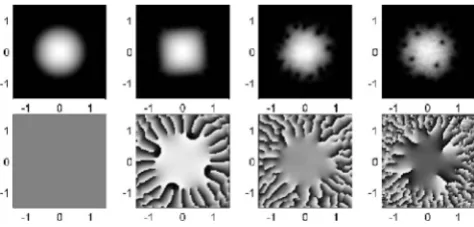
We can however observe vortex nucleation in inhomoge-neous effective magnetic fields provided we choose the po-tential in Eq. 共4兲 to couple to modes higher than m= 2. In Fig. 2, we demonstrate nucleation of vortices for the =32 field with an asymmetric perturbation to the harmonic trap of rotational symmetry j= 4, where␣0ᐉis chosen to be slightly above the critical value as determined by Fig. 1.
The presence of energetic instability is a necessary, but insufficient criterion for vortex nucleation; it reflects only that the wave function is no longer a local minimum of the energy above a critical ␣0ᐉ, where spontaneous creation of elementary excitations is favorable. The nucleation of vorti-ces is due to the dynamical instability, the signature of which is a complex excitation energy, allowing small amplitude perturbations to grow exponentially in time causing a signifi-cant change to the initial state. Consistent with this picture, our studies indicate the existence of an upper as well as lower bound of␣0ᐉbetween which vortex nucleation occurs, corresponding to a window of dynamical instability. How-ever, the location of an energetic instability is useful for pre-FIG. 1. Location of the energetic instability of the surface
modesmfor three different vector potentials of the formA⬃re. We assume here and for the remainder of the paper the parameter
values R=共2/m2兲1
[image:3.609.318.555.67.180.2]2= 1, g/= 1 and 共ប/2兲2= 0.001 共 the chemical potential兲, which describe a condensate in the Thomas-Fermi regime. Above the critical field strength␣0ᐉ, the mode exci-tation becomes negative, so that in the presence of dissipation the system may lower its energy by going into an “anomolous” mode, which can become dynamically unstable.
[image:3.609.54.293.67.262.2]dicting vortex nucleation because dynamical instabilities only exist in conditions of energetic instability关34兴.
In accord with the studies of Refs. 关33,35,36兴, we note that the width of the unstable region increases with ⑀, the degree of anisotropy in the trapping potential of Eq.共4兲. For the parameters = 2 and j= 5, we observe vortex nucleation within the range ␣0ᐉ= 15.25 to 16.25 for ⑀= 0.05 and ␣0ᐉ= 15.0 to 17.0 for⑀= 0.1.
IV. VORTEX LATTICE
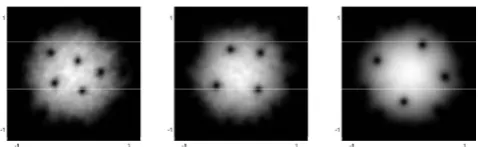
Let us also briefly mention variation in the structure of the vortex lattice as a function of the geometry of the effective magnetic field. As is well known, the condensate in a ho-mogenous effective magnetic field with a large number of vortices favors an Abrikosov-type lattice关37兴. Even with our small number of vortices, it is clear that the lattice ap-proaches a regular homogenous structure for = 1. In con-trast to the homogeneous case, we note that for inhomoge-neous effective magnetic fields with ⬎1 the vortices tend to be concentrated toward the edges of the cloud where the effective magnetic field is stronger, an effect which is en-hanced asis increased共see Fig.3兲. Some additional insight into this effect can be gained by using the concept of diffused vorticity 关38兴, which is applicable if the there are a large number of vortices in the cloud and consequently a dense vortex lattice 共much more so than in the examples shown here兲. In these conditions, the course grained average of the velocity field˜v associated with the lattice will be a smooth
function of the radius r. A dense regular array of equally spaced vortices would thus mimic solid-body rotation. Ap-proximating the wave function as =
冑
eiS˜, where and˜S are, respectively, coarse-grained averages of the density and phase such that ˜v=Mប˜S, we obtain an expression for the energy,E=
冕
dr冋
ប2
2M
兩兩2 +
M
2v
⬘
·v⬘
+V+g
2 −
册
, 共5兲 where v⬘
=˜v−MA. Minimizing with respect to ˜v we findv
˜=MA, independent of the local density共r兲, and the average vorticity is given by⫻˜v=MB.
Thus, it is energetically favorable for the induced vorticity to mimic the effective magnetic field, implying that for a field of the form B⬀r−1共⬎1兲 there should be a higher concentration of vortices at a larger radius. This is what we indeed see in Fig.3. Of course, this analysis takes no account of the vortex-vortex interactions共repulsive for vortices of the same “charge”兲, which become more important as the vortex density is increased and will tend to restore regularity to the lattice.
V. SUMMARY
In the examples considered, we find that the nucleation of vortices is crucially dependent on instabilities in the spec-trum of elementary excitations, as is known to be the case for condensates subject to external rotation. The form of the magnetic fields considered here dictates that the dynamics are primarily determined by the surface excitations. It is in-teresting to speculate whether investigation of vortex genera-tion due to more localized effective magnetic fields could provide a connection in the theory with experiments where the condensate is stirred by an optical “spoon” to create vor-tices 关39兴 as opposed to rotating bucket type configurations 关2兴.
ACKNOWLEDGMENTS
This work was supported by the United Kingdom EPSRC. S.M.B thanks the Royal Society and the Wolfson Foundation for financial support. D.G. acknowledges financial support from MEC共Spain, Grant No. TEC2006-10009兲and Govern Balear共Grant No. PROGECIB-5A兲.
关1兴A. J. Leggett,Quantum Liquids共Oxford University Press, Ox-ford, 2006兲.
关2兴K. W. Madison, F. Chevy, W. Wohlleben, and J. Dalibard, Phys. Rev. Lett. 84, 806共2000兲.
关3兴L. Pitaevskii and S. Stringari, Bose-Einstein Condensation 共Oxford University Press, Oxford, 2003兲.
关4兴C. J. Pethick and H. Smith, Bose-Einstein Condensatiion in Dilute Gases 共Cambridge University Press, Cambridge, En-gland, 2002兲.
关5兴S. Sinha and Y. Castin, Phys. Rev. Lett. 87, 190402共2001兲.
关6兴T.-L. Ho, Phys. Rev. Lett. 87, 060403共2001兲.
关7兴N. R. Cooper, N. K. Wilkin, and J. M. F. Gunn, Phys. Rev. Lett. 87, 120405共2001兲.
关8兴U. R. Fischer and G. Baym, Phys. Rev. Lett. 90, 140402 共2003兲.
关9兴F. Chevy, K. W. Madison, and J. Dalibard, Phys. Rev. Lett. 85, 2223共2000兲.
关10兴R. Onofrio, C. Raman, J. M. Vogels, J. R. Abo-Shaeer, A. P. Chikkatur, and W. Ketterle, Phys. Rev. Lett. 85, 2228共2000兲. 关11兴O. M. Maragò, S. A. Hopkins, J. Arlt, E. Hodby, G. Hechen-FIG. 3. Density att= 450 for BEC in an asymmetric trap subject
[image:4.609.54.293.67.140.2]blaikner, and C. J. Foot, Phys. Rev. Lett. 84, 2056共2000兲. 关12兴M. Olshanii, Phys. Rev. Lett. 81, 938共1998兲.
关13兴M. D. Girardeau and E. M. Wright, Phys. Rev. Lett. 84, 5691 共2000兲.
关14兴P. Öhberg and L. Santos, Phys. Rev. Lett. 89, 240402共2002兲. 关15兴V. Bretin, S. Stock, Y. Seurin, and J. Dalibard, Phys. Rev. Lett.
92, 050403共2004兲.
关16兴V. Schweikhard, I. Coddington, P. Engels, V. P. Mogendorff, and E. A. Cornell, Phys. Rev. Lett. 92, 040404共2004兲. 关17兴M. A. Baranov, K. Osterloh, and M. Lewenstein, Phys. Rev.
Lett. 94, 070404共2005兲.
关18兴J. Ruostekoski, G. V. Dunne, and J. Javanainen, Phys. Rev. Lett. 88, 180401共2002兲.
关19兴D. Jaksch and P. Zoller, New J. Phys. 5, 56共2003兲. 关20兴E. J. Mueller, Phys. Rev. A 70, 041603共R兲 共2004兲.
关21兴G. Juzeliūnas and P. Öhberg, Phys. Rev. Lett. 93, 033602 共2004兲.
关22兴G. Juzeliūnas, P. Öhberg, J. Ruseckas, and A. Klein, Phys. Rev. A 71, 053614共2005兲.
关23兴K. J. Günter, M. Cheneau, T. Yefsah, S. P. Rath, and J. Dali-bard, Phys. Rev. A 79, 011604共R兲 共2009兲.
关24兴J. Leach, M. R. Dennis, J. Courtial, and M. Padgett, Nature 共London兲 432, 165共2004兲.
关25兴M. V. Berry, Proc. R. Soc. London, Ser. A 392, 45共1984兲. 关26兴S. Franke-Arnold, J. Leach, M. J. Padgett, V. E. Lembessis, D.
Ellinas, A. J. Wright, J. M. Girkin, P. Öhberg, and A. S. Ar-nold, Opt. Express 15, 8619共2007兲.
关27兴L. Allen, M. W. Beijersbergen, R. J. C. Spreeuw, and J. P. Woerdman, Phys. Rev. A 45, 8185共1992兲.
关28兴D. R. Murray, S. M. Barnett, P. Öhberg, and D. Gomila, Phys. Rev. A 76, 053626共2007兲.
关29兴N. G. Parker and C. S. Adams, Phys. Rev. Lett. 95, 145301 共2005兲.
关30兴N. G. Parker, R. M. W. van Bijnen, and A. M. Martin, Phys. Rev. A 73, 061603共R兲 共2006兲.
关31兴K. W. Madison, F. Chevy, V. Bretin, and J. Dalibard, Phys. Rev. Lett. 86, 4443共2001兲.
关32兴A. Recati, F. Zambelli, and S. Stringari, Phys. Rev. Lett. 86, 377共2001兲.
关33兴E. Hodby, G. Hechenblaikner, S. A. Hopkins, O. M. Maragò, and C. J. Foot, Phys. Rev. Lett. 88, 010405共2001兲.
关34兴A. D. Jackson, G. M. Kavoulakis, and E. Lundh, Phys. Rev. A 72, 053617共2005兲.
关35兴E. Lundh, J.-P. Martikainen, and K.-A. Suominen, Phys. Rev. A 67, 063604共2003兲.
关36兴M. Krämer, L. Pitaevskii, S. Stringari, and F. Zambelli, Laser Phys. 12, 113共2002兲.
关37兴D. R. Tilley and J. Tilley,Superfluidity and Superconductivity 共Institiute of Physics, Bristol, 1990兲.
关38兴R. P. Feynman,Progress in Low Temperature Physics共 North-Holland, Amsterdam, 1955兲.