An Evaluation of Critical Frequency of Vortex as a
Function of Number of Atoms N in
Bose Einstein Condensates
ANANT KUMAR SINHA1 and LALIT KUMAR MISHRA2
2
Department of Physics Magadh University, Bodh-Gaya-824234, Bihar, INDIA.
1
Department of Physics,
A. M. College, Gaya-823001, Bihar, INDIA.
(Received on : July 12, 2012)
ABSTRACT
In this paper, we have presented a method of evaluation of critical frequent Ωc of vortex whose circulation number к=1confined in a spherical trap with N atoms of 87Rb. We have taken the values of ah0=0.791 µm. Our к=1 theoretically evaluated results indicate that Ωc decreases with N and decrease is more pronounced as one goes to higher N. Our theoretical results are consistent with those of the others theoretical workers.
Keywords: Super fluidity, Bose-Einstein Condensation (BEC), critical frequency, circulation number к, phase coherence.
1. INTRODUCTION
Super fluidity is one of the most spectacular consequences of Bose-Einstein condensation. However, the explicit connection between super fluidity and BEC is not trivial and has been the object of a long-standing and deep investigation in the last decades, mainly forits importance in understanding the physics of liquid helium. In macroscopic bodies super fluidity shows up with many peculiar features : absence of viscosity, reduction of the moment of inertia,
the study of transport phenomena are not easily feasible in trapped gases. On the other hand, interference patterns, associated with phase coherence, have been already observed (Andrews, Townsend et.al.)1 and successfully compared with theory. This opens a promising field of research based on the investigation of coherence phenomena, including the realization of the so-called “atom laser.”
2. MATHEMATICAL FORMULA USED IN THE EVALUATION
Among the several properties exhibited by super fluids, the occurrence of quantized vortices and the strong reduction of the moment of inertia represent effects of primary importance.
In a dilute Bose gas, the structure of quantized vortices can be investigated starting from the Gross-Pitaevskii equation. Indeed one of the primary motivations of the theory was the study of vortex stated in weakly interacting bosons.2-4These studies were further developed by Fetter,5 including higher-order effects in the interaction.
A quantized vortex along the z axis can be described by writing the order parameter in the form
( )
r
v( , ) exp(
r z
i
)
φ
=
φ
⊥κϕ
(1)where
ϕ
is the angle around the z axis,κ
is an integer, andφ
υ(
r z
⊥,
)
=
n r z
(
⊥,
)
This vortex state has tangential velocityv
mr⊥
κ
= h (2)
The number
κ
is the quantum of circulation and the angular momentum along z isN
κ
h
. The equation for the modulus of the order parameter is obtained from the GP equation. The Kinetic energy brings a new centrifugal term arising from the velocity flow that pushes the atoms away from the z axis. The GP equation then takes the form2 2 2 2
2 2 2
2
[ ( ) ( , ) ( , ) ( , )
2 2 2 v v v
m
r g r z r z r z m mr
κ ω φ φ µφ
⊥ ⊥ ⊥ ⊥ ⊥
⊥ ∇
−h +h + + =
(3)
Due to the presence of the centrifugal term, the solution of this equation for
κ
has to vanish on the z axis. For non interacting systems the solution of Eq. (3) is analytic and forκ
=1, has the form(
)
(
2 2)
, exp
2 z
m
r z r r z
υ
φ ⊥ ⊥ ω⊥ ⊥ ω
∞ − h + (4)
In this case, the vortex state corresponds to putting all the atoms in the m=1 single-partial state. Its energy is then N
h
ω
⊥ plus the ground state energy.Similarly to what happens for the ground state without vortices, the presence of repulsive forces; dramatically reduces the density with respect to the non interacting gas, the condensate wave function becoming much broader.
The structure of the core of the vortex is fixed by the balance between the kinetic energy and the two-body interaction term. For a uniform Bose gas, the size of the core is of the order of the healing length
(
)
1/ 28 na
ξ
π
−of the core size can be obtained using the central value of the density in the absence of vortices for n. If the trap is spherical, the ratio between and the radius R of the condensate takes the form6.
2
ho
a
R
R
ξ
=
(5)where we have used the Thomas-Fermi approximation for the central density and the radius R. For the condensate in the figure, the radius is about 4.1 in units of aho and the ratio
ξ
/ R
is then ~ 0.06. The actual core size depends, obviously, also on the position on the position on the z axis and becomes larger when the vortex line reaches the outer part of the condensate, where the density decreases.The energy of the vortex can be evaluated through the energy functional (5). The difference between the energy of the vortex state and the one of the ground state allows one to calculate the critical frequency needed to create a vortex. In fact in a frame rotating with angular frequency Ω the energy of a system carrying angular momentum Lz is given by
(
E− ΩLz)
, where E and Lz are defined in the laboratory frame. At low rotational frequencies this energy is minimal without the vortex. If Ω is large enough the creation of a vortex can become favorable due to the term−Ω
L
z. This happens at the critical frequency1
(
) [(
)
(
) ]
c c
E
E
N
κN
κ
−Ω =
h
−
(6)where
E
κ is the energy of the system in the presence of a vortex with angularmomentum
N
h
κ
. When one plots thecritical frequency for the creation of a vortex with
κ
=1 as a function of the number of atoms, for rubidium in a spherical trap. As shown in the figure, the predicted critical frequency is a fraction of the oscillator frequency and, in typical experimental conditions, corresponds to a few Hz. It decreases when N increases, because for large systems the energy cost associated with the occurrence of vortex increases as In N, while the gainΩ
L
zis always linear in N. This behavior is similar to the one exhibited by uniform systems where, approximating the vortex core as a cylindrical hole of radius,
ξ
one can explicitly calculate the critical frequency and findsΩ =c(
N mR/ 2)
in(
R/ξ
)
,where R is the radius of the region occupied by the vortex flow. Analogous expressions can also be derived in the presence of harmonic trapping for large N. Baym and Pethick6 and Sinha7 have shown that the critical frequency, in units ofω
ho goes(
aho/R) (
2in R/ξ
)
. Using the asymptotic solution of the GP equation in the large N limit, Lundh, Pethick and Smith8 have found a useful analytic expression for the critical velocity in the case of axially symmetric traps:2
0.671 5
ln 2
c
R
mR
ξ
⊥ ⊥
Ω = h (7)
the central density of the gas without vortex. This formula gives a critical frequency that significantly differs from the numerical result N smaller that about 2000, while for larger N it becomes more and more accurate.
3. DISCUSSION OF RESULTS
In this paper, we have presented a method of evaluation of critical frequency
c
Ω
of vortex whose circulation number 1κ
= confined in a spherical trap with N atoms of we have taken the value of aho=0.791µ
m.In table T1 we have given the evaluated results of critical frequencyΩ
cin the units ofω
⊥as a function of atoms N. We have also compared our theoretically evaluated results with those of the other worker.9-14Table T1
Evaluated results of critical angular velocity
c
Ω
in units ofω
⊥for the vortexκ
=1in a spherical trap as a function of atoms N of. 87
b
R The value of aho =0.791
µ
mc
Ω
in units ofω
⊥ N Ours Other60 1.05 1.16
1000 0.85 1.10
2000 0.82 0.96
3000 0.78 0.82
4000 0.68 0.76
5000 0.46 0.70
6000 0.42 0.62
7000 0.40 0.48
8000 0.38 0.42
9000 0.36 0.40
10000 0.35 0.40
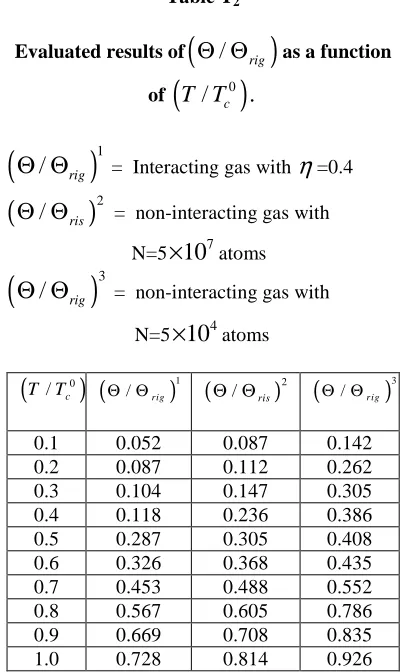
Table T2
Evaluated results of
(
Θ Θ/ rig)
as a function of(
T T/ c0)
.(
)
1/
rigΘ Θ
= Interacting gas withη
=0.4(
)
2/ ris
Θ Θ = non-interacting gas with
N=5
×
10
7atoms(
)
3/
rigΘ Θ
= non-interacting gas withN=5
×
10
4atoms(
0)
/ c .
T T
(
Θ Θ/ rig)
1(
)
2
/ ris
Θ Θ
(
)
3/ r ig
Θ Θ
0.1 0.052 0.087 0.142 0.2 0.087 0.112 0.262 0.3 0.104 0.147 0.305 0.4 0.118 0.236 0.386 0.5 0.287 0.305 0.408 0.6 0.326 0.368 0.435 0.7 0.453 0.488 0.552 0.8 0.567 0.605 0.786 0.9 0.669 0.708 0.835 1.0 0.728 0.814 0.926
c
Ω
Decreases with N and decrease is more pronounced as one goes to higher N. Our theoretical results are consistent with those of the other6as far as the trend is concerned. In other calculation, we have evaluated the ratio of(
Θ Θ/ rig)
as a function of(
T T/ c0)
.These results are shown in table T2.Here we have evaluated the ratio in three different cases. In first case we have taken the interacting gas with0.4
taken the non-interacting gas having no. of atoms
5 10
×
7and
5 10
×
4and respectively. In all the three evaluated results(
Θ Θ/ rig)
increases with(
T T/ c0)
.The increases in more faster in the non-interacting gas case and less faster in interacting case.15 Some recent calculations 16-23
also revel the same behavior.
REFERENCES
1. M.R. Anderson, S.M. Kurn, H.J. Miesner, D.S. Durfee, C.G. Townsend, S. Inouge and W. Ketterl, Phys. Rev.
Lett. (PRL) 80, 2967 (1998).
2. E.P. Gross, Nuovo Cimento 20, 454 (1961).
3. E.P. Gross, Nuovo Cimento 20, 454 (1961).
4. L.P. Pitaevskii, Phys. Lett. A 221, 14 (1996).
5. A.L. Fetter, J. Low. Temp. Phys. (JLTP) 113,189 (1998).
6. G.Baym and C. Pethick, Phys. Rev. Lett.
(PRL) 76, 6 (1996).
7. S. Sinha, Phys. Rev. A 55, 4325 (1997). 8. E.Lundh, C.J. Pethick and H. Smith,
Phys. Rev. A 58, 4816 (1998).
9. N.K.J. Wilkin, M.F. Gunn and R.A. Smith, Phys. Rev. Lett. (PRL) 80, 2265 (1998).
10. R.J. Donnelly, ‘Quantized Vortex in Helium II’ (Cambridge University Press, Cambridge) (1991).
11. D. Rolhsar, Phys. Rev. Lett. (PRL) 79, 2164 (1997).
12. M. Benakli, S. Raghavan, A. Smerxi, S. Fantoni and S.R. Shenoy, e-print cond. Mat/9711295 (1997).
13. F.L. Fetter, J. Low. Temp. Phys. (JLTP) 106, 643 (1997).
14. T. Isohima and K. Machida, J. Phys.
Soc. Jpn. 66, 3502 (1998).
15. M. Cozzini and S. Stringari, Phys. Rev.
A 67, 041502 (2003).
16. A. Kitaev, Ann. Phys. 321, 2 (2006). 17. C. J. M. Mathy and F.A. Base, Ann.
Phys. 322, 709 (2007).
18. F. E.Carnino, W. Zhou and V. J. Goldman, Phys. Rev. Lett. (PRL) 98, 076805 (2007).
19. M. Dolev, M. Heiblum, V. Unaskhy, A. Stern and D. Mahlau, Nature 482, 829 (2008).
20. P. Bondrown and J. K. Slizgerland,
Phys. Rev. B78, 125523 (2008).
21. F. A. Base, J. K. Slizgerland and S. M. Hasker, Phys. Rev. Lett. (PRL) 102, 220403 (2009).
22. Y. Xin, D. Qian, D. Hsish, L. Wrang, A. Pal, H. Lin, A. Baneil and H. Z. Hasan,
Nature, 5, 308 (2009).
23. Can- Li- Song, Yi Lin Wang, Yo-Ping Jiang, Yi Zhang and C. Z. Cheng, Appl.