PYTHONTM
DDS-DC DATA COMPRESSION
DAT TAPE DRIVES
Model: 4322 (3.50-lnch, Internal Tape Drive)
4542 (5.25-lnch, Internal Tape Drive)
4352 (External Subsystem)
PRODUCT DESCRIPTION MANUAL
January 1992
PYTHONlM
DDS-DC DATA COMPRESSION DAT DRIVES
4322: 3.5-lnch, Internal Tape Drive
4542: 5.25-lnch, Internal Tape Drive
4352: External Subsystem
PRODUCT DESCRIPTION MANUAL
,v-6
COfJft'
.;(~~
ARCHIVE CORPORATION
1650 Sunflower Avenue Costa Mesa, CA 92626
ARCHIVE PYTHON DDS-DC DA T DRIVES---PRODUCT DESCRIPTION MANUAL
DATE
01/92
REVISION RECORD
REV
002
REVISED PAGES
i through viii, 1-1 through 1-3, 1-6, 1-8 through 1-11, 2-2, 2-4 through 2-6, 2-8, 2-9 and 2-10 deleted, 3-6, 3-10
through 3-12, 4-1 through 4-2, 4-10 through 4-11, 5-1, 5-4 through 5-8, 6-1 through 6-16, 7-3 7-8, 8-2 through 8-14, 9-1, A1-A3, C1, C-4 through C-7, C-10, C-12
Manual Part Number 27296-002
Copyright 1991 and 1992 Archive Corporation. All rights reserved. No part of this publication may be reproduced, stored in a retrieval system, or transmitted, in any form or by any means, electronic, mechanical, photocopying, recording or otherwise, without prior written permission from Archive Corporation.
Archive, Python, and QICstream are trademarks of Archive Corporation.
CONTENTS
Preface . . . .
Chapter 1. Introduction 1.1 Overview. . . . 1.2 Python Models. .
1.2.1 Python Model Numbers. . 1.2.2 Python OAT Drives . . . . 1.3 Features . . . . 1.4 Typical System Configurations. . 1.5 OAT Technology Overview . .
1.5.1 Helical Scan Recording. 1.5.2 Tape Formats. . . . 1.5.3 Data Compression---General 1.5.4 Flash EEPROM.
1.6 Software . . . . 1. 7 About This Manual. .
Chapter 2. Specifications. . . 2.1 Overview . . . . 2.2 Physical Specifications. 2.3 Power Specifications. .
2.4 Drive Performance Specifications. 2.5 Environmental Requirements . 2.6 OAT Cassette Specifications. 2.7 Regulatory Compliance. .
Chapter 3. Installation. . . . 3.1 Introduction . . . . . . . 3.2 Guidelines and Cautions (4322 and 4542 Internal Models) 3.3 Unpacking and Inspection . . .
3.4 Cabling and Connectors . . . . . 3.4.1 Cabling Considerations . . 3.4.2 Electrical Characteristics . .
3.4.3 Single-Ended SCSI Connector---Internal Models 4322 and 4542. 3.4.4 Single-Ended SCSI Connector---Model 4352
3.5 Installing the Python 4322 and 4542 Internal Drives. 3.5.1 Setting Operational Switches
3.5.2 Mounting the Drive Unit . . . . 3.5.3 Completing Connections . . . 3.6 Installing the Python 4352 External Drive. .
3.6.1 Selecting the SCSI Address. . . . 3.6.2 Completing the Interface Connection . 3.6.3 Connecting the Power Cord.
viii 1-1 1-1 1-3 1-3 1-4 1-6 1-7 1-8 1-8 1-8 1-9 · .1-10 · . . 1-10 . . . . 1-11
ARCHIVE PYTHON DDS-DC OAT DRIVES---PRODUCT DESCRIPTION MANUAL
4.3 Front Panel LED Operation . . . . 4.4 Loading/Unloading the Cassette. . . . 4.4.1 LoadinglUnloading a Cassette (Normal Operation) . 4.4.2 Unloading a Cassette (Manual Operation).
4.5 Using a Blank Cassette . . . .
4.6 Using a Cassette Containing Data . . . . 4.7 Using a Prerecorded Audio Cassette. . . .
4.8 Loading Revised Firmware via Archive Firmware Cassette.
Chapter S. SCSI Interface 5.1 Introduction . . . . 5.2 SCSI-1 Interface . .
5.3 ANSI X3.131 Conformance Statement (SCSI-I). 5.4 SCSI-2 Interface . . . .
5.5 ANSI X3T9.2 Conformance Statement (SCSI-2) (Working Draft, Rev 10) .
Chapter 6. Tape Formats . . . 6.1 Introduction . . . . 6.1.1 DDS Format . . 6.1.2 DDS-DC Format . .
6.1.3 Commonalities Between the Formats. 6.2 Entities (DDS-DC Format Only) . .
6.3 Tape Layout . . . . 6.4 Single Data Space Layout. . . . .
6.4.1 Device Area . . . . 6.4.2 Reference and System Area. 6.4.3 Data Area . . . . 6.4.4 End-of-Data (EOD) Area . . 6.5 Two-Partition Layout . . . . 6.6 Data Storage Organization. . 6.7 Individual Track Layout.
6.7.1 Main Area. 6.7.2 Subareas. . . . . 6.8 Group Structure. . .
6.8.1 Data Frames . . 6.8.2 Index. . . . 6.8.3 ECC Frame. . . 6.8.4 Amble Frames . 6.9 Indexing. . . .
6.9.1 Group Information Table (GIT) . . 6.9.2 Block Access Table (BAT). . 6.10 Vendor Group . . .
6.11 Read-After,Write . . .
Chapter 7. Data Compression. 7.1 Introduction . . . .
7.1.1 Data Compression Considerations 7.1.2 DCLZ Algorithm . . . .
7.1.3 Hardware Compression. 7.1.4 Data Integrity . . . .
· .4-2 · .4-5 .4-5 · .4-6 · .4-9 .4-10 .4-10 .4-11
· .5-1
.5-1 · .5-1 .5-4 · .5-5
· .5-7
· .6-1 · .6-1 .6-1 · .6-2 · .6-2 · .6-3 · .6-4 · .6-4 · .6-5 · .6-5 · .6-7 · .6-7 · .6-7 · .6-8 · .6-9 · .6-9 .6-10 . . 6-11
· 6-12 .6-12 .6-12 · 6-13 · 6-13 · 6-13 .6-14 · 6-15 6-16
7.2 DCLZ Algorithm . . . . 7.2.1 Simplified Compression Operation 7.2.2 Dictionary. . . . 7.2.3 Simplified Decompression Operation . 7.3 AHA3101 Data Compression Chip. .
Chapter 8. Theory of Operation. . 8.1 OvelView. . . . 8.2 Block Diagrams . . . . 8.3 Python DDS-DC DAT Drives
8.3.1 Helical Scan Recording -- Four-Head Design. 8.3.2 Motors and Control Circuits.
8.3.3 Flash EEPROM. . 8.3.4 Sensors . . . . 8.3.5 Audio Output Jack 8.4 DAT Cassette . . . .
Chapter 9. Maintenance and Reliability. 9.1 Maintenance . . . . 9.1.1 Head Cleaning . . . .
9.1.2 Automatic Drive Spin-Down and Write . .
9.1.3 Guidelines for High Temperature or Humidity Conditions. 9.2 Reliability . . . .
9.2.1 Mean-Time-Between-Failure . 9.2.2 Mean-Time-To-Repair
Appendix A. Glossary of Terms . . .
Appendix B. Acronyms and Measurements . . B.1 Abbreviations and Acronyms . . . B.2 Measurements. . . .
Appendix C. Data Compression---SCSI Information . . . . C.1 Introduction . . . .
C.2 MODE SELECT Page. . . . C.2.1 Compression Control---Byte 02 . . C.2.2 Decompression Control---Byte 03. C.3 MODE SENSE Page . . . .
C.3.1 Compression Control---Byte 02 . . C.3.2 Decompression Control---Byte 03. C.3.3 Compression Algorithm---Byte 07 . C.3.4 Decompression Algorithm---Byte 11 . C.4 Request Sense Data . . . . C.5 Implementation Notes . . . .
7-4 7-4
7-5
· . 7-6
7-7
8-1 8-1 8-2 . . . 8-2 8-7 · . 8-8 · . . 8-10 · . . 8-10 · .8-10 .8-11
· 9-1 9-1 9-1 9-2 9-2 9-3 9-3 9-3
. . . A-I
· B-1 · . B-1 · . B-2
· C-l
· C-l · . C-l · . . C-2 · C-2 · . C-4 · . . C-S
· C-5
· . C-6 · C-6 . . . . . . . C-6 . . . C-7 C.5.l Retrieval of Compressed Data from Noncompressing Modes . · . C-7 C.S.2 SCSI Command Operation for Noncompressing Modes.
C.6 WRITE DATA BUFFER (3Bh) . . . . C.6.l WRITE DATA BUFFER Command Descriptor Block C.6.2 Command Descriptor Block Field Descriptions .
ARCHIVE PYTHON DDS-DC OAT DRIVES---PRODUCT DESCRIPTION MANUAL
Figure 1-1. Python 4322 OAT Drive . . Figure 1-2. Python 4542 OAT Drive. Figure 1-3. Python 4352 OAT Drive.
FIGURES
Figure 1-4. SCSI System Sample Configurations.
Figure 2-1. Python 4322 OAT Drive General Dimensions . . . Figure 2-2. Python 4542 OAT Drive General Dimensions.
Figure 2-3. Python 4352 External Subsystem General Dimensions .
Figure 3-1. Python 4322 Switchbank Access. Figure 3-2. Python 4542 Switchbank Access.
1:; .... " .. "" 'l. 'l. T'''D (;:""tr-h n .. f'<llllt c;;: .. tt1nO'c:
... .IoU.\,., - ' - - ' - ~.a..I.. \..1 . . . "".1.1. ..,"" ... ~"" ... .&.b- • • •
Figure 3-4. SCSI Device Address Selection (4322 and 4542) . Figure 3-5. JP6 External SCSI Address Port .
Figure 3-6. Mounting Hole Locations (4322). . . . Figure 3-7. Mounting Hole Locations (4542). . . . Figure 3-8. Power and SCSI Connectors---4322 OAT Drive Figure 3-9. Power and SCSI Connectors---4542 OAT Drive Figure 3-10. Python 4352 Rear Panel . .
Figure 3-11. Daisy chain Diagram . . .
Figure 4-1. Python 4322 Front Panel. Figure 4-2. Python 4542 Front Panel. Figure 4-3. Python 4352 Front Panel .
Figure 4-4. Cassette Loading (4322 OAT Drive) . .
Figure 4-5. Manually Removing a Cassette---Python 4322 Drive . . Figure 4-6. Manually Removing a Cassette---Python 4542 Drive . . Figure 4-7. Manually Removing a Cassette---Python 4352 Drive . .
Figure 6-1. Single Data space Tape Layout . . . . Figure 6-2. Reference and System Area Layout. Figure 6-3. Two-Partition Tape Layout . . Figure 6-4. Individual Track Layout . . . . Figure 6-5. Group Structure . . . .
Figure 6-6. Group Structurc---DDS and DDS-DC Formats . .
· .1-4 · .1-5 · .1-5 .1-7
· .2-2 · .2-3 · .2-3
.3-6 · .3-7 ,3-8 .3-9 · 3-12 · 3-13 .3-14 · 3-15 · 3-16 .3-17 . . 3-18
· .4-3
· .4-3
· .4-4
· .4-5 · .4-7
. . . . . 4-8 .4-9
· .6-5 · .6-6 .6-8 · .6-9 . . . . 6-11 .6-12
Figure R-l. Simplified Block Diagram -- Python DDS-DC Drives. . .8-3 Figure 8-2. Block Diagram -- SCSI Controller Python Models 4322NT and 4542NT
DDS-DC Drives . . . . . ..8-4 Figure 8-3. Block Diagram -- SCSI Controller Python Models 4322NP, 4542NP, and 4352XP
DDS-DC Drives . . . . . S-5
Figure 8-4. Python State Diagram . . . . . 8-6
Figure 8-5. Four-Head Design . . . . .8-7
Figure 8-6. Alternate Azimuth Angles . .8-8
Figure 8-7. OAT Cassette . . . 8-11
Figure 8-9. Write-Protect Tab on DAT Cassette.
Figure C-1. LBAs of Tape in Example. . .
TABLES
Table 1-1. Python DDS-DC SCSI DAT Models---Cross Reference Table 1-2. Chapter Descriptions. . . .
Table 2-1. Table 2-2. Table 2-3. Table 2-4. Table 2-5. Table 2-6. Table 2-7.
Physical Specifications for Python DAT Drives. Power Specifications for the 4322 and 4542 Drives . .
Power Connector Pin Assignments (Models 4322 and 4542) . . Power Specifications for the Python 4352 Drives. . . . Perfonnance Specifications: Python DDS-DC DAT Drive (Data
Compression Enabled) . . . . Environmental Specifications: Python DDS-DC Drives Regulatory Compliances . . . .
Table 3-1. Single-Ended SCSI Connector Pin Assignments: Models 4322 and 4542. Table 3-2. Single-Ended SCSI Connector Pin Assignments: Model 4352 .
Table 4-1. LED Summary. .
Table 5-1. Status Codes---SCSI-l . . Table 5-2. Message Codes---SCSI -1. . Table 5-3. Commands---SCSI-l. Table 5-4. Status Codes---SCSI-2 . .
Table 5-5. Message Codes---SCSI-2.
.
...
Table 5-6. Commands---SCSI-2.
Table 6-1. Bit configurations of Flag Byte (DDS-DC Fonnat Only) .
Table 7-1. Simplified Compression . . . Table 7-2. Simplified Decompression. Table 7-3. Dictionary. . . .
Table 8-1. Tape Lengths and Capacities. . .
Table 9-1. Reliability Specifications. . . .
· .8-13
· . C-8
. . . . 1-3 . . . 1-11
· 2-2 · 2-4 2-5 2-5
2-6 2-7 · 2-8
· 3-4 3-5
4-4
· 5-1 · 5-2 5-3 . . . . 5-5 5-5 5-6
· .6-15
· 7-4 7-6 7-7
.8-12
· . 9-3
Table C-1. Data Compression MODE SELECT Page. . . . C-l
Table C-2. DDE and RED Bit Configurations. . . C-3
Table C-3. Algorithms---MODE SELECT Page. . . C-4
Table C-4. Data Compression MODE SENSE Page. . . C-4
Table C-5. Algorithms---MODE SENSE Page. . . C-6
Table C-6. Sense Data Values and Descriptions. . . C-7
Table C-7. Command Descriptor Block: WRITE DATA BUFFER . . C-I0
ARCHIVE PYTHON DDS-DC OAT DRIVES---PRODUCT DESCRIPTION MANUAL
PREFACE
The Archive Python™ DDS-DC Digital Audio Tape (DAT) products---Models 4322NT, 4322NP, 4542NT, 4542NP, and 4352XP---are computer DAT drives with data compression. These drives also contain an embedded Small Computer System Interface (SCSI) controller that provides a single-ended SCSI-lor SCSI-2 interface.
The 4322 models are 3.5-inch, internal drives. The 4542 models designate 5.25-inch versions of these 3.5-inch internal drives, factory-built with a 5.25-inch bezel and mounting rails. The 4352 model is a self-contained, external subsystem with power supply.
The 4-digit, 2-letter model numbers used for Python DAT drives are explained in Section 1.2.1. In this manual, the short, 4-digit model designation (4322, for example) refers to all of the 4-digit, 2-letter models included in that model designation. For example, 4322 refers to the 4322NT and 4322NP models.
This document gives you an in-depth look at the Python 4322, 4542, and 4352 DDS-DC drives. It is intended for those familiar with basic tape drive technology or who are using or evaluating Python DAT data compression drives.
This manual contains all the technical information pertinent to the internal and external Python DDS-DC DAT drives except for details of the SCSI-l and SCSI-2 interfaces. Detailed technical information about the Python SCSI interfaces (including a complete command summary) is contained in the Python Technical Reference Manual (PIN 25356-002; DDS SCSI commands only) or the Python SCSI Manual (pIN
27298-001) available in 1992. However, Appendix C of this manual provides specific, important SCSI information pertaining to data compression.
1.1 Overview
CHAPTER 1
INTRODUCTION
Archive Python Digital Audio Tape (DAT) drives are designed for computer environments requiring high performance, high capacity data storage. Based on a proven 3.5-inch mechanism, the Python drives described here---Models 4322NT and 4322NP (3.5-inch), 4542NT and 4542NP (5.25-inch), and 4352XP (external)---provide hardware data compression which supports the industry standard Digital Data Storage Data Compression (DDS-DC) format.
All Python data compression drives provide an embedded, single-ended Small Computer Systems Interface (SCSI) controller. The drives are equipped with either a 512 kilobyte (KB) on-drive buffer or a 1 megabyte (MB) buffer to facilitate efficient operation. In addition, the 4322NP, 4542NP, and 4352XP models offer leading-edge electronically erasable, programmable, read-only memory (flash EEPROM), which enables qualified Archive OEMs to download revised firmware to the drive via three methods: using the Python drive's serial port, the SCSI bus, or a specialized Archive firmware cassette.
The Python DDS-DC drives comply with the American National Standards Institute (ANSI) and European Computer Manufacturers Association (BCMA) DDS format, which ensures interchange compatibility of digital data stored on a small removable DAT cassette (approximately 2 inches x 3 inches x 0.4 inch) using 4 mm tape. The Python data compression drives also comply with the ANSI/ECMA Digital Data Storage Data Compression (DDS-DC) format, which is the industry standard format for DAT data compression and is a superset of the DDS format. These Python drives use an advanced DCLZ (data compression LempelZiv) algorithm to compress data by up to four or more times. More importantly, however, DDS-DC data compression is transparent to the host software and SCSI driver, enabling rapid integration and preserving existing software investments.
Because the DDS-DC format is a superset of the DDS format, the Python data compression drives are fully compatible with the DDS format for reading and writing standard, uncompressed data. To switch operation from compressed to uncompressed mode, the host computer can issue a SCSI command. On internal Python DDS-DC models, a hardware switch is also available to enable or disable the DDS pass-through (uncompressed) mode as an initial power-on default.
ARCHIVE PYTHON DDS-DC OAT DRIVES---PRODUCT DESCRIPTION MANUAL
cassette and 8.0 GB on a 90-meter DDS data cassette. The transfer rate at this 4:1 compression ratio is 732 KB/sec (44 MB/min). Although this 4:1 compression ratio (and corresponding 8.0 GB capacity and 44 MB/minute transfer rate) is termed a "maximum", these values are a nominal maximum only for the more
conventional file types. With more highly redundant data, Python DDS-DC drives are capable of much higher compression ratios, capacities, and transfer rates.
Python DDS-DC drives combine inherent DAT technology and DDS-DC data compression capabilities with Archive's proven computer grade design to provide unmatched reliability and performance characteristics among DDS products. These drives are ideal for PC, workstation, network, and minicomputer applications such as:
o
Backup of high capacity fixed disks.o
Data interchange between systems.o
Software distribution.o
Online data collection.o
Direct-access secondary storage for text, graphics or multimedia information of all types.o
Archival storage.Built using long-wearing materials and custom Large Scale Integration (LSI) components, the Python 3.5-inch SCSI DAT drive used in all these DDS-DC models was engineered for heavy-duty computer applications. Providing carefully controlled tape handling and rapid, smooth operation, the Python design promotes long life for key components such as the rotating DAT drum, drive heads, and the media itself. One major benefit of this new, computer grade engineering is low power consumption -- typically below 7 Watts.
All Python DDS-DC drives contain an embedded SCSI controller that supports SCSI-1 (ANSI X3.131, 1986)
and SCSI-2 (ANSI X3T9.2 Working Draft, Revision 10). The 3.5-inch and 5.25-inch internal drive form
factors are tailored for easy installation in today's computers, and the full-featured embedded SCSI controller facilitates easy integration into a variety of systems. The internal models (4322 and 4542) are hardware switch-selectable for SCSI-1 or SCSI-2, and all models are software selectable for SCSI-1 or SCSI-2. The Python DDS-DC drives also provide synchronous or asynchronous SCSI and a high speed burst rate of 5 MB/second.
Python DDS-DC products provide unmatched reliability through three levels of error correction code (BCC) and the four-head design, which allows read-after-write (RAW) error detection and correction. Python internal data compression models also contain an onboard serial port that provides the capability for extensive testing of the Python drives.
All Archive Python drives comply with the DDS tape format standard---American National Standard Helical-Scan Digital Computer Tape Cartridge 3.81 mm (0.150 in) for Information Interchange. The Python
1.2 Python Data Compression Models
The Python SCSI drives with data compression are as follows:
o
3.5-inch, half-high DDS-DC DAT drives that mount internally (Models 4322NT and 4322NP).o
5.25-inch, half-high DDS-DC DAT drives that consist of a 3.5-inch drive with 5.25-inch mountingrails and bezel that mount internally in a 5.25-inch half-high space (Models 4542NT and 4542NP).
o
A complete external subsystem containing the 3.5-inch DDS-DC DAT drive and built-in worldwidepower supply (Model 4352XP).
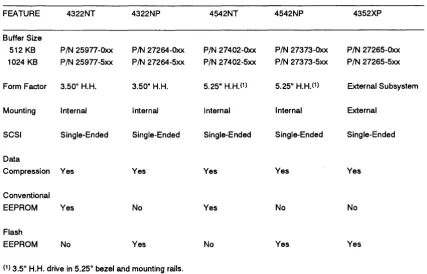
[image:12.615.101.529.286.560.2]Table l-llists a cross reference of data-compression models and features.
Table 1-1. Python DDS-DC SCSI OAT Models--Cross Reference
FEATURE 4322NT 4322NP 4542NT 4542NP 4352XP
Buffer Size
512 KB PIN 259n-Oxx PIN 27264-Oxx PIN 27402-Oxx PIN 27373-Oxx PIN 27265-Oxx 1024 KB PIN 25977 -5xx PIN 27264-5xx PIN 27402-5xx PIN 27373-5xx PIN 27265-5xx
Form Factor 3.50" H.H. 3.50" H.H. 5.25" H.H,<1) 5.25" H.H.(1) External Subsystem
Mounting Internal Internal Internal Internal External
SCSI Single-Ended Single-Ended Single-Ended Single-Ended Single-Ended
Data
Compression Yes Yes Yes Yes Yes
Conventional
EEPROM Yes No Yes No No
Flash
EEPROM No Yes No Yes Yes
(1) 3.5" H.H. drive in 5.25" bezel and mounting rails.
NOTES: Certain part numbers listed may be available only as a special order.
Part numbers listed are for generic Archive Python DDS-DC OEM products only. Contact your distributor or dealer for the correct distribution part numbers for ordering information.
1.2.1 Python Model Numbers
ARCHIVE PYTHON DDS-DC DA T DRIVES---PRODUCT DESCRIPTION MANUAL
Position 1 shows the tape drive type. This character is always 4 for Archive DAT products, which refers to the 4-millimeter tape size.
Position 2 shows the fonn factor. This character is either a 5, which refers to the 5.25-inch internal fonn factor, or a 3, which refers to either the 3.5-inch internal fonn factor or an external Python subsystem, which (like all Archive Python drives) uses a 3.5-inch internal mechanism.
Position 3 is a marketing option.
Position 4 denotes the following: 0 for single-ended SCSI interface models without data compression; 1 for differential SCSI interface models without data compression; and 2 for single-ended SCSI interface models with data compression.
Position 5 also shows whether the drive is an internal or external unit. This character is an N for internal or an X for external.
Position 6 shows the interface and PROM type. For the SCSI-l or SCSI-2 compatible interface (default setting SCSI-2) with the standard PROM, this character is a T. For the SCSI-l or SCSI-2 compatible interface (default setting SCSI-2) with flash EEPROM, this character is a P.
1.2.2 Python OAT Drives
Figures 1-1, 1-2, and 1-3 illustrate the Python 4322, 4542, and 4352 drives, respectively.
Figure 1-2 Python 4542 DAT Drive
ARCHIVE PYTHON DDS-DC OAT DRIVES---PRODUCT DESCRIPTION MANUAL
1.3 Features
The Python data compression drives embody Archive's commitment to engineering reliable and durable tape drive products which implement leading-edge technology. In summary form, key features of the Python DDS-DC drives are:
o
All Python DDS-DC drives based on proven 3.5-inch Python DAT drive, with the identical drive mechanism used in standard (non-compressed) Python productso
3.S-inch internal form factor for installation in a 3.S-inch half-high space (Model 4322NT and 4322NP)o
3.S-inch DAT drive with factory-installed S.25-inch mounting rails and bezel for installation in a S.25-inch half-high space (Models 4S42NT and 4S42NP)o
External subsystem with built-in, auto-sensing, worldwide power supply (Model 4352)o
Advanced onboard DDS-DC hardware using DCLZ (Data Compression LempelZiv) data compression algorithmo
ANSI/ECMA DDS and DDS-DC tape format compliance for compatibility and interchangeo
Reads and writes both DDS uncompressed and DDS-DC compressed data and data cassetteso
Typical capacity of 4 GB, nominal maximum capacity of 8 GB on a 90-meter DDS cassetteo
High speed random access of 20 seconds (average) to any file on a 60 m tape; 30 seconds for a 90 m tapeo
High speed transfer rates for fast backups:-- 183 KB/sec (11 MB/min)---uncompressed data -- 366 KB/sec (22 MB/min) typical---compressed data
-- 732 KB/sec (44 MB/min) nominal maximum---compressed data
o
High performance SCSI burst transfer rate of S MB/sec with up to 1 MB on-drive data buffer to facilitate the most efficient use of the host computero
Four-head design with RAW error detection and rewriteso
Three levels ofECC to ensure data integrityo
Uncorrectable error rate ofless than 1 in 1015 bitso
Flash EEPROM ("NP" and "XP") models enable electrically upgradeable drive firmwareo
Custom Archive designed LSI circuitry to reduce component count and boost drive reliabilityo
Advanced, single-chip, DAT formatter LSIo
Low power consumption---Iess than 7 Watts (typical) for internal driveso
Single-ended SCSI connection with these features:-- Embedded full LSI, high speed SCSI controller
-- Switch selectable SCSI-1 or SCSI-2 interface on internal models (as default setting at power up) for flexibility in system integration
-- Onboard output jack on internal models for configuring the SCSI address if repackaged in an external box
-- Compatibility with the Archive SCSI Viper quarter-inch cartridge drives
o
Onboard serial port for internal diagnostics (internal models only---4322 and 4542)o
Automatic power-on self tests (switch option on internal models)o
Manual emergency cassette ejection procedure1.4 Typical System Configurations
The SCSI standard supports up to eight SCSI addresses or IDs. These IDs refer to host adapters or peripheral devices such as printers, magnetic disks, or tape drives. The eight devices or hosts are daisy chained together. Figure 1-4 shows sample configurations of SCSI systems.
COMPUTER HOST ~ SCSI BUS
...
PYTHONSYSTEM ADAPTER ~ ~ DRIVE
SINGLE INITIATOR -SINGLE TARGET
COMPUTER HOST ~ SCSI BUS
...
PYTHON SYSTEM ADAPTER ~ JIll"" DRIVESINGLE INITIATOR -SINGLE TARGET MAGNETlC
...
DISK,JIll"" PRINTER,or OPTlCAL
DISKS
COMPUTER HOST ... SCSI BUS
...
PYTHON SYSTEM ADAPTER...
~ DRIVEMAGNETlC
...
DISK,...
PRINTER,or OPTICALDISKS
MAGNETlC
...
DISK, -". PRINTER, orOPTICAL DISKS
MAGNETIC
COMPUTER HOST ~
...
PRINTER,or DISK,SYSTEM ADAPTER ~ ."",.. OPTICAL DISKS
ARCHIVE PYTHON DDS-DC OAT DRIVES---PRODUCT DESCRIPTION MANUAL
1.5 OAT Technology Overview
First developed for the audio electronics market, DAT technology was first applied in computer peripherals in the late 19808. Unlike traditional magnetic tape audio cassette products, DAT technology proves inherently reliable through the helical scan recording method, which provides a high recording density with
a very low error rate. All DAT products, including computer implementations, use the helical scan recording method. This recording method has been used in professional video tape recorders (VTRs) since 1956 and in home video cassette recorders (VCRs) since 1974. In 1986, DAT products using helical scan technology were first developed for audio applications. DAT consumer products are specifically designed for digital audio recording and playback and compete with such products as analog audio cassette decks and compact disk (CD) players.
1.5.1 Helical Scan Recording
Helical scan recording was originally developed as method of efficiently recording high-quality television signals on a relatively slow moving tape. It requires that both the tape and the recording head move simultaneously. This recording method results in an extremely high recording density, far higher than can be achieved with stationary-head devices such as 1I2-inch open-reel or 1/4-inch cassette tapes. (See Chapter 8, "Helical Scan Recording -- Four-Head Design" for additional information.)
In helical scan recording, both the read and write heads are located on a rapidly rotating cylinder or drum. The cylinder is tilted at an angle in relation to the vertical axis of the tape. As the tape moves horizontally, it wraps around the part of the circumference of the cylinder (900) so that the head enters at one edge of the tape and exits at the other edge before the tape unwraps.
The horizontal movement of the tape in combination with the angular movement of the cylinder causes the track to be recorded diagonally across the tape rather than straight down its length. The resulting recorded track, nearly one inch, is approximately eight times longer than the width of the tape.
1.5.2 Tape Formats
Archive Python DDS-DC drives are designed to use the industry standard DDS and DDS-DC tape formats. These two formats are summarized in the following text.
DDS Tape Format
This standard fonnat was codeveloped by DDS manufacturers to support DAT devices as computer peripherals. The objectives of DDS are to maximize storage capacity and performance; to facilitate data interchange; to provide compatibility with existing tape storage command sets; and to provide extremely fast random access. The DDS format also takes advantage of the helical scan recording method and the inherent error correction capability of the DAT technology to augment error detection and correction.
Although data groups are fixed-length and always contain 22 data frames, the DDS format is designed such that variable-length computer records can be stored in the fixed-length data groups.
The native transfer rate of 11 million bytes/minute (183 KB/sec) is a characteristic of the DDS format for computer OAT technology. At this transfer rate, a full 1.3 GB of information can be written in 120 minutes, and a full 2.0 GB of information can be written in 180 minutes. Another important speed consideration is that once the information is written, specific files or data sets can be located at up to 200 times the speed at which they were originally written. The resulting average time to randomly access any file on a 60-meter OAT cassette is 20 seconds.
DDS-DC Tape Format
A superset of the basic DDS OAT format, DDS-DC drives can write compressed and uncompressed data to the same cassette. Thus, because DDS-DC is based on the DDS format, backward compatibility is maintained.
Introduced by the DDS Manufacturers Group and approved by ANSI and ECMA, DDS-DC is a record compression industry-standard format that provides support for loss less compression algorithms based on substitution---such as those of the Lempel-Ziv family.
This format supports compressed and uncompressed records. A recorded OAT cassette may contain compressed records, uncompressed records, filemarks, and setmarks. Compressed records exist within recorded objects called entities. Entities and uncompressed records are collected into groups.
Many aspects of the DDS-DC format are identical to those of the DDS format:
o
The series of transformations (randomizing, interleaving, generation and inclusion of two Reed-Solomon error-correcting codes, and etc.) applied to a group before recordingo
The tape layouto
The third group-based level of Reed-Solomon error-correcting codes (C3)The only differences between the DDS and DDS-DC formats are in the contents of the groups.
The combination of OAT technology and the DDS-DC format provides a solid core around which computer OAT drives with exceptional performance and reliability can be designed, such as the Python data compression prodUCts.
1.5.3 Data Compression---General
Data compression is based on reducing the redundancy that occurs naturally in data streams of text, graphics, code, and other data. Reducing or eliminating such redundancy prior to recording the information to tape significantly increases the amount of data that can be recorded on a given amount of tape.
ARCHIVE PYTHON DDS-DC OAT DRIVES---PRODUCT DESCRIPTION MANUAL
The Lempel-Ziv (LZ) algorithms are a family of string-based compression algorithms developed in the late 1970s by Messrs Lempel and Ziv. The Python DDS-DC DAT drives use the DCLZ algorithm, which is based on a Lempel-Ziv algorithm that was enhanced by WeIch. DCLZ builds a symbol dictionary that represents data strings identified as repeated events in incoming data. The algorithm then writes the symbols to the tape. This compressed data is then decompressed with the original data strings resubstituted for the symbols from the dictionary when the data is read back. (See Chapter 7, "Data Compression", for detailed information about the algorithm.)
1.5.4 Flash EEPROM
Another technological advancement incorporated into the Python 4322NP, 4542NP, and 4352XP drives is flash EEPROM, which is useful should the drive's SCSI firmware need to be upgraded at some point. With the permanently installed, electrically upgradeable, flash EEPROM memory, revised SCSI firmware for the Python drive can be loaded into the drive via anyone of three methods:
o
Archive OEM firmware cassette (See Section 4.8.)o
Host SCSI buso
Python drive serial port (internal drives) (See Chapter 8.)This feature enables qualified Archive OEMs needing to revise DDS-DC drive SCSI firmware to do so rapidly and at a reduced cost. Flash EEPROM should also prolong the life cycle of a drive because many new techniques---such as increasing the capacity of the drive through support for ionger tapes---may require only a firmware upgrade.
1.6 Software
One of the most cost-effective uses of DAT drives is to back up fixed disks. The software required to perform a disk backup runs under the control of the host computer's operating system. Compatibility with a wide range of software is also an important consideration in system integration. The Python DDS-DC computer DAT drives are designed to take advantage of the host computer's standard magnetic tape backup software or, optionally, to use backup software provided by Archive and other suppliers.
These Python drives comply with the QIC-I04 standard ensuring compatibility with the Archive Viper and other quarter-inch cartridge software. (python drives maintain full SCSI-interface compatibility with the Archive Viper SCSI 150-MB quarter-inch cartridge prodUCt.) Also, use of variable-length records and the ability to overwrite previously recorded data allow the Python drives to run software originally written for l/2-inch reel-to-reel tape backup.
Standard Python DDS drives have been proven compatible with an exceptionally wide range of SCSI host adapters and interfaces, and network, operating system, and application software.
1.7 About This Manual
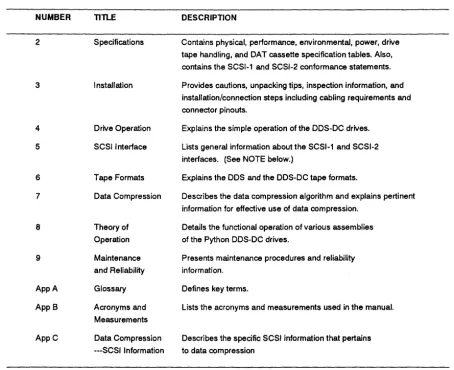
The remaining chapters and the appendices in this manual are briefly described in Table 1-2. A glossary of terms is also included.
Table 1-2. Chapter Descriptions
NUMBER TlT1..E DESCRIPTION
2 Specifications
3 Installation
4 Drive Operation
5 SCSI Interface
6 Tape Formats
7 Data Compression
8 Theory of Operation
9 Maintenance and Reliability
Contains physical, performance, environmental, power, drive tape handling, and OAT cassette specification tables. Also, contains the SCSI-1 and SCSI-2 conformance statements.
Provides cautions, unpacking tips, inspection information, and installation/connection steps including cabling requirements and connector pinouts.
Explains the simple operation of the DDS-DC drives.
Lists general information about the SCSI-1 and SCSI-2 interfaces. (See NOTE below.)
Explains the DDS and the DDS-DC tape formats.
Describes the data compression algorithm and explains pertinent information for effective use of data compression.
Details the functional operation of various assemblies of the Python DDS-DC drives.
Presents maintenance procedures and reliability information.
AppA Glossary Defines key terms.
App8 Acronyms and Measurements
AppC Data Compression ---SCSI Information
Lists the acronyms and measurements used in the manual.
Describes the specific SCSI information that pertains to data compression
[image:20.626.88.543.189.559.2]ARCHIVE PYTHON DDS-DC DA T DRIVES---PRODUCT DESCRIPTION MANUAL
2.1 Overview
CHAPTER 2
SPECIFICATIONS
Archive Python DDS-DC DAT drives provide exceptional reliability in storing large amounts of computer data. This chapter includes technical specifications for the internal (4322 and 4542) and external (4352) SCSI Python drives. This information covers the following specifications and requirements:
o
Physical specificationso
Power requirementso
Drive performance specificationso
Environmental requirementso
DAT cassette specificationso
Regulatory complianceo
ANSI Conformance Statements (SCSI-l and SCSI-2)2.2 Physical Specifications
The physical specifications of Python drives are listed in Table 2-1.
ARCHIVE PYTHON DDS-DC OAT DRIVES---PRODUCT DESCRIPTION MANUAL
Table 2-1. Physical Specifications for Python OAT Drives
SPECIFICATION 4322 4542 4352
Height 1.6 in/ 41 mm 1.6 in/ 41 mm 3.4 in/ 85 mm
Width 4.0 in/101 mm 5.7 in/146 mm 5.3 in/135 mm
Length 6.0 in/152 mm 7.1 in/180 mm 9.3 in/235 mm
[image:23.618.112.478.286.524.2]Weight 2.0 Ibs/0.9 kg 2.4 Ibs/1.1 kg 5.2 Ibs/2.4 kg
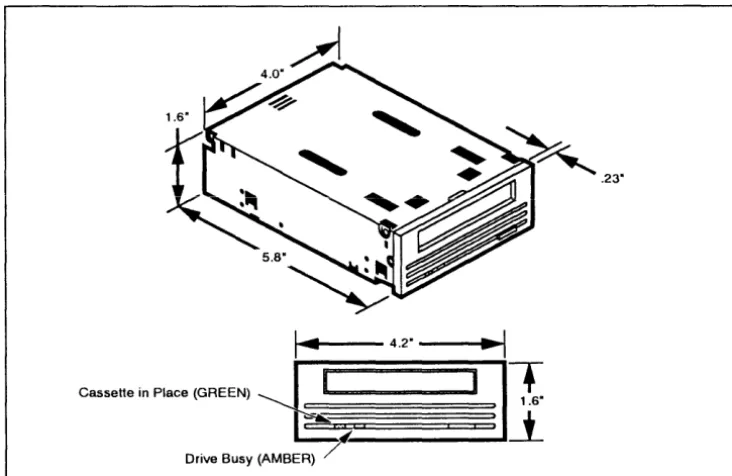
Figure 2-1 illustrates the Python 4322 drive showing its general dimensions .
... - - 4 . 2 · ~I
~~I
11:
~---
....
:-~
Figure 2-1
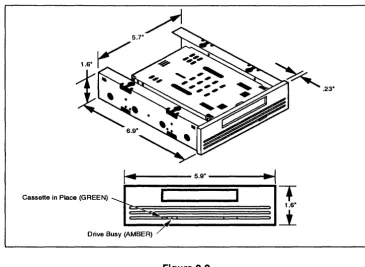
Figure 2-2 illustrates the Python 4542 drive showing its general dimensions.
11-ooII~_---5.9· ----~~I
Cassell.;n Place (GREEN)
~~~_~~I ~~~~~~~~
11
[image:24.617.140.506.128.395.2]Drive Busy (AMBER)
~
Figure 2-2
Python 4542 Computer OAT Drive General Dimensions
Figure 2-3 illustrates the Python 4352 subsystem showing its general dimensions.
DRIVE BUS
(AMBER
)v,
CASSETIE IN PLAC
(GREEN) POWER ON
(GREEN)
E-
i"
-v
I
I
I
I
~
C!::;
t
3.4"ARCHIVE PYTHON DDS-DC OAT DRIVES---PRODUCT DESCRIPTION MANUAL
2.3 Power Specifications
Table 2-2 lists the power specifications for the Python 4322 and 4542 drives. (power specifications are measured at the tape drive power connector and are nominal values.)
Table 2-2. Power Specifications for the Python 4322 and 4542 Drives
SPECIFICATION
DC Voltage
Voltage Tolerance
Operational Current
Standby Current
Peak
Power Sequence
Ripple (peak to peak)
Power Dissipation (Operating)
MEASUREMENT
+12 VDC
+or-10%
210 milliamps
210 milliarnps
1.40 amps
None
100 mV
< 5.0 Watts (excluding surge)
+5VDC
+ or -7%
900 milliamps
700 milliamps
1.30 amps
None
100mV
Table 2-3 lists pin assignments for the power connector for the internal models (4322 and 4542).
Table 2-3. Power Connector Pin Assignments (Models 4322 and 4542)
PIN ASSIGNMENT
+12 VDC
2 +12 return
3 +5 return
4 +5VDC
The Python 4352 external drives have a built-in power supply that senses the incoming voltage and automatically adapts to voltages within the range of 100 to 240 volts, 50 to 60 Hz. Table 2-4 lists its power specifications.
Table 2-4. Power Specifications for the Python 4352 Drives
SPECIFICATION AC INPUT VOLTAGE
100 (Japan) 120 (US) 240 (European)
AC Input Current 230 milliamps 200 milliamps 125 milliamps
ARCHIVE PYTHON DDS-DC OAT DRIVES---PRODUCT DESCRIPTION MANUAL
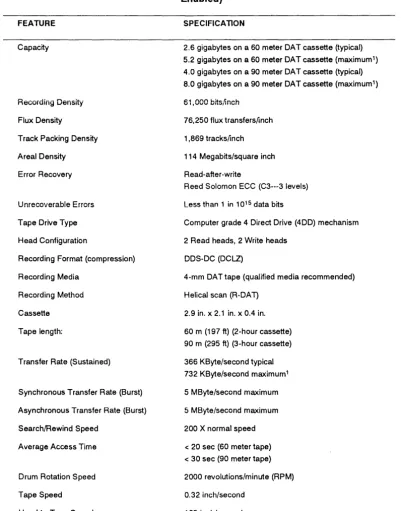
2.4 Drive Performance Specifications
[image:27.618.91.493.178.690.2]Table 2-5 lists performance specifications for Python DDS-DC DAT drives with data compression.
Table 2-5. Performance Specifications: Python DDS-DC OAT Drives (Data Compression Enabled)
FEATURE
Capacity
Recording Density
Flux Density
Track Packing Density
Areal Density
Error Recovery
Unrecovera.ble Errors
Tape Drive Type
Head Configuration
Recording Format (compression)
Recording Media
Recording Method
Cassette
Tape length:
Transfer Rate (Sustained)
Synchronous Transfer Rate (Burst)
Asynchronous Transfer Rate (Burst)
SearchlRewind Speed
Average Access Time
Drum Rotation Speed
Tape Speed
Head-to-Tape Speed
SPECIFICA TlON
2.6 gigabytes on a 60 meter OAT cassette (typical) 5.2 gigabytes on a 60 meter OAT cassette (maximum1) 4.0 gigabytes on a 90 meter OAT cassette (typical) 8.0 gigabytes on a 90 meter OAT cassette (maximum1)
61,000 brts,'Inch
76,250 flux transferslinch
1,869 trackslinch
114 Megabits/square inch
Read-after-write
Reed Solomon ECC (C3---3 levels)
Less than 1 in 1015 data bits
Computer grade 4 Direct Drive (400) mechanism
2 Read heads, 2 Write heads
DDS-DC (DCLZ)
4-mm OAT tape (qualified media recommended)
Helical scan (R-DAT)
2.9 in. x 2.1 in. x 0.4 in.
60 m (197 ft) (2-hour cassette) 90 m (295 ft) (3-hour cassette)
366 KByte/second typical 732 KByte/second maximum1
5 MByte/second maximum
5 MByte/second maximum
200 X normal speed
< 20 sec (60 meter tape)
< 30 sec (90 meter tape) 2000 revolutions/minute (RPM)
0.32 inch/second
123 inch/second
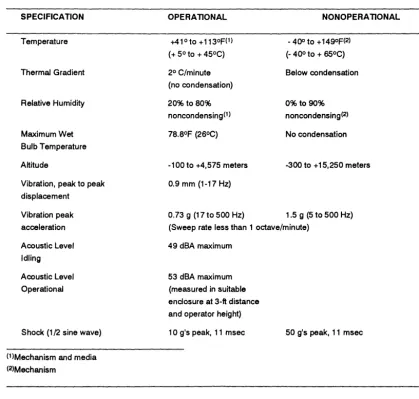
2.5 Environmental Requirements
[image:28.629.116.535.190.589.2]Table 2-6 lists the environmental specifications for Python drives. The Python internal DAT drives may be mounted either vertically (drive left side up or right side up) or horizontally.
Table 2-6. Environmental Specifications: Python DDS-DC Drives
SPECIFICATION Temperature Thermal Gradient Relative Humidity Maximum Wet Bulb Temperature Altitude
Vibration, peak to peak displacement
OPERAllONAL
+41 0 to + 1130F(1) (+ 50 to + 450C)
20 C/minute (no condensation)
20% to 80% noncondensing (1)
-100 to +4,575 meters
0.9 mm (1-17 Hz)
0.73 9 (17 to 500 Hz)
NONOPERA llONAL
- 400 to + 149°F(2) (- 400 to + 65°C)
Below condensation
0% to 90% non condensing (2)
No condensation
-300 to +15,250 meters
1.5 9 (5 to 500 Hz) Vibration peak
acceleration (Sweep rate less than 1 octave/minute)
Acoustic level Idling
Acoustic level Operational
Shock (1/2 sine wave)
(1)Mechanism and media (2)M ech an ism
49 dBA maximum
53 dBA maximum (measured in suitable endosure at 3-ft distance and operator height)
10 g's peak, 11 msec
2.6 OAT Cassette Specifications
50 g's peak, 11 msec
Python DDS-DC DAT drives provide maximum data integrity and reliability when Archive-qualified DAT cassettes are used as the recording medium. Archive maintains an ongoing program to· qualify manufacturers of DAT cassettes. The following cassettes are recommended:
o
DDS data cassette: Archive Model M3l300, 60-meter tape (Archive PIN: 2540B-lOx; order multiples of five)ARCHIVE PYTHON DDS-DC OAT DRIVES---PRODUCT DESCRIPTION MANUAL
o
DDS cleaning cassette: Archive Model M7301 (Archive PIN: 25495-10x; order multiples of five)These cassettes fully meet the specifications in the document Proposed ANSI Helical-Scan Digital Computer
Tape Cassette 3.81 mm (0.150 in) for Information Interchange, (ASC X3 Project No. 668). Only data grade DAT cassettes with the official DDS logo are recommended for use in Python drives.
Contact your Archive sales representative for information on qualified DDS data and cleaning cassette manufacturers and models.
2.7 Regulatory Compliance
All Python DAT drives comply with the regulations listed in the Table 2-7.
AGENCY
CSA
TUV-RHEINLAND
UL
FCC
VDE
Table 2-7. Regulatory Compliances
REGULAll0N
C22.2, No. 220-M 1986
EN 60 950
1950
Class 8(1)
0871, Class 8
(1) Required compliance for external model; verification on file for internal models.
The Python DDS-DC drives also conform to the following safety standards:
o
UL 1950, "Information Technology Equipment, Including Electrical Business Equipment" (First Edition)o
CSA C22.2, No. 950-M89, "Safety of Information Technology Equipment, Including Electrical Business Equipment" (First Edition) (All Python internal drives, external drives pending)o
EN 60 950, "Safety of Information Technology Equipment, Including Electrical Business Equipment" (First Edition)Use the Python DDS-DC drives only in equipment wbere tbe combination bas been determined to be suitable by an appropriate certification organization (for example, Underwriters Laboratories Inc. or tbe Canadian Standards Association in Nortb America). You sbould also consider tbe following safety points.
o
Install the Python drive in an enclosure tbat limits tbe user's access to live parts, gives adequate system stability, and provides tbe necessary grounding for the drive.3.1 Introduction
CHAPTER 3
INSTALLATION
This chapter tells you how to install the Python DDS-DC DAT drives. Some of the information relates to all Python models drives; other information is specifically based on the drive model. The following paragraphs briefly outline the organization of this chapter.
o
Section 3.2 lists guidelines for handling the 4322 and 4542 drives.o
Section 3.3 contains general infonnation that you should read before you begin the installation.o
Section 3.4 gives specific cabling requirements and connector pinouts for the drives.o
Section 3.5 describes installing Model 4322, the inch internal drive, and Model 4542, the 3.5-inch drive with 5.25-3.5-inch mounting rails and bezel.o
Section 3.6 describes installing Model 4352, the external subsystem.3.2 Guidelines and Cautions (4322 and 4542 Internal Models)
The following guidelines and cautions apply to handling and installing Python 4322 and 4542 internal drives. Keep them in mind as you install the drive.
o
Because Python internal drives contain components that are sensitive to static electricity, the drives are shipped in a protective anti-static bag. DO NOT remove the drive from the anti-static bag until you are ready to install it.o
Before you remove the drive from the anti-static bag, touch a metal or grounded surface to discharge any static electricity buildup from your body.CAUTION: If you touch static-sensitive parts of the drive, such as a printed circuit board, and discharge static electricity, the components may be damaged
ARCHIVE PYTHON DDS-DC OAT DRIVES---PRODUCT DESCRIPTION MANUAL
3.3 Unpacking and Inspection
Although Python drives are inspected and carefully packaged at the factory, damage may occur during shipping. Follow these steps for unpacking the drive.
1. Visually inspect the shipping containers; notify your carrier immediately of any damage.
2. Place shipping containers on a flat, clean, stable surface; then, carefully remove and verify the contents against the packing list.
If parts are missing or the equipment is damaged, notify your Archive representative.
3. Save the containers and packing materials for any future reshipment.
3.4 Cabling and Connectors
The Python DDS-DC drives provide standard single-ended SCSI transmission. ANSI SCSI standards specify the technical requirements for correctly cabling and connecting single-ended devices. This section provides infonnation about SCSI cabling and connectors for the 4322, 4542, and 4352 drives.
Refer to Sections 3.5 and 3.6 for actual installation instructions.
3.4.1 Cabling Considerations
Either 50-pin flat cable or 25-signal twisted-pair cable with a maximum length of 6 meters (19 feet) may be used to connect the Python drives to the SCSI host adapter output. If twisted-pair cabling is used, connect the twisted pairs to physically opposing contacts on the connector.
A stub length no greater than 0.1 meter should be used off the mainline connection within any connected equipment.
The cable characteristic impedance should not be less than 90 ohms nor greater than 140 ohms. A cable characteristic impedance of greater than 100 ohms is recommended.
To minimize noise and ensure even distribution of tenninator power, the minimum recommended conductor size is 28 A WG (0.08042 mm 2).
3.4.2 Electrical Characteristics
All signals except GROUND and TEMPWR must be terminated at both ends of the cable. Each signal termination consists of 220 ohms (+ or -5%) to TEMPWR and 330 ohms (+ or -5%) to GROUND and must meet the following specifications:
o
Terminators must supply a characteristic impedance of 100 to 132 ohms.o
External terminators must be powered by the TEMPWR line, and units providing terminator power to the cable must have:VTERM = 4.25 to 5.25 VDC
900 milliamps minimum source drive capability
o
The external drive normally supplies terminator power to the SCSI bus.o
When TEMPWR matches the above values, the voltage of released signal lines must be at least 2.5 VDC.o
When a driver asserts a line and pulls it to 0.5 VDC, the current available to the signal line driver may not exceed 48 milliamps. The first two terminators may only supply 44.8 milliamps of this current.o
When at least one device supplies TEMPWR, these conditions may be met by any valid configuration of targets and initiators.All signals use open-collector drivers. The output characteristics (measured at the connector of the drive) of signals driven by the Python drive are:
o
Signal assertion (low-level output voltage): 0.0 to 0.5 VDC at 48 milliamps sinkingo
Signal negation (high-level output voltage): 2.5 to 5.25 VDCSignals received by the Python drive have the following characteristics.
o
Signal assertion (low-level input voltage): 0.0 to 0.8 VDCo
Signal negation (high-level input voltage): 2.0 to 5.25 VDCo
Maximum input load (low-level input current: -0.4 at 0.5 VDCo
Minimum input hysteresis: 0.2 VDC3.4.3 Single-Ended SCSI Connector - Internal Models 4322 and 4542
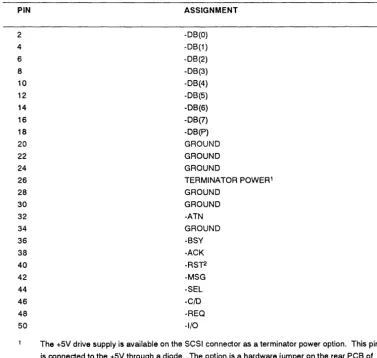
The Python 4322 and 4542 internal drives provide a 50-pin, right-angle, dual-row connector on the main PCB at the rear of the drive. The pin assignments for this single-ended connector are listed in Table 3-1.
NOTE: All odd pins except pin 25 are connected to signal ground at the drive. Pin 25
is
left open. A signal name or abbreviation preceded by a - (dash) indicates that the signalARCHIVE PYTHON DDS-DC OAT DRIVES---PRODUCT DESCRIPTION MANUAL
Table 3·1. Single-Ended SCSI Connector Pin Assignments: Models 4322 and 4542
PIN 2 4 6 8 10 12 14 16 18 20 22 24 26 28 30 32 34 36 38 40 42 44 46 48 50 ASSIGNMENT -DB(O} -DB(1} -DB(2} -DB(3} -DB(4} -DB(S} -DB(6} -DB(7} -DB(P) GROUND GROUND GROUND TERMINATOR POWER1 GROUND GROUND -ATN GROUND -BSY -ACK -RST2 -MSG -SEL -c/O -REQ -I/O
The +SV drive supply is available on the SCSI connector as a terminator power option. This pin is connected to the +SV through a diode. The option is a hardware jumper on the rear PCB of internal Python drives with terminator power disabled as a factory default. On external Python drives, terminator power is enabled.
2 ANSI defines -RST as a bidirectional pin. On the Python drive, -RST is input only.
3.4.4 Single-Ended SCSI Connector -- Model 4352
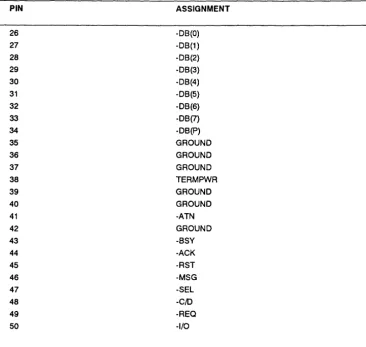
The Python 4352 external drive provides two 50-pin, shielded connectors (ANSI Alternative 2) on the rear panel of the drive. These connectors consist of two rows of ribbon contacts spaced 2.16 mm (0.085 in) apart.
These two connectors facilitate adding the drive to a daisy-chain configuration. Either connector is a "SCSI IN" connection; the other is a "SCSI OUT" connection. When the Python drive is the last device in the chain, a terminator is plugged in the "SCSI OUT" connector.
The pin assignments for these single-ended connectors are·liste.d in Tahle 3-2.
NOTE: Pins 1-12 and 14-25 are connected to ground. Pin 13 is left open. A signal name or
Table 3-2. Single-Ended SCSI Connector Pin Assignments: Model 4352 PIN 26 27 28 29 30 31 32 33 34 35 36 37 38 39 40 41 42 43 44 45 46 47 48 49 50 ASSIGNMENT -DB(O) -DB(l) -DB(2) -DB(3) -DB(4) -DB(5) -DB(6) -DB(7) -DB(P) GROUND GROUND GROUND TERMPWR GROUND GROUND -ATN GROUND -BSY -ACK -RST -MSG -SEL -c/O -REO -I/O
3.5 Installing the Python 4322 and 4542 Internal Drives
The Python 4322 is a 3.5-inch drive that mounts internal to the computer in a 3.5-inch half high space. The Python 4542 is a 3.5-inch drive with mounting rails and bezel for internal installation in a 5.25-inch half high space.
Installing these two drives consists of a few easy steps:
1. Set operational switches (Section 3.5.1).
2. Mount the drive unit (Section 3.5.2).
3. Complete the power and interface connections (Section 3.5.3).
ARCHIVE PYTHON DDS-DC DA T DRIVES---PRODUCT DESCRIPTION MANUAL
3.5.1 Setting Operational Switches
Before you install the 4322 or 4542 drive in the computer, set the eight-position switch bank mounted on the PCB at the rear of the drive.
Figure 3-1 illustrates the switchbank location for the 4322 drive.
TERMINATORS
PIN 1 SERIAL PORT
Figure 3-1
Python 4322 Switchbank Access
Figure 3-2 illustrates the switchbank location for the 4542 drive.
TERMINATORS PIN 1
SERIAL PORT
DATA COMPRESSION CHIP
Figure 3-2
Python 4542 Swltchbank Access
These switches allow you to set up the following configuration options:
o
SCSI device address (S1 through S3): Default = SCSIID 0 (S1 through S3 = OFF)o
SCSI mode at power-up (S4): Default = SCSI-2 (S4 = ON)o
Parity check enable/disable (S5): Default = Parity disabled (S5 = OFF)o
DDS pass-through mode enable/disable (S6): Default = Pass-through mode disabled (S6=OFF)NOTE: WhenS6
is
OFF, DDS-DC data compressionis
enabled. WhenS6 is ON, DDS-DC data compression is disabled.o
Power-on self-test enable/disable (S8): Default = Power-on self-test disabled (S8 = OFF)NOTE: Switch S7 is reserved and must be in the OFF position.
ARCHIVE PYTHON DDS-DC OAT DRIVES---PRODUCT DESCRIPTION MANUAL
58
57
56
55
54
53
52
51
• OFF
~ ~ ~ ~ ~ ~ ~ ~
*Defau~Settilgs:
Self·
Test Reserved
DDS
Parity
5CSI
5CSIIO
·ON
Pass-Through
Mode
OFF OFF OFF 0ON=EnabIe ON=DOO ON=EnabIe ON:SCSI-2 OFF OFF ON 1 OFF::Oisabie OFF=DOO-OC OFF::OisabIe OFF:SCSI-1 OFF ON OFF 2
OFF ON ON 3
ON OFF OFF 4
·Shown: General purpose ON OFF ON 5 default settings only. ON ON OFF 6 ON ON ON 7
Figure 3-3
Dip Switch Default Settings
NOTE: The drive must be turned OFF; then, ON in order for switch settings to take effect, or a SCSI Bus Reset must be received.
If the default settings are correct for your system, go to Section 3.5.2. DDS-DC data compression enabled (S6
=
OFF) is also set as a factory defaultIf you need to change any defauit settings, refer to the appropriate following section; make the changes and then go to Section 3.5.2.
SCSI Device Address (S1 through S3)
SCSI Device Address S3 S2 S1
OFF
0
~
~ ~
ON
OFF
~ ~ ~
ON
OFF
2
~ ~
~
ON
OFF
3
~ ~ ~
ON
OFF
4
~ ~
~
ON
OFF
5
~ ~
~
ON
OFF
6
~
~
~
ON
OFF
7
~ ~ ~
ON
ARCHIVE PYTHON DDS-DC DA T DRIVES---PRODUCT DESCRIPTION MANUAL
SCSI Mode at Power-Up (S4)
The S4 switch selects either SCSI-lor SCSI-2 as the default operational mode for the Python SCSI bus at power-up. The default is SCSI-2 (S4
=
ON), a superset of SCSI-I. Chapter 5 provides more information about the SCSI-l and SCSI-2 interfaces.S4
=
ON selects SCSI-2 S4=
OFF selects SCSI-lParity Check Enable/Disable (S5)
The S5 switch enables or disables parity checking for the SCSI bus. The default is parity disabled (S5 =
OFF).
S5 = ON enables parity checking S5
=
OFF disables parity checkingDDS Pass-Through Mode Enable/Disable (S6)
The S6 switch enables or disables DDS pass-through mode. The default is DDS pass-through mode disabled (S6=OFF).
S6
=
ON enables DDS pass-through mode S6 = OFF disables DDS pass-through modeNOTES: When S6 is OFF, DDS-DC data compression is enabled during writing. When S6 is
ON, DDS-DC data compression is disabled. When reading, DDS-DC compressed data is always decompressed, regardless of the position of S6.
The function of the S6 switch can be over-ridden by the proper SCSI MODE SELECT command issued from the host computer. Regardless of the position of S6, the MODE SELECT command can enable or disable data compression.
Reserved Switch (S7)
The S7 switch is reserved and should be left in its factory default setting.
Power-on Self-Test Mode Enable/Disable (Sa)
The S8 switch enables or disables execution of power-on self-test diagnostics when the power comes ON. The default is power-on self-test mode disabled (S8 = OFF). If ON, the drive responds to SCSI commands after successful completion of the test (about 5 seconds). .
SCSI-1/SCSI-2 Interface
The Python 4322 and 4542 drives allow you to choose either SCSI-lor SCSI-2 as the default interface with the computer system. However, the factory default for the drives is the SCSI-2. (Chapter 5 provides summary information about the SCSI-1 and SCSI-2 interfaces.)
The SCSI-1 interface conforms to the ANSI X3.131-1986 standard. SCSI-2, which conforms to ANSI X3T9.2, Revision 10, is a standard that augments the SCSI-1 command set and generally includes everything in SCSI-I.
If the hardware default setting is SCSI-2 for power up, issuing a CHANGE DEFINITION command allows SCSI-1 to be selected until the next power up. To tum data compression OFF, the host computer issues a SCSI MODE SELECT command.
Terminator Power
At the rear of the Python 4322 and 4542 drives, a 2-pin header allows you to enable +5-volt terminator power if needed for terminators or other SCSI devices. The factory default for internal Python DDS-DC drives is with terminator power disabled Gumper shunt over one pin). To enable terminator power, place the jumper shunt over the two pins. (See Figure 3-1 for the 4322 drive and Figure 3-2 for the 4542 drive.) Be sure it is firmly in place.
CAUTION: If the jumper is installed, be careful not to short the TERMPWR signal to ground.
The terminator power fuse is located beside the terminator power jumper to prevent damage to drive components in case the terminator power is shorted. If terminator power is enabled and the SCSI cable is connected upside down, this fuse may blow to prevent damage to the drive itself. In that case, return the drive to an authorized repair facility.
Serial Port
A unique feature of the Python internal 4322 and 4542 drives is the 3-pin serial port available at the rear of the drive unit This serial port allows access to internal drive diagnostics stored in firmware. These internal diagnostics allow standalone testing of the drive through connection to an external computer.
Should this capability be needed, contact your Archive sales representative about receiving the Archive Python Serial Port Diagnostics Kit, which includes a TTL logic converter, manual, cables, and host PC software.
ARCHIVE PYTHON DDS-DC OAT DRIVES---PRODUCT DESCRIPTION MANUAL
External SCSI Address Port
A 6-pin header on a PCB at the rear of the drives allow remote SCSI address selection. For example, if an OEM chooses to enclose the Python 4322 or 4542 in an external housing, the 6-pin header allows the SCSI address selection to be brought out the rear panel. Figure 3-5 illustrates this 6-pin header (JP6) .
5 •
•
•
1
6
2
Figure 3-5
JP6 External SCSI Address Port
NOTE: Follow thoe switch settings for selecting the SCSI address as illustrated in Figure 3-4. To turn S1, S2, or S3 ON, place a jumper shunt over the two vertical pins for each
switch required.
To turn S1, S2, or S3 OFF, remove the jumper shunt from the two vertical pins for
each switch required.
Set the DIP switches S1, S2, and S3, all to OFF to use the external SCSI address port.
3.5.2 Mounting the Drive Unit
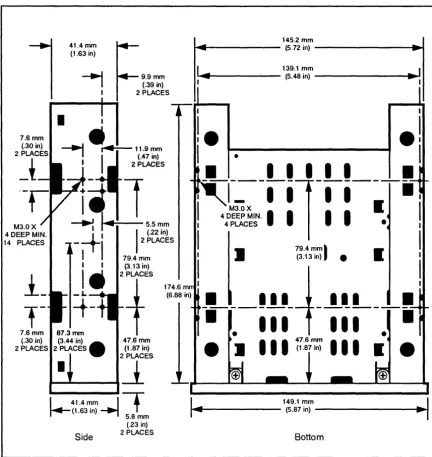
The Python 4322 and 4542 internal drives can be installed in three different orientations: one horizontally (eject button right) and two vertically (eject button up or eject button down).
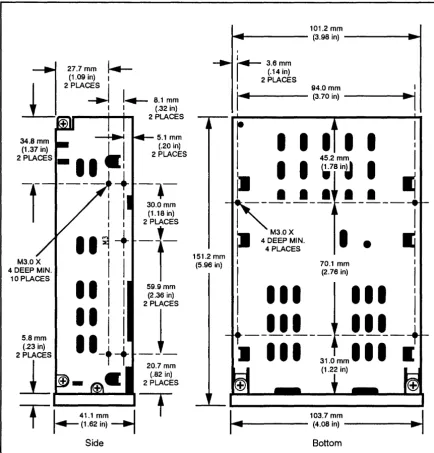
The 4322 drive chassis contains threaded mounting holes for M3.0 metric screws. Four are located on the bottom and five are on each side of the frame. See Figure 3-6.
n
27.7 mm !-.--(1.09 in) IlJ
2PLACESI
~
1.--
8.1mm I I (.32 in)'~, ... --+--+-t 2 PLACES
+
34.8mm
~~I
2 PLACES _ (1.37 in)II
I5.1 mm (.20 in) 2 PLACES
M3.0X 4 DEEP MIN.
10 PLACES
---- -+
-l-I I
I I
I III
~-+
I I
30.0 mm (1.18 in) 2 PLACES
II
II II
59.9mm (2.36 in) 2 PLACES-f-II
I Il
I--~~ -20~-mm
(.82 in)2 PLACES
Side
151.2 mm (5.96 in)
101.2 mm
... - - - (3.98 in) ---~
I
1r-3.
6mm (.14 in) 2 PLACESI ~~mm I 1 - 0 1 1 . . . . ------ (3.70 in) - - - - -. . ~I
r
I I I I I !
',w
.
I I
. .
~~8~~
..
I
J
-;
-,
,
~ M3.0X
I
~I
I.
4 DEEP MIN. • 4 PLACESI 70.1 mm I
I
(2.76 in)I
I
III
III
II
III
III
I
-III
31.0 mmIII
[image:42.617.106.540.107.560.2]I
103.7 mm... - - - (4.08 in) ---~
Bottom
Figure 3-6
ARCHIVE PYTHON DDS-DC OAT DRIVES---PRODUCT DESCRIPTION MANUAL
(1.63 in)
~ ~
..
i9~~
2 PLACES
145.2 mm
~--- (5.72 in) ---~
I
139.1 mm I""-. . __ - - - (5.48in) - - - -__ ~~
I •
l
41.4mm~
P---~~ ~-~--~
M3.0X 4 DEEP MIN. 14 PLACES
•
•
•
~ ....:--11.9mm
- I
I
(.47 in) I 2 PLACES1
~~-5.5mm
2 PLACES
I
(.22 in)79.4 mm (3.13 in) 2 PLACES
•
•
!.
.!
I
•
I
_'-- ___ LI
I_LI ___
II
· 1-
I I I I I
-.
I
4D~~~ ~IN.
I I
I I
I
I
• 4 PLACES • •
I
I
79.4mmJI
I
• (3.13 in) • I
I
I
I
'[.4;,';,~)
' .
~
• • •
-t •••
~.
I
.---'"- -'II--
iI
•
•
+
7.6 mm 87.3 mm
(.30 in) (3.44 in) • 2 PLACES 2 PLACES
47.6mm (1.87 in) 2 PLACES
t--.~---4~
I
41.4 mml-r
~(1.63in) ~
5.8mmT
(.23 in)
Side 2 PLACES
I I
47.6 mmIII
e
I
(1.87 in}e
[image:43.618.83.516.102.559.2]I
149.1 mmI
... __ - - - (5.87 in) - - - -... ~~
Bottom
Figure 3-7
3.5.3 Completing Connections
The power and interface connectors for the Python 4322 and 4542 internal drives are located at the back of the drive unit. Figure 3-8 illustrates these connections for the 4322 drive, and Figure 3-9 illustrates these connections for the 4542 drive.
NOTE: Turn off all power before inserting connectors. Pin 1 on the SCSI connector
is
to your right as you look at the back of the drive. (See Figures 3-8 and 3-9.) Your SCSI cable should have Pin 1 highlighted by a color strip. Be sure to mate Pin 1 on the cable toPin 1 on the drive. Failure to do so could make the Python drive inoperative.
o
The recommended power mating connector requires an AMP 1-48024-0 housing with AMP 60617-1 pins or equivalent.o
The mating interface connector for 4322 and 4542 drives is a single-ended connector as described in Section 3.4 with pin assignments as listed in Table 3-1. When you make the connection, be sure pin 1 of the connector aligns with pin 1 on the Python SCSI connector. (See Figures 3-8 and 3-9.)o
The layout for the mating interface connector for the 6-pin external SCSI address header is shown in [image:44.620.112.536.227.541.2]Figure 3-5.
Figure 3-8
MANUFACTURING TEST PORT
EXTERNAL SCSI ADDRESS HEADER
DATA COMPRESSION CHIP