Fabio Simeoni1, Leonardo Candela2, George Kakaletris3, Mads Sibeko4, Pasquale Pagano2, Giorgos Papanikos3, Paul Polydoras3, Yannis Ioannidis3, Dagfinn Aarvaag4, and Fabio Crestani1
1Department of Computer and Information Sciences, University of Strathclyde, Glasgow, UK
{fabio.simeoni, f.crestani}@cis.strath.ac.uk
2Istituto di Scienza e Tecnologie dell’Informazione “Alessandro Faedo” – CNR, Pisa - Italy
{candela, pagano}@isti.cnr.it
3Department of Informatics and Telecommunications, University of Athens – Athens, Greece
{g.kakaletris, g.papanikos, p.polydoras, yannis}@di.uoa.gr
4
Fast Search & Transfer ASA, Oslo, Norway {mads.sibeko, dagfinn.aarvaag}@fast.no
Abstract. In large-scale distributed retrieval, challenges of latency, heterogene-ity, and dynamicity emphasise the importance of infrastructural support in reduc-ing the development costs of state-of-the-art solutions. We present a service-based infrastructure for distributed retrieval which blends middleware facilities and a design framework to ‘lift’ the resource sharing approach and the computational services of a European Grid platform into the domain of e-Science applications. In this paper, we give an overview of the DILIGENTSearch Framework and illus-trate its exploitation in the field of Earth Science.
1
Introduction
The problem of retrieving information which is widely disseminated and autonomously managed has a wide range of possible solutions. Variability is in terms of:
– models: from those in which queries and data are structured or semi-structured (data
retrieval), to those in which they are mostly or entirely unstructured (document or content-based retrieval) [1];
– approaches: from those in which queries are distributed along with the data
(dis-tributed retrieval) [2,3], to those in which the data is centralised around the queries (content crawling and metadata harvesting) [4];
– architectures: from those in which queries emanate from clients and data is held at
servers (client-server architectures), to those in which both may originate from any of a number of peers (peer-to-peer architectures) [5].
Across the spectrum, the core challenges remain those associated with the latencies of the underlying network and the heterogeneity of data, tools, means, and purposes which may be observed across communicating nodes. It is increasingly recognised that the scale of these challenges requires infrastructural support to reduce the development costs normally associated with state-of-the-art solutions [6]. It is equally recognised
L. Kov´acs, N. Fuhr, and C. Meghini (Eds.): ECDL 2007, LNCS 4675, pp. 161–173, 2007. c
that, in most areas, infrastructural support remains piecemeal and revolves around open-source implementations of standard protocols and formats.
Issues of large scale distribution and heterogeneity are particularly acute in e-Science communities, where infrastructures are called upon to enable secure, cost-effective, and on-demand resource sharing [7]. This is the Grid vision [8], and current-generation infrastructures increasingly realise it under a service-based paradigm and for low-level computational resources, such as networks, storage, and processing cycles [9,10]. Building on these platforms, next-generation infrastructures set out to extend the vi-sion into application domains, where the scope for resource sharing broadens to in-clude, among others, retrieval services [11]. The impact is potentially non-trivial, for co-ordinated sharing of application resources may invalidate cost analyses of retrieval solutions which assume more conventional deployment scenarios: solutions with high adoption costs may be outsourced to the Grid infrastructure.
The DILIGENTproject1is one of the first attempts to systematically lift into the
Dig-ital Library (DL) domain the facilities of a European Grid platform2(see also [12,13]).
The expected outcome is a rich infrastructure of internetworked machines, middleware services, domain services, and application services in which resource sharing is an implication of virtual digital libraries, i.e. DLs that are: (i) assembled declaratively from community-provided datasets and application services; and (ii) deployed and re-deployed on-demand across machines by middleware services, according to availabil-ity, performance, and functional constraints. This is genuinely ambitious, for it reflects a model of application-level sharing which encompasses not only data resources but also domain and application services: like computing cycles, storage, and data before, application logic becomes a commodity within an infrastructure which abstracts over its physical location at any given time. The dynamic deployment of services is the key challenge of DILIGENTand its primary contribution to the Grid vision for application domains.
The DILIGENTinfrastructure retains the service-orientation of the underlying plat-form and organises its services across three layers: the Collective Layer (CL), where middleware services define, deploy, secure, and otherwise support the operation of DLs; the Digital Library Layer (DLL), where domain services manage the data and orches-trate processes against it; and the Application Specific Layer (ASL), where application services mediate between users and the services of the CL and DLL layers. Within the DLL layer, in particular, the infrastructure offers novel opportunities for supporting application development: not only may its domain services be invoked to offer sophisti-cated functionality, they may also be designed so as to be specialised and extended into application services which are tailored to the bespoke needs of adopting communities. In this case, a service-oriented infrastructure becomes a service-oriented framework.
In this paper, we focus on a core part of the DILIGENTDLL layer in which infras-tructural support is largely in terms of a framework for application services. In partic-ular, we abstract away from DLL services dedicated to content, metadata, annotation, and workflow management, and concentrate instead on the DILIGENTSearch Frame-work, i.e. the set of DILIGENTservices for the distributed retrieval of both data and
1
http://www.diligentproject.org/
2
documents. We discuss the framework in Section 2 and we report on its exploitation within the domain of Earth Science, a challenging e-Science, in Section 3. Finally, we conclude in Section 4, where we outline directions for further work.
2
The DILIGENT
Search Framework
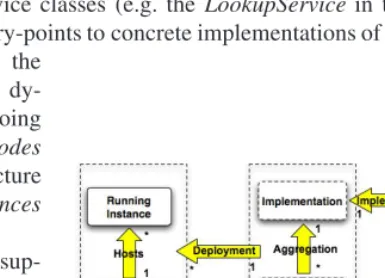
[image:3.513.191.384.220.359.2]Within a service-oriented framework, the notion of ‘service’ acquires structure and granularity to accommodate functional composition and abstraction, respectively (cf. Figure 1). Precisely, our service model distinguishes between: (i) service classes, i.e. flat groupings of services within the same functional area (e.g. the Index class), (ii) services, i.e. abstract instances of service classes (e.g. the LookupService in the Index class), and (iii) web services, i.e. entry-points to concrete implementations of abstract services
Fig. 1. Service Model LookupFactoryService). (e.g. the
Service implementations are dy-namically deployable, and doing so on one or more Host Nodes of the DILIGENT infrastructure (DHNs) yields running instances of the service (RIs).
Against this model, the sup-port offered by the framework is twofold. Firstly, it provides a set of core services which co-ordinate the functionality of ap-plication and domain services to-wards a wide range of distributed
search processes; depending on the semantics of the orchestrated services, processes may fall at arbitrary points within the content-based vs. data-based spectrum and oper-ate upon different forms of content and metadata (full-text or multimedia search, sim-ilarity search, structured and semi-structured search, etc.). Discussed in Section 2.1, the core services provide foundations to support the heterogeneity and dynamicity of data and processing requirements which can be observed within e-Science scenarios. Secondly, the Search framework offers design blueprints, partial implementations, and libraries for the development of application and domain services compliant with second-generation Web Service standards [14,15]. Two distinguished classes of such services, namely the index management services and the service for content description, selection and result fusion, are outlined in Sections 2.2 and 2.3, respectively.
2.1 The Core Services
serve IR in DILIGENT. Finally, we refer to Search Framework when implying not only software but also protocols, rules and even guidelines for implementing and extending
DILIGENTIR.
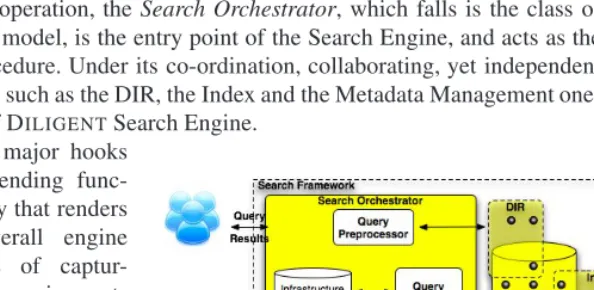
Search Overview. DILIGENTSearch Engine, modular even in its internal structure, captures its requirements through a complex, yet straightforward, set of concepts and mechanisms, which are depicted in Figure 2.
The main idea behind the presented architecture is that the actual work of retrieving and processing the information and data contained in DILIGENTor other sources, is not an integral part of the Search Service, but can rather be off-loaded to entities that focus on different (D)IR and data processing aspects. Yet, the Search Service comes bundled with a set of such entities to enable the out-of-the-box use of the system.
The search task is captured by a set of steps which manage:
– Interaction with the ultimate consumer of the service (e.g. the User Interface)
through a query language and various alternative interaction staging facilities;
– Consolidation of information regarding the status and availability of resources in
need / reach;
– Preparation of the IR process through advanced facilities that potentially impose
changes over the initial query;
– Operation planning, producing a near-optimal workflow of low-level search
opera-tions, in terms of resource utilisation;
– Execution of the workflow, i.e. invocation of the low-level search operations,
(po-tentially off-loaded to external engines) and progress monitoring;
[image:4.513.86.383.420.565.2]In this operation, the Search Orchestrator, which falls is the class of Services in the service model, is the entry point of the Search Engine, and acts as the manager of the IR procedure. Under its co-ordination, collaborating, yet independent, sets of service classes, such as the DIR, the Index and the Metadata Management ones, form the back-bone of DILIGENTSearch Engine.
Fig. 2. The DILIGENTSearch Framework The major hooks
for extending func-tionality that renders the overall engine capable of captur-ing the requirements for custom process-ing, raised by its addressed communi-ties, have been sketched in the above. These entail both the IR prepa-ration steps, masked
the quality and performance of the IR operations are, to a large degree, subject to the performance of particular elements plugged-in at these predefined placeholders.
In the following paragraphs we deepen on selected aspects of the DILIGENTSearch Engine and its operation.
Serving a Request. The first step, even prior to searching, is the construction of a user
query, i.e. an XML based, tree-like, abstract representation of the IR processing tasks involved in a search operation, that the engine must perform on behalf of the user. This query, formulated in a strict structure, is passed to the Search Orchestrator and has its validity thoroughly verified.
This procedure, i.e. validation, is an informed decision based on the availability of infrastructure resources. This information is gathered by the DIS, the DILIGENTCL service playing the role of global registry commonly used in both SOA architectures and Grid infrastructures to monitor and discover resources. The DIS has a two-fold role in the context of Search. The first is the discovery of the hosting environment the engine resides and the resources it can allocate to a task, e.g. Web Services, RIs, DHNs. This environment does not only drive the construction of query execution plans, but in conjunction with the dynamic deployment feature and the modular nature of service oriented approaches, it can imply the need to create new resources to utilise in future evaluations. The second key role of the DIS is to actually enable the modular architecture the Search framework provides. Available service instances define their semantics within the search context by publishing them to the DIS in a common way. These semantics are used by the Query Planner to produce execution plans.
The Search Orchestrator is constantly aware of the environment, through repetitive interactions with the DIS. Given a user query, the service supervises the individual steps that produce the query results. These steps include validation, preprocessing, such as injecting personalised information and pre-selection over the available sources, and linguistic processing. The enriched query and the environment information are passed to the Query Planner, in order for it to construct the execution plan.
The individual steps of this plan are performed by elements which are labelled as Search Operators. These operators are actually services that enable both information re-trieval and data processing. Processing can refer to standard operations, e.g. sort, join, merge, but also to more complex ones, such as mathematical and logical expression evaluation, aggregation and even branching evaluation, all within the same workflow. Following the service-oriented approach, search operators build up a pool of dynam-ically selectable services, allowing unconstrained extensibility of the Search Service through the addition of new, custom, processing blocks. These very concepts equip the Search Engine with the capability to exploit elements such as DataFusion, Indices and Metadata handling services, as Search Operators themselves, even if they are distinct components. Search Operators follow the aforementioned Service Model, thus it is pos-sible to have the domain-specific Services embedding multiple operation steps in a sin-gle Operator Service, leaving room for trade-off evaluation of distributed computational power versus highly optimised local transactions.
Planning and Optimising Execution. In order to produce the execution plan, the
The outcome of the procedure is a graph of service invocations, adopting the orchestra-tion model of the Business Process Execuorchestra-tion Language (BPEL). According to this, there is a global view of the participant service instances, under the central control of the execu-tion engine (the DILIGENTProcess Execution Service). This paradigm accommodates,
among others, better performance, sophisticated control and fine grained error handling. The final plan is subsequently passed to the available execution engine which executes and monitors it so that the desired results are produced and passed back to the user.
Due to the dynamic nature of the underlying infrastructure, the query planner does not have inherent knowledge of available service instances, but instead receives this information externally from the Search Orchestrator. This favours both extensibility, by adding/removing service instances, and flexibility, by changing existing instances.
It is a fact that, due to the plethora of resources, a single user query can be served by more than one execution plan, with semantic equivalence yet significant diversion in terms of resource requirements. Under this observation, the Query Planner, and more specifically its optimisation component, is responsible not only to construct a seman-tically and operationally valid execution plan, but also to achieve minimal resource consumption while maintaining a certain quality of service level. Yet, this optimisation has to accomplished within a reasonable time limit, since searching for the best execu-tion plan is generally a computaexecu-tionally intractable problem and involves enumerating and checking a potentially huge number of alternative options.
Query optimisation is managed with optimisation techniques borrowed from dis-tributed databases [16,17]. It traverses through the solution space of alternative exe-cution plans, estimates their costs and chooses the best candidate. This involves not only selecting the best set of services that can compute a user query, but also choosing the best hosting nodes of these service instances. Optimisation takes place in two-steps [18]. First, an abstract execution plan is produced and then site selection is performed.
A mathematical cost formula, tailored to the DILIGENTservice oriented architec-ture, is employed. It takes into consideration factors like data source statistics, service operational complexity, intermediate results size, cost of messages among service invo-cations, communication initialization/termination overheads, intermediate result frag-mentation, etc. Cost estimation is constantly enhanced by an active component that monitors the plan execution and refines both the formula and the stored statistics [19].
Moving Large DataSets. Throughout the execution of a search workflow, the need to
transfer potentially large amounts of data between services is evident. Given the par-ticular hosting environment of the Grid, enriched by the possibilities provided by the dynamic deployment features of DILIGENT, it is essential to utilise a common frame-work for data transferring.
The encapsulated logic allows on-the-spot processing of data, eliminating unneces-sary data movements, usually avoiding protocol stack and network engagement.
Furthermore, pipelining of execution is enabled through paged data transfer facili-ties, integrated in the framework. Based on this feature, the ResultSet can also act as a flow control mechanism, freeing component services of unnecessary resource con-sumption in a uniform manner.
2.2 Index Generation and Management
The role of the Index service in the Search framework is to facilitate fast and scal-able information retrieval from a number heterogeneous information sources over the distributed and unstable Grid environment. This is achieved by generating and main-taining a number of different indices, deeply integrated in the DILIGENTinfrastructure. In collaboration with the Planner and the other Search services, both low response time services and complex search operators are made available.
The main obstacle to be overcome by the design of the Index service, was to be able to ensure both stability and low response times on a highly distributed and heteroge-neous system. Clearly replication, both concerning files and services, was needed. As an indices might grow very big, replicating the full index is potentially a slow and band-width heavy process. With this in mind, it was decided to represent indices by way of delta files3, which can both easily be replicated through DILIGENTservices and be used to keep service replications up to date. In order to manage the delta files and replication process the Index service has been designed as service oriented framework characterised by services playing three distinct roles: (i) Manager service, i.e. a service managing and representing one specific index in terms of delta files used to build it; (ii) Updater ser-vice, i.e. a service responsible for consuming content from a content source, transforming this into delta files, and updating the Manager service of a specific index. Any number of Updater instances may be connected to a single Manager instance, allowing for highly distributed feeding of an index; and (iii) Lookup service, i.e. a service that will use the delta files maintained by a Manager in order to build a replication of the index locally on a node. Any number of Lookup instances can be connected to one logical index repre-sentations (Manager instances), thereby providing replication of the Lookup Service and the actual physical index, adding both stability, fault tolerance and query performance. In order to ensure that the Manager-Updater-Lookup framework is easily and uni-formly implemented current and future Index service implementations, a library han-dling delta files storage, management and retrieval in addition to providing needed Web Service operations for the different roles was implemented. Using the library, the three roles can be implemented in a single Service, or as distinctly separate Services. In this manner, four different index distribution configurations can be implemented: (i) All-in-one, all roles are implemented through the same Service thus ensuring low latency between document feeding and searchability; (ii) Lookup separated, promoting any number of lookup instances thus supporting query intensive environments even if it might not be applicable for large indices or indices with a large number of information
3
sources; (iii) Updater separated, keeps the Updater separated from the rest thus being able to handle a more intense feeding process for large indices or indices with a number of information sources where a low query frequency is expected; (iv) One service per role, promotes one service per role on diverse nodes thus offering replication both at the updater and lookup level.
Three standard index implementations have been created in the current DILIGENT
implementation supporting three different indexing scenarios with distinct data types. A Full Text Index providing the functionality of retrieving entries based on text queries against the full text contents of the entries. By manipulating the index profile it is possible to customize this index, e.g. specify the index structure, the query process-ing supported and the result sets includprocess-ing advanced lprocess-inguistic processprocess-ing. The full text index is implemented using the one-service-per-role distribution. A Forward Index supporting simple and fast key-value lookups. It is implemented using the one-service-per-role distribution. A Geographical Index, supporting geospatial and spatio-temporal search over a very large set of objects described by their location in a geographical system. In expectation of highly distributed content sources, intense feeding process, and high query frequencies, it was decided to use the one-service-per-role index dis-tribution. This lead to the Geographical index being implemented by way of the fol-lowing three Web Services: GeoIndexManagementService, GeoIndexUpdaterService and GeoIndexLookupService. The functionality of the latter Web Service in respect to Earth Science will be further described in Section 3.
2.3 DIR Services
Complementing search and indexing services, three service classes provide further sup-port for content-based retrieval within the framework: namely, Content Source Selection (CSS), Content Source Description (CSD), and Data Fusion (DF). Collectively, CSD, CSS, and DF services perform the tasks which characterise content-based Distributed Information Retrieval [3], an active field of research which has had limited uptake in the practice of information services so far [20]. In more detail: (i) CSD services gen-erate and maintain summary descriptions of content sources, such as partial indices, collection-level term statistics, or result traces from training or past queries; (ii) CSS services limit the routing of queries to the sources which appear to be the best tar-gets for their execution, where ‘goodness’ criteria include the relevance of content, the sophistication of retrieval engines, and the monetary costs associated with query exe-cution; and (iii) DF services derive a total order of the result sets produced by target sources with respect to different scoring functions and content statistics.
The framework sets out to support a wide range of DIR strategies. For example, a CSD service may base source descriptions on term statistics derived from full-text content indices, while another may do so using partial indices derived directly from the content through query-based sampling techniques [21]. Similarly, a DF service may rely on a round-robin algorithm to merge results, another may be biased by the output of a CSS service, and yet another may employ non-heuristic techniques and leverage the output of a CSD service to ‘consistently’ re-rank results with respect to global content statistics.
design. In it, services are stateful and the state of their RIs is comprised of source de-scriptions (CSD) or sets thereof (CSS, DF) which are generated, accessed, and updated through distinguished web services. In particular:
– access services expose the state of RIs to clients, or otherwise consume it on their
behalf. CSS selectors and DF mergers consume sets of descriptions to select over content sources and merge results which emanate from them, respectively. CSD de-scriptors expose descriptions through fine-grained interfaces suitable for selective access, or through file-transfer facilities suitable for coarse-grained access. Selectors choose sources based on cut-off points within rankings of their descriptions, where cut-offs are either specified by the client or else are derived from upper bounds on the number of results to be retrieved, also indicated by clients; in the latter case, selectors return an estimate of the number of results to be retrieved from selected sources. To promote responsiveness and optimal resource consumption, mergers process streams of results, using facilities provided the ResultSet service. Streaming is also supported in output, if the merging strategy allows it; in this case, a callback mechanism allows result merging on demand within configurable timeouts.
– monitor services observe the external environment for changes which may trigger
an update to the state of RIs. CSD monitors react to changes to indices of content sources, for which they subscribe with instances of Index services; the regeneration of a description is governed by update policies based on a configurable combination of time and space criteria (i.e. every so often and/or whenever indices have changed of a given proportion). CSS and DF monitors react instead to changes to descrip-tions, for which they subscribe with CSD descriptors. In all cases, subscriptions are brokered by services in the CL, so as to achieve resilience to the redeployment of notification producers.
– factory services generate the state of RIs. The separation of factories and access
services distinguishes two phases in the lifetime of RIs: in the operative phase, clients interact with access services to act upon state; in the generative phase, state is created, derived, updated or otherwise materialised locally to the instances. While the two phases may interleave during the lifetime of instances, their exact time of occurrence is ultimately determined by client strategies. Further, state generation may occur in either a passive or a proactive mode: in the passive mode, clients trigger generation by interacting with factories at any point in the lifetime of RIs; in the proactive mode, the instances create resources autonomously by reacting to the observation of key events in the environment, starting from their very deployment of the instance on a node (bootstrapping).
3
The Search Framework in Action: Searching the Earth Science
Information Space
Earth Science is a discipline that well represents the complex nature of e-Science activ-ities and may thus gain tremendous benefits from the DILIGENTinfrastructure. Earth Science scientists need to access data and tools within a multi-institutional, heteroge-neous and large-scale context. The analysis and the generation of objective facts on the Earth status, i.e. Earth Observation (EO), require integration of specific data products, handling of information in multiple forms and use of storage and computing resources in a seamless, dynamic and cost effective way. The typical desiderata about the retrieval paradigm consists in mixing bugs of keywords, either free terms or ontology extracted, with geo-location features aiming to capture the area of pertinence.
The building of periodical environmental reports, for example, is a typical EO activ-ity where the DILIGENTsearch infrastructure proves its appropriateness. These com-plex information objects, mostly built as aggregation of other information objects, re-quire a lot of existing information, coming from worldwide distributed heterogeneous sources. This information has to be properly discovered and uniformly accessed. The so collected information has often to be coherently integrated with pertinent informa-tion generated on-demand through procedures that often need to access and process huge amount of data. This scenario has been termed Implementation of Environmental Conventions (IMPECT) and details on its implementation are provided in the follow.
The DILIGENTinfrastructure to serve IMPECTconsist of “external” content provid-ers, such as the NASA CEOS IDN initiative4, the European Environment Agency5, and
Medspiration6, plus a pool of three community specific data sources, all placed at the
ESA’s European Space Research Institute (ESRIN), namely: the EO ESA web portal7
documents and data, the EO Grid on demand system8, and EO catalogue together with
relevant databases and archives.
The resulting information space is tremendously heterogeneous, it contains classic documents like research studies and meteorological papers, satellite images, EO prod-ucts like Chlorophyll-1 measure or vegetation indexes. To process such data effectively and efficiently appropriate customisation and instantiations of the DILIGENT Search framework have been needed but easy thanks to the possibility to plug-in new search operators in the search procedure.
With respect to the indexing facilities, the Geographical index is intended for such use. The web services used to implement this index use innovative techniques providing a highly dynamic search experience and allowing for post-index-creation addition of ad hoc query and sorting algorithms.
The Geographical index can be queried through an “index replication” represented by an instance of a GeoIndexLookupService. As these replications are based on a two dimensional R-Tree [22], the two step query processing normally used with R-Trees
4
http://idn.ceos.org
5http://www.eea.eu.int/ 6
http://www.medspiration.org/products/
7
http://www.eoportal.org
8
[23] is also used in the Geographical index. This scheme calls for a filter step and a re-finement step. In the filter step, standard MBR (Minimal Bounding Rectangle) queries are performed against the R-Tree producing a candidate set based on entries MBRs, which may have a number of false hits when considering the actual detailed geometry of both the query and entries [23]. In order to eliminate false hits, the candidate set is refined based on additional parameters, often but not necessarily relating to the actual geometry of the objects or queries. In between the standard two R-Tree query process-ing steps, the GeoIndexLookupService also implements a third step in order to rank and sort the refined results. The algorithms used in both the refinement and ranking steps greatly affect the functionality of the application and will vary for different use cases. By relying on the openness of the whole framework and on the Index, it is possible to introduce other refinement and sorting algorithms making the Geographical index adaptable to potentially any use case.
Two refinement operators and two ranking operators have been implemented. The TemporalRefiner and PolygonalRefiner refinement operators allow the user to refine the search results based on their timestamp or a specified polygonal shape. The Tempo-ralRankEvaluator and ArealOverlapRankEvaluator ranking operators allow the results to be ranked based on their timestamp or based on the amount of overlap between their MBR and the query.
In case the refinement algorithm is very computing intensive and the candidate set returned from the filter step is large, low response times are upheld by exploiting the ResultSet Service mechanism. By only doing partial filtering [24] and ranking steps, and synchronising these with requests to the ResultSet Service, these steps are only performed for the entries returned to the user, saving a vast amount of computing cycles, and greatly lowering the GeoIndexLookupService’s response time.
4
Conclusion and Future Works
We have outlined the design of a service-based framework for large-scale distributed retrieval, built atop the computational facilities of a European Grid platform. While ini-tial experience in the Earth Observation domain has built up some confidence around the capacity of the framework to accommodate the requirements of e-Science applica-tions, there are a number of implementation and design improvements which are to be addressed in the immediate future, some of which we outline next.
Further abstraction over some particular service types, such as the information sources (e.g. indices, external search engines), will enhance opportunities for inte-gration in search operations. Experimentation on query planning and optimisation by utilisation of domain-specific heuristics and content distribution statistics, based on non-linear regression techniques [26] is expected to yield faster and higher quality results. Improvements on the performance of the ResultSet transport mechanism are expected to be achieved through further exploitation of facilities provided by the un-derlying platform, such as GridFTP’s parallel striped transfers. Partitioning of indices across DHNs, so as to exploit the resource pooling of the Grid for the distributed storage of very large indices, will improve availability on extremely large datasets. Finally, the support of uncooperative DIR strategies, such as query-based sampling techniques for generating term histograms or partial indices of external content sources, would allow us to support more advanced techniques of selection and fusion (e.g. the Semisuper-vised Learning method of data fusion [27] and the Unified Utility Maximisation method of resource selection [28]).
Acknowledgments. This work is partially funded by the European Commission in the
context of the DILIGENT project, under the 2nd call of FP6 IST priority.
References
1. Blair, D.C.: The data-document distinction revisited. SIGMIS Database 37, 77–96 (2006) 2. Sanderson, R.: Srw: Search/retrieve webservice. Public Draft (2003)
3. Callan, J.: 5 Distributed Information Retrieval. In: Advances in Information Retrieval, pp. 127–150. Kluwer Academic Publishers, Hingham, MA (2000)
4. Kobayashi, M., Takeda, K.: Information retrieval on the web. ACM Comput. Surv. 32, 144– 173 (2000)
5. Risson, J., Moors, T.: Survey of research towards robust peer-to-peer networks: search meth-ods. Comput. Networks 50, 3485–3521 (2006)
6. Atkinson, M., Crowcroft, J., Goble, C., Gurd, J., Rodden, T., Shadbolt, N., Sloman, M., Sommerville, I., Storey, T.: Computer Challenges to emerge from eScience (e-Science vision document)
7. Foster, I., Kesselman, C., Tuecke, S.: The Anatomy of the Grid: Enabling Scalable Virtual Organization. The International Journal of High Performance Computing Applications 15, 200–222 (2001)
8. Foster, I., Kesselman, C., Nick, J., Tuecke, S.: The Physiology of the Grid: An Open Grid Services Architecture for Distributed Systems Integration. Open Grid Service Infrastructure WG, Global Grid Forum (2002)
10. EGEE: Enabling Grids for E-sciencE. INFSO 508833,
http://public.eu-egee.org/
11. Atkins, D.E., Droegemeier, K.K., Feldman, S.I., Garcia-Molina, H., Klein, M.L., Messer-schmitt, D.G., Messina, P., Ostriker, J.P., Wright, M.H.: Revolutionizing science and engi-neering through cyberinfrastructure. Report of the National Science Foundation Blue-Ribbon Advisory Panel on Cyberinfrastructure (2003)
12. Larson, R.R., Sanderson, R.: Grid-based digital libraries: Cheshire3 and distributed retrieval. In: JCDL ’05: Proceedings of the 5th ACM/IEEE-CS Joint Conference on Digital Libraries, pp. 112–113. ACM Press, New York (2005)
13. GRACE: GRid seArch & Categorization Engine (2005),http://www.grace-ist.org
14. Banks, T.: Web Services Resource Framework (WSRF) - Primer. Committee draft 01, OASIS (2005), http://docs.oasis-open.org/wsrf/wsrf-primer-1. 2-primer-cd-01.pdf
15. Niblett, P., Graham, S.: Events and service-oriented architecture: The oasis web services notification specification. IBM Systems Journal 44, 869–886 (2005)
16. Kossmann, D.: The state of the art in distributed query processing. ACM Computing Sur-veys 32, 422–469 (2000)
17. Ioannidis, Y.E.: Query optimization. ACM Computing Surveys 28, 121–123 (1996) 18. Stonebraker, M., Aoki, P., Litwin, W., Pfeffer, A., Sah, A., Sidell, J., Staelin, C., Yu, A.:
Mariposa: A Wide-Area Distributed Database System. The VLDB Journal 5, 48–63 (1996) 19. Chen, C., Roussopoulos, N.: Adaptive selectivity estimation using query feedback. In: 1994
ACM SIGMOD International Conference on Management of data, pp. 161–172 (1994) 20. Simeoni, F., Azzopardi, L., Crestani, F.: An application framework for distributed
informa-tion retrieval. In: Sugimoto, S., Hunter, J., Rauber, A., Morishima, A. (eds.) ICADL 2006. LNCS, vol. 4312, pp. 192–201. Springer, Heidelberg (2006)
21. Callan, J.P., Connell, M.E.: Query-based sampling of text databases. Information Systems 19, 97–130 (2001)
22. Guttman, A.: R-trees: a dynamic index structure for spatial searching. In: SIGMOD ’84: Proceedings of the 1984 ACM SIGMOD international conference on Management of data, pp. 47–57. ACM Press, New York (1984)
23. Manolopoulos, Y., Nanopoulos, A., Papadopoulos, A., Theodoridis, Y.: R-Trees: Theory and Applications. In: Advanced Information and Knowledge Processing, Springer, Heidelberg (2006)
24. Mart´ınez, C.: Partial Quicksort. In: The First Workshop on Analytic Algorithmics and Com-binatorics (ANALCO04), New Orleans (2004)
25. Callan, J.P., Lu, Z., Croft, W.B.: Searching distributed collections with inference networks. In: SIGIR ’95: Proceedings of the 18th annual international ACM SIGIR conference on Re-search and development in information retrieval, pp. 21–28. ACM Press, New York (1995) 26. Sun, W., Ling, Y., Rishe, N., Deng, Y.: An instant and accurate size estimation method for
joins and selections in a retrieval-intensive environment. In: SIGMOD ’93: Proceedings of the 1993 ACM SIGMOD international conference on Management of data, pp. 79–88. ACM Press, New York (1993)
27. Si, L., Callan, J.: A semisupervised learning method to merge search engine results. ACM Trans. Inf. Syst. 21, 457–491 (2003)