Content-Based Image Retrieval Using Machine
Learning And Soft Computing Techniques
Palwinder Kaur, Dr. Rajesh Kumar Singh
Abstract: There is increase in size of image acquisition and data storage methods and also there is increase in database of images. Ear lier textual description and manual annotation of images were used for retrieval of images that was a time consum ing task. The need of the hour is to manage the large collections through efficient systems called content-based image retrieval systems. In this case visual contents of the image like shape, arrangement and color of the objects is present in the images are also considered along with the associated data with the image. As compared to other conventional method of image retrieval these systems are more efficient and fast. In this paper we have proposed a new system in which features are extracted using Gabor filtering which are further optimized using lion optimization. In the end the classification is done using SVM for cuckoo sea rch optimization and decision tree method for lion optimization. The proposed method is tested in terms of various parameters tha t show improved results are achieved using Lion optimization as compared to cuckoo search optimization
Index Terms: Content based image retrieval, ICA, Gabor filter, Cuckoo search, Lion optimization, SVM, Decision tree, Image retrieval
—————————— ——————————
1.
INTRODUCTION
The image database size is getting increased day by day. This happen due to the development in technology and by increase in various high speed internets, increase in capacity and various storage devices creates the need of development in image retrieval systems. In earlier cases images were manually annotated and texts, keywords and tags then they were used to describe it that is known as metadata [1]. The manual annotation becomes difficult in case of large datasets that results in increase of cost, time and also there is need of large amount of manual labour. Two different users can choose different words to describe the image characteristics that results in irrelevant retrieval results. To get rid of all these issues of existing systems content based image retrieval (CBIR) has been developed [2]. In content based method images are searched using visual contents like color, texture, shape and spatial information in the image. Then CBIR systems are used to search the images in large database of images on the basis of present visual information. For browsing use of CBIR systems are more cost effective, fast and efficient. IBM’s Query by Image Content (QBIC) was the first commercial CBIR. Other developed systems are VisualSEEk, Vhoto, Excalibur, WebSEEk, Virage, Photobook and Berkeley's Blobworld [3]. Followed by feature extraction methods other various segmentation techniques incorporated with content based retrieval. After that best possible matches are find out between the images using the best possible matches from extracted features. To get the maximum efficiency various researchers have started implemented a neural network [4].Animal species multitude is endowed by earth in which dimensions, spaces and colors are used to uniquely identify each species. It is challenging task to extract the above mentioned features. Animals have different attributes such as number of horns, stripes, spots [5]. These are the attributes that differentiate them from each other. So, a single technique does not work to accomplish this work [6]. Various methods advantages are combined to diverse this scheme that gives best possible results.
This paper is divided into different sections. The second section contains the brief detail about CBIR along with its block diagram. The third section contains the various challenges or problem in existing work and the proposed idea used in this paper to improve it. The fourth section consists of review on existing work done for contrast enhancement using CLAHE. In this work we have used ICA and Gabor filter for feature extraction that is explained in section fifth and sixth section contains the description of feature extraction using Cuckoo search and LION optimizer.
2
CONTENT-BASED
MEDICAL
IMAGE
RETRIEVAL (CBMIR)
The healthcare is becoming more effective and patient friendly by growth in important of medical image in healthcare. The diseases can be detected in started phases with more precision by use of innovative imaging technology. Then the diseases can be treated more specific, less invasive and give beneficial results. In X-rays, dermatology, radiology, cardiology, HRCT, endoscopy, MRI and dermatology like various departments use of digitally produced images are getting stronger. By this these digital medical images repositories access and management has become more complex. Mainly modality, description like study characteristics or patient identification basis is used to access these digital medical images. The digital medical images can be retrieved as content based and text based methods. Till now number of medical image retrieval systems have been proposed by various researchers on the basis of content or text based methods or on the basis of both. The main motive of CBIR is to retrieve relevant data from audio, video and images like media items, database, etc. On the basis of media items content its relevancy is judged and there are several steps that is performed for it. The basic block diagram of CBIR is given below:
_______________________
Palwinder Kaur, Research scholar, IKG PTU University, Kapurthala,
India, E-mail: [email protected]
Dr. Rajesh Kumar Singh, Director, SUS Institute of Computer Science,
Fig. 1. Block diagram of CBIR system
There are number of images present in image database and first step is to extract the features from images present in database. In this shape, texture and color information low level features of images are extracted. And in feature database these features are stored as feature vector then a query image is enters into the system. After extraction of query image features a feature vector is generated which is further compared with all vector stored in database. Various approaches can be used to do this comparison.
3 PROBLEM STATEMENT AND PROPOSED
WORK
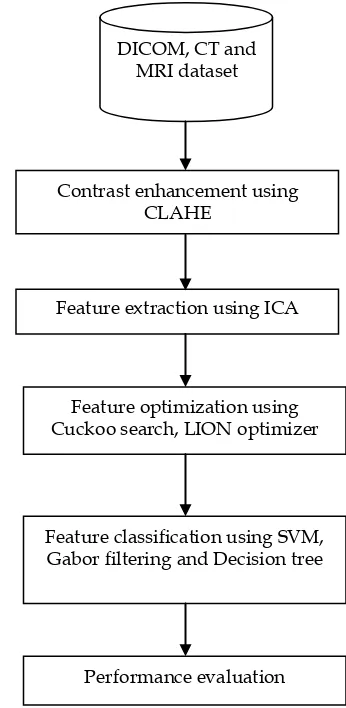
The importance of developing alternate and new access methods comes in existence by increase in amount of visual data produced in medical field. In large archives identification of similar images using CBIR techniques help doctors in assessing medical images that helps in decision. But still this technology is unable to solve the practical problems related to medical. Some of the challenges related to CBIR in medicine are that there is need of fast feature extraction and indexing techniques due to increase in amount of medical data. Other challenge is granularity of classification in differentiating medical CBIR from general purpose multimedia applications. This granularity refers to the level of invariance that the CBIR system should guarantee. The performance of CBIR is depend on shape, texture and color or other features of image. In high dimensional feature space firstly the image data is represented in terms of features and then images similarity is stored in the database which is further compared with query image. Due to this the image data representation in terms of selecting similarity measure and features becomes a most critical component in CBIR systems. In this work we have proposed a new approach in which Independent Component Analysis (ICA) a computational method to get hidden values of random variables is used. These features are pre-processed using Contrast limited adaptive histogram equalization (CLAHE). To further optimize these features a Cuckoo search and LION optimization algorithm are used and then further classified using Support vector machine (SVM), Gabor filtering and decision tree classifier. The proposed work is evaluated on DICOM, CT and MRI dataset that contains number of modalities images.
Fig. 2. Flowchart of proposed work
4 CONTRAST ENHANCEMENT
In image enhancement most commonly used method is histogram equalization due to this method has computation load and simple. So to enhance the color retinal image a Contrast Limited Adaptive Histogram Equalization (CLAHE) is used by A. W. Setiawan, et.al, (2013) [7]. In color retinal image a noise effect is introduced by acquisition process that creates a need to enhance the image. As compared to other images a color retinal image has unique characteristics and these images have important in green (G) channel. In ophthalmology a important contributed is made by image enhancement. So, A. W. Setiawan, have proposed a CLAHE new enhancement method in G channel that improves the quality of color retinal image. The proposed enhancement method is evaluated in G channel that gives an enhancement in the quality of color retinal image. CLAHE has also been used in improving the visibility level of foggy video or image. So, in real time system a CLAHE has been used by G. Yadav, et.al, (2014), for improving the quality of video[8]. Adaptive histogram equalization (AHE) is different due to use of several methods corresponding to different parts of image by AHE. This is also used to further redistribute the lightness value of the image and shape of histogram is defined using Distribution parameter in case of CLAHE that produced even better results than AHE. In this a bell shaped histogram is created by algorithm Rayleigh distribution parameter. The CLAHE can be used for both heterogeneous and homogeneous fog; single image and
DICOM, CT and MRI dataset
Feature extraction using ICA Contrast enhancement using
CLAHE
Feature optimization using Cuckoo search, LION optimizer
Feature classification using SVM, Gabor filtering and Decision tree
Performance evaluation Query Image
Feature extraction
Feature Matching
Image Features Image
Database
Feature extraction
video system on other hand AHE only work over homogeneous fog. CLAHE can be use for both gray level and colored images. In the field of digital image processing a color image enhancement is use as one of the vital emerging techniques. A CLAHE and Laplacian filter is used by S. Bhairannawar, et.al, (2017), to propose a color image enhancement [9]. The computer vision group database original RGB color image is used that is converted into HueSaturation-Value (HSV) and to V and S components a laplacian filter is applied. After that S component contrast stretching and CLAHE is applied on enhanced luminance component output. CLAHE is different from ordinary histogram equalization as several histograms are computed using adaptive method corresponding to a distinct section of the image and image lightness values is redistributed. This makes this approach suitable for enhancing edges of the image.
Fig. 3. Neighborhood pixel illustrations
The pixels which are near to boundary of image are treated in a special way because neighbourhood of it doesn’t lie completely within the image. In case of above figure it will be applied to left and above the blue pixel [10]. But by using mirroring pixel lines and columns to extend the image in order to solve above mentioned problem and this is done with respect to the image boundary.
5 FEATURE EXTRACTION
The Image recognition and Independent component analysis (ICA) algorithm are focused by P. Xie, (2012) [11]. They have presented the algorithm that mixed signal dimension can be smaller than separation Independent component dimension that ensure good precision. It means that a actual character of the object can be achieved by using a small number of signal acquisition device that results in reduction of processing cost. The results achieved using ICA increases the use of it in various application. This method is based on signal of high order statistics analysis method and it is a blind source separation technology. This method is mainly developed for linear decomposition of observed data that is decomposed into statistical independent component. Every decomposed signal component by ICA is mutually independent and using a set of basic functions is a basic idea used in it to show a series of random variables. The mixed signal of ICA is expressed as:
In this equations B is a signal mixing matrix or unknown transfer matrix. The dimensional observation signal vector is denoted by s and n(t) is a observation noise vector. S. Duan, et.al, (2014), have adopted an ICA and wavelet package based extracting electroencephalography (EEG) features method for extraction of majority of motor imaginary EEG for
brain-computer interface study. The proposed approach extracts the event related synchronization (ERS) or event related desynchronization (ERD) and imaginary movement produced signals [12]. They have used wavelet packet to decompose the EEG signal into five levels. This was done to eliminate the statistical correlation between different EEG rhythms. Along with it they have extracted the some sub-band with the characteristics of notable ERS/ERD phenomenon. After that on sub-band components features a ICA was applied that results in μ rhythms and β rhythms corresponding to the ERD/ERS phenomenon. In last for imaginary movement recognition a quantity index for the recognition was introduced by ERS/ERD coefficient. The proposed approach is evaluated that shows the enhancement in imaginary movement produced ERS/ERD feature information [13]. In bio signal processing a major role was played by feature extraction and its main two approaches are feature identification and selection. Using feature learning approach a best application suited features are selected and identified. The idea behind feature learning is to avoid dealing with any feature extraction or reduction algorithms and to train the suggested model on learning with avoiding the exposure to feature extraction which is mainly based on researcher experience. For learning purpose M. F. Ibrahim, et.al, (2016), have used ICA as feature learning technique for extracted features from input data [14].
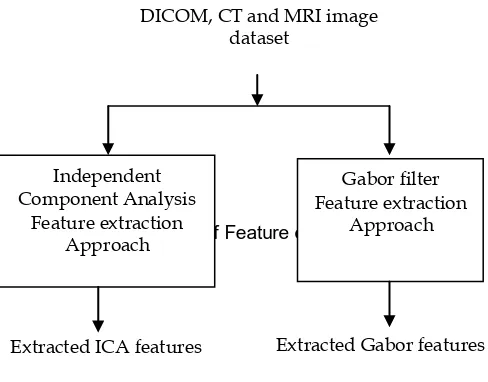
Fig. 4. Flow of Feature extraction
How to extract essential characters of things from complex representation is the main motive of image feature extraction approaches. Mainly it deals with how to express difference between things by refining less data that reduces the problems of feature dimension. It gives hidden values of random variables and it is mainly designed for multivariate data. It is related to PCA but it also performs well in case of failure of Principal component analysis (PCA). Gabor filters are used in number of purposes like stereo disparity estimation, texture analysis and feature extraction. It is a band pass filters in which image is accessed and direction, magnitude of each component is filtered for optimization. A filter band is achieved by applying Gabor filter that will store the real parts values of obtained images. When there is processing of magnitude and scaling of the uploaded image then there is change is direction of medical image obtained pictures. This will divide the images into number of complex and real samples segments as the
Independent Component Analysis
Feature extraction Approach
DICOM, CT and MRI image dataset
Extracted ICA features
Gabor filter Feature extraction
Approach
magnitude of the image and this must be high for high contrast of the image.
5 FEATURE OPTIMIZATION
Cuckoo search is a nature inspired heuristic algorithm that is inspired by cuckoo bird’s aggressive strategy to breeding. To explore search space a Levy flight random walk is iteratively used by this algorithm. A. HAarkat, et.al, (2014), have presented the method for classification of normal and abnormal arrhythmia beats in which they have extracted features using continuous wavelet transform [15]. Further cuckoo search algorithm via Levy flight is used to optimize RBF. Best values of parameters are searched by optimizing the RBF classifier and ECG data taken from MIT-BIH arrhythmia database is used to conduct the experiment. It will classify the normal and abnormal beats that give overall accuracy of 98.32% and sensitivity of 98.92%. Cuckoo search is inspired with brood parasitism of various cuckoo species in which they use lying of their spawns in the shells of other birds or species. In this case if crowd bird determines the spawns are not their individually then they will through those eggs away from their house or rebuild a new house away. In imitation female cuckoos are specialized and decorate the spawns of a few selected host species. It has breeding behavior that can be functional for number of optimization difficulties. In online social networks one of the important issues is detection of communities in such networks. There is need to analyze such social network due to large amount of data and problem of community detection is an optimization problem. It includes how to divide the network into groups of nodes while keeping better connectivity between nodes in the same group as compared with other nodes. R. Babers, et. al., (2015), have proposed a Ant Lion optimization (ALO) optimization to detect the automatic number of communities [16]. The ALO is able to find an quality function based optimized community structure. A great attention is received by metaheuristic algorithm in solving complex optimization problems. Due to this from last past few years number of metaheuristic algorithms have been developed and number of them are inspired by various phenomena of nature. M. Yazdani, et.al, (2016), have introduced a Lion Optimization Algorithm (LOA) inspired from population [17]. Behind development of this optimization algorithm main motive is the special lifestyle of lions and their cooperation characteristics. From existing work they have selected the benchmark problems and then proposed solution for them and compared it with other existing meta-heuristics for these problems. Lions have high planes of antipathy and collaboration and are particular concentration due to their durable erotic dimorphism in both the presence and behaviour of community [18]. Lions have two kind of social body and its first type is migrants and residents. Residents are known as pride and they acts in groups and finest obtained clarification for every lion is an approved iterations that is a greatest visited location. And this is updated gradually throughout the procedure of optimization. Pride ground is the zone that contains each associate best stayed position. In every pride particular females are designated aimlessly go stalking and to enclose and clasp them hunters move near the prey. Rest of the females changed toward dissimilar positions of terrain. On other hand arrogance male lions wonder in area and female mate with some resident males lions [19]. From parental pride of every pride a new males are expected and when maturity is sprayed
by them then they develop named. They have less power than local males.
6 CLASSIFICATION
For searching and retrieving the query image from big databases CBIR is come as developing trend in digital image processing. Some of the limitations of CBIR are its low speed, it is unable to label negative examples and in single step it gives poor accuracy and last is introduction of noisy examples into the query. To get rid of these limitations various new solutions has been explored. K. Sugamya, et.al, (2016), have proposed a new approach in which firstly low level features are extracted and then noisy positive examples are handle using SVM classifier [20]. In their work a image similarity are obtained by combining different distance metrics and multiple features suing SVM classifier. The proposed approach gives efficient results in terms of shape, color and texture. The SVM classifier is trained to distinguish between irrelevant and relevant images after the selection of features. N. Tripathi, et.al, (2017), have used multi kernel Support Vector Machine (SVM) and multifeature method for contrast enhancement in CBIR [21]. Earlier binary SVM were used and in this new extended kernel SVM are comes in existence. In today era there is peak development in multimedia technology and images can be retrieved on the basis of texture, surface, color and features of an object using CBIR. This has found its use in national security and medical science like technology. The similarity ranking for proper retrieval and image indexing is a main challenge in this system. To solve this problem Anjali T, et.al, (2018), have used firefly optimization with decision tree classifier that reduced the computational complexity in the classification stage of feature extraction [22]. For evaluation purpose of their proposed approach they have used recall and precision rate that shows it is more efficient in CBIR system than existing approaches. In nature association rule is one of the most important rules and each type of object in remotely sensed image is related to special association rules. So for image classification an association rules is considered as important features and for accurate classification rational and mining selection of the effective rules is the key issue. Z. Zhou, et.al, (2013), have presented the approach that combined decision tree and rule analysis which is applied to object oriented high resolution image classification [23]. In their work optimal rules for classification is find out using decision tree and mining strong rules from an image is adopted done by adopting association rules analysis. For experimental purpose Geoeye-1 image is used that is firstly segmented then selection of color space, spectral, band ration and spatial features is done. The association rules in a training set are mined, and a decision tree is designed with consideration of confidence, support of mined rules, as well spectral complexity and the generation sequence of rules. In present time educational data mining is one of the developing discipline and in this an important role is played by classification techniques. V. Shanmugarajeshwari, et.al, (2017), have used decision tree as classifier to predict the teachers attainment by using the relevant features [24]. In their work they have used C5.0, C4.5 and ID3 to predict the teacher’s attainment in educational data mining. Decision tree classification is non parametric approaches that have multistage decision making and final obtained results resemble the intended desired solution. Various advantages of this approach are:
It can handle both discrete and continuous attributes
In the presence of noise it is quite robust
On other hand its disadvantages are:
The construction of decision tree gets affects by irrelevant attributes
Decision boundaries are rectilinear that creates a difficulty is designing an optimal decision tree
The choice of feature subsets at each internal node, appropriate tree structure choice and choice of decision rule are three structures of tasks of decision tree classification. C4.5, CART, ID3 are some of the Hunt algorithm based existing decision tree algorithms. Decision tree is grown according to information entropy.
7 RESULTS AND DISCUSSIONS
In proposed work we have used two approaches. In one approach the features are extracted using ICA feature extraction approach and then these features are optimized using Cuckoo search and in last classification are obtained using SVM classifier. In second approach firstly CLAHE is applied on dataset for contrast enhancement and then Gabor filtering is used for feature extraction. After that these features are optimized suing LION optimization and the in the last classification is performed using Decision tree. For testing purpose DICOM, CT and MRI image dataset is used. Various parameters used for testing the proposed approaches are precision, recall rate, sensitivity and F-measure. The system ability to retrieve only similar images to query image is measure by sensitivity and precision.
TABLE 1. COMPARISON TABLE OF RESULTS OBTAINED USING CUCKOO SEARCH AND LION OPTIMIZATION
The above shown table gives the performance evaluations results of proposed approach in terms of high sensitivity rate
which shows the high true positive rate, high recall which is totally based on the recalling the training process to classify the things in the testing phase which also must be high, high precision rate and high F-measure. If these evaluations are high then the performance will automatically increases with less error rate probabilities. As predicted from table that use of LION optimization for feature optimization and classification using decision tree gives better results as compared to cuckoo search optimization and SVM.
8 CONCLUSION
Now a days there is increase in size of image database by the development in technology. Development in image retrieval systems comes in existence by increase in various storage devices, high speed internet and increase in capacity. Earlier the images were manually annotated and tags, keywords and texts were used to describe it that is known as metadata. In visual contents a color, texture, shapes and spatial information is present in the image. Then CBIR systems are used to search the images in large database of images on the basis of present visual information. We have divided this chapter into different sections. The second section contains the brief detail about CBIR along with its block diagram. The third section contains the various challenges or problem in existing work and the proposed idea used in this paper to improve it. The fourth section consists of review on existing work done for contrast enhancement using CLAHE. In this work we have used ICA and Gabor filter for feature extraction that is explained in section fifth and sixth section contains the description of feature extraction using Cuckoo search and LION optimizer. The next sections the results obtained using proposed approaches. For evaluation purpose a DICOM, CT and MRI images dataset was used and as compared to cuckoo search an improved results are obtained using lion optimization.
9 ACKNOWLEDGEMENT
Authors are highly thankful to the RIC department of IKG Punjab Technical University, Kapurthala, Punjab, India for providing the resources and opportunity to conduct this research work.
REFERENCES
[1] R. Hirwane, "Fundamental of content based image retrieval", International Journal of Computer Science and Information Technologies, pp. 3260-3263, 2012 [2] A. Srinagesh, K. Aravinda, G. P. Saradhi Varma, A.
Govardhan and M. Sree Latha, "A modified shape feature extraction technique for image retrieval", International Journal of Emerging Science and Engineering, pp. 9-13, 2013
[3] A. R. Sheikh, Lye. M. H., S. Mansor, M. F. A. Fauzi, F. M. Anuar, "A content based image retrieval system for marine life images", IEEE 15th International Symposium on Consumer Electronics, pp. 29-33, 2011
[4] S. Agarwal, A. K. Verma, N. Dixit, "Content based image retrieval using colour edge detection and discrete wavelet Transform", International Conference on Issues and Challenges in Intelligent Computing Techniques, pp. 368-372, 2014
[5] M. Sahu, M. Shrivastava, Dr. M. A. Rizvi, "Image mining: A new approach on data mining based on texture", Third International Conference on Computer and Communication Technology, pp. 7-9, 2012 [6] H. Zhao, P. Kim, J. Park, "Feature analysis based on
edge extraction and median filtering for CBIR", II th International Conference on Computer Modelling and Simulation, pp. 245-249, 2009.
[7] A. W. Setiawan, T. R. Mengko, O. S. Santoso, A. B. Suksmono, “Color Retinal Image Enhancement using CLAHE”, International Conference on ICT for Smart Society, pp. 1-3, 2013.
[8] G. Yadav, S. Maheshwari, A. Agarwal, “Contrast Limited Adaptive Histogram Equalization Based Enhancement For Real Time Video System”, 2014 International Conference on Advances in Computing,Communications and Informatics (ICACCI), pp. 2392-2397, 2014.
Parameter Cuckoo Search optimization
Lion optimization
Recall 0.44289 0.11144
Precision 0.69305 0.89974
Sensitivity 0.7024 0.90037
[9] S. Bhairannawar, A. Patil, A. Janmane, M. Huilgol, “Color Image Enhancement using Laplacian filter and Contrast Limited Adaptive Histogram Equalization”, International Conference on Innovations in Power and Advanced Computing Technologies, pp. 1-5, 2017.
[10] N. Kharel, A. Alsadoon, P.W.C. Prasad, A. Elchouemi, “Early Diagnosis of Breast Cancer Using Contrast Limited Adaptive Histogram Equalization (CLAHE) and Morphology Methods”, 2017 8th International Conference on Information and Communication Systems (ICICS), pp. 120-124, 2017. [11] P. Xie, “The Study of Image Feature Extraction Based on Independent Component Analysis”, 2012 International Conference on Computer Science and Service System, pp. 374-377, 2012.
[12] S. Duan, T. Xu, W. Zhuang, D. Mao, “The Feature Extraction of ERD/ERS Signals Based on the Wavelet Package and ICA”, Proceeding of the 11th World Congress on Intelligent Control and Automation, pp. 5621-5625, 2014
[13] S. Estrin, R. M. Cancino, S. Makeig, V. Gilja, “Improving Classification Accuracy in Cortical Surface Recordings using ICA-based Features”, 2018 IEEE International Conference on Systems, Man, and Cybernetics, pp. 3285-3288, 2018.
[14] M. F. Ibrahim, A. A. Al-jumaily, “ICA based Feature Learning and Feature Selection”, 2016 5th International Conference on Electronic Devices, Systems and Applications (ICEDSA), pp. 1-4, 2016. [15] A. Harkat, R. Benzid, L. Saidi, “Features Extraction
and Classification of ECG beats using CWT combined to RBF neural network optimized by Cuckoo search Via Levy Flight”, 2015 4th International Conference on Electrical Engineering (ICEE), pp. 1-4, 2015.
[16] R. Babers, N. I. Ghali, A. Hassanein, N. M. Madbouly, “Community Detection Based on Lion Optimization Algorithm”, 2015 11th International Computer Engineering Conference (ICENCO), pp. 1-6, 2015. [17] M. Yazdani, F. Jolai, “Lion Optimization Algorithm
(LOA): A nature-inspired metaheuristic algorithm”, Journal of Computational Design and Engineering, pp. 24-36, 2016.
[18] S. Salesi, G. Cosma, “A Novel Extended Binary Cuckoo Search Algorithm for Feature Selection”, 2017 2nd International Conference on Knowledge Engineering and Applications, pp. 6-12, 2017. [19] H. M. Zawbaa, E. Emary, B. Parv, “Feature Selection
Based on Antlion Optimization Algorithm”, IEEE Third World Conference on Complex Systems (WCCS), pp. 1-7, 2015.
[20] K. Sugamya, S. Pabboju, Dr. A.Vinaya Babu, “A CBIR classification using support vector machines”, International Conference on Advances in Human Machine Interaction, pp. 1-6, 2016.
[21] N. Tripathi, P. Sharna, M. Gupta, “A New Technique For CBIR with Contrast Enhancement using MultiFeature and Multi Class SVM Classification”, International conference on Signal Processing, Communication, Power and Embedded System, pp. 2031-2036, 2017.
[22] Anjali T, Rakesh N, Akshay Krishna M P, “A Novel based Decision Tree for Content Based Image
Retrieval: An Optimal Classification Approach”, International Conference on Communication and Signal Processing, pp. 698-704, 2018.
[23] Z. Zhou, Y. Zhang, “Integration of Association-rule and Decision Tree for High Resolution Image Classification”, 2013 21st International Conference on Geoinformatics, pp. 1-4, 2013.