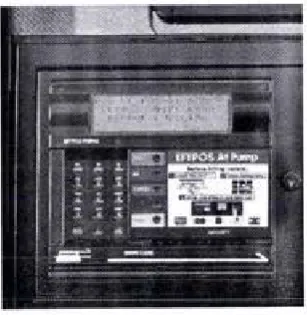
The Development of a Computer
Human Interf
ace
using
Touch
Input
for Point of Sale Applications
A thesis presented in panial fullilmcnl of the requirements
for the degree of Master of Technology in Product Development at
Massey University
Katha
r
ine
Julia
O'Driscoll
199
8
This was a
joint project between P
EC (New Zealand) ltd
. and
Massey University.
Abstract
This project developed a touch screen interface for a new generation EFTPOS sales tenninal al the fuel pump in a service station.
Scenario plans and creative
obscn1ation of consumers and analysis of their exp
r
essed needs.
wants, and requirements were developed within the context of the client's specifications. This enabled the production of a physical and graphical user interface that provided initial appeal, ease of learning, high speed of user task perfonnance. low user error rate, subjective user satisfaction, and user retention over time.Using multimedia c<,mputcr software as a rapid prototyping tool enabled realistic feedback 10 be obtained early in the development stages and facilitated the modification of prototypes to minimise the barriers to potential consumer acceptance.
The designer was able to effectively communicate the goals and details of the product 10 the ream implementing the design using flow charts and diagrams to define the stnicture and
content of the interface.
The process used to develop the interface was compared with published product
development techniques that incorporated consumer testing checkpoints throughout the discrete phases of product crea1ion. It was dctcm1ined that lhc generic processes were useful
in practice, but only if the checkpoints were chosen appropriately and the tests cus1omised for the developing product.
Testing at fixed stages in the design process was found 10 be detrimental to 1he project.
Pulling excessive emphasis on the tes1ing of the product curbed creativity by removing valid
solutions before 1hey could
be
inves1igated fully.The touch screen interface developed will
be used
to lead customers through fuel deliveries, Electronic Funds Transfer (EFT} transactions, and the purchase of other service station related products and services. The interface allows incorporation of advertising andcustomisation for use in other coumrics. meets the company's specifications, and has polled
well in consumer tests when incorporated in a simulated mounting.
Acknowledgments
The researcher would like to acknowledge with gratitude the assistance of the following
individuals and companies:
Supervisor, Pradeep Sharma, Design Management, UNITEC Institute of Technology.
(Formerly - Department of Consumer Technology, Massey University). A special thanks for
continuing to supervise both project and student after moving to Auckland.
Supervisor/ Project Coordinator, Ian Palmer, Electronic Hardware, PEC (New Zealand) Ltd.
Foundation for Research, Science and Technology (FRST) for funding this project through
the Graduate Research in Industry Fellowship (GRIF).
Tony Bray, PEC (New Zealand) Ltd, who championed the product form the beginning, and
was always available to advise on Director scripting.
Kevin Low, Director Product Development, PEC (New Zealand) Ltd.
John Corbett, School of Design, Wanganui Polytechnic, Course Controller - Time Based
Media.
PEC (New Zealand) Ltd. Staff members who dedicated many hours to the testing of the
product.
Consumer Technology Department, Massey University, for assistance with initial focus
group and testing.
BP (Pioneer liighway), for distributing and collecting questionnaires during the initial
research.
Mobil (Rangitikei St), and BP (Fitzherbert Ave) for assisting with observation testing.
The researcher's parents, who provided hours of practical assistance with proof reading.
Contents
Abstract
Acknowledgments
Contents
List of Figures
List of Charts
1. Introduction
2. Project Background
2.1 Sponsoring Company
2.2 Rationale
2.3 Current Product
2.4 Product Intent
3. Project Plan
3.1 Project Outline
3 .2 Development Process Plan
4. Initial Research
4.1 Literature Review
4.1. l Multimedia Literature
4.1.2 Process Development Literature
4.2 Consumer Studies
4.2. l Related Technologies Questionnaire
4.2.2 Focus Group
4.3 Observational Analysis
4.3.l Paying At the Pump using the Current FST
4.3.2 Paying Instore
4.4 Technical Studies
4.4.1 Standards and Specifications
4.4.2 Touch Screens
4.4.3 Touch Screen Interface
4.4.4 Pump Authorisation
5. Product Specification
5.1 System Overview
5.1.1 Terminal
5.1.2 Site Controller
11. Modifications and Further Work
11.1 Modifications
11.2 Interface Navigation and Flow
11.3 Further Work
11.3.1 Graphical User Interface 11.3.2 Component Development 11.3.3 Standards Approval 11.3.4 Field Testing
12. Conclusions and Recommendations
References
Appendices
Appendix i -Related Technologies Questionnaire and Responses
Appendix ii - Interface Questionnaire and Responses
Appendix iii - Interface Component Results
Appendix iv - Formal Questionnaire and Responses
Appendix v - Interface Testing Results
Appendix vi - Graphical User Interface - Screen Pictures
Li
s
t
o
f Fi
g
ur
es
2.1 Current Forecourt Service Tenninal (FST) 4
2.2 Forecourt Service Tenninal (FSD variations 4
4.1 Client Centred Muhimedia Project Cycle 19
4.2 New Product Development Process 27
4.3 New Product Development Process 31
4.4 Normal message flow for EFTPOS transaction on current FST 36
4.5 Most commonly observed order used 10 make a fuel purchase 38
4.6 Possible order of tasks when purchasing fuel 39
6.1 Computer actions
54
6.2 Sample storyboard page 56
7.1 Selection of concepts for dividing interface into static and dynamic partS 76
8.1 Design concepts for the physical user interface 104
8.2 Elevations showing preferred physical user interface 105
8.3 Custom-wood models of physical user interface 106
8.4 Plan and section of current physical user interface 107
8.5 Foam model of physical user interface 108
9.1 Existing pump head 111
9.2
Rear view of lCSI rig showing location of computer 1119.3 External action buttons 113
9.4 Test rig mounted on trolley 113
9.5 Test rig 113
I 0.1 Button sizing 120
10.2 Button spacing 121
10.3 Time taken vs errors made by evaluators using purchase list I 123
10.4 Time taken vs errors made by evaluators using purchase list 4 123
List of Charts
6.1 Human Interaction Chart 59
6.2 Human Interaction and Computer Action Chart 61
6.3 Computer Action Chart - Preset Fuel Amount 63
6.4 Computer Action Chart - Pick up Pump 63
6.5 Computer Action Chart - Dispense Fuel 65
6.6 Computer Action Chart - Check Card 65
6.7 Computer Action Chart - Personal Details 67
6.8 Computer Action Chart Additional Purchases 69
6.9 Computer Action Chart - Print Receipt 69
11. l Interface Navigation Chart 151
11.2 Dynamic Screen Section - Fuel Preset 153
11.3 Dynamic Screen Section - Car Purchases 155
11.4 Dynamic Screen Section - Other Purchases 157
11.5 Independent User Action - Insert Card 157
11.6 Dynamic Screen Section Card Details 159
11. 7 Dynamic Screen Section - Extra Card Details 161
11.8 Dynamic Screen Section - Finalise Transaction 163
11.9 Independent User Action - Remove Card 165
11. l 0 Independent User Action - Pick up Pump 165
11.11 Independent User Action Start Dispensing 167
11.12 System Alert Message - Timeout 169
11.13 System Alert Message - Error Message 169
Introduction
The project was commissioned by PEC (New Zealand) Ltd, a company specialising in
innovative and high technology products for the oil and security industries.
The product required was a touch screen graphical user interface that was to be incorporated
into a Forecourt Service Terminal (FST) being developed by the Company. The point of
sale device would be located at the petrol pump in service stations. The FST would allow
customers to purchase fuel and other products using EFTPOS, fuel, or local cards at the
pump. The FST builds upon another product that PEC currently have on the market that
enables a customer to purchase fuel using an EFTPOS card at the pump.
The projects joint aim was to present a practical application of the theoretical product
development process and to apply generic product development techniques to guide the
project through the appropriate design, prototyping, and testing phases.
The theoretical product development process as applied to the interface development was as
follows:
Clarify PEC's needs;
Analyse current systems and practices;
Define product specifications;
Generate product concepts by creating a simple storyboard based on the specifications then develop the storyboard to incorporate innovative options;
Develop selected product concept and produce a multimedia interface to fit;
Conduct initial consumer testing to canvas consumer and technical opinion, then modify the storyboard and prototype accordingly;
Develop the physical aspects of mounting the user interface and model the options;
Develop product detail and prototype the interface on the computer;
Consumer test the product to identify areas of acceptance and areas for modification;
Refine the product design and repeat testing and modification until stakeholders are satisfied with the design;
Prepare a formal project report;
The resu
l
ting touch sc
r
een interface
is
innovative,
technically
sound
,
is
inviting
to customers
and easy to use
,
allows
incorporation
of
advertising and customisat
i
on for use
in
other
count
r
ies
,
meets the companies
specification
s,
and has po
ll
ed well in consumer tests whe
n
incorporated
in a
simulated
mounting.
Pub
l
is
h
ed
p
r
oduct
development
techniq
u
es
which incorporate co
n
sumer testing checkpointS
thr
oughou
t
discrete
phases
of p
r
oduct creation were found to
beusefu
l
in practice
,
but
on
l
y
if the checkpoints we
r
e chosen appropriate
l
y and
t
he
tests
customised for the
developing
product. Generic
methodologies
need to be translated and adapted for the partic
ul
ar product
area and
type.2
Project Background
2
.
1 Sp
o
n
s
orin
g
Company
PEC (New Zealand) Lid is a company specialising in innova1ive and high lcchnology
produc1s. ·n,ey have been working 10 mee1 the needs of ctistomers, including oil and
securily industries, since 1947. Under the main PEC (New Zealand) Ltd umbrella
there
are
three
business units:
Reiail Solutions - world leading retail automation sysierns,
Cardax - integrated security access control systems, and
Pumps- sophis1ica1ed fuel dispensing equipmcn,.
All lhe bllSiness units arc based a, si1es loea1ed in Marton. where each uni, can benefi1
from the technologies used and developed by 1he company. PEC currenily houses an
extensive multidisciplinary product development group consis1ing of over 100
technologists.
PEC's products include poinl of sale. fuelling, and security conirol systems. and are
sold in over JO couniries.
2
.2
R
ationa
le
In
199
1
,
PEC began 1he design and development ofa card reader system 10 be locatedin the head of existing petrol pumps. TI1is product would allow for the purchase and
paymcm of fuel at a pump on 1he forecourt of a service swtion. Similar products
combining a card reader with a pump had been available for a short time on the
international market and had a small following. 11 was PEC's vision to redesign an
indoor point of sale unit for mounting a, the pump 10 create a "Forecourt Service
Terminal". Unlike a s1raigl11 card reader and pump, the unit would have the capability
10 sell more 1han just petrol. For PEC, the development of the Forecourt Service
Tem1inal (FST) was a natural progression building on their experience with both card
reading and petrol pumps in their existing product lines.
2
.
3
C
ur
re
n
t
P
rod
u
ct
In 1993 tooling for a prototype run of Forecoun Service Terminal (FST) units was
completed. The first FST units were then produced for customers in Brazil and Hong
Kong. The units were purchased by the cus10mers for very different reasons. For
Brazil the purchase of around 60 units came at a time where policy changes meant
that service stations were being upgraded. The fitting of the FST units added an extra
feature for the service station at a minimal extra cost. For Hong Kong, with extremely
busy roads, the installation of the FST units increased productivity at service stations
while de<:reasing fraud. Each pump and FST could
be
assigned to a different attendant(attendant tagging), with all sales being run through the FST by either the customer or
the attendant. FST units have since been installed in New Zealand, Australia, South
[image:19.574.189.343.309.467.2] [image:19.574.66.472.532.707.2]Africa, and Malaysia.
Figure 2
.I
:
Current Forecourl Service Terminal
(FS1)
Figure 2
.
2
:
Forecourt Service
Termina
l
(FS1)
variations
The FST is produced in three different colours of plastic, which is then pad printed
with the appropriate text. There are currently around 15 variants of the FST front.
Each customer has their own combination of colours and text, making the front end of
the unit a costly item to produce, and an item which can only be sold to the one
customer. Due to the high level of customisation of the FST front, holding the unit in
stock is not cost effective.
The FST has been very successful. The tooling, which was intended to cover a
prototype run of no more than 500 units, has produced around 14 OOO units to date.
The first major break in technology for the FST came from a need to include Smart
Card transactions in the South African market. The use of different types of card was
not envisaged in the initial design of the FST, but a successful solution was found.
2.4 Product Intent
The FST had always been sold as a unit with the capabilities to sell other products,
however, in reality when a customer wanted to be able to sell oil from the FST, it
required extensive input from software engineers to add that one function.
Changing the original design to include today's additional requirements is becoming
harder and more time consuming. The cost of customisation is inhibitive.
In 1994, PEC began work on a model upgrade for the FST. The reasoning behind the
upgrade was to provide a system that required less support from PEC staff. This
upgrade would be achieved by producing an FST that was driven more by the
software than the hardware, allowing the unit to be customised more easily.
The development of concepts for the new FST were based around known strengths
and weaknesses within PEC's existing range of products. The major strengths
identified for the current FST unit included:
The ability to be mounted into the majority of existing petrol pumps,
The ability to be combined with another PEC product, a site controller, to supply a complete service station solution.
The new product had to be easily customised, with functionality that was flexible to
meet the needs of individual markets. It was decided that using a flat panel Liquid
6
Crystal Display (LCD) screen with a touch overlay in the FST mark 3 would provide
a suitable solution to facilitate customisation. The physical user interface would
be
able to remain the same throughout all the models, while the screen would contain the