Codon usage in vertebrates is associated with a
low risk of acquiring nonsense mutations
Schmid and Flegel
R E S E A R C H
Open Access
Codon usage in vertebrates is associated with a
low risk of acquiring nonsense mutations
Pirmin Schmid and Willy A Flegel
*Abstract
Background:Codon usage in genomes is biased towards specific subsets of codons. Codon usage bias affects translational speed and accuracy, and it is associated with the tRNA levels and the GC content of the genome. Spontaneous mutations drive genomes to a low GC content. Active cellular processes are needed to maintain a high GC content, which influences the codon usage of a species. Loss-of-function mutations, such as nonsense mutations, are the molecular basis of many recessive alleles, which can greatly affect the genome of an organism and are the cause of many genetic diseases in humans.
Methods:We developed an event based model to calculate the risk of acquiring nonsense mutations in coding sequences. Complete coding sequences and genomes of 40 eukaryotes were analyzed for GC and CpG content, codon usage, and the associated risk of acquiring nonsense mutations. We included one species per genus for all eukaryotes with available reference sequence.
Results:We discovered that the codon usage bias detected in genomes of high GC content decreases the risk of acquiring nonsense mutations (Pearson’s r= -0.95;P< 0.0001). In the genomes of all examined vertebrates, including humans, this risk was lower than expected (0.93 ± 0.02; mean ± SD) and lower than the risk in genomes of non-vertebrates (1.02 ± 0.13;P= 0.019).
Conclusions:While the maintenance of a high GC content is energetically costly, it is associated with a codon usage bias harboring a low risk of acquiring nonsense mutations. The reduced exposure to this risk may contribute to the fitness of vertebrates.
Background
Codon usage bias in genomes is relevant for organisms. It influences the translation speed and thus gene expres-sion [1]. Artificially deoptimized codon usage can decrease gene expression and create an attenuated viral virulence that may be used for vaccine production [2]. HIV-1 modifies the tRNA pool of the infected cells to increase translation efficiency of its own genes [3]. Initial studies on codon usage bias were based on few genes in single species: lists of the codon usage [4], determination of the number of codons used in genes [5], and models, such as the codon adaptation index (CAI). The CAI compared the codon usage of each gene with an “optimal”codon usage, which is inferred from high-expression gene sets [6]. Whole genome sequen-cing data and newer algorithms have allowed
researchers to overcome previous limitations, study more genes, and classify genes in more detailed cate-gories [7]. Codon usage bias is associated with tRNA concentration [8] and also the GC content of genomes [9-12].
Loss-of-function mutations, such as nonsense muta-tions, are the molecular basis of many recessive disor-ders, conditions that stem from non-functional gene products or, in case of null alleles, a lack of gene pro-ducts. Nonsense mutations cause the premature stop of translation with shortened and often non-functional proteins. As part of the RNA surveillance, nonsense-mediated decay efficiently eliminates any mRNA that harbors nonsense mutations [13]. For example, loss of tumor suppressor genes have been recognized as a key mechanism in many cancers [14]. Retaining one func-tional allele of critical genes is essential for survival. Still, null alleles are common: the blood group O is a widely recognized and clinically relevant example [15].
* Correspondence: [email protected]
National Institutes of Health, Clinical Center, Bethesda, MD, USA
Rare null phenotypes of blood groups have been used to identify null alleles in large populations using routine clinical methods [16,17].
We wondered if the codon usage bias in organisms is associated with a propensity of acquiring nonsense mutations. The consequence of a single nucleotide sub-stitution, like a synonymous, missense or nonsense mutation, is intrinsic in the genetic code. Based on this association, we developed a method to calculate the risk of acquiring nonsense mutations in coding sequences (CDS) relative to an unbiased random codon usage. We applied this method to investigate the codon usage in the whole genome sequences of 40 eukaryotic species.
Methods
Risk of acquiring nonsense mutations
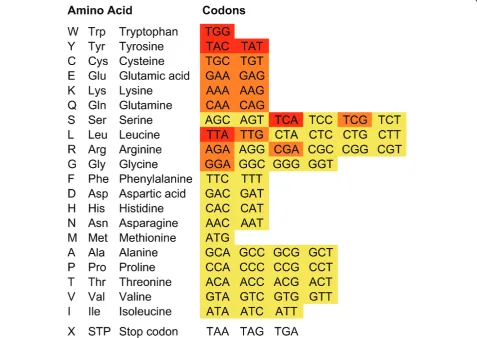
We used an event based model to estimate the risk of acquiring nonsense mutations by a single nucleotide substitution. A scoreω of {0, 1, 2} was determined for each of the 61 non-termination codons based on the
number of possible single nucleotide substitutions that lead to a stop codon (Figure 1). For this study, the countcxxxand risk scoreωxxxof each codon xxx, withx
of {A, C, G, T}, was used to determine a risk score
Ωse-quencefor all coding sequences (CDS) of a species:
sequence=
xxx
cxxx·ωxxx (1)
To account for the different proteins encoded by the genomes of different species,Ωrandom was calculated for comparison assuming an unbiased usage of codons, which was deduced by the number of amino acids aa
(xxx) encoded by codonxxx and synonymous codons,
and the number of codons encoding this amino acidn sy-nonymous,(xxx):
random=
xxx
aa(xxx)
nsynonymous,(xxx) ·ωxxx (2)
[image:3.595.60.538.354.692.2]Based on these equations, the parameter “stop risk factor”Fwas calculated for the entire set of CDS in the
Figure 1Genetic code and risk of acquiring nonsense mutations. The codons of the standard genetic code are listed along with the 20 amino acids and the three stop codons. A risk scoreωis shown asω= 0 (yellow),ω= 1 (orange), andω= 2 (red). The list is sorted according to the mean risk of the codons encoding a specific amino acid.
Schmid and FlegelJournal of Translational Medicine2011,9:87 http://www.translational-medicine.com/content/9/1/87
species’genome:
F= sequence random
(3) This Fdefines the risk of acquiring nonsense muta-tions for each species relative to the risk with an unbiased codon usage. With the intention to compare the risk of acquiring nonsense mutations among various species, we concluded that a random codon usage was the most neutral denominator. These calculations allowed a novel approach to study codon usage bias in whole genomes.
GC and CpG contents
GC content was calculated as C+G per total nucleotide count, and CpG content as number of CpG dinucleo-tides per total nucleotide count. The CpG content of genomes was comparable to the results of a recent in silico study [18] forPan troglodytes, Mus musculus, Rat-tus norvegicus, Bos taurus, Canis lupus familiaris, and
Danio rerio. Our calculated figures for CpG content match the data obtained by the original in vitro method [19,20].
The expected GC content for the CDS was calculated with the number of codonsnin the CDS and GC con-tentxxxdenoting the GC content of the codonxxx:
expected GC content =1
n·
xxx
aa(xxx) nsynonymous,(xxx)·
GC contentxxx (4)
The expected CpG content was calculated as described [21]:
expected CpG content =
GC content 2
2
(5)
Database and species selection
The NCBI table Eukaryotic Genome Sequencing Pro-jects (March 30, 2010) [22] was used to include all spe-cies with a genome status“complete” or“assembly”and an available RefSeq. We restricted analysis to one spe-cies per genus (Additional file 1, Figure S1 and Table S1). Sequence data represent NCBI RefSeq database release 40 (March 2010) for 39 species plus GRCh37.p2 (August 2010) for the human genome [23].
Software
We developed a script driven software package, which parsed the genomic data (FASTA for nucleotide sequences and GenBank flatfile for meta-data including CDS definitions) and calculated the parameters defined in this study, in particular the stop risk factor F. In total, 145 GB of data were analyzed.
Algorithms
(i) Data selection. The whole genomes of the species were scanned by the software. Non-standard code sequences, in particular mitochondrial sequences, were excluded from analysis.(ii) Analysis of the whole
gen-omes. Nucleotide count, GC content and CpG content were calculated for the genomic sequences of the ana-lyzed species. Non-ACGT nucleotides (3.8%) were excluded. (iii) Analysis of CDS. CDS were used as defined in the RefSeq [23]. CDS were excluded that were incomplete at their 5’or 3’end (4.2%) or contained errors (triplets 1.3%, no stop codon 0.5%, non-ACGT nucleotides 0.4%). If CDS were associated with an identical geneID, like in splice variants, the longest CDS was used and the alternate sequences (multiples, 13.0%) excluded (Additional file 1, Table S2). F, GC content, CpG content and relative codon collection usage were calculated for the CDS.
Statistical analysis
Results are shown as mean and standard deviation (mean ± SD) or 95% confidence interval (CI) based on the normal distribution, which was tested by D’Agos-tino-Pearson. We evaluated correlations by Pearson’s correlation coefficient r and compared the GC content of CDS and genomes among species groups by two-sided Mann-Whitney Utest. P < 0.05 was considered statistically significant. Statistical analysis was done with MedCalc (MedCalc Software, Mariakerke, Belgium).
Results and Discussion
We analyzed the whole genomes and CDS of 40 eukar-yotes (Additional file 1, Tables S1 to S4) to determine the stop risk factor F using the propensity of each codon to acquire a nonsense mutation (Figure 1).
RiskFof acquiring nonsense mutations
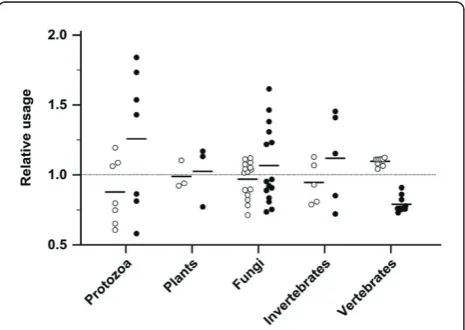
F deviated from the risk of an unbiased codon usage, which is represented byF= 1.0 (Figure 2). All 10 verte-brates had an F< 1.0 and were clustered (0.93 ± 0.02, range 0.91 - 0.96), while theFof all 30 non-vertebrates was higher and ranged widely (1.02 ± 0.13, range 0.82 -1.37; P= 0.019). Fifteen non-vertebrate species had anF
> 1.0.
Fand GC content
Fcorrelated strongly and inversely with the GC content of the CDS (Figure 3; Pearson’sr = -0.95; P < 0.0001). The inverse correlation of F and GC content is explained by the nucleotide composition of the three stop codons: TAA, TAG, and TGA. The GC content of these three codons is only 2/9, while the expected mean
is 1/2. Codons with a high GC content have a nucleotide
codons. In comparison, codons with a low GC content are more similar to the stop codons. Hence, codons with a high GC content have on average a lower risk of acquiring a nonsense mutation (Additional file 1, Table S5).
The GC content of codons correlates with the overall GC content of the genomes in many species [9,12,24]. This was confirmed by our data (Additional file 1, Tables S3 and S4). Genes and gene families occur more frequently in genome regions with a high GC content [25,26]. Both observations have been attributed to mechanisms that enrich the GC content, e.g. the
increased recombination rates in GC rich regions [27]. High GC content is also associated with increased gene density [28,29], shorter introns [26,28], and longer exons [30].
However, CpG hypermutability, a tenfold increased mutation risk at the position of CpG dinucleotides, causes genomes to drift from a high GC content to a high AT content [31,32]. Active cellular processes are therefore needed to maintain a high GC content [33]. Silencing of specific repair enzymes in S. typhimurium
strains increases the mutation rate 6-fold to 100-fold with 98% of the mutations converting GC to AT; organ-isms with AT rich genomes have been explained by the lack of these repair enzymes [34]. Despite knowing sev-eral mechanisms to increase and maintain a high GC content in a genome, the utility of a high GC content for an organism is not obvious. The maintenance of a high GC content costs energy and inflicts CpG hyper-mutability, but is associated with a low risk of acquiring nonsense mutations.
Fand CpG content
The genomes of all 10 vertebrates had a low risk of acquiring nonsense mutations - as shown by a lowF -while maintaining a low CpG content along with a low CpG hypermutability (Figure 4). This observation is counterintuitive: lowFcorrelated generally with a high GC content (Figure 3) and the associated high CpG content typically inflicts a high risk for mutations. How-ever, all 10 vertebrates expressed a high GC content while keeping the CpG content low in their CDS. The ratio of observed and expected CpG content was lower in the 10 vertebrates (mean 0.48, 95% CI 0.45 - 0.51) than in the 30 non-vertebrates (mean 0.82, 95% CI 0.74 - 0.89; P = 0.0001). With the single exception of the fungusE. cuniculi (F= 0.94 and CpG content = 0.034), harboring the smallest genome in this study, all other 29 non-vertebrate species were exposed either to a high
For to a high CpG content in their CDS (Figure 4).
Fand codon usage
[image:5.595.56.291.88.255.2]In the 10 vertebrates, codon usage was consistently biased towards codons without risk of acquiring non-sense mutations (Figure 5). Codon usage bias can con-trol translation speed and protein folding, increase the efficiency of protein synthesis [1], and be influenced by tRNA concentrations in many species [8]. Nonsense errors that occur during translation delay protein synth-esis and cost energy [35]. Use of specific codons is cru-cial near splice sites because even synonymous mutations at splice sites can lead to splice variants caus-ing phenotypical changes [36] or diseases [37]. The pre-ferred usage of codons with lower risk of acquiring nonsense mutations may indicate an additional driving
Figure 2Stop risk factorFin the coding sequences (CDS) of 40 species.Fcharacterizes the relative risk of acquiring nonsense mutations and is shown for 40 species in 5 groups. The black bar represents the mean. The CDS in a species with an unbiased codon usage has anF= 1.0 (dotted line).
Figure 3GC content of CDS relative toF. The correlations are shown between the GC content of all CDS in 40 species and the stop risk factorF. The species are grouped like in Figure 2: protozoa (△), plants (□), fungi (○), invertebrates (▲), and vertebrates (●). The CDS in a species with an unbiased codon usage has anF= 1.0 (dotted line).
Schmid and FlegelJournal of Translational Medicine2011,9:87 http://www.translational-medicine.com/content/9/1/87
force for codon usage bias at the genomic level. Indeed, this was found in all vertebrates.
Conclusions
[image:6.595.57.291.88.260.2]We show that the codon usage bias in genomes of high GC content is associated with a low risk of acquiring nonsense mutations. Despite their high GC content, the 10 vertebrate genomes had a low CpG content of < 0.04 (Figure 4). The low risk of acquiring nonsense muta-tions combined with a low exposure to CpG hypermut-ability [38] is unique in vertebrates. It was not a common feature in the 30 examined non-vertebrates. A low risk of acquiring nonsense mutations may have
advantages for organisms with relatively long lifespans and small numbers of offspring.
Calculating F is a novel tool for addressing codon usage bias in genes and genomes. Here we applied this approach for comparing the whole genomes among species. F can be applied to study GC content shift within the genome of one species [10]. F should also provide novel insights in the analysis of individual genes, like oncogenes and evolutionary conserved genes. Based on the fact that a very low F indicates a gene with a low risk of acquiring nonsense mutations,
F may be used as a screening tool among the genes with presently unknown function. First, genes with a very low Fmay more likely belong to the set of crucial genes, whose loss is deleterious for an organism. Sec-ond, genes with a very high Fmay have a large num-ber of null alleles in the population, which allows a wider variety of recessive alleles to become phenotypi-cally expressed. Third, the fitness of a species is not just influenced by mutations in its germ line but also in the organism’s somatic cells, which could be evalu-ated using our novel method.
We restricted our current approach to nonsense mutations. It is feasible to broaden our technique and to encompass missense mutations. While nonsense tions are a more stringent criterion than missense muta-tions, more codon usage bias could be explained by including unfavorable non-conservative missense muta-tions in the analysis.
Conflict of interest disclosure
The authors declare that they have no competing interests.
Additional material
[image:6.595.58.291.513.678.2]Additional file 1: Figure S1. Flowchart for selection of whole genome data sets.Table S1. List of species that were analyzed in this study.Table S2. CDS selection for analysis.Table S3. CDS analysis data. Table S4. Whole genome analysis data.Table S5. GC content and risk scoreωof the 61 codons.
Acknowledgements and Funding
We acknowledge the discussions with Franz F. Wagner in 1996 while working on Bombay blood group alleles [16] when the idea for this study was conceived. We thank Elizabeth Furlong and Michael J. Huvard for English editing. This research was supported by the Intramural Research Program of the NIH Clinical Center. PS was initially supported by a Swiss National Science Foundation fellowship (SNSF no. PBBEA-121056). The views expressed do not necessarily represent the view of the National Institutes of Health, the Department of Health and Human Services, or the U. S. Federal Government.
Authors’contributions
WAF conceived the study; PS developed the analysis software; WAF and PS analyzed and interpreted the data, and wrote the manuscript. Both authors read and approved the final manuscript.
Figure 4CpG content of all CDS in 40 species relative toF. Symbols are identical to Figure 3: protozoa (△), plants (□), fungi (○), invertebrates (▲), and vertebrates (●). The CDS in a species with an unbiased codon usage has anF= 1.0 (horizontal dotted line). All vertebrates have a CpG content < 0.04 (vertical dotted line).
Received: 31 May 2011 Accepted: 8 June 2011 Published: 8 June 2011
References
1. Fredrick K, Ibba M:How the sequence of a gene can tune its translation. Cell2010,141:227-229.
2. Mueller S, Coleman JR, Papamichail D, Ward CB, Nimnual A, Futcher B, Skiena S, Wimmer E:Live attenuated influenza virus vaccines by computer-aided rational design.Nat Biotechnol2010,28:723-726. 3. van Weringh A, Ragonnet-Cronin M, Pranckeviciene E, Pavon-Eternod M,
Kleiman L, Xia X:HIV-1 modulates the tRNA pool to improve translation efficiency.Mol Biol Evol2011.
4. Grantham R, Gautier C, Gouy M, Pavé A:Codon catalog usage and the genome hypothesis.Nucleic Acids Res1980,8:r49-r62.
5. Wright F:The‘effective number of codons’used in a gene.Gene1990, 87:23-29.
6. Sharp PM, Li WH:The codon adaptation index - a measure of directional synonymous codon usage bias, and its potential applications.Nucleic Acids Res1987,15:1281-1295.
7. Davis JJ, Olsen GJ:Modal codon usage: assessing the typical codon usage of a genome.Mol Biol Evol2010,27:800-810.
8. Ikemura T:Correlation between the abundance of Escherichia coli transfer RNAs and the occurrence of the respective codons in its protein genes: a proposal for a synonymous codon choice that is optimal for the E. coli translational system.J Mol Biol1981,151:389-409. 9. Sharp PM, Li WH:An evolutionary perspective on synonymous codon
usage in unicellular organisms.J Mol Evol1986,24:28-38. 10. Jørgensen FG, Schierup MH, Clark AG:Heterogeneity in regional GC
content and differential usage of codons and amino acids in GC-poor and GC-rich regions of the genome of Apis mellifera.Mol Biol Evol2007, 24:611-619.
11. Chen SL, Lee W, Hottes AK, Shapiro L, McAdams HH:Codon usage between genomes is constrained by genome-wide mutational processes.Proc Natl Acad Sci USA2004,101:3480-3485.
12. Lü H, Zhao WM, Zheng Y, Wang H, Qi M, Yu XP:Analysis of synonymous codon usage bias in Chlamydia.Acta Biochim Biophys Sin (Shanghai)2005, 37:1-10.
13. Hentze MW, Kulozik AE:A perfect message: RNA surveillance and nonsense-mediated decay.Cell1999,96:307-310.
14. Hahn WC, Dunn IF, Kim SY, Schinzel AC, Firestein R, Guney I, Boehm JS: Integrative genomic approaches to understanding cancer.Biochim Biophys Acta2009,1790:478-484.
15. Yamamoto F, Clausen H, White T, Marken J, Hakamori S:Molecular genetic basis of the histo-blood group ABO system.Nature1990,345:229-233. 16. Wagner FF, Flegel WA:Polymorphism of the h allele and the population
frequency of sporadic nonfunctional alleles.Transfusion1997,37:284-290. 17. Wagner FF, Bittner R, Petershofen EK, Doescher A, Müller TH:Cost-efficient
sequence-specific priming-polymerase chain reaction screening for blood donors with rare phenotypes.Transfusion2008,48:1169-1173. 18. Su J, Zhang Y, Lv J, Liu H, Tang X, Wang F, Qi Y, Feng Y, Li X:CpG_MI: a
novel approach for identifying functional CpG islands in mammalian genomes.Nucleic Acids Res2010,38:e6.
19. Josse J, Kaiser AD, Kornberg A:Enzymatic synthesis of deoxyribonucleic acid. VIII. Frequencies of nearest neighbor base sequences in deoxyribonucleic acid.J Biol Chem1961,236:864-875. 20. Swartz MN, Trautner TA, Kornberg A:Enzymatic synthesis of
deoxyribonucleic acid. XI. Further studies on nearest neighbor base sequences in deoxyribonucleic acids.J Biol Chem1962,237:1961-1967. 21. Bird AP:DNA methylation and the frequency of CpG in animal DNA.
Nucleic Acids Res1980,8:1499-1504.
22. NCBI:Eukaryotic Genome Sequencing Projects.Internet2010 [http://www. ncbi.nlm.nih.gov/genomes/leuks.cgi], accessed on 03-30-2010.
23. Pruitt KD, Katz KS, Sicotte H, Maglott DR:Introducing RefSeq and Entrez Gene: curated human genome resources at the NCBI.Trends Genet2000, 16:44-47.
24. Hershberg R, Petrov DA:General rules for optimal codon choice.PLoS Genet2009,5:e1000556.
25. Zeeberg B:Shannon information theoretic computation of synonymous codon usage biases in coding regions of human and mouse genomes. Genome Res2002,12:944-955.
26. Galtier N, Paganeau G, Mouchiroud D, Duret L:GC-content evolution in mammalian genomes: the biased gene conversion hypothesis.Genetics
2001,159:907-911.
27. Fullerton SM, Carvalho AB, Clark AG:Local rates of recombination are positively correlated with GC content in the human genome.Mol Biol Evol2001,18:1139-1142.
28. Lander ES, Linton LM, Birren B, Nusbaum C, Zody MC, Baldwin J, Devon K, Dewar K, Doyle M, FitzHugh W, Funke R, Gage D, Harris K, Heaford A, Howland J, Kann L, Lehoczky J, LeVine R, McEwan P, McKernan K, Meldrim J, Mesirov JP, Miranda C, Morris W, Naylor J, Raymond C, Rosetti M, Santos R, Sheridan A, Sougnez C,et al:Initial sequencing and analysis of the human genome.Nature2001,409:860-921.
29. Mouchiroud D, D’Onofrio G, Aïssani B, Macaya G, Gautier C, Bernardi G:The distribution of genes in the human genome.Gene1991,100:181-187. 30. Oliver JL, Marín A:A relationship between GC content and
coding-sequence length.J Mol Evol1996,43:216-223.
31. Coulondre C, Miller JH, Farabaugh PJ, Gilbert W:Molecular basis of base substitution hotspots in Escherichia coli.Nature1978,274:775-780. 32. Duncan BK, Miller JH:Mutagenic deamination of cytosine residues in
DNA.Nature1980,287:560-561.
33. Michaels ML, Cruz C, Grollman AP, Miller JH:Evidence that MutY and MutM combine to prevent mutations by an oxidatively damaged form of guanine in DNA.Proc Natl Acad Sci USA1992,89:7022-7025.
34. Lind PA, Andersson DI:Whole-genome mutational biases in bacteria.Proc Natl Acad Sci USA2008,105:17878-17883.
35. Gilchrist MA, Shah P, Zaretzki R:Measuring and detecting molecular adaptation in codon usage against nonsense errors during protein translation.Genetics2009,183:1493-1505.
36. Luettringhaus TA, Cho D, Ryang DW, Flegel WA:An easy RHD genotyping strategy for D- East Asian persons applied to Korean blood donors. Transfusion2006,46:2128-2137.
37. Chamary JV, Parmley JL, Hurst LD:Hearing silence: non-neutral evolution at synonymous sites in mammals.Nat Rev Genet2006,7:98-108. 38. Misawa K, Kikuno RF:Evaluation of the effect of CpG hypermutability on
human codon substitution.Gene2009,431:18-22.
doi:10.1186/1479-5876-9-87
Cite this article as:Schmid and Flegel:Codon usage in vertebrates is
associated with a low risk of acquiring nonsense mutations.Journal of
Translational Medicine20119:87.
Submit your next manuscript to BioMed Central and take full advantage of:
• Convenient online submission
• Thorough peer review
• No space constraints or color figure charges
• Immediate publication on acceptance
• Inclusion in PubMed, CAS, Scopus and Google Scholar
• Research which is freely available for redistribution
Submit your manuscript at www.biomedcentral.com/submit Schmid and FlegelJournal of Translational Medicine2011,9:87
http://www.translational-medicine.com/content/9/1/87