EFFECTIVENESS OF CHILD TO CHILD PROGRAM THROUGH
POWER POINT PRESENTATION ON KNOWLEDGE
REGARDING ILL EFFECTS OF TELEVISION
WATCHING AMONG SCHOOL
CHILDREN
A DISSERTATION SUBMITTED TO THE TAMIL NADU
DR. M.G.R. MEDICAL UNIVERSITY, CHENNAI,
IN PARTIAL FULFILLMENT OF THE
REQUIREMENTS FOR THE DEGREE
OF MASTER OF SCIENCE
IN NURSING
EFFECTIVENESS OF CHILD TO CHILD PROGRAM THROUGH
POWER POINT PRESENTATION ON KNOWLEDGE
REGARDING ILL EFFECTS OF TELEVISION
WATCHING AMONG SCHOOL
CHILDREN
BY
301317152
A DISSERTATION SUBMITTED TO THE TAMIL NADU
DR. M.G.R. MEDICAL UNIVERSITY, CHENNAI,
IN PARTIAL FULFILLMENT OF THE
REQUIREMENTS FOR THE DEGREE
OF MASTER OF SCIENCE
IN NURSING
Certified that this is the bonafide work of
301317152
At the Annammal College of Nursing,
Kuzhithurai.
Submitted in partial fulfillment of the requirements for
the degree of Master of Science in Nursing from the Tamilnadu
Dr. M.G.R. Medical University, Chennai.
Examiners
1.
2.
Prof. Mrs.J.M. JerlinPriya., M. Sc (N), Ph. D
Principal
EFFECTIVENESS OF CHILD TO CHILD PROGRAM THROUGH
POWER POINT PRESENTATION ON KNOWLEDGE
REGARDING ILL EFFECTS OF TELEVISION
WATCHING AMONG SCHOOL
CHILDREN
RESEARCH GUIDE«««««««««««««««««««
Prof. Mrs. J.M.JerlinPriyaM.Sc (N).,Ph. D
Principal, Annammal College of Nursing,
Kuzhithurai, K.K District, Tamil Nadu.
CLINICAL GUIDE«««««««««««««««««««
Mrs. B. Bebiula Sahaya Rani M.Sc (N).,
HOD in Child health Nursing,
Annammal College of Nursing,
Kuzhithurai, K.K District, Tamil Nadu.
MEDICAL GUIDE: ...
Dr. Rajendran, MBBS. DCH
Paediatrician,
Rajendran Clinic,
Marthandam.
A DISSERTATION SUBMITTED TO THE TAMIL NADU
DR. M.G.R. MEDICAL UNIVERSITY, CHENNAI,
IN PARTIAL FULFILLMENT OF THE
REQUIREMENTS FOR THE DEGREE
OF MASTER OF SCIENCE
IN NURSING
DECLARATION
I hereby declare that the present dissertation title ³A study to assess the effectiveness
of child to child program through power point presentation on knowledge regarding ill
effects of television watching among school children in Kids Oxford Matriculation
Higher Secondary school, Kuzhithurai at Kanyakumari District´ is the outcome of the
original research work undertaken and carried out by me under the guidance of Prof. Mrs.
J.M Jerlin Priya M.Sc (N), Ph.D Principal cum professor in Medical Surgical Nursing
Department, and Mrs. B. Bebiula Sahaya Rani M.Sc (N), HOD, in Child health Nursing.
I also declare that the material of this has not found in any way, the basis for the award of any
degree or diploma in the university or any other university.
301317152
ACKNOWLEDGEMENT
I wish to acknowledge my heartfelt gratitude to the LORD ALMIGHTY for all the
wisdom, knowledge, guidance, strength, protection, shield and support. He has offered me
throughout this endeavour and given me courage to overcome the difficulties and thus
complete this study successfully.
It is my honour to thank our beloved Chairman Dr. Sheeba Jayalal MBBS., DGO.,
for providing entire facility and encouragement for conducting this study.
I express my sincere gratitude to Dr.Jayalal MS., FICS., DLS(Germany)., MBA.,
FIAGES., Hon. Secretary of Annammal College of Nursing for giving me the precious
opportunity to be a part of this esteemed institution.
I, consider myself to be privileged to express my honest and sincere gratitude to
Prof. Mrs. J.M. Jerlin Priya M.Sc (N)., Ph.D Principal cum professor, Annammal College
of Nursing, for her invaluable guidance, affection, continuous support, promising criticisms,
suggestions and concern during the entire course of this dissertation.
At this moment I convey my profound gratitude to Mrs. Sujatha M.Sc(N)., Vice
Principal and Class Coordinator of II year M. Sc Nursing, for her guidance, encouragement
and support which helped me in completion of this dissertation.
I extend my deepest gratitude to Mrs. B. Bebiula Sahaya Rani. M.Sc. (N)., HOD in
Child Health Nursing for her time in checking and rechecking the manuscripts and for
sharing her suggestions which was a key for the successful completion of this study.
I express my thanks to Mrs. Shali. M.Sc. (N)., Mrs. Divya. M.Sc (N), Assistant
Professors in Department of Child Health Nursing for their guidance and suggestions for the
completion of the study.
I express my thanks to the entire faculty of Annammal College of Nursing,
Kuzhithurai, for their co-operation and encouragement.
I am pleased to convey my profound thanks to Headmistress, Kids Oxford
Matriculation Higher Secondary School, Kuzhithurai who allowed me to conduct this
I am deeply indebted to Dr. Rajendran MBBS, DCH., Paediatrician, Rajendran
Clinic, Marthandam my Medical guide for his timely advice and guidance throughout the
study.
I extend my thanks to Mr. Anto John Britto M.Sc., M.Ed., M.Phil., P.G.DBM.,
Professor of Bio Statistics, for his valuable opinion, suggestions and guidance in analysis and
interpretation of data.
I am very much grateful to Mrs. Mary Shajitha., Librarianof my college for her help
in procuring books whenever required.
I thank all the office staff for their help in taking photocopies of study reviews.
I express my deep sense of gratitude and heartfelt thanks to the experts who have
validated and edited my study and who devoted their valuable hours in solving my doubts
and in providing meticulous attention.
,W¶V P\ JUHDW SOHDVXUH WR H[SUHVV P\ GHHS VHQVH RI VSHFLDO JUDWLWXGH WR P\parents
M.Gabriel (late), Mr. G.Mary Sarojam, my loving husband Mr. B. Vinoj B.E, my
daughter V.B. Juhia, my son V.B. Juhaan, my father in law Mr. V. Bala Krishnan, my
mother in law Mrs. Renjethem, my family members and my dear friends for their
continuous help and support throughout the study and encouraging me to overcome the tides
of heavy schedules and problems in the path of progress in this study.
301323152
TABLE OF CONTENTS
CHAPTER NO CONTENTS PAGE NO
I INTRODUCTION
Background of the study
Need for the study
Statement of the problem
Objectives of the study
Hypotheses
Assumptions
Operational definitions
Delimitations
Projected Outcome
Conceptual framework
Summary
1-10
2
4
5
5
6
6
7
8
8
8
9
II REVIEW OF LITERATURE
x Studies related to ill effects of television
watching.
x Studies related to effectiveness of child to child
program on various health aspects.
x Studies related to effectiveness of child to child
program regarding ill effects of television
watching.
Summary
11-17
11
CHAPTER NO CONTENTS PAGE NO
III RESEARCH METHODOLOGY
Research approach
Research design
Variables
Settings
Population
Sample
Sample size
Sampling technique
Sampling criteria
Development of the tool
Description of the tool
Validity
Reliability
Pilot study
Data collection procedure
Plan for data analysis
Ethical consideration
Summary
18-26
18
18
20
20
21
21
21
22
22
22
23
24
24
24
25
25
26
CHAPTER NO CONTENTS PAGE NO
IV DATA ANALYSIS AND INTERPRETATION 28-49
V DISCUSSION 50-53
VI SUMMARY, CONCLUSION, IMPLICATIONS
AND RECOMMENDATIONS
54-61
REFERENCES
LIST OF TABLES
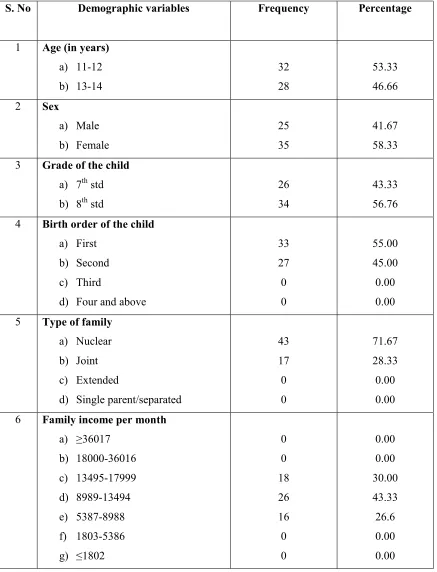
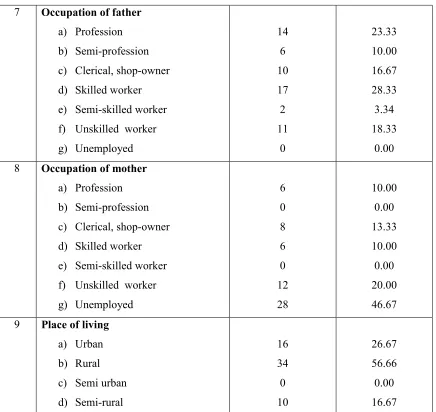
TABLE NO TITLE PAGE NO
1. Data pertaining to the frequency and percentage distribution
of socio-demographic variables among school children 30
2. Data pertaining to the frequency and percentage distribution
of clinical variables among school children 40
3
Data pertaining to pre-test and post-test level of knowledge
regarding ill effects of television watching among school
children
44
4.
Data pertaining to the effectiveness of child to child program
through power point presentation on knowledge regarding ill
effects of television watching among school children
45
5.
Data on association between the post test level of knowledge
and selected socio demographic variables among school
children.
46
6. Data on association between the post test level of knowledge
LIST OF FIGURES
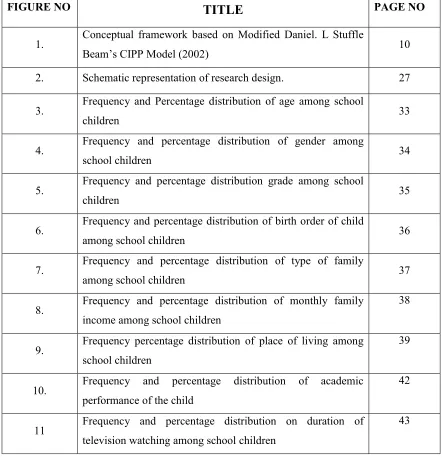
FIGURE NO
TITLE
PAGE NO1. Conceptual framework based on Modified Daniel. L Stuffle
%HDP¶V&,330RGHO) 10
2. Schematic representation of research design. 27
3. Frequency and Percentage distribution of age among school
children 33
4. Frequency and percentage distribution of gender among
school children 34
5. Frequency and percentage distribution grade among school
children 35
6. Frequency and percentage distribution of birth order of child
among school children 36
7. Frequency and percentage distribution of type of family
among school children 37
8. Frequency and percentage distribution of monthly family
income among school children
38
9. Frequency percentage distribution of place of living among
school children
39
10. Frequency and percentage distribution of academic
performance of the child
42
11 Frequency and percentage distribution on duration of
television watching among school children
LIST OF ANNEXURES
ANNEXURE NO TITLE
I Letter seeking permission to conduct the study.
II Letter granting permission to conduct the study.
III Ethical Committee Letter.
IV Letter seeking H[SHUW¶V opinion for the validity of the tool.
V Evaluation criteria checklist for validating the tool.
VI List of experts.
VII Research Participants consent form.
VIII Certificate of English Editing.
IX Certificate of Statistical analysis and interpretation.
X
Tool for data collection
Tool: I Demographic variables.
Tool: II Structured Knowledge Questionnaire on ill effects of television watching
XI Lesson plan on ill effects of television watching
ABSTRACT
EFFECTIVENESS OF CHILD TO CHILD PROGRAM THROUGH POWER POINT
PRESENTATION ON KNOWLEDGE REGARDING ILL EFFECTS OF
TELEVISION WATCHING AMONG SCHOOL CHILDREN
INTRODUCTION
Television watching is an enjoyable activity for the children. It is the window of the
world. From the past few decades television has crawled to Indian homes. Accessibility to
television is on increase day by day and has been accepted by the society. Varieties of
programmes like News, Sports, Educative, Entertainment, Cartoon etc are available round the
clock. These are especially designed to attract all sectors of society, specially the children.
Children who watch television too much have several bad effects, three of which are effect to
their cognitive, effect to their health, and effect to their habit. First effect is to their cognitive.
Children who watch television programs can be lack of concentration. The second effect is to
their health. The child who likes to watch television programs can be in front of it many
hours. If the children watch television programs too much, they will have a problem with
their eyes, overweight, etc. The third effect is their habit. They become lazy to do something
else such as study because they do not want to miss the television programs. It will influence
their intelligence. Another bad effect to their habit is they will be influenced a violence in
some television programs because they have not been able to think long and think what is
better or bad. In brief, watching TV programs too much will give the children bad effects.
Chithra J (2009) conducted a quasi- experimental study to evaluate the effectiveness
of child-to child approach through planned teaching program in reducing harmful effects of
TV watching among selected schools in Bangalore. An evaluatory approach with pre test and
post test design was used. Convenient sampling technique was used. Sample sizes of 60, 8th
standard school children were selected. A structured questionnaire was conducted to select
the change agent. Child to child programme was conducted through planned teaching
program. There was significant difference between pre-test and post-test results about
harmful effects of TV watching. The major findings of the study revealed that the knowledge
child-to-child programme through planned teaching program reducing the harmful effects of TV
watching was effective in school children.
Kennedy John (2013) conducted a study to evaluate the effectiveness of child to
child programme in rural Hariyana about the concept of television watching and its bad
effects. A child to child programme was carried out in eighth and ninth standard students of
six rural schools. 590 students and 80 peers from four of the project schools were evaluated
and compared with 199 children and 45 peers from two control schools. The project children
showed higher knowledge in the topic at the end of the year. They also improved their
practices at home.
STATEMENT OF THE PROBLEM
A study to assess the effectiveness of child to child program through power point
presentation on knowledge regarding ill effects of television watching among school
children in Kids Oxford Matriculation Higher Secondary School, Kuzhithurai at
Kanyakumari District.
OBJECTIVES OF THE STUDY
x To assess the pre test and post test level of knowledge regarding ill effects of
television watching among school children.
x To evaluate the effectiveness of child to child program through power point
presentation by comparing the pre test and post test level of knowledge regarding ill
effects of television watching among school children.
x To find out the association between the post test level of knowledge regarding ill
effects of television watching and selected socio demographic and clinical variables
among school children.
HYPOTHESES
H1 - There will be a significant difference between pre test and post test level of knowledge
regarding ill effects of television watching among school children.
H2 - There will be significant association between the post test level of knowledge and
RESEARCH METHODOLOGY
A quantitative study was conducted to assess the effectiveness of child to child
program through power point presentation regarding ill effects of television watching.
The study was conducted in Kids Oxford Matriculation Higher Secondary School,
Kuzhithurai at Kanyakumari District. Formal permission was obtained from the school before
the data collection. The researcher selected 6 change agents and the health education on ill
effects of television watching was given to them by the researcher using power point
presentation. Sample size was 60 and simple random sampling was used to select the
samples. Pre test was conducted by using structured knowledge questionnaire. The total 60
samples were divided into 6 subgroups. Each group of 10 students were educated regarding
ill effects of television watching by the 6 change agents who underwent health education
classes by the investigator already. Post test was administered after 7 days of child to child
programme. The same knowledge questionnaire was used to collect the post test data. After
that the post test score was evaluated.
DATA ANALYSIS
Collected data was analysed and interpreted as per the objectives of the study by using
the descriptive and inferential statistics such as frequency, percentage, mean, standard
deviation, paired µW¶WHVWDQGFKLVTXDUH3DLUHG µW¶WHVWZDV used to compare the pre test and
post test level of knowledge among school children. Chi square test was used to find out the
association of post test level of knowledge with their selected socio demographic and clinical
variables.
FINDINGS OF THE STUDY
Findings related to the effectiveness of child to child program through power point
presentation on knowledge regarding ill effects of television watching among school
children
It represents that in pre test mean value was 13.61 with standard deviation of 2.04. Where as
in post test mean value was 24.92 with standard deviation of 3.42. The mean difference was
11.31 and the paired µW¶ WHVW YDOXH ZDV &KLOG WR FKLOG SURJUDP WKURXJK SRZHU SRLQW
Findings related to association between the post test level of knowledge and selected
socio demographic and clinical variables among school children
It represents the summary of chi-square analysis, which was used to bring out the
association between the post test level of knowledge among school children and their selected
demographic variables like age (0.00000992***) and grade of child (0.00759**) and clinical
variable like previous knowledge (0.0067**) with post test level of knowledge.
RESULT AND SUMMARY
This study was conducted to assess the effectiveness of child to child program
through power point presentation on knowledge regarding ill effects of television watching
among school children. The objectives of the study were to evaluate the effectiveness of child
to child program and find out the association between post test level of knowledge and
selected socio demographic and clinical variables among school children.
In overall, knowledge reveals that child to child program was effective to improve
knoZOHGJH DW µS¶ YDOXH Hence the research hypothesis (H1) was accepted.
Chi square test revealed that there was a significant association between the post test level of
knowledge among school children with their age, grade and previous knowledge. Hence the
research hypothesis (H2) was partially accepted.
CONCLUSION
The study revealed that child to child program helps to improve level of knowledge
regarding ill effects of television watching among school children. The overall experience of
conducting the study was new experience for the investigator in the field of research. The
consent encouragement and the direction of guides, co-operation of respondents to participate
1
CHAPTER I
INTRODUCTION
³7HOHYLVLRQLVDQLQVWUXPHQWZKLFKFDQSDUDO\]HWKLVFRXQWU\´
- William Wetmoreland
Television is the window of the world. From the past few decades television has crawled to
Indian homes. Now the television has its firm roots in many houses across the length and
breadth of the country. Accessibility to television is on increase day by day and has been
accepted by the society. Varieties of programmes like News, Sports, Educative,
Entertainment, Cartoon etc are available round the clock. These are especially designed to
attract all sectors of society, specially the children. Many targeted programmes and
commercials in television are drawing more number of children to its folds.
Television viewing is quite random these days. People are more addicted to it rather than
giving time to their dear ones. ,W¶V getting quite serious and people should understand that, it
is affecting their social life and thus, they should limit their viewing. The number of TV
owning homes has come a long way; more than 100 million TV households have been
accounted for so far. The cable operators have done a good job by building up a cable and
satellite penetration of 90 million homes all over India. Most viewers in future will, however,
are watching their TV mainly via cable, terrestrial and direct to home television delivered via
satellite. Cable TV infrastructure will have improved.
The media that has most impact on children in the world is Television. It has also become one
of the most significant socializing agents in the lives of young children. They are particularly
vulnerable to the messages conveyed through television, which influence what they think and
how they behave. The TV viewer has to sit in front of this glamorous small screen. Such
practices have the possibility of hindering the physical, mental and psychological wellbeing.
But today the beneficial and adverse effects of television are a matter of great concern. The
harmful effects have been often postulated and reported. But no serious scientific attempts
2
associated with a variety of significantbehavioural consequences, including obesity and poor
eating habits, decreased physical activity and physical fitness, and impaired school
performance. Television-viewing habits could havethis impact on sleep. The presence of an
independent factor, such as poor parental limit-setting, may account for both excessive
televisionwatching and bedtime resistance. Obviously television watching is harmful to both
children and adult. If awareness come in to act, the ill effects of television watching can be
prevented among children.
BACKGROUND OF THE STUDY
7HOHYLVLRQDQGFRPSXWHUQHWZRUNVKDYHDVVXPHGFHQWUDOUROHVLQ RXUFKLOGUHQ¶VGDLO\ OLYHV
The media has demonstrated potentially profound effects, both positive and negative, on
childreQ¶V FRJQLWLYH VRFLDO DQG EHKDYLRXUDO GHYHORSPHQW ,W LV ZLGHO\ DFFHSWHG WKDW PHGLD
has profound influence on child health, including violence, obesity, tobacco and alcohol use,
and risky sexual behaviours.
The effects of the television watching have been found to be far-reaching and potentially
harmful in influencing the health-related behaviours of children and adolescents, many of
whom are not yet mature enough to distinguish fantasy from reality, particularly when it is
SUHVHQWHG DV ³UHDO OLIH´ 7Kis is particularly important for very young children who
developmentally think concretely and are unable to distinguish fantasy from reality.
Furthermore, time spent with media decreases the amount of time available for pursuing other
more healthy activities such as sports, physical activity, community service, cultural pursuits,
and family time.
Most researchers have concluded that protracted Television can have detrimental effects on
children. It has primary negative health effects on behaviours, sexuality, academic
performance, body concept, self image, nutrition, dieting and obesity, and substance abuse.
Increase verbal and physical aggressiveness, reduced persistence at problem solving, greater
sex stereotyping and reduced creativity have been reported repeatedly. Like movies,
television programme and commercials contain many implicit and explicit messages that
3
In terms of health, excessive television viewing has been linked to obesity and high
cholesterol levels in children.The main problem is obesity through a lack of exercise, and so
television has been blamed for this in part. This is because watching television distracts the
receptors in the brain which let the child know when they are full. However, there is no
research to state that this has any more effect than general family habits. Television is like
any other factor in life; it viewing, and so it is down to personal and family choice.
According to IAP 2010, Children, who observe others exhibiting a specific aggressive
behaviour in the media or in the environment around them are more likely to perform the
same aggressive behaviour immediately. Exposure to media violence has been positively
related to subsequent aggressive behaviour, ideas, arousal, and anger. Additionally, there is a
significant negative effect of exposure to violence on subsequent helping behaviour.
Infrequent exposure is not likely to produce lasting consequences, but parents, particularly
need to be urged to protect their children against the kind of repeated exposures that
excessive play with violent video games or immersion in violent TV programs.
Ray, et al. (2014) from India reported that children having exposure to violence through
watching television had poorer school performance and its impact on their psychosocial
adjustments was detrimental. Another study from India showed that vivid display of violence
through media caused stress in adolescents.
Yama, et al. (2012) described that some of the fears, tensions, bad dreams and tendencies
towards delinquencies of children are a result of frequent and a regular exposure to
murder-mystery movies, and stories filled with violence and torture that children view on TV and
movies. Association between TV viewing and suicidal behaviour has also been reported from
India. Both content exposure and screen time of media had independent detrimental
associations with school performance in children and adolescents
Primack, et al. (2009) showed that excessive TV viewing in children is a risk factor for
development of depression in young adulthood. TV viewing may play an exacerbating, if not
causal, role in the development of attention-deficit/hyperactivity disorder (ADHD). This
hypothesis is consistent with evidence indicating that children with ADHD watch more
television than their peers and experience significant impairments in comprehending stories, a
4
NEED FOR THE STUDY
Television is simply automated day-dreaming.
- Lee Lovinger
Child viewer is in very active developmental stages. Their attitudes, beliefs, and ideas about
the world, as well as physical and social skills, are taking form; and they absorb information
from everywhere. Because of the considerable number of hours spent viewing television,
however, television becomes a disproportionately informational and attitudinal source.
The amount of television watched, or thought to have been watched, by children has caused
considerable concern for parents and educators alike. It is thought that children remain glued
to the set for long periods of time, viewing unsuitable programme which may adversely affect
not only their cognitive and emotional development, but their academic achievement. There
is no doubt that children are susceptible to the images which they see on the television screen.
Dietz and Gortmaker (2013) reported that each additional hour of TV viewing per week
increased the risk of obesity by 2%. The experimental study by Robinson found strong
evidence of a causal link between TV viewing and children being Overweight. In India, this
association has also been emphasized. Mechanism of effect of TV exposure on overweight
risk is undoubtedly multifactorial. It appears to operate independently from reduced physical
activity. Excessive TV exposure may instead operate through the extensive advertising
messages for unhealthy foods targeted at very young children or from a tendency of children
to snack while watching TV. A randomized controlled trial found that increasing screen time
resulted in reduced energy expenditure and increased energy intake.
Clara Joel (2012) conducted a descriptive study on determining TV viewing habits of
children and their families as well as parental perspectives on the impact of TV on child
health using a provider completed indigenously developed questionnaire in Hindi. The study
group comprised of 109 children attending a government hospital who belonged
predominantly to lower socio-economic strata with poor maternal literacy. It was observed
that 100 % children watched excessive TV (> 2 hours daily), with majority viewing
unsupervised and low quality content. There were minimal parental restrictions and no active
5
and eating habits in most children. Most parents were unaware of unhealthy viewing and the
associated deleterious effects. The above studies supports strongly that television watching is
harmful to the children.
Ninety eight percent of households have at least one television set and many children have
their own set in their bedrooms. It is extremely unlikely that any child will be denied the
opportunity to watch television. The children who watches too much cartoons on television
are more likely to have a Mental and Psychological Effects. From school age up to their
graduation and a child watches television around 18,000hrs. This comparison is an outrage
because of the amount of television that is watched by a child will have an effect on their
brain, emotions and their sense to feel pain.
Considering the increasing exposure of children to newer forms of media, there is a intense
need to review the current literature on the effects of media on child health both in the
Western countries and India. Hence the investigator, who believes that the students are the
leaders of future India, decided that there is a need to improve the knowledge of the students
regarding ill effects of Television watching through power point presentation. Hence, the
investigator was indentifying the effectiveness of child to child programme.
STATEMENT OF THE PROBLEM
³A study to assess the effectiveness of child to child program through power point
presentation on knowledge regarding ill effects of television watching among school
children in Kids Oxford Matriculation Higher Secondary School, Kuzhithurai at
Kanyakumari District´.
OBJECTIVES OF THE STUDY
x To assess the pre test and post test level of knowledge regarding ill effects of
television watching among school children.
x To evaluate the effectiveness of child to child program through power point
presentation by comparing the pre test and post test level of knowledge regarding ill
6
x To find out the association between the post test level of knowledge regarding ill
effects of television watching and selected socio demographic and clinical variables
among school children.
HYPOTHESES
H1 - There will be a significant difference between pre test and post test level of knowledge
regarding ill effects of television watching among school children.
H2 - There will be significant association between the post test level of knowledge and
selected socio demographic and clinical variables among school children.
ASSUMPTIONS
The study assumes that,
x Television watching will cause increase in the risk of morbidity among school
children like eye strain, obesity, behavioural problems and social withdrawal etc.
x Child to child program may help in enhancing the knowledge of school children
regarding ill effects of television watching.
x Gain in knowledge will help in reducing the ill effects of television watching among
school children.
OPERATIONALDEFINITIONS
Effectiveness
In this study, it refers to the significant improvement in the knowledge scores of school
children regarding ill effects of television watching, which is elicited by comparing pre test
7
Child to child program
It is a programme through which the investigator will teach the selected school children
studying 7th & 8th std about the ill effects of television watching through power point
presentation and prepare them to pass this messages to other siblings or peers, in an effective
way thereby improving the knowledge of school children regarding ill effects of television
watching.
Power point presentation
In this study, power point presentation is a slide show presentation program regarding ill
effects of television watching.
Knowledge
In this study, knowledge refers to the correct response given by the school children regarding
ill effects of television watching, through structured knowledge questionnaire.
Ill effects:
In this study it refers to, alteration in health status of school children as a result of excessive
television watching such as visual disturbances, obesity, heart diseases, behavioural disorders
etc.
Televisionwatching:
In this study, television watching is defined as an act, occasion of seeing the television for the
purpose of entertaining or recreation.
School children:
In this study it refers to the children between the age group of 11 - 14 years and studying
8
DELIMITATIONS
The study is delimited to
¾ School children those who are studying 7th and 8th std.
¾ School children those who are having habits of television watching.
¾ 60 samples only
¾ Period of data collection for 4 weeks.
PROJECTED OUTCOME:
The child to child programme will improve the knowledge on ill effects of television
watching among school children who will help them to reduce the habit of television
watching and disseminate the knowledge to others.
CONCEPUTAL FRAME WORK
Conceptual framework is interrelated concepts or abstractions that are assembled together in
some rational schemes by virtue of their relevance to a common theme.
(Polit and Beck)
The conceptual frame work set up for the study is the modified model of Daniel Stuffle Beam
CIPP model (2002). Daniel Stuffle Beam proposed a prescriptive theory of nursing which is
described as a conceiving of a desired situation of the ways to attain it.
CONTEXT EVALUATION
The context evaluation assess needs, problems, assets and opportunities to help decision
makers define goals and priorities and help the broadergroup of users to judge goals,
priorities and outcomes. The goal of a present study is imparting knowledge regarding ill
effects of television watching among school children in Kanyakumari district.
INPUT EVALUATION
Input evaluation assesses the alternative approaches among competing plans to meet
9
Development of tools to assess the knowledge regarding ill effects of television
watching before and after the child to child program and establishment of content
validity and reliability of the tools.
Development planned health teaching programme and preparation of power point
presentation.
Selecting the change agents.
Health education to change agents through power point presentation regarding ill
effects of television watching.
PROCESS EVALUATION
Process evaluation assess the implementation of plans to help the investigator to
carryout activities and later help the broad group of user judge programme performance and
interpret outcomes.
In this study the process evaluation refers to
x Selection of samples
x Pre test assessment of knowledge by structured knowledge questionnaire.
x Health education regarding ill effects of television watching by change agents.
x Post test assessment of knowledge.
PRODUCT EVALUATION
The Product evaluation identify and assess outcomes of short term and long term both
intended and unintended, which help the investigator keep an enterprise focused on achieving
important outcomes and ultimately to help the broader groups in meeting targeted needs. In
this present study product evaluation refers to effectiveness of child to child program which
was proved by comparing pre test and post test assessment of knowledge regarding ill effects
of television watching.
SUMMARY
This chapter dealt with the detailed information of ill effects of television watching,
background of the study, need for the study, statement of the problem, objectives of the
study, hypotheses, operational definitions, assumptions, delimitation, projected outcome
10
)LJ,&R
QFHSWX
DO)U
DPHZ
RUN%DVHG2Q
0RGLILHG
'DQLHO
/6W
XIIO
H%HD
P¶V&,3
30
RGHO
CO NTEXT E V AL U ATI ON INPUT E V AL U ATI ON PR OC E S S E V AL U ATI ON P R O DUCT EVALUATIO Socio Dem ographic Var iables Ag
e, sex, g
rade o f th e child, b ir th or der of child, ty pe o f f am ily , fam ily incom e per m onth, occupa ti on of fath er, occu pation o f m o
ther and p
lac e of liv ing . Clini cal Va riab le s Academ ic per fo rm ance of child, du
ration of te
lev ision watch ing and prev ious k nowledg e obta ined. Study Se tt ing Kid s Oxfo rd Mat ri culation Hig h er Seconda ry School , Kuz h it hur ai at Kany ak um ari Distri ct Selec ti on o f to ols Dev elopm
ent of p
lann ed he alt h te ach ing prog ramm e Selec ting chan g e ag ent s Healt h edu ca tion to chang e ag ents th roug h power po in t pres entation 60 sa mple s P re te st Hea lth educa tion b y the change agents thro ugh po wer p o int presen tat ion Po st te st Evaluat ing the effect iven ess o f ch il d to ch ild p rogra m Chil d t o ch ild progra m w a s effect
ive to imp
11
CHAPTER II
REVIEW OF LITERATURE
Review of literature is a key step in research process. It refers to an extensive, exhaustive and
systematic examination of publications relevant to the research project. Nursing research may
be considered as a continuing process in which knowledge is gained from earlier studies in an
integral part of research in general.
(Denise F Polit)
Literature review refers to the activities involved in searching for information on a topic and
developing a comprehensive picture of the state of knowledge on the topic.
(Polit and Hungler 1993)
Therefore the investigator studied and received their view of literature to broaden her
understanding about the topic and to gain insight into the selected problem.
In this present study the review of literature are divided into three following headings.
I. Studies related to ill effects of television watching among school children.
II. Studies related to effectiveness of child to child program on various health aspects.
III.Studies related to effectiveness of child to child program regarding ill effects of
television watching.
I. STUDIES RELATED TO ILL EFFECTS OF TELEVISION WATCHING AMONG
SCHOOL CHILDREN
Raghotham Sashidhar (2015) conducted a cross sectional study on different factors
associated with TV watching on vision in school children in Govt. Senior Secondary Schools
of Block Lakhanmajra. Datas were collected from 1265 school children. Students aged 6-15
years studying in class 1 to 10 were included in the study. Visual Acuity (VA) test was
performHGXVLQJ6QHOOHQ¶V(FKDUWDQGDQLQWHUYLHZZDVGRQHRQWKHEDVLVRITXHVWLRQQDLUH
The findings of clinical examination were recorded on a pre-tested performa and were
analyzed. Result of this study was out of 1265, 93 students did not watch TV. Out of the
remaining 1172, 161 students (13.7 %) had defective vision. Out of 109 students (9.3 %) who
watched TV in darkness, 24 students (22%) had defective vision. Out of 129 students (11 %)
who watched TV from a distance of less than 5 feet, 27 students (20.9 %) had defective
12
(12.4 %) had defective vision and out of 129 students (11%) who watched TV from a
distance >10 feet, 21 students (16.3%) had defective vision. Prevalence of defective vision
was more in cases of longer duration of TV watching. The results indicated that distance,
GXUDWLRQDQGHQYLURQPHQWRIWHOHYLVLRQZDWFKLQJPD\EHUHVSRQVLEOHIRULPSDLULQJDFKLOG¶V
visual development. Defective vision can have a long term impact on the learning abilities of
school children.
Lacunae, (2014) conducted a cross sectional study on television viewing habits among high
school children to know the beneficial and harmful effects of television viewing in
Khammam Town. 450 children in between 13 and 15 years of age, of both sex, studying in
different schools were selected by simple random technique. Information was collected in a
pre-structured proforma by interview method. The data thus obtained was subjected for
analysis by using appropriate statistical tests. Data was statistically analysed by using
Statistical Package for Social Sciences. P value <0.05 was considered to be statistically
significant. The study revealed that out of 450 children 251 were Male and 199 were Female.
Average time for TV viewing was 1.96 hours ± 1.0 /day with a range from 1 to 6 hours /day.
Headache (12.6%), eye strains (11.5%), sleep disturbances (10.8%), neck pain (0.4%), nail
biting (8.6%), etc were the health disturbances due to television viewing. So the study was
concluded that, duration of TV viewing had direct role in causing headache and eye strain.
Bickham, et al. (2013) investigated the relationship between TV viewing time, content,
context and peer integration in Delhi. As children spend more total time watching TV, they
VSHQG D VLJQLILFDQWO\ VKRUWHU DPRXQW RI WLPH ZLWK IULHQGV DV FRPSDUHG WR WKRVH ZKR GRQ¶W
Thus, viewing television causes poor peer relationships and thereby increases the risk for
social isolation, anxiety disorder, agoraphobia and antisocial behaviour, including aggression
and gang involvement. Study concluded that children who are spending more time to watch
television are at risk for exhibiting aggressive and violent behaviour.
Joyce Giammattei, et al (2013) conducted a prospective cohort study on television exposure
as a risk factor for aggressive behaviour among children in Maharashtra. Data collected at
home and by telephone from parents of children born from 1998 to 2000 from 20 cities
(n = 3128). Results showed that the children who were spanked in the past month
(beta = 1.24, P < 0.001), lived in a disorderly neighbourhood (beta = 2.07, P < 0.001), and
13
P < 0.001) were significantly more likely to exhibit aggressive behaviour. Direct child TV
exposure (beta = 0.16, P < 0.001) and household TV use (beta = 0.09, P < 0.001) were also
significantly associated with childhood aggression, even when controlling for other factors.
Study concluded that children exposed to more TV are at increased risk for exhibiting
aggressive behaviour.
Marshall S J, et al (2012) conducted a Meta analysis study on relationship between media
use, body fatness and physical activity in children and youth in Manipur. Included studies
presented at least one empirical association between Television viewing, video / computer
game use and body fatness or physical activity among samples of children and youth aged
2 ± 18 years. Based on data from 52 independent samples, the mean sample ± weighted effect
size between Television viewing and body fatness was 0.066. The sample weighted fully
corrected effect size was 0.084. A statistically significant relationship exists between
television viewing and body fatness among children and youth.
Parameshwara Reddy (2009) conducted a study on the effects of television viewing on a
child's eating habits, general physical health, physical activities and interest in study and
school performance at Sir Padampat Mother & Child Health Institute, Jaipur (Rajasthan). 250
children of 3-10 years age groups were studied for a period of nine months (January 2009 to
September 2009). Average duration of television exposure to an individual child was 18.5
hours per week in the study. Increase in weight was observed in 19.6% children suggesting
that the television viewing may predispose to childhood obesity. In 30.4% cases decrease in
physical activity was found, 18.4% children showed decreased interest in study, while 10%
children showed decrease in school performance and sleep pattern was disturbed in 24%
children. Medical problems were found in 11.6% children. Significantly two children had
precipitation of fits on television viewing.
Villani S (2006) conducted a study on impact of media on children and adolescents to review
the research literature published within the past 10 years regarding the impact of media on
children and adolescents in Orissa. Media categories researched with computer technology
included Television and movies, rock music and music videos, advertising, video games, and
computers and the Internet. The primary effects of exposure are increased violent and
aggressive behaviour, increased high risk behaviours, including alcohol and tobacco use,
14
Munni Ray (2005) conducted a survey study on television viewing and dietary intake in
Chandigar. With the instrument of questionnaires, were analyzed for 564 middle school
students and 1366 high school students who had complete data. The children were
categorized that limited television users (<2 hours/daily), moderately high television viewers
(2-5 hours/daily), and heavy television viewers (>/=5 hours/daily). Among the younger
cohort, heavy television viewers reported lower fruit intake and higher sugar-sweetened
beverage consumption than the other two groups. Among the older cohort, watching five or
more hours of television per day, predicted lower intakes of fruits, vegetables, whole grain
and calcium-rich foods, and higher intakes of trans fat, fried foods, fast food menu items,
snack products, and sugar-sweetened beverages (products commonly advertised on
television) five years later. Study concluded that television viewing in middle and high school
predicted poorer dietary intake five years later. Television viewing, especially during high
school, may have long-term effects on eating choices and contribute to poor eating habits in
young adulthood.
II. STUDIES RELATED TO EFFECTIVENESS OF CHILD TO CHILD PROGRAM
ON VARIOUS HEALTH ASPECTS
Clin Nurs J (2013) conducted a quasi- experimental study to evaluate the effectiveness of
child-to-child approach through role play on prevention of worm infestation in selected
school in Bangalore. An evaluatory approach with pre test and post test design was used.
Convenient sampling technique was used. Sample sizes of 30, 4th standard school children
were selected. A structured interview schedule was conducted. Child to child programme was
conducted through role play. There was significant difference between pre test and post-test
results about prevention of worm infestation. The results indicated that child-to-child
programme through role play on prevention of worm infestation in school children is
effective.
Muneeswari B (2013) conducted a quasi experimental study to assess the effectiveness of
teaching programme using child to child approach on knowledge of selected first aid
measures among children at Dharapuram in Erode district, Tamil Nadu. Total 200 samples
ZHUHVHOHFWHGE\VLPSOHUDQGRPVDPSOLQJPHWKRG7KHUHVXOWVVKRZHGWKDWµ=¶YDOXH
15
percent of students gained adequate knowledge after teaching programme using child-to-child
approach.
Leena K C (2012) conducted a quasi experimental study to determine the effectiveness of
traditional and child to child approach of health education among primary school children at
Karnataka. 100 samples were selected through cluster sampling technique. Health education
was provided to a group of children using traditional methods. To another group health
education was provided through peers trained and motivated by the investigator to carry out
peer interaction. The study found the mean difference in the knowledge scores of children
significant in traditional health education group (t=5.61, p<0.05), child to child group
(t=6.42, p<0.05). A significant difference in the post health education knowledge scores were
observed (t=2.06, p<0.05). A significant association was found between pre health education
knowledge scores and education of parents (x=9.74, p<0.05). The study concluded that
through proper training of peers and motivation the child to child approach to health
education improves the knowledge level of children on common issues concerning children
in an effective way.
Rasslan O et al (2012) conducted a study to evaluate the effectiveness of child to child
programme on knowledge regarding sex and sex related issues in a selected school in Bhopal.
The research approach selected was evaluative. The sampling technique was purposive and
sample size was 10 change agents and peer groups. The tool comprised of structured
questionnaire. The pre test knowledge scores range between 29.2 % to 43.3 % and post test
knowledge scores range between 65.3 % and 88.4 %. The gains in knowledge scores range
between 25.6% and 45 %. The result showed that the post test knowledge was greater than
the pre test knowledge in every section of child to child programme.
Pallavi M K (2011) conducted a study to assess the impact of child to child programme on
knowledge, attitude and practice regarding diarrhoea among rural school children in Belgaum
district in Karnataka. The subjects included sixth grade students of primary schools. Pre
designed questionnaire was administered to study group and the control group students to
know their knowledge, attitude and practice prior to starting of the programme. Once a week
one hour child to child session were conducted for the study group students. The result of the
16
knowledge, change in attitude and practice of the study group students after the intervention
when compared to control group students.
Chaturvedi A et al (2007) conducted an evaluative study to evaluate the effectiveness of
child-to-child programme on prevention of vitamin A deficiency among high school children
in selected government schools of Bangalore. An evaluatory approach with pre test and post
test was used. Purposive sampling was used to select 200 samples. Pre test was conducted to
the VDPSOHVDQGµFKDQJHDJHQWV¶ZHUHVHOHFWHGEDVHGRQWKHKLJKSUH test scores and the
interest of the children and the planned teaching program on prevention of deficiency of
vitamin A was conducted to them and they were asked to teach their peers. Pre test
knowledge score was 29.4% and it was increased to 88.54% on post test. So the results
concluded that child- to- child programme is effective on prevention of Vitamin A deficiency.
III. STUDIES RELATED TO CHILD TO CHILD PROGRAM AND ILL EFFECTS
OF TELEVISION WATCHING
Kennedy John (2013) conducted a study to evaluate the effectiveness of child to child
programme in rural Hariyana about the concept of television watching and its bad effects. A
child to child programme was carried out in eight and ninth students of six rural schools. 590
students and 80 peers from four of the project schools were evaluated and compared with 199
children and 45 peers from two control schools. The project children showed higher
knowledge in the topic at the end of the year. They also improved their practices at home.
Abiyona Krongo (2010) conducted an experimental study to assess the effectiveness of child
to child programme to reduce the incidence of harmful effects of television watching among
7th standard students of Don Bosco Matriculation High school at Hyderabad city. The study
was conducted among 120 students. Convenient sampling technique was used to select the
samples. Pre test was conducted to the samples and 20 students were selected based on the
high pre test scores and the planned teaching program on harmful effects of television
watching was conducted to them. They were asked to teach their peers about the knowledge
they gained from the class. Pre test knowledge score was 31.3% and it was increased to
75.3% on post test. Hence it was found that child- to- child programme is effective on
17
Chithra J (2009) conducted a quasi- experimental study to evaluate the effectiveness of
child-to child approach through planned teaching program in reducing harmful effects of TV
watching among selected schools in Bangalore. An evaluatory approach with pre test and
post test design was used. Convenient sampling technique was used. Sample sizes of 60, 8th
standard school children were selected. A structured questionnaire was conducted to select
the change agent. Child to child programme was conducted through planned teaching
program. There was significant difference between pre-test and post-test results about
harmful effects of TV watching. The major finding of the study revealed that the knowledge
level has increased from 40.2% to 75.8% in the post test. The results indicated that
child-to-child programme through planned teaching program reducing the harmful effects of TV
watching was effective in school children.
SUMMARY
This chapter dealt with the review of literature under various headings. This literature review
has provided an understanding and broadened the investigators outlook necessary for the
research study.
.
18
CHAPTER - III
RESEARCH METHODOLOGY
Research methodology involves the systematic procedures by which the researcher starts
from the initial identification of the problem to its final conclusion. It involves steps,
procedures and strategies for gathering and analysing data in a research investigation.
Denise F. Polit (2011)
This chapter includes research approach, design, variables under study, the settings of the
study, population, sample, sample size, sampling technique, criteria for sample selection,
development and description of the tool, validity and reliability of the instruments, scoring
interpretation, pilot study, data collection procedure, plan for data analysis and ethical
consideration.
RESEARCH APPROACH
Evaluative research approach was used as an appropriate research approach for the present
study to assess the effectiveness of child to child program through power point presentation
on knowledge regarding ill effects of television watching among school children in Kids
Oxford Matriculation Higher Secondary School, Kuzhithurai at Kanyakumari District.
RESEARCH DESIGN
Research design is the overall plan for obtaining answer to the questions being studied for
handling some of the difficulties encountered during research process
Denise F. Polit (2011)
The research design adopted for the study was pre experimental one group pre-test post-test
19
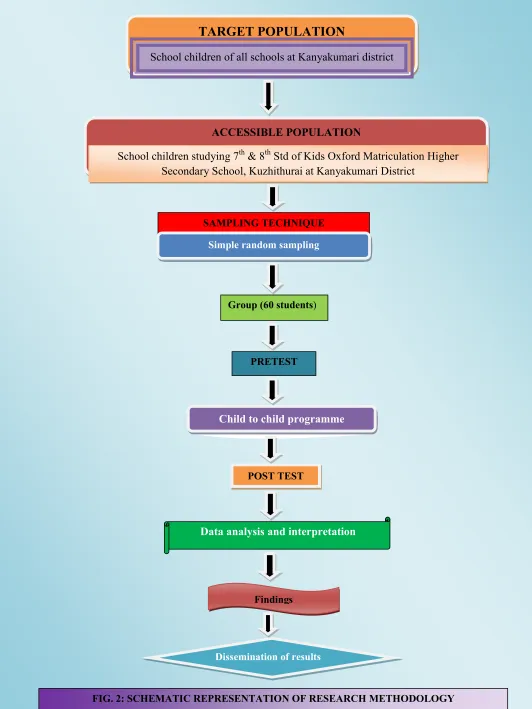
SCHEMATIC REPRESENTATION OF RESEARCH DESIGN
PRE TEST INTERVENTION POST TEST
O1 X O2
Keys
O1 - Pre-test assessment of knowledge on ill effects of television watching.
X - Child to child programme on ill effects of television watching.
20
VARIABLES
A variable is a phenomena or characteristic or attribute under study. Variables are the
measureable characteristics of a concept that consist of a logical group of attributes.
Poilt and Beck (2008)
Independent variable
Independent variable LV GHILQHG DV ³Whe variable that is believed to cause or influence the
GHSHQGHQWYDULDEOH´
Denise F. Polit (2011)
In this study, the independent variable was child to child program on ill effects of television
watching.
Dependent variable
'HSHQGHQW YDULDEOH LV GHILQHG DV ³WKH YDULDEOH K\SRWKHVL]HG WR GHSHQG RQ RU EH FDXVHG E\
another variable of LQWHUHVW´
Denise F. Polit (2011)
In this study, the dependent variable was level of knowledge of school children regarding ill
effects of television watching.
Extraneous variables
A variable that confounds the relationship between the independent and dependent variables
and that need to be controlled either statistically or in the research design.
Denise F. Polit (2011)
In this study it refers to age, sex, grade of the child, birth order of child, type of family,
family income per month, occupation of parents, place of living, academic performance of
child, duration of television watching, previous knowledge obtained and sources of
information.
SETTING
Setting is the physical location and condition in which data collection takes place in the
study.
Denise F. Polit (2011)
The setting was chosen on the basis of availability of samples and the cooperation extended
by the management of the school. The study was conducted in Kids Oxford Matriculation
Higher Secondary school, Kuzhithurai at Kanyakumari District. This was the private school
consists of 130 students between the age group of 11-14 years who were all studying from
21
POPULATION
3RSXODWLRQ LV GHILQHG DV ³WKH HQWLUH VHW RI LQGLYLGXDOV RU REMHFWV KDYLQJ VRPH FRPPRQ
charaFWHULVWLFV´
Denise F. Polit (2011)
TARGET POPULATION
A target population is defined as the entire population in which a researcher is interested and
to which he or she would like to generalize the study result.
Denise F. Polit (2011)
In this study, the target population consisted of school children studying in 7th and 8th
standard in all schools at Kanyakumari District.
ACCESSIBLE POPULATION
An accessible population is defined as the population of people available for a particular
study often a non random subset of the target population.
Denise F. Polit (2011)
The accessible population for the study consisted of school children studying in 7th and 8th
standard in Kids Oxford Matriculation Higher Secondary School, Kuhithurai at Kanyakumari
District.
SAMPLE
Sample refers to a fraction or portion of the element in a universe drawn out deliberately in a
planned representative manner for studying interested characteristics of a large group of
population
Denise F. Polit (2011)
In this study, school children were selected from the age between 11 and 14 years studying in
Kids Oxford Matriculation Higher Secondary School, Kuzhithurai at Kanyakumari District
who satisfied the sampling criteria.
SAMPLE SIZE
6DPSOHVL]HLVGHILQHGDV³WKHQXPEHURISHRSOHZKRSDUWLFLSDWHLQDVWXG\´
Denise F. Polit (2011)
Sample size was 60 school children studying in 7th and 8th std in Kids Oxford Matriculation
Higher Secondary School, Kuzhithurai at Kanyakumari District who satisfied the inclusion
22
SAMPLING TECHNIQUE
It refers to the process of selecting a portion of the population to represent the entire
population
Denise F. Polit (2011)
Simple random sampling technique was used to select the samples in the study.
SAMPLING CRITERIA
Sampling criteria involves selecting cases that meet some predetermined criterion of
importance. The criteria for sample selection are mainly depicted under two heading, which
includes the inclusion criteria and exclusion criteria.
Inclusion criteria
The study included school age children who
¾ are studying 7th & 8th standard
¾ have the habits of watching television
¾ can read and write English
¾ are available at the time of data collection
Exclusion criteria
The study excluded school age children who
¾ do not have television in their homes
¾ are not willing to participate in this study
¾ has any acute illness at the time of data collection
SELECTION AND DEVELOPMENT OF THE TOOL
Tool development is a complex and time consuming process. It consists of defining the
construct to be measured, formulating the items, assessing the items for content validity,
developing instructions for respondents, pre-testing, estimating the reliability and conducting
pilot-study.
Polit and Hungler (1993)
The tool was prepared on the basis of objectives of the study. The following methods were
used for the development of the tool by the investigator.
Review of literature from books, journals, other publications and web-sites.
Discussion with subject experts in child health nursing, paediatrician and
23
DESCRIPTION OF THE TOOL
The tool used for the study includes socio demographic proforma, clinical proforma and
structured knowledge questionnaire regarding ill effects of television watching.
TOOL 1:
Socio demographic Proforma
The socio demographic proforma consisted of items on background data of the participants. It
included age, sex, grade of the child, birth order of the child, type of family, family income
per month, occupation of father, occupation of mother and place of living,
Clinical Proforma
In this study the clinical variables are academic performance of child, duration of television
watching, previous knowledge about ill effects of television watching and sources of
information.
TOOL -2:
Structured knowledge questionnaire
The structured knowledge questionnaire was constructed for the students in the form of
multiple choice questions. It consisted of 30 items, in that 10 questions for healthy practices
of television watching and 20 questions for ill effects of television watching. Score of 1 is
allotted for each correct answer and score of 0 was allotted for each incorrect answer. The
total maximum and minimum score were 30 and 0 respectively.
The score was interpreted as
Score Interpretation
0-10 Inadequate knowledge
11- 20 Moderately adequate knowledge
21-30 Adequate knowledge
DEVELOPMENT OF POWER POINT PRESENTATION
Power point presentation was prepared regarding ill effects of television watching. It
comprises of definition, reason for television watching, advantages, healthy practices and ill
24
VALIDITY
CoQWHQWYDOLGLW\LVGHILQHGDV³Hxtent to which an instrument accurately reflects the abstract
construct (or concept) being examLQHG´
Suresh K Sharma (2007)
To ensure the content validity, the prepared data collection tool along with the problem
statement, objectives, operational definitions, hypotheses, and criteria checklist designed for
validation were submitted to ten experts in the fields like one paediatrician, eight child health
nursing personnel and one Bio- Statistician. The experts were requested to judge the items for
relevance, appropriateness and degree of agreement for the study. All the experts gave their
consensus and the tool was finalized.
RELIABILITY
5HOLDELOLW\ LV GHILQHG DV ³Whe degree of consistency or dependability with which an
LQVWUXPHQWPHDVXUHVDQDWWULEXWH´
Denise F. Polit (2011)
The reliability of the tool for knowledge was established by test, re-test method. The
reliability score is r = 0.84 which showed a positive correlation. The score indicates a high
correlation and the tool was considered as highly reliable for proceeding of the study.
PILOT STUDY
Pilot study is a small scale version or trial seen designed to test the method to be used in a
large, more vigorous study which is sometimes referred to as the patent study
Denise F. Polit (2011)
Pilot study was conducted in Kids Oxford Matriculation Higher Secondary School,
Kuzhithurai at Kanyakumari District. Permission was obtained from the head of the
institution for conducting the pilot study. Pilot study was conducted in the month of
December for a period of one week. The investigator selected one student who was the
change agent, according to the academic performance and given health education regarding
ill effects of television watching through power point presentation. Then the investigator
selected 6 samples using simple random sampling based on inclusion criteria. Pre test was
conducted to the 6 students by using structured knowledge questionnaire. On the same day
health education was given to them by the change agent who underwent health education
classes by the investigator already. After 7 days of child to child program post test was
25
of the pilot study were analyzed, which gave the evidence that the tool was reliable. Findings
of the pilot study also revealed that it was feasible and practicable to conduct the study at the
selected school setting and the criterion measures were found to be effective.
DATA COLLECTION PROCEDURE
The data collection procedure was done for a period of one month, during the month of
January in Kids Oxford Matriculation Higher Secondary school, Kuzhithurai at Kanyakumari
District. Formal permission was obtained from the school authorities before data collection.
Step 1
The researcher selected 6 change agents based on their academic excellence their interest and
willingness. The health education on ill effects of television watching was given to them by
the researcher using power point presentation. Then these children were prepared to pass this
message to other friends or peers.
Step 2
The researcher selected 60 students by using simple random sampling technique. The
researcher introduced herself to the selected group of students and obtained their consent.
Then the study was explained and assurance regarding confidentiality of the answers was
proved. Pre test was conducted by using structured knowledge questionnaire.
Step 3
The total 60 samples were divided into 6 subgroups. Each group of 10 students were educated
regarding ill effects of television watching by the 6 change agents who underwent health
education classes by the investigator already.
Step 4
Post test was administered after 7 days of child to child programme. The same knowledge
questionnaire was used to collect the post test data.
PLAN FOR DATA ANALYSIS
Data analysis is the systematic organization and synthesis of research data and testing
hypothesis by using the obtained data.
Polit and Beck (2008)
The data was analysed using both descriptive and inferential statistics such as mean, standard
26
Descriptive Statistics
¾ Frequency and percentage distribution of samples according to socio demographic
and clinical variables of school children.
¾ Frequency and percentage distribution of samples according to their level of
knowledge on ill effects of television watching before and after child to child
program.
¾ Mean and standard deviation were used to assess the effectiveness of child to child
program on ill effects of television watching.
Inferential Statistics
¾ Paired t-test was used to compare the pre-test and post-test level of knowledge on ill
effects of television watching among school children
¾ Chi square was used to find the association between the post test level of knowledge
on ill effects of television watching with the selected socio demographic and clinical
variables.
ETHICAL CONSIDERATION
For this study the investigator took into consideration of the ethical issues. No ethical issues
rose against conducting the study.
¾ Permission obtained from the ethical committee of Annammal College of nursing.
¾ Permission obtained from the concerned authorities of the Kids Oxford Matriculation
Higher Secondary School, Kuzhithurai at Kanyakumari District.
¾ Permission was obtained from each student before starting data collection.
¾ The subjects were informed that the confidentiality of the data will be maintained.
SUMMARY
This chapter dealt with the selection of research approach, research design, setting,
population, sample, sampling technique, sampling criteria, selectio