Den europœiske Investeringsbank Europäische Investitionsbank Ευρωπαϊκή Τράπεζα Επενδύσεων European Investment Banlt Banco Europeo de Inversiones Banque européenne d'investissement Banca europea per gli investimenti Europese Investeringsbank
Banco Europeu de Investimento
February 1986 · No 48
ISSN 0250-3891
ElB-lnformatlon
EIB Financing in 1985 approaches
7.2 biliion ECUs
In Brief...
In an unsettled economie climate with a recovery in investment varying from one country to another, financing provided by the European Investment Bank in 1985 showed a modest increase compared with the already high level recorded during the previous year: almost 7.2 biliion ECUs were advanced, 4% more than in 1984.
lUlain features of the 1985 financial year were:
Ο an increase in the Bank's capital to 28.8 billion ECUs;
Ο growth in lending for advanced technology and environmental protection ; Ο the even greater role of the ECU;
Ο financing for 6 500 small and medium-sized ventures;
Within the Community, an upturn of 12.7% was recorded in lending from own resources, whereas loans from the resources of the New Community Instrument for borrowing and lending (NCI) dipped by 25%. On a country-by-country basis, a considerable rise was observed in financing in the Uni ted Kingdom and Greece, with less pronounced growth in Denmark and France. A modest level of activity was again recorded in Belgium, while operations resumed in the Nether lands. Loans in Italy roughly matched the high level attained during the previous year and accounted for alm ost 46% of aggregate EIB financing.
A feature of EIB activity in 1985 was the marked growth in lending in Spain and Portugal provided as part of pre-accession financial co-oper ation in support of investment de signed to help integrate these coun tries into the Community economy. Since conclusion of agreements with Spain in 1981 and with Portugal in 1976, the EIB has made available 550 million ECUs and 725 million ECUs respectively in these two countries. As
membership of the Bank goes hand in hand with accession to the EEC, Spain and Portugal have, since 1 January 1986, enjoyed access to EIB lending with no ceiling on the amounts which may be committed. A further upturn in operations in these two countries can therefore be antici pated as from this year.
In 1985, lending under financial pro tocols concluded with the Mediterra nean countries mostly benefited pro jects in the Maghreb region.
Under the second Lomé Convention, implementation of which is now draw-ing to a close, the EIB last year com-pleted commitment of the amount earmarked for risk capital operations from European Development Fund re-sources and deployed a record amount in loans from own resources. EIB borrowings reached 5.7 billion ECUs, the main currencies raised be-ing the US$, ECU, DM and Yen. A further increase was recorded in ECU-denominated issues which totalled
Of the EIB's total lending in 1985,6.52 billion ECUs were for capital invest-ment projects in the European Com-munity. A further 260 million ECUs were lent in the two new member countries, Spain and Portugal, roun-ding off long-stanroun-ding pre-accession financial co-operation. This repre-sents 6.78 billion ECUs of loans in a now enlarged Community of Twelve. Investments were supported with 235 million ECUs in 30 African, Caribbean and Pacific (ACP) countries under the terms of the second Lomé Conven-tion, and with 165 million in five Medi-terranean countries under existing fi-nancial protocols.
Lending from the Bank's own resour-: ces, made up essentially of its bor-rowings on capital markets, accoun-ted for 6.22 billion ECUs, of which 5.9 billion ECUs for projects within the Community of Twelve and 324 million in the ACP and Mediterranean count-ries.
The balance of funds (960 million ECUs) were deployed under mandate from the Community or the Member States. 884 million ECUs were lent within the framework of the New Community Instrument and 76 million from budgetary resources within the framework of Community aid policy. Operations under mandate are ac-counted for off balance sheet in the EIB's Special Section.
730.6 million and occupied second place on the list of currencies bor-rowed. A marked rise was observed in floating-rate borrowings (chiefly in US$) which ran to 899.2 million ECUs in all.
Lending within the Community
Loans provided within the EEC in 1985 were made up of 5 640.7 million ECUs from EIB own resources (-1-12.7%) and 883.7 million ECUs from NCI resources (-25.2%). These operations accounted for some 60% of overall Community financing (grants plus loans) in support of in-vestment and for almost 85% of EEC loans financed from the proceeds of borrowings. They also corresponded to around 1.2% of gross fixed capital formation within the Community in 1985, a figure which rises to 3.3% in Ireland, 3.5% in Italy (as much as 6 . 1 % in the Mezzogiorno) and 5% in Greece.
On the basis of data available at the time of project appraisal, the EIB puts at some 19.6 billion ECUs the total fixed asset cost of projects financed last year, with Bank lending covering on average 38% of the cost of ven-tures. In terms of employment, these projects are expected directly to gen-erate almost 43 000 permanent jobs. Furthermore, orders and works relat-ing to schemes financed, particularly in the case of infrastructure, rep-resent substantial temporary employ-ment — over periods ranging from 2 to 10 years, depending on the scheme involved. This is estimated at around 190 000 man-years in the first two years and progressively less later for projects supported in 1985. Taking into account loans made in previous years, the number of people in work in 1985 through implementation of pro-jects co-financed by the EIB is put at over 550 000.
Economic policy objectives
As in previous years and in line with the EIB's principal task, regional de-velopment (3.39 billion ECUs) re-mained at the forefront of the Bank's lending targets: 72% of loans under this heading focused on countries beset with very severe structural prob-lems (Italy, Greece, Ireland and the United Kingdom), while more than 60% was channelled to regions with unemployment rates above, and aver-age income below, the Community average.
Financing aimed at reducing the EEC's dependence on oil imports continued to represent the Bank's second major objective, accounting for 2.28 billion ECUs. Of this, 1.48 billion ECUs went towards developing indigenous resources, with the em-phasis on constructing nuclear and hydroelectric power stations and tap-ping oil and gas deposits; a further 551.2 million ECUs went to diversify-ing energy supply sources and pro-moting rational use of energy (inter-connection of high voltage electricity grids, electrification of rail lines, heat recovery and development of renew-able sources of energy, such as geothermal and solar).
A substantial proportion of funding for the energy sector was made avail-able in the form of global loans for smaller scale ventures (251 million ECUs): last year, 279 such schemes attracted global loan allocations total-ling 263.1 million ECUs (industry: 126.5 million ECUs; infrastructure: 136.6 million ECUs).
When fully operational, energy pro-jects financed in 1985 should repre-sent 9.3 million tonnes of oil equiva-lent (toe) per annum. S>ince 1981, the cut-back in oil imports achieved through projects financed by the EIB is estimated at 60.9 million toe per annum, of which 14.8 million toe were attained though energy savings: this
C
Table 1 : Financing operations in 1985 and 1984 (million ECUs)
1985 1984 Within the Community
from EIB own resources from NCI resources Spain and Portugal Mediterranean protocols Second Lomé Convention Total
6 524.4 5 640.7 883.7 260.0 165.2 235.0 7 184.6
6188.8 5 007.0 1 181.8 220.0 327.6 160.7 6 897.1
represents 18.4% of projected Com-munity oil imports in 1990.
iVIodernisation and conversion of undertakings constituted the EIB's thjrd main objective in terms of funds advanced (979 million ECUs), with global loans from NCI resources (629.1 million ECUs) for productive ventures mounted by small and medium-sized firms making up a size-able proportion of overall financing. Loans were also provided for moder-nising the textile industry and 325.6 million ECUs went to investment aimed at developing or introducing advanced technology in industry and telecommunications, including 59.9 million ECUs in the form of global loans for smaller scale schemes. In providing 384.2 million ECUs last year for developing Community in-frastructure, the EIB financed con-struction of numerous sections of road and motorway as well as port development schemes improving communications between Member States (Northern Italy, France, United Kingdom). In the Netherlands, funds were advanced for bolstering the fleet of aircraft used on intra-Community routes, while interconnection of the British and French and Italian elec-tricity grids, classified under the heading of energy projects, again helped to develop Community infras-tructure, as did a telecommunications satellite scheme in France.
Financing for environmental protec-tion, totalling 3éo.4 million ECUs in 1985, showed a marked upswing com-pared w i t h ^ t h ^ previous year (156.8 million ECUs); funds benefited sew-age treatment schemes in the basins of the rivers Po, Arno and Tiber and the Venice lagoon in Italy, in several coastal towns in Greece, in a number of Counties in Ireland and in several regions of the United Kingdom.
Sectoral breakdown
The sectoral spread of financing high-lights the role (2.4 billion ECUs) played by infrastructural works, especially communications and tele-communications; the EIB also helped in implementing water schemes — particularly sewage treatment works — and establishing industrial estates; furthermore, small scale infrastruc-ture schemes were financed through global loans.
processing and storage facilities, electricity transmission and distribu-tion systems and district heating schemes all attracting EIB support. Reflecting a trend of recent years, lending to industry and the produc-tive sector generally (including for-estry, tourism and vocational training establishments) amounted to 1.9 bil-lion ECUs in 1985, of which 500 mil-lion ECUs were devoted to large-scale projects involving chiefly innovative schemes in the chemicals, electronics, and mechanical engineering sectors. Global loans for small and medium-sized ventures, totalling 1.4 billion ECUs, again accounted for some 75% of financing for mdustry.
Allocations made in 1985 from ongo-ing global loans earmarked for pro-ductive investment in industry, reached 1 432 million ECUs, compri-sing 708 million ECUs from EIB own resources for 2 770 ventures in assi-sted areas and 724 million ECUs from NCI resources for 2 916 schemes mainly outside such areas. In addi-tion, 279 allocations (263 million ECUs) benefited energy schemes, with a further eight (29.2 million ECUs) going to smaller ventures de-ploying advanced technology. Of the various smaller scale industrial ventures funded through global loan allocations in 1985, 98% were imple-mented by undertakings with fewer than 500 employees, including over 70% by firms with a workforce of less than 50.
Borrowings
To finance its lending from own re-sources '", in 1985 the EIB's borro-wings totalled 5 709.2 million ECUs, an upturn of 32% compared with 1984 (4 360.9 million ECUs). 4 229 million ECUs were raised by means of public loan issues, 1 095.5 million ECUs in private placings and 374 million ECUs through the issue of commercial paper.
Following their trial launching in 1984, floating-rate operations made fresh ground in 1985 to total 899.2 million ECUs, the equivalent of 649.1 million of this in US$. The breakdown shows 468.7 million ECUs raised via
swap operations against fixed-rate borrowings, 374.0 million through the issue of commercial paper and 56.5 million in direct borrowings on the floating-rate market.
The bank drew on the proceeds of its floating-rate borrowings to finance lending operations chiefly in the Uni-ted Kingdom, France, Italy and Greece.
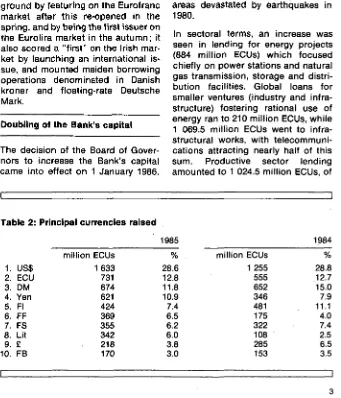
The ECU topped the list of Communi-ty currencies raised by the Bank in 1985 and came second only to the dollar in terms of aggregate borro-wings for the year (see table 2). 1985 saw the Bank floating maiden ECU issues on the French, Italian and Ja-panese markets. The EIB also appre-ciably stepped up its borrowings in French francs and trebled its fund-raising in Lire. The main countries where loans were wholly or partially disbursed in ECUs were: France (299.6 million ECUs), Italy (273.9 mil-lion), Greece (115.5 milmil-lion), Denmark (51.2 million), Spain (45.2 million), Ireland (22.5 million) and Portugal (5.4 million).
The financial year 1985 was likewise one in which the EIB broke new ground by featuring on the Eurofranc market after this re-opened in the spring, and by being the first issuer on the Eurolira market in the autumn; it also scored a "first" on the Irish mar-ket by launching an international is-sue, and mounted maiden borrowing operations denominated in Danish kroner and floating-rate Deutsche Mark.
Doubling of the Bank's capital
The decision of the Board of Gover-nors to increase the Bank's capital came into effect on 1 January 1986.
Automatically subscribed to by Spain and Portugal by virtue of their acces-sion and standing at 14.4 billion ECUs since 1981, the capital has now been effectively doubled to 28.8 billion ECUs. The latest increase means that the maximum amount of outstanding EIB lending, which cannot exceed 250% of subscribed capital, has been raised to 72 billion ECUs. Capital paid in and to be paid in represents about 9% of subscribed capital. For the contributions of the Member Count-ries to the Bank's capital see EIB-Information N" 47, table page 7.
Loans in the R/lember States
Lending in Italy totalled 2 978 million ECUs, including 374 million ECUs from NCI resources. Close on 60% (1 720 million ECUs) related to regio-nal development projects, mainly tele-communications and transport infra-structure, as well as to global loans for smaller scale ventures. 1 467.4 million ECUs were channelled into projects in the Mezzogiorno, of which 44 million ECUs under the heading of Community aid for reconstruction of areas devastated by earthquakes in 1980.
[image:3.588.206.547.402.800.2]In sectoral terms, an increase was seen in lending for energy projects (884 million ECUs) which focused chiefly on power stations and natural gas transmission, storage and distri-bution facilities. Global loans for smaller ventures (industry and infra-structure) fostering rational use of energy ran to 210 million ECUs, while 1 069.5 million ECUs went to infra-structural works, with telecommuni-cations attracting nearly half of this sum. Productive sector lending amounted to 1 024.5 million ECUs, of
Table 2: Principal currencies raised
1985 1984
I" NCI loans are funded from borrowings raised by the Connmissiòn on behalf of the EEC
1. US$ 2. ECU 3. DM 4. Yen 5. Fl 6. FF 7. FS 8. Lit 9. £ 10. FB
million ECUs
1 633 731 674 621 424 369 355 342 218 170
%
28.6 12.8 11.8 10.9 7.4 6.5 6.2 6.0 3.8 3.0
million ECUs
1 255 555 652 346 481 175 322 108 285 153
%
28.8 12.7 15.0 7.9 11.1 4.0 7.4 2.5 6.5 3.5
Table 3: Lending within the Community from EIB own and NCI resources In 1985 and 1984 Breakdown by location, economic objective and major sector
1985 1984
million ECUs
%
million ECUsown resources
NCI Total own
resources
NCI Total
Increase/decrease 1985/1984 own resources Total United Kinadom Total 1 096.7 5 640.7 33.4 883.7"' 1 130.1 6 524.4 17.3 100.0 888.2 5 007.0 44.3 1 181.8 932.5 6188.8 15.1 100.0 -1- 23.5 -1- 12.6
-1- 21 2
-1- 5.4 1. LOCATION Belgium 77.8 Denmark 264.0 Germany 91.4 Greece 401.7 France 889.6 Ireland 146.6 Italy 2 603.9
Luxembourg — Netherlands 69.1
ilted Kingc
ital
2. ECONOMIC POLICY OBJECTIVE
Regional development 3 286.2 Common European
Interest/modernisation-conver-sion of undertakings ' 3 194.2 energy objectives™ 2 241.6 communications and other Community infrastructure 617.4 modernisation/conversion advanced technology . . . 335.2 deduct»' - 839.7
3. SECTOR
Energy and Infrastructure 4 400.0 energy'*' . . . ; . . 2 230.9 transport and telecommunications 1 393.7
water schemes 435.1 other infrastructure 133.3 infrastructure global loans 207.0 Industry, agriculture and services 1 240.7
Individual loans 469.4 global loans 771.3
Allocations from current global loans 1132.3
industry 863.0 infrastructure 269.3 68.5 22.0 357.8 27.9 374.1 77.8 332.5 91.4 423.7 1 247.4 174.5 2 978.0 69.1 1.2 5.1 1.4 6.5 19.1 -2.7 45.6 1.1 32.5 183.9 134.3 275.5 814.0 124.0 2 538.2 16.4 — 134.6 — 69.3 386.3 50.0 497.3 — 32.5 318.5 134.3 344.8 1 200.3 174.0 3 035.5 16.4 0.5 5.1 2.2 5.6 19.4 2.8 49.0 0.3 + 139.4 + 43.6 - 31.9 -H 45.8 + 9.3 + 18.2 -I- 2.6 - 100.0 139.4 4.4 31.9 22.8 3.9 0.3 1.9 100.0
104.5 3 390.7 52.0 3 085.5 195.0 3 280.5 53.0 6.5 3.4
811.4 40.4 127.3 643.7 - 3 2 . 2
226.6 — 167.4 36.5 22.8 — 657.1 27.9 629.1 729.0 724.2 4.8 4 005.6 2 282.0 744.7 978.9 - 8 7 1 . 9
4 626.6 2 230.9 1 561.1 471.6 156.1 207.0 1 897.8 497.3 1 400.4 1 861.3 1 587.2 274.1 61=4 35.0 11.4 15.0 - 13.4 71.0 34.6 23.7 7.2 2.4 3.2 29.0 7.6 21.4 28.5 24.3 4.2 2 723.0 1991.5 393.0 338.5 - 8 0 1 . 5
3 799.2 1 873.0 1324.8 304.4 173.6 123.4 1 207.8 532.8 675.0 1058.4 744.6 313.8 1 123.0 250.1 38.1 834.8 - 136.2 390.8 221.2 .91.5 49.2 28.9 — 791.0 19.4 771.6 715.5 687.0 28.5 3 846.0 2 241.6 431.1 1 173.3 - 937.7 4190.0 2 094.4 1 416.3 353.6 202.5 123.4 1 998.8 552.2 1446.6 1 773.9 1431.6 . 342.3 62.1 36.2 6.9 19.0 - 15.1 67.7 33.9 22.9 5.7 .3 2.0 32.3 8.9 23.4 28.6 23.1 5.5 -1- -l-+ _ -1- H -+ 1 - -t-17.3 12.6 57.1 1.0 15.8 19.1 5.2 42.9 23.2 67.7 2.7 11.9. 14.3 -1-+ -1-_ -1-+ 1 - -1-— -4.1 1.8 72.7 16.6 10.4 6.5 10.2 33.4 22.9 67.7 5.1 9.9 3.2
'" of which 869.6 from NCI III and 14.1 from the NCI tranche earmarked for earthquake reconstruction;
'" development of Indigenous resources, diversification of Imports and rational use of energy, excluding energy-related capital investment contributing more to regional development than to attainment of the Community's energy objectives as such.
which 717.5 million ECUs were made available in the form of global loans for smaller scale ventures, over two thirds of these in the Mezzogiorno. Advanced technology projects recei-ved 171 million ECUs, including 15.8 million ECUs through global loans for innovative smaller scale schemes. Together with ongoing global loans, 2 535 ventures received 1 012.9 mil-lion ECUs in 1985, broken down as follows:
— 302.4 million ECUs from EIB own resources for 1 113 industrial ventu-res in the Mezzogiorno plus 142.9 million ECUs for 391 schemes in assi-sted areas of Central and Northern Italy;
— 352 million ECUs from NCI resour-ces for 819 industrial ventures in Cen-tral and Northern Italy;
— 215.6 million ECUs for 212 ventu-res promoting rational use of energy. Loans in France came to 1 247.4 million ECUs, of which 357.8 million ECUs from NCI resources. 560.1 mil-lion ECUs supported industrial invest-ment, comprising 69.5 million ECUs for high tech installations at a motor vehicle plant in Pas-de-Calais and 490.6 million ECUs in the form of global loans for small and medium-sized ventures, located both within and outside (NCI) assisted areas, or deploying advanced technology. 495.7 mjllion ECUs went towards mo-dernising and developing the road and motorway networks, mainly in Western France, Lorraine and Auver-gne, providing high speed train servi-ces between Paris and the Atlantic coast and establishing a satellite tele-communications network. The EIB maintained close ties with CAECL (Caisse d'Aide à l'Equipement des Collectivités Locales), advancing 147.1 million ECUs for smaller infra-structural works in assisted areas. In addition, 191.6 million ECUs benefi-ted energy projects: a hydroelectric scheme at Sault-Brenaz in the Alps, Flamanville nuclear power station in Lower Normandy, a district heating system using geothermal energy re-sources in the Pahs region and cables interconnecting the French and Bri-tish and French and Italian electricity grids. The Bank also concluded glo-bal loans in support of smaller ventu-res promoting rational use of energy in industry and infrastructure. From global loans already in opera-tion, 669.1 million ECUs were made
available in 1985 for over 3 500 small and medium-sized ventures:
— 1 049 smaller scale industrial sche-mes in assisted areas received 168 million ECUs from EIB own re-sources;
— 1 889 smaller scale industrial sche-mes, mainly outside assisted areas, attracted 303.1 million ECUs from NCI resources;
— 487 smaller infrastructure sche-mes — chiefly departmental roads — accounted for 121.3 million ECUs; — 67 industrial and infrastructural schemes complying with Community energy policy objectives received 47.5 million ECUs;
— 8 industrial ventures deploying ad-vanced technology absorbed 29.2 mil-lion ECUs.
Lending in the United Kingdom rose by 2 1 % to 1 130 million ECUs (£660.1 million), 33.4 million ECUs of this from NCI resources. 60% of funds were channelled to energy projects which alone attracted 657 million ECUs (£382.9 million): Torness Point and Heysham nuclear power stations, nuclear fuel reprocessing facilities and development of a gasfield in the North Sea. The E4B also supported implementation of infrastructural schemes, mainly in the Assisted Areas, aimed at improving communi-cations (chiefly by road), providing sewage treatment and disposal facili-ties and establishing industrial esta-tes. 164.5 million ECUs (£97.6 million) went to industrial investment through loans for agri-foodstuffs, chemicals, electronics and newsprint projects and a scheme involving introduction of computerised management sy-stems by a co-operative society as well as through three global loans to the 31 group (Investors in Industry) and the Department of Trade and Industry for funding smaller ventures. In conjunction with ongoing global loans, 164 small and medium-sized ventures, mainly in industry, attracted allocations totalling 62.9 million ECUs (£37.3 million) in 1985.
In Greece, 423.7 million ECUs, inclu-ding 22 million ECUs from NCI resour-ces, went chiefly towards regional development with the emphasis on integrating the most remote regions of the country. Infrastructural works (303.3 million ECUs) accounted for almost three quarters of total lending and included development and mod-ernisation of both national and
inter-national telecommunications the latter via satellite — upgrading of the road network, equipping regional air-ports and air-ports, sewage treatment and disposal facilities, irrigation sche-mes and smaller scale infrastructure. In the energy sector, the EIB advan-ced 71.7 million for ongoing work at Pigai, Thissavros and Stratos hydro-electric power stations. In addition, 48.6 million ECUs were made avail-able in the form of global loans to the Agricultural Bank of Greece and to EOMMEX for smaller scale invest-ment. From global loans already in operation, 54 small and medium- sca-le industrial and agricultural ventures received 67.7 million ECUs in 1985. In Denmark, 332.5 million ECUs were made available, of which 68.5 million ECUs from NCI resources, chifefly for constructing transmission and dis-tribution networks as part of work on developing gasfields in the North Sea as well as for promoting more rational use of energy (124 million ECUs) by establishing district heating systems and electrifying rail lines. On Bor-nholm Island, the EIB financed a port scheme, windmills for electricity gen-eration and a district heating system and, in North Jutland, a more energy-efficient plasterboard factory. As for small and medium-sized indust-rial ventures, three global loans (42.5 million ECUs) were concluded in 1985 with Finansieringsinstituttet for In-dustrie og Handvaerk A/S and Egnsud-viklingsrâdet (regional development board). In conjunction with funds av-ailable under ongoing global loans, 124 smaller scale ventures attracted allocations worth 41.3 million ECUs in all in 1985.
Although no new global loan con-tracts for financing smaller ventures were signed in 1985, co-operation with intermediary institutions con-tinued, with 7.5 million ECUs (IRE5.4 million) going to support 84 smaller scale industrial schemes under global loans concluded in previous years with the Industrial Credit Company (ICC).
In Germany, EIB loans amounted to 91.4 million ECUs going entirely for projects helping to attain Community energy policy objectives; funds were advanced for Neckarwestheim and Emsland nuclear power stations, two sections of gasline — one carrying Soviet natural gas to the EEC, the other connecting up with the Danish network and fields in the North Sea — and a system of conduits drawing on waste heat from industrial plant in the Saar for district heating purposes. In Belgium, the EIB continued to provide financing, totalling 77.8 mil-lion ECUs, for the second and third units of the nuclear power stations at Doel, near Antwerp, and Tihange, pro-vince of Liège. Electricity generated by these power stations when fully operational will save an estimated 8.5 million tonnes of imported oil per annum.
In the Netherlands, the Bank mounted its first operations since
1976, lending 69.1 million ECUs for bolstering KLM's and NetherLines' fleets of aircraft with an eye to extend-ing and improvextend-ing intra-Community links, as well as for constructing a flower auction centre near Amster-dam, a project of interest to the Com-munity as a whole.
Although no funds were lent in 1985 for projects in Luxembourg, it should be pointed out that the EIB advanced 11.9 million ECUs for various road schemes in Lorraine, including work on establishing a continuous motor-way link at Thionville, connecting up with the A31 motonway from Luxem-bourg.
Lending in Spain and Portugal
The 160 million ECUs lent by the EIB in Spain in 1985 has exhausted the 250 million ECUs foreseen under the last extension of pre-accession finan-cial co-operation covering the period 1 July 1984 to 31 Decenriber 1985. Of this total, 47 million ECUs was adv-anced towards developing five sec-tions of the trunk road network serv-ing Barcelona, Cordoba, Burgos, Val-ladolid and Murcia; 40 million ECUs helped to fund construction of a hy-droelectric complex comprising three
C 3
A new method of financing :
trust operations
To help finance a compressor station on the gas pipeline connecting the Danish network to the German and Community networks, the EIB has made the equivalent of 10 million Deutsche Marks available to Compagnie luxembourgeoise de ia Dresdner Bank AG Dresdner Bank International (DBI) -which has onlent the proceeds to the German company Al-Turbo-Verwaltung-sgesellschaft mbH. The relevant contract is subject to regulations introduced in the Grand-Duchy in 1983 governing trust operations; this is the first time that these have affected EIB financing.
In accordance with these regulations, the operation is mounted by DBÌ off balance sheet. DBI's own finance contract with the final beneficiary Al-Turbo, which has leased out the compressor station to the company DEUDAN (Deutsch-Dänische Erdgastransport-Gesellschaft mbH und Co. KG), is drawn up in such a way as to apply the provisions of the EIB's customary clauses to Al-Turbo. The latter has assigned its rights against DEUDAN for rent to DBI instead of normal repayment of the loan. The EIB's financing is secured by the guarantee of the Danish company, Dangas, whose entire capital is owned by the Danish state.
This type of trust operation is a relatively new method of financing in the Grand Duchy. By accepting its use, the EIB is helping to develop flexible lending formulae better adapted to the particular requirements of projects such as this gas pipeline which, by helping to develop the Community's internal resources and reduce its dependence on imported oil, will contribute directly towards attaining Community energy objectives.
artificial storage reservoirs and two power plants 60 km south-west of Valencia; 30 million ECUs contributed towards upgrading railway
infrastruc-ture on the line connecting Madrid and Barcelona to France; and a loan for 13 million ECUs went towards financing construction of a bulk car-go quay and associated facilities at the port of Cadiz and for protection and development works in the north-eastern and southern docks at Santa Cruz de Tenerife harbour in the Ca-nary Islands. Two global loans ac-counted for the balance: one, for 20 million ECUs, went to the Banco de Crédito Industrial, and the other, for 10 million ECUs, to the Banco de Crédito Local de Espana, both for funding ventures mounted by smaller businesses in the industrial and ser-vice sectors.
Ongoing global loans were drawn on to the extent of 50.1 million ECUs in the form of 111 allocations to small and medium-sized enterprises, while a further 27.2 million ECUs was taken up via 17 allocations in support of small and medium-scale infrastructur-al schemes (chiefly roads and water supply networks).
Under the second extension of the pre-accession financial co-operation agreement with Portugal, the remain-ing amount foreseen for the country came to 100 million ECUs out of a total of 150 million provided for over the period 1 July 1984 to 31 December 1985. This balance has now been used in full, with 30 million ECUs going towards the installation of a fourth 300 MW generating unit at the coal-fired power station under con-struction at Sines, a loan for 20 mil-lion ECUs assisting construction of a 38 km section of the motorway bet-ween Oporto and Lisbon, and 20 mil-lion ECUs for work on various sec-tions of road (99 km in all) on key routes linking the port of Aveiro and Coimbra with Vilar Formoso. The list is rounded off by two global loans, each for 15 million ECUs, one to Caixa Geral de Depósitos, the other to Ban-co Portuguès de Investimento, both for funding ventures mounted by small and medium-sized enterprises in the industrial, tourism, and service sectors, as well as for smaller-scale energy-saving and environmental pro-tection schemes.
Lending under financial protocols with the Mediterranean countries The Bank mounted operations in the three IVIaghreb countries in 1985. In Algeria, 50 million ECUs was made available under the First Financial Protocol and 25 million ECUs under the Second Financial Protocol. The funds went towards upgrading sec-tions of highway (133 km in all) bet-ween Jijel and Constantine for the purpose of cutting down on journey times, offering fuel savings and prom-oting the economic development of the country's north-eastern region. Also financed was a harbour develop-ment scheme at Bejaia involving the construction of a 750 m new quay and the establishment of 2.5 ha of quay levels for freight traffic at this port in the east of the country.
In Tunisia, the agricultural and fisheries sectors were the be-neficiaries of Bank lending totalling 23.5 million ECUs (including 5 million ECUs made available from Commun-ity budgetary funds). The credit was furnished to the Banque Nationale de Développement Agricole (BNDA) for onlending towards a variety of ven-tures, notably acquisition of ten traw-lers, capital investment schemes mounted by farm co-operatives with a view to improved productivity, chiefly in northern and north-western Tunisia, small and medium-scale on-farm investment and agricultural-pro-cessing schemes.
In IVIorocco, a global loan of 8.5 million ECUs was concluded with the Caisse Nationale de Crédit Ag-ricole (CNCA) for funding on-farm in-vestment (livestock and equipment purchases, construction of buildings, smaller-scale agricultural-processing schemes, etc.) with the emphasis on increased self-sufficiency in staple foods and the introduction of modern farming methods.
The launching of operations under the Second Financial Protocol with Cyprus saw the EIB lending 30.2 mil-lion ECUs (including 3.7 milmil-lion ECUs from Community budgetary funds) in 1985 for water schemes designed to make better use of the island's natural resources. The Bank's funds aided construction of the Kouris dam and works to tap run-off water from the Southern Troodos mountains for pip-ing to Nicosia, Famagusta, Limassol and Larnaca in the south-east of the island. The project will supply water for both industrial and domestic
con-sumption, as well as aiding develop-ment of agriculture and the tourist trade.
In Syria, a loan for 28 million ECUs helped to uprate the capacity of Mehardeh thermal power station, in the north of the country, through the installation of two 165 MW turbines in addition to the existing twin 150 MW units. The project will enable the sta-. tion to cope with the rapid growth in
the electrification of rural areas.
Lending under the second Lomé Convention and the Council Decision on the OCT.
There was a marked upturn in financ-ing operations mounted in the Afri-can, Caribbean and Pacific (ACP) States and the Overseas Countries and Territories (OCT) in 1985, mainly attributable to increased lending from the Bank's own resources which ran to 167.8 million ECUs in contrast to 79.1 million ECUs the previous year. Funds advanced in the form of risk capital assistance amounted to 67.2 million ECUs, as against 81.6 million ECUs in 1984, virtually covering the balance foreseen under this heading (291 million ECUs) in the Second Lomé Convention. By the end of 1985 the EIB had lent 577.5 million ECUs from its own resources (out of a poss-ible maximum of 700 million) in these countries since entry into effect of the Convention.
The breakdown of lending in 1985 shows close on 5 1 % for industrial and agricultural-processing ventures (32.8% of this for fairly large projects and 18.1% for small and medium-sized enterprises). In seeking to re-duce the ACP States' extremely costly dependence on oil imports, the Bank directed 27% of its finance towards energy projects, notably those help-ing to harness indigenous resources. The telecommunications sector ab-sorbed 12% of financing, the trans-port sector 3.4%, water supply schemes 3%, and feasibility studies 4%.
About two thirds of projects financed in the industrial sector, via individual loans or global loan allocations, were aimed at deriving maximum benefit from local resources, fostering domestic production by way of sub-stitution for imports, and encouraging exports. The Bank financed capital investment totalling 700 million ECUs. An amount of 33.8 million ECUs was taken up during 1985 under ongoing
global loans, serving to fund 82 smal-ler-scale ventures.
Industrial rehabilitation and the rein-statement of infrastructure were two key objectives which continued to receive Bank support in 1985. Not only did the EIB provide credit to help firms hit by the recession to moder-nise or revamp their operations, but it furnished promoters with the risk cap-ital to strengthen their equity base. The Bank also contributed funds to assist the smooth running of local water and electricity utilities. EIB de-velopment support for telecommuni-cations, harbour infrastructure and electricty generating and supply schemes has served to uprate living standards and to create a better economic environment for firms to operate in, and has helped to make a positive impact on countries' balance of payments, notably by trimming oil imports.
As in previous years, EIB loans were involved in co-financing operations with bilateral or multilateral aid, EEC budgetary funds, or finance provided by other banks and multilateral in-stitutions.
con-tainer facilities at Bridgetown port (also of benefit to Saint Lucia, Saint Vincent and the Grenadines, Domini-ca and Guyana); Surinam, 4.25 m (risk capital) for small-scale enter-prises and technical assistance; Guy-ana, 4 m (risk capital) for small-scale enterprises; French Polynesia (OCT), 4m for electricity transmission lines; Mali, 3.4 m (risk capital) for rice mill complex; Lesotho, 3 m (risk capital) for small-scale enterprises; Seychel-les, 3 m (risk capital) for small-scale enterprises; Guinea, 2.7 m (risk capi-tal) for the State's subscription to capital, and an EEC equity participa-tion, in the Banque International pour le Commerce et l'Industrie de Guinée; Chad, 2 m (risk capital) for
rehabilit-ation of small-scale enterprises; Equatorial Guinea, 2 m (risk capital) to the State's subscription and share-holders' advance for national electric-ity company; Vanuatu, 2 m (risk capi-tal) for small-scale enterprises; Mont-serrat (OCT), 0.9 for electricity gener-ation and transmission; Zaire, 0.5 m (risk capital) for natural gas develop-ment feasibility study; Zambia, 0.5 m (risk capital) for oil pipeline reinstate-ment study; Solomon Islands, 0.1 m (risk capital) for study on merger of two shipyards; Saint Vincent and the Grenadines, 0.1 m (risk capital) for airfield study; and Swaziland, 0.04 m (risk capital) for reorganisation study of the National Industrial Develop-ment Corporation.
ECU
Spanisi! and Portuguese
participation in
EiB's decision-malcing bodies
The Treaty of Rome which established the European Economic Community set up the European Investment Bank, giving it a separate legal identity and autonomous structure. It is directed and managed by a Board of Governors, a Board of Directors and a Management Committee. An explanation of the roles and responsibilities of the Bank's decision-making bodies is given in EIB-Information No. 47 (January 1986).
Members of the EIB's Board of Governors are a Government Minister, usually the Minister of Finance, from each of the twelve Member States. The EIB's Governor for Spain is Mr Carlos SOLCHAGA CATALAN, Minister of Economy and Finance.
The Governors have appointed two Directors nominated by the Kingdom of Spain, Mr José Maria GARCIA ALONSO, Director General of Treasury and Financial Policy at the Ministry of Economy and Finance, and Mr Julian GARCIA VARGAS, President of the Instituto de Credito Oficial.
Mr Miguel MORA HIDALGO, Adviser to the General Director of Treasury and Financial Policy, Spanish Ministry of Economy and Finance, has been appointed Alternate; he was nominated by common accord of Spain and Portugal. Directors and Alternates are appointed for a period of five years, which is renewable. The current period expires in 1988 for all members. Information on the Governor for Portugal and the Director to be appointed on nomination by the Portuguese Republic will be given in the next issue of EIB-Information.
^ " " " ^ Mr Miguel Angel ARNEDO ORBANANOS, Spanish, aged 41, has been appointed sixth Vice-President of the EIB. Having gained degrees in law and eco-nomics, Mr Arnedo Orbananos joined the Banco de Espana in 1969 as economist in its Research Department, specialising in international economic affairs from 1973, and becoming Deputy Director for Monetary and Statistical Research in 1981, and Deputy Director for Foreign Operations in 1984. Members of the Management Committee, which is composed of the Bank's President and six Vice-Presidents, are appointed by the Board of Governors on a proposal from the Board of Directors for a six year period which is renewable. The current term expires in 1988.
Below are the ECU'S values in nation-al currencies, as at 31 December 1985; these rates are applied to the present quarter in preparing financial statements and operational statistics of the Bank:
DM
e
Ffrs Lit Fl Ptas
2.18386 0.615334 6.70474 1 489.94
2.46133 136.519
Bfrs Lfrs Dkr Dr IR£ Esc US$
44.6450 44.6450 7.95672 131.200
0.714055 140.736
0.887927
N.B.: ECU/national currency conver-sions given in this issue for opera-tions in 1985 are based on different exchange rates, applicable at the time of each contract signature.
EIB-Information is published per-iodically by the European Invest-ment Bank in nine different langua-ges (Danish, Dutch, English, French, German, Greek, Italian, Portuguese and Spanish).
Material which appears in EIB-Infor-mation may be freely reproduced; an acknowledgement would be appre-ciated and also a clipping of any article published.
700, bd Konrad Adenauer L-2950 Luxembourg tel. 4379-1 - telex 3530 bnkeu lu
telecopier 43 77 04 Department for Italy: Via Sardegna, 38 - 1-00187 Rome tel. 4711-1 - telex 611130 bankeu i
telecopier 474 58 77 Liaison Office for the United Kingdom:
68. Pall Mall London SW1Y 5ES
tel. 839 3351 telex 919159 bankeu g
telecopier 930 9929 Representative Office in Athens:
Ypsilantou 13-15 GR-10675 Athens
tel. 724 9811 telex 222126 bkeu gr
telecopier 724 9814 Representative Office in Brussels:
Rue de la Loi 227 B-1040 Brussels
tel. 230 98 90 - telex 21721 bankeu b telecopier: 230 58 27