Q]G^[p©(3m D[D\!7©8ÖDLU©mÖ ©ΘΠΰΟχ
Ν" 2 8 · F e b r u a r y 1 9 8 2
©cm
©(uiii®fó)£§fi©Ga§ ui?M§@Q©(?öin)|]©E;i
ni® 0(iû«^s^M®ciQ§to)aoi)te
[gaöiKgiM)© llQflIlJISpIcgOuOì)© (o|°D(nK!^S©Qfl©@©[nJi)©[ii)ß
dfeOogg) Ilü0(?®(öx§g) [ó)©(? gOO 0(JD^^Sgßfl(JuD©(n)üß
l(M)[i®(ô)©§© 0(jiK!^s§Qs(ifi[fög]§io)a(iöte
ISSN 0250-3891
FÄnaridriig Operations in 1981 totai 3 850 million
Έ£1
The European Investment Bank (EIB) made available over 3 360 million ECUs for industrial, agricultural, energy and infrastructure investment In EEC Member Countries last year.
With the number of jobless In the Community building up to some 10 million, the Bank concentrated most of its financing operations on investment in less de veloped and worst unemployment areas, including
reconstruction in the parts of Southern Italy hit by the November 1980 earthquakes.
The other priority was to channel funds into a range of energy facilities to cut the Community's depend ence upon oil imports; this included not only energy production and transmission projects, but also in vestment to reduce or rationalise energy consump tion, principally in industry.
Outside the Community, close to 500 million ECUs went to develop ment in the two "candidate" coun tries to the EEC — Spain and Por tugal — and in 33 other countries in the Mediterranean region, Africa, the Caribbean and the Pacific which have, signed cooperation agree ments with the Community.
Borrowings which the EIB made during 1981 to resource its lending operations totalled some 2 300 mil lion ECUs; the funds were raised mainly through public bond issues.
The year ended with the doubling of the ElB's subscribed capital to 14 400 million ECUs, ensuring a sound base for a continued develop ment of the Bank's operations over the years ahead.
In the Community
Priorities: counter the unemploy ment trends, reduce oil imports
Finance provided by the EIB for investment projects In or of direct interest to Community Member Countries totalled 3 361.3 million ECUs,, composed of
— 2 539.4 million in loans from the ElB's own resources (i.e. essentially from funds the Bank borrows on capital markets) plus 282.1 million ECUs in guarantees, on loans pro vided by other banks;
— 539.8 million in loans from the resources of the. New Community
Instrument for borrowing and lend ing — NCI or "Ortoli Facility" (see page 3). ·
-In real terms - r i.e. after taking account of inflation — this about maintained the level of last year's operations (2 950.8 million ECUs, in cluding 197.6 million in NCI loans) against a worsened economic cli mate. Tensions on the capital mar kets, high interest rates, the deepen ing recession and budgetary difficul ties in some countries all had their impact, showing through in a drop in investment and fewer requests for finance.
The ElB's main tasks under the EEC Treaty are to assist investment promoting regional development or serving a common interest of sever al Member Countries or the Com munity as a whole.
Within these overall objectives, the Bank endeavoured to support policies vyhich the European Coun cil sees as decisive for the Commun ity's economic future:
— combat unemployment by giving priority to investment based on sound productivity and increaised competitiveness;
— reduce disparities between Member States' economic perform ances;
— tackle structural change;
— step up energy Investment aimed at cutting oil Imports, including measures to reduce energy con sumption;
— back the setting up or expansion of small and medium-scale ventures In the Community, which are often dynamic job creators.
/nvesfmenf.the Bank calculates that financing in 1981 — both from Its own resources and New Community Instrument funds — contributed to new fixed investment in the Com munity totalling about 11.7 billion ECUs.
Convergence of national econ omies: nearly three quarters of lending was concentrated in the four countries — Italy, Ireland, Greece and the United Kingdom — with the most difficult structural problems.
Much of the lending In Italy (over 40%) and most in Ireland (85%) car ried Interest subsidies of 3%, paid from the Community budget, under arrangements made to help less prosperous countries fully par ticipating in the European Monetary System — EMS (see page 3). Emp/oyment;most of the Investment projects financed last year are not Yet finished but it can be estimated that they involve the direct creation or safeguarding of some 31 000 full time jobs, mainly in Industry. '
con-structlon (often for some years) and also on employment In the supply of necessary services and materials — this principally concerns large-scale energy and Infrastructure works: the total effect of projects supported in 1981 can be put at the equivalent of about 465 000 man-years of work.
There is also the long-term impact of most Infrastructure projects — e.g. water supplies, sewerage, communi-cations — which'while creating few permanent jobs in themselves are necessary for industrial develop-ment and other activities.
Energy: new projects financed In 1981 aimed at supporting Communi-ty energy objectives should repre-sent, when all fully operational, the means to replace some 10.6 million tonnes of imported oil per year. This saving will come mainly from new energy production facilities — nuclear and hydro power stations, development of European oil and gas resources — but also from pro-jects aimed at diversifying the Com-munity's energy imports away from oil (to natural gas and coal) and from investment to reduce energy con-sumption (in industry and In district heating systems).
The Council of the European Com-munities has said that the EEC should limit oil Imports in 1990 to no more than In 1978, i.e. 470 million tonnes. The EIB estimates that the energy projects which It has helped
to finance in the last five years (1977-1981) should have the total effect of reducing dependence upon oil Im-ports by close on 61 million tonnes per year, which corresponds to about 13% of the Community's ceil-ing figure.
ECU
In May 1981, the ElB's Board of Governors decided that, with ef-fect retroactively from 1 January 1981, the Bank was to use the ECU as its unit of account. The composition of the ECU is identi-cal to that of the unit used pre-viously.
The ECU'S values in national cur-rencies at 31 December 1981 are given below; the Bank is applying these rates during the present quarter in drawing up its financ-ing and borrowfinanc-ing statistics: DM 2.44436 Lfrs 41.7467 e 0.566523 Dkr 7.94077 Ffrs 6.20177 Dr 62.2263 Lit 1 303.57 IR£ 0.686819 Fl 2.68309 US$ 1.08517 Bfrs 41.7467
N.B. ECU/national currency con-versions given in this review of operations in 1981 are based on different exchange rates, applic-able at the time of each contract signature.
Regional breakdown
Priority to worst unemployment areas
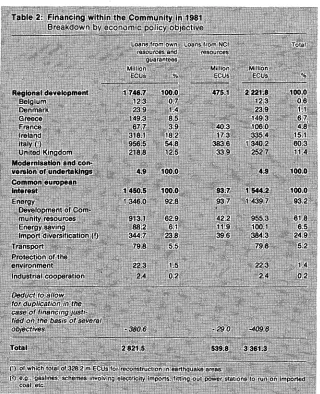
Two thirds (2 221.8 million ECUs) of the Bank's lending operations in the Community last year were In support of Investment In regions which are economically less developed or con-fronted with industrial conversion problems.
Those suffering from the highest unemployment were the obvious target: 85% of the lending went to areas where the jobless figures are 25% or more above the Community average.
Over 80% of the funds were focused on the regions given a special priori-ty under Communipriori-ty regional policy because of the serious development difficulties they face: Ireland, the Italian Mezzogiorno, Greece (out-side the Athens and Thessaloniki areas). Northern Ireland arid Green-land,
Lending for regional development •concerned Industrial, agricultural
and services Investment, telecom-munications, road and rail Improve-ments, port development, water sup-plies, sewerage and other infrastruc-ture.
A special aspect last year was the first lending — 328.2 million ECUs, with 3% interest subsidies paid from the Community budget — as part of the Community's aid to help recon-struction in areas of Southern Italy hit by the November 1980 earth-quakes (see opposite).
Action under the ElB's other main task — supporting projects of "com-mon interest" to several Member Countries or the Community as a whole — was heavily concentrated on energy investment; other loans went to improved air and shipping links between Member Countries, environmental protection (Including sewerage schemes in Denmark and Greece to reduce pollution in the Baltic and the Mediterranean), high technology industrial cooperation between enterprises from different Member Countries.
Main sectors
Drop in overall lending to industry but more funds go to small-scale ventures
Increased finance for energy and communications
Demand for finance from industry was sluggish last year and loans for the productive sectors — mainly industry, but also some agricultural and service investment — totalled 472.3 million ECUs, an almost 20% drop on the previous year's lending (585.4 million).
On the other hand, there was a posi-tive element, with a rise in the share of financing which went to small and medium-scale investments through global loans; these are basically lines of credit opened by the EIB to banks or other financing institutions working at regional or national level which use the funds to finance a series of investments chosen in agreement with the EIB.
Last year the amount of new global loans for productive sector invest-ment rose by 20% to 318.4 million ECUs (265.5 million in 1980).
Most w/ere granted for financing small and medium-scale ventures setting up or expanding in regional development areas, but there were also some global loans aimed speci-fically, at financing equipment to re-duce or rationalise energy consump-tion in industry.
During the year, the number of pro-ductive sector investments assisted via global loans rose to 856 (-i- 65% on the number in 1980: 518) and the total amount of credits drawn from global loans came to 281.6 million ECUs, more than double 1980's total (131.6 million).
The vast majority of these invest-ments — about 95% by number and 80% by amount — were carried out by small or medium-sized. Indepen-dent firms.
Larger industrial projects financed with individual loans show several Important aspects:.
— more than 40% of the funds went to modernisation and restructuring so as to improve productivity and companies' competitive positions;
— part of the finance was taken by forward-looking, technology-based industries;
use of energy consumption, or switch from oil to other fuels.
Financing In the energy sector, for both production and transmission facilities, totalled 1 513.5 million ECUs (composed of 1 137.7 million ECUs in loans from the ElB's own resources and 282.1 million In guarantees on loans provided from other banks; 93.7 million In loans from New Community Instrument re-sources).
This Is close on a 30% rise on 1980's total (1 078 million ECUs) and ac-counted for about 45% of all the Bank's financing operations In the Community last year.
Increased funds went to nuclear facilities (700.6 million ECUs, against 432.6 million in 1980), de-velopment of hydrocarbon deposits-oil, gas and peat (138.5 million, against 105.2 million the previous year), the laying of gasllnes (285 million, compared with 179.3 mil-lion) and Improvements to electricity transmission networks (150.2 mil-lion, against 64.4 million).
Other main fields of activity were;
Transport (Improvements to road, rail, sea and air links) which ac-counted for 400.6 million ECUs, in-cluding 99.5 million from New Com-munity Instrument resources; this compares with a t o t a l o f 243.6 mil-lion In 1980.
Telecommunications (Improve-ments to telephone and telex net-works In many areas, and Improved links via satellite with Greenland) which took 362.6 million ECUs, In-cluding 63.7 million from New Com-munity Instrument resources; the previous year's total was 366.4 mil-lion.
Water supplies/sewerage which took 206.1 million ECUs, Including 60 million New Community Instru-ment loans (total in 1980; 221.4 mil-lion).
Irrigation/land drainage which at-tracted loans worth 83.1 million ECUs, all from the Bank's own re-sources (193.2 million in 1980).
Other infrastructure (mainly basic works to prepare for new housing and school repairs In Southern Ita-ly's earthquake areas. Industrial and agricultural training centres in Ire-land) accounted for 311.5 million ECUs, the majority — 222.9 million — from New Community Instrument funds; the previous year's figure was 131.2 million.
A point of Interest; the Bank granted four global loans to a financial in-stitution in France to help finance various small-scale, local infrastruc-ture works assisting regional de-velopment.
Country by country
mainland, near Modena, Emilia Romagna; construction of the Algeria-Italy gasllne In Calabria and Campania and other major exten-sions to the gasllne network in the Abruzzi, Lombardy and Emilia Romagna; conversion of depleted gasfields into gas storage reservoirs (Minerbio, Emilia Romagna, and
1981 saw a shift In the country breakdown of Bank activities with demand for finance slackening a lit-tle in Ireland and substantially in the United Kingdom, but offset by a strong expansion In Italy (the rise largely due to loans for reconstruc-tion in the earthquake areas) and In Greece, and by Increased operations also in Belgium, Denmark and Ger-many. Lending in France was main-tained at about the same level as In 1980.
In Italy, lending totalled 1 699.6 million ECUs, worth Lit 2 139.6 bil-lion at exchange rates ruling at con-tract signatures, including 448.3 mil-lion ECUs/LIt 566 bilmil-lion from New Community Instrument resources.
This represents a substantial In-crease on the previous year (1 290.3 million ECUs/Lit 1 533.2 billion).
Over three quarters of the total — 1 311.3 million ECUs/Lit 1 654.4
billion — went to investment in the Mezzogiorno, Including 328.2 mil-lion ECUs/Lit 416 bilmil-lion as part of the Community's aid to earthquake areas.
Over 60% of the lending in Italy last year carried 3% Interest subsidies under the European Monetary Sys-tem arrangements or the measures to help the earthquake areas.
Increases in lending for both energy and industria] Investment were two welcome features.
Energy production and transmission accounted for loans worth 609.2 mil-lion ECUs/Lit 764.7 bilmil-lion, roughly 35% of total lending. Most of the projects financed are designed to reduce dependence upon oil im-ports. Loans went towards construc-tion of hydro-electric power staconstruc-tions (Edolo, Lombardy; Presenzano, Campania; Calusia, Calabria), con-version of power stations from oil to coal-firing (Brindisi, Apulia; Sulcls, Sardinia) and work on a nuclear plant (Montalto di Castro, Latium), representing in total a generating capacity of over 5 500 MW; develop-ment of oil and gas fields In the Adriatic and Ionian Seas, off the Southern coast of Sicily, and on the
New Community Instrument The Commission of the European Communities has been authorised by the Council of the European Communities to borrow funds in the name of the EEC, up to limits specified by the Council, for the purpose of promoting investment in the Community. The Commis-sion decides on the eligibility of each project for a loan within guidelines laid down by the Coun-cil. The EIB examines the loan applications in accordance with its customary criteria, and in the name of the Community decides on the loans to be granted and the terms, and administers the loans. So far the main applications for NCI loans have been to finance energy projects helping to reduce the Community's oil import de-pendence and infrastructure in-vestment improving conditions for regional development.
European Monetary System By decision of the Council of the European Communities, 3% inter-est subsidies, paid from the Com-munity budget, may be applied to selected loans from the ElB's own resources and from those of the New Community Instrument made in less prosperous countries fully participating in the European Monetary System (Ireland and Ita-ly have been designated as such). These subsidised loans are to be concentrated on infrastructure projects which help to solve major structural problems in the coun-tries concerned, reduce regional disparities and improve the em-ployment situation. The subsid-ised loans may total a maximum of 5 billion ECUs over the period 1979 to 1983. i.e. 1 billion ECUs per annum. The Commission is responsible for deciding the eligi-bility of investment projects for a subsidy in the light of guidelines laid down by the Council.
Earthquake aid
Ripalta, Lombardy); strengthening of the power transmission networks in Sicily, Calabria and Sardinia, Im-proved North-South connections on the national grid, and works on re-constructing the electricity network in the earthquake areas; a combined heat and power station for a district heating system at Brescia, Lombar-dy; conversion of Rome's gas net-work so as to burn natural gas in-stead of town gas produced from oil feedstock; modernisation and re-structuring of an oil refinery In Taranto, Apulia.
Lending for industry came to 277.7 million ECUs/Lit'349.3 billion. Over half — 173 million ECUs/LIt 218 bil-lion — was in the form of global loans for financing small and medium-scale Investments. Most of these global loans are aimed at sup-porting the creation or expansion of industrial ventures in the Mezzogior-no (loans to IMI - Istituto Mobiliare Italiano, ISVEIMER - Istituto per lo Sviluppo Economico dell'Italia Meriodlonale, IRFIS - Istituto Re-gionale per II Finanziamento alle Industrie in Sicilia, Banco di Sicilia, CIS - Credito Industriale Sardo); other global loans (to IMI and Mediocredito Centrale) will be used for similar purposes In less de-veloped parts of Central and North-ern Italy, while a further global loan (to IMI) is for financing various smal-ler-scale industrial investments in the Central/Northern regions which reduce or rationalise energy con-sumption.
Larger industrial projects supported by the Bank came from a range of sectors and here again energy-saving or replacing oil by other fuels was an important aspect (e.g. Invest-ment aimed at reducing energy con-sumption in FIAT plants in Turin, Piedmont, and In the production and distribution of industrial gases by a Milan company; equipment at a molasses-to-alcohol distillery in Ferrara, Emilia Romagna, to enable the plant to burn production process residue Instead of oil; conversion of four cement works in Sicily from oil to coal-firing).
Several loans went towards indust-rial modernisation and restructuring to keep up with technological prog-ress and Improve competitiveness (e.g. at a pharmaceuticals factory at Torre Annunziata, Campania; a paints factory at Galvano, Cam-pania; a carbon products factory at Narni Scalo, Umbria; food proces-sing factories at Cisterna di Latina and Latina, Latium; a fork lift truck factory at Bari, Apulia; a typewriter factory at Crema, Lombardy). Fi-nance was provided also for new industrial activities, mainly In the Mezzogiorno (e.g. fine chemicals plants at Termoli and a liquid deter-gents factory at Pozzili, Molise; a car components factory at Atessa, Abruzzi; a factory producing ther-mal Insulation glass at San Salvo, Abruzzi).
At the same time the EIB supported industrial development in the
Mez-Table 1 : Financing within the Community in 1981 Breakdown by project location
LOan.i Irom own Lüjns IroTi iesour,.fìs Hnrì NCI refiGjrcs
quairintecs
Totar
Belgium Denmark Germany ( ) Greece France Ireland (') Italy 1') United Kingd Non-Membpr
Total
om
Countries 1 )
M i l l i o n
IHCJs
18Z5 1429 292 0 159 2 226 7 325 3 1 251 3
2188 22 8
2 821.5
I t
6 5 5 1 10 3 5 6 8 0 11 5 44 4
7 8 OS
100.0
M i l l i O "
ecus
40 3 173 448 3
33 9
539.8
M i l l o n
ECUS
182 5 142 9 292 0 159 2 267 0 342 6 1 699 6 252 7 22 8
3 361.3
" ' w 5 4 4 3 8 7 4 7 7 9 102 50 6 7 5 0 7
100.0
[ t nf wh ch r;u«nrjntfìfì opcr,iticns 282 1 rr Ecus ( 1 ol » t i i j . l t M S tubiitìiSÈfi loans l o t j i .'89 6 m ECUs
ί"ι i ( wh.,·l· EMS -uUii-Jiitrt loans loUi .'35 i m ECUs
subò di^oii IO.ÎHS 3S Conn<unity aiil lor >Mrthouak.' aretis ΐοΙ,ιΙ 323 2 m t i υ ,
,-) Loan Όϊ pioje^i in Tun sia οϊ c'itoci intcìasÌ In C'tmrn'^nity niarfc m y c ' n ' d j n c e ivitn the sorond paraqiaph i l A t eie 18 (1) -ìf i h t B?-ik <; Statute
zogiorno by making available 43.0 million ECUs/Lit 54 billion for layout or improvement of several Industrial zones (Prosinone, Cassino and Anagni, Latium; Chieti and Sangro-Aventlno, Abruzzi; Naples and Saler-no, Campania; ' Syracuse and Catania, Sicily).
Loans worth 211.5 million ECUs/LIt 266 billion went to telecommunica-tions works involving about 330 000 new telephone subscriber connec-tions In Abruzzi, Molise, Latium, Campania and Sardinia, some 20 000 telex connections in the Mez-zogiorno, and covering urgent re-pairs and first stage reconstruction of the telecommunications network in the earthquake areas:
Transport projects accounted for 189.9 million ECUs/LIt 240;5 billion. Loans were made for strengthening air links with other Member Coun-tries (purchase of 8 A 300 European Airbus jetliners for the ALITALIA fleet), several major road improve^ ments in Latium, Apulia and Sicily, plus repair and reconstruction work on 900 km of roads and over 1 000 km of railway lines damaged by the earthquakes.
Loans totalling 157.4 million ECUs/ Lit 200 billion went to Irrigation works — covering over 40 000 hec-tares Iri the Oristano and Campidano plains, Sardinia; the Gela plain, Sicl-ly;''the Foggia area, Apulia; Agro Pontino, Latium — and water supply schemes in many parts of Latium, the Abruzzi, the Marches, Campania, Basilicata. Calabria and Sardinia, plus repair and reconstruction works to both the water and sewer-age systems in the earthquake areas.
A further 21 i .0 million ECUs/LIt 265 billion went towards basic infra-structure for new housing In the earthquake areas and repairs to some 1 200 school buildings.
In Ireland lending totalled 342.6 mil-lion ECUs/IR£ 237.1 milmil-lion, includ-ing 17.3 million ECUs/IR£ 12 million from New Community Instrument re-sources; this was a slight reduction on the previous year's total (376 million ECUs/IR£ 252.8 million).
Almost 85% of the funds were lent with 3% interest subsidies under the European Monetary System ar-rangements.
power Station (a 600 MW plant at Moneypoint, Co. Clare) and power lines linking it to the national grid, uprating of two peat-fired power sta-tions (Shannonbridge, Co. Offaly; Lanesborough, Co. Longford) and for development of peat bogs to increase production of this fuel.
As in previous years there was also strong emphasis on financing small and medium-scale industrial and agro-industrial investment with global loans to ICC - Industrial Cre-dit Company Limited and ACC - Ag-ricultural Credit Corporation Ltd., plus a global loan to ACC specifical-ly for financing small-scale farm In-vestment; in total these were worth 53.1 million ECUs/IR£ 36.5 million.
To back up Industrial and agricul-tural development, and in particular give more young people the possi-bility to train for skilled jobs, the EIB lent 28.9 million ECUs/IR£ 20 million to help finance the construction or extension of training centres at some 45 locations.
Other fields for lending were tele-communications (55.6 million ECUs/ IR£ 38.4 million for works involving about 90 000 new subscriber con-nections), transport (33.3 million ECUs/IR£ 23 million for electrifica-tion of Dublin suburban railway ser-vices and a new ferry to be used on Ireland-Great Britain routes), and water supplies/drainage (32.9 mil-lion ECUs/IR£ 22.8 milmil-lion for works carried out by local authorities in most areas of Ireland and drainage to raise agricultural productivity of 80 000 hectares of land in Counties Meath, Limerick and Mayo).
Operations in Germany totalled 292.0 million ECUs/DM 725 million (14.2 million ECUs/DM 36 million in 1980), with financing provided for two important energy projects.
The Bank facilitated progress on the 1 225 MW nuclear power station at Mülheim-Kärllch, Rhineland-Palati-nate, by guaranteeing loans for the construction made by a banking consortium. It also lent for the laying of a gasllne In Schleswig-Holstein which will link the Danish and Ger-man natural gas networks, another step in developing a fully intercon-nected European gas transmission system.
In France lending totalled 267 mil-lion ECUs/Ffrs 1 595.7 milmil-lion, in-cluding 40.3 million ECUs/Ffrs 240 million from New Community Instru-ment resources (lending in 1980: 279 million ECUs/Ffrs 1 631 million).
Over half went to energy projects (159 million ECUs/Ffrs 950.9 million) with loans granted for power plant construction (units with a 3 750 MW capacity at the Creys-Malville, Rhône-Alpes, and Belleville, Centre, nuclear power stations) and work on the EURODIF uranium enrichment plant at Tricastin, Rhône-Alpes.
Several loans (57.8 million ECUs/ Ffrs 344.8 million) were made for transport improvements: construc-tion of the last secconstruc-tion of the A 63 Basque motorway (St. Geours de Maremne, Aquitaine — Franco/ Spanish frontier), and the Poitiers-Bordeaux section of the A I O Paris-Bordeaux motonway, and extension of the conimercial port at La Rochelle-La Pallice (Poitou-Charentes).
Four global loans worth in total 50.2 million ECUs/Ffrs 300 million were made to CAECL - Caisse d'Aide à l'Equipement des Collectivités Locales to finance smaller-scale road, port, rural electrification and other local Infrastructure works helping regional development.
In the United Kingdom lending drop-ped appreciably under the double Impact of the recession hitting in-dustrial investment and reduced de-mand from the public sector.
Loans totalled 252.7 million ECUs/ £ 142.6 million, including 33.9 mil-lion ECUs/£ 20 milmil-lion from Nevy Community Instrument resources. This compares with 688 million
ECUs/£ 417.3 million In 1980· •
Demand from industry fell, with loans amounting to 25.8 million ECUs/£ 14 million, less than a'fifth of 1980's operations. Funds went to-wards a factory for micro-processor based computer systems (Leeds, Yorkshire), the manufacture and as-sembly of dozers for the construc-tion industry (Redruth, Cornwall), expansion of a newspaper printing works (Manchester); a global loan was made to the Midland Bank to finance small and medium-scale in-dustrial investment in assisted areas of England and Wales.
As in previous years, the EIB sup-ported several major water supply, sewerage and drainage schemes necessary for regional development: loans totalling 114.3 million ECUs/ £ 64.6 million went towards the Kiel-der Water Project (aimed at improv-ing water supplies to most of North East England), various works In the North West, Cornwall, Devon, York^ shire and Humberside, the Fife
region In Scotland, and in the Glas-gow area and Irvine New Town, Strathclyde region of Scotland (the last-mentioned project also Included construction of part of the "Monk-land" motorway through Glasgow).
Telecommunications Improvements accounted for 61.2 million ECUs/ £ 36 million. Loans went towards Investment In digital telephone ex-changes and associated transmis-sion equipment in North-East and North-West England, Scotland and Wales, part of the key structure for the future UK fully electronic system and for development of the local telephone network at Hull (North-East England).
Loans worth 51.4 million ECUs/£ 28 million helped to finance transport projects: 210 new railway sleeping cars (to be used by British Rail on the London-Scotland lines and on the routes from London and Scot-land to the West of EngScot-land), various road Improvements In Northern Ire-land and Liverpool.
In Belgium loans rose to 182.5 mil-lion ECUs/Bfrs 7.5 bilmil-lion, up rough-ly a fifth on 1980's total (153.2 million ECUs/Bfrs 6.22 bilmillion).
-The majority (170.2 million ECUs/ Bfrs 7 billion) went towards con-struction of power plant represent-ing a total generatrepresent-ing capacity of 3800 MW (units at the Doel, Antwerp; and Tihange, Liege, nuclear power stations).
A global loan (12.3 million ECUs/Bfrs 500 million) was granted.to Société National de Crédit à l'Industrie - SNCI to help finance industriai ventures in regional development areas.
For Greece, 1981 was the first year as Member of the European Com-munity with borrowers having ac-cess to EIB funds on the same basis as in other Member Countries.
Loans totalled 159.2 million ECUs/ Dr 9.81 billion (101 million ECUs/ Dr 6 billion were lent In 1980, in the last operations under the financial protocol to the former EEC-Greece Association Agreement).
Invest-ment Bank for Industrial ment, Hellenic Industrial Develop-ment Bank, Agricultural Bank of Greece, Investment Bank).
To Improve conditions for industrial development outside the congested Athens-Piraeus conurbations, 11.3 million ECUs/Dr 700 million was lent towards work on laying out indust-rial zones at Komotini (Thrace), Kavala (Eastern Macedonia), Volos (Thessaly), Patras (Péloponnèse) and Heraklion (Crete).
Transport accounted for 30.1 million ECUs/Dr 1.85 billion (improved radar and other equipment for air traffic control, construction of the Thes-saloniki-Serres section of the high-way from Central Macedonia to the Bulgarian frontier); 27.5 million ECUs/Dr 1.7 billion went to telecom-munications development involving over 80 000 new telephone sub-scriber connections.
Several loans (15.2 million ECUs/ Dr 930 million) helped to finance irrigation schemes covering 17 500 hectares and drainage works in the Drama and Nestos plains. Eastern Macedonia, and the Boida-Mavri and Konitsa plains, Epirus; 13.9 mil-lion ECUs/Dr 850 milmil-lion were lent for sewerage works both to improve the conditions foi· industry to set up or expand in the areas of loannma (Epirus), Larissa (Thessaly), Kastoria and Ptolemais (Western Macedonia) and to reduce the problem of ef-fluent discharged Into rivers, which adds to pollution of the Mediterra-nean.
Lending in Denmark totalled 142.9 million ECUs/Dkr 1 121.2 million (99.2 million ECUs/Dkr 772.7 million in 1980).
This reflects mainly demand for financing energy investment. Loans worth 119 million ECUs/Dkr 932 mil-lion went towards development of coal-fired district heating systems (Randers, East Jutland; Herning and Ikast, West Jutland; Kalundborg, West Zealand) and the laying of two major gasllnes (one to bring In sup-plies from a field In the Danish sec-tor of the North Sea, the other link-ing the Danish network with the German system).
Two global loans (9.5 million ECUs/ Dkr 75 million) were made to the State for use by the Regional Development Board In financing small and medium-scale ventures In assisted areas.
Other loans went towards Improved telecommunications with Greenland — mainly via satellite links — and strengthening of the island's
inter-Table 2: Financing within the Community in 1981 Breakdown bv economic policy objective
Regional development Belgium
Denmark Greece France Ireland Italy ( ) United Kingdom Modernisation and con-version of undertakings Common european interest
Energy
Development of Com-munity resources Energy saving
Import diversification (') Transport
Protection of the environment
Industrial cooperation
Deduct to allow for duplication in the case of financing justi-fied on the basis o l several objectives
Total
L o a n « r o m o w n l e s o u r c e s a n d g u a r a n t L ' e s M i l l i o n
ECUS
1 746.7 1?3 23 9 149.3 67.7 318 1 956.5 218 8
4.9
1 450.5 1 346.0
913.1 88.2 344.7 79 8
22.3 2.4
-380 6
2 821.5 100 0
0 7 1 .·.
ft"; • l ì * • 1 . ^
• Ή ΐ η •••.-b
100 0 100 0
-^•Γι
1 . 9
G-J.» e
· , •.,
1 -ί
0 ?
L o a r s l-orn NCI r i ' s o u i r e s
W . l l i o n ECUS
475.1
40.3 17.3 383.6 33 9
93.7 93.7
•
42.2 11 9 39.6
-29.0 539.8
M i l l i o n i-CVs
2 221.8 123 23 9 149 3 106 0 335.4 1 340 2
252 7 4.9 1 544.2 1 439.7 955 3 100.1 384 3 79 8 22.3 2.4
-409.6 3 361.3
•
100.0 l i p 1 ' fi-Λ 6 15-. r.f ι -I l 4 100 0 100 0 93:: fi-e
6-. .'4-J
•J J
1 4 01'
(') o l w h i c h t o i a i of 3 ϊ β L' m F C U s l o i re>.-onstruction in e a r t h q u a k e a r e a s
( • l e g q a s i i n e s s c h e m e s invol^in.-^ e l e c t n o i t y - m p o r t s l i l t i n g o u t p o w e r s t a t i o n s t o r u n o n - m p o r t c d
fo.il etc
nal system (6.8 rhillion ECUs/ Dkr 54.2 million); construction of a fishery research and development centre at Hirtshals, North Jutland. (3.8 million ECUs/Dkr 30 million); port extension at Aabenraa, South Jutland (1.9 million ECUs/Dkr 15 mil lion) and sewerage works in the area of Kalundborg, West Zealand (1.9 million ECUs/Dkr 15 million) to serve local industry and reduce pollution
in the Baltic Sea from the discharge of effluent.
Last year the ElB's Board of Gover nors gave special authorisation for the Bank to lend for an energy pro ject outside the Community but of direct interest to the EEC; this was the laying of a section of the Algeria-Italy gasllne where it passes through Tunisia (loan for 22.8 million ECUs/ US$ 25 million).
Outside the communSty: lending in 35 countries
1981 was a year of progress in the ElB's operations in countries which have signed association or coopera tion agreements with the Com munity.
The Bank lent a total of 486.8 million ECUs to help finance investment — mainly in industry, energy and mining — In 35 countries. More than 80% of the funds — 396.4 million ECUs — came In the form of loans from the ElB's own resources, gen erally with interest subsidies paid by the Community; the remainder (90.4 million ECUs) was made available as finance on special conditions (extra long term loans at minimal Interest
rates and various kinds of risk capi tal operations) from budgetary funds which the Bank manages on the Community's behalf.
points In the year's activities Key
were:
..^— first loans In Spain under the Community's financial cooperation arrangements to help prepare the Spanish economy for the country's membership of the EEC;
[image:6.588.230.550.38.432.2]— completion of lending In Turkey under the third EEC-Turkey financial protocol;
— first lending In Cyprus;
— completion of lending from the ElB's own resources under the Fi-nancial protocols between the EEC and Morocco, Tunisia, Jordan, the Lebanon and Israel;
— a marked expansion of financing in the African, Caribbean and Pacific (ACP) countries as operations under the second Lomé Convention got under way.
Mediterranean region
Lending In the Mediterranean region totalled 277 million ECUs, of which 39 million from budgetary re-sources.
In Spain, the financial cooperation agreement with the EEC provides for 200 million ECUs In EIB loans for investment projects; last year the first 40 million ECUs were lent to convert the firing of cementworks from oil to coal, and for small and medium-scale industrial ventures in less-developed regions (through a global loan to Banco de Crédito Industrial).
In Portugal, 79 million ECUs went towards plantation of eucalyptus trees for paper pulp and cardboard production, improvements to the Lisbon-Algarve highway and in the form of a global loan to Banco de Fomento Nacional to help finance small and medium-scale industrial and tourism ventures. These loans used up the balance of the 200 million ECUs of lending which had been foreseen under the EEC-Por-tugal financial protocol (application of the protocol was accelerated, with the expiry date brought forward from end 1983 to end 1981) and started the pre-accesslon aid pack-age which provides for 150 million ECUs of EIB loans and 125 million ECUs in Community grant aid.
In Turkey — linked to the Communi-ty since 1963 through an Association Agreement — lending totalled 49 million ECUs, of which 39 million were provided on special condi-tions.
Loans went towards construction of the Karakaya hydro-electric power station on the Euphrates and instal-lation of a national control centre for electricity generation and transmis-sion, both with Important roles to play in reducing Turkey's heavy de-pendence on oil Imports.
These operations fully absorbed the balance of funds under the 3rd EEC-Turkey Financial Protocol (310 mil-lion ECUs), which expired at the end of October.
Other operations In Mediterranean countries were as follows:
Cyprus - 12 million ECUs: uprating the Dhekelia power station
Algeria -10 million ECUs: improve-ments to the road from Constantino to the port of Jijel
Morocco - 30 million ECUs: small and medium-scale Industrial ven-tures (through global loan to the Banque Nationale pour le Dévelop-pement Economique); works to im-prove two of the country's largest ports, Safi and Agadir
Tunisia - 12 million ECUs: agricul-tural development, including irriga-tion and drainage works, agri-cultural equipment, processing and storage installations, greenhouses
Jordan - 3 million ECUs: develop-ment of the Amman industrial zone
the Lebanon - 12 million ECUs: up-rating the Jleh and Zouk power sta-tions
Israel - 30 million ECUs: lent to the Industrial Development Bank of Israel for financing various Invest-ments, including reduction of ener-gy consumption.
African, Caribbean and Pacific Countries
With a total of 209.8 million ECUs lent for development In 25 countries, 1981 saw a rapid start to the ElB's activities in the African, Caribbean and Pacific (ACP) countries under the second Lomé Convention, which came into force at the beginning of the year.
Three quarters of the funds — 158.4 million ECUs — came frorh the ElB's own resources, with the remainder — 51.4 million ECUs — drawn from part of the Community's European Development Fund (EDF) which is reserved for financing risk capital operations on concessionary terms, managed by the EIB.
The Bank extended Its financing op-erations to a number of countries In which it had aot operated before. Another feature was the first financ-ing under Article 59 of the Conven-tion which makes special provision
for the EIB to lend for mining and energy investments of joint Interest to the ACP State concerned and the Community '".
Financing was concentrated on de-velopment in three sectors: mining, energy (principally development of local resources so as to reduce oil imports) and industry. In particular small and medium-scale ventures supported through global loans to development banks in ACP coun-tries.
Brief details follow:
AFRICA
140.4 million ECUs
Zambia - 33 million ECUs in two global loans* to the Development Bank of Zambia and for process facilities to recover copper from mining "waste" dumped over some 40 years.
Gabon - 22 million ECUs for de-velopment of uranium mining and uprating a hydro-electric power sta-tion
Senegal - 12.7 million ECUs for modernisation and expansion of a cementworks, construction of a chemicals (sulphuric and phos-phoric acids)/fertilizer plant*, a pre-investment study on development of an offshore oil field and funds for oil exploration on and offshore*
Cameroon - 10 million ECUs for modernisation of a section of the Trans-Cameroon railway
Niger - 1 0 million ECUs for uprating a thermal power station (fuelled with local coal),
Kenya - 8.13 million ECUs for expan-sion of cementworks and switching from oil to coal-firing for part of the production, construction of a chemi-cals plant (furfural, acetic and for-mic acids) *, pre-Investment study on production of sodium fluoride*
Tanzania - 7.5 million ECUs for off-shore oilfield development *
(1) The second Lomé Convention was signed on 31 October 1979, came into force on 1 January 1981 and expires on 28 February 1985. This Convention, to-gether with the Decision on aid to Overseas Countries and Territories, provides for the EIB to lend 700 million ECUs from its own resources, with interest subsidies paid by the Community, and carry out risk capital • operations worth 291 million ECUs^ Apart from these amounts. Article 59 of the Convention foresees the possibility for the EIB to lend up to a further 200 million ECUs from its own resources for mining and energy investments of joint interest to ACP countries in which they are undertaken and the Community.
Swaziland - 7 million ECUs towards a hydroelectric power station
Zaire - 6 million ECUs In a global loan to Société Financière de Dé-veloppement for financing small and medium-scale industrial ventures*
Togo - 4.4 million ECUs for exten-sion of port facilities at Lomé
Burundi - 4 million ECUs for con-struction of a glass bottles and jars factory *
Lesotho - 3.1 million ECUs In a global loan to Lesotho National Development Corporation for financing small and medium-scale ventures*, studies* on ceramics in-dustry and tourism development
Madagascar - 2.17 million ECUs for a study * on development of bitumin-ous sandstone deposits (for extrac-tion of oil to replace imports)
Djibouti - 1.8 million ECUs for up-rating a thermal power station *
Liberia - 700 000 ECUs for two palm oil mills and technical assistance*
Malawi - 400 000 ECUs for a geologi-cal study* with a view to developing limestone deposits
Uganda - 350 000 ECUs.for a study* concerning a copper mine
Mali - 210 000 ECUs for technical assistance* In managing a rice-niill
Comoros - I70 000 ECUs for a par-ticipation*, on the Community's be-half, in the recently-formed Como-ros Development Bank.
In addition to the above operations the EIB lent 5 million ECUs to Ban-que Ouest-Africaine de Développe-ment and took a 1.8 million ECUs equity participation* on the Com-munity's behalf, to help the bank extend Its financing of small and medium-sized Investment In West Africa, mainly In the Industrial, ener-gy and telecommunications sectors. BOAD operates In the Member States of the West African Monetary Union: Benin, Ivory Coast, Niger, Senegal, Togo and Upper'Volta.
THE CARIBBEAN '
St. Lucia -180 000 ECUs for a study* on possible development of geother-mal energy resources
THE PACIFIC
68.17 million ECUs " . .'
Papua - - New Guinea - 52 million ECUs for mining of gold-bearing copper ore deposits* (mostly fi-om
the Bank's own resources — 40 mil-lion ECUs — under Article 59 of the Lomé Convention)
Fiji - 12.17 million ECUs for extend-ing a hydro-electric scheme and a feasibility study on producing ethanol (a substitute for some oil derivatives) from sugar cane*
Western Samoa - 3 million ECUs for of a hydroelectric power station*
Tonga - 1 million ECUs to the Tonga Development Bank to help finance small Industrial and tourism under-takings*.
Under provisions parallel to the Lomé Convention, extending de-velopment aid to Overseas Coun-tries and Territories which have close links with certain Community Member Countries, 1 million ECUs was lent in New Caledonia in the form of a global loan to Société Immobilière et de Crédit de la Nouvelle-Calédonie for financing small-scale industriai, handicraft and tourism ventures*.
Borrowing operations in 1981
To finance Its lending activities In 1981, the EIB raised the equivalent of 2 309.7 million ECUs on the capi-tal markets, slightly less than the previous year (2 466.8 million).
Of the total, 1 267.8 million ECUs was raised in public issues and 974.9 million in private pjaclngs. A further 67 million came from the sale to thii^d parties of participations in ElB loans, guaranteed by the Bank.
The currencies for the Bank's bor-rowings were the ÜS$ (615.3 million ECUs, 27.4%), the Deutsche Mark (358.3 million ECUs, 16%), Guilders (319.1 million ECUs, 14.2%), Swiss francs (300 million ECUs, 13.4%), Yen (263.5 million ECUs, 1l!8%), French francs (128.5 million ECUs, 5.7%), ESterling (106.8 million ECUs, 4.8%), Belgian francs (51.7 million ECUs, 2.3%), Luxembourg francs (14.5 million ECUs, 0.6%); for the first time the EIB also borrowed. ECUs (85 million ECUs, 3.8%).
ElB's capital doubled
With .effect from 31 December 1981, the^-ElB's subscribed capital was doubled to 14^4 billion ECUs. The decision had been taken by the Board of Governors at its annual meeting on 15 June.
The part of the increase to be paid in by the Member States Is set at 540 million ECUs, which brings the total amount of the Bank's capital paid In or to be paid In to 1 465.715 million ECUs. The Member States will pay in the 540 million ECUs in eight half-yearly Instalments.
The capital increase ensures capaci-ty for continued growth In Bank lending. The level of financing oper-ations which the EIB can undertake from Its own resources is geared directly to the size of its subscribed capital. Under the terms of Its Sta-tute (which forms part of the Treaty of Rome) the Bank's outstanding loans and guarantees must not ex-ceed the equivalent of 250% of its subscribed capital.
With the doubling of the Bank's subscribed capital the statutory limit is therefore Increased from 18 to 36 billion ECUs. At end-1981 the amount of outstanding loans and guarantees had reached 16.95 bil-
lion.'-Wew .telephone numbeirs
ο The ElB's Department for Opera tions in Italy, in Rome, has changed number to 49 79 41.
ο From 15 April next, the number of the Representative Office in Brus sels will be 230 98 90 (remains 735 21 38 up to that date).
ElB-INFORMATION is published pe riodically by the European Invest ment Bank in seven different languages (Danish, Dutch, English, French, Gerinan, Greek and Italian). Material which appears in ElB-INFORMATION may be freely repro duced; an acknowledgement would be appreciated and also a clipping of any article published.
100, bd Konrad Adenauer '. L-2950 Luxembourg tel. 4379-1 - telex 3530 bnkeu lu
telecopier 43 77 04 • Department for Italy: Via Sardegna, 38 - 1-00187 Rome tel. 49 79 41 - telex 611130 bankeu i
telecopier 474 58 77 Representative Office in Brussels:
Rue de la Loi 227 B-1040 Brussels :
tel. 735 21 38 - telex 21721 bankeu b telecopier: 230 58 27
Liaison Office for the United Kingdom: 23, Queen Anne's Gate, Westminster
London SW1H 9BU tel: 222 2933 telex 919159 bankeu g
Telecopier 222 2936 .
Printed in Luxembourg by éditpress luxembourg, 44. r. du canal, Esch/Alzette