http://dx.doi.org/10.9717/JMIS.2018.5.1.27
27
I. INTRODUCTION
Cloud Computing consists a technology of internet services, providing remote use of hardware and software. As a result, the users of Cloud Computing could have access to information and data from any place at any time. In recent years, giant companies of the IT and software sectors investigate in survey the services of Cloud Computing. Furthermore, another technology which generated relaying on Cloud Computing is Mobile Cloud Computing. Mobile Cloud Computing based on the concept of the “Cloud” and provides any type of information and data by no matter where and when, through mobile devices. Particularly, Mobile Cloud Computing is defined as “the integration of Cloud Computing and Mobile technology in order to make any type of mobile devices resourceful in terms such as computational power, memory, storage and energy”. Regarding the usage of Cloud services in Mobile devices many types of services could be processed through it. Thus, high quality media could be transmitted through Cloud environment progressed in applications which were installed and operated in Cloud. Considering this Mobile
Cloud Computing, and also Cloud Computing in general, could be settled as a base technology to operate other technologies, such as Internet of Things, and consequently to be accomplished an integration of Cloud and IoT [1] [2] [3] [4] [5].
Internet of Things (IoT) is “a system of interrelated computing devices, mechanical and digital machines, objects that are provided with unique identifiers and the ability to transfer data over a network without requiring
human-to-human or human-to-computer interaction”.
Based on this definition, in IoT environments could be established transmission networks for information and data produced by applications running on it. Some examples of the possible application scenarios in Internet of Things would be the domotics, e-health, assisted living, and enhanced learning. Thus, all these could lead us to the conclusion that IoT can be used in order to operate applications that provide digital media [6] [7] [8] [9]. Digital media could be produced by surveillance video systems. In most cases, surveillance is used by people in order to influence, manage, direct, or protect them, by using sensors and cameras or other compatible devices.
Algorithms for Efficient Digital Media Transmission over IoT and
Cloud Networking
Christos Stergiou
1,
Kostas E. Psannis
1*,
Andreas P. Plageras
1, Yutaka Ishibashi
2, and Byung-Gyu Kim
3Abstract
In recent years, with the blooming of Internet of Things (IoT) and Cloud Computing (CC), researchers have begun to discover new methods of technological support in all areas (e.g. health, transport, education, etc.). In this paper, in order to achieve a type of network that will provide more intelligent media-data transfer new technologies were studied. Additionally, we have been studied the use of various open source tools, such as CC analyzers and simulators. These tools are useful for studying the collection, the storage, the management, the processing, and the analysis of large volumes of data. The simulation platform which have been used for our research is CloudSim, which runs on Eclipse software. Thus, after measuring the network performance with CloudSim, we also use the Cooja emulator of the Contiki OS, with the aim to confirm and access more metrics and options. More specifically, we have implemented a network topology from a small section of the script of CloudSim with Cooja, so that we can test a single network segment. The results of our experimental procedure show that there are not duplicated packets received during the procedure. This research could be a start point for better and more efficient media data transmission.
Key Words: Cloud Computing, Internet of Things, Digital Media, Efficient Transmission, CloudSim, Contiki OS, Cooja.
Manuscript received January 31, 2018; Revised February 22, 2018; Accepted February 25, 2018. (ID No. JMIS-2018-0005)
Corresponding Author (*): Kostas E. Psannis, Address, +302310891737,[email protected] .
1Department of Applied Informatics, University of Macedonia, Thessaloniki, Greece, [email protected],
28 Ordinarily, digital media format could be defined as the
high quality video format produced by surveillance cameras. Those three aforementioned technologies could be combined and operate consolidated with the aim to have a more efficient network. This network would be based on Cloud and IoT environment, for transmitting high quality data, such as digital media [10] [11] [12] [13].
The rest of the paper is organized as follows. In section 2 there is a review of the related research in the area, which deals with the integration of Cloud and IoT, as these are used as a basis for data transmission. Section 3 presents and illustrates the simulation method of this work. In Section 4 demonstrated the simulation and the experimental results recorded. Finally, section 5 provides the conclusions of the current work and offers new possibilities for the development of future work.
II. RELATED REVIEW
In this section we present related works to our research. By studying the areas of collection, delivery, management, and analysis of large-scale data (Big Data), it is concluded that data centers are responsible for everyone since everything that happens to them will affect us all. So in [14] is presented, through several open source platforms (e.g. Arduino), the implemented data center environmental monitoring system. The system’s architecture design is the implementation key of success. With the implemented design and through the Internet we can identify in real-time the system logs and status. As an extension of that system is proposed the monitoring of real-time Big Data through HTML5 charts.
A region based approach is presented in [15], where Jun-Ho Huh and Kyungryong Seo discuss about efficient power consumption through the technologies and techniques of Smart Grid. The main focus area of this research is the Programmable Logic Controller (PLC) technology in conjunction with power lines for the transmission of data in a network since it is an efficient and low-cost solution for efficient metering. The results from the analysis of the implemented PLC-based power-aware home network system design, using OPNET Modeler 14.5 PL8, were analyzed and compared to those of IEEE 802.11 WLAN MAC.
In another region based approach [16], a novel power-aware routing protocol is proposed. With this protocol and a mechanism which controls the delays, researchers maximize the lifetime of every node in an Ad-hoc network system. NS-2 was the simulator used for the verification of the network.
As is known, with the blooming of Big Data, the Cloud Computing (CC) also blossomed. However, there are open
issues and challenges in this technology, for some of which are provided solutions by several researchers. In [17] there is an attempt to solve the problems of ignoring the content of multimedia and the difficulty in implementing solutions for the cloud platform. So, researchers proposed a new distributed multimedia programming model for its implementation on different service platforms and different multimedia applications. Also, an algorithm for decision making by users, based on local information, is also proposed.
One of the most challenging fields of Multi-clouds is the efficient workflow scheduling. So, in [18] researchers proposed an algorithm (Multi-Clouds Partial Critical Paths, MCPCPP) for Big data scheduling in Multi-clouds. This algorithm reduces the workflows’ execution costs. At the same time, the algorithm indulges the determined restriction deadline. From the results it is concluded that the proposed algorithm is promising.
Moreover, in [19] researchers talk about the networking perspectives of three popular applications. These are YouTube, Facebook, and WhatchUp. Researchers analyzed the traffic and the network infrastructure which hosts these data flows. The DBStream platform was used to analyze the large amounts of data. Solutions for traffic monitoring, analysis, and services of cellular networks have also been proposed and discussed.
The Big Data are usually transmitted from the data production center to the remote environment so that it can be provided the analysis of these large amounts of data. The multiple bandwidth reservation requests issue is discussed with the use of a High-Performance Network (HPN) in which succeeded with the best average transmission. So, in [20] have been proposed two efficient and high-speed algorithms with polynomial time complexity. The algorithms were compared with two others and from the experimental results were both verified for their advanced performance.
The pervasive network services outstretch into ubiquitous computing environment. The users to get the services they need, they have to share personal and private information. To avoid the exposure to various attacks (eg. eavesdropping) researchers proposed in [21] a security scheme to secure the communications. The authentication scheme guarantees reliability and availability by securing the remote access in Pervasive Computing Environment (PCE). The scheme provides security and convenience to the users.
III. SIMULATION METHOD
http://dx.doi.org/10.9717/JMIS.2018.5.1.27
29 transmission a simulation tool was used. The simulation platform that used in this work is CloudSim. This simulation platform operates in the Eclipse environment, in java programming language. In CloudSim using the logic of a virtual system, and thus virtual management, we create Virtual Machines (VMs) [22] [23] [24] [25].
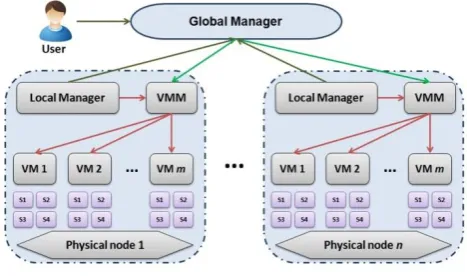
Fig. 1. Cloud System Model.
Figure 1 demonstrates how a user could interact through a Global Manager (application software) to a number of Cloud Virtual Machines. More specifically, each Cloud
Virtual Machine consists of a Local Manager which
interacts with a Virtual Machine Manager (VMM), and through the VMM established a communication path with the various individual VM devices. Each VM is connected to four sensors, from which it receives the data it then transmits to VMM. For each Cloud Virtual Machine there is a Physical Node which connects it to the network.
Table 1. Cloud Servers Configuration.
Server Configuration 1
Server Configuration 2 Model Dell PowerEdge
T110
HP ProLiant ML110 G5
CPU Model Intel E2160, 2C
1800MHz
Intel Xeon 3075, 2C 2660MHz
RAM 4GB 4GB
Network
Bandwidth 1GB/sec 1GB/sec Performance 1800 MIPS/core 2660 MIPS/core
Number of
Servers Used 400 400
Table 1 lists the two types of Virtual Server Configuration for the Cloud which have been used for the simulation. In this work we used 400 Virtual Servers of the model Dell PowerEdge T110 and 400 Virtual Servers of the model HP ProLiant ML 110 G5.
Table 2. Power Consumption Information in Watt.
Consumption in %
Dell PowerEdge T110
HP ProLiant ML110 G5
0% 86 93.7
10% 89.4 97
20% 92.6 101
30% 96 105
40% 99.5 110
50% 102 116
60% 106 121
70% 108 125
80% 112 129
90% 114 133
100% 117 135
Table 2 depicts the rate of Watt Power Consumption from the information produced and transmitted from each type of Cloud Server, either Dell PowerEdge T110 or HP ProLiant G5. As we can observe, when the rate of consumption of watts increases, both the transmission of information increases.
Table 3. Virtual Machine Configuration.
VM 1 VM 2 VM 3 VM 4
CPU Type
High-CPU medium instance
Extra Large instance
Small instance
Micro instance
Number
of Cores 1 Core 2 Cores 3 Cores 4 Cores
RAM 0.85GB 3.75GB 1.7GB 613MB
Network 1GB/sec 1GB/sec 1GB/sec 1GB/sec
Perform ance
2500 MIPS/core
2000 MIPS/core
1000 MIPS/core
500 MIPS/core
Table 3 shows the four types of VM that created and used for the simulation method. Each type had differentiated characteristics in order to be studied a wide range of results.
Table 4. Cloudlet Parameters.
Length (MB) File size (MB) Output size (MB)
5000 5000 5000
Table 4 demonstrates the Cloudlet Parameters which represent the volume of data used in a network in association with IoT technology. With the aim to proceed at a better simulate of high quality data, referring to digital data, we used large sizes in MB.
Subsequently, for further simulation procedure, we used Cooja Contiki simulator with the purpose of personalizing and extracting our network data in an environment with a defined topology.
30 Having already tested the performance of the network we
created in CloudSim, we perform a simulation in Cooja Contiki, where we tried to map the same network scenario, but also studied more aspects of this network.
We implement a network topology of a small part of the previous scenario where examining a single network segment. Namely, we examined the communication and the efficiency of data transmission in a VMM, which includes in its range five VMs.
Fig. 2. Network Topology ([2a] and [2b]).
Figure 2a and Figure 2b show the topology of our proposed network. As we already mentioned, each separate part of our network consists of one VMM and five VMs. In each VM are connected four sensors. The range of the VMM contains only the five VMs, and the range of every VM contains only its four sensors. According to this, we observe that each VM contains only four sensors in its range, so as not to be inserted from the range of other VMs. Figure 3 (a) and Figure 3 (b) demonstrates the Power Consumption of the Network. Figure 3 (a) demonstrates the average Power Consumption, where we can observe that LPM’s power (red color) remains almost constant over time, as well as CPU’s power (blue color). In contrast, the Radio listen’s power (green color) and a little less the Radio transmit’s power (yellow color) where there is a greater variation in Power Consumption. Figure 3 (b) demonstrates the Instantaneous Power Consumption, where, same as before, we can observe that LPM’s power (red color) remains almost constant over time, as well as CPU’s power (blue color). And also, in contrast again, the Radio listen’s power (green color) and a little less the Radio transmit’s power (yellow color) where there is a greater variation in Power Consumption. In Instantaneous Power Consumption we observe that there is a big difference as regards the variation of the Radio transmit’s power, compared with Average Power Consumption, as there are momentary fluctuations in the change in energy consumption during transmission.
(a) Average Power Consumption.
(b) Instantaneous Power Consumption Fig. 3. Power consumption of the proposed network.
Fig. 4. Received Packets Per Node.
http://dx.doi.org/10.9717/JMIS.2018.5.1.27
31 received per node. As we can observe, in most cases and almost every time all the nodes received the same number of packets. In addition to this, we can conclude that there are no duplicated packets received.
Fig. 5. Timeline showing the packets received per mote (node) over time.
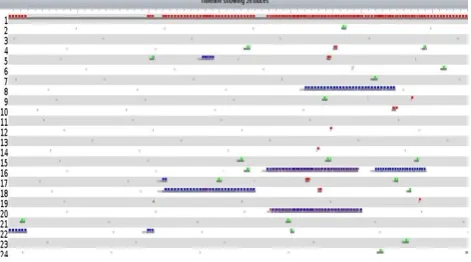
Figure 5 demonstrates the packet transmission procedure through all the motes we used for the simulation in Contiki. With the word ‘mote’ is defined the node in ‘Contiki language’. Through Figure 5, we can see that during the simulation process transmission, there are array packages with large size (large-scale data).
V. CONCLUSION
Due to the blooming of IoT in CC which takes part in the last years, the there is a need of discovering new methods of technological support in many sciences by the researchers. As part of these researches, in this work, with the aim to achieve a type of network that will provide more intelligent media-data transfer, we have studied new technologies, and the use of various open source tools, such as CC analyzers and simulators. Tool like these are useful for studying the collection, the storage, the management, the processing, and the analysis of large volumes of data. Furthermore, the simulation platform used is CloudSim and operates on Eclipse environment. Thus, after measuring the network performance with CloudSim, we use the Cooja emulator of the Contiki OS in order to confirm and access more metrics and options. As a result, we implemented a network topology from a small section of the script of CloudSim with Cooja, so that we can simulate a single network segment. The results of the experiment show that there are not duplicated packets received.
Finally, as future research, we suggest a further examination of the simulation analysis of the network performance in CloudSim simulator, and other simulation platforms, with the aim to have a better and improved contribution of the technology of Internet of Things with
the additional ‘help’ of the Cloud Computing technology for the purpose of better transmission of high quality data. This research could be a start point for better and more efficient media data transmission.
REFERENCES
[1] M. Aazam, E.-N. Huh, M. St-Hilaire, C.-H. Lung, I. Lambadaris, “Cloud of Things: Integration of IoT with
Cloud Computing” Springer, Robots and Sensor Clouds,
vol. 36, pp. 77-94, August 2015.
[2] C. Stergiou, K. E. Psannis, B.-G. Kim, B. B. Gupta, “Secure integration of IoT and Cloud Computing”, Elsevier, Future Generation Computer Systems, vol. 78, part 3, pp. 964-975, January 2018.
[3] S. Sakr, A. Liu, D. M. Batista, M. Alomari, “A survey of large scale data management approaches in cloud
environments”, IEEE Communications Surveys &
Tutorials, vol. 13, issue 3, pp. 311-336, April 2011. [4] R. Kaur, S. Kinger, “Analysis of Security Algorithms in
Cloud Computing”, International Journal of
Application or Innovation in Engineering & Management (IJAIEM), vol. 3, issue. 3, pp. 171-176, March 2014.
[5] S. H. H. Madni, M. S. A. Latif, Y. Coulibaly, Shafi’i M. Abdulhamid, “Resource scheduling for infrastructure as a service (IaaS) in cloud computing: Challenges and
opportunities”, Journal of Network and Computer
Applications, vol. 68, pp. 173-200, June 2016. [6] C. Stergiou, K. E. Psannis, A. P. Plageras, Y. Ishibashi,
B. B. Gupta, B.-G. Kim, “Architecture for security monitoring in IoT environments”, in Proceedings of IEEE 26th International Symposium on Industrial Electronics (ISIE), Edinburgh, Scotland (UK), 19-21 June, 2017.
[7] A. P. Plageras, C. Stergiou, G. Kokkonis, K. E. Psannis, Y. Ishibashi, B.-G. Kim, B. B. Gupta, “Efficient Large-scale Medical Data (eHealth Big Data) Analytics in Internet of Things”, in Proceedings of 19th IEEE Conference on Business Informatics, International Workshop on Internet of Things and Smart Services, Thessaloniki, Greece, 24-26 July, 2017.
[8] C. Stergiou, K. E. Psannis, “Efficient and Secure Big
Data delivery in Cloud Computing”, Springer,
Multimedia Tools and Applications, vol. 76, issue: 21, pp. 22803–22822, November 2017.
[9] F. Tao, Y. Cheng, L. D. Xu, L. Zhang, B. H. Li, “ CCIoT-CMfg: Cloud Computing and Internet of Things-Based
Cloud Manufacturing Service System”, IEEE
32 [10] M. Hilbert, P. López, “The World’s Technological
Capacity to Store, Communicate, and Compute Information”, Science, vol. 332, issue: 6025, pp. 60-65, April 2011.
[11] A. P. Plageras, K. E. Psannis, Y. Ishibashi, B.-G. Kim,
“IoT-based Surveillance System for Ubiquitous
Healthcare”, in Proceedings of IEEE 42nd Annual Conference of Industrial Electronics Society (IECON 2016), Florence, Italy, 23-26 October 2016.
[12] A. P. Plageras, C. Stergiou, K. E. Psannis, B.-G. Kim, B. B. Gupta, Y. Ishibashi, “Solutions for Inter-connectivity and Security in a Smart Hospital Building”, in Proceedings of IEEE 15th International Conference on Industrial Informatics (INDIN), Emden, Germany, 24-26 July, 2017.
[13] C. Stergiou, K. E. Psannis, “Recent advances delivered by Mobile Cloud Computing and Internet of Things for Big Data applications: a survey”, Wiley, International Journal of Network Management, vol. 27, issue: 3, pp. 1-12, May/June 2016.
[14] L. Nkenyereye, J. Jang, “Design of Data Center Environmental Monitoring System Based On Lower
Hardware Cost”, Journal of Multimedia and
Information System, Vol. 3, No. 3, pp. 63-68, October 2016.
[15] J.-H. Huh, K. Seo, “PLC-Based Smart grid Home Network System Design and Implementation using
OPNET Simulation”, Journal of Multimedia and
Information System, Vol. 1, No. 2, pp. 111-118, December 2014.
[16] J.-H. Huh, Y. Kim, K. Seo, “Power Aware Routing Protocol in Multimedia Ad-hoc Network Considering Hop Lifetime of Node”, Vol. 1, No. 2, pp. 101-110, December 2014.
[17] M. Zheng, W. Wang, “Distributed Multimedia Scheduling in the Cloud”, Journal of Multimedia and Information System, Vol. 2, No. 1, pp. 143-152, March 2015.
[18] P. Fiadino, P. Casas, A. D’Alconzo, M. Schiavone, A. Baer. “Grasping Popular Applications in Cellular Netwoks with Big Data Analytics Platform”, IEEE Transactions on Network and Service Management, vol. 13, issue: 3, pp. 681-695, September 2016.
[19] B. Lin, W. Guo, N. Xiong, G. Chen, A. V. Vasilakos, H. Zhang. “A Pretreatment Workflow Scheduling Approach for Big Data Applications in Multi-cloud Environments”, IEEE Transactions on Network and Service Management, vol. 13, issue: 3, pp. 681-695, September 2016.
[20] L. Zuo, M. M. Zhu, “Concurrent Bandwidth Reservation Strategies for Big Data Transfers in
High-Performance Networks”, IEEE Transactions on
Network and Service Management, vol. 12, issue: 2, June 2015.
[21] B. Djellali, P. Lorenz, K. Balarbi, A. Chouarfia.
“Security Model for Pervasive Multinedia
Environment”, Journal of Multimedia Information
System, Vol. 1, No. 1, pp. 23-43, September 2014. [22] Y. Chao-Tung, L. Jung-Chun, C. Shuo-Tsung, H.
Kuan-Lung, “Virtual machine management system based on the power saving algorithm in cloud”, Journal of Network and Computer Applications. vol. 80, pp. 165-180, February 2017.
[23] T. Fei, Y. Lei, L. Tianrui, D. Danting, “Energy efficiency of VM consolidation in IaaS clouds”, The Journal of Supercomputing. Vol. 73, issue: 2, pp. 782-809, February 2017.
[24] Q. Nguyen, T. Nam, T. “Minimizing Total Busy Time with Application to Energy-efficient Scheduling of Virtual Machines in IaaS clouds”, in Proceedings of International Conference on Advanced Computing and Applications, pp. 141-148, Can Tho, Vietnam, 23-25 November 2016.
[25] B. Dinh-Mao, Y. YongIk, H. Eui-Nam, J. SungIk, “Energy efficiency for cloud computing system based on predictive optimization”, Journal of Parallel and Distributed Computing, Vol. 102, pp. 103-114, April 2017.
Authors
Christos Stergiou
is currently a
PhD student in the Department of
Applied Informatics, School of
Information Sciences, University
of Macedonia, Greece. His main
research
interests
include
Algorithms for Cloud Computing,
Big Data and Wireless Communication. In 2017, he
was awarded by the conference committee of 19th
IEEE Conference on Business Informatics (CBI) for
Doctoral Student Work titled “Algorithms for Big
Data in Advanced Communication Systems and
Cloud Computing”.
Kostas E. Psannis
was born
in Thessaloniki, Greece.
Kostas received a degree in
Physics
from
Aristotle
http://dx.doi.org/10.9717/JMIS.2018.5.1.27
33
degree from the Department of Electronic and
Computer Engineering of Brunel University (UK).
From 2001 to 2002 he was awarded the British
Chevening scholarship sponsored by the Foreign &
Commonwealth Office (FCO), British Government.
He was awarded, in the year 2006, a research grant by
IISF (Grant No. 2006.1.3.916). Since 2004 he has
been a (Visiting) Assistant Professor in the
Department of Applied Informatics, University of
Macedonia, Greece, where currently he is Assistant
Professor (& Departmental LLP/ Erasmus-Exchange
Students Coordinator and Higher Education Mentor)
in the Department of Applied Informatics, School of
Information Sciences. He is also joint Researcher in
the Department of Scientific and Engineering
Simulation, Graduate School of Engineering, Nagoya
Institute of Technology, Japan. He has extensive
research, development, and consulting experience in
the area of telecommunications technologies. Since
1999 he has participated in several R&D funded
projects in the area of ICT (EU and JAPAN). Kostas
Psannis was invited to speak on the EU-Japan
Co-ordinated Call Preparatory meeting, Green & Content
Centric Networking (CCN), organized by European
Commission (EC) and National Institute of
Information
and
Communications
Technology
(NICT)/
Ministry
of
Internal
Affairs
and
Communications (MIC), Japan (in the context of the
upcoming ICT Work Programme 2013) and
International Telecommunication Union (ITU) SG13
meeting on DAN/CCN, July 2012, amongst other
invited speakers. He has several publications in
international Conferences, books chapters and peer
reviewed journals. His professional interests are:
Multimodal Data Communications Systems, Haptic
Communication between Humans and Robots, Cloud
Transmission/Streaming/Synchronization,
Future
Media-Internet
of
Things,
Experiments
on
International Connections (E- ICONS) over TEIN3
(Pan-Asian), Science Information Network (SINET,
Japan), GRNET (Greece)-Okeanos Cloud, and
GEANT (European Union) dedicated high capacity
connectivity. He is Guest Editor for the Special Issue
on Architectures and Algorithms of High Efficiency
Video Coding (HEVC) Standard for Real-Time Video
Applications (2014), Journal of Real Time Image
Processing (Special Issue). He is Guest Editor for the
Special Issue on Emerging Multimedia Technology
for Smart Surveillance System with IoT Environ-ment
(2016), The Journal of Supercomputing (Special
Issue). He is Guest Editor for the Special Issue on
Emerging Multimedia Technology for
Multimedia-centric Internet of Things (mm-IoT) (2016),
Multimedia Tools and Applications (Special Issue).
He is currently GOLD member committee of IEEE
Broadcast Technology Society (BTS) and a member
of the IEEE Industrial Electronics Society (IES). From
2017 Prof. Kostas E. Psannis serving as an
ASSOCIATE EDITOR for IEEE ACCESS and IEEE
Communications Letters. He is also a member of the
European Commission (EC) EURAXESS Links
JAPAN and member of the EU-JAPAN Centre for
Industrial Cooperation.
Andreas
P.
Plageras
is
currently a PhD student in the
Department
of
Applied
Informatics,
School
of
Information
Sciences,
University
of
Macedonia,
Greece. His main research
interests include Algorithms for Big Data delivery
over Internet of Things.
Yutaka Ishibashi
received the
B.E., M.E., and Ph.D. degrees
from
Nagoya
Institute
of
Technology, Nagoya, Japan, in
1981,
1983,
and
1990,
respectively. In 1983, he joined
the
Musashino
Electrical
34
![Fig. 2. Network Topology ([2a] and [2b]). Figure 2a and Figure 2b show the topology of our](https://thumb-us.123doks.com/thumbv2/123dok_us/8814119.1779333/4.595.309.547.80.273/fig-network-topology-a-b-figure-figure-topology.webp)