A Multi-Model And Ai-Based Collegebot
Management System (Aicms) For Professional
Engineering Colleges
K. Arun, A. Sri Nagesh, P. Ganga
Abstract: Chatbot is a program which provides human conversation using Artificial Intelligence (AI). Chatbots are designed to work as VIRTUAL ASSISTANTS (VA). They themselves provide a platform for the promotions of the Products and Services online. All Higher Educational Institutes provide the complete information through their internet sites for students, which admits the use of social nets such as Facebook, WhatsApp, and College websites. Total-in-All, in any website, searching functionality is required to search for any information and it includes Social Media Applications like Facebook and WhatsApp regular response are utilized. Therefore, Chatbot is an effective auto-response system, and also an instant messaging platform. In this paper, AICMS an AI-Based CollegeBot management system for professional Engineering college system provide the auto-response to student queries about the college basic information, class timetables, examination schedules related to academics. Many Queries about the subjects and placements can be inputted to the system. Here the system AICMS is designed with Dialogflow which is supported by the Google API. AI and running as a messenger in the Facebook, which takes the input as the text and voice and it provides the response as text and voice. It gives a quick, accurate response to student and staff queries in an interactive fashion.
Keywords: Chatbot, Natural Language Processing, machine learning.
I. INTRODUCTION
Chatbots are used in many service areas as an information provider in conversation mode. These Chatbots are adopted in government sectors as well as private sectors. One of the biggest railway transportation in the world is Indian Railways, Indian Railways using the Chatbot named as "ask DISHA", which provides the information in the good conversational way. In the private sector, Chatbot services are increased extremely. Product promotions, product demonstrations, customer care services.
In the banking area also Chatbots are used as conversational banking, which provides the banking services provided by conversational chatting. This bot provides the loan predictions along with the basic information of the customer.
In the social networks, Chatbots react to the messages, without human integration bots are giving the responses to each and every message.
Revised Manuscript Received on July 09, 2019
K. Arun, Research Scholar in CSE Dept, Acharya Nagarjuna
University, Guntur (Andhra Pradesh), India.
Dr A. Srinagesh, Associate Professor in CSE Dept, RVR&JC, Guntur
(Andhra Pradesh), India.
P. Ganga, Assistant Professor in CSE Dept, in MRCE, Hyderabad (Telangana), India
Chatbots takes input as voice and it converts into Speech-to-text process it and then response generated in the form of text-to-speech [16]. Many health care, counselling bots are supporting for the people who are needing the counselling like diabetic patients, drinkers [10], psychiatric [9, 10], old age people who are suffering from memory loss (dementia) [12]. The Chatbot provides the conversational counselling service.
When coming to the college level, students and staff always need a common platform, which provides all required information about the college, student information, examination section information, placement cell information, and cultural events. Actually, all such types of information are provided on college websites. Here the proper searching process is required. But this Engineering College Chatbot provides the information in an interactive way, it allows voice, text type of input and it provides the text, voice response to the user. It allows miss-spellings, different forms of questions. System trains, one question in many forms to give the proper response. With this type of service Chatbot of engineering, college Chatbot become very close to the staff and students.
Online chat such as twitter, Facebook, slak, viber, Twillo, Skype, kik, LINE, Telegram, Amazon Alexa these applications provide APIs. In this work Chatbot integration with Facebook. Chatbot placed in the college Facebook link, which is already used in the college. Dialog flow is used to design the Chatbot. The Dialog flow is also called as Google API.AI. No code is required for this Dialog flow. No need for installation, just integration has been sufficient and free of cost.
This work explained in V sections, which follows I section is about the introduction, II, section describes related work, III, section provides the information about the system Design, IV, section describes the experimentation and the result, V section conclusion and future work, finally references of this paper.
II. LITERATURE REVIEW
Chatbots were designed for a long time; these conversational Chatbots are used in many application areas. The following two parts are given 1. Chatbot types and 2. Related Work.
A. Chatbot Types
A Chatbot is a programmed computer using auto-reply via multimedia style, i.e., text, pictures, links, video, and voice. The Chatbots are available in two flavors. 1.
Rule-Based, 2. AI_Based
Rule-based Chatbots depend on the rules and conditions. It is not reliable for all the cases, whenever users ask questions that the questions have no conditions or rules, a Chatbot is not recognized that questions. The second type of Chatbot is an AI-based or intent-based approach is machine learning. A Chatbot is trained based on natural language processing (NLP) with the data sets, which are conversion dialogs, to extract the combination of conversation, including intent, context, an entity [20]. Many modern tools that can be used for this approach such as IBM Watson [18], Api. AI or Dialog flow and Wit. AI [19]. Typically, the basis of implementation Chatbot requires templates that can match the user's inputs and generate the appropriate answer. At this moment, there are many ways to develop a Chatbot without coding which makes the development of the Chatbot is simple, convenient and fast.
B. RELATED WORK
A Chatbot can be implemented using an interactive model-based system and can be used as an efficient machine-to-human conversation systems using AI and NLP [2]. Today world, the demand for customers is a quick reply from the service centers, which are unable to provide to the customers. Another demand is self-service. Customers are not prepared to wait days, hours or even minutes for an employee to help them. The Chatbot is so designed using AIML and LSA provide responses within seconds, which server's user satisfaction [5] [8].
The benefit of developing, deploying a Chatbot in any field of application is that it can behave as a personal assistant, one of the basic needs of human life is medical services. Chatbot act as medical consultants based on the information on symptoms and treatment regarding previous records [9]. In addition, a Chatbot aims to suggest a text-based conversational service for psychiatric counseling based on high-level NLU (Natural Level Understanding) [10].
A Chatbot can also be applied in education systems such as technical institutions and engineering colleges. It is used to improve student interaction and collaboration, acting as a game changer in the innovative tech-world. Chatbot provides a personalized learning environment, virtual assistant, smart feedbacks, efficient teaching, instant help to students and better student support. The Chatbot will be a multi-model technical assistant to serve humanity for their multifarious activities and requirements' [1] [15] [16].
III. SYSTEM DESIGN AND IMPLEMENTATION
In this section, the system design and implementation are explained. Initially, the system architecture is briefly explained. Then the implementation process is explicated. Finally, the tools which are used in the Chatbot are also explained.
A. Conversational Formula
Let xu ={(yi, ai,bi,li)}N i=1 denote a set of N single-turn human-bot conversations, where yi indicates the user that presents the post ai, bi stands for a candidate response corresponding to ai, and li is a label denoting whether bi is an appropriate reply to ai or not. If bi is acceptable for ai, li should be set to 1, otherwise li=0. This CollegeBot provides the conversational service between users (students, staff, principal, and college people), CollegeBot (Chatbot). For the user queries how the bot going to give response
[image:2.595.305.548.109.205.2]automatically. The function f (bi|ai, yi) to measure the coordination between bi and ai taking yi into consideration. This function is used for the measuring the matching accuracy in between CollegeBot response and user interactions.
Figure 1: CollegeBot Architecture
B. System Architecture
The Chatbot in our system is CollegeBot, is the intent-based approach, the architecture is shown in Fig. 1, the Chatbot is implemented in IM application, where the Facebook application is used in our study. Through Facebook, the user sends any conversation to the application. The application transfers the message to Dialog flow, which is the engine of the CollegeBot. The message is extracted to obtain the intent. The response, according to message intent and entity, these are predefined from the training phase in the fulfillment. Another way of the response generation depends on the external API’ and database. To implement this extra type some additional coding is needed. The user can be able to read the response from the system. The receiving response of the user in the forms of text, image, audio, and video.
C. Implementation Process
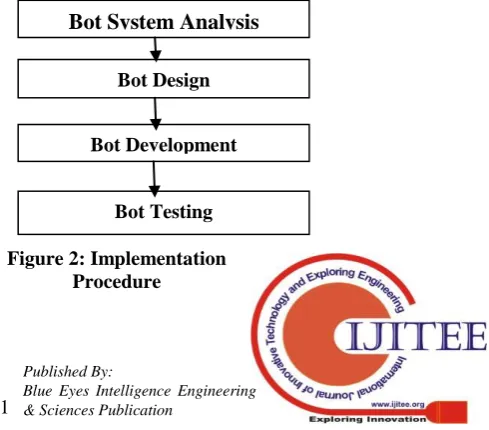
To implement CollegeBot as Figure-2, process divided into four parts, such as CollegeBot System Analysis, Bot Design, Bot Development, and Bot Testing, these are explained in the following.
1. Bot System Analysis:
Generally any Chatbot can be developed with varied options. In our CollegeBot system contains three roles 1. Principal 2. Staff 3. Students. For each and every role defined by the required number of questions.
The role of the principal he provides some information to the CollegeBot like announcing notices and instructing the staff and students, the holidays, results, placement information. Queries related to the college, staff, and students.
The role of the staff providing information about works, responsibilities, and common queries in the department.
Figure 2: Implementation Procedure
Bot System Analysis
Bot Design
Bot Development
[image:2.595.303.548.622.837.2]The role of the student is getting responses from the CollegeBot what he required from the college, about his class, time tables, subjects, staff, events, results, college-level programs, university-college-level programs, internships, project works, material, examination, cultural events. Altogether CollegeBot prepared for 150+ queries and responses. This information is used to train the CollegeBot.
2. CollegeBot Design:
CollegeBot is designed 48 intents including more entities. Twenty intents of sub-details of college details such as college name, code, fee, address, seat allotments, branches, library details, canteen facilities. Ten intents of sub-details of the class details such as timetable, subjects, room locations, class in-charge, and department notices. Eight intents are defined about the placement information like dates, company, qualification, how many rounds, location of the company, packages.
3. Development:
To develop CollegeBot, Dialog flow from Google was used as a major tool. The steps of this process are given below. a) Create an agent (CollegeBot) in a Dialog flow by using a Google Account.
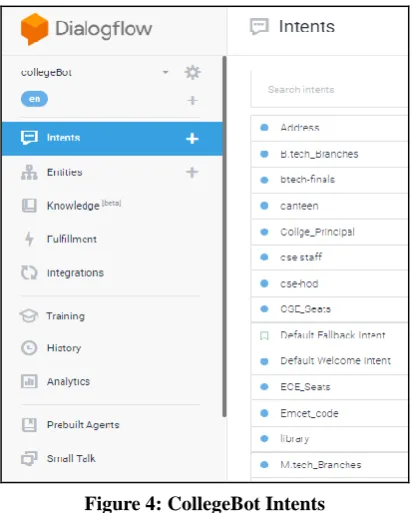
b) Generate the intent by using college information on the college sites. In figure 3 specifies utterness of the College address intent and figure 4 specifies all intents in the collegebot.
c) Train phrases and response are the functions in intent. Define the training phrase to match user queries.
[image:3.595.342.549.246.503.2]Define responses to display to the user which can be phrased, image, voice, and video. Here image, video, and audio must be coded by using JSON format. The phrases, which were trained in the training process.
Figure 3: College Address Intent
d) Entities are used to pick out specific pieces of information that your users mention in the intents of the agent. In the dialog flow. There are 3 types of entities are supported by the Dialog flow 1. System entities, 2. Developer entities, 3. Session entities, 4. Manage entities.
4. Testing
In the implementation, final step is the testing. Testing’s are classified into three types 1. Testing during the training, 2. Integration testing, 3. System testing.
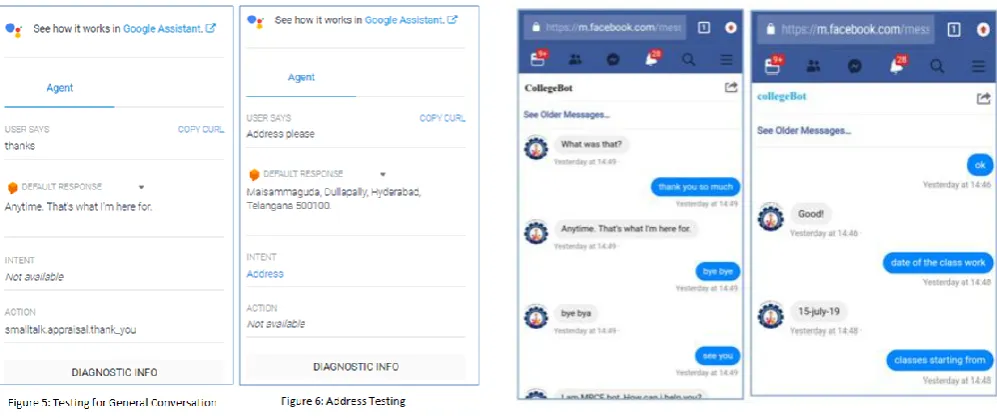
Testing during the training step: in this step for each and every time new intent is trained, then verification of the trained data at that time only. If the testing response is not matched, then additional training phrases are required. This testing during the training, figure 6 explains the testing during the training.
Integration testing is the testing process, when Dialog flow is integrated with different platforms, like Facebook, Skype, line, Google assistant. For each intent training in the Dialog flow, it is better to check whether it is trained correctly or not. In this CollegeBot Facebook is integrated into Dialog flow.
Figure 4: CollegeBot Intents
[image:3.595.85.255.431.701.2]Figure 6: Conversation Testing B) Tools to develop CollegeBot
The CollegeBot designed with the Dialog flow application is the engine and the heart of the CollegeBot. The Dialog flow is also called as Api.ai with the support from Google.
Dialog flow is not needed any coding, because of the (NLU) Natural Language Understating feature. The NLU converts the input or queries into intent by using the (NLP) Natural Language Processing. Now, this CollegeBot integrated with Facebook, out of all supported IM platforms. Now the Dialog flow directly supports languages converts 32 languages, including the Indian language “Hindi”.
IV. RESULTS
CollegeBot is implemented to fulfil the requirements of the college students and the staff in any higher educational institutions in the facebook. One of the sample facebook bot conversation explained in the figure 7.This CollegeBot is based on the Dialog flow tool which is supported by the Google AP.ai. The CollegeBot providing the updated information to the student, staff and college admissions. Finally how many users are used this bot with different queries and responses. Figure 8 is sample of analysis of bot utilization.
V. CONCLUSION
This AICMS bot is an auto AI based college information and interactive system. It trained with all the required college information and regular conversations. Users can access information in the conversational and instant massaging fashion. Once trained the bot it works always without human intervention. Dialogflow interfaces were implemented to design as the core part without any code. As an interface Facebook is used. The CollegeBot creates a single conversational platform for the students, staff, and the principal.
In future work CollegeBot will works with the multilingual conversations. Provision for the Conversations support in the local languages can also be implemented and tested.
[image:4.595.306.548.261.498.2]Flesh 7: Results at the Facebook interface.
Figure 8: Analysis of User and College Bot conversation.
ACKNOWLEDGMENT
I would wish to convey my deep gratitude to Dr. A. Srinagesh, My research supervisor, for his patient
guidance and encouragement of research. And I am grateful to Dr. P. John, Paul, Principal of Malla Reddy College of Engineering, who provided valuable support in this study.
REFERENCES:
1. Molnár, György and Zoltán Szüts. “The Role of Chatbots in Formal Education.” 2018 IEEE 16th International Symposium on Intelligent Systems and Informatics (SISY) (2018): 000197-000202.
2. B. R. Ranoliya, N. Raghuwanshi, and S. Singh, "Chabot for university-related FAQs," 2017 International Conference on Advances in Computing, Communications, and Informatics (ICACCI), Udupi, 2017, pp. 1525-1530.
3. Mulyana, Eueung, Hendrawan, and Rifqy Hakimi. “Bringing Automation to the Classroom: A ChatOps-Based Approach.” OSF, 11 July 2018. Web.
5. A. Atiyah, S. Jusoh and F. Alghanim, "Evaluation of the Naturalness of Chatbot Applications," 2019 IEEE Jordan International Joint Conference on Electrical Engineering and Information Technology (JEEIT), Amman, Jordan, 2019, pp. 359-365.
6. F. Alaieri and A. Vellino, "A decision-making model for ethical (robots)," 2017 IEEE International Symposium on Robotics and Intelligent Sensors (IRIS), Ottawa, ON, 2017, pp. 203-207.
7. L. N. Michaud, "Observations of a New Chatbot: Drawing Conclusions from Early Interactions with Users," in IT Professional, vol. 20, no. 5, pp. 40-47, Sep. -Oct. 2018.
8. Atiyah, Ayah et al. “An Efficient Search for Context-Based Chatbots.” 2018 8th International Conference on Computer Science and Information Technology (CSIT) (2018): 125-130.
9. Rosruen, Nudtaporn, and Taweesak Samanchuen. “Chatbot Utilization for Medical Consultant System.” 2018 3rd Technology Innovation Management and Engineering Science International Conference (TIMES-iCON) (2018): 1-5.
10. Dongkeon Lee, Kyo-Joong Oh and Ho-Jin Choi, "The chatbot feel you - a counseling service using emotional response generation," 2017 IEEE International Conference on Big Data and Smart Computing (BigComp), Jeju, 2017, pp. 437-440.
11. H. Wang, Q. Zhang, M. IP, and J. T. Fai Lau, "Social Media–based Conversational Agents for Health Management and Interventions," in
Computer, vol. 51, no. 8, pp. 26-33, August 2018.
12. Tsai, Yin-Te and Wei-An Lin. “Design of an Intelligent Cognition Assistant for People with Cognitive Impairment.” 2018 IEEE 20th International Conference on High-Performance Computing and Communications; IEEE 16th International Conference on Smart City; IEEE 4th International Conference on Data Science and Systems (HPCC/Smart City/DSS) (2018): 1207-1212.
13. Syahirah Ahmad, Nur & Hamim Sanusi, Mohd & Abd Wahab, Mohd Helmy & Mustapha, Aida & Abidin Sayadi, Zainal & Saringat, Mohd. (2018). “Conversational Bot for Pharmacy: A Natural Language Approach.” 76-79.
14. K. Oh, D. Lee, B. Ko, and H. Choi, "A Chatbot for Psychiatric Counseling in Mental Healthcare Service Based on Emotional Dialogue Analysis and Sentence Generation," 2017 18th IEEE International Conference on Mobile Data Management (MDM), Daejeon, 2017, pp. 371-375.
15. K. Bala, Mukesh Kumar, Sayali Hulawale, Sahil Pandita, "Chat-Bot For College Management System Using A. I", Nov-2017, IRJET, pp-2032
16. Bala, Kumkum & Kumar, Mukesh & Hulawale, Sayali & Pandita, Sahil.”Chat-Bot for College Management System Using A. I”. 2018, IJAERD, 2395-0056.
17. Dialog flow, “Learn about basic Dialog flow concepts.” [Online]. Available: https://dialogflow.com/docs/.
18. Thomas Watson, “IBM WATSON,” 2011. [Online]. Available: https://www.ibm.com/watson/. [Accessed: 20-Aug-2011].
19. wit.ai, “wit.ai,” 2018. [Online]. Available: https://wit.ai/.
20. E. Pratt, “A Primer Artificial Intelligence and Chatbots in Technical Communication – A Primer,” pp. 2–9, 2017.
21. Al-Zubaide, H, and A. A. Issa, “Ontbot: {Ontology} based Chatbot,” Fourth Int. Symp. Innov. Inf. Commun. Technol., pp. 7–12, 2011.
AUTHORSPROFILE
K. Arun, Research scholar in Acharya
Nagarjuna University in the Department of Computer Science and Engineering. His areas of interest are Machine learning, Text Analytics and Artificial Intelligence. He has eight years of teaching experience engineering colleges. He has published six international journals.
Dr. A. Srinagesh, is presently working as
Associate professor in the Department of Computer Science and Engineering at RVR&JC Engineering College, Guntur. His areas of interest are Image processing, Big Data, Machine Learning, and Artificial Intelligence. He has 20 years of teaching experience and 4 years of Industry experience. He has 20 international journals and 7 International Conference Publications. He is an active Member of ISTE, CSI and ACM.
P. Ganga, is presently working as Assistant