International Journal of Innovative Technology and Exploring Engineering (IJITEE) ISSN: 2278-3075, Volume-8 Issue-10, August 2019
Abstract: The emerging ubiquitous nature of wireless sensor networks has made it suitable and applicable to a diversified number of vital applications that include environment surveillance, health monitoring using implantable sensors, weather forecasting and other plethora of contexts. The critical issues such as computation time, limited memory and energy are more common due to the tiny sized hundred and thousands of sensor nodes existing in the networks. In this context, the network lifetime completely depends on the potential use of available resources. The process of organizing closely located sensor nodes into clusters is convenient for effective management of cluster and improving the lifetime of the complete network. At this juncture, swarm intelligent and evolutionary algorithms the pertains to the problem of NP-complete is determined to achieve a superior optimal solution. In this paper, a Hybrid Artificial Bee Colony and Bacterial Foraging Algorithm-based Optimized Clustering (HABC-BFA-OC) is proposed for achieving enhanced network lifetime in sensor networks. In this proposed HABC-BFA-OC technique, the benefits of Bacterial Foraging Optimization is included for improving the local search potential of ABC algorithm in order to attain maximum exploitation and exploration over the parameters considered for cluster head selection. The simulation experiments of the proposed HABC-BFA-OC technique confirmed an enhanced network lifetime with minimized energy consumptions during its investigation with a different number of sensor nodes
.
Keywords: Cluster Head Selection, (ABC)Artificial Bee Colony, (BFO)Bacterial Foraging Optimization, Network Lifetime, Exploitation, Exploration.
I. INTRODUCTION
In general, the sensor nodes are deployed randomly for the objective of monitoring a particular area in temporal space and geographical region [1]. The maintenance of network connectivity is considered as the essential requirement for facilitating accurate detection of events under reduced energy consumptions [2]. A plethora of research studies was contributed in the area of wireless sensor networks for working on the objective of minimizing energy consumptions in clustering algorithms
[3].However, most of the research studies failed in including the performance parameters related to Quality of Service (QoS) for significant Improvement of network lifetime in the sensor network [4]. Further, meta-heuristic algorithms are identified to be suitable for optimizing the QoS parameters that play an anchor role of optimization process [5]. The
Revised Manuscript Received on August 05, 2019.
Bandi Rambabu Associate Professor, CVR College of Engineering and
Research Scholar, JNTUH Hyderabad
Dr. A Venugopal Reddy, Professor, JNT University, Hyderabad
Dr.J Sengathir Associate Professor, CVR College of Engineering,
JNTUH Hyderabad
meta-heuristic algorithm like ABC, when implemented as a standalone algorithm, is considered to be lacking in terms of local search [6]. At this juncture, bacterial Foraging Algorithms that could ensure maximum exploitation is required for integrating it with the standard ABC algorithm [7]. This possibility of establishing the tradeoff between exploitation and exploration is essential for optimizing the parameters like network lifetime, energy consumptions and delay under the event of cluster head selection in the network [8]. Furthermore, the formulation of objective function plays a vital in optimizing the factors that are responsible for attaining maximum lifetime in the network [9]. In addition, the network model and energy model with ideal assumptions need to be formulated for appropriate investigation process [10]
.In this paper, a Hybrid Artificial Bee Colony and Bacterial
Foraging Algorithm-based Optimized Clustering
(HABC-BFA-OC) is proposed for achieving enhanced network lifetime in sensor networks. In this proposed HABC-BFA-OC technique, the benefits of Bacterial Foraging Optimization is included for improving the local search potential of ABC algorithm in order to attain maximum exploitation and exploration over the parameters considered for cluster head selection. The simulation experiments of the proposed HABC-BFA-OC technique is evaluated using a percentage of alive nodes, percentage of dead nodes, throughput with different sensor nodes in the network
.
The paper is organized as follows: Section II discusses the various optimized clustering techniques based on metaheuristic methods for wireless sensor network, subsequently discussed in detail the proposed A Hybrid Artificial Bee Colony and Bacterial Foraging Algorithm for Optimized Clustering in Wireless Sensor Network in Section III. Finally, in Section IV simulation results analysis and conclusion of the work addressed.
II. RELATED WORK
An improved Distributed Energy-Efficient Clustering scheme using swarm intelligence was proposed to enrich the life expectancy and throughput of the wireless sensor networks [11]. This bio-inspired algorithm adapted Artificial Bee colony optimization for selecting the cluster heads. It included a fitness function which contains not only residual energy but also the factors such as intra-distance in the cluster, inter-cluster distance, and cluster size. It focused on optimizing the energy consumption and communication cost in terms of delay and the number of packets exchanged. This ABC-based approach confirmed the quality of the network in terms of energy consumption,
delay and live nodes with respect to the cluster size.
Bandi Rambabu, A Venugopal Reddy, Sengathir Janakiraman
A Hybrid Artificial Bee Colony and Bacterial
Foraging Algorithm for Optimized Clustering in
Sensor Network
Then, Multi-hop PSO-based clustering scheme (MPSO)scheme was proposed for the efficient selection of cluster heads during the clustering process [12]. It was adopted by devising a superior fitness function that includes average distance, the energy of the member nodes in the cluster and number of cluster heads in the current iteration of the selection process. The results of MPSO demonstrated its superior performance in terms of the packet delivery ratio, end-to-end delay, packet dropping ratio, network lifetime, relative energy consumption and average residual energy. An optimized cluster selection approach named Harmony Search Algorithm and Particle Swarm Optimization (HSA-PSO) was proposed for outperforming network in terms of throughput, lifetime expectancy and quality of service. This HSA-PSO scheme searches for the potential cluster heads by improving HSA through best factors of PSO to select the cluster head selection optimally in WSNs [13]. The fitness function defined in HSA-PSO used the factors that relate to the distance of nodes from cluster heads, node count and nodes’ residual energy of nodes for selecting cluster heads. It was identified to be superior over hybrid HSA-PSO algorithm with the average residual energy and throughput of 83.89% and 29.12%, respectively.
Further, an integrated K-means and PSO clustering scheme was proposed for enriching the performance of the clustering scheme with the cluster head selection [14]. It used the K-Means algorithm for constructing clusters with PSO algorithm responsible for optimal selection of cluster head in the network. It confirmed superior performance compared to the LEACH and K-Means cluster head schemes which confirmed a predominant energy conservation rate of 49% over the LEACH scheme and about 18% over the K-means clustering schemes. An Artificial bee colony-based cluster head selection scheme was contributed for optimized clustering and routing with considered an improvement in the vital parameters such as the lifetime of network and throughput [15]. This ABC-based cluster head selection derived the potential sensor nodes as cluster heads by assigning a weight factor defined by the fitness function. It utilized the fitness function defined based on the distance of a node from cluster head and base station, cluster head to the base station, the ratio of residual to initial energy and the number of nodes in a cluster. It was proved to be excellent in energy consumption, lifetime of a network and throughput compared to the primitive MRP and PSO-based cluster head selection approaches.
III. A HYBRID ARTIFICIAL BEE COLONY BACTORIAL FORAGING ALGORITHM FOR
OPTIMIZED CLUSTERING IN WSNS
The proposed ABC-BFA scheme concentrates mainly on the process of cluster head selection from a cluster by assuming that the activity of cluster formations has been already done. The main objective of the proposed scheme focuses on selecting a cluster head in an energy-efficient way.
Initialization of population in the ABC-BFA scheme In the phase of initialization, the complete population (set of sensor nodes) is randomly distributed in the network. The position of the randomly distributed sensor nodes represent the initial solution to this problem of optimising cluster head in the network. The random initial position of the sensor nodes are derived based on Equation (1)
)
(
)
1
,
0
(
,D T T T
k
L
rand
L
U
S
(1)
Here, ‘
D
’ represents the dimension used for investigating each and every sensor node ‘K’ in the totalnumber of sensor nodes of the network considered as NS.
L
T andU
T are the lower and upper threshold values of dimensions through which the sensor nodes could be explored in that specific dimension withrand(0,1)
as the randomly generated variable that lies between 0 and 1. Here, the position of sensor nodes that has the possibility of being selected as cluster head is presented based on Equation (2))]
,
),...(
,
(
),
,
[(
k1(t1( k2(t2) k2(t2) k2(t2) k1(t) n1(t)k
S
R
S
R
S
R
S
(2)
The employee bee phase of ABC-BFA scheme
In this phase, the number of sensor nodes and the number of possible ways through which the sensor nodes are exploited for identifying significant sensor nodes as the cluster head is considered to be equal. Then the feasible ways of searching a new sensor node to be selected as cluster head are initiated.
The new sensor node selected as cluster head in this phase is represented through Equation (3)
)
(
(,) (,) )( , ) 1 (
,
t D l t
D k t
D k t
D
k
S
S
S
N
(3) Where ‘
’ is the randomly generated number that ranges between -1 and +1 with the condition k
l. When the process
of employee bee agents involved in exploitation identifies a new sensor node for cluster head selection, the process of estimating the fitness value for that newly selected sensor node is determined based on the objective function formulated based on intra-cluster distance, residual energy and distance to sink station. At this juncture, the fitness value of the newly selected cluster head sensor node is compared with the current cluster head existing in the network through the method of greedy approach. If the fitness value of the newly selected cluster head is greater than the fitness of existing cluster head, then the current sensor node is replaced with the newly selected cluster head. In this context, the fitness value of the newly selected cluster head sensor node is determined based on Equation (4)
Otherwise
S
fit
S
fit
if
S
fit
S
FIT
k k
k k k
k k
k
)
(
1
0
)
(
)
(
1
1
{
)
(
(4)
Where ( )
k k S
FIT and fitk(Sk)
corresponds to the objective and the fitness function respectively.
In this context, the exploitation level introduced by the employee bee phase towards local optimization is limited, since they have the tendency to entering into the local point of optimality without solution maturity. Thus, the Bacterial Foraging Algorithm (BFA) is
International Journal of Innovative Technology and Exploring Engineering (IJITEE) ISSN: 2278-3075, Volume-8 Issue-10, August 2019
this improvement phase, the initial population of sensor nodes utilized by the employee phase is considered as input to the bacterial foraging algorithm for the local optimization process. The BFA incorporates a unit-walk in a random direction until the pre-final step and unit-walk in the sequential direction during the final step. If ‘
i
th’ bacterium (considered as sensor node) with ‘k
’ number of reproductive states (possible states under potentially) with ‘m
’ exploitation step, then the potential bacteria (potent sensor node) is selected as the cluster head based on Equation (5))
(
)
(
)
,
,
(
)
,
,
1
(
) ( )
( ) ( )
(
i T i
i i
L i
i
DV
DV
DV
R
m
k
a
m
k
a
(5)
Where
DV
( )i refers to the direction vector corresponding to the ‘m
th ’ exploitation step and it is considered to vary between -1 and 1 respectively. Finally, the fitness value is recomputed in every run for deciding about the cluster head selection.Onlooker bee phase
In this phase, the information about the retained or newly selected cluster head sensor node is derived from the employee bee phase. Then, the task of selecting the cluster head is re-investigated based on onlooker bee probability computation. The probability of retained or newly selected cluster head sensor node in the onlooker bee phase is
estimated based on Equation (6)
)
(
)
(
Pr
1
k NS
k k
k k k
S
fit
S
fit
ob
(6) However, the onlooker bee phase of ABC also needs an improvement that could be derived from the reproductive phase of BFA. The health condition (fitness value) of each bacteria (sensor node) is computed based on the aggregate value of fitness determined during their entire lifetime period based on Equation (7)
MSj BFA
k
a
k
m
ob
1 )
(
(
1
,
,
)
Pr
(7) Then, the sensor nodes are sorted and ranked based on their fitness value in the reverse order in the reproductive step. The sensor node that meets the eligibility of being selected as a cluster head is divided into two search population, thereby maintain the number of sensor nodes in the network. The sensor nodes that fail to satisfy the requirements are considered as an abandoned solution (worst sensor nodes) and enters into the scout bee phase of the exploration process. Scout bee phase
In this phase, the abandoned solution (worst sensor nodes) is explored with possible dimensions. If the fitness value of the sensor nodes does not change during the investigation period, then new sensor nodes derived from the onlooker bee phase are considered for exploration. This process of exploration is continued until a superior cluster head complying to the objective function is identified or the number of iterations used for implementation is terminated.
IV. RESULT ANALYSIS AND CONCLUSION The simulation experiments of the proposed ABC-BFA and the benchmarked GSFA, HSA-PSO and HSA-CSO schemes are evaluated using MATLAB simulation tools. The simulation parameters considered for the evaluation of the proposed ABC-BFA and the benchmarked GSFA, HSA-PSO and HSA-CSO schemes are highlighted in Table 1.
Table 1: Simulation parameters used for implementing the proposed ABC-BFA
Simulation parameters Values
Network area 1000, 1000
Number of sensor nodes 1000 Maximum Lifetime 2500 Size of data packets 4000
Data aggregation rate 9
10
5
Initial energy of sensor nodes 0.1 Joule
Receiver energy 9
10
50
JoulesTransmitter energy 9
10
50
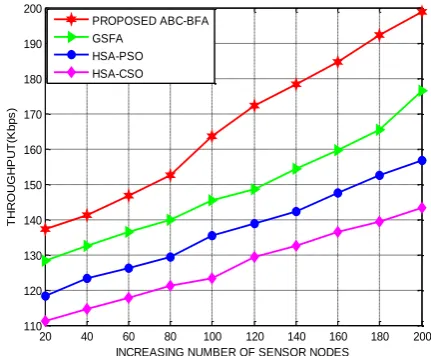
JoulesIn the first level of investigation, the performance of the proposed ABC-BFA and the benchmarked GSFA, HSA-PSO and HSA-CSO schemes are compared based on throughput and delay with different number of sensor nodes in the network. Figure 2 depicts the performance of the proposed ABC-BFA scheme with the compared GSFA, HSA-PSO and HSA-CSO schemes using throughput under a different number of sensor nodes in the network. The throughput of the proposed ABC-BFA is considered to be enhanced independent to the number of sensor nodes in the network since it is potent in discriminating significant cluster head sensor nodes form impotent sensor nodes during the process of clustering.
The throughput of the proposed ABC-BFA is proving to be improved by 10.21%, 12.36% and 14.82%, superior to the compared GSFA, HSA-PSO and HSA-CSO schemes used for analysis.
20 40 60 80 100 120 140 160 180 200
110 120 130 140 150 160 170 180 190 200
INCREASING NUMBER OF SENSOR NODES
TH
R
O
U
G
H
P
U
T(
K
b
p
s
)
PROPOSED ABC-BFA GSFA
[image:3.595.312.541.180.320.2]HSA-PSO HSA-CSO
[image:3.595.324.540.532.710.2]Sensor Network
50 100 150 200 250 300 350 400 450 500 20
40 60 80 100 120 140 160
INCREASING NUMBER OF SENSOR NODES
D
E
L
A
Y
(M
IL
L
IS
E
C
O
N
D
S
)
PROPOSED ABC-BFA GSFA
HSA-PSO HSA-CSO
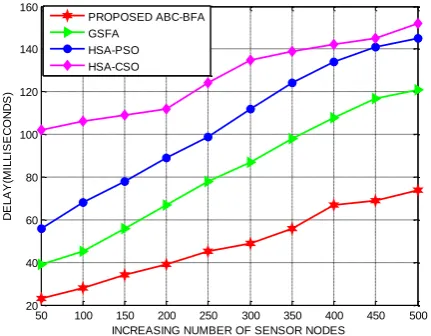
Figure 3: Proposed ABC-BFA-Delay with different number of sensor nodes
Figure 3 portrays the delay incurred by the proposed ABC-BFA scheme on par with the compared GSFA, HAS-PSO and HSA-CSO schemes evaluated with different number of sensor nodes in the network. The delay of the proposed ABC-BFA is determined to considerably minimized even under an increasing number of sensor nodes in the network, since the use of BFA enhances the local optimality of the basic ABC scheme during the clustering process. The delay of the proposed ABC-BFA is proving to be improved by 12.32%, 13.65% and 15.62%, superior to the compared GSFA, HSA-PSO and HSA-CSO schemes used for investigation.
In the second level of investigation, the performance of the proposed ABC-BFA and the benchmarked GSFA, HSA-PSO and HSA-CSO schemes are compared based on the average packet loss rate, Average end-to-end delay, percentage of alive nodes and percentage of dead nodes with different number of sensor nodes in the network.
0 5 10 15 20 25 30 35 40
A
V
ER
A
G
E
P
A
C
K
ET
L
O
SS
R
A
TE
(I
N
%
)
NUMBER OF SENSOR NODES
[image:4.595.305.543.52.239.2]PROPOSED ABC-BFA GSFA HSA-PSO HSA-CSO
Figure 4: Proposed ABC-BFA-Average packet loss rate under different sensor nodes
0 10 20 30 40 50 60 70
M
EA
N
E
N
D
-TO
-E
N
D
DE
LA
Y
(SE
C
O
N
DS)
NUMBER OF SENSOR NODES
[image:4.595.68.284.61.229.2]PROPOSED ABC-BFA GSFA HSA-PSO HSA-CSO
Figure 5: Proposed ABC-BFA-Average end-to-end delay under different sensor nodes
Figure 4 and 5 demonstrates the potential of the proposed ABC-BFA with the baseline GSFA, HSA-PSO and HSA-CSO schemes based on average packet loss rate and average end-to-end delay under a different number of sensor nodes in the network. The average packet loss rate and average end-to-end delay of the proposed ABC-BFA is visualized to end-to-end delay of the proposed ABC-BFA is visualized to be highly minimized due to the adaptive rate of the BFA that focuses on improving the degree of exploitation and exploration in the selection of cluster head in the network. Thus, the average packet loss rate of the proposed ABC-BFA is identified to be improved by 6.72%, 8.12% and 9.65%, remarkable to the benchmarked GSFA, HSA-PSO and HSA-CSO schemes used for investigation. The average end-to-end delay of the proposed ABC-BFA is confirmed to be reduced by 5.98%, 6.74% and 8.94%, remarkable to the benchmarked GSFA, HSA-PSO and HSA-CSO schemes used for investigation.
0 10 20 30 40 50 60 70 80
P
ER
C
EN
TA
G
E
O
F
A
LI
V
E
N
O
DE
S
(I
N
%
)
NUMBER OF SENSOR NODES
PROPOSED ABC-BFA GSFA HSA-PSO HSA-CSO
[image:4.595.52.286.482.677.2] [image:4.595.311.545.494.690.2]International Journal of Innovative Technology and Exploring Engineering (IJITEE) ISSN: 2278-3075, Volume-8 Issue-10, August 2019
0 20 40 60 80
P
ER
C
EN
TA
G
E
O
F
D
EA
D
N
O
D
ES
(
IN
%
)
NUMBER OF SENSOR NODES
[image:5.595.51.307.52.202.2]PROPOSED ABC-BFA GSFA HSA-PSO HSA-CSO
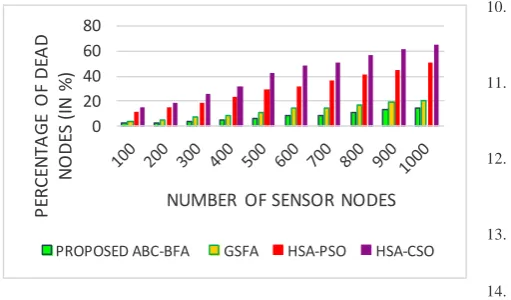
Figure 7: Proposed ABC-BFA-Percentage of dead nodes under different sensor nodes
Figure 6 and 7 exemplars the significance of the proposed ABC-BFA with the baseline GSFA, HSA-PSO and HSA-CSO schemes based on percentage of alive nodes and dead nodes under a different number of sensor nodes in the network. The percentage of alive nodes of the proposed ABC-BFA is proved to be improved due to the reduced frequency in the cluster head selection since the fitness function is formulated with all potential parameters that need to be emphasized during intensification and extensification. The percentage of alive nodes of the proposed ABC-BFA is concluded to enhance significantly by 6.87%, 7.24% and 8.56%, excellent to the benchmarked GSFA, HSA-PSO and HSA-CSO schemes used for investigation. In addition, the percentage of dead nodes of the proposed ABC-BFA is confirmed to be phenomenally minimized by 4.68%, 5.84% and 7.24%, remarkable to the benchmarked GSFA, HSA-PSO and HSA-CSO schemes used for investigation.
REFERENCES
1. Baradaran and K. Navi, “CAST-WSN: The Presentation of New
Clustering Algorithm Based on Steiner Tree and C-Means Algorithm
Improvement in Wireless Sensor Networks,” Wireless Personal
Communications, vol. 97, no. 1, pp. 1323–1344, 2017.
2. V. Krishnaswamy and S. S. Manvi, “Fuzzy and PSO Based Clustering
Scheme in Underwater Acoustic Sensor Networks Using Energy and
Distance Parameters,” Wireless Personal Communications, 2019.
3. R. Kumar and D. Kumar, “Multi-objective fractional artificial bee colony
algorithm to energy aware routing protocol in wireless sensor
network,” Wireless Networks, vol. 22, no. 5, pp. 1461–1474, 2015.
4. T. S. Murugan and A. Sarkar, “Optimal cluster head selection by
hybridisation of firefly and grey wolf optimisation,” International
Journal of Wireless and Mobile Computing, vol. 14, no. 3, p. 296, 2018.
5. Q. Ni, Q. Pan, H. Du, C. Cao, and Y. Zhai, “A Novel Cluster Head
Selection Algorithm Based on Fuzzy Clustering and Particle Swarm
Optimization,” IEEE/ACM Transactions on Computational Biology and
Bioinformatics, vol. 14, no. 1, pp. 76–84, 2017.
6. V. Pal, Yogita, G. Singh, and R. Yadav, “Cluster Head Selection
Optimization Based on Genetic Algorithm to Prolong Lifetime of
Wireless Sensor Networks,” Procedia Computer Science, vol. 57, pp.
1417–1423, 2015.
7. P. Rajpoot and P. Dwivedi, “Optimized and load balanced clustering for
wireless sensor networks to increase the lifetime of WSN using MADM
approaches,” Wireless Networks, 2018.
8. Shankar and N. Jaisankar, “Security Enabled Cluster Head Selection for
Wireless Sensor Network Using Improved Firefly
Optimization,” Advances in Intelligent Systems and Computing
Proceedings of the Eighth International Conference on Soft Computing and Pattern Recognition (SoCPaR 2016), pp. 176–192, 2017.
9. M. A. Hasnat, M. Akbar, Z. Iqbal, Z. A. Khan, U. Qasim, and N. Javaid,
“Bio inspired distributed energy efficient clustering for Wireless Sensor
Networks,” 2015 5th National Symposium on Information Technology:
Towards New Smart World (NSITNSW), 2015.
10. Vimalarani, R. Subramanian, and S. N. Sivanandam, “An Enhanced
PSO-Based Clustering Energy Optimization Algorithm for Wireless Sensor Network,” The Scientific World Journal, vol. 2016, pp. 1–11, 2016.
11. T. Shankar, S. Shanmugavel, and A. Rajesh, “Hybrid HSA and PSO
algorithm for energy efficient cluster head selection in wireless sensor networks,” Swarm and Evolutionary Computation, vol. 30, pp. 1–10, 2016.
12. F. Solaiman and A. Sheta, “Energy optimization in wireless sensor
networks using a hybrid K-means PSO clustering algorithm,” Turkish Journal Of Electrical Engineering & Computer Sciences, vol. 24, pp. 2679–2695, 2016.
13. P. S. Mann and S. Singh, “Artificial bee colony metaheuristic for
energy-efficient clustering and routing in wireless sensor networks,” Soft Computing, vol. 21, no. 22, pp. 6699–6712, 2016.
14. R. Prasad, P. V. Naganjaneyulu, and K. S. Prasad, “A Hybrid Swarm
Optimization for Energy Efficient Clustering in Multi-hop Wireless Sensor Network,” Wireless Personal Communications, vol. 94, no. 4, pp. 2459–2471, 2016.
15. S. Kaur and R. Mahajan, “Hybrid meta-heuristic optimization based
energy efficient protocol for wireless sensor networks,” Egyptian Informatics Journal, vol. 19, no. 3, pp. 145–150, 2018.
AUTHORS PROFILE
Bandi Rambabu received the B.Tech. degree in
Computer Science and Engineering , M.Tech degrees in CSE and Pursuing Ph.D. in CSE from Osmania University Hyderabad Telangana, India. His current research interests include computer networks, wireless and mobile computing and wireless sensor networks.
Email:[email protected]
Prof. A. Venugopal Reddy did his B.Tech. from
JNTU Hyderabad in 1977, M.Tech. from IIT Delhi in 1979, M.Phil in Computer Methods from University of Hyderabad (1980) and Ph.D. from University of Roorkee (IIT, Roorkee) in the area of Functional Programming Languages. Prof. Reddy’s research interests include Functional Programming Languages, Algorithms, and Mobile Computing.
Email:[email protected]
Dr. Sengathir Janakiraman is currently working as an
Associate Professor in the Department of Information Technology from CVR College of Engineering, Telangana, India. He has received his B.Tech. degree in Computer Science and Engineering, M.Tech. degree in Information security and Ph.D. degree in Mobile ad hoc Networks from Pondicherry Engineering College, Pondicherry, India. His fields of interest include Mobile Ad hoc Networks and Software Engineering.