X10 for High-Performance Scientific
Computing
Josh Milthorpe
A thesis submitted for the degree of
Doctor of Philosophy at
The Australian National University
Except where otherwise indicated, this thesis is my own original work.
Acknowledgments
If you were successful, somebody along the line gave you some help. There was a great teacher somewhere in your life.
– Barack Obama, 13 July 2012, Roanoke, Virginia.
There have been many great teachers in my life. Foremost among these in recent years have been my supervisor, Alistair Rendell; Steve Blackburn; and David Grove. These three have favoured me with countless hours of discussion, review and advice, for which I will always be grateful.
This research would not have been possible without the support of many re-searchers within IBM. Thanks go specifically to Olivier Tardieu, Vijay Saraswat, David Cunningham, Igor Peshansky, Ben Herta, Mandana Vaziri and Mikio Takeuchi.
For valuable discussions, ideas and difficult questions, I am indebted to: Bradford Chamberlain, John Mellor-Crummey, Vivek Sarkar, Jisheng Zhao, Andrey Blizniuk, Daniel Frampton, Peter Gill, Michelle Mills-Strout, Thomas Huber, Vivek Kumar, Taweetham Limpanuparb, Peter Strazdins and Uwe Zimmer.
For moral support and broader intellectual contributions, I would like to thank Evan Hynd, Ben Swift, Torben Sko, Ian Wood, Ting Cao, Brian Lee, Xi Yang, Nimalan Nandapalan, Joseph Antony, Pete Peerapong Janes, Jie Cai, James Barker, Lawrence Murray, John Taylor, Shin-Ho Chung, Henry Gardner, Chris Johnson, Lynette Johns-Boast, Richard Jones, Andrew Holmes and my sister Naomi Milthorpe.
The ANUChem application codes benefited from significant contributions by V. Ganesh, Andrew Haigh and Taweetham Limpanuparb – thank you all for the code, and the fun we had writing it. Andrew Gilbert and Taweetham Limpanuparb provided the comparison timings for Q-Chem used in chapter4.
I have received generous financial support in the form of an Australian Postgrad-uate Award from the Australian Government and a supplementary scholarship from the ANU College of Engineering and Computer Science. Computing facilities to support this work were provided by IBM and the ANU under Australian Research Council Linkage Grant LP0989872, and by the NCI National Facility at the ANU.
Finally I would like to thank all my family and friends who have tirelessly sup-ported me through long years. In particular I thank my parents Robyn and John, who first set me on the path that led me to a research career and have supported me again through this second childhood; and most of all Amy, for sticking with me and reminding me that there’s always more to life.
Abstract
High performance computing is a key technology that enables large-scale physical simulation in modern science. While great advances have been made in methods and algorithms for scientific computing, the most commonly used programming models encourage a fragmented view of computation that maps poorly to the underlying computer architecture.
Scientific applications typically manifest physical locality, which means that in-teractions between entities or events that are nearby in space or time are stronger than more distant interactions. Linear-scaling methodsexploit physical locality by ap-proximating distant interactions, to reduce computational complexity so that cost is proportional to system size. In these methods, the computation required for each portion of the system is different depending on that portion’s contribution to the overall result. To support productive development, application programmers need programming models that cleanly map aspects of the physical system being simu-lated to the underlying computer architecture while also supporting the irregular workloads that arise from the fragmentation of a physical system.
X10 is a new programming language for high-performance computing that uses the asynchronous partitioned global address space (APGAS) model, which combines explicit representation of locality with asynchronous task parallelism. This thesis argues that the X10 language is well suited to expressing the algorithmic properties of locality and irregular parallelism that are common to many methods for physical simulation.
The work reported in this thesis was part of a co-design effort involving re-searchers at IBM and ANU in which two significant computational chemistry codes were developed in X10, with an aim to improve the expressiveness and performance of the language. The first is a Hartree–Fock electronic structure code, implemented using the novel Resolution of the Coulomb Operator approach. The second evalu-ates electrostatic interactions between point charges, using either the smooth particle mesh Ewald method or the fast multipole method, with the latter used to simulate ion interactions in a Fourier Transform Ion Cyclotron Resonance mass spectrometer. We compare the performance of both X10 applications to state-of-the-art software packages written in other languages.
This thesis presents improvements to the X10 language and runtime libraries for managing and visualizing the data locality of parallel tasks, communication using active messages, and efficient implementation of distributed arrays. We evaluate these
improvements in the context of computational chemistry application examples. This work demonstrates that X10 can achieve performance comparable to estab-lished programming languages when running on a single core. More importantly, X10 programs can achieve high parallel efficiency on a multithreaded architecture, given a divide-and-conquer pattern parallel tasks and appropriate use of worker-local data. For distributed memory architectures, X10 supports the use of active messages to construct local, asynchronous communication patterns which outperform global, synchronous patterns. Although point-to-point active messages may be implemented efficiently, productive application development also requires collective communica-tions; more work is required to integrate both forms of communication in the X10 language.
Contents
Acknowledgments vii
Abstract ix
1 Introduction 1
1.1 Scope and Problem Statement. . . 1
1.2 Contributions . . . 3
1.3 Thesis Outline . . . 3
2 Programming Models and Patterns for High Performance Scientific Computing 5 2.1 Distributed Memory Models . . . 7
2.1.1 MPI. . . 8
2.1.2 Charm++ . . . 8
2.1.3 Active Messages . . . 9
2.1.4 Libraries for One-Sided Communications. . . 9
2.2 Shared Memory Models . . . 10
2.2.1 Pthreads . . . 10
2.2.2 OpenMP . . . 11
2.2.3 Cilk++ . . . 12
2.2.4 TBB . . . 13
2.2.5 OpenCL / CUDA. . . 13
2.3 Partitioned Global Address Space Models. . . 15
2.3.1 UPC . . . 15
2.3.2 Coarray Fortran. . . 16
2.3.3 Titanium . . . 16
2.3.4 Global Arrays . . . 17
2.4 Asynchronous Partitioned Global Address Space Models . . . 17
2.4.1 X10 . . . 17
2.4.1.1 Active Messages in X10 . . . 20
2.4.1.2 X10 Global Matrix Library . . . 20
2.4.2 Habanero Java. . . 21
2.4.3 Chapel . . . 21
2.4.4 Fortress . . . 22
2.5 Quantum Chemistry . . . 23
2.5.1 The Self-Consistent Field Method . . . 24
2.5.2 Resolution of the Coulomb Operator . . . 26
2.6 Molecular Dynamics . . . 28
2.6.1 Calculation of Electrostatic Interactions . . . 29
2.6.2 Particle Mesh Ewald Method . . . 29
2.6.3 Fast Multipole Method . . . 31
2.6.4 Molecular Dynamics Simulation of Mass Spectrometry . . . 33
2.7 Application Patterns . . . 35
2.7.1 Dense Linear Algebra . . . 37
2.7.2 Spectral Methods . . . 37
2.7.3 N-body Methods . . . 38
2.8 Summary . . . 38
3 Improvements to the X10 Language to Support Scientific Applications 39 3.1 Task Parallelism . . . 39
3.1.1 Worker-Local Data . . . 40
3.1.1.1 Managing and Combining Worker-Local Data . . . 41
3.1.1.2 New Variable Modifiers for Productive Programming . 44 3.1.2 Visualizing Task Locality In A Work Stealing Runtime . . . 44
3.2 Active Messages. . . 46
3.2.1 Serialization of Active Messages . . . 47
3.2.1.1 Byte-Order Swapping . . . 47
3.2.1.2 Object Graphs and Identity . . . 49
3.2.2 Collective Active Messages Usingfinish/ateach . . . 49
3.2.2.1 A Tree-Based Implementation offinish/ateach . . . . 51
3.3 Distributed Arrays . . . 54
3.3.1 Indexing of Local Data. . . 54
3.3.2 Ghost Region Updates . . . 55
3.3.2.1 Implementing Ghost Region Updates for X10 Distributed Arrays . . . 56
3.3.2.2 Evaluation of Ghost Updates. . . 59
3.4 Summary . . . 59
4 Electronic Structure Calculations Using X10 61 4.1 Implementation . . . 62
4.1.1 Parallelizing the Resolution of the Operator . . . 64
4.1.2 Auxiliary Integral Calculation with a Work Stealing Runtime . . 65
4.1.2.1 Use of Worker-Local Data to Avoid Synchronization . . 65
4.1.2.2 Overhead of Activity Management . . . 66
4.1.2.3 Optimizing Auxiliary Integral Calculations for Locality 67 4.1.3 Distributed and Replicated Data Structures. . . 68
4.1.4 Load Balancing Between Places. . . 70
Contents xiii
4.2 Evaluation . . . 73
4.2.1 Single-Threaded Performance . . . 73
4.2.2 Shared-Memory Scaling . . . 75
4.2.3 Distributed-Memory Scaling . . . 79
4.3 Summary . . . 82
5 Molecular Dynamics Simulation Using X10 83 5.1 Direct Calculation . . . 83
5.1.1 Implementation . . . 84
5.1.2 Evaluation . . . 85
5.2 Particle Mesh Ewald Method . . . 86
5.2.1 Implementation . . . 86
5.2.1.1 Domain Decomposition With Distributed Arrays . . . . 87
5.2.1.2 Charge Interpolation Over Local Grid Points . . . 87
5.2.1.3 Use of Ghost Region Updates to Exchange Particle Data 87 5.2.1.4 Distributed Fast Fourier Transform . . . 89
5.2.2 Evaluation . . . 89
5.2.2.1 Single-Threaded Performance . . . 90
5.2.2.2 Distributed-Memory Scaling . . . 91
5.3 Fast Multipole Method . . . 92
5.3.1 Implementation . . . 92
5.3.1.1 Distributed Tree Structure Using Global References . . 93
5.3.1.2 Load Balancing . . . 95
5.3.1.3 Global Collective Operations. . . 97
5.3.2 Evaluation . . . 97
5.3.2.1 Single-Threaded Performance . . . 98
5.3.2.2 Overhead of Activity Management . . . 101
5.3.2.3 Shared-Memory Scaling . . . 102
5.3.2.4 Distributed-Memory Scaling . . . 103
5.4 Simulating Ion Interactions in Mass Spectrometry . . . 106
5.4.1 Implementation . . . 107
5.4.1.1 Integration Scheme . . . 107
5.4.1.2 Ion Motion . . . 108
5.4.1.3 Induced Current . . . 108
5.4.2 Evaluation . . . 108
5.5 Summary . . . 111
6 Conclusion 113 6.1 Future Work . . . 115
Appendices 117
A Evaluation Platforms 119
List of Figures
2.1 The three arms of science . . . 5
2.2 OpenMP code for matrix multiplicationC= A×B . . . 11
2.3 Cilk code to calculate Fibonacci sequence . . . 12
2.4 C++ code for sum over array of doubles using Intel Threading Building Blocks (TBB) . . . 14
2.5 High-level structure of an X10 program . . . 18
2.6 X10 code demonstrating use of closures . . . 19
2.7 X10 code using active messages to implement a single-slot buffer . . . . 21
2.8 Chapel code demonstrating domain map and scalar promotion . . . 22
2.9 Charge interpolation in the particle mesh Ewald method . . . 30
2.10 Fourier Transform Ion Cyclotron Resonance Mass Spectrometer: dia-gram of Penning Trap . . . 34
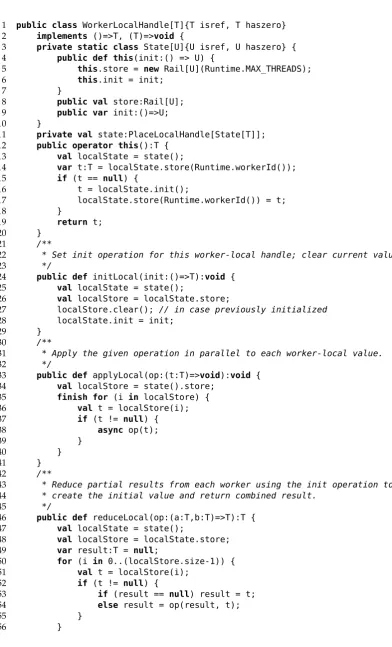
3.1 An improvedx10.util.WorkerLocalHandle: key features . . . 43
3.2 Locality of activity-worker mapping forHistogrambenchmark . . . 46
3.3 Locality of activity-worker mapping for Histogram benchmark with divide-and-conquer loop transformation . . . 46
3.4 X10 benchmark code for serialization . . . 48
3.5 X10 version 2.4 compiler transformation ofateach . . . 50
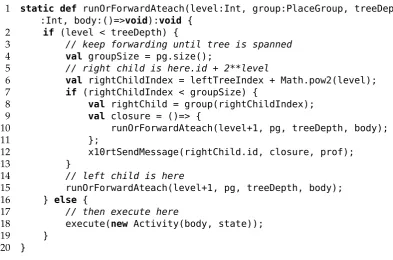
3.6 Implementation of tree-basedateachin x10.lang.Runtime . . . 51
3.7 X10 benchmark code forfinish/ateach . . . 52
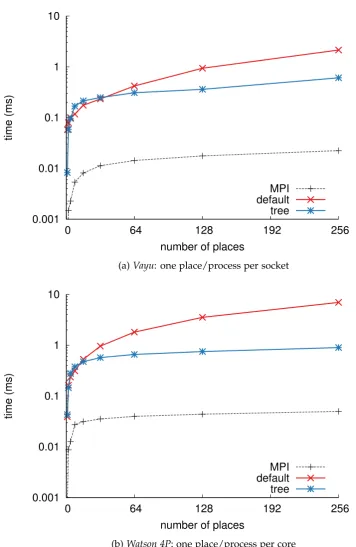
3.8 Scaling with number of places of the ateach construct on Vayu and Watson 4P, and comparison with MPI broadcast. . . 53
3.9 Solution of a system of partial differential equations on a grid . . . 56
3.10 Ghost region update weak scaling . . . 60
4.1 Pseudocode for construction of Coulomb and exchange matrices using resolution of the operator . . . 62
4.2 Variation in time to compute auxiliary integrals for different shells . . . 65
4.3 X10 code to compute auxiliary integrals,DlmandBusingWorkerLocalHandle . . . 66
4.4 Parallel loop to compute auxiliary integrals: single activity per thread with cyclic decomposition . . . 67
4.5 Parallel loop to compute auxiliary integrals: single activity per thread
with block decomposition . . . 68
4.6 Parallel loop to compute auxiliary integrals: recursive bisection trans-formation. . . 69
4.7 High level structure of X10 code to compute Fock matrix . . . 70
4.8 RO contributions toKmatrix: block pattern of distributed computation for different numbers of places . . . 72
4.9 Multithreaded component scaling and efficiency of RO long range energy calculation with basic parallel loop . . . 76
4.10 Locality of auxiliary integral calculation with different methods of loop division . . . 78
4.11 Multithreaded component scaling and efficiency of RO long range energy calculation with recursive bisection of loops . . . 79
4.12 Multi-place component scaling of RO long range energy calculation (8 threads per place, 3D-alanine4, cc-pVQZ,N0 =11,L=19). . . 80
5.1 X10 code for direct calculation of electrostatic interactions between particles . . . 84
5.2 X10 code to distribute charge grid array in PME . . . 87
5.3 X10 code to interpolate charges to grid points in PME . . . 88
5.4 Subcell halo region used to calculate direct interaction in particle mesh Ewald method (PME). . . 88
5.5 Comparison between X10 and GROMACS PME mesh evaluation on Core i7-2600 (one thread): scaling with number of particles . . . 90
5.6 Strong scaling of PME potential calculation onRaijin . . . 91
5.7 Low accuracy comparison between PGAS-FMM and exaFMM on Core i7-2600 (one thread): scaling with number of particles. . . 98
5.8 Time for M2L transformation for different orders of expansion p . . . . 100
5.9 Higher accuracy comparison between PGAS-FMM and exaFMM on Core i7-2600 (one thread): scaling with number of particles . . . 101
5.10 Multithreaded component scaling and efficiency of PGAS-FMM on Core i7-2600 . . . 103
5.11 Locality of activity-worker mapping for FMM force evaluation . . . 104
5.12 Strong scaling of FMM force calculation onRaijin . . . 104
5.13 Strong scaling of FMM force calculation onWatson 2Q . . . 105
5.14 MPI communication map for FMM force calculation onRaijin . . . 106
List of Tables
2.1 The ‘thirteen dwarfs’: patterns of communication and communication . 36
4.1 Time to compute Fock matrix for different molecules using RO . . . 74 4.2 Multithreaded component scaling of RO long range energy calculation
on Raijin with different methods of dividing integral and J matrix loops between worker threads (8 threads, 3D-alanine4, cc-pVQZ,N0 = 11,L=19) . . . 77 4.3 Distributed Fock matrix construction using resolution of the Coulomb
operator (RO): load imbalance between places . . . 80 4.4 DistributedK matrix construction using RO: floating-point and
com-munication intensity . . . 81
5.1 Direct calculation of electrostatic force: cycles per interaction, X10 vs. C++.. . . 86 5.2 Component timings of PGAS-FMM for varying numbers of particles
and accuracies . . . 99 5.3 Slowdown due to X10 activity management overhead for PGAS-FMM . 102 5.4 Amino acids in ANU mass spectrometer: timings onRaijin . . . 109 5.5 Amino acids in ANU mass spectrometer: predicted and measured
frequencies . . . 110
Chapter 1
Introduction
This thesis concerns the interplay between programming models and scientific appli-cations. Specifically, it considers the asynchronous partitioned global address space programming model and its use in the productive development of high performance scientific application codes.
1.1
Scope and Problem Statement
Applications of scientific computing, in particular physical simulations, tend to ex-hibit properties ofscaleandphysical locality. Scale means a system may be simulated at different levels of accuracy depending on the phenomena of interest. Physical locality means that interactions between events or entities that are nearby in space or time are stronger than those between distant events. Linear-scaling methodsexploit physical locality by approximating distant interactions, so as to reduce the computa-tional complexity of simulation. These methods generate irregular parallelism, where the amount of computation required for each given portion of the system is different depending on its importance to the simulation as a whole.
When implementing a scientific algorithm for execution on a high performance computing architecture, the primary concerns of parallel computing are:
• Parallelism: the computation must be divided into tasks to be executed in par-allel, producing an even load between processing elements, with minimal task overhead.
• Data locality: data must be arranged in memory to minimize the amount of movement between levels in the memory hierarchy and between distributed processing elements (communication).
• Synchronization: the computation must be ordered for correctness with minimal locking or other wait overhead.
The properties of scientific applications have a direct bearing on these concerns: phys-ical scale tends to generate irregular parallelism in simulation, and physphys-ical locality
has a direct bearing on data locality and synchronization between computational tasks.
Traditional programming languages such as C++ and Fortran fail to address the concerns outlined above. To fill the gap, programmers have used extensions based on either a shared memory model such as Open Multi-Processing (OpenMP), or a distributed memory model such as the Message Passing Interface (MPI). As almost all modern high performance computing systems have multiple levels of par-allelism, with different levels corresponding to both memory models, the dominant programming model is now a hybrid of a sequential language, OpenMP and MPI. As well as effectively requiring programmers to learn three different programming languages, the hybrid model results in several conceptual mismatches. For exam-ple, synchronization betweenMPIprocesses is achieved through matching message calls, whereasOpenMP uses explicit synchronization constructs such as barriers and atomic directives; and data movement between memory spaces inMPIis explicit in communication, whereasOpenMP does not explicitly recognize data movement be-tween areas of the memory hierarchy. The ease with which the programming model supports the expression of parallelism has been identified as a dominating factor in programming productivity for high performance computing (HPC) [Kuck,2004].
In comparison with established HPC programming models, the asynchronous partitioned global address space model [Saraswat et al.,2010] has two distinguishing features: distributed task parallelism and a global view of memory which accounts for data locality. The aim of this research has been to investigate whether this model, as realized in the X10 programming language1, allows thesuccinct expressionof typical scientific application codes while achievingperformancecomparable to or better than established programming languages and libraries. The programming model, however, is only one factor in the clarity and performance of a given application code. Of arguably equal importance are data structures and high level operations provided by the runtime or third-party libraries. These are the building blocks from which the most important parts of any application are constructed, and allow the programmer to operate at a higher level of abstraction than individual numerical or memory update operations. Finding the right data structures and operations to express a given algorithm can greatly reduce both the development and execution time of the application.
This thesis seeks to address the following questions:
• How can the explicit representation of data locality and task parallelism in the APGASprogramming model be used to succinctly express data structures and high-level operations that support scientific applications?
• How does the performance of these operations compare with traditional mod-els? What are the barriers to performance, and how can these be overcome?
These questions are considered with regard to the three concerns of parallel comput-ing identified above.
§1.2 Contributions 3
Unavoidably, there are many important aspects of high performance scientific com-puting that are not addressed in this thesis. For example, development productivity is a major factor in ‘time to solution’ and was the key driver for the Defence Ad-vanced Research Projects Agency (DARPA)’s High Productivity Computing Systems project which funded the initial development of the X10 language [Dongarra et al., 2008]. Objective measurement of development productivity is a complex systems analysis problem, therefore productivity is not considered in this thesis except insofar as ‘clarity’ or ‘expressiveness’ may be taken as subjective factors in total development effort. Another key concern for high performance computing is fault tolerance, as increasing system complexity reduces mean time between failures. Finally, numerical accuracy is a perennial concern; the correctness of results, as well as the balance between accuracy and computation time, are critical to the effective application of scientific computing. Fault tolerance and numerical accuracy are both areas in which the programming model may be expected to play a role, but they are orthogonal to the concerns addressed in this thesis.
1.2
Contributions
This thesis presents results from an ongoing co-design effort involving researchers at IBM and ANU, in which a new programming model – the asynchronous partitioned global address space model – is applied to high performance scientific computing. Insights gained from application development inform language design and vice versa. The contributions presented in this thesis fall into two main categories: firstly, enhancements to the X10 programming language or theAPGASprogramming model to improve expressiveness or performance, and secondly, the development of sci-entific application codes, high level data structures and operations to motivate and evaluate such improvements. Many of the concepts and techniques used in the X10 programming language are found in other languages, and as such this work has a wider application than the X10 language itself.
1.3
Thesis Outline
The presentation of this thesis is focused on two example applications from the field of computational chemistry: molecular dynamics and the Hartree–Fock method; this reflects an early decision that this research should be strongly application-driven. These applications were the first significant X10 codes created outside of the X10 development team, and as such represented an important source of external feedback for the language designers.
programming. Chapters4and5describe the application of theAPGASprogramming model to two different scientific problems: the implementation of a Hartree–Fock self-consistent field method, and calculation of electrostatic interactions in a molecular dynamics simulation. Finally, Chapter6summarizes how the contributions presented in this thesis support productive programming of high performance scientific appli-cations, and identifies opportunities for future research.
In evaluating the contributions, we conducted performance measurements on five parallel machines, ranging from a typical desktop machine to a highly-multithreaded, tightly integrated compute cluster; these machines are described in detail in ap-pendixA.
Chapter 2
Programming Models and Patterns
for High Performance Scientific
Computing
The goal of science is to increase our understanding of the physical world, to explain and predict natural phenomena. Traditionally, the two arms of science have been modelling and experiment. Scientists construct a simplified theoreticalmodelof phys-ical phenomena; this is tested and refined based on observations of the real world gained throughexperiment.
nature
model
[image:23.595.361.517.456.613.2]experiment
simulation
Figure 2.1:The three arms of science Computing has enabled the development of
a third arm of modern science: simulation. By translating abstract models into numerical sim-ulations, scientists can compare systems with different parameters and starting conditions, ob-serve simulated phenomena at scales that may be impossible to observe in a real-world exper-iment, and quickly test whether a change in the model improves its correspondence to experi-mental data. Figure2.1shows the relationship between these three arms of modern science: simulation is used to understand and refine a model, which can then be tested against exper-imental observations of the natural world.
In the same way that scientists use simpli-fied models to understand physical phenomena,
computer programmers construct simplified models of computer architectures. Mod-ern computer architectures are unavoidably complex. Typical descriptions of modMod-ern architectures run into hundreds or thousands of pages (for example, Intel [2013a]; IBM[2012]), describing instruction sets, functional units and pipelines, memory man-agement, cache hierarchies and I/O. A programming model provides a framework
which captures those features of the architecture that are essential to the program-mer while abstracting away less important details. A good programming model enhances programmer productivity and may be applied to a whole class of similar architectures.
Typical scientific models exhibit three properties which have particular bearing on computer simulation:
1. Measure: Descriptions of physical phenomena are quantitative, meaning that simulation requires numerical computing.
2. Locality: Interactions between events or entities that are nearby in space or time are stronger than those between distant events.
3. Scale: A system exhibits qualitatively different behavior depending on the spatial or temporal scale at which it is observed, and may therefore be simulated at different levels of accuracy depending on the phenomena of interest. (Notable exceptions to this rule exist in non-linear and chaotic systems.)
The latter two properties are of particular interest when considering the implementa-tion of the physical model as a computer code:
• Locality: Physical locality in the scientific model may be mapped to data locality in the simulation. Computer systems also exhibit locality, in the form of a distance-dependent cost for data transfers between portions of the memory system (e.g. between levels in the cache hierarchy or between local and remote memory spaces). As memory access costs become increasingly non-uniform, a programming model which makes these costs explicit would support greater performance portability and transparency.
• Scale: The requirement to simulate areas of greater interest at higher levels of accuracy translates into irregular computation. This presents a challenge for load balancing, which is becoming more important with the trend towards larger numbers of hardware threads. Anasynchronous, task-based programming model is an attractive approach for load balancing irregular computations on highly multithreaded architectures.
This thesis will argue that the asynchronous partitioned global address space (APGAS) programming model is well suited to implementation of scientific applications on modern architectures, as it combines the explicit representation of data locality with task-based parallelism.
§2.1 Distributed Memory Models 7
extend the PGAS model with support for asynchronous tasks. Sections 2.1–2.4 dis-cuss the key features of each model and some commonly usedHPC programming technologies which exemplify them.
A physical simulation may describe the target system at different levels of approx-imation. At the highest level of description, systems of particles might be modeled according to relativistic quantum mechanics. Successive approximations may be made to create a hierarchy of models; lower level (coarser grained) models lose the ability to model certain kinds of behavior, but gain applicability to larger systems or longer timescales [Berendsen,2007, §1.2]. This thesis presents applications from the domain of computational chemistry at two different levels of the hierarchy. Quantum chemistry, introduced in section2.5, models the interactions between atomic nuclei and electrons in bound states. Molecular dynamics, introduced in section2.6, oper-ates at a higher level of abstraction and approximoper-ates the interactions between atoms and molecules using classical mechanics. While both of these levels are relatively high on the hierarchy of simulation (compared to, for example, fluid dynamics), they represent significant classes of scientific application programs, including the bulk of materials science applications. They are therefore of interest in evaluating programming models for current and emerging architectures.
Finally, section2.7places the application examples used in this thesis within broad classes of scientific and engineering applications. Such a classification is useful in programming language–application co-design as it helps to determine the scope and generality of design choices.
2.1
Distributed Memory Models
In the distributed memory model, computation is divided between a number of pro-cesses, each with its own private address space. Processes communicate via explicit messages, which may be passive (data transfer only) or active (also initiating compu-tation at the receiving end). Two-sided communications require the cooperation of sender and receiver, whereas one-sided communications allow one process to directly access data owned by another process without its explicit cooperation.
2.1.1 MPI
The Message Passing Interface (MPI) was developed to address the issues of pro-grammability mentioned above with the first standard,MPI-1, released in 1994 [MPI Forum,1994]. MPIdefines a set of high-level message functions along with data types, collective operations and operations for creating and managing groups of processes. Originally, all message functions were two-sided operations in which each call from a sending process must be matched with a corresponding call from the receiving process. MPI-2 added one-sided communications such as put and get, which have the potential to map to hardware support for remote direct memory access (RDMA) available on modern architectures [MPI Forum,2003].
The availability of implementations of MPIfor all high performance architectures makes it an attractive candidate as a communications layer on top of which to imple-ment high-level languages. However, theMPI-2 model of one-sided communications received some criticism that it was a poor match for new partitioned global address space parallel languages [Bonachea and Duell, 2004]. Partly in response to these criticisms,MPI-3 implemented a new memory model for one-sided communications, as well as adding non-blocking and sparse collective operations [MPI Forum,2012].
MPIhas been exceedingly successful in high performance computing, such that it may be considered as the de facto standard for distributed memory programming. There are high performance implementations ofMPIavailable for every majorHPC architecture, andMPIhas been used to implement a vast range of scientific applica-tions. Despite these successes, MPI has a number of drawbacks from the point of view of programmer productivity. Firstly, the message passing model encourages a fragmented view of computation, in which data structures and control flow are explicitly decomposed into per-process chunks [Chamberlain et al.,2007]. The details of decomposition tend to obscure the high-level features of the computation. Sec-ondly,MPIprocesses do not share data except by explicit communication; in contrast, modern computing architectures are typically composed of multiple cores with a shared cache hierarchy. To take full advantage of such systems, the programming model must reflect the sharing of data between tasks. Section 2.2 describes such shared memory models.
2.1.2 Charm++
Charm++ is an extension to C++ for message-driven parallel programming [Kalé and Krishnan, 1993]. It is based on migratable objects called chares, which interact through asynchronous method invocations. New chares can be created by aseed— a constructor invocation which may be called on any processing element to instantiate the chare. The ability to migrate chares allows the runtime system to provide fault tolerance and adapt to changing processor resources. The Charm++ runtime system has been used to implement AdaptiveMPI, which provides dynamic load balancing and multithreading in a traditionalMPIframework [Huang et al.,2003].
§2.1 Distributed Memory Models 9
of shared memory by, for example, allowing multiple chares to operate on shared data structures.
2.1.3 Active Messages
Active messages are an alternative to two-sided messages, which allow overlapping of computation and communication with minimal overhead [von Eicken et al.,1992]. They differ from general remote procedure call mechanisms in that an active message handler is not required to perform computation on data, but merely to extract data from the network and integrate them into ongoing computation. An active message contains the address of a user-level handler to be executed on receipt of the message.
Active messages are a primitive communication mechanism, which may be used to implement higher-level communication models including message passing. For example, the Parallel Active Message Interface (PAMI) is used on the Blue Gene/Q supercomputer to implementMPI[Kumar et al.,2012].
2.1.4 Libraries for One-Sided Communications
While efforts to define a standard for two-sided communications achieved success throughMPI, approaches to one-sided communications have been more varied. Dur-ing the 1990s, vendors developed platform-specific interfaces for one-sided commu-nications (or remote memory access) such as Cray’s SHMEM [Barriuso and Knies, 1994] and IBM’s LAPI [Shah et al., 1998]. Following these efforts, the Aggregate Remote Memory Copy Interface (ARMCI) was created as a portable library for effi-cient one-sided communications [Nieplocha et al.,2006b]. ARMCIhas been used to support the global address space communication model implemented in the Global Arrays library (see §2.3.4), complementing message-passing libraries likeMPI, and has also been used to implement Coarray Fortran (CAF) (see §2.3.2). Remote memory operations in ARMCI do not require any action by the receiving process in order to progress. ARMCI supports non-contiguous data transfers, which are important in scientific applications involving multidimensional arrays. It also provides remote atomic accumulate and read-modify-write operations and distributed mutexes.
WhileARMCIprovides powerful communication primitives, it is targeted at the development of runtime systems and libraries rather than at application program-ming [Nieplocha et al.,2006b]. The lack of explicit rules for synchronization requires some care to avoid errors in using ARMCIremote put operations, and may lead to complications when combined with sequential programming models.
By themselves, active messages and libraries for one-sided communication do not constitute a parallel programming model; a complete model must also define how the computation is to be divided locally into parallel tasks, and how tasks and messages should synchronize.
2.2
Shared Memory Models
In the shared memory model, a single address space is shared between a number of threads, each of which has a private stack and control flow. ‘Communication’ is implicit, via threads operating on shared data structures and observing the re-sults of updates from other threads. To ensure consistency of operations, explicit synchronization between threads is required by means of memory barriers, locks or higher-level synchronization constructs. Shared memory models may be further di-vided into threading models, in which the programmer divides the computation into units of work according to available hardware parallelism; and task-based models, in which the programmer exposes potentially parallel tasks to be scheduled by a runtime system for execution on one or more processing elements. The following sections describe a pure threading model (Pthreads), an API which supports both threading and task-based programming (OpenMP), two purely task-based models (Cilk and Intel Threading Building Blocks (TBB)), and finally theOpenCLandCUDA models for accelerators, which address issues of partitioned memory spaces arising from programming for accelerators such asGPUs.
2.2.1 Pthreads
The most widely used example of the shared memory model is the Posix Threads standard (Pthreads) [IEEE,2008], which defines an API for creating and managing threads and is implemented for all UNIX-like systems. Threads synchronize through barriers, mutexes and condition variables.
§2.2 Shared Memory Models 11
1 double *a = new double[M*K]();
2 double *b = new double[K*N]();
3 double *c = new double[M*N]();
4 #pragma omp parallel for schedule(static) collapse(2)
5 for (size_t j = 0; j < N; j++) {
6 for (size_t i = 0; i < M; i++) {
7 double x = 0.0;
8 for (size_t l = 0; l < K; l++) {
9 x += a[i+l*K] * b[l+j*N];
10 }
11 c[i+j*N] = x;
12 }
13 }
Figure 2.2: OpenMPcode for matrix multiplicationC=A×B
2.2.2 OpenMP
OpenMP[Dagum and Menon,1998] is a portable, high-levelAPIfor shared memory parallel programming in C, C++, and Fortran. It supplements these languages with compiler directives, runtime library functions and environment variables. OpenMP uses a fork-join model like that ofPthreads, with code executing sequentially until it enters aparallel region. Work-sharing directives support both data parallelism (over loops) and functional decomposition (using parallelsections).
Figure 2.2 shows an OpenMP code to perform the matrix multiplication C = A×B. The compiler directive on line 4 defines a parallel region over the following block (lines 5-12); it also declares that the following forloop(s) should be executed in parallel. The schedule(static) clause declares that loop iterations should be divided evenly between threads using a static block division; collapse(2) means that the iteration space of the following two loops (overMandN) should be divided in two dimensions between all threads.
OpenMP programs are structured in terms of teams of cooperating threads. The primary model of parallelism inOpenMPis explicit threading: parallel sections create a defined number of threads, between which work can be shared. Explicit threading makes it difficult to compose parallelism at multiple levels using nesting due to a combinatorial explosion in the number of threads [McCool et al.,2012, chapter 1]. For this reason, the default usage is to disable nested thread creation.
1 cilk int fib(int n) {
2 if (n < 2) return n;
3 else {
4 int n1, n2;
5 n1 = spawn fib(n1);
6 n2 = fib(n2);
7 sync;
8 return (n1 + n2);
9 }
10 }
Figure 2.3:Cilk code to calculate Fibonacci sequence
OpenMP4.0 [OpenMP ARB,2013] added support for accelerators such as graphics processing units (GPUs) using target constructs to manage data and tasks on the target device, and places to define thread affinity policies to improve data locality. In these respectsOpenMPis moving towards explicit representation of data locality similar toPGASmodels (see §2.3).
OpenMP has enjoyed significant success due to widespread compiler support as well as the ease with which programmers can incrementally add parallelism to existing codes using compiler directives. The most common use ofOpenMPforHPC is to express shared-memory parallelism within a larger distributed memory code, e.g. intra-node parallelism for each node of a cluster. This approach requires the programmer to decompose the program at two levels, leading to a fragmented view of the algorithm.
2.2.3 Cilk++
Cilk++ [Blumofe and Leiserson,1999;Leiserson,2010] is an extension to C/C++ for task parallelism using a fork-join model. The programmer converts a normal serial program to a parallel program by annotating with special Cilk keywords to fork and join tasks. A function is marked for possible execution in parallel using the keyword
cilk; it may then be called as a separate task using the keywordspawn. The keyword
syncis used to wait for termination of all tasks started by the current block. Figure2.3 demonstrates the use of these keywords in a Cilk program to compute the Fibonacci sequence in parallel.
The Cilk runtime was the first to schedule tasks throughwork stealing. The runtime maintains a pool of worker threads which execute activities, each with its own double ended queue or deque1 of tasks. When a worker encounters a spawn statement, it pushes a task to the top of its own deque. If another worker thread is idle, it picks another worker at random and attempts to steal a task from the bottom of its deque. Thus the victim and the thief operate on opposite ends of the deque, reducing the need for synchronization.
§2.2 Shared Memory Models 13
Recognizing the importance of data parallelism and loop structures to typical applications, Cilk provides a keyword cilk_for, which allows the iterations of a loop to run in parallel [Leiserson, 2010]. The loop is automatically parallelized using divide-and-conquer recursion. Divide-and-conquer parallelism has positive implications for data locality in some loops, which will be discussed in chapter3.
Cilk-style work stealing has been adopted in numerous programming languages and libraries, including the Java Fork-Join framework [Lea, 2000], X10 (see §2.4.1), Chapel (§2.4.3) andTBB.
2.2.4 TBB
Intel Threading Building Blocks (TBB) [Reinders,2010] is a C++ template library that supports task parallelism. It focuses on divide-and-conquer parallel algorithms and thread-safe data structures, and it implements load balancing using Cilk-style work stealing.
TheTBBscheduler, like other work-stealing schedulers, requires the problem to be divided into a set of nested tasks. To this end, it provides for parallel loops to be created by recursively subdividing a loop range. TBBintroduces the concept of a splittable type, which defines a splitting constructor that allows an instance of the type to be split into two pieces.
By using standard C++ template programming practices, TBB provides an ac-cessible path for C++ programmers to incrementally add parallelism to existing applications. For example, the code in figure2.4(a)calculates a simple sum reduction over an array of double-precision floating-point numbers. Figure2.4(b)shows how TBB’sparallel_loopconstruct can be used to divide this loop into a set of tasks to be executed in parallel. While the loop-splitting approach is powerful, defining loop body objects for each parallel loop using the C++98 standard requires rather verbose code. The use of lambda functions introduced in the C++11 standard reduces this burden [Robison et al., 2008]. Figure 2.4(c) shows code for the same parallel sum usingTBBwith lambda expressions.
TBBdirectly supports a number of commonly used parallel programming patterns including map, reduce, pipeline and task graph. It also provides multiple flavors of mutex and atomic operations to synchronize between tasks, and scalable memory allocation routines designed for use by multiple threads.
The direct support for fundamental parallel patterns means that many parallel applications may be expressed concisely using TBB. It assumes a shared-memory model, meaning that a complementary distributed memory model such as MPI is required to address issues of data locality.
2.2.5 OpenCL / CUDA
1 double SerialSum(double a[], size_t n) {
2 double sum = 0.0;
3 for (size_t i = 0; i < N; i++) {
4 serial_sum += a[i];
5 }
6 return sum;
7 }
(a) Serial sum
1 struct Sum {
2 double value;
3 Sum() : value(0.0) { }
4 Sum(Sum& s, tbb::split) { value = 0.0; }
5 void operator()(const tbb::blocked_range<double*>& r) {
6 double res = value;
7 for (double* v = r.begin(); v != r.end(); v++) {
8 res += *v;
9 }
10 value = res;
11 }
12 void join(Sum& rhs) { value += rhs.value; }
13 };
14
15 Sum sum_body;
16 tbb::parallel_reduce(tbb::blocked_range<double*>(a, a+N), sum_body);
17 double sum = sum_body.value;
(b) Parallel sum using TBB
1 double sum2 = tbb::parallel_reduce(
2 tbb::blocked_range<double*>(a, a+n),
3 0.0,
4 [](const tbb::blocked_range<double*>& r, double value)->double
5 {
6 return std::accumulate(r.begin(), r.end(), value);
7 },
8 std::plus<double>()
9 );
(c) Parallel sum using TBB and lambda expressions
§2.3 Partitioned Global Address Space Models 15
work items, which are processed in work groups (mirroring the architecture of a typical GPU). There are mechanisms for allocating and sharing memory between threads in a work group, and synchronizing within a group. Kernels are executed asynchronously on the accelerator through a queuing system, and may also be ex-ecuted on a standard CPU. TheOpenCLmemory model distinguishes between the main memory of the host device and memory of the accelerator device, and anAPI is provided to manage transfers between the two. Device memory is further divided into private memory, local memory accessible by all threads in a work group, constant memory that is readable by all threads, and global memory. The Compute Unified Device Architecture (CUDA) framework [NVIDIA,2013] is similar toOpenCL, but is specific to NVIDIAGPUs.
TheOpenCLandCUDAprogramming models reflect the divisions in memory of typicalGPUarchitectures, and the cost of transferring between portions of the mem-ory. However, they also allow for threads to share memory using a relaxed memory consistency model. As such they combine elements of both distributed and shared memory models. The close mapping between these models and target architectures (GPUs) supports the development of high performance codes, however, it may not be possible to achieve performance portability to other non-GPUarchitectures.
2.3
Partitioned Global Address Space Models
The partitioned global address space (PGAS) model is similar to the shared memory programming model in that all threads of execution have access to a global shared memory space. However, in thePGASmodel, the memory space is divided into local partitions, with an implied cost to moving data between partitions. The programmer has control over the placement of data and consequently computation over those data, which is critical for high performance on modern computers [Yelick et al.,2007a].
2.3.1 UPC
A reliable approach to implementing the PGASmodel is to extend an existing pro-gramming language. UPC [UPC Consortium, 2005] extends ANSI C with shared
UPC’s simple locality model provides performance portability across a range of shared and distributed memory systems. SPMD-style applications written in UPC have achieved high performance on the largest computing clusters. It is less well suited to irregular applications requiring load balancing, as data decompositions are static and new threads cannot be created.Min et al.[2011] propose a dynamic tasking library andAPIas an extension toUPCto support such applications.
2.3.2 Coarray Fortran
CAFis an extension of Fortran for SPMDprogramming with the partitioned global address space model [Numrich and Reid,1998;Mellor-Crummey et al.,2009]. Multi-ple process images execute the same program, each with its own local data. The key concept inCAFis thecoarray, which is an array shared between multiple images in which each image has a local portion of the array, but may directly access data local to other images. The original coarray extensions (which have since been adopted into the Fortran 2008 standard) required coarrays to be statically allocated across all processes. Later work [Mellor-Crummey et al.,2009] expandsCAFto support dynam-ically allocated arrays over subsets of images, and global pointers for the creation of general distributed data structures.
By extending Fortran, CAF builds on decades of effort in the development of high-performance compilers and application codes, and provides an evolutionary pathway for existing codes to exploit parallelism using thePGASmodel.
2.3.3 Titanium
Titanium is a parallel dialect of Java designed for high performance scientific comput-ing [Yelick et al.,1998]. Titanium extends serial Java with multi-dimensional arrays, separating the index space (domain) from the underlying data, and an unordered loop construct,foreach, which allows arbitrary reordering of loop iterations to sup-port optimizations such as cache blocking and tiling [Yelick et al.,2007b]. To avoid the overheads associated with boxed types in Java, Titanium supports the definition ofimmutable classes, which save memory and preserve locality by dispensing with pointers.
§2.4 Asynchronous Partitioned Global Address Space Models 17
2.3.4 Global Arrays
The Global Arrays library [Nieplocha et al.,2006a] providesPGASsupport for array data, and has been used successfully as a component in computational chemistry codes such as NWChem [Valiev et al.,2010] as well as a range of other codes. Global Arrays supports one-sided put and get operations, synchronization and collective operations but does not support active messages.
2.4
Asynchronous Partitioned Global Address Space Models
The asynchronous partitioned global address space (APGAS) model extends the PGASmodel with support for asynchronous tasks. APGAS is exemplified by three languages developed under the DARPA High Productivity Computing Systems (HPCS) program [Dongarra et al., 2008], which aimed to reduce ‘time to solution’ for high performance applications. It has been widely acknowledged that the non-uniform programming models prevalent in HPC are a limitation on programmer productivity [Hochstein et al., 2005; Dongarra et al., 2011]. Accordingly, one com-ponent of the program was the development of new parallel programming models and languages. Initially, three companies were funded to develop new programming languages:
• IBM - theX10language;
• Cray - theChapellanguage; and • Sun - theFortress language.
DARPA funding for Fortress was discontinued in 2007 and active development on the project ended in 2012. Although DARPAfunding for X10 and Chapel ended in 2012 with the completion of theHPCSprogram, both IBM and Cray continue active development of their languages.
All three HPCS languages use the APGAS programming model. The APGAS model provides a global view of memory in which a portion of the memory is local to each process. It is therefore straightforward to write programs in which processes access remote data, while still accounting for locality and associated communication costs. X10 is entirely explicit about locality whereas Chapel and Fortress support oper-ations with implicit remote access. They are all strongly-typed languages supporting object-oriented programming with parameterized types.
2.4.1 X10
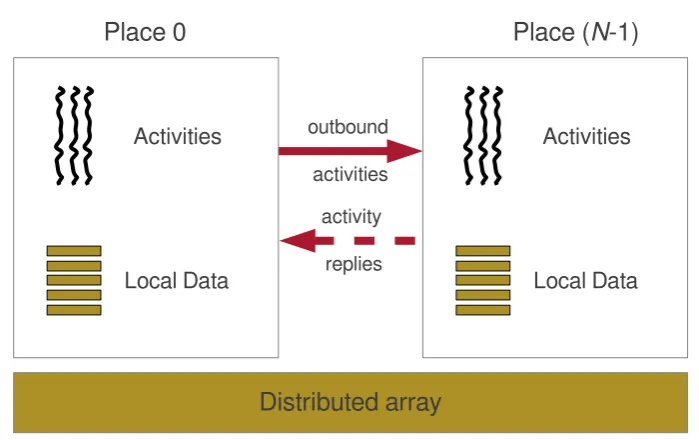
Distributed array
Place 0
Place (
N
-1)
outbound activities
activity replies
Activities
Local Data Activities
[image:36.595.100.450.111.331.2]Local Data
Figure 2.5:High-level structure of an X10 program
local storage. The async statement provides task parallelism, allowing the creation of activities at any place, which may be synchronized using atomic blocks. The atstatement combines communication and computation inactive messages, and the finish construct supports distributed termination detection. Figure 2.5shows the high-level structure of an X10 program.
Mutual exclusion is ensured between activities running at the same place by the use of conditional and unconditional atomic blocks (when and atomic). An atomic block executes as though all other activities in that place are suspended for the duration of the block. A conditional atomic blockwhen(c)Ssuspends until such time as the conditioncis true and then executes the statementSatomically. Correctness requires that any update by another activity affecting the condition cmust also be made within an atomic block; otherwise it would be invisible to the activity waiting on the condition. Activities can beclocked– synchronized in phased computation, where all activities must advance to the next phase together.
X10 also provides a rich array sub-language, based in part on the ZPL array language [Chamberlain,2001]. Anarrayis a collection of objects which are indexed bypointsin an arbitrary bounded region. A key data structure in X10 is thedistributed array. Each element in a distributed array is assigned to a particular place according to the arraydistribution, which is a mapping from point to place. Distributed arrays are very general in scope: they allow for arbitrary distributions (for example, block, block-cyclic, recursive bisection, fractal curve) and arbitrary regions (for example dense or sparse, rectangular, polyhedral or irregular). X10 is also designed using the multi-resolution approach, so the array library and runtime are largely implemented using lower-level language constructs of X10.
§2.4 Asynchronous Partitioned Global Address Space Models 19
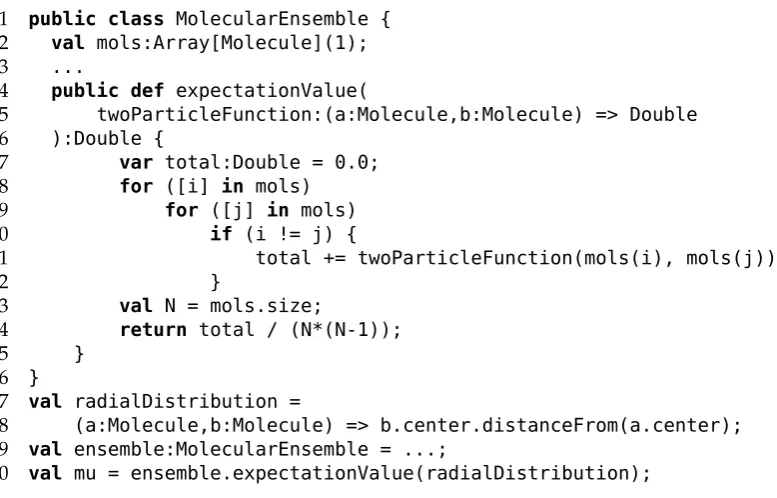
language). The X10 code example in figure2.6demonstrates the use of a first class function to evaluate an expectation value for a two-particle property of a molecular ensemble. The closure radialDistribution() (lines 17-18) is defined to calculate
1 public class MolecularEnsemble {
2 val mols:Array[Molecule](1);
3 ...
4 public def expectationValue(
5 twoParticleFunction:(a:Molecule,b:Molecule) => Double
6 ):Double {
7 var total:Double = 0.0;
8 for ([i] in mols)
9 for ([j] in mols)
10 if (i != j) {
11 total += twoParticleFunction(mols(i), mols(j));
12 }
13 val N = mols.size;
14 return total / (N*(N-1));
15 }
16 }
17 val radialDistribution =
18 (a:Molecule,b:Molecule) => b.center.distanceFrom(a.center);
19 val ensemble:MolecularEnsemble = ...;
[image:37.595.119.508.168.417.2]20 val mu = ensemble.expectationValue(radialDistribution);
Figure 2.6:X10 code demonstrating the use of a first class function to evaluate the expectation value of the two-particle functionradialDistribution()for a molecular ensemble
the distance between two molecules. It is passed to the methodexpectationValue()
(lines 4–16), which executes the closure over all pairs of molecules in the system and returns the average (expectation) value. The sameexpectationValuemethod could be used to calculate any two-particle property of the ensemble, simply by passing it a different closure.
X10 addresses the issue of load balancing through work-first work stealing be-tween worker threads at each place [Tardieu et al.,2012]. The X10global load balancing framework [Saraswat et al., 2011] extends this approach to work stealing between places using lifeline graphs for distributed termination detection. The local (shared memory) and global (distributed memory) work stealing implementations have not yet been integrated.
X10 provides a global reference type GlobalRef, and a PlaceLocalHandletype which provides a globally usable reference to a unique object at each place. The issue of distributed garbage collection is solved using a Global Object Tracker which maintains a record of all remote references to globalized objects [Kawachiya et al., 2012].
binary application using a standard C++ compiler. Communication between places is handled byX10RT, a C++ library implementation of the X10 runtime layer. There are several implementations of X10RT which use different communication methods including sockets,MPI, PAMI(for use on Blue Gene and Infiniband interconnects), and a stand-alone implementation to support multiple places on a single host. These implementations make it possible to run multi-place X10 programs on a wide range of computer systems.
While X10’s parallel primitives support productive programming, they are not sufficient. Issues arise regarding efficient implementation of the primitives to vide acceptable performance on modern computer architectures; furthermore, pro-ductive programming requires reusable distributed data structuresthat support high-performance operations. These issues will be considered in chapter3.
2.4.1.1 Active Messages in X10
X10 supports theactive messageidiom (see §2.1.3), which combines data transfer and remote computation within a single message; this allows for the terse expression of many distributed algorithms using localized patterns of communication and synchro-nization. This simple idea is at the core of theAPGAS programming model: the X10 and Chapel languages have supported active messages since their inception, and ac-tive messages have been proposed as extensions forUPC[Shet et al.,2009], Co-Array Fortran [Scherer et al.,2010], and the Global Arrays library [Chavarría-Miranda et al., 2012].
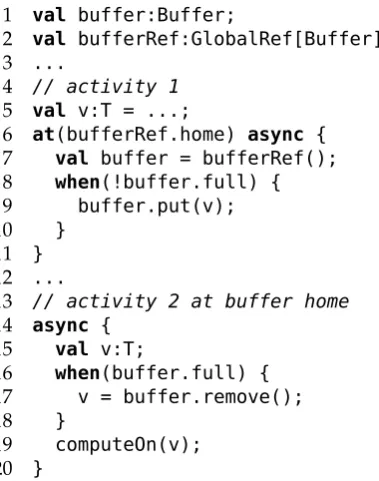
In X10, the computation initiated by an active message may include synchroniza-tion with other activities running at the target place. The code in figure2.7uses active message synchronization to implement a single-slot buffer. Activity 1 sends an active message (lines 6–11) to the home place of a buffer, which fills the buffer with a value of typeT. Activity 2, already running at the buffer’s home place, waits for the buffer to be filled (line 16), and then removes and computes on the value.
In Chapter 3 we show how synchronization in active messages may be used to implement an efficient update algorithm for ghost regions in distributed arrays.
2.4.1.2 X10 Global Matrix Library
§2.4 Asynchronous Partitioned Global Address Space Models 21
1 val buffer:Buffer;
2 val bufferRef:GlobalRef[Buffer];
3 ...
4 // activity 1 5 val v:T = ...;
6 at(bufferRef.home) async {
7 val buffer = bufferRef();
8 when(!buffer.full) {
9 buffer.put(v);
10 }
11 }
12 ...
13 // activity 2 at buffer home 14 async {
15 val v:T;
16 when(buffer.full) {
17 v = buffer.remove();
18 }
19 computeOn(v);
[image:39.595.117.307.117.358.2]20 }
Figure 2.7:X10 code using active messages to implement a single-slot buffer
at runtime [Hamouda et al.,2015]. GMLis used in the work described in chapter 4 of this thesis.
2.4.2 Habanero Java
Early versions of the X10 specification were closely based on the Java programming language. This early design led to the development at Rice University of the Habanero Java language, an extension of Java for theAPGASprogramming model [Cavé et al., 2011]. Habanero Java includes the same parallel constructs as X10 (with some differ-ences in naming), as well as sequential extensions for multidimensional arrays and efficient complex arithmetic. Where X10 provides clocks, Habanero Java provides a more generalphaser accumulator, which is a unification of collective and point-to-point synchronization, including support for reduction [Shirako and Sarkar,2010]. Yan et al. [2010] developedhierarchical place trees in Habanero Java, as a generalization of X10 places which maps more closely to the deep memory hierarchies on modern com-puter architectures. Habanero Java is an important vehicle for research into runtime implementation and compiler optimizations forAPGASlanguages; many techniques developed for it are directly applicable in X10, and vice versa.
2.4.3 Chapel
necessary evolution from the fragmented view of computation inherent in theMPI programming model, in which programs are described on a per-task basis, explicitly dividing computation and data into per-task portions.
Chapel represents locality through thelocaletype. A locale represents one or more co-located processing elements with associated local storage, for example a single cluster node. Data and tasks can be specifically assigned to locales. Domain maps support arbitrary mappings from array indices to locales, allowing the decomposition of array data and computations. Figure2.8demonstrates the use of Chapel domain maps to distribute array data between locales. The code computes the DAXPY op-eration Y = αX+Y. Line 2 defines the domain for the distributed arrays xand y, block-distributed over locales. Line 5 uses scalar promotion of the multiplication and addition operators over the arrays to specify the operation in a single line of code. This is equivalent to a parallel loop over all indexes in the index set of the domain, performing the DAXPY operation on corresponding elements of the arrays. As in this simple example, Chapel is able to express many distributed array computations succinctly.
1 config const N = 1000000, alpha = 3.0;
2 const VecDom: domain(1) dmapped Block({0..#N}) = {0..#N};
3
4 proc daxpy(x:[VecDom] real, y:[VecDom] real):int {
5 y = alpha * x + y;
6 }
Figure 2.8:Chapel code demonstrating domain map and scalar promotion in computation of DAXPY over vectors
Chapel is designed on the principle of multi-resolution, meaning that high-level language features are implemented in terms of lower-level features that are not hid-den from the programmer. For example, high-level data-parallel abstractions are implemented using the lower-level features of tasking and locality control. This per-mits the programmer to use high-level features for productive development, while retaining fine control for performance critical code [Chamberlain et al.,2011].
Chapel supports interoperability with other languages including C, C++, Fortran, Java and Python, through interface definitions for the Babel framework [Epperly et al., 2011]. Data structures such as local and distributed arrays may be shared between codes of different languages, but all communication is handled by the Chapel runtime [Prantl et al.,2011].
2.4.4 Fortress
§2.5 Quantum Chemistry 23
notation, supporting Unicode characters and two-dimensional notation. Mathemati-cal notation may be coded using ASCII shorthand notation and is typeset for display. For example, the definition of the factorial function [Allen et al.,2008]:
factorial(n) = PROD[i <- 1:n] i
would be rendered for display as:
f actorial(n) =
∏
i←1:ni
This is intended to make it easier for scientists to compare code with formulae and switch between the two during development.
Fortress is implicitly parallel, intentionally requiring more effort to implement an explicitly sequential version of an algorithm. The primary form of parallelism is divide-and-conquer; for example, aforloop is recursively divided into sub-tasks that may be executed on different processing units. Explicit task parallelism is also sup-ported. The Fortress runtime uses Cilk-style work stealing to balance load between processors.
Fortress provides information to programs about the execution environment through theregiondata structure. Aregionin Fortress holds information about hard-ware resources and relative communication costs. Aggregate data structures such as distributed arrays are mapped to regions through the mechanism of adistribution.
As the development of Fortress suffered from a lack of funding, and active devel-opment ceased in 2012, there is a lack of compelling application examples in scientific computing. Although a high-performance implementation of the entire language was never completed, Fortress included a number of interesting features, for example, its mathematical syntax and typesetting (jokingly described as ‘run your whiteboard’), conditional inheritance and method definition, and integrating physical units into the type system. Some of these concepts may find future application in other languages for scientific and parallel programming.
2.5
Quantum Chemistry
Quantum chemistry uses quantum mechanical principles to model the nuclei and electrons that constitute a molecule. The time-independent Schrödinger equation,
HΨ=EΨ, (2.1)
is the fundamental equation of quantum chemistry and relates the energy of a system described by wavefunction Ψ to the Hamiltonian operatorH over the constituent particles. The electronic Schrödinger equation describes the wavefunction of the electrons in a molecular system according to the Hamiltonian,
He=−
1 2
∑
i ∇2
i −
∑
i,AZA riA
+
∑
i>j1 rij
in which the first sum represents the kinetic energy of the electrons, the second represents Coulomb attraction between the electrons and nuclei, and the third sum represents repulsion between electrons. The electronic wavefunction of a molecu-lar system allows the calculation of the potential energy surface for the nuclei and many important properties including stable conformations, active sites, ionization potentials, and spectral properties.
The Hartree–Fock approximation [Fock,1930] expresses the electronic wavefunc-tion |Ψi in the form of a linear combination of permutations of one-electron spin orbitalsχi, conveniently represented as a Slater determinant:
|Ψi= √1
N!
χ1(1) χ2(1) . . . χa(1) . . . χN(1) χ1(2) χ2(2) . . . χa(2) . . . χN(2)
..
. ... ... ...
χ1(N) χ2(N) . . . χa(N) . . . χN(N)
. (2.3)
Each spin orbital is the product of a spatial orbitalψi and a spin functionαorβ. The Hartree–Fock energy,
E0= hΨ0|H |Ψ0i, (2.4) is an upper bound on the ground state energy of the system. According to the variational principle, the ‘best’ spin orbitals to use are those which minimize the Hartree–Fock energy [Szabo and Ostlund,1989].
In this thesis, we will consider only restricted closed-shell Hartree–Fock calcula-tions, in which each spatial orbital is doubly occupied by electrons of opposing spin values, hence the wavefunctions are calculated over spatial orbitals only. The spatial molecular orbitalsψi are usually expanded in the basis of a set of atomic orbitalsφj,
ψi(r) =
∑
jcijφj(r), (2.5)
where thecij are the molecular orbital coefficients. Most quantum chemical
calcula-tions are performed using Gaussian-type atomic orbitals of the form:
φ(r−R) =N(x−Ax)k(y−Ay)m(x−Az)ne−α|r−R|
2
, (2.6)
whereRis the orbital center, Nis a normalization factor andx,y,z are the Cartesian components ofr.
2.5.1 The Self-Consistent Field Method
The self-consistent field method (SCF) is a foundational method in quantum chem-istry, and is widely used in computational chemistry packages such as GAMESS (US) [Schmidt et al.,1993], Gaussian [Frisch et al.,2009], NWChem [Valiev et al.,2010] and Q-Chem [Shao et al.,2013].
§2.5 Quantum Chemistry 25
and Ostlund,1989]
FC=eSC, (2.7)
where e is a diagonal matrix of the orbital energies and F, C and S are the Fock, molecular orbital Coefficient and Overlap matrices respectively, the dimensions of which are dependent on the number of basis functions used to represent the molecular system, and therefore indirectly on the number of atoms in the system. The overlap matrixS is a constant Hermitian matrix composed of the overlap integrals between pairs of basis functions:
Sµν = Z
dr1φ∗µ(1)φν(1). (2.8)
The Fock matrix F is dependent on C, which necessitates use of an iterative pro-cedure to solve (2.7). This procedure is defined by the so-called Roothaan–Hall equations [Roothaan,1951;Hall,1951]:
Fµν = Hµνcore+
∑
λσPλσ[(µν|λσ)− 1
2(µσ|λν)] (2.9) Pµν =2
∑
i CµiC
∗
νi (2.10)
(µν|λσ) = Z Z
dr1dr2φ∗µ(1)φν(1) 1 r12
φ∗λ(2)φσ(2) (2.11)
Hµνcore = Z
dr1φ∗µ(1)(1 2∇
2 1−
∑
A ZA r1A
)φν(1) (2.12)
Starting with an initial guess for the density matrix P, the procedure solves the density matrix that minimizes the energy for a given molecular system. The most expensive part in theSCFprocedure is the creation of the Fock matrix (2.9), whereµ, ν,λ, σ denote atom-centered basis function indices,(µν|λσ)is a four-centered two-electron integral (2.11), and Hcore is a matrix containing one-electron integrals (2.12). The Fock matrix represents the single-electron energy operator in the chosen basis set. It comprises two components: the Coulomb orJmatrix representing the Coulomb operator,
ˆ Jj(1) =
Z
φj(2)∗
1 r12
φj(2)dr2, (2.13)
and the Exchange orKmatrix representing the exchange operator,
ˆ
Kj(1)φi(1) =
Z
φj(2)∗
1 r12
φi(2)dr2
φj(1). (2.14)
Given these components and the one-electron Hamiltonian ˆh(1), the Fock operator is defined [Szabo and Ostlund,1989, §3.4.1] as
ˆ
F(1) =h(ˆ 1) +
∑
j
2 ˆJj(1)−Kˆj(1)
. (2.15)