HPJava: Programming Support for High-Performance
Grid-Enabled Applications
Han-Ku Lee
2035 Hughes Hall
Old Dominion University
Norfolk, VA 23529
U.S.A.
Bryan Carpenter, Geoffrey Fox, Sang Boem Lim
Pervasive Technology Labs at Indiana University
Indiana University
Bloomington, IN 47404-3730
U.S.A.
Abstract
The paper begins by considering what a Grid Computing Environment might be, why it is de-manded, and how the authors’ HPspmd programming fits into this picture. We then review our HPJava environment1
as a contribution towards programming support for High-Performance Grid-Enabled Environments. Future grid computing systems will need to provide programming models. In a proper programming model for grid-enabled environments and applications, high performance on multi-processor systems is a critical issue. We describe the features of HPJava, including run-time communication library, compilation strategies, and optimization schemes. Through ex-periments, we compare HPJava programs against FORTRAN and ordinary Java programs. We aim to demonstrate that HPJava can be used “anywhere”—not only for high-performance parallel computing, but also for grid-enabled applications.
Keywords: HPspmd, HPJava, High-Performance, Grids, Grid-Enabled Environments, Java
1
Introduction
HPJava is an environment for parallel and scientific programming with Java, developed by the present authors [14]. It provides a programming model with various similarities to—and some notable differences from—the programming model of High Performance Fortran, (HPF) [13, 19]. In comparison with HPF, HPJava has a stronger emphasis on the role of libraries that oper-ate on distributed data. This emphasis sits naturally with the object-oriented features of the base language—Java rather than Fortran2
. In other respects HPJava provides a lower-level pro-gramming model than HPF—with multiple SPMD threads of control. But it retains important distributed data abstractions from HPF. It is most specifically aimed at distributed memory ar-chitectures, although of course HPJava can also run on shared memory computers. We call our general programming model theHPspmd model—so HPJava is a realization of the HPspmd model. An initial release of the HPJava environment was placed in the public domain last year (2003). This includes a reasonably sophisticated translator implementing the full HPJava language (which
1This work was supported in part by the National Science Foundation Division of Advanced Computational Infrastructure and Research, contract number 9872125.
2
includes the full Java language as a subset), and a set of supporting libraries. In earlier publications we argued that HPJava should eventually provide acceptable performance, making it a practical tool for HPC [7, 8]. We showed in [20] that HPJava node performance is quite reasonable, compared with C, Fortran, and ordinary Java: in particular on many platforms Java is no longer much slower than C or Fortran. Thus we verified our library-based HPspmd programming language extensions can be implemented quite efficiently in the context of Java.
In part because the SPMD programming model is relatively loosely coupled (compared with HPF), and in part because of its foundation in a ubiquitous Internet programming language (Java), we can make the case that our HPspmd programming model provides promising programming support for high-performance grid-enabled environments. This paper begins with an interpretation of what “grid computing” means, why it is needed, and how our HPspmd programming model can be adapted to this end—shifting the focus from high-performance computing to high-performance grid-enabled environments. We then review some features of HPJava including run-time library and compilation strategies, and optimization schemes. We present some experiments on simple HPJava programs, comparing against Fortran and ordinary Java programs. We hope to demonstrate a promising future for HPJava, which can be used “anywhere”—not only for high-performance parallel computing, but also forgrid-enabledapplications.
2
High-Performance Grid-Enabled Environments
2.1
Grid Computing
Grid computing environments have been defined as computing environments that are funda-mentally distributed, heterogeneous, and dynamic, in their resources and performance. According to [11], Grid initiatives will establish a huge environment—connecting global computer systems, including end-computers, databases, and instruments, into a World-Wide-Web-like distributed sys-tem for science and engineering.
Many researchers in science and engineering believe that the future of computing will heavily depend on the Grid for efficient and powerful computing, improving legacy technology, increas-ing demand-driven access to computational power, increasincreas-ing utilization of idle capacity, sharincreas-ing computational results, and providing new problem-solving techniques and tools. Substantially pow-erful Grids can be established using high-performance networking, computing, and programming support, regardless of the location resources and users.
We can ask what will be the biggest hurdles—in terms of programming support—to simplify distributed heterogeneous computing—in the same way that the World Wide Web simplified infor-mation sharing over the Internet. One possible answer ishigh performance—a slow system that has a clever motivation is not very useful. There will be a pressing need for grid-enabled applications
that hide the heterogeneity and complexity of the underlying grid, without losing performance. Today, programmers often write grid-enabled application in what is in effect an assembly lan-guage: sometimes using explicit calls to the Internet Protocol’s User Datagram Protocol (UDP) or Transmission Control Protocol (TCP), with hard-coded configuration decisions for specific com-puting systems. We are a far from portable, efficient, high-level languages.
2.2
HPspmd Programming Model: Towards Grid-Enabled Applications
To support “high-performance grid-enabled applications”, future grid computing systems will need to provideprogramming models[11]. The main thrust of programming models is to hide and simplify complexity and details of implementing the system, while focusing on application design issues that have a significant impact on program performance or correctness.
grid-enabled environments, we probably need compilation techniques, programming models, applica-tions, components—and also modern base languages.
Generally, we see different programming models in sequential programming and parallel pro-gramming. For instance, in sequential programming, commonly used programming models for modern high-level languages furnish applications with inheritance, encapsulation, and scoping. In parallel programming we have distributed arrays, message-passing, threads, condition variables, and so on. There is much less clarity about what programming model is appropriate for a grid environment, although it seems certain that many programming models will be used.
One approach is to adapt programming models that have already proved successful in sequen-tial or parallel environments. For example a data-parallel language model like our HPspmd pro-gramming model might be an excellent propro-gramming model for supporting and developing high-performance grid-enabled applications, allowing programmers to specify parallelism in terms of process groups and distributed array operations. High-performance grid-enabled applications and run-time systems demand “adaptability”, “security”, and “ultra-portability”. These should be relatively easy to provide in HPJava, since it is implemented in the context of Java, which has always had such design goals.
The HPJava language has quite acceptable performance on scientific and engineering algorithms, which also play important roles in grid-enabled applications—from search engines to “parameter searching”. Another interesting Grid problem where HPJava may have a role is coordinating the execution and information flow between multiple Web services, where each Web service has a WSDL style interface. For example we plan to use HPJava as middleware in the project called “BioComplexity Grid Environments” [4] at Indiana University. So we believe HPJava and the HPspmd Programming Model are promising candidates for constructing high-performance grid-enabled applications and components.
3
The HPJava Language
3.1
HPspmd Programming Model
HPJava [14] is an implementation of what we call the HPspmd programming language model. This is a flexible hybrid of HPF-like data-parallel features and the popular, library-oriented, SPMD style, omitting some basic assumptions of the HPF [13] model.
To facilitate programming of massively parallel, distributed memory systems, we extend the Java language with some additional syntax and some pre-defined classes for describing distributed arrays, and for passing these as arguments to library calls. Besides distributed arrays, HPJava also includes true multi-dimensional “sequential” arrays—a modest extension to the standard Java language. HPJava introduces three new control constructs: the overall,at, andonstatements.
3.2
Features
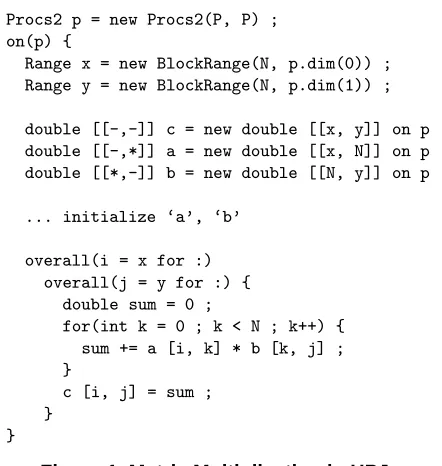
Figure 1 is a basic HPJava program for a matrix multiplication. It includes much of the HPJava special syntax, so we will take the opportunity to briefly review the features of the HPJava language. The program starts by creating an instancepof the classProcs2. This is a subclass of the special base class Group, and describes 2-dimensional grids of processes. When the instance of Procs2 is created, P×P processes are selected from the set of processes in which the SPMD program is executing, and labeled as a grid.
Procs2 p = new Procs2(P, P) ; on(p) {
Range x = new BlockRange(N, p.dim(0)) ; Range y = new BlockRange(N, p.dim(1)) ;
double [[-,-]] c = new double [[x, y]] on p ; double [[-,*]] a = new double [[x, N]] on p ; double [[*,-]] b = new double [[N, y]] on p ;
... initialize ‘a’, ‘b’
overall(i = x for :) overall(j = y for :) {
double sum = 0 ;
for(int k = 0 ; k < N ; k++) { sum += a [i, k] * b [k, j] ; }
c [i, j] = sum ; }
[image:4.595.182.403.102.335.2]}
Figure 1. Matrix Multiplication in HPJava.
The Range class describes a distributed index range. There are subclasses describing index ranges with different properties. In this example, we use theBlockRangeclass, describing block-distributed indexes. The first argument of the constructor is the global size of the range; the second argument is aprocess dimension—the dimension over which the range is distributed. Thus, rangesxandyare distributed over the first dimension (i.e. p.dim(0)) and second dimension (i.e. p.dim(1)) ofp, and both haveNelements.
The most important feature HPJava adds to Java is the multiarray. There are two kinds of multiarray in HPJava: distributed arrays and sequentialmultidimensional arrays3
. A distributed array is acollective array, shared by a number of processes. Like an ordinary array, a distributed array has some index space and stores a collection of elements of fixed type. Unlike an ordinary array, the index space and associated elements are scattered across the processes that share the array. A sequential multi-dimensional array is similar to an ordinary Fortran array. Like in Fortran (but unlike ordinary Java arrays) one can form aregular section of a multiarray.
With a process group and a suitable set of ranges, we can declare distributed arrays. The type signature of a distributed array is clearly distinguished by double brackets. In the type signature of a distributed array each slot holding a hyphen,-, stands for a distributed dimension, while an asterisk, *, stands for a sequential dimension. The arraycis distributed in both its dimensions. Arrays aand bare also distributed arrays, but now each of them has one distributed dimension and onesequential dimension.
The overall construct is another control construct of HPJava. It represents a distributed parallel loop, sharing some characteristics with theforall construct of HPF. The symboliscoped by theoverallconstruct is called adistributed index. Its value is alocation—an abstract element of a distributed range. In general the subscript of a distributed array must be a distributed index, and the location should be an element of the range associated with the array dimension. This unusual restriction is an important feature of the model, ensuring that referenced array elements are locally held.
Figure 1 does not have any run-time communications because of the special choice of alignment relation between arrays. All arguments for the innermost scalar product are already in place for the computation. We can make a completely general matrix multiplication method by taking
argu-3
void matmul(double [[-,-]] c,
double [[-,-]] a, double [[-,-]] b) {
Group p = c.grp() ;
Range x = c.rng(0) ; Range y = c.rng(1) ;
int N = a.rng(1).size() ;
double [[-,*]] ta = new double [[x, N]] on p ; double [[*,-]] tb = new double [[N, y]] on p ;
Adlib.remap(ta, a) ; Adlib.remap(tb, b) ;
on(p)
overall(i = x for :) overall(j = y for :) {
double sum = 0 ;
for(int k = 0 ; k < N ; k++) sum += ta [i, k] * tb [k, j] ;
c [i, j] = sum ; }
}
Figure 2. General matrix multiplication.
ments with arbitrary distribution, and remapping the input arrays to have the correct alignment in relation to the output array. Figure 2 shows the method. It has two temporary arraysta,tbwith the desired distribution format. This is determined fromcby using DAD inquiry functionsgrp() andrng()to fetch the distribution group and index ranges of a distributed array. Adlib.remap() does the actual communication to remap. Adlib [9], described in section 3.3, is a communication library available for use with HPJava.
This simplified example encapsulates some interesting principles of library construction with HPJava—in particular how arrays can be created and manipulated, even though the distribution formats are only determined at run-time.
We will give another old favorite program, red-black relaxation. It remains interesting since it is a kernel in some practical solvers (for example we have an HPJava version of a multigrid solver in which relaxation is a dominantly time-consuming part). Also it conveniently exemplifies a family of similar, local, grid-based algorithms and simulations.
We can see an HPJava version of red-black relaxation of the two dimensional Laplace equation in Figure 3. Here we use a different class of distributed range. The classExtBlockRangeadds ghost-regions [12] to distributed arrays that use them. A library function called Adlib.writeHalo() updates the cached values in the ghost regions with proper element values from neighboring pro-cesses.
Procs2 p = new Procs2(2, 3) ; on(p) {
Range x = new ExtBlockRange(N, p.dim(0)) ; Range y = new ExtBlockRange(N, p.dim(1)) ;
double [[-,-]] a = new double [[x, y]] on p ;
... initialization for ‘a’
for(int iter=0; iter<count; iter++){ Adlib.writeHalo(a, wlo, whi); overall(i=x for 1 : N - 2)
overall(j=y for 1+(i‘+iter)%2 : N-2 : 2) { a[i,j] = 0.25F * (a [i-1,j] + a [i+1,j] +
a [i,j-1] + a [i,j+1]); }
} }
Figure 3. Red-black iteration.
3.3
Run-time Communication Library
The examples in this paper use the communication library called Adlib [9]. Earlier versions of this library were developed some years ago by the current authors, as run-time systems for HPF translators. The current version is a reimplementation in Java, designed as an application level
library for HPJava programming. It provides a family of collective operations that work directly with the distributed arrays of our HPspmd model.
The new version of Adlib is implemented on top of a low-level API calledmpjdev[21], designed with the goal that it can be implemented portably on network platforms and efficiently on parallel hardware. It needs to support communication of intrinsic Java types, including primitive types, and objects. It should transfer data between the Java program and the network while keeping the overheads of the Java Native Interface as low as practical.
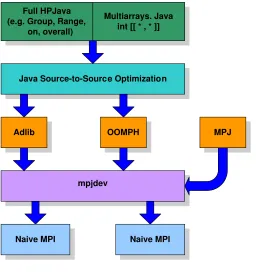
Unlike MPI which is intended for the application developer, mpjdev is meant for library devel-opers. Application level communication libraries like the Java version of Adlib, or MPJ [6] might be implemented on top of mpjdev. The positioning of the mpjdev API is illustrated in Figure 4. The initial version of the mpjdev has been targeted to HPC platforms—implemented through a JNI interface to a subset of MPI. A Java “New I/O” based version, providing a more portable network implementation, is under development.
4
Compilation Strategies for HPJava
In this section, we will discuss efficient compilation strategies for HPJava. The HPJava compi-lation system consists of four parts; Parser, Type-Analyzer, Translator, and Optimizer. HPJava adopted JavaCC [16] as a parser generator. Type-Analyzer, Translator, and Optimizer are reviewed in following subsections. Figure 4 is the overall architecture of the HPJava translator.
4.1
Type-Analysis
The current version of the HPJava type-checker (front-end) has three main phases;type-analysis,
Full HPJava (e.g. Group, Range,
on, overall)
Multiarrays. Java int [[ * , * ]]
Java Source-to-Source Optimization
Adlib OOMPH MPJ
mpjdev
[image:7.595.173.429.107.381.2]Naive MPI Naive MPI
Figure 4. HPJava Architecture.
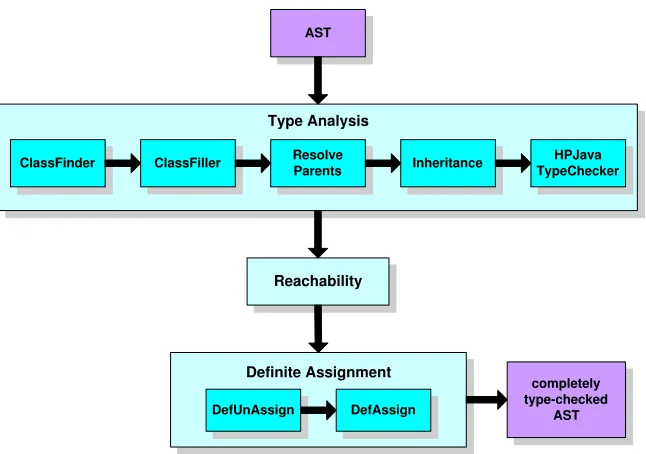
The first phase is type-analysis. It has five subordinate phases: ClassFinder, ResolveParents,
ClassFiller, Inheritance, andHPJavaTypeChecker.
1. ClassFindercollects some simple information about top-level and nested class or interface declarations, such as names of the classes, the names of super class, and the names of super interfaces.
2. ResolveParentsresolves class’s proper super class and super interfaces using the information from ClassFinder.
3. ClassFillerfulfills a more complicated mission. It collects all of the rest of the information about top-level and nested class or interface declarations, such as field declarations, method declarations, constructor declarations, anonymous class allocations, and so on. ClassFiller also collects and resolves single-type-import declarations and type-import-on-demand decla-rations.
4. Inheritancecollects and resolves the method inheritance, overriding, and hiding information to be used inHPJavaTypeChecker.
5. HPJavaTypeCheckerdoes type-checking on statements, statement expressions, and expres-sions, including all ordinary Java, and the newly introduced HPJava constructs—multiarrays, etc.
AST
Type Analysis
ClassFinder Resolve
Parents
ClassFiller Inheritance HPJava
TypeChecker
Reachability
Definite Assignment
DefUnAssign DefAssign
completely type-checked
[image:8.595.138.461.104.331.2]AST
Figure 5. The Architecture of HPJava Front-End.
The third phase isdefinite (un)assignment analysis. It consists of two parts,DefAssignand De-fUnassign, which checks the definite (un)assignment rules for Java, implementing the flow analysis of the Java language specification.
The three phases are basically inspired by carefully organizingThe Java Language Specification, Second Edition (JLS) [17]. The current HPJava type-checker system only supports exactly what JLS says (plus the HPJava extensions, of course). But the Java language itself keeps evolving in a slow manner. For example, Sun’s SDK 1.4 Java compiler supports some changes to JLS, and the 1.5 release will add many more. We expect to update the HPJava type-checker system when the new edition of JLS is eventually published. Figure 5 shows the complete architecture of HPJava front-end.
4.2
Translation
Currently, the HPJava translator has two phases,pre-translationandtranslation. Pre-translation reduces the source HPJava program to an equivalent program in arestricted form of the full HP-Java language. The translation phase transforms the pre-translated program to a standard HP-Java program. The main reason the current HPJava translator has two phases is to make the basic translation scheme simple and clear, by transforming certain complex expressions involving mul-tiarrays into simple expressions in the pre-translation phase. Thus, the restricted form generated by the pre-translator should be suitable for being processed in the translation phase.
Unlike with HPF, the HPJava translation schemedoes notrequire insertion of compiler-generated communications, making it relatively straightforward. The current translation schemes is docu-mented in detail in the HPJava manual, called Parallel Programming in HPJava [7], and also in the paper [5].
4.3
Optimization
the complexity of the terms in the subscript expressions for addressing local elements of distributed arrays. When anoverallconstruct is translated, the naive translation scheme generates 4 control variables outside the loop (refer to [7]). A control variable is often a dead code, and is partially redundant for the outter overallfor nestedoveralls.
Optimization strategies should remove overheads of the naive translation scheme (especially for overall construct), and speed up HPJava, to produce a Java-based environment competitive in performance with existing Fortran programming environments.
4.3.1 Partial Redundancy Elimination
Partial Redundancy Elimination(PRE) [18] is a very important optimization technique to remove partial redundancies in the program by solving a data flow problem that yields code replacements. PRE is a powerful and proper algorithm for HPJava compiler optimization, sinceloop invariants, which are naturally partially redundant, often occur in the subscript expression of distributed arrays.
PRE should be applied to a general or Static Single Assignment (SSA) [10] formed data flow graph after addinglanding pads[24], representing entry to the loop from outside.
PRE is a complicated algorithm to understand and to implement, compared with other well-known optimization algorithms. However, the basic idea of PRE is simple. Basically, PRE converts partially redundant expressions into redundant expressions. The key steps of PRE are:
Step 1: Discover where expressions are partially redundant using data-flow analysis.
Step 2: Solve a data-flow problem that shows where inserting copies of a computation would convert a partial redundancy into a full redundancy.
Step 3: Insert the appropriate code and delete the redundant copy of the expression.
4.3.2 Strength Reduction
Strength Reduction (SR) [2] replaces expensive operations by equivalent cheaper ones from the target machine language. Some machine instructions are considerably cheaper than others and can often be used as special cases of more expensive operators. For instance, x2 is invariably
cheaper to implement asx∗xthan as a call to an exponentiation routine. Moreover, an additive
operator is generally cheaper than a multiplicative operator.
SR is a very powerful algorithm to transform computations involving multiplications and addi-tions together into computaaddi-tions only using addiaddi-tions. It is a natural candidate to optimize the current HPJava compiler because of the complexity of the terms in the subscript expression of a multiarray element access.
4.3.3 Dead Code Elimination
Dead Code Elimination (DCE) [2] is an optimization technique to eliminate some variables not used at all. An overall construct generates 6 variables outside the loop according to the naive translation scheme. Since these control variables are often unused, and the methods are specialized methods known to the compiler—side effect free—we don’t have any side effects from applying DCE with data flow analysis to them.
4.3.4 Loop Unrolling
In conventional programming languages some loops have such a small body that most of the time is spent to increment the loop-counter variables and to test the loop-exit condition. We can make these loops more efficient byunrollingthem, putting two or more copies of the loop body in a row. This technique is calledLoop Unrolling(LU) [2].
Our experiments [20] did not suggest that this is a very useful source-level optimization for HPJava, except in one special but important case. LU will be applied for overall constructs in an HPJava Program of Laplace equation using red-black relaxation. For example,
overall (i = x for 1 + (i‘ + iter) % 2 : N-2 : 2) { ... }
The overall is repeated in every iteration of the loop associated with the outer overall. Because red-black iteration is a common pattern, HPJava compiler should probably try to recognize this idiom. If a nested overall includes expressions of the form
(i‘ + expr) % 2
where expr is invariant with respect to the outer loop, this should be taken as an indication to unroll the outer loop by 2. The modulo expressions then become loop invariant and arguments of the call to localBlock(), the whole invocation is a candidate to be lifted out of the outer loop.
4.3.5 HPJOPT2
To eliminate complicated distributed index subscript expressions and to hoist control variables in the inner loops, we adopted the following algorithm;
Step 1: (Optional) Apply Loop Unrolling.
Step 2: Hoist control variables to the outermost loop by using compiler information if loop invariant.
Step 3: Apply Partial Redundancy Elimination and Strength Reduction.
Step 4: Apply Dead Code Elimination.
We call this algorithmHPJOPT2(HPJavaOPTimization Level2)4
. Applying Loop Unrolling is optional since it is only useful when a nestedoverallloop involves the pattern,(i‘ + expr) % 2 such as in Figure 3. We don’t treat Step 3 of HPJOPT2 as a part of PRE. It is feasible for control variables and control subscripts to be hoisted by applying PRE. But using information available to the compiler, we often know in advance they are loop invariant without applying PRE. Thus, without requiring PRE, the compiler hoists them if they are loop invariant.
In the section 5, we will see the performance of HPJava adopting HPJOPT2 optimization strategies.
5
Experiments
5.1
Node Performance
We showed in a previous publication [20] that HPJava individual node performance is quite acceptable, and Java itself can get 70 – 75% of the performance of C and Fortran.
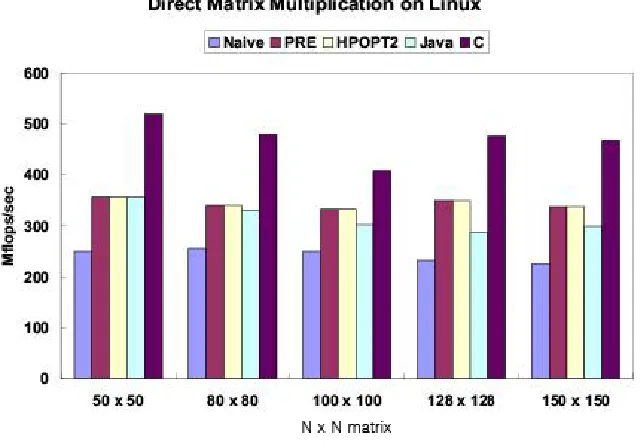
The “direct” matrix multiplication algorithm in Figure 1 is relatively easy and potentially efficient since the operand arrays have carefully chosen replicated/collapsed distributions. Figure
4
Figure 6. Matrix multiplication on the Linux machine.
6 shows the performance of the direct matrix multiplication programs inMflops/secwith the sizes of 50×50, 80 ×80, 100×100, 128×128, and 150×150 in HPJava, Java, and C on the Linux
machine.
From Figure 6, we can see the significant benefit of applying PRE or HPJOPT25
. The results use the IBM Developer Kit 1.3 (JIT) with-Oflag on Pentium4 1.5GHz Red Hat 7.2 Linux machines. Thus, now, we expect that the HPJava results will scale on suitable parallel platforms, so amodest
penalty in node performance is considered acceptable.
5.2
Laplace Equation with Red-Black Relaxation
First, we experiment with HPJava on a simple Laplace Equation with red-black relaxation on the Sun Solaris 9 with 8 UltraSPARC III Cu 900MHz Processors and 16GB of main memory. Figure 7 shows the result of five different versions (HPJava with HPJOPT2 optimization, HPJava with PRE optimization, HPJava with naive translation, Java, and C) of red-black relaxation of the two dimensional Laplace equation. After applying HPJOPT2 for the naive translation, the speedup of HPJava is 177% on a single processor and 138% on 8 processors.
Second, The results of our benchmarks use an IBM SP3 running with four Power3 375MHz CPUs and 2GB of memory on each node. This machine uses AIX version 4.3 operating system and the IBM Developer Kit 1.3.1 (JIT) for the Java system. We are using the shared “css0” adapter with User Space (US) communication mode for MPI setting and -O compiler flag for Java. For comparison, we have also completed experiments for sequential Java, Fortran and HPF version of the HPJava programs. For the HPF version of program, we use IBM XL HPF version 1.4 with
xlhpf95compiler command and-O3and-qhotflag. And XL Fortran for AIX with-O5flag is used for Fortran version.
Figure 7. Laplace Equation with red-black relaxation with size of 512 x 512 on SMP.
[image:12.595.145.454.431.694.2]Figure 9. Three dimensional Diffusion equation with size of 128 x 128 x 128 on SMP.
Figure 8 shows the results from four different versions (HPJava, sequential Java, HPF and Fortran) of red-black relaxation for the two dimensional Laplace equation with size of 512 by 512. In our runs parallel HPJava can out-perform sequential Java by up to 17 times. On 36 processors HPJava can get about 78% of the performance of HPF. This is satisfactory performance for the initial benchmark result. Scaling behavior of HPJava is slightly better than HPF. Probably this mainly reflects the low performance of a single Java node compared to Fortran6
.
5.3
3-Dimensional Diffusion Equation
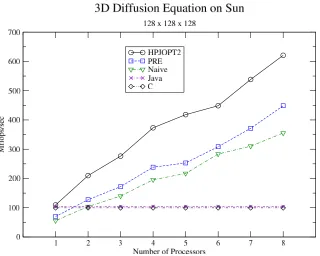
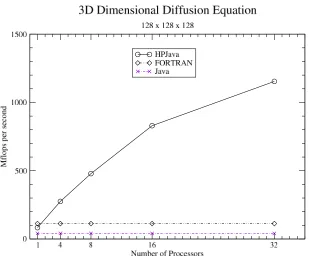
We see similar and better behavior on a larger three dimensional Diffusion Equation benchmark (Figure 9 and 10). After applying HPJOPT2 for the naive translation, the speedup of HPJava is 192% on a single processor and 567% on 8 processors. In general we expect 3 dimensional problems will be more amenable to parallelism, because of the large problem size.
5.4
Discussion
In this section, we have explored the performance of the HPJava system on two machines using the efficient node codes previously discussed in [20]. In the results here, the HPJOP2 algorithm was applied systematically by hand to the code generated by the existing translator. The next stage of this work is to include this algorithm in the translator.
The speedup of each HPJava application is satisfactory even with expensive communication methods such as Adlib.writeHalo() and Adlib.sumDim(). Moreover, performances on both machines show consistent behavior similar to that seen on the Linux machine. One machine does not have a big advantage over others. Performance of HPJava is good on all machines we have
6
Figure 10. Three dimensional Diffusion equation with size of 128 x 128 x 128 on IBM SP3.
benchmarked. HPJava has an advantage over some systems because performance of HPJava on Linux machines, shared memory machines, and distributed memory machines are consistent and promising. Thus, we hope that HPJava has a promising future, and can be used anywhere to achieve not only high-performance parallel computing but also grid-enabled applications.
6
Related Works
6.1
Co-Array Fortran
HPJava is an instance of what we call the HPspmd model: arguably it is not exactly a high-level parallel programming language in the ordinary sense, but rather a tool to assist parallel programmers in writing SPMD code. In this respect the closest recent language we are familiar with is probably Co-Array Fortran [22]. But HPJava and Co-Array Fortran have many obvious differences. In Co-Array Fortran array subscripting is local by default, or involves a combination of local subscripts and explicit process ids. There is no analogue of global subscripts, or HPF-like distribution formats. In Co-Array Fortran the logical model of communication is built into the language—remote memory access with intrinsics for synchronization. In HPJava, there are no communication primitives in the language itself. We follow the MPI philosophy of providing communication through separate libraries.
6.2
ZPL
prefixed by a region specifier, aligned elements of arrays distributed over the same region can be accessed. This idea has similarities to our overallconstruct. In ZPL, parallelism and communi-cation are more implicit than in HPJava. The connection between ZPL programming and SPMD programming is not explicit. While there are certainly attractions to the more abstract point of view, HPJava deliberately provides lower-level access to the parallel machine.
6.3
JavaParty
JavaParty [23] allows easy ports of multi-threaded Java programs to distributed environments such as clusters. Regular Java already supports parallel applications with threads and synchro-nization mechanisms. While multi-threaded Java programs are limited to a single address space, JavaParty extends the capabilities of Java to distributed computing environments. It adds remote objects to Java purely by declaration, avoiding disadvantages of explicit socket communication and the programming overhead of RMI.
JavaParty is for parallel cluster programming in Java. Because the only extension is theremote keyword, it is quite simple and easy to use. Conversely, HPJava provides lower-level access to the parallel machine. Compared to the HPJava system, the basic approach of JavaParty, remote objects with RMI hooks, might become a bottleneck because of unavoidable overhead of RMI.
6.4
Timber
Timber[26] is a Java-based programming language for semi-automatic array-parallel program-ming, in particular for programming array-based applications. The language has been designed as part of the Automap project, in which a compiler and run-time system are being developed for distributed-memory systems. Apart from a few minor modifications, Timber is still a superset of Java.
Like HPJava, Timber introduces multidimensional arrays, array sections, and a parallel loop. They have some similarities in syntax, but semantically Timber is very different to HPJava. Al-though Timber supports parallel operations such aseach,foreachconstructs, it maps less directly to massively parallel distributed memory computing. Timber does not include HPF-like multiar-rays, or support low-level access to the parallel machine. For high-performance, Timber chose C++ as its target language. But in the meantime Java performance has been improved greatly, while C++ remains less portable and secure.
6.5
Titanium
Titanium[27] is another Java-based language (not a strict extension of Java) for high-performance computing. Its compiler translates Titanium into C. Moreover, it is based on a parallel SPMD model of computation.
Titanium is originally designed for high-performance computing on both distributed memory and shared memory architectures. (Support for SMPs is not based on Java threads.) The system is a Java-based language, but, its translator finally generates C-based codes for perceived perfor-mance reasons. Titanium does not provide any special support for distributed arrays, and the programming style is quite different to HPJava.
6.6
GrADS
is, the main interest of the GrADS is in application technologies that make it easy to construct and execute applications with reliable performance in the constantly-changing environment of the Grid. The main goals of the GrADS project are in constructing libraries for Grid-ware components and developing innovative new science and engineering applications to run effectively in Grid Environments.
To achieve these goals, the GrADS project focuses on prototype forms of important scientific applications, together with programming systems and problem-solving environments to support the development of Grid applications by end users. It emphasizes execution environments that dynamically match Grid applications to available resources for consistent performance, hardware and software for experimentation with GrADS programs. This emphasis is distinguished from (though perhaps complementary with) our HPJava-based approach.
6.7
Discussion
One edge the HPJava system has compared to other systems is that HPJava not only is a Java extension but also is translated from a HPJava code to a pure Java byte code. Moreover, because HPJava is totally implemented in Java, it can be deployed any systems without any changes. Java is object-oriented and highly dynamic. That can be as valuable in scientific computing as in any other programming discipline. Moreover, it is evident that SPMD environments are successful in high-performance computing, although programming applications in SPMD-style is relatively difficult. Unlike other systems our HPspmd programming model targets SPMD environments, providing lower-level access to the parallel machines.
Many systems adopted implicit parallelism which have the benefit of simplicity for users. But this results in the difficulty of implementing the system. Some systems chose C, C++, and Fortran as their target language for high-performance. But, as mentioned earlier, Java is now a competitive language for scientific computing. The choice of C or C++ makes the systems less portable and secure in the modern computing environment.
7
Conclusions
The first fully functional HPJava is operational and can be downloaded from [14]. The system fully supports the Java Language Specification [17], and has tested and debugged against the HPJava test suites andjacks[15], a Java Automated Compiler Killing Suite. This means that the HPJava front-end is very conformant with Java. The HPJava test suites includes simple HPJava programs, and complex scientific algorithms and applications such as a multigrid solver, adapted from an existing Fortran program (called PDE2), taken from the Genesis parallel benchmark suite [1]. The whole of this program has been ported to HPJava. Also, a Computational Fluid Dynamics (CFD) application for fluid flow problems7
has been ported to HPJava. An applet version of this application can be viewed atwww.hpjava.org.
There are two main parts to the software. The HPJava development kit, hpjdk contains the HPJava compiler and an implementation of the high-level communication library, Adlib. The only prerequisite for installing hpjdk is a standard Java development platform, like the one freely available for several operating systems from Sun Microsystems. The installation of hpjdk is very straightforward because it is a pure Java package. Sequential HPJava programs can immediately be run using the standard javacommand. Parallel HPJava programs can also be run with the javacommand, provided they follow amultithreaded model.
To distribute parallel HPJava programs across networks of host computers, or run them on
7
supported distributed-memory parallel computers, one should install the second HPJava package—
mpiJava. A prerequisite for installing mpiJava is the availability of an MPI installation on your system.
The main purpose of this paper was to investigate whether our library-based HPspmd Program-ming Model can be efficiently adapted into programProgram-ming support for high-performancegrid-enabled
applications. Through the experiments, we proved that HPJava has quite acceptable performance on “scientific” algorithms, which play very important roles in high-performance grid-enabled ap-plications, including “search engines” and “parameter searching”.
References
[1] C. Addison, V. Getov, A. Hey, R. Hockney, and I. Wolton. The Genesis Distributed-Memory Bench-marks. Elsevier Science B.V., North-Holland, Amsterdam, 1993.
[2] A. V. Aho, R. Sethi, and J. D. Ullman.Compilers: Principles, Techniques, and Tools. Addison-Wesley Pub Co, 1986.
[3] F. Berman, A. Chien, K. Cooper, J. Dongarra, I. Foster, D. Gannon, L. Johnsson, K. Kennedy, C. Kesselman, J. Mellor-Crummey, D. Reed, L. Torczon, and R. Wolski. The GrADS Project: Soft-ware Support for High-Level Grid Application Development. The International Journal of High Performance Computing Applications, 15(4):327–344, 2001.
[4] BioComplexity Institue Home Page. http://biocomplexity.indiana.edu/.
[5] B. Carpenter, G. Fox, H.-K. Lee, and S. B. Lim. Translation Schemes for the HPJava Parallel Programming Language. Lecture Notes in Computer Science, 2624(2):18–32, 2003.
[6] B. Carpenter, V. Getov, G. Judd, A. Skjellum, and G. Fox. MPJ: MPI-like message passing for Java.
Concurrency: Practice and Experience, 12(11):1019–1038, 2000.
[7] B. Carpenter, H.-K. Lee, S. Lim, G. Fox, and G. Zhang. Parallel Programming in HPJava. Draft, 2003. http://www.hpjava.org.
[8] B. Carpenter, G. Zhang, G. Fox, X. Li, X. Li, and Y. Wen. Towards a Java environment for SPMD programming. In D. Pritchard and J. Reeve, editors,4th International Europar Conference, volume 1470 ofLecture Notes in Computer Science. Springer, 1998. http://www.hpjava.org.
[9] B. Carpenter, G. Zhang, and Y. Wen. NPAC PCRC runtime kernel definition. Technical Report CRPC-TR97726, Center for Research on Parallel Computation, 1997. Up-to-date version maintained at http://www.npac.syr.edu/projects/pcrc/doc.
[10] R. Cytron, J. Ferrante, B. K. Rosen, M. N. Wegman, and F. K. Zadeck. Efficient Computing Static Single Assignment Form and the Control Dependence Graph. ACM Transactions on Programming Languages and Systems, pages 451–490, 1991.
[11] I. Foster and C. Kesselman. The Grid: Blueprint for a New Computing Infrastructure. Morgan Kaufmann Publishers, 1999.
[12] M. Gerndt. Updating Distributed Variables in Local Computations. Concurrency: Practice and Experience, 2(3):171–193, 1990.
[13] High Performance Fortran Forum. High Performance Fortran language specification. Scientific Pro-gramming, special issue, 2, 1993.
[14] HPJava Home Page. http://www.hpjava.org.
[15] Jacks (Java Automated Compiler Killing Suite). http://www-124.ibm.com/developerworks/oss/cvs/ jikes/∼checkout∼/jacks/jacks.html.
[16] JavaCC – Java Compiler Compiler (Parser Generator). http://www.webgain.com/products/java cc/. [17] B. Joy, G. Steele, J. Gosling, and G. Bracha. The Java Language Specification, Second Edition.
Addison-Wesley Pub Co, 2000.
[18] R. Kennedy, S. Chan, S.-M. Liu, R. Lo, P. Tu, and F. Chow. Partial Redundancy Elimination in SSA Form. ACM Transactions on Programming Languages and Systems, 21(3):627–676, 1999.
[19] C. Koelbel, D. Loveman, R. Schreiber, J. G.L. Steel, , and M. Zosel. The High Performance Fortran Handbook. MIT Press, 1994.
[20] H.-K. Lee, B. Carpenter, G. Fox, and S. B. Lim. Benchmarking HPJava: Prospects for Performance. In
Sixth Workshop on Languages, Compilers, and Run-time Systems for Scalable Computers(LCR2002), Lecture Notes in Computer Science. Springer, March 2002.
[21] S. B. Lim, B. Carpenter, G. Fox, and H.-K. Lee. Collective Communication for the HPJava Program-ming Language. To appear Concurrency: Practice and Experience, 2003. http://www.hpjava.org. [22] R. Numrich and J. Steidel. F- -: A simple parallel extension to Fortran 90. SIAM News, page 30,
1997. http://www.co-array.org/welcome.htm.
[23] M. Philippsen and M. Zenger. JavaParty - Transparent Remote Objects in Java. Concurrency: Practice and Experience, 9(11):1225 – 1242, 1997.
[24] B. K. Rosen, M. N. Wegman, and F. K. Zadeck. Global Value Numbers and Redundant Computations.
ACM SIGACT-SIGPLAN Symposium on Principles of Programming Languages, 1988.
[25] L. Snyder. A ZPL Programming Guide. Technical report, University of Washington, May 1997. http://www.cs.washington.edu/research/projects/zpl.