Int. J. Electrochem. Sci., 11 (2016) 10123 – 10134, doi: 10.20964/2016.12.37
International Journal of
ELECTROCHEMICAL
SCIENCE
www.electrochemsci.org
Conducting Polymer All Solid State Potentiometric Sensor for
the Tramadol Assay
Farnoush Faridbod*, Atefeh Shafaat, Mohammad Reza Ganjali
Center of Excellence in Electrochemistry, School of Chemistry, College of Science, University of Tehran, Tehran, Iran
*
E-mail: [email protected]
Received: 31 August 2016 / Accepted: 1 October 2016 / Published: 10 November 2016
A new methodology was applied for the designing potentiometric membrane sensors. An electrochemically polymerized Poly(Pyrrole)s (PPy) film was applied as a solid contact-ion to electron transducer on the surface of a pencil graphite electrode (PGE) to make an all-solid-state ion selective electrode (CP-ASS-ISE) for the determination of Tramadol Hydrochloride. A thin layer of a PVC membrane containing synthesized ion-pair as the active element and suitable plasticizer was then placed on the surface of the conducting polymer layer to prepare the sensor. The suggested sensor showed a Nernstian response (a slope of 57.17 mV per decade) over the concentration range of 1.0×10⁻⁶ to 1.0×10⁻¹ mol L-1. The Tramadol sensor had a low detection limit of 7.4×10⁻⁷ mol L-1 with response time of less than 10s in the concentrated solutions. The working pH range of the sensor was 2.0-7.0. Finally, the proposed sensor used for the Tramadol assay in some pharmaceutical tablets.
Keywords: Potentiometry; Tramadol hydrochloride; Conducting Polymer; All-solid-state ion selective electrode (ISE); Poly(Pyrrole)s
1. INTRODUCTION
Conducting polymers (CPs) are polymers which have electrical and ionic conductivity. Because of such property, they are able to act as an ion to electron transducer in designing sensors and biosensors [1]. They form an interface layer between the surfaces of metallic or carbonic electrodes and create high electrical conductivity in these interfaces. An obvious capacitive current observed at the surface of conducting polymers leads to the potential stability in solid contact electrodes. The electrically conducting polymers as a solid contact can be used in potentiometric all-solid state electrodes to promote the performance of the sensors [1,2].
electrodes (ASS) and field effective transistors (FET) [3-6]. Indicator electrodes in the potentiometry are classified into two major groups; symmetrical and asymmetrical electrodes. In symmetrical ion selective electrodes the ion selective membrane is placed between the internal and external analyte solutions. While in the asymmetrical type, one side of the membrane is in contact with a solid state transducer and the other side is in contact with the analyte solution [7]. In general, the symmetrical ion-selective electrodes have two main weaknesses. First, their potential change with time is a little bit high. Second, it is necessary to use an internal reference electrode and inner solution [8]. In addition a coated wire electrode (CWE), which is a carbonic or metallic conductor coated by an ion-selective membrane [9], as an asymmetric electrode, has defect of drift in potential because of high charge-transfer resistance and low double-layer capacitance between the electron conductor and the ionic conductor [10].
All-solid-state ion selective electrodes (ASS-ISEs) as the other class of asymmetric electrodes have the advantages of simplicity and cost-effectiveness in practical applications [11]. In this type of electrodes, a layer with both electronic and ionic conductivity as ion-to-electron transducer is applied at the interface between the conductor and ion selective membrane [10].
Using conducting polymers in designing symmetric electrodes can offer a better ion-to-electron conductivity, which causes overcome the above drawbacks and improve the performance of the sensors. Among conducting polymers, poly(pyrrole)s (PPy) which can be synthesized in various electrolytes with high conductivity [9], is a good candidate. In addition, polypyrrole can form as a stable film on the surface of the various electrode materials from aqueous solutions. Thus, make it suitable and applicable in sensor fabrication [12]. Films of PPy should be yellow but due to the some oxidation in the air they change to darken. Doped films of PPy can be observed as blue or black depending on the degree of polymerization and film thickness. They are amorphous, showing only weak diffraction. PPy is categorized as "quasi-unidimensional" in contrast with one-dimensional, because some crosslinking and chain hopping occurs during its polymerization. Un-doped and doped films are normally insoluble in solvents but swellable. Doping makes the materials brittle. They can be stable in air up to 150 °C [2]. PPy is an insulator, but its oxidized derivatives are good electrical conductors. The conductivity of the material depends on the conditions and reagents used in the oxidation process. Conductivities range from 2 to 100 S/cm. Higher conductivities can be achievable using larger anions. The surface of polypyrrole films represent fractal properties and ionic diffusion through them show anomalous diffusion pattern [2].
Nowadays, many symmetric and asymmetric potentiometric ion-selective electrodes (ISE) are reported in analysis of many inorganic and organic analyte [13-20]. However, the aim of this study is to develop an all-solid-state potentiometric drug sensor based on conducting polymer for the determination of Tramadol hydrochloride Conducting polymer, poly(pyrrole)s (PPy) is used as the ion-to-electron transducer and ion-pair complex of Tramadol-tetraphenyl borate is applied as sensing element. Tramadol was selected because beside its clinical and pharmaceutical importance, our group has previously reported symmetric and asymmetric potentiometric sensors for its determination [21,22] and here comparison of performances of the electrodes can be possible.
moderate to severe pain. The drug is used as an anti-addictive by addicts. However a severe dependence to Tramadol in addicts has been reported due to its binding to µ-opioid receptors in the central nervous system. Side effects such as frequent dizziness, headache and somnolence have been reported in most patients. Another side effect is a significant risk of hypotension. As a result, the quantification of very low Tramadol level has been of increasing importance in clinical chemistry.
2. EXPERIMENTAL
2.1. Chemicals
Pyrrole (Merck, > 98%) was purified by double distillation and stored at low temperature protected from light. KI, KCl, KBr and KNO3 were received from Merck (Darmstadt, Germany). The high-molecular weight poly(vinylchloride) (PVC) was from Fluka Co. Other chemicals (of analytical reagent grade) such as sodium tetraphenyl borate (NaTPB), tetrahydrofuran (THF), dibutylphthalate (DBP), benzyl acetate (BA), nitrobenzene (NB), o-nitrophenyloctylether (o-NPOE) and the chloride and nitrate salts of the used cations were purchased from Merck (Darmstadt, Germany). Tramadol hydrochloride and its tablets were obtained from Darou Pakhsh Pharmaceutical Company (Tehran, Iran). All aqueous solutions were prepared using triply distilled deionized water. The ion-pair of the Tramadol-Tetraphenyl borate was synthesized as describe elsewhere [21].
2.2. Apparatus
Electrochemical polymerization of pyrrole was performed using a DropSens μStat400 Bipotentiostat/Galvanostat (Asturias, Spain). The polymerization was performed in a three-electrode electrochemical cell. The working electrode was a pencil graphite electrode (PGE) (Staedtler, 2B, 2mm diameter, Germany) and the reference electrode was an Ag/AgC1/3 M KC1 electrode. A platinum rod was used as the auxiliary electrode. Potentiometric measurements were made using an Ag/AgC1/3 M KCl electrode as reference electrode and solid contact-ISE as indicator electrode were connected to a mili-voltmeter (±0.1).
2.3. Electrochemical synthesis of poly(pyrrole)s (PPy)
2.4. Fabrication of conducting polymer-all solid state- ion selective electrode (CP-ASS-ISE)
For the Fabrication of conducting polymer-all solid state Tramadol-ISE, a certain amount of PVC and different amounts of ion-pair, plasticizer and additive were dissolved in tetrahydrofuran (THF) and mixed well. The solvent was evaporated to obtain an oily concentrated mixture. The PGE/PPy (I) was dipped in the above prepared cocktail for about 10 s and left to dry for 12h. The resulting electrode is indicated as PGE/PPy (I)/Tramadol-ISM. The ion-selective membrane (ISM) was also applied on bare PGE which indicated as PGE/Tramadol-ISM. Finally the prepared electrodes were conditioned in a 1.0×10⁻³ mol L-1 Tramadol hydrochloride solution for 48 h.
2.5. Potentiometric measurements
After the conditioning step, the electrodes were removed from the Tramadol hydrochloride solution and placed into the electrochemical cell. Potentiometric measurements were made by the two-electrode system (CP-ASS-ISE | sample solution | reference two-electrode) in a concentration range of 1.0×10⁻⁸ to 1.0×10⁻¹ mol L-1. When the potential became stable, it was recorded and plotted as a logarithmic function of Tramadol cations concentrations.
3. RESULTS AND DISCUSSION
[image:4.596.129.480.481.694.2]3.1. PPy films electrosynthesis
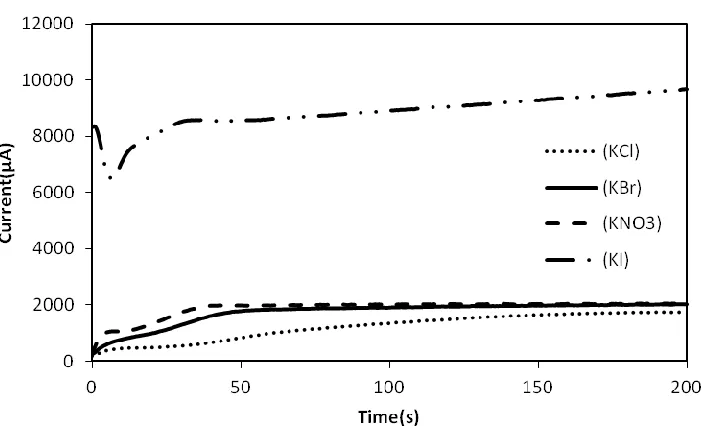
The electrodeposition of PPy films on the pencil graphite electrode was also carried out in potentiostatic mode at 0.80 V vs. Ag/AgCl. Electropolymerization of PPy by the highest charge in some electrolytes leads to the fabrication of thicker films [23]. Fig. 1 shows I vs. t curve for electrodeposition of PPy films in different electrolyte. As it can be seen, the film synthesized in KI solution, shows the highest charge and as a result the highest thickness.
Cyclic voltammetry (CV) is the most common electrochemical method applied for the characterization of conducting polymers. The method involves applying the potential in forward and backward directions to the polymer in an electrolyte solution [24]. In this study the cyclic voltammograms were recorded at bare PGE, PGE/PPy (I), PGE/PPy (Cl), PGE/PPy (Br) and PGE/PPy (NO3). The current at the bare PGE was insignificant whereas in case of the other electrodes an obvious capacitive current was observed. This capacitive current at the PGE/PPy (I) was several times higher than the current at PGE/PPy (Cl), PGE/PPy (Br) and PGE/PPy (NO3). The higher capacitive current or the higher redox capacitance in PGE/PPy (I) leads to the potential stability in the all-solid-state ISE. There is another advantage when polymerization of PPy is done in KI as electrolyte solution. The presence of I2/I- couple helps the polymerization process occurs in the potentials about 400 mV lower than the polymerization potential in the other electrolytes. On the other hand the polymerization of PPy (I) can be catalyzed by the I2/I- couple too [25].
3.2. Membrane composition effect on the potential response of the electrode
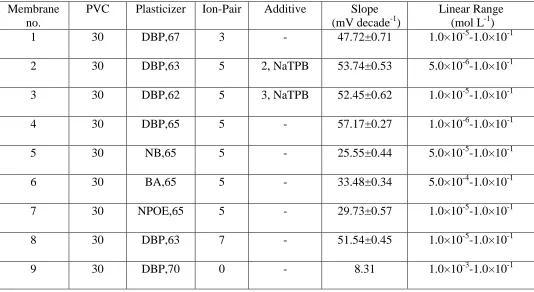
Table 1. Optimization of the membrane composition of the PPy based all-solid-state ion selective electrode; the sensor response for Tramadol ion is investigated as a function of (a) PVC, (b) Plasticizer, (c) Ion-Pair and (d) Additive amounts.
Membrane no.
PVC Plasticizer Ion-Pair Additive Slope (mV decade-1)
Linear Range (mol L-1)
1 30 DBP,67 3 - 47.72±0.71 1.0×10⁻⁵-1.0×10⁻¹
2 30 DBP,63 5 2, NaTPB 53.74±0.53 5.0×10⁻⁶-1.0×10⁻¹
3 30 DBP,62 5 3, NaTPB 52.45±0.62 1.0×10⁻⁵-1.0×10⁻¹
4 30 DBP,65 5 - 57.17±0.27 1.0×10⁻⁶-1.0×10⁻¹
5 30 NB,65 5 - 25.55±0.44 5.0×10⁻⁵-1.0×10⁻¹
6 30 BA,65 5 - 33.48±0.34 5.0×10⁻⁴-1.0×10⁻¹
7 30 NPOE,65 5 - 29.73±0.57 1.0×10⁻⁵-1.0×10⁻¹
8 30 DBP,63 7 - 51.54±0.45 1.0×10⁻⁵-1.0×10⁻¹
[image:5.596.32.566.472.764.2]
To investigate the effect of membrane composition on the sensor response, different amounts of ion-pair, PVC, plasticizer and suitable additives were dissolved in THF and applied on the electropolymerized conducting polymer film synthesized on the surface of a PGE. As other previous works, the composition of the membrane were optimized as presented inTable 1. ItThe best results will be obtain with 5% of ion-pair in the membrane composition. According to this table, membrane with no sensing element shows poor response toward Tramadol ions (no. 9). Plasticizers are organic compounds which help Tramadol ions to extract from an aqueous sample solution to the membrane. In our previous work (14), we proved that DBP, which is a low-polar solvent, shows better response to Tramadol in comparison with BA, NB and o-NPOE. Here, in this work, DBP was also selected as the best plasticizer for the fabrication of CP based solid-contact ISE. Ionic additives are components applied in the membrane in order to diminish the electrical resistance [26]. The presence of PPy in the electrode construction leads to the remarkable decrease in charge-transfer resistance during the potential measurement. As a result there was no need to use ionic additives in the sensor fabrication. As it can be seen in Table 1, the membrane with the composition of 30% PVC, 5% ion-pair, and 65 % DBP (no. 4) was the optimum composition in fabrication of the Tramadol sensor.
3.2. The effect of pH on the electrode response
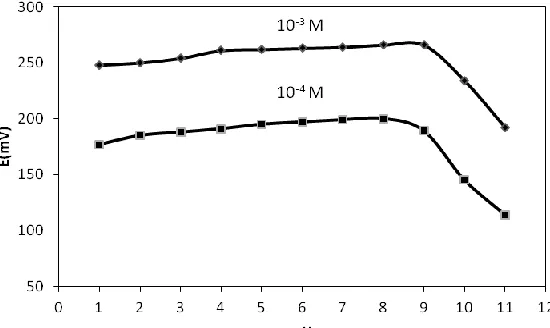
[image:6.596.161.436.479.643.2]The effect of pH on the response of the CP-based sensor was studied in Tramadol solutions (1.0×10⁻³ mol L-1 and 1.0×10⁻⁴ mol L-1) over a pH range of 1-11. The pH of the solution was adjusted at the required value by addition of concentrated HCl or NaOH. Fig. 2 shows that the potential does not change in the pH range of 2.0 to7.0, which indicates the applicability of the sensor in this range. Fluctuation above the pH 7.0 is due to the removing positive charge on the drug molecule.
Figure 2. Potentiometric responses of the all-solid-state ion selective electrode in 1×10⁻⁴ mol L-1 and 1×10⁻³ mol L-1 Tramadol ion solutions at several pH values.
3.3. Calibration curve and potentiometric response
[image:7.596.117.459.209.389.2]
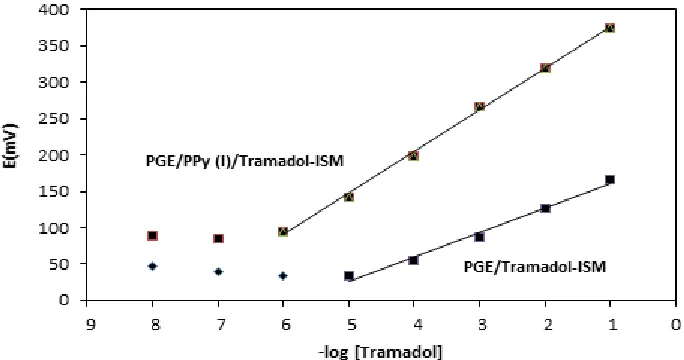
response was plotted versus logarithmic function of Tramadol cation concentrations. The measuring range of a potentiometric sensor is the linear part of the calibration curve. As it is shown in Fig. 3, this linear part toward the Tramadol concentration is from 1.0×10⁻⁶ to 1.0×10⁻¹ mol L-1. As control experiment, a PGE coated PVC membrane was also prepared and the calibration curve was also plotted for PGE/Tramadol-ISM. As it can be seen in Fig. 3, the PGE/PPy (I)/Tramadol-ISM shows wide linear dynamic range (LDR), low limit of detection (LOD) and Nernstian response in comparison with PGE/Tramadol-ISM.
Figure 3. Calibration curve of Tramadol in different concentrations in the range of 1.0×10⁻⁸ to 1×10⁻¹ mol L-1
3.4. Detection Limit
Detection limit for an ion selective electrode is defined as the concentration at which the measured potential differs from the Nernstian response. According the IUPAC recommendation in 1976, the detection limit is measured by the cross-section of the two extrapolated linear parts of the ion-selective electrode calibration curve [27-30]. As shown in Fig. 3, the lower detection limit of proposed solid contact ISE with respect to Tramadol ions is 7.4×10⁻⁷ mol L-1.
3.5. Response time
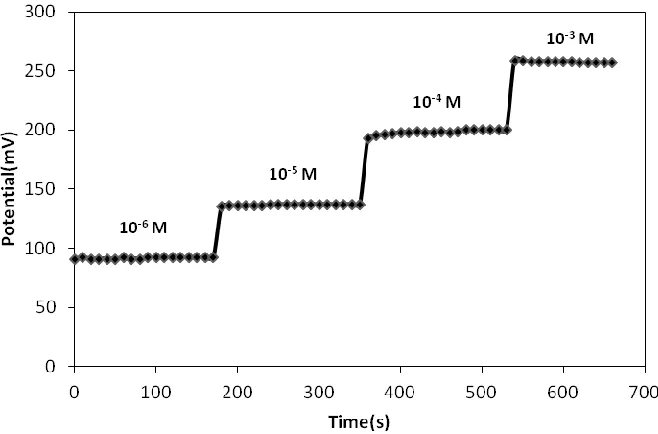
In IUPAC recommendations, response time is defined as the time between the instant at which the ion-selective electrode and the reference electrode are dipped in the sample solution and the first instant at which the potential of the cell has reached 90% of the final value [27-30].
Figure 4. The potentiometric time trace response toward the Tramadol concentration.
3.6. Lifetime
[image:8.596.135.464.76.293.2]The reported average lifetime for most of the ion-selective electrodes is about 4–10 weeks [31-33]. After this time, the Nernstian slope of the sensor will decrease and the detection limit will increase. This phenomenon is due to the loss of plasticizer and ionic sites from the polymeric membrane by leaching into the sample solution. The solid contact ISEs were used one hour per day for about 10 weeks. As shown in Fig. 5, the proposed electrode can be used for at least eight weeks (8.5 weeks).
Figure 5. The lifetime of the Tramadol ion- selective- electrode.
[image:8.596.139.462.498.673.2]
3.7. Selectivity
Selectivity is one of the most significant characteristics of a new sensor. In order to fabricate highly selective ISEs, selective recognition elements combined with the other membrane components. The aim is to incorporate only the target into the electrode in the presence of interfering ions [30-33].
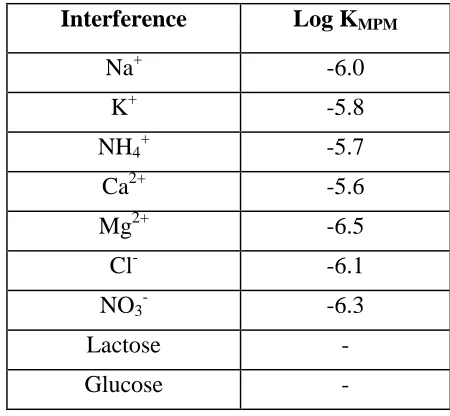
[image:9.596.184.409.271.479.2]The selectivity coefficients of the Tramadol ISE were obtained by the matched potential method (MPM) [32-35]. As shown in Table 2, the selectivity coefficient of Tramadol ISE in the presence of all interferences tested is too low to be significant, which indicates the high selectivity of the proposed sensor toward Tramadol ions.
Table 2. Selectivity coefficients for Tramadol ion selective electrode
Interference Log KMPM
Na+ -6.0
K+ -5.8
NH4+ -5.7
Ca2+ -5.6
Mg2+ -6.5
Cl- -6.1
NO3- -6.3
Lactose -
Glucose -
3.8. Determination of Tramadol in Formulations
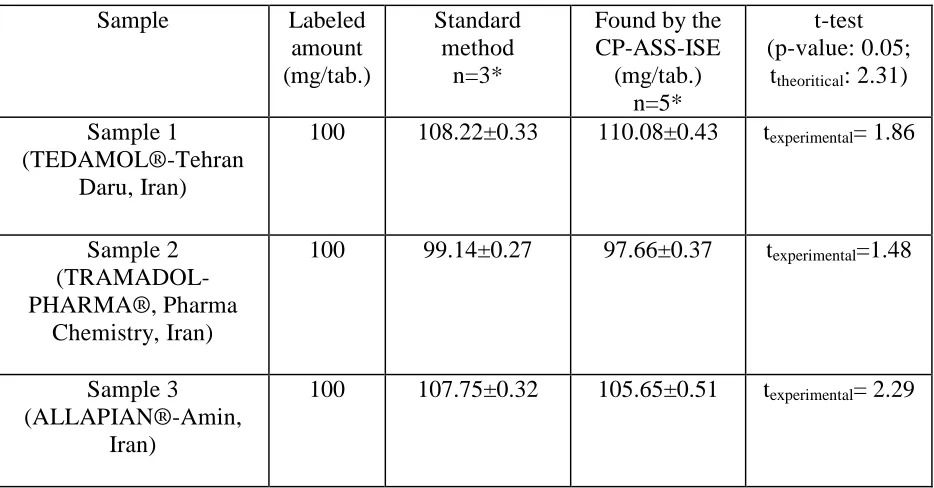
Table 3. Results of Tramadol Assay in Tablets by the Tramadol all-solid-state ion selective electrode
Sample Labeled
amount (mg/tab.)
Standard method
n=3*
Found by the CP-ASS-ISE
(mg/tab.) n=5*
t-test (p-value: 0.05;
ttheoritical: 2.31) Sample 1
(TEDAMOL®-Tehran Daru, Iran)
100 108.22±0.33 110.08±0.43 texperimental= 1.86
Sample 2 (TRAMADOL-PHARMA®, Pharma
Chemistry, Iran)
100 99.14±0.27 97.66±0.37 texperimental=1.48
Sample 3 (ALLAPIAN®-Amin,
Iran)
100 107.75±0.32 105.65±0.51 texperimental= 2.29
Assessment of the repeatability of the sensor was also performed through repeatedly testing three standard synthetic samples and the RSD% of the results was obtained 2.76%. Further the ruggedness of the test procedure based on the CP-ASS-ISE was evaluated through the comparison of the results of intra- and inter-day assay by two analysts in the same laboratory and the RSD% was found to be 3.2%. Robustness was obtained while the important parameters (i.e. pH of the solution and the laboratory temperature) changed slightly. Tramadol recovery presents were acceptable under most conditions, and show no significant change when the critical parameters were changed.
A comparison of the previous Tramadol potentiometric sensors [20, 21, 37] (Table 4), shows the superiority of the new sensors in some terms, lifetime, response time, reproducibility, repeatability.
Table 4. Comparison of developed sensor for Tramadol determination with other sensors previously reported.
Type of sensor DL (M) LR (M) RT pH range Life-time Year
PME 1.0 ×10⁻⁵ 1.0 ×10⁻⁵ -1.0 ×10 -1
10 s 3-8 7 weeks 2009 [20]
M-CPE 1.8×10⁻⁶ 5.5×10⁻⁶-1.0 ×10⁻¹ ~8 s 1.5-10 Not reported 2010 [37] PME 2.1×10⁻⁶ 5.5×10⁻⁶-1.0 ×10⁻¹ 5-10 s 1.5-6 33 days 2011 [38] SC-ISE 3.9×10⁻⁷ 1.0×10⁻⁶-1.0 ×10⁻² 5s 3-7 Not reported 2015 [39] CWE, CPE,
M-CPE
1.0×10⁻⁹ 1.0×10⁻⁸-1.0 ×10⁻² <5s 3-7 >8 weeks 2016 [40]
ASS-PME 6.0×10⁻⁸ 1.0×10⁻⁷-1.0 ×10⁻³ 23 s 3-7 8 weeks 2016 [21]
[image:10.596.28.569.577.718.2]
4. CONCLUSION
Electropolymerization of Poly(pyrrole)s (PPy) was made in aqueous potassium iodide solution. The proposed PPy (I) film was used as a solid contact ion to electron transducer in an all-solid-state Tramadol- ISE. A simple and inexpensive pencil graphite electrode was used as a solid contact. The conducting polymer-based all-solid-state sensor is a useful tool for the sensitive determination of Tramadol in pharmaceutical tablets in comparison to traditional symmetric PVC membrane electrodes or even asymmetric coated wire ones. The resulting ion-selective electrode exhibits an attractive selectivity in the presence of interferences and long term stability in a wide linear range (1.0×10⁻⁶ -1.0×10⁻¹ mol L-1) with a Nernstian response.
ACKNOWLEDGEMENT
The authors thank the research council of University of Tehran for financial support of this work.
References
1. J. Bobacka, Electroanalysis 18 (2016) 7.
2. G. Inzelt, Chapter 1: Introduction. In F. Scholz, Conducting Polymers: A New Era in
Electrochemistry. Monographs in Electrochemistry. Springer. (2008) pp. 1–6. ISBN 978-3-540-75929-4.
3. F. Faridbod, N. Davarkhah, and S. Karamdoust, Int. J. Electrochem. Sci. 10 (2015) 8308.
4. V. Arabali, M. Ebrahimi, M. Abbasghorbani, V. K. Gupta, M. Farsi, M. R. Ganjali, and F. Karimi, J. M. Liq. 213 (2016) 312.
5. M. R. Ganjali, Z. Memari, F. Faridbod, and P. Norouzi, Int. J. Electrochem. Sci. 3 (2008), 1169. 6. M. R. Ganjali, M. Rezapour, M. R. Pourjavid, and S. Haghgoo, Anal. Sci. 20 (2004) 1007. 7. M. R. Ganjali, P. Norouzi, M. Rezapour. Encyclopedia of sensors, potentiometric ion sensors.
American Scientific Publisher (ASP): Stevenson Ranch, CA, USA. 8 (2006) 197.
8. I. P. Gorelov, S. S. Ryasenskii, S. V. Kartamyshev, M. V. Fedorova, J. Anal. Chem. 60 (2005) 65. 9. T. Momma, M. Yamamoto, S. Komaba, and T. Osaka, J. Electroanal. Chem. 407 (1996) 91. 10. Z. Mousavi, J. Bobacka, A. Lewenstam, and A. Ivaska, J. Electroanal. Chem. 633 (2009) 246. 11. A. Michalska, Electroanalysis 24 (2012) 1253.
12. J. Bobacka, Z. Gao, A. Ivaska, and A. Lewenstam. J. Electroanal. Chem. 368 (1994) 33. 13. M. R. Ganjali, S. Rasoolipour, M. Rezapour, P. Norouzi, A. Tajarodi, and Y. Hanifehpour,
Electroanalysis 17 (2005) 1534.
14. M. R. Ganjali, F. Faridbod, N. Davarkhah, S. J. Shahtaheri, and P. Norouzi, Int. J. Environ. Res. 9 (2015) 333.
15. H. A. Zamani, M. T. Hamed-Mosavian, E. Aminzadeh, M. R. Ganjali, M. Ghaemy, H. Behmadi, and F. Faridbod, Desalination 250 (2010) 56.
16. M. R. Ganjali, A. Roubollahi, A. R. Mardan, M. Hamzeloo, A. Mogimi, and M. Shamsipur, Microchem. J. 60 (1998) 122.
17. M. Shamsipur, S. Rouhani, M. R. Ganjali, H. Eshghi, and H. Sharghi, Microchem. J. 63 (1999) 202.
18. F. Faridbod, M. R. Ganjali, B. Larijani, E. Nasli-Esfahani, S. Riahi, and P. Norouzi, Int. J. Electrochem. Sci. 5 (2010) 653.
20. M. R. Ganjali, T. Razavi, F. Faridbod, S. Riahi, and P. Norouzi, Curr. Pharm. Anal. 5 (2009) 28. 21. M. R. Ganjali, B. Larijani, and E. Pourbasheer, Int. J. Electrochem. Sci. 11 (2016) 2119.
22. U. Paramo-García, J. G. Ibanez, and N. Batina, Int. J. Electrochem. Sci. 8 (2013) 2656. 23. Introduction to Conductive Electroactive Polymers: CRC Press (2008) pp. 1-58. 24. T. Lindfors, J. Bobacka, and A. Ivaska, Anal. Chim. Acta 355 (1997) 217.
25. F. Faridbod, P. Norouzi, R. Dinarvand, and M. R. Ganjali, Sensors 8 (2008) 2331.
26. M. R. Ganjali, N. Motakef-Kazami, F. Faridbod, S. Khoee, and P. Norouzi, J. Hazard. Mater. 173 (2010) 415.
27. H. A. Zamani, M. R. Ganjali, P. Norouzi, and S. Meghdadi, Anal. Lett. 41 (2008) 902.
28. M. R. Ganjali, P. Norouzi, A. Atrian, F. Faridbod, S. Meghdadi, and M. Giahi, Mater. Sci. Eng. C 29 (2009) 205.
29. H. A. Zamani, J. Abedini-Torghabeh, and M. R. Ganjali, Electroanalysis 18 (2006) 888. 30. M. R. Ganjali, P. Norouzi, M. Adib, and A. Ahmadalinezhad, Anal. Lett. 39 (2006) 1075. 31. H. A. Zamani, M. R. Ganjali, and M. J. Pooyamanesh, J. Brazil. Chem. Soc. 17 (2006) 149. 32. H. A. Zamani, F. Malekzadegan, and M. R. Ganjali, Anal. Chim. Acta 555 (2006) 336.
33. M. R. Ganjali, I. Alahdadi, M. Aghazadeh, and E. Pourbasheer, Int. J. Electrochem. Sci. 10 (2015) 6913.
34. H. A. Zamani, A. Imani, A. Arvinfar, F. Rahimi, M. R. Ganjali, F. Faridbod, and S. Meghdadi, Mater. Sci. Eng. C 31 (2011) 588.
35. Y. Umezawa, K. Umezawa, H. Sato, Pure Appl. Chem. 67 (1995) 507. 36. S. H. Gan and R. Ismail, J. Chromatogr. B 759 (2001) 325.
37. H. M. Abu-Shawish, N.A. Ghalwa, F.R. Zaggout, S. M. Saadeh, A. R. Al-Dalou, and A. A. A. Assi, Biochem Eng J. 48 (2010) 23.
38. H. M. Abu-Shawish, S. M. Saadeh, A. R. Al-Dalou, N. A. Ghalwa, and A. A. A. Assi, Mater. Sci. Eng. C 31 (2011) 300.
39. M. R. Elghobashy, A. M. Mahmoud, M. R. Rezk, and M. K. Abd El-Rahman. J Electrochem. Soc. 162 (2015) H1.
40. N. A. Abdallah, Sens Mater. 28 (2016) 797.