International Journal of Innovative Technology and Exploring Engineering (IJITEE) ISSN: 2278-3075, Volume-8 Issue-9, July 2019
Abstract: Mobile ad hoc networks (MANETs) are keenly categorized by multiform mobile affinity and dynamically altering network earth space. Wireless ad hoc multipart is a gathering of infra-structure less mobile nodes making a short-term network devoid of any centralized organization. The various ad hoc routing protocols have been recommended and fulfilled, which include Ad hoc On-Demand Distance Vector Routing (AODV1), NMDC1 (Node Mobility and Density Classifier 1) and Temporally Ordered Routing Algorithm (TORA 1). Though, simulation work has been done extensively to estimate the performance of these routing protocols, a new performance assessment is mandatory. Hence, in this paper, we perform the all-embracing simulations using Network Simulator - 2 considering the node density, node delay throughput and static scenario. Further, we evaluated the show variances to parallel the above-declared regularly used conventions. To find the consequence of web size on the performance of these protocols, we chose a scenario specifically 10 and 70 nodes, with rectangular area sizes 1500 • 2000m2. Results revealed that for specific differentials, TORA reveals enhanced performance over the two protocols, that is, NMDC and AODV. Therefore, our results are expected to enhance performance of several ad hoc networks in the future.
Index Terms: Node Mobility, Route Validity, Density Classifier, Node Density, Network Simulator2.
I. INTRODUCTION
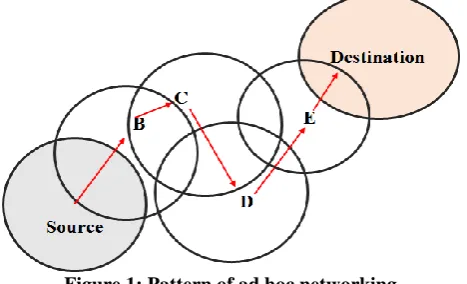
In advanced networking and communications technologies, portable wireless devices are commonly found in our daily activities. Mostly, people carry and use laptop, computers and phones that help roaming computing of network users. In wireless communication, a node can transmit information through the electromagnetic waves to all of its adjacent nodes. Simultaneously, a node can receive numerous signals sent from its neighbors. MANET is one form of wireless networks, is an independent system of mobile hosts attached by wireless links. There is no base station (static infrastructure) for this network. Each node in the network also acts as a router, sending data packets for other nodes [1,2]. The knowledge of such networking is to assist robust and effective operation in mobile wireless networks by including routing functionality into mobile nodes. Pattern of an ad hoc network is shown in Figure 1, where there are several combinations of broadcast areas for various nodes. From the source node to the destination node, there are different tracks of connection at a certain point of time. It is evident from the Figure 1, every node typically has a limited area of transmission by the elliptical circle around each node. A source can only transfer
Revised Manuscript Received on July 05, 2019.
K.Nirmaladevi, Ph.D Research Scholar, Computer Science, Periyar University PG Extension Centre, Dharmapuri, Tamil Nadu, India.
Dr.K.Prabha, Assistant Professor, Computer Science ,Periyar University PG Extension Centre, Dharmapuri, Tamil Nadu, India.
data to node B, but B can transfer data either to C or D. It is a
Difficult task to opt a good method to create the connection between a birthplace and a endpoint. Therefore, they can ramble around and transmit strong communication.
[image:1.595.311.545.233.375.2]Figure 1: Pattern of ad hoc networking
Several protocols have been planned for MANETs, with aim of recognizing capable overwhelming [4–7]. These algorithms are changed in the process used for searching a novel route and modifying a well-known route, when hosts move. The ad hoc defeating protocols are generally classified as table-driven and source initiated on-demand driven. The simulation results were well acknowledged in the previous literatures, it shows that on demand routing protocols have higher packet delivery ratio and require less routing protocols are more messages the table-driven routing protocols [8, 9]. There are four foremost ad hoc routing protocols such as AODV, NMDC, TORA and destination sequence distance vector (DSDV). All these protocols are continually being enriched by the research community [10].As a result; a inclusive presentation calculation of ad hoc overwhelming protocols is required. This paper compares the performance of three ad hoc routing protocols namely, AODV, TORA and NMDC routing protocols using the Simulator Network version 2. Tool Command Language is vulnerable calligraphy semantic which is used to program NS2 and trace analysis is performed using PERL / MATLAB. The mobility models are commonly used in their longitudinal and sequential colonies. The entity of mobility models is specified to handle the movement of individual mobile nodes within the group. Hence, we estimated all available metrics sustained by Simulator Network version 2 for used protocols and then accomplished reasonable performance estimation. Since these protocols have unrelated appearances, the comparison of all performance differentials is
not feasible. Nevertheless,
the following system
parameters are used for
An Efficient Energy of Mobile Pattern Ad Hoc
Networks in Reactive Routing Protocols
reasonable study on the protocols: a) ACK packets expected
b) Signals reached with power above RX thoughtfulness c) Signals communicated
d) BCAST (packets received clearly) e) UCAST (packets received clearly) f) Average end-to-end delay
g) Smashes
h) Data packets time-honored
i) Number of packet endeavor to be sent to MAC j) Signals arrived with power above RX threshold k) Broadcast (packets sent to channel)
l) Unicast (packets sent to channel) m) TTL’s of delivered packets.
II. DISSIMILAR TECHNIQUES OF AD-HOC NETWORKS
A. AODV
AODV is the combining both DSR and DSDV protocols. It’s the basic route innovation and route conservation of the both dsr and dsdv. The AODV routing protocols are both reactive and proactive it’s based on hop – by – hop routing an distance sequence number method[2]. The number of messages through forwarding and receiving the data forwarding is also available. The route discovery can also done by requested message can appropriate data. RREQ and RREP are commonly used in this ad-hoc network while the combination of node updates the lifetime information in the routing table.
B. FWM
The Freeway Mobility model are considered the motion of behavior of the mobile nodes can be freely moving the tacking [3]. The velocity of the mobile node can examined the both previous and after velocity model. In this model we use the maps and graphs.
C. DSR Reactive Routing Protocol
The Dynamic Source Routing (DSR) is the reactive protocol that explains the method of routing source to destination. DSR routing operations can expressed two main phases one is route discovery and another one is route maintenance. They are two structures are applicable in DSR protocols. One is Free Space Structure and another one is Two Ray Ground Structure.
D. Objectives of Mobile Ad-hoc Networks
The MANET is an intense of the requirement of new application routing protocol is a major advantage of topology is used frequently. MANET is having the objective of the routing method to find the optimum route to the destination in terms of minimum delay and shortest path. The mainly used in the routing protocols in MANET assumes friendly and co-operative environment but presence of mischievous node and exposure to security the node [4]. The malicious nodes are minimizing the performance of protocol under the attack of node to improve the flooding attacks. Secure routing and transfer protocols are improved flexibility.
III. INTENTION AND EXECUTION OF NODE MOBILITY In MANET the routing protocols are commonly derived the formation of right huge quantity of nodes with partial
properties [5]. The protocol involves the performed and disconnected the data packets can sending and receiving the n number of nodes. Routing protocols need to be the following qualities are scattered action, loop development, liberty, petition based action, pre-emptive process and volatile operation. The Node mobility and Density Classifier using Mobile Ad-hoc Network that considered the travelling the node movement and node density method.
A. NM & NNB Algorithm
Node move able ness establishes a range of problem that is not handling well by periodically stimulating state figures as algorithms intended for static networks typically do. The design of quasi-static cover on top of a mobile topology has been performed [6]. It has dynamic with local networks along with nodes and exhibits self-healing and self-organization capabilities with respect to failures and node mobility. MANET has numerical reproductions to faithfully assess the sharing of the generation of a wireless connection. In this method a nodes move capriciously within embarrassed regions. In this link the lifetime can be computed through a two-state Markov model and further apply the divided value total eligible elaboration. It is the optimization of segmentation method of information stream.
D =
X = Starting Process, Y = Ending Process.
B. Limitations of NS2
NS2 is widely used in the research and enhancements of the problematical configuration which is difficult to be re-claimed in the real life execution. It’s also wiretaps found in changeable and flexible. Uncensored and inter domain connection are routing and sub netting are provided the NS2 emulation.
C. Limitations of NS3
In this paper presented the following Consideration are explored to study the effects of flexibility of the node on each of the moldiest routing procedures. There is limited for visualization due to the use of python in Network Simulator 3[3]. It requires the powerful community contribution in order to improve it. The wireless systems are real time animators are required its complex to use.
Node Mobility and Validity
To safeguards that the route between each n number of nodes is well founded. It states that movement is flowing from node i to node j only when the link (i ,j) exists.The direction-finding algorithm is explored through the effects of motion model are compared the nodule concentration and classify using Mobile Ad hoc Network. The percentage of the number of packages established and number of packages distributed. The suspension path is different from home to end or contributor and receiver waypoints. The ratio of number of data communications are sloping or dispatched. The route power is defined as the eclipse form of report on the connections through widely
International Journal of Innovative Technology and Exploring Engineering (IJITEE) ISSN: 2278-3075, Volume-8 Issue-9, July 2019
organizations are overthrowing schemes like single cast, newscast, multicast, any cast, geo cast. A mobile knob contribution of MANET will be entries in knob’s route quantity.
Some of Algorithm
IV. PERFORMANCE EVALUATION METRICS OF MANET Efficient Network Based on Broadcasting Network
The MANET routing protocols are the resolution of the controls the nodes can sending the routing packets between the source to the destination. In mobile ad-hoc networks, how to nodes are determine the network topology. A new node can anomies the presence of network broadcasting algorithm between the neighbor nodes[9]. The reactive and proactive methods are commonly used in the efficient network in manet. The Manet routing protocols are related with the concerns like appeared and disappeared of nodes in different locations. Computer networks are group of networks that computes the user applications with each other.
The node mobility is the key attribute of ad-oc networks. Modeling is the movement of the set of nodes is evaluating the performance of a mobile ad-hoc network. PING Packet Internet Grouper is a computer network is used to check the Internet Packet based network. The manet is a adaptive network the underlying communication graph changes overtime the dynamic topology control, limited resources and limited wireless communications range through nearby devices connected modules.
To route the PING packet its node, needs the routing protocol. The reactive based routing protocol can be considered at the rout on demand at the start of the communication network[10]. In AODV, its considered at the normalization of control overhead. AODV Query and AODV reply. RREQ is message broadcasted to other nodes for finding the other nodes. The Destination node will generate the unicast back to the network communication. This protocols works the assumption that all nodes in the network are friendly and co-operative nodes.
The network community is largely depending on simulation of the performance of protocols. The field of communication
of the two discrete simulators likes NS2 and NS3. The AODV of scenarios is MANET environment. The performance of NS2 could like platform, language, architecture, memory, visualization and finally we got the results at simulation.
V. EXPERIMENTAL RESULTS OF NETWORK NODE
MOBIILITY MODEL
[image:3.595.55.275.123.329.2]The Network of Node Mobility and Density Classifier using MANET around as the formation of routing protocols. The proactive protocols are also called the table driven routing protocols where information about every node is maintained the required AODV and DSR [16]. The reactive protocols are on demand routing protocols where routes are discovered only when required the AODV. The proactive protocols are latency of finding the route and node mobility its less than but its extra overhead control messages. Reactive protocols are advantage of saving the bandwidth and it’s easy to maintain the routs so that reactive protocols are main popular protocols in MANET [17]. The presence of compromised nodes cans many problems in MAET. All routing protocols are require cooperative environment such like as some attacks are possible in MANET.
Table – 1: Parameters using during simulation
Parameters Value
Simulation Setup 1000*1500 m
No. of nodes 10 to 80
Time Manipulation 10 to 100 sec
No. of repetition 5 times
Physical/Mac layer IEEE 802.11E
Pause time 30 sec
Mobility model Random direction model
Node movement 5 – 35 m/s
Random Type CBR & TCP
MANETS uses a multiple number of derivations in the performance of n number of packets and protocols.
A. Jitter
Its derived the deviation of packet delay between the node mobility and network broadcasting method.
B. Packet Data Delivery Ratio
The ratio of the number of packets delivered to the destination nodes and number of the data packets can sending and receiving the nodes at source and destination.
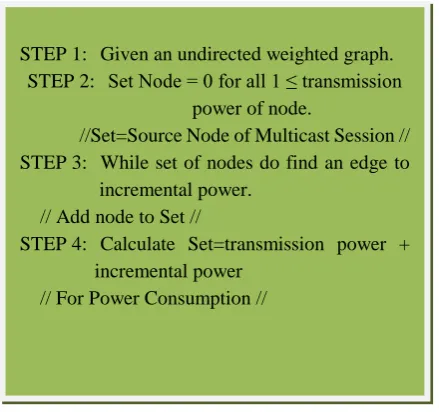
C. End-To-End Delay STEP 1: Given an undirected weighted graph.
STEP 2: Set Node = 0 for all 1 ≤ transmission ……….. power of node.
………//Set=Source Node of Multicast Session // STEP 3: While set of nodes do find an edge to …………incremental power.
// Add node to Set //
STEP 4: Calculate Set=transmission power + ………...incremental power
// For Power Consumption //
The packet delivery ratio re similarly consider the n number of packets through Manet at the packet can sending end to end delay process. The sums of packets can directing and receiving the data as the client and server.
Thus the location information of the source and destination nodes is estimated. In this LTA, the current locations are considered and messages are transmitted between source nodes to destination node. The entrance time is recorded in a given time period and compute the location information using LTA. By recording all the transmission paths the distance of each and every node to destination is known. It helps to identify the nodes which are nearer to destination intentionally better parameter for Cluster Head selection. Thus the LTA is used to provide exact location for efficient communication over network.
[image:4.595.310.544.70.374.2]Packet Delivery Ratio can be applicable in the sending and receiving packets.
Table -1 Generated only 50 nodes
Node Mobility (m/s)
Node Lifetime Existing
NM
Proposed NDM
Proposed Node Mobility
5 65 82 98
10 70 78 97
20 68 77 96
30 62 63 95
40 60 62 94
50 58 61 93
Figure 1- Node of Validity 50 Nodes
0 20 40 60 80 100 120
10 20 30 40 50
Existing
Proposed NM
Proposed RVM
[image:4.595.57.281.104.208.2]
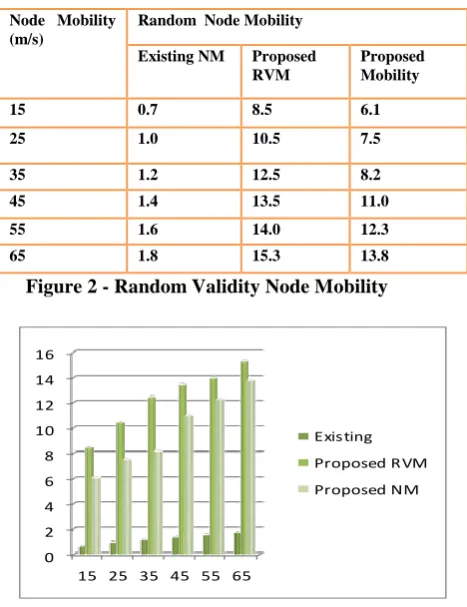
Table : 2 Random Validity Mobility Model
Node Mobility (m/s)
Random Node Mobility
Existing NM Proposed RVM
Proposed Mobility
15 0.7 8.5 6.1
25 1.0 10.5 7.5
35 1.2 12.5 8.2
45 1.4 13.5 11.0
55 1.6 14.0 12.3
65 1.8 15.3 13.8
Figure 2 - Random Validity Node Mobility
0 2 4 6 8 10 12 14 16
15 25 35 45 55 65
Existing
Proposed RVM
Proposed NM
[image:4.595.59.543.390.831.2]
Table : 3 Normalized Control Overhead
Node Mobility (m/s)
Normalized Control Overhead
Existing NM Proposed NCO
Proposed Node density
10 1.1 10.5 5.1
15 1.3 11.5 6.5
25 1.7 12.5 7.2
35 2.0 13.5 10.0
45 2.2 14.5 11.3
55 2.9 15.5 12.8
65 3.2 16.5 13.7
Figure – 3 Normalized CO / NM
International Journal of Innovative Technology and Exploring Engineering (IJITEE) ISSN: 2278-3075, Volume-8 Issue-9, July 2019
VI. CONCLUSION
In this paper we presented the Node Mobility and Node Density Classifier using the Manet. The scenario of the AODV protocol preforms the static and dynamic protocols are considered the remaining energy of inferior quality network and Mobile Ad-hoc Network. From the simulation results the performance of the random mobility model and density node mobility model are better than the other random models. Is evident the results and random waypoint are the performance of mobility model is lower. This is significant the mobility node models are the routing protocols are AODV and DSR. It’s all based on various norms. We assumed the recital of systems in relationships of data, number of conventional packages and path technique socket portrait.
A. Abbreviations and Acronyms
MANET – Mobile Ad-hoc Network
NS2 – Network Simulator 2
RWMM – Random Waypoint Mobility Model
NM – Node Mobility
AODV – Ad-hoc On Demand Vector
DSR – Dynamic Source Routing
TORA – Temporally On Demand Routing
Algorithm
PING – Packet Internet Grouping PDR – Packet Delivery Ratio
RVMM – Random Validity Mobile Model NCO – Normalized Control Overhead.
REFERENCES
1. Imran Ali Khan "an improved cover angle-based broadcasting algorithms is proposed for Mobile Ad hoc Networks".
2. T. Clausen and P. IEFT "OLSR" Networking Group, October 2003. 3. Awadesh Kumar, Prabhat Singh, Vinay Kumar, " Performance of
AODV,DSR,OLSR and MANET Routing Protocol using NS2 Simulation" , September 2006.
4. Bhavyesh Divecha, Ajth Abhraham, Sugatha Sanyal, "Impact of Node Mobility on MANET routing Protocol Models", Journal of Digital Information, Feb 2007.
5. Thomas Heide Clausen, Phillipe Jacquet and Laurent Vienet inria Hipercom, "Comprative study of Routing Protocols for MANET". 6. R.Mishra and C.R. Mandhal, "Performance Comprasion of AODV /
DSR, On Demand Distance Vector Routing Protocol for Ad-hoc Networks in Constrained Network" , 2005.
7. E.Abdelfattah and G. Liu, "Performance Evaluation of Mobile Ad-hoc Routing Protocols" , Novel Algorthims and techniques in Telecommunications, and industrial Electronics, Springer, 2008. 8. A.A.A Radwan, T.M. Mahmoud, and E.H. Houssien, " Evaluation of
the Comparison of Some Ad-hoc Networks Routing Protocols", Elsevier Egyption Informatics Journal, Vol 12. Issue 2, July 2011/. 9. Teerawat Issariyakul and Ekram Hossain, " Introduction of NS2
Simulator" , Springer 2011.
10. Mohsin, R.J. Woods j., Shawkat M.Q., " Density and Mobility impact on MANET routing Protocols in a Maritime Environment Science and Information Conference (SAI), 2015.
11. E.M. Rover, C.K.Toh., "A review on Current Routing Protocols in MANET", IEEE Communication, vol 6, 1999, pp., 46-55.
12. H ongyan Du, "Zone Based Routing Protocols", for High Mobility Models., 2003 IEEE.
13. Mehran Abolhasan, Tadeusz Wysocki, Eryk Dutkiewiez, "A review of routing Protocols for Mobile Adhoc Networks", Received 25 march 2003.
14. BhupendraSuman, Dr.SC Sharma, and Dr. Millie Pant, "BeMAP: Bandwidth Efficient Medium Access Protocol for Tactical MANET Waveforms", International Journal of Engineering Research and Applications, Vol.2, Issue.3, pp.2434-2440, Jun 2012.
15. Chan Yeob Yeun, Kyusuk Han, Duc Liem Vo, and Kwangjo Kim, "Secure authenticated group key agreement protocol in the MANET
environment", Journal of Information Security Techniques, pp.158-164, 2008.
16. Dr.K.Prabha, K.Nirmaladevi, "An Enhanced Routing Technique for Node Mobility and Density Classifier using Manet", "International Journal of Scientific Research and Publication" , vol 7, issue 7, July 2017.
AUTHORSPROFILE
K.Nirmaladevi, received B.Sc degree in Computer Science from Periyar University. She done her Master Degree in Computer Science in Periyar University and she awarded M.Phil Computer Science from the Bharathiyar University. Currently She is doing her Ph.D computer Science in Periyar University. Her Research area includes Networking and Manet Security.