Abstract: The article is devoted to the formation of integrated system development models in the information and telecommunications cluster. It has been established that the study of European experience in cluster development allows identifying the main participants in communication processes that significantly accelerate interaction using an integrated communication system. It has been proven that the key participants in communication platforms include information and telecommunications enterprises, professional communities, local authorities and government institutions that regulate the activities of cluster members, educational institutions and research institutes, technology transfer centers, business incubators, investors and cluster coordination councils. It has been determined that all these organizations will have equal access to platforms, which corresponds to the basic principles of partnership, especially the principle of transparency and openness to innovations based on mutual trust. It has been revealed that the structural-functional model of an integrated system of information and communication support for the interaction of participants shows the directions and ways of virtualizing communications on dedicated platforms.
Keywords: cluster, information and telecommunications enterprise, model, platform, structure, competition.
I. INTRODUCTION
The problem of the interaction of participants with various legal, financial, economic, organizational and managerial structures arises in the process of formation and development of information and telecommunications clusters. In this case, cluster interaction of enterprises and organizations of various forms of ownership gives them the necessary flexibility based on the principles of combining partnership and competition and contributes to the formation of more harmonious relations in the transfer of information, knowledge and technology.
At the same time, it is necessary to develop the basic principles of partnership to ensure the effectiveness of these relations. Therefore, an urgent issue is to determine the principles of partnership between cluster members, who begin to interact intensively among themselves, integrating
Revised Manuscript Received on October 05, 2019.
Yulia Nikolaevna Samylina, Tver State Technical University (TvSTU), Tver, Russia.
Pavel Aleksandrovich Matveev, Russian State Social University, Moscow, Russia.
Elena Nikolaevna Malysheva, Russian State Social University, Moscow, Russia.
Tatiana Nikolaevna Fedorova, Tver State University, Tver, Russia.
Valentina Mikhailovna Repnikova, Plekhanov Russian University of Economics, Moscow, Russia.
into a complex socio-economic system of a higher order. Therefore, the need to create the shortest individual trajectories of diffusion of new knowledge and competencies for participants in innovation clusters, namely for specialists, representatives of local government, managers of business structures, leaders of public organizations and university scientists, requires appropriate partnership mechanisms and tools based on the use of information and communication technologies sensitive to the emergence of new knowledge open to the perception and dissemination of innovations.
One of such mechanisms in the process of creating and developing clusters is the formation of an appropriate infrastructure based on the application of partnership principles. As European and world experience shows, countries that made the innovative development of the information and communication sector their national priority, depending on the conditions and pace of entry into the global knowledge-based economy, chose the priorities of their innovative strategies through breakthroughs either in production processes that were interconnected by computerized innovative systems or processes, or directly in information and communication technologies.
The study of the information and telecommunications cluster problems development was reflected in the works by Yu.V. Vertakova [1], V.A. Volkov [2], E.L. Loginov [3], O.V. Mazorenko [4], P.A. Matveev [5], N.A. Stefanova [6], etc. The analysis of scientific works revealed the need for further development of approaches to the development of a modern integrated system in the information and telecommunications cluster.
II. METHODS
The methodological basis of the research was based on the fundamental provisions of modern economic theory. The solution of the set tasks was carried out from the standpoint of a systematic approach using modern research methods, namely: historical and monographic methods and abstraction method (to study and generalize the theoretical and methodological foundations of the formation and development of information and telecommunications clusters); economic-statistical and economic-mathematical methods, as well as tabular and graphic methods (to establish the main approaches to the development of information and telecommunications clusters).
Formation of Integrated System Development
Models in the Information and
Telecommunications Cluster
The information base of the research included laws and regulatory data of state bodies, data of financial and management reporting of enterprises, works of Russian and foreign scientists, Internet resources, as well as documents regulating the development of information and communication clusters [7-9].
In the research process, it is planned to improve approaches to the formation of integrated system development models in the information and telecommunications cluster, develop measures to coordinate activities between the main participants in the information and telecommunications cluster and substantiate the rational functioning of information and communication clusters.
III. RESULTS
Studies show that the strategy of sustainable and balanced development should be based on the principles of partnership and interaction of innovative potentials of different firms, united in cluster structures, as well as in interregional and transregional networks of smart cities, territories, regions, which respectively enhances the synergistic effect of economic and socio-political integration. Therefore, it is necessary to determine the basic principles of partnership and their impact on the diffusion of new knowledge and innovation in order to form a long-term partnership between the participants of the information and telecommunications cluster.
In these conditions, an important task is to improve the cluster interaction of network partnership processes of information and telecommunications enterprises with other potential participants of innovative clusters and to form the basic models of strategic partnership of public authorities, universities and private business structures in the context of projects aimed at the formation and development of cluster structures.
The study of various models of economic development suggests that the most effective model is the model of innovative clustering, i.e. the creation and development of clusters for the production of innovative goods and services, for the formation of a new quality of human resources, for the introduction of organizational and market innovations, which involves the formation of an appropriate information and communication infrastructure of cluster interaction.
At the same time, integration of potential participants in cluster interaction should be based on diffusion of information, open innovations, information and communication technologies. This model can be used to accelerate the transformation processes of economic systems at the micro, meso and macro levels and, as a rule, it is based primarily on effective computerized social communications and market (marketing) communications.
Under the influence of the transformation of social relations, the processes of cluster interaction between enterprises of one industry can be created for interaction between industries and sectors of the economy and contribute to the formation of a new, network-based socially-responsible knowledge economy. All subjects of such relations can own and dispose of a significant part of the individual, collective, social and national wealth, namely
knowledge and innovation.
The study of the practice of developing interactions in clusters allows identifying key success factors for cluster interaction processes, which are uneven in both hourly and spatial dimensions and form the basic principles of an effective partnership of economic relations in the field of dissemination and interaction of knowledge and innovation.
Therefore, the issues of enterprise competitiveness, which will be developed on the basis of network partnerships, as well as diffusion of new knowledge and innovation, become obsolete in the Russian Federation where, unlike Europe, today, there are processes of inter-regional divergence, which is accompanied by increased asymmetry of the socio-economic development of different regions due to the concentration of a significant part of businesses in large cities.
It is the potential of cluster interaction of information and telecommunications enterprises and organizations with different organizational and legal forms that should prevent the curtailment of economic activity in depressed regions of the Russian Federation. The conducted research of cluster interaction forms between the private information and telecommunications sector and public institutions in many countries of the world testify to the innovative character of cooperation in those countries where the introduction of partnership principles in processes of formation and development of clusters is carried out. For example, in Finland, it is a cluster interaction of information and telecommunications companies and educational institutions; in Portugal, it is a partnership in the construction and operation of airports and roads; in Ireland, it is educational and environmental clusters. Of special note is the experience of Austria, wherein the context of dual integration – border and pan-European – innovative cluster structures are developing rapidly based on the interaction of public and private structures.
The key feature of the cluster interaction of enterprises and, at the same time, the main advantage is the optimal combination within the cluster of cooperation and
[image:3.595.42.552.130.373.2]competition, which provides an opportunity for all participants of the association for a qualitatively new level of economic development.
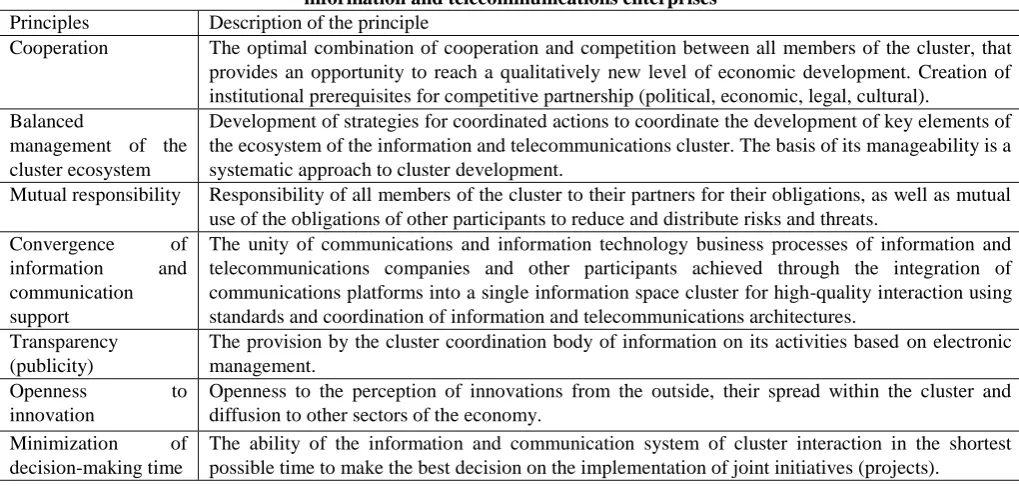
Table 1. Basic principles of partnership in the formation and development of a system of cluster interaction of information and telecommunications enterprises
Principles Description of the principle
Cooperation The optimal combination of cooperation and competition between all members of the cluster, that provides an opportunity to reach a qualitatively new level of economic development. Creation of institutional prerequisites for competitive partnership (political, economic, legal, cultural).
Balanced
management of the cluster ecosystem
Development of strategies for coordinated actions to coordinate the development of key elements of the ecosystem of the information and telecommunications cluster. The basis of its manageability is a systematic approach to cluster development.
Mutual responsibility Responsibility of all members of the cluster to their partners for their obligations, as well as mutual use of the obligations of other participants to reduce and distribute risks and threats.
Convergence of information and communication support
The unity of communications and information technology business processes of information and telecommunications companies and other participants achieved through the integration of communications platforms into a single information space cluster for high-quality interaction using standards and coordination of information and telecommunications architectures.
Transparency (publicity)
The provision by the cluster coordination body of information on its activities based on electronic management.
Openness to
innovation
Openness to the perception of innovations from the outside, their spread within the cluster and diffusion to other sectors of the economy.
Minimization of decision-making time
The ability of the information and communication system of cluster interaction in the shortest possible time to make the best decision on the implementation of joint initiatives (projects).
This approach becomes an important aspect of the economy because competition itself does not create value and the combination of competition with cooperation becomes very useful. The most important advantages arising from compliance with the principle of cooperation together with competition in the cluster are as follows: access to innovation; price advantage, which is the result of saving transaction costs by coordinating activities in the implementation of joint projects (initiatives); economies of scale in the joint use of technology or market relations.
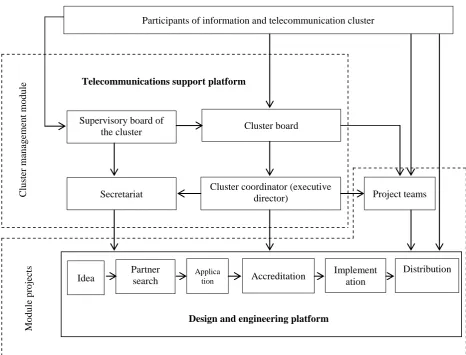
Fig. 1. The scheme of cluster members interaction in the process of preparing and implementing public projects. The practice has shown that the concept of proactive
management is to use models for predicting the development of an organization and its elements in conjunction with the analysis of the current situation and the development of solutions based on the most accurate forecasts of the organization's behavior. Moreover, the accuracy of forecasts depends on the accuracy of forecast models of the organization's behavior and its environment in interaction. In our opinion, the main elements of this concept can be applied to justify the processes of rapid response to cyclical changes in the development of cluster interaction of information and telecommunications enterprises, namely:
1) Economic and social processes can be reliably considered only in dynamics.
2) There is a synergistic effect due to the systemic nature and connectivity of the cluster key elements observed in the process of their interaction.
3) All joint business processes in the cluster are cyclical, that is, resources that are invested and used at the beginning of the cycle, as a rule, are compensated by multiplication at the end.
4) The nature of the processes of cluster interaction allows using the basic principles of simulation to control the processes of their progress according to the criterion of time minimization.
At the same time, rapid response to cyclical changes and selection of optimal solutions are the leading characteristic of the development process of enterprises in the cluster and will be taken into account in the formation of the strategy for the
development of the information and telecommunications cluster. Therefore, the model of cluster interaction based on the public-private partnership can be successfully implemented in all sectors of the economy and the spheres of public life.
It is possible to introduce one of three institutional models of partnership in the process of forming cluster interaction between enterprises using international experience in the Russian Federation: centralized, when a single separate coordinating body is created (Canadian experience); decentralized, when each ministry or local government deals with cluster initiatives based on local information and telecommunications enterprises (experience of France and Portugal); mixed, when the central coordinating body is developing partnership policies and departments of individual ministries are developing and implementing cluster projects (experience of Great Britain, Italy and the Netherlands).
IV. DISCUSSION
The reliability of the presented approaches is confirmed by the fact that compliance with the basic principles of partnership is a prerequisite for the formation of integrated system development models in the information and telecommunications cluster.
Participants of information and telecommunication cluster
C
lu
ster
m
an
ag
em
en
t m
o
d
u
le Telecommunications support platform
Supervisory board of
the cluster Cluster board
Secretariat Cluster coordinator (executive director) Project teams
Mo
d
u
le
p
ro
jects
Design and engineering platform Partner
search
Therefore, it is necessary to form a single information space to structure and develop the processes of interaction between the participants in the information and telecommunications cluster [10-12].
At the same time, the structural-functional model of building an integrated system of information and communication support for the interaction of participants shows the directions and ways of virtualizing communications on the five platforms that have been identified. Functional elements of interactions include the following: a training platform; a communication platform for professionals; a platform for mass informal communications; a design and engineering platform; an information and communications support platform.
It can be argued that the information and communication infrastructure of the cluster, with which the organization of the communication process will take place, plays a decisive role in the development of cluster interaction, considering the process of building an integrated enterprise communications system in an information and telecommunications cluster based on a five-element spiral model. In the model, it is possible to distinguish existing methods of communication in the cluster, in particular, virtual universities, mass online professional communities, webinars, blogs, etc.
However, the available communication methods are not sufficient. It is possible to expand communication methods and implement them in virtual space using the web portal of an information and telecommunications cluster to more effectively use the communication potential of the cluster members, namely: web conferences, information and telecommunications forums, web fairs (auctions), laboratories for joint creation of innovations in the private and public sectors, integrated groups for the implementation of joint innovative projects and foresight groups for strategic management of the information and telecommunications cluster.
It is possible to implement a design and engineering platform on the web portal of a cluster for information and communication support of integrated project teams interaction. Therefore, monitoring the processes of cluster interaction and balanced access to a single information space will be one of the tasks of the cluster coordinator. However, their purpose is not so much to maintain the equilibrium and structure of the cluster as such but to ensure the efficient use of the potential of cluster interaction for the implementation of joint projects.
V. CONCLUSION
Summing up, it can be noted that the study of the European experience in the development of clusters allows identifying the main participants in the communication processes that significantly accelerate interaction with the use of an integrated communication system. The key participants in communication platforms can be information and telecommunications enterprises, professional communities, local authorities and government institutions that regulate the activities of cluster members, educational institutions and research institutes, technology transfer centers, business incubators, investors and cluster coordination councils.
All these organizations will have equal access to platforms,
which corresponds to the basic principles of partnership, especially the principle of transparency and openness to innovations based on mutual trust. At the same time, the structural-functional model of building an integrated system of information and communication support for the interaction of participants shows the directions and ways of virtualizing communications on the platforms that have been identified.
REFERENCES
1. Yu.V. Vertakova, E.D. Leontev, V.A. Plotnikov, “Razvitie tekhnicheskoi infrastruktury obespecheniya klasternogo razvitiya ekonomiki” [The development of the technical infrastructure for ensuring the cluster development of the economy], Izvestiya Tulskogo gosudarstvennogo universiteta. Ekonomicheskie i yuridicheskie nauki
[Bulletin of Tula State University. Economic and legal sciences], 5(1), 2014, pp. 322-331.
2. V.A. Volkov, E.N. Ponomarenko, E. Ruzhitskii, M.I. Bocharov, “Modelirovanie epidemicheskikh protsessov v korporativnoi informatsionno-telekommunikatsionnoi seti s odnorodnymi klasterami” [Modeling of epidemic processes in a corporate information and telecommunications network with homogeneous clusters], Informatsiya i bezopasnost [Information, and Security], 20(3), 2017, pp. 314-321. 3. E.L. Loginov, V.E. Loginova, A.A. Shkuta, "Dizain myshleniya"
elementov iskusstvennogo intellekta dlya preodoleniya barerov polucheniya novogo znaniya v elektronnoi srede kollaboratsionnoi nauchnoi supersistemy ["Design of thinking" of elements of artificial intelligence to overcome barriers for obtaining new knowledge in the electronic environment of collaborative scientific super-system].
Iskusstvennye obshchestva [Artificial Societies], 13(3), 2018, pp. 5. 4. O.V. Mazorenko, “Podkhod k otsenke urovnya informatsionnogo
obespecheniya funktsionirovaniya i razvitiya predpriyatiya” [An approach to assess the level of information support for the functioning and development of an enterprise]. Uchet i statistika [Accounting and Statistics], 1(29), 2013, pp. 113-120.
5. P.A. Matveev, “Pravovye kontseptsii doli v ustavnom kapitale obshchestva s ogranichennoi otvetstvennostyu” [Legal concepts of a share in the authorized capital of a limited liability company].
Grazhdanskoe pravo [Civil Law], 1, 2018, pp. 18-21.
6. N.A. Stefanova, “Ponyatie i obshchie printsipy formirovaniya klasterov tsifrovoi ekonomiki v Rossii” [The concept and general principles of the formation of clusters of the digital economy in Russia]. Azimut nauchnykh issledovanii: ekonomika i upravlenie [Azimuth of scientific research: economics and management], 7(1(22)), 2018, pp. 237-241. 7. E.V. Agamirova, E.V. Agamirova, O.Ye. Lebedeva, K.A. Lebedev, S.V.
Ilkevich, “Methodology of estimation of quality of tourist product”,
Quality - Access to Success, 18(157), 2017, pp. 82-84.
8. N.I. Demkina, P.A. Kostikov, K.A. Lebedev, “Formation of professional competence of future specialists in the field of information environment”, Espacios, 40(23), 2019, pp. 3.
9. O.V. Markova, N.A. Zavalko, V.O. Kozhina, O.V. Panina, O.Ye. Lebedeva, “Enhancing the quality of risk management in a company”,
Espacios, 39(48), 2018, pp. 26.
10. O.A. Blokhina, O.N. Beketova, E.E. Kuzmina, O.Ye. Lebedeva, M.I. Podzorova, “Improving the technology of innovation systems management at an enterprise”, International Journal of Civil Engineering and Technology, 9(13), 2018, pp. 137-143.
11. K.A. Lebedev, O.S. Reznikova, S.D. Dimitrieva, E.I. Ametova, “Methodological approaches to assessing the efficiency of personnel management in companies”, Journal of Advanced Research in Law and Economics, 9(4), 2018, pp. 1331-1336.