International Journal of Innovative Technology and Exploring Engineering (IJITEE) ISSN: 2278-3075, Volume-8 Issue-5S March, 2019
Abstract: Nowadays, technology simplifies the learning process and assists in the communication between learners, lecturers, and administrators of universities and other educational organisations. At present, most of the universities in Somalia still use the face-to-face teaching approach and lecturers do not have an electronic repository for the learning materials. This demonstrates that an e-Learning model that is able to fulfil the users’ requirements is lacking. This shortcoming is addressed in this study by developing a requirements model for an e-Learning Management System (eLMS) to improve the quality of the learning process. To achieve this objective, a design research methodology was adopted. During the modelling process, the Web Application Extension (WAE) for the Unified Modeling Language (UML) model was used to design the requirements model for the proposed eLMS. The significance of this model is that it facilitates the interaction between students, lecturers, and administrators, thus enhancing the learning process at the university. In addition, the proposed model will be a useful reference for other researchers working in a similar domain, or for developers who are interested in developing similar models. Additionally, the expected output of this research is the eLMS system that will enable students, lecturers, and administrators to communicate with each other.
Keywords: e-Learning Management System (eLMS); Requirement Engineering; Unified Modeling Language(UML); Web Application Extension(WAE); Learning Management System(LMS)
I. INTRODUCTION
The internet has provided the means for fast communication and access to information and services. Both synchronous and asynchronous interactions between learners and teachers can be used in designing distance learning [1]. The internet has become one of the most significant ways to deliver learning materials to students in order to contribute and gain information [2]. Todays’ students are digital natives, as they have grown up utilising advanced technologies like laptops, mobiles, and the internet [3].
E-Learning is a relatively new learning mode that is fully dependent on the internet. It is an ICT that is based on applications for learning purposes. It assists in eliminating the distance between learners and universities. Saving time is another e-Learning objective, due to which it has become popular in the current education scenario [4].
Revised Manuscript Received on March 08, 2019.
Mazni Omar, School of Computing, Universiti Utara Malaysia, 06010 UUM Sintok, Kedah, Malaysia,
Abdulkadir Osman Mohamed, School of Computing, Universiti Utara Malaysia, 06010 UUM Sintok, Kedah, Malaysia,
According to [5], e-Learning is particularly useful for people who are already working and have the desire to continue learning, since they can use e-Learning to attend classes whenever they want from any location. E-Learning is a synonym for distance education. This term has been extensively used to describe distance education products and processes where learning relies on different technologies that allow communication between the teacher and the learner irrespective of their location [6].
At present, educational institutions in Somalia are still using the traditional ways of managing all learning activities. The current learning system is based on lecture-centred interactions between learners and lecturers, both inside and outside the classroom. Hence, technology still does not feature in the learning process, indicating the need for better alternatives that would improve the learning environment. The cost associated with face-to-face faculty education is higher than that incurred by e-Learning. Moreover, the financial benefits of e-Learning are higher than its costs [7]. Thus, the main goal of this research is to overcome the problems faced by Mogadishu University in order to improve its learning environment. This is achieved by proposing a requirements model of an e-Learning Management System (eLMS) for Mogadishu University that would improve the quality of the learning process, as well as facilitate communication among the university stakeholders.
II. RELATED WORKS
Requirement Model for e-Learning
Requirement identification is considered as an essential activity in any system development process. Software success or failure depends on how the requirements are collected and interpreted. Thus, requirements modelling has an essential role in the Requirement Engineering (RE) process [8]. It provides a structured explanation of the requirements that can be used throughout the requirement process and other system development processes. It is also the most important communication language among participants with dissimilar backgrounds [9]. Modelling notation delivers an abstract level of requirement description, which is achieved by using terminologies and structural rules for problem components. Modelling assists in analysing and classifying detailed requirements [10].
Requirements models are characterised as an information technology used to capture, interconnect, track, analyse, verify, validate, view, and manage hierarchical and interrelated system requirements [11].
A Requirements Modeling for E-Learning
Management System (eLMS)
Chumpia [12] proposed the development of a requirements model for social network learning sites, particularly forums and chat rooms, for Hatyia Technical College. The author used UML diagrams to represent the requirements model. However, [12] did not study the significant requirements for educational purposes. On the other hand, [13] proposed a requirements model used to store and retrieve IOS documents for the teaching and learning process. While he used UML diagrams to model
the requirements, [13] focused on management
requirements, rather than capturing other significant requirements and tools that can improve e-Learning performance. More recently, [14] proposed a generic requirements model for eLMS. During the requirement collection process, the story card technique was used. The collected requirements for this study were presented using UML diagrams, which were based on the use case and class diagrams. Moreover, [14] focused on communication channels, such as announcements and forums.
According to [15], The King Saud University’s e-Learning Management System offers most functionalities needed by the university to provide courses. It manages them via the internet—including the management of admissions and registration—and provides virtual class tools. However, some important e-Learning management activities and aspects are not available. Furthermore, [15] stated that there is no material sharing activity on the existing system that would allow lecturers to share materials with students. Another weakness of the existing system is that there is no forum for students to discuss various topics of interest with each other.
A number of universities in African countries, especially in Rwanda, still lack IT support systems for teaching and learning activities. Moreover, the e-Learning systems that have been implemented several years ago in other higher education systems are not available to the students and faculty [16]. In addition, the systems that are available are not functional and have failed to meet users’ expectations [16].
To overcome these barriers to learning, in this study, an eLMS that can overcome the challenges encountered in face-to-face learning is proposed, as recommended by Simad University [17]. However, the limitations of e-Learning environments are not the focus of this study. For instance, important functions, such as searching, sending messages to interact with lecturers and students, and posting announcement and notification functions are not addressed in this work. Furthermore, as the system administrator functions are not fully working, the prototype was designed using UML diagrams and the prototype evaluation was not based on stakeholders' acceptance.
While the studies reviewed in the preceding sections have revealed some significant requirements, their authors did not highlight the important functional requirements that are useful for educational processes, such as searching, sending message notifications and event calendars, and open source designing tools like Web Application Extension (WAE). According to [18], since the proposed prototype is a web application which is more complex compared to the
provide the web-specific constructs for modelling the web information. Thus, in order to design the prototype, the StarUML software was used, which can be employed to draw the essential UML diagrams that help in developing system components. Additionally, it provides support in designing web applications, as it includes modules for the implementation of notation extensions, which allow diagram representation for WAE.
e-Learning
E-Learning enables the educational institutions to share information with the entire student body via electronic communication channels. It is also simple to use, as users can retrieve records and create reports without much effort [19]. E-Learning is a tool that helps students and lecturers interact while learning [20][21]. In general, it is a web-based system that offers access to the learning environment [22] and supports virtual learning [23].
The National Centre for e-Learning and Distance Learning (NCEL) has created its own learning management system in partnership with a meteor group of companies in Malaysia named Jusus LMS [24]. Jusur LMS was created according to universal standards and has the following 17 tools: the course description tool, survey manager tool, announcements tool, learning content management system tool, courseware controls tool, glossary tool, forum tool, file sharing tool, assignments tool, tests and assessment tool, virtual classroom tool, lecturer information tool, user administration tool, tracking forum participation tool, general chat tool, questions bank tool, and grad book tool [25].
International Journal of Innovative Technology and Exploring Engineering (IJITEE) ISSN: 2278-3075, Volume-8 Issue-5S March, 2019
The national ICT policy for Kenya, which lays the framework for e-Learning, is considered crucial to its development and utilization [28] [29]. Similarly, according to Kenya's Ministry of Education Policy Framework for Education and Training [30], ICT is identified as a major vehicle for teaching and learning. One of the strategies that can be adopted to achieve this aim is the establishment of an Open University of Kenya and expand ODL and e-Learning in the existing universities by leveraging on ICT in order to take advantage of the ICT infrastructure within the country. However, developing countries like Kenya still face many challenges, as implementing e-Learning requires an advanced level of technological infrastructure and heavy investment in resources, especially at the initial stages. According to [31], poverty is one of the most important barriers to technological innovation, due to which, ICT is relatively more expensive in Africa than in developed countries. Ssekakubo[32] pointed out that the majority of e-Learning initiatives implemented in Sub-Saharan Africa (SSA) tend to fail partially or completely due to various barriers to e-Learning.
III. METHODOLOGY
The present study was conducted in three main phases, namely (1) identification of eLMS requirements, (2) development of the eLMS requirements model based on the identified requirements, and (3) verification of the requirements model using horizontal prototype. The eLMS requirements were gathered through interviews. In this study, interviews were conducted with lecturers, administration, and learners of Mogadishu University to gather the appropriate information on the model functionalities and users’ needs. The 20 participants (5 lectures, 10 students, and 5 admin) were interviewed using
social media like Skype and Viber. The obtained list of requirements provided a better idea of the existing leaning process at the Mogadishu University.
These requirements were utilised when designing the requirements model for eLMS for Mogadishu University. First, the proposed model was developed to explain the feasibility of such eLMS. The designing process aimed to give more details about the design of the model to provide lecturers, admin, and students of Mogadishu University with the beneficial information, which depends on the requirement processes and the components of the software, such as the application platform and database. WAE-UML was used to create and build a case diagram, a storyboard sequence, and a navigational map. In order to verify the proposed requirements model, a horizontal prototype was constructed to ensure the interface and process flow are correctly mapped by the model.
IV. RESULTS AND DISCUSSION
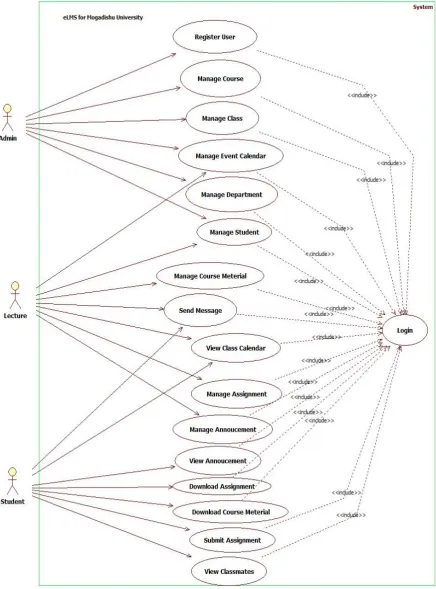
Fig. 1 Use Case Diagram for eLMS
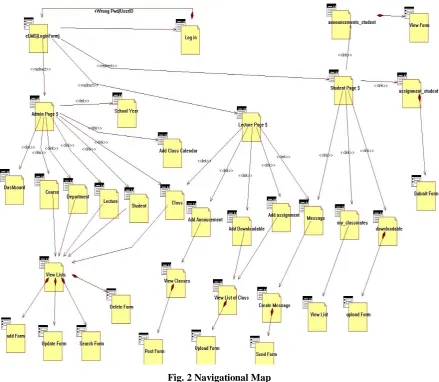
The navigational map is a view of the e-Learning system, which displays how users will navigate the framework. It can be represented as a hierarchical tree diagram [33].Nor [18] stated that the navigational path map conveys the structure of a system’s screens with their possible navigational pathways.
International Journal of Innovative Technology and Exploring Engineering (IJITEE) ISSN: 2278-3075, Volume-8 Issue-5S March, 2019
[image:5.595.96.498.458.681.2]Fig. 2 Navigational Map
Figure 3−7 provide examples of the screenshots of the prototype system to verify the proposed requirement model.
Fig. 3 Main Interface
Figure 3 illustrates the main home page of the eLMS for Mogadishu University. This is where the lecturers and
Fig. 4 Admin Main Page
Figure 4 illustrates the main administrator page after a successful login. The page gives the user an access link to courses, classes, admin users, departments, students,
[image:6.595.118.481.301.474.2]lectures, school year and calendar of events, as well as the link to sign out after the admin finished the tasks.
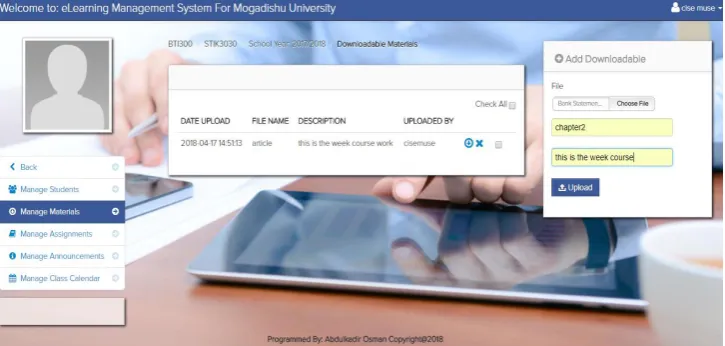
Fig. 5 Manage Course Material
Figure 5 shows to lecture page used to upload materials relevant to a particular class. After the lecturer provides the file information (file name and description), the page gives
[image:6.595.115.488.546.720.2]the lecturer an access link to manage course materials, assignments, announcements, and the class calendar, along with the link for signing out after finishing the tasks.
International Journal of Innovative Technology and Exploring Engineering (IJITEE) ISSN: 2278-3075, Volume-8 Issue-5S March, 2019
Figure 6 illustrates to lecture page used to post assignments for a particular class. The lecturer first chooses the relevant class and then writes the file name and the
[image:7.595.101.498.99.288.2]description. As soon as this is finished, he/she can click the “Upload” button. In addition, the lecturer can download, remove, and view students who submitted the assignment.
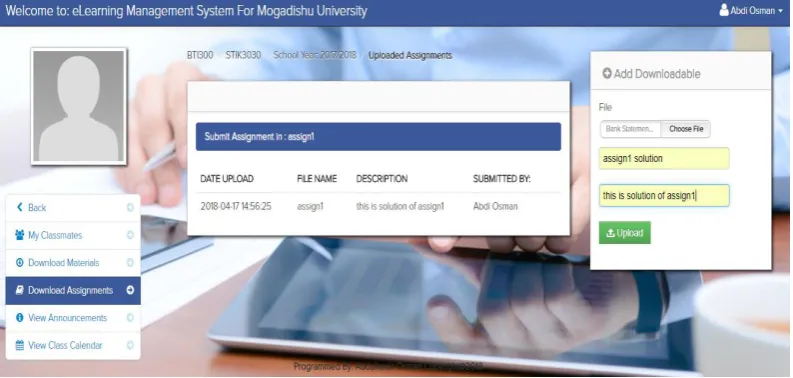
Fig. 7 Submit Assignment
Figure 7 illustrates the student page used to download and submit assignments. The student fills the file name and description, and chooses the assignment file to be upload. The student can also view the list of files he/she has uploaded to the system.
V. CONCLUSION
In this study, a requirements model for eLMS was proposed, primarily focusing on interactions and communication between admin, lecturers, and students. Although the requirements model for eLMS has been successfully implemented, there is still room for improvements. At present, the prototype does not have fully functional requirements for enhancing the learning environment, like a quiz function, and notes repository that allows the students and lecturers to upload any document types, such as video and audio files. In addition, the model can also be improved by having a “manage exam” function. The model also needs to be fully tested by the stakeholders to ensure that their requirements are met. It is hoped that this eLMS requirements model can guide the development of a comprehensive eLMS for a university.
REFERENCES
1. M. Ajmal, "Implementation of Quality Assurance and Accreditation Policy in Open Distance Learning Teacher Education Programs in Pakistan," Journal of Contemporary Teacher Education, vol. 1, pp. 67-78, 2017.
2. H. Richard, and A. Haya, A, "Examining student decision to adopt web 2.0 technologies: theory and empirical tests," Journal of computing in higher education, vol., pp. 183-198, 2009.
3. M. Prensky, "Digital natives, digital immigrants," On the horizon (NCB University Press), vol. 9, pp. 1-6, 2001.
4. S. Banerjee and S. Karforma, "Object oriented modeling for authentication of certificate in e-learning using digital watermarking," International Journal of Advanced Research in Computer Science, vol. 8, pp. 54-57, 2017.
5. E. Syrtsova, O. Tokmakova, I. Merkulova, and O. Sinitsyna, "E-Learning System Development in Accordance with the Requirements of EFQUEL: Vyatka State University Experience," International Journal for Quality Research, vol. 11, pp. 379-396, 2017.
6. C. Goumopoulos, P. Nicopolitidis, D. Gavalas, and A. Kameas, "A distance learning curriculum on pervasive computing," International Journal of Continuing Engineering Education and Life Long Learning, vol. 27, pp. 122-146, 2017.
7. S.K. Pande, "Enhancing Learning Opportunities Through Development of Open and Distance Education in Africa,“ Optimizing Open and Distance Learning in Higher Education Institutions, vol. 71, 2017. 8. A. Almohammad, J. F. Ferreira, A. Mendes, and P. White,
"Hierarchical Requirements Modeling and Test Generation for Industrial Control Systems," in 4th International Workshop on Requirements Engineering and Testing (RET17), Lisbon, Portugal, 2017, pp. 351-358.
9. A. Vegendla, A. N. Duc, S. Gao, and G. Sindre, "A Systematic Mapping Study on Requirements Engineering in Software Ecosystems," Journal of Information Technology Research (JITR), vol. 11, pp. 49-69, 2018.
10. S. D. Axinte, G. Petrica, and I.-D. Barbu, "E-learning platform development model," in 2017 10th International Symposium on Advanced Topics in Electrical Engineering (ATEE), Bucharest, Romania 2017, pp. 687-692.
11. D. Barker, "Requirements modeling technology: A vision for better, faster, and cheaper systems," in VHDL International Users Forum Fall Workshop, Orlando, Florida, 2000, pp. 3-6.
12. S. Chumpia, "Requirement Model for Hatyai Technical College Social Network Learning Site," Masters thesis, College of Arts and Sciences, Universiti Utara Malaysia, Malaysia, 2011.
13. J. Badriyah, "Requirement Model for Storing and Retrieving ISO Document: Teaching and Learning Process," Master thesis, Faculty of Information Technology, Universiti Utara Malaysia, Malaysia, 2004. 14. Rizal, "A Generic Requirement Model for E-Learning Management
System," Masters thesis, College of Arts and Sciences, Universiti Utara Malaysia, Malaysia, 2010.
15. A. Aljumaah, "Modeling students acceptance of E-learning: A case of the KS university," in 2010 Fifth International Conference on Digital Information Management (ICDIM), Ontario, Canada, 2010, pp. 460-464.
16. J. Rubagiza, E. Were, and R. Sutherland, "Introducing ICT into schools in Rwanda: Educational challenges and opportunities," International Journal of Educational Development, vol. 31, pp. 37-43, 2011. 17. A. A. Abdisamed, "E-Learning Management System for Simad
18.N. M. Nor, "A requirements model for employees training management system: applying WAE-UML," in International Conference on Information Management and Engineering 2009 (ICIME'09), Kuala Lumpur, Malaysia, 2009, pp. 569-573.
19.M. Brumbulli, B. Topçiu, and A. Dalaçi, "SMIS: A Web-Based school management information system," in International Scientific Conference Computer Science, Kavala, Greece, 2008, pp. 564-569. 20.G. O. Ouma, F. M. Awuor, and B. Kyambo, "E-Learning Readiness in
Public Secondary Schools in Kenya," European Journal of Open, Distance and E-learning, vol. 16, pp. 97-110, 2013.
21.D. Xanthidis, S. W. Wali, and P. Nikolaidis, "E-Learning in Saudi Universities, Challenges and Issues," in 2013 Fourth International Conference on e-Learning" Best Practices in Management, Design and Development of e-Courses: Standards of Excellence and Creativity", Manama, Bahrain, 2013, pp. 473-478.
22.W. Titthasiri, "A Comparison of E-Learning and Traditional Learning: Experimental Approach," in International Conference on Mobile Learning, E-Society and E-LearningTechnology (ICMLEET), Singapore, 2013, pp. 67-74.
23.P. Behar, "Constructing pedagogical models for e-learning," International Journal of Advanced Corporate Learning (iJAC), vol. 4, pp. 16-22, 2011.
24.H. S. Al-Khalifa, "A first step in evaluating the usability of Jusur learning management system," presented at the 3rd Annual Forum on e-Learning Excellence in the Middle East 2010: Bringing Global Quality to a Local Context, Dubai, U.A.E., 2010.
25.National Centre for e-learning and Distance Learning: JUSUR LMS System", (2009, Dec. 05). [Online]. Accessed on: Nov. 3, 2017. Available:
http://www.elc.edu.sa/portal/index.php?mod=content&page=27 26.H. S. Al-Khalifa, "E-learning in Saudi Arabia," in E-Learning
Practices, Cases on Challenges Facing E-Learning and National Development: Institutional Studies and Practices vol. 1, U. Demiray, Ed., ed Eskisehir, Turkey Anadolu University, 2010, pp. 745-772. 27.O. I. Al-Salum, (2009, August. ). Deficiencies in the Jusur Learning
Management System, Information Technology. Accessed on Sept. 28, 2017. [Online]. Available: http://www.alriyadh.com/450962
28.G. Kariuki, "Growth and improvement of information communication technology in Kenya," International Journal of Education and Development using ICT, vol. 5, pp. 146-160, 2009.
29.M. Waema, "A brief history of the development of an ICT policy in Kenya," At the Crossroads: ICT policy making in East Africa, pp. 25-43, 2005.
30.Constitution of Kenya, "A Policy Framework for Education and Training: Reforming Education and Training in Kenya.," vol. 35, The Ministry of Education Science and Technology, Ed., ed, 2012, pp. 1 -7. 31.J. Zake. (2009, April. ). Challenges to e-learning in developing
communities of Africa. Accessed on Aug. 28, 2014. [Online]. Available: http://ernwaca.org/panaf/spip.php?article676
32.G. Ssekakubo, H. Suleman, and G. Marsden, "Issues of adoption: have e-learning management systems fulfilled their potential in developing countries?," in Proceedings of the South African Institute of Computer Scientists and Information Technologists conference on knowledge, innovation and leadership in a diverse, multidisciplinary environment, Cap Town, South Africa, 2011, pp. 231-238.