THESES, SIS/LIBRARY R.G. MENZIES BUILDING N0.2 Australian National University Canberra ACT 0200 Australia
USE OF THESES
This copy is supplied for purposes of private study and research only. Passages from the thesis may not be copied or closely paraphrased without the
written consent of the author.
THE AUSTRALIAN NATIONAL UNIVERSITY
Telephone: -+B1 2 6125 4631 Facsimile: -+B1 2 6125 4063
A thesis submitted for the degree of
Doctor of Philosophy
of The Australian National University.
The
David B. Pyne PhD Candidate
to
15 September 1994.
ll
IS
or organisations:
on a 8.
on a
lS
respectively.
to
assess
on
as
11
as a
are followed by experiments
the same group of subjects
some
or on
AvvHUAH'-'OCU stress
to
The following
stress
As
Physiology
Kaylene Hood, Mr
subjects, especially the ACTAFL umpires and the swunmers,
Campbell,
Cole,
endured
exhaustive exercise bouts and numerous invasive tests throughout the various
experiments.
Dr Louise Burke for her personal support and the setting of an exceptional work
ethic and academic standard.
v
1
Telford,R. .
an intensive
swimmers on neutrophil oxidative Proceedings
The effects of an
swimmers on oxidative
as
or
Press. Boca 31-50.
Gray,A.B.
of Figures List of Tables Abbreviations
Chapter
V I
to
Exercise-Induced Activation of Neutrophils Rate and Neutrophil Oxidative Study
Exercise-induced Downregulation of the Conclusions References l ll v x 1 4 7 9 11
14
1 61 76 8283
85
Review - Exercise-induced muscle damage and inflammation. 9 5
Summary 96
Introduction 97
Mechanical stress 99
Metabolic stress l 01
The nature of exercise-induced damage to muscle 102
Exercise-induced oxidative damage 105
Measurement of free radical generation 110
Delayed Onset Muscle Soreness 112
Cytokines - immunomediators of inflammation and tissue damage 114 Neutrophil regulation of the immunological and inflammatory
events after exercise : a theoretical model 118
Methods Discussion References
Eccentric exercise induces ... ''"'"'' cytokines trained athletes.
Summary Introduction Methods Results Discussion References
damage but not
References
Summary Introduction Methods Results
References
39
265
270 272
285
30
314 L Abstract Med. Sci. Sports. Exerc 25:Sl02, 1993. 3
2. Abstract ASMF Conference, 1993. 3
3. Abstract ASMF Conference, 1994 316
to
mechanical stress on
stress
significant
and soreness.
mcrease
x
systemic
_ ... ,..., (metabolic
of
to on
~ .. ,, .... ,..., was associated was
uu0•-.nv damage
a significant
of lymphocytes,
cortisol (p<0.05) after only growth
hormone increased (p<0.05) after level and downhill running. There were no
significant changes in the plasma concentration of the inflammatory mediators
interleukin-lb and complement component C3a, nor in the acute phase protein
C-reactive protein, after strenuous or eccentrically-biased running. This suggests that
trained runners may sustain moderate and transient elevations markers of tissue
no
was
chemiluminescent '"'"'""c'"J
(ie.
neutrophil
a a
se
mechanical stress on
spectrophotometric
Chemiluminescence decreased after
after
Analysis of an intensive 16-week training cycle by elite swimmers showed reactive oxygen formation by neutrophils was lower (p<0.05) across the 16 week
period compared with that observed in cells from sedentary individuals, and declined
significantly during strenuous training prior to competition. There was no difference
the self-reported upper respiratory tract infection rate between the swimmers and
stresses of exercise and
can
necessarily
statement on
non~
an
to
before
Ll 1 3.1 3 3 3 l 4.2
120 4.3
150 5.1
the to
sequence of events the of
to
of oxygen-and
exerc1se-induced activation neutrophils that act to damage v v • . n a • u membranes
components including lipids, proteins and nucleic acids.
Theoretical model of immunological and inflammatory responses to
exercise and muscle damage showing the central roles of cytokines and
neutrophils in the repair of damaged tissue.
Mean oxygen uptake averaged during the final four minutes of each of
eight by five minute intervals of near-level, uphill and downhill treadmill running. Significance of the difference between the first and
1 5
1
178 6.3
1 8
197 7 .1
201 7 .2
202 7.3
214 8.1
an regions.
minute bout of moderate
release temporal variability.
superoxide
two
experimental
Changes the plasma concentration of lymphocyte subsets uphill, downhill and near-level treadmill running.
a
Plasma adrenaline concentration before and after 40 min of near-level, uphill and downhill running.
Plasma cortisol concentration at various time points before and after 40 min of downhill, near-level and uphill running.
xv
8 to
8 to
1
and
238 9.3
to
260 Capacity response to
in-vitro stimulation of
261 10.6 Capacity of neutrophils to produce hydrogen peroxide response to in-vitro stimulation (PMA) before and after bouts of treadmill running.
262 10. 7 Plasma concentration of elastase before and after different bouts of treadmill running.
263 10.8 Expression of complement receptor C3bi by neutrophils before and after bouts of treadmill running.
lL 11 12.1 2.1 2 3.1 1 5.1 5 5.3
174 1
175 6.2
176 6.3
a reserve.
ranges and subsets.
Changes in the circulating concentration of leucocyte and granulocytes
with two 40 minutes bouts of moderate intensity treadmill runs.
Changes in neutrophil oxidative activity with two bouts of moderate
intensity treadmill running assessed by the fluorescent probe DHR
(flow cytometric) to OZ- and PMA-stimulation.
Changes in neutrophil oxidative activity during 40 minutes of moderate
intensity cycling assessed by the fluorescent probe DHR (flow
7.1
2 8.1
235
1 The effectcomponent (C3a).
11.1
1 11
1
11
summer
288 1
running) and mechanical stress (downhill
297 12.2 Summary of changes indicators of neutrophil oxidative activity with
B
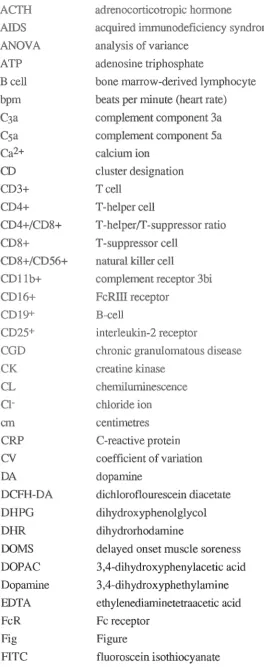
beats per
CD3+ Teen
cm
C-reactive protein coefficient of
DA dopamine
DCFH-DA dichloroflourescein diacetate
DHPG dihydroxyphenolglycol
DHR dihydrorhodamine
DOMS delayed onset muscle soreness
DOPAC 3,4-dihydroxyphenylacetic acid
Dopamine 3,4-dihydroxyphethylamine
EDTA ethylenediaminetetraacetic acid
FcR Fe receptor
Fig Figure
[image:19.596.145.409.99.766.2]SG GTP h HBSS IFNg 1 IgG MDA mmHg MPO NA NADH NADPH NADPH oxidase
NK
NO water Hank's 1 constant. . . ~VL~,_, . . . ,..~ activating
malondialdehyde minute
millilitres per kilogram per minute millimetres of mercury (pressure) myeloperoxidase
noradrenaline
nicotinamide adenine dinucleotide (reduced)
nicotinamide adenine dinucleotide phosphate (reduced) enzyme complex located on plasma membrane of neutrophil that produces reactive oxygen species natural killer cell
PAF PE PGE2 PKC PMA
POMC
max
xx
kinase C
phorbol myristate acetate u•RJuu"•'-'= leucocyte
1
IS
or competition.
scientist are ""'~~'""'""" on
cellular and humoral ~~·~r,..:;-_;::-.~ .. w
statements
nature
terms
the literature is
UH\.,C\/.:> lS
to
and
""""'~~"''"'"' ... ~.~~·~~ changes
to establish whether
on whether exercise
(1 1
to
One of key concepts of issue is so-called paradox between exercise
intensity and immune cell function. Moderate-intensity exercise is thought to be
largely immunopotentiating or beneficial to immune cell function (Nieman, 1993).
Many recreational athletes and fitness enthusiasts claim that regular participation in
this form of physical activity improves immunity, with an associated reduction in the
frequency and severity of upper respiratory tract infections. This position is
supported in laboratory studies that have examined the effects of moderate exercise
Nehlsen-A
premise
to
et 1).
suggest that it
experimentally.
2
on
individuals
be difficult to test their reliability and validity
Much of the previous work in the field of exercise immunology has adopted the
experimental approach outlined in Fig 1.1. Studies have examined, variously, the
physical and/or psychological stresses of exercise and training, the effects of these
stresses on the distribution and function of cellular and humoral components of the
3
Ll areas
~
to
can be considered to
(innate) of the .::nucuci'""
defence as
or
neutrophil, a key non-specific immune cell, is important for several reasons: (a)
it is the most abundant immune cell in the circulation; (b) it is mobilised rapidly to form the so-called "first-line-of-defence" against microbial attack; (c) it plays a
crucial effector role as a "professional" phagocyte in non-specific host defence by
expressing potent bactericidal and viricidal activity; (d) its functional deficiency can
lead to recurrent and life-threatening infections. More recently the ability of the
neutrophil to synthesize cytokines, the immunomodulatory proteins that regulate a
(Morel et
bone marow
a
sequence is
is a
are
there
cells
5
to
What are the effects of exercise and training on the
been
stem
variable
to
marginated cells are
a
(number)
functional state (function) of the neutrophil population? It is important to distinguish
between these two possibilities, as neutrophils may respond to exercise in different,
even opposite, directions (eg. an exercise-induced increase in the number of
neutrophils in the circulation may be accompanied by a decrease in functional
activity individual cell). The overall effect of these responses may be beneficial,
neutral or detrimental to immunocompetence. Acute bouts of exercise generally
6
exercise is
acute
over
m
to two separate
to an U A A H n A U • o U V
generally report an the neutrophil, increased expression to
receptors on the plasma membrane; initiation of phagocytosis; release of proteolytic
enzymes (degranulation); translocation of cytoplasmic proteins to plasma
membrane; and evidence of the formation of toxic reactive oxygen and nitrogen
species - the so-called respiratory burst may have been initiated in vivo - (Hack et aL
1992; Gray et al. 1993). In terms of the so-called "paradox" between exercise
intensity and immune cell function, only one preliminary report (Dziedzak, 1990)
has examined this relationship directly by measuring neutrophil oxidative activity in
targets
function or
tract
is to
an PV1"\PT"1
to
.. ,,. •. ,,. .. ,""'""' to as
to enter the VH'V~AMU'VAAo
(sigA) "'vu.vvu
after exercise
(Mackinnon et
AAA . . . L~A> the
1 by phagocytosis.
lS
1993)
a
sigA-opsonized
acute
not been examined.
on
""'""'',. nature of the changes
occur after a single episode of exercise, it is possible that the cumulative effects
repeated episodes are responsible for eliciting more permanent changes in immune
cell function. Information on whether significant fluctuations neutrophil number
and function are associated with alterations in the frequency of infections of the
upper respiratory tract, may help to establish whether the observed changes
represent normal fluctuations in immunity, or whether they are the expression of a
8
at a our
,~v=~·.,.n,~~ between exercise and endocrine
relatively and immune cell function observed after single
episodes of exercise could simply to temporal (circardian rhythms) or
experimental variability. Few studies have employed a parallel non-exercising
control group to differentiate between the effects of exercise per se and those of
normal temporal variation evident in immune responses. In his review, Cannon
(1993) has suggested that future studies should include appropriately matched
control groups to account for these temporal (circadian and seasonal) differences.
9
1. assess
to measure
2. effects
of exercise.
To assess lS a between of
3.
on
5. To examine relationship between exercise-induced mobilisation and
activation of neutrophils with systemic markers of and the
acute phase response in trained individuals.
6. To determine the differential effects of metabolic and mechanical stress of
exercise on the ability of neutrophils to respond to stimulation in vitro at the
season
11
1 to
L
(1
1
Gray,A.B. Telford,R.D. Collins,M. Baker,M.S. and Weidemann,M.J. (1993).
Granulocyte activation induced by intense interval running. Journal of
Leukocyte Biology 53: 591-597.
Hack,V. Strobel,G. Rau,J.P. Weicker,W. (1992). The effect of maximal
exercise on the activity of neutrophil granulocytes in highly trained athletes in
a moderate training period. European Journal of Applied Physiology 65:
(1
19
B
N ehlsen-Cannarella, S
Yang,H. Chritton,D.B.W. Lee,J.W. and Arabatzis,
elite
Balk-Lamberton,A.J. (1990a). The effects of moderate exercise training on natural killer cells and acute upper respiratory tract infections. International Journal of Sports Medicine 11: 467-473.
Nieman,D.C. Johanssen,L.M. and Lee,J.W. (1990b). Infectious episodes m
runners before and after the Los Angeles Marathon. Journal of Sports Medicine and Physical Fitness 30: 316-328.
(
Sports
Challenge to
of System
Illness Infection
Specific Acute Effects of Different Types of Exercise (i) Acute Moderate Aerobic Exercise
lS on
Nehlsen-Cannarella, l
1· , et et
review proposes a events
leucocytosis exercise, the between exercise
presents
two
defence.
monocytes
acute phase proteins, complement, lysozyme. These components,
which do not require prior contact with an infectious agent to be invoked, are capable
of acting alone or combination with the antigen-specific defences.
The specific system, which includes the and B-lymphocytes and the soluble
immunoglobulins, uses immunological memory to produce specific antibodies or
cytotoxic cells directed against infectious agents. In contrast to the non-specific
system, the specific defence mechanisms are activated after an initial exposure to
18
cause
variety
severe
~·~·U~H to ..,,,,, ... .,JL..:>Vo
or external means. Acute 0"•-~~·•A
common
tetanus
on
uu·~~···~u to . . ~•.uu.uw are
body contact sports, to superficial tissues internal
organs. The typical over-use syndrome manifest in injuries such as "swimmer's
shoulder" or "jumper's knee" may result damage to skeletal muscle tissue,
bone, tendons, ligaments and cartilage.
Psychological Modification of the Immune System.
One of the difficulties of interpreting the results of research into the effects of exercise
and training on the immune system is to distinguish between physical and
stress It a
or
stress
stress was associated,
an increased "n'r"'r,n.ru tract
to
It is
two [Ebbeling (1989) (
et al. (1991)] as events stimulate then mediate
exercise-induced damage to muscle tissue. Although originally proposed to describe the
sequence of events in the pathology of tissue damage, they can also be applied, in
broad terms, to categorise events which influence exercise-induced activation of the
immune system. A suggested schema for the exercise-induced changes in the
High intensity exercise (Concentric mode)
flow Decreased
[image:41.596.120.482.99.643.2]activities)
of
same way
cause
21
absence of a pathogenic agent (Armstrong et
research effects
less been to the
effect) as a
et
over
1992). It is generally agreed
et
bruises)
see
the leucocytosis depends on the of the exercise Of
particular interest is the effect different types and intensities exercise on the
distribution of the key specific (mononuclear leucocytes) and non-specific
(polymorphonuclear leucocytes) immune cells (Table
There is normally an increase in the total number of circulating leucocytes after
exercise, with accompanying changes in the proportions of the main subpopulations
(lymphocytes, monocytes, granulocytes). The leucocytosis of exercise is initiated by
to
exercise. Exercise
phase)
in the plasma of
rate
et
is
marrow
opioid peptides may contribute to conflicting results (Mackinnon and Tomasi,
1988). The early lymphocytosis is related to the catecholamine-induced release of
lymphocytes from various storage sites and the walls of endothelial tissues (Crary et
al. 1983). The lymphopoenia which develops one hour after exercise is most likely
due to cortisol, which inhibits the further entry of lymphocytes into the circulation
and promotes the redistribution of the proportion already there to peripheral tissues.
Although the absolute number of cells in each of the lymphocyte subsets increases
to
The
to mitogenic
excess
are
et
have long-term on
Several studies have shown that exercise causes an increase the number of
circulating granulocytes (Edwards et al. 1984; Nieman et 1989; McCarthy et al.
1991; Fry et al. 1992; Gabriel et al. 1992). The granulocytosis (primarily
neutrophilia) observed after exercise reflects either a mobilisation of a phagocytic and
L
Leucocytes - 1
- 1
1 - 1
These reference values are based on results of immunophenotyping of
athletes (at rest) at the Sports Science and Sports Medicine Centre,
Australian Institute of Sport, Canberra, Australia, and previously
suggested by Nieman and Nehlsen-Cannarella (1992) and Lydyard
and Grosi (1989). Other laboratories should develop a normal range
or
increase
et al. (
count
on
on
marrow.
or an
at the same
measurements
or
and immune systems. Intense exercise (> 60% generally activate the sympathoadrenal pituitary-adrenocortical endocrine systems (Bunt, 1986),
leading to an increase the plasma concentrations of the catecholamine (e.g.
adrenaline and noradrenaline) and glucocorticoid (e.g. cortisol) hormones.
Adrenaline and cortisol are associated with the regulation of the immune response
during and after exercise (McCarthy and Dale, 1988). Research into the
endocrinological control of leucocytosis was given increased impetus by studies
vessel
lymph nodes,
the~~~~~·
axes.
a
on
et
leucocytes to
et promoting
inducing the release of norepinephrine as triggers
immunosuppressive responses observed with intensive exercise with the
increase in the plasma concentration of cortisol. The release of cortisol from the
adrenal gland is dependent upon the duration and intensity of exercise, with
.
significant increases occurring at workloads in excess of 60% V02 max (Farrell et al.
1983). Moderate aerobic exercise usually induces no change, or even a slight
decrease, the plasma cortisol concentration. The immunosuppressive effects of
cortisol are mediated partly through the inhibition of the synthesis of
marrow is
race
count a
There is a
may
have
leading to proposal of an intensity-dependent model for the
neuro-endocrine control of neutrophil function. It seems plausible that exercise may
influence the intensity of the non-specific immune response through the interaction of
hormones and other immunomediators with receptor-bearing immune cells.
Despite increased understanding of the importance of the interactions between
hormones, neuropeptides and cells of the immune system, the effect of exercise on
these relationships is unclear. At present it is unknown whether alterations in both
not
as an
different
It is a
acute
cancer
between acute exercise,
stress-related aspects of a
measurements
together
to
... ~,··~ .. on
... ~ ... ~ system is invaluable monitoring
and designing individual training programs to
optimise fitness without increasing susceptibility to illness.
The major clinical diagnoses are those of self-limiting viral infections of the
respiratory (e.g. the common cold and influenza) and gastrointestinal tracts, or
specific infections such as pharyngitis, pneumonia and the frequently-encountered
infectious mononucleosis (Heath et al. 1992; Hanson, 1984; Brenner et al. 1994).
Exercise
to
considered
et
et
et
or at or
to
A
one
case, an of infectious hepatitis polluted water resulted 90
out of 97 members the football team becoming affected, despite fact that no
other students or staff became ill drinking the same water (Morse et al. 1972).
Another case study reported that the incidence of aseptic meningitis in a high school
was twice as high, and the symptoms more severe, among members of the football
team than among students peers (Baron et al. 1982).
Other studies have examined the relationship between training load or volume and the
a
runners
Douglas and AA~ . . u~· . .
crew
tract
runners
tract
or race
a race
a 61
are
Athletes often expenence intense psychological stress and
international level sporting competitions. these situations it is difficult to determine whether any significant change in immunity and, consequently, in the incidence of
illness and infection is caused by physiological and/or psychological stressors.
Several researchers have suggested that these stressors may have a cumulative
immunosuppressive effect (Simon, 1984; Fitzgerald, 1988; Mackinnon, 1992). This
may be one explanation for the increased incidence of illness in elite athletes in highly
et
et
minutes at 60%
unexercised f ' A r • r r r .
example.
3
an
rate reserve, 5 days per week) was
an
more recent
to
an
a common
body-contact sports where external force on spleen and any violent collision,
may have more severe consequences if the organ is already susceptible. Simon (1987) advises that patients with mild upper respiratory tract infections need not
restrict their training schedules. However, those with a lower respiratory tract
infection, fever, arthralgia or myalgia should avoid strenuous training until recovery
is complete. The athlete, coach and physician should consider carefully the need to
are to
expectoration
c
tract et
a on
as been
this work was provided by Cannon Kluger (1984), concluded, from a review of data from animal experiments, that moderate exercise prior to contact with a pathogen may increase resistance to infection. Smith et al. (1990) showed that
.
moderate exercise (60 minutes of cycling at 60% V02 max) by human subjects produced an increase neutrophil oxidative burst that was sustained for six hours. Pyne et al. (1993) confirmed this finding by showing that 40 minutes of running at
.
at 2 to serum
on
'""""'~"""'" an
exercise provides stress.
et (
cyclists
were
to two
(ii) Exhaustive Aerobic Exercise
Several laboratory studies have indicated that moderate to maximum intensity aerobic
exercise may have a negative effect on some aspects of immune cell function. The
changes that may influence immunity are usually transient, and levels return to
hygienic Ensure ,_,,._,iuvuui hygiene
common
over
or
return to over
tract
acute
completed four randomly-ordered
max, at 35% max,
65%
to
an an
of on
at
were
runners was
examined by Berk et al. (1989). Ten experienced marathoners were exercised for 3
hours on a laboratory treadmill. Serial blood samples were taken during the first 21
hours of recovery and analysed for the total number of lymphocytes expressing
membrane antigens specific for natural killer cells. At 1.5 and 6 hours of recovery
natural killer cell activity decreased significantly compared with the baseline
measurement. Normal activity was restored by 21 hours post-exercise. With data
from the same study, Nieman et al. (1989) reported that a 3 hour endurance run was
(Pedersen et
monocytes is ~~,,A~,,~
oxygen
199 The
21
not return
is depressed
(2000m) long-term (10,000m) tests ten moderately-trained
male subjects. Chemiluminescence decreased by 18% after the 10,000m tests,
indicating an impaired ability to generate reactive oxygen species. These data
indicate that exhaustive exercise tends to suppress some cellular activities associated
categories
be ,.,..,,.,._a,_,,_,,,,.,'""
exercise.
overcome
et
one
rest
-(1992) examined
area, a recent to
at
was
an
change the proportion of lymphocyte max
-neutrophils.
subsets vitro response in eight trained subjects who undertook an interval
training session of 15 work bouts of I-minute duration. A significant decrease in the
response of lymphocytes to the T-cell mitogen concanavalin A was observed. This
depression of T-cell function was not due simply to an increase in suppressor T-cells,
but reflected a redistribution of subpopulations of reactive cells in the circulation after
exercise. Nieman et al. (1992) examined the distribution and proliferative response
was
changes are
can
an
our current knowledge,
by exercise.
cause a
coach can
to to
several strategies (Table 2.2) for the prevention and management of illness in elite
athletes, aimed at reducing the risk of an illness or infection which would
deleteriously affect their performance. An understanding of these concepts will also
permit the prescription of moderate exercise programs to enhance the level of
events
1
Exercise,
(1
team.
(1
onset
soreness.
Boxer,L. Allen,J. and Baehner,R. (1980). Diminished polymorphonuclear leukocyte
adherence: endothelial cells after stimulation of beta-receptors by epinephrine.
Journal of Clinical Investigation 66: 268-274.
Brahmi,Z. Thomas,J. Park,M. and Dowdeswell,I.R.G. (1985). The effect of acute
exercise on natural killer-cell activity of trained and sedentary human subjects.
Journal of Clinical Immunology 321-328.
Brenner,I.K.M. Shek,P.N. and Shephard,R.J. (1994). Infection in Athletes. Sports
( to
3:
973-981.
stress
to common
61
Crary,B. Hauser,S Borysenko,M. and Hoban,C. (1983).
induced changes the distribution of lymphocytes subsets peripheral blood
of humans. Journal of Immunology 131: 1178-1181.
D'Alessio,D.J. Peterson,J.A. Dick,C.R. and Dick,E.C. (1976). Transmission of
experimental rhinovirus colds in volunteer married couples. Journal Infectious
of Diseases 133: 28-35.
Douglas,D. and Hanson,P. (1978) Upper respiratory infections in the conditioned
(1
to
on B. (1983 ).
to
system.
3
Fitzgerald,L. (1991). Overtraining increases the susceptibility to infection.
International of Sports Medicine 12: Supplement l:S6-8.
Foster,N.K. Martyn,J.B. Ragno,R.E. Hogg,J.C. and Hardy,R.L. (1986).
Leukocytosis of exercise: role of cardiac output and catecholamines. Journal of
Applied Physiology 61: 2218-2223.
Fry,R. Morton,A.R. and Keast,D. (1991). Overtraining in athletes - An update.
1
1
(
to
1
(1
(1 Effect long-term
on
reactivity: Similarity to spaceflight reactions. Aviation and Space Environmental Medicine 59: 146-151.
Good,R.A. and Fernandes,G. (1981). Enhancement of immunologic function and
resistance to tumor growth in BALB le mice by exercise. Federation
Proceedings 40: 1040.
Gray,A.B. Smart,Y.C. Telford,R.D. Weidemann,M.J. and Roberts,T.K. (1992).
Anaerobic exercise causes transient changes in leucocyte subsets and IL-2R
(1
1 L
to
tract
Hetherington,S.V. and Quie,P.G. (1985). polymorphonucelar leukocytes of
the bone marrow, circulation and marginated pool: function and granule protein
content. American Journal of Haematology 20: 235-246.
Heyden,S. and Fodor,G.J. (1988). Does regular exercise prolong life expectancy?
Sports Medicine 6: 63-71.
Jemmot,J.B. (1984). Psychosocial factors, immunologic mediation and human
susceptibility to infectious disease: how much do we know? Psychology
8
(
stress on
(
killer decrements
status HIV-1. 229-242.
Lerner,A.M. and Wilson,F.M. (1973). Virus myocardiopathy. Progress Medical
Virology 63.
Lewicki,R. Tchorzewski,H. Denys,A. Kowalska,M. and Golinska,A. (1987).
Effect of physical exercise on some parameters of immunity in conditioned
1
(1
J.
(
6: 333-363.
cells : is
Exercise
exercise: a
McCarthy,D.A. Grant,M. Marbut,M. Watling,M. Wade,A.M. McDonald,L
Nicholson,S. Melsom,R.D. and Perry,J.D. (1991). Brief exercise induces an
immediate and a delayed leucocytosis. British Journal of Sports Medicine 25:
191-195.
McCarthy,D.A. Macdonald,L Grant,M. Marbut,M. Watling,M. Nicholson,S.
Deeks,}. Wade,A.J. and Perry,J.D. (1992a). Studies on the immediate and
delayed leucocytosis elicited by brief (30-min) strenuous exercise. European
to an
levels.
(1
Nieman,D. C. Nehlsen-Cannarella,S.L. (199 The effects of acute and
exercise on immunoglobulins. Sports Medicine 11: 183-201.
Nieman,D.C. Nehlsen-Cannarella,S.L. Donogue,K.M. Chritton .B.
Haddock,B.L. Stout,R.W. and Lee,J.W. (1991). The effects of acute
moderate exercise on leukocyte and lymphocyte subpopulations. Medicine and
Science in Sports and Exercise 23: 578-585.
Nieman,D.C. and Nehlsen-Cannarella,S.L. (1992). Effects of endurance exercise on
the immune response. in Endurance in Sport. R.J.Shephard and P.-0.Astrand
tract
823-831.
(1 acute
(
129-131.
Pedersen,B.K. Tvede,N. Klarlund,K. Christensen,L.D. Hansen,F.R. Galbo,H.
Kharazm,A. and Halkjaer-Kristensen,J. (1990). Indomethacin in vitro and in
vivo abolishes post-exercise suppression of natural killer cell activity in
peripheral blood. International Journal of Sports Medicine 11: 127-131.
Pedersen,B.K. (1991). Influence of physical activity on the cellular immune system:
Mechanisms of action. International Journal of Sports Medicine 12: (Suppl
(1
(
1 ).
serum
acid related to delayed-onset muscle soreness? Physician
11: 124-131.
.
(Sports
c
strenuous
Shephard,KJ. (1991). Physical activity and cancer. International Journal of Sports
Medicine 11: 413-420.
Shephard,R.J. Verde,T.J. Thomas,S.G. and Shek,P. (1991). Physical activity and
(
141.
cancer (Ed)
(1 Exercise,
a
onset
L
Soppi,E. Varjo,P. (1982).Effects of strenuous stress on
circulating lymphocyte number and function before
of Clinical Laboratory Immunology 8: 43-46.
after training. Journal
Spandoni,G. Spagnoli,A. Cianfarani,S. Del Principe,D. Menichelli,A. Di
Giulo,S. and Boscherini,B. (1991). Enhancement by growth hormone of
phorbol diester-stimulated respiratory burst in human polymorphonuclear
S. (1
system.
1
3
Neutrophils
The Exercise
recent
Degranulation releases proteolytic enzymes and other proteins involved the
microbicidal process into the phagolysosomal vacuole. These two processes,
together, result in the killing and digestion of the engulfed bacteria and, if prolonged,
the development of a localised inflammatory response. Although the respiratory
burst has been well studied, the mechanisms by which exercise may influence its
intensity are not well understood. Most studies undertaken to date show a transient
suppression of oxidative burst capacity immediately after exercise, although cycling
as stress or
arm
exercise
on
most
pools, or
within specific tissues Once released into the circulation,
neutrophils may remain mobile for up to 10 hours before undergoing re-margination.
the presence of chemoattractants, neutrophils are recruited in large numbers from
the blood stream to local inflammatory sites via the processes of diapedesis,
migration and chemotaxis (Fig 3.1 ). The neutrophil is one of the first cells to arrive
at sites of injury or infection. It releases a number of chemoattractants to amplify the
response through the recruitment of additional neutrophils and a variety of
structures.
or or
a
events
if a
exercise-induced damage to skeletal muscle
fragments from damaged myofibrils and components leaking from the extracellular
matrix may constitute a significant particulate stimulus to initiate phagocytosis
chemotactically-attracted neutrophils. A number of soluble stimuli are produced
simultaneously and these may contribute to the initiation of phagocytosis and the
degradation of tissue fragments by a combination of powerful chemical and
enzyme-catalyzed reactions (Weiss, 1989). The recruitment of additional neutrophils to the
L
Tissues
5
6
events
L
is not
More
release
The
et
as as
recognised
a
of exercise
has studied extensively during the twenty years. A number of reviews have
examined various aspects of the relationship between exercise and the distribution of
leucocytes (McCarthy and Dale, 1988; Keast et al. 1988; Shephard et al. 1991;
Nieman and Nehlsen-Cannarella, 1992). The experimental studies have shown,
collectively, an increase in the circulating leucocyte count after exercise, with the
magnitude of the leucocytosis reflecting the intensity and duration of the workload.
The leucocytosis is biphasic in nature, consisting of an immediate and transient
same source
rncrease
plasma cortisol after a hour delay, to release newly-differentiated
neutrophils from the bone marrow. Further work by McCarthy et al. (1992)
supported the model with findings that post-exercise increases in plasma cortisol
correlated with the magnitude of the delayed neutrophilia. However, contradictory
results have been cited by Hansen et al. (1991) who found no correlation between the
plasma concentration of cortisol and the number of circulating neutrophils.
state
an
resprnrise to
exposure
account some
states a
to
acetate
The mechanism of priming is not clear, but it is thought to relate to coordinated
changes a number of related intracellular parameters, which include
concentration of cytosolic Ca2+, the number and state of plasma membrane receptors,
the organisation of various components of the NADPH oxidase complex and the
orientation of the intracellular granules. Priming is thought to be influenced by the
presence of such factors as bacterial lipopolysaccharide (LPS), platelet activating
act as
et
subsequently,
to
a
et
phorbol esters.
is one common
to
1 are
an ennm1ce:u n""r""""''u,1·" to
were
To confirm the proposed role of growth hormone, studies of the effects of
recombinant GH supplementation on neutrophil function in vivo are required. With
the wide range of known physiological and metabolic effects of growth hormone,
some work has been done on the effects of GH supplementation on
non-immunological parameters. Rudman et al. (1990) showed that a six month period of
dietary supplementation of elderly men with recombinant human growth hormone
of enzyme
state. events
VAJ"UUi>'-' is
Stimulation/Recognition Phase
is normally metabolically "dormant"
its non-mitochondrial oxidative metabolism by a
are
is
it is stimulated to accelerate
of 50-100 to deliver reactive
products needed for its phagocytic and cytotoxic actions. Physiological stimuli at the
site of local inflammation include opsonized and IgG-coated microorganisms and
tissue fragments, the complement fragment C5a, various N-formylated methionyl
peptides, bacterial endotoxins, platelet activating factor (PAF), leukotriene B4
Final assembly
oxidase on plasma membrane. Activation of NADPH oxidase
to produce intra-and extra-cellular release of reactive oxygen species (ROS).
events
ROS
ROS
ROS
the neutrophilic movement triggered et are to are a nature chemotaxis
occurs the onset
not
are
lS
related to the properties of Fe receptors on the cell surface. receptors on
monocytic and granulocytic cells mediate responses initiated by immune complexes
of IgG-coated targets (Petroni et al. 1988). Human neutrophils possess two classes
of receptor for the constant region of IgG. There are approximately 10,000 - 20,000
Fe receptor type II (FcRII) and 100,000 - 300,000 Fe receptor type III (FcRIII)
molecules expressed on the plasma membrane of each neutrophil. Huizinga et
(1990) have shown that occupation of FcRII activates both the NADPH oxidase and
release
target
stimulation
undergoes a
a
lS
to
translocation of protein kinase C to
the inner of the plasma membrane; degranulation of enzymes and oxidase
components; and, ultimately, assembly and activation of the NADPH oxidase
complex (Omann et al. 1987; Edwards, 1991 ). The GN protein is located within the
specific granules and is translocated to the plasma membrane during degranulation
and activation (Retrosen et al. 1990). It appears that this is a common mechanism
involved in signal transduction irrespective of the origin of the stimulus. Wilde et al.
to stores 2+
Activated protein kinase C phosphorylates specific cytosolic proteins (e.g p47phox) which then translocate to the membrane to form the
NADPH oxidase.
not an
a common
1
are
In
c
events to
After the initiation of signalling process, a series intermediary steps takes place
that involve the production of secondary messengers. One of the most important
sequences is the turnover of phosphoinositides (Sandborg and Smolen, 1988) which
leads, initially, to the activation and translocation of protein kinase C from the cytosol
to the plasma membrane where it catalyses protein phosphorylation. It is generally agreed that signal transduction involves the stimulation of a
phosphatidylinositol-4,5-bis phosphate-(PtdlnsP2)-specific phospholipase C through a
stores
superoxide
1991).
to
more recent
it
to
et 1
are
an
it
enzyme release (Lipschitz et
Although the roles of phosphotidyl inositol hydrolysis, free cytosolic calcium
concentration and PKC are well documented for some stimuli, it is claimed by the
group of Rossi and co-workers that these changes are neither essential nor unique
steps sequence of events that brings about activation of the respiratory burst
and phagocytosis in neutrophils (Rossi et al. 1989; Della Bianca et al. 1990).
one
oxygen
a 'V\;J_r-_LLV'-'
components oxidase are located cytosol
et nor
a
been
one
to
lS to
monophosphate shunt metabolism. molecule of oxygen accepts a single
electron, resulting in the generation one molecule of 02- anion, according to the
reaction (see also Fig 3.5).
rac
NADPH Binding Unit
rac
on
a more
shown
Or to is
1
to
- to
+ +
peroxide
is It
the the vacuole due to dismutation
Subsequent acidification of the vacuole (which causes the pH to
on
+
+
it
+ +
a
et
summary, the effects of NADPH oxidase activation can be either beneficial and/or
harmful. Beneficial effects occur when species released within the phagolysornal
area or the immediate extracellular environment cause death to pathogenic
microorganisms. Harmful effects of NADPH oxidase activation include damage to
the neutrophil itself and to surrounding host tissues. Exercise-induced activation of
NADPH oxidase may have destructive effects on skeletal muscle fibres that
amounts
of
as
sources of
can
as
et
or
ensures a
enzyme-complex) was measured eight ran for a
significant elevation (p<O.O 1) was noted, with peak values being reached
immediately after exercise.
Elastase, contained within the primary granules of neutrophils, consists of a mixture
of four isoenzymes that act directly by degrading bacterial cell walls and indirectly by
potentiating the activity of lysozyme (Thorne et al. 1976) and cathepsin G (Odeberg
and Olsson, 197 6). The activities of these enzymes may facilitate the penetration of
to contents
et (
et
an
et
to
is most
(Estensen et
decreases the number of lactoferrin-positive vesicles the area they
occupy. Flow cytometric analysis showed degranulation was accompanied by
an overall decrease in cell size. Lactoferrin released from secondary granules
response to a chemotactic stimulus may contribute to the regulation of neutrophil
adhesiveness. Since neutrophils are thought to be the exclusive source of
intravascular lactoferrin, measureable changes in the plasma concentration of this
an
now been experiments
to
on
assessment
changes. that have examined "'""'"!".'~"
most have adopted the following systematic approach (see 3.1):
blood sampling before and after a bout of exercise, use of whole blood or isolated
preparations of pure neutrophils, and then assessment of one or more of the
following processes: (a) migration; (b) adherence; (c) expression of various receptors
on the plasma membrane; (d) phagocytic activity; (e) release of cytoplasmic enzymes
such as elastase and myeloperoxidase; (f) decrease in flow cytometric side scatter (as
to
means,
et
of
even
literature.
The differential responses are highlighted by Lewicki et aL (1987) who measured
adherence and phagocytic activity in neutrophils from 20 trained cyclists and 19
untrained male control subjects undertaking progressive cycle ergometer exercise to
exhaustion. In the trained cyclists, the adherence of neutrophils to vascular
endothelial tissues decreased whilst phagocytic activity remained unchanged. In
untrained subjects, the adherence of the neutrophils remained unchanged despite an
an H H I J U H
exercise of more
prolonged,
seven ""'"u"''
ten
IS
after
L
.
V02max
Gray et 1993 1 intervals at
'
100% V02max Ortega et al 1993a 1 h cycling at 50%
.
V02max Pyne et al. 1993a 40 min running
.
50% V02max
.
90% V02max Pyne et al. 1993b 16 weeks of
sw1mrmn training
Burst Oxidative Burst Oxidative Burst De granulation Phagocytic function Oxidative Burst Oxidative Burst
Pre and Post Decreased
Pre and Post
50% max
80% max
Pre and Post
Pre and Post
Pre and Post
Pre and Post
Pre and Post
Post, 1, Increased
6, 24 h post
Pre, Post and Increased
15 min post
Pre, Post, 1, 6
and 24 h post Increased
Decreased
was
at
status et
findings the
at rest was
speculated episodes of may
increase resistance to infection by "priming" microbicidal activity neutrophils at
low stimulus concentration, whilst regular intensive training may lead to a more
prolonged increase in susceptibility to infection by diminishing this activity.
Rodrigeuz et al. (1991) also examined neutrophil activity after physical exercise.
Eleven young, healthy but untrained male and female subjects were required to
until a state of exhaustion'. The precise nature of this exercise challenge, apart from
6-81
rates
were
not
made of
was
on
Although these studies exercise as a factor that affects aspects of the
phagocytic and microbicidal functions of circulating neutrophils, the variability in
age, sex and initial fitness levels of the subjects studied, the intensity and duration of
the exercise protocols used, and the different methodological procedures employed,
have made it difficult to form a clear picture of the relationship. Further well-designed studies are required to identify the nature of the factors and mechanisms that
It
a
experiments
tract
a to
enter
substantial number of demonstrating that exercise may impact negatively on
lymphoid cell distribution and function (reviewed by Cannon, 1993; Nieman, 1993;
Shephard et al. 1991). The large number of high intensity training sessions that elite
athletes undertake each week may leave a significant proportion of their circulating
neutrophils in a chronically refractory state. This may be one explanation for the
observation that elite athletes, as a group, are more prone to upper respiratory tract
to
to a
as
It is or
responses subsequent
contradictory results, moderate exercise appears to a delayed
enhancement of neutrophil activity whilst intensive exercise may suppress
et
women
women
to
some
Further
studies are required to determine the effects of acute exercise and prolonged training
on more discrete aspects of neutrophil activity, including attachment, phagocytosis
and the respiratory burst.
An understanding of these aspects of exercise, training, exercise-induced muscle
damage and associated immunological and inflammatory processes is important in
H'V<VAUUUGH.hY are more 01.,.v'V,.UV
1 L
Cannon,J.G. (1993). Exercise
Physiology 74: 973-981. S.
(
as
energy
resistance to infection.
Casimir,C. Chetty,M. Bohler,M-C. Garcia,R. and Fischer,A. (1991). Identification
of the defective NADPH-oxidase component in chronic granulomatous disease:
a study of 57 European families. European Journal of Clinical Investigation
Edwards,S (Ed)
1). Regulation of
Oxygen
Press. Cambridge. pp 35-76.
(
1
a
on
Cambridge University
Esaguy,N. Aguas,A.P. Vilanova,M. and Silva,M.T. (1991). Activation of human
neutrophils by phorbol ester decreases the cytoplasm compactness and the
lactoferrin content of the granulocytes. Journal of Leukocyte Biology 50:
(
phagocytes by 2 1
Goldstein,LM. Hoff stein,S Weissman,G. (1975). Mechanisms of
lysosomal enzyme release from human polymorphonuclear leukocytes.
of Cellular Biology 66: 647.
Gray,A.B. Telford,R.D. Collins,M. Baker,M.S. and Weidemann,M.J. (1993).
5
strenuous
1 1.
1
s
180.Keast,D. Cameron,K. and Morton,A.R. (1988). Exercise
Sports Medicine 5: 248-267.
L
the immune response.
Kokot,K. Schaefer,R.M. Teschner,M. Gilge,U. and Plass R. (1988). Activation of
leucocytes by prolonged physical exercise. Advances in Experimental Medicine Biology 240: 57-63.
Lash,J.A. Coates,T.D. Lafuze,J. Baehner,R.L. and Boxer,L.A. (1983). Plasma
Macha,M. Schlafer,M. and Kluger,M.J. (1990). peroxide generation following physical exercise.
and Physical Fitness 30: 412-419.
(
. (1988).
on
neutrophil hydrogen
of Sports Medicine
McCarthy,D.A. and Dale,M.M. (1988). The leucocytosis of exercise: a review and model. Sports Medicine 6: 333-363.
McCarthy,D.A. MacDonald,!. Grant,M. Marbut,M. and Watling,M. (1992). Studies
on the immediate and delayed leucocytosis elicited by brief (30-min) strenuous
s
s
to acute
tract
(1
~·~·,·~ .. of sedentary men
acute moderate exercise. Physiology 66:
Ortega,E. Barriga,C. and De Fuente,M. (1993b). Study of the phagocytic process
in neutrophils from elite sportswomen. European Journal of Applied
Physiology 66: 37-42.
91
s
( 8).exocytosis to
(1
(
(
phagocyte V"-'.u"''"'
265: 8745-8750.
Rodrigeuz,A.B. Barriga,C. and De la Fuente,M. (1991). Phagocytic function
blood neutrophils in sedentary young people after physical exercise.
International Journal of Sports Medicine 12: 276-280.
Rosales,C. and Brown,E.J. (1991). Two mechanisms for IgG Fe-receptor-mediated
phagocytosis by human neutrophils. The Journal of Immunology 146:
events
(1
phagocytic
granulomatous disease.
centers
et
( on
(1
molecular pathology
83: 1785-1793.
Shephard,R.J. Verde,T.J. Thomas,S.G. and Shek,P. (1991). Physical activity and
the immune system. Canadian Journal of Sports Sciences 16: 163-185.
Smith,J.A. and Weidemann,M.J. (1990a). The exercise and immunity paradox: a
neuro-endocrine/cytokine hypothesis. Medical Science Research 18: 749-753.
Smith,J.A. and Weidemann,M.J. (1990b). Effect of human growth hormone men
(1
Acta
Novotny,M.M. (1989).
Evidence for a defect hereditary and acquired myeloperoxidase deficiency. Blood 73: 1980-1985.
Uhlinger,D.J. Tyagi,S.R. Inge,K.L. and Lambeth,J.D. (1993). The respiratory
burst oxidase of human neutrophils. The Journal of Biological Chemistry 268: 8624-8631.
Uings,I.J. Thompson,N.T. Randall,R.W. Spacey,G.D. and Bonser,R.W. (1991).
Tyrosine phosphorylation is involved in receptor coupling to phospholipase D
Mechanical
cause
to
measurement of
as
measurement
to
are
as
restore
to
a
These be a common sequence of
immunological events leading to reversible damage to muscle
fibres (Appell et al. 1992), removal of injured tissue, promotion of growth and
repair, and, ultimately, restoration of normal physiological function (Fig 4.1). This
sequence can be divided, according to the model of Armstrong et al. (1991), into
three phases; (i) the auto genie phase where the loss of membrane integrity initiates a phagocytic response (2-6 hours post-injury); (ii) the inflammatory phase, characterised by the infiltration of active macrophages into the perimyosium (hours
L
1).
Inflammatory
(Macrophage Response)
(hours - days)
3. Regenerative Phase
(Tissue Repair)
(days - weeks)
stress
a common
skeletal
measurement
process are be
are not
IS
damaging to animals et humans
(Schwane et 1983a,b; Newham et 1988). Novel or unaccustomed exercise,
particularly eccentrically-biased exercise such as downhill running, specific
plyometric exercises and negative repetition work during resistance training, may
result in significant muscle damage and soreness. Schwane et al. (1983a) found that
oxygen uptake and the accumulation of blood lactate as indicators of metabolic cost,
were significantly lower during eccentric (downhill running) compared with
concentric exercise (level running), yet the former produced significantly greater
to an rate
were to
cross-1 The
cause some focal
a
a
disorganisation occurred in eccentrically-contracted leg. a subsequent study,
which also used the step test protocol, Newham et al. (1986) found muscles
expose to eccentric work developed tenderness and discomfort, accompanied by
changes in membrane permeability that allowed accumulation of technectium
pyrophosphate (isotope uptake) and efflux of cytoplasmic enzymes. Newham
(1988) concluded that, despite considerable evidence that muscle damage occurs
after eccentric contractions, the actual cause of delayed onset muscle pain, and the
role of the implied relationship between enzyme release and muscle fibre
as enzyme efflux - were
studied three ~~'""'"'A two
was greatest
progressively bouts.
the recovery rates
second bouts.
is to
occur causes
waste
AAAU~AAA~A•VAU rate
cause these
ATP synthesis not ATP hydrolysis so insufficient
ATP is available to maintain contraction specific compartments of muscle.
Animal experiments have shown that experimental manipulation of calcium-sensitive
ATPase activity, leading to decreased steady-state levels of ATP, causes rapid and
dramatic damage to the ultrastructural components of muscle (Duncan and Jackson,
1987). Evidence of ultrastructural damage after temporary incomplete ischaemia is
characteristic of myopathies of ischaemic origin (Sjostrom et al. 1982).
O'Reilly et al. (1987) suggested that metabolic stress - in the form of muscle
occur or together,
exact nature of
to
exercise can
to
were
was no
u•;-,•u··-exercise can
depending on
to
to
the of myofibre, sarcomeres sarcoplasmic
reticulum, or a combination of these (Friden et 1984; Stauber, 1989). Animal
studies have shown that exercise-induced muscle damage may initiate the release of
filament fragments whose peptides are capable of being depicted as chemotactic
signals for leucocytes (Michna, 1989). This work provides a mechanism linking
muscle damage with mobilisation of an immune and inflammatory response.
Damage to muscle fibres is normally assessed by measuring the efflux of specific
cytosolic enzymes into the circulation, combined with histological techniques or
are
1
more
streaming or
the content
et
a
as a AAAVCH~·~· ~~'""~ ... et
is found exclusively and so most
exercise-induced muscle damage have included its measurement (Hortobagyi and Denahan,
1989). The time course of its efflux after exercise has been studied extensively
(Noakes, 1987; Clarkson et al. 1988; Hortobagyi and Denahan, 1989). Peak CK
efflux is delayed until well after the cessation of exercise, with the extent of the
delay dependent upon the type of exercise undertaken. Although there may be
detectable increase in activity immediately after exercise, its peak is usually reached
between 24 and 72 hours post-exercise (Lijnen et al. 1988). Tiidus and Ianuzzo
more
It is
free
to a
general hypothesis be
mediated a rise free
has been on the basis of
membrane to
was
been referred to as overload phase'
Armstrong et al. (199 in their model of exercise-induced damage to skeletal
muscle. A rise in free cytosolic calcium may also be related, independently, to the
activation of the respiratory burst in phagocytic cells (Rossi, 1986), which suggests
that parallels may exist between the mechanisms involved in exercise-induced tissue
damage and the activation of cells involved in non-specific immune responses.
Exercise-induced Oxidative Damage to Muscle.
Much attention has been paid to free radicals and their putative role as mediators of