R E S E A R C H
Open Access
Comparative biochemical analysis of recombinant
reverse transcriptase enzymes of HIV-1 subtype B
and subtype C
Hong-Tao Xu
1, Yudong Quan
1, Eugene Asahchop
1, Maureen Oliveira
1, Daniella Moisi
1, Mark A Wainberg
1,2,3*Abstract
Background:HIV-1 subtype C infections account for over half of global HIV infections, yet the vast focus of HIV-1 research has been on subtype B viruses which represent less than 12% of the global pandemic. Since HIV-1 reverse transcriptase (RT) is a major target of antiviral therapy, and since differential drug resistance pathways have been observed among different HIV subtypes, it is important to study and compare the enzymatic activities of HIV-1 RT derived from each of subtypes B and C as well as to determine the susceptibilities of these enzymes to various RT inhibitors in biochemical assays.
Methods:Recombinant subtype B and C HIV-1 RTs in heterodimeric form were purified fromEscherichia coliand enzyme activities were compared in cell-free assays. The efficiency of (-) ssDNA synthesis was measured using gel-based assays with HIV-1 PBS RNA template and tRNA3Lysas primer. Processivity was assayed under single-cycle conditions using both homopolymeric and heteropolymeric RNA templates. Intrinsic RNase H activity was compared using 5’-end labeled RNA template annealed to 3’-end recessed DNA primer in a time course study in the presence and absence of a heparin trap. A mis-incorporation assay was used to assess the fidelity of the two RT enzymes. Drug susceptibility assays were performed both in cell-free assays using recombinant enzymes and in cell culture phenotyping assays.
Results:The comparative biochemical analyses of recombinant subtype B and subtype C HIV-1 reverse
transcriptase indicate that the two enzymes are very similar biochemically in efficiency of tRNA-primed (-) ssDNA synthesis, processivity, fidelity and RNase H activity, and that both enzymes show similar susceptibilities to commonly used NRTIs and NNRTIs. Cell culture phenotyping assays confirmed these results.
Conclusions:Overall enzyme activity and drug susceptibility of HIV-1 subtype C RT are comparable to those of subtype B RT. The use of RT inhibitors (RTIs) against these two HIV-1 enzymes should have comparable effects.
Introduction
Human immunodeficiency virus type 1 (HIV-1) genetic diversity is reflected by the existence of three groups (M, N, and O), of which group M is responsible for greater than 90% of HIV-1 infections. Currently, there are at least nine group M subtypes (A, B, C, D, F, G, H, J, and K) and numerous recombinant forms that show 25-35% overall genetic variation that includes 10-15% variability in reverse transcriptase (RT) [1,2]. Subtype C variants of HIV-1 are responsible for over 50% of the
worldwide pandemic, and largely represent the domi-nant viral species in Sub-Saharan Africa and India [3]. Despite this, no work has yet been reported on the com-parative biochemistry of RT enzymes derived from either subtype B or C. Most data have been inferred from enzymatic studies on prototypic subtype B viruses [4].
HIV-1 RT is a multi-functional enzyme that possesses both RNA- and DNA-directed DNA polymerase activ-ities as well as an RNase H activity [5]. Due to its key role in HIV-1 replication, RT has been a major target for development of antiviral drugs. RT inhibitors (RTIs) are core constituents of antiretroviral (ARV) regimens and include both nucleoside and nucleotide RTIs * Correspondence: [email protected]
1
McGill University AIDS Centre, Lady Davis Institute for Medical Research, Jewish General Hospital, Montreal, Quebec, Canada
Full list of author information is available at the end of the article
(NRTIs), the first of which was zidovudine (ZDV) [6]. Currently, eight NRTIs and four non-nucleoside reverse transcriptase inhibitor (NNRTIs) are approved for treat-ment of HIV-1 infection. The former are activated by host enzymes to their active triphosphate forms (dipho-sphate for tenofovir), which bind to the active site of RT, acting as competitive inhibitors of RT and interfer-ing with the addition of incominterfer-ing nucleosides to grow-ing viral DNA chains. The NNRTIs are non-competitive inhibitors that bind allosterically to an asymmetric and hydrophobic cavity, about 10 Å away from the catalytic site of the HIV-1 RT [7]. RNase H is responsible for degradation of the RNA template after the synthesis of minus-strand strong stop (-ss) DNA [8] and is also a potential target for drug discovery [9]. Despite remark-able progress in the development of antivirals, the occurrence of drug resistance remains a problem in the management of HIV infection.
RT exists as a heterodimer that consists of 66 kDa (p66) and 51 kDa (p51) subunits. The p51 subunit shares the same N-terminal sequence, as does p66, but lacks the C-terminal 140 amino acids of the latter. Although p51 provides RT with essential structural and conformational stability, p66 is the catalytically active subunit and includes the N-terminal polymerase domain (residues 1-321) and C-terminal RNase H domain dues 441-560), linked by a connection domain (cn) (resi-dues 322-440) [7]. All of these domains can be involved in drug resistance [10]. Enzymatic studies using purified subtype B recombinant RT have provided valuable infor-mation on catalytic properties and mechanisms of resis-tance [11].
Differences among subtypes can occur in the develop-ment of and interactions among drug resistance muta-tions. This genetic diversity has the potential to influence rates of development of drug resistance and relevant mutational pathways [12-15]. Although antire-troviral drugs have been designed based on subtype B RT, this is the first report of a comparative biochemical analysis of the subtype B and C RT enzymes.
Results
Purification of recombinant HIV-1 RTs from subtype B and subtype C
The subtype C HIV-1 RT sequence used in this study differs from consensus subtype B RT by 6.96% of amino acids. Thirty-nine amino acids were variable in subtype C RT, of which 16 were in the DNA polymerase domain (residues 1-321), 12 were in the connection domain (residues 322-440) and 11 were in the RNase H domain (residues 441-560). This level of variation is in agree-ment with previous reports showing that HIV-1 RT sub-types differ from one another by ≈ 5%-6% of amino acids [16]. By co-expression of the HIV-1 protease (PR)
with the RT coding sequence in one plasmid and through use of the well-established method of immobi-lized metal affinity chromatography (IMAC), followed by ion-exchange chromatography [17], recombinant het-erodimeric (p66/p51) RTs of both subtypes B and C were purified to >95% homogeneity and shown to pos-sess similar molar ratios (Figure 1.). This indicates that the amino acid polymorphisms in subtype C RT do not affect protease cleavage, p66/p51 heterodimer formation, or RT purification [18]. Through individual expression of the p66 and p51 subunits from separate plasmids and mixing the E. colicell paste containing both subunits prior to cell lysis, various labs have obtained homoge-nous HIV-1 RT heterodimers [19-21]. This strategy has also been used for purification of heterodimeric HIV-1 RTs from different subtypes [22]. The results presented here show that the one plasmid co-expression strategy is effective, non-laborious, and convenient, especially for the simultaneous biochemical analysis of a large panel of RTs of different subtypes. The inclusion of a 6-His tag in recombinant RT enzymes has been shown to be devoid of deleterious effects on polymerase, RNase H, tRNA binding, and RT inhibitor susceptibilities [23-25].
[image:2.595.306.539.86.319.2]To determine the specific activity of the recombinant enzyme preparations, DNA polymerase activity was mea-sured using synthetic poly(rA)/oligo(dT)12-18 template/ Figure 1Purified recombinant heterodimer RT enzymes of subtypes B and C were analyzed by 8% SDS-PAGE after Coomassie-Brilliant Blue staining. M (molecular weight markers in kilodaltons are shown on the left); B RT/C RT, (subtype B/C HIV-1 wild-type RTs). The positions of purified recombinant RT
primer with variable amounts of RT enzymes over a time-course reaction. The calculated initial velocities were then divided by the concentration of enzyme used in the assay to determine the specific activity of the recombinant RT preparations. Recombinant RTs from HIV-1 subtype B and subtype C shared similar activities at 238 units/μg and 233 units/μg respectively. This result also confirmed the efficiency of the expression and purifi-cation procedure.
Susceptibilities of HIV-1 subtype B and subtype C recombinant RTs and viruses to RT inhibitors
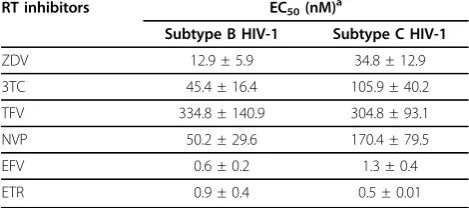
To test whether NRTIs and NNRTIs have similar inhibi-tory effects on HIV-1 subtype B and C RT, recombinant RT heterodimers were analyzed in cell-free RNA-depen-dent DNA polymerase assays in the presence of NRTIs ZDV-TP, 3TC-TP, and TFV-DP, or NNRTIs NVP, EFV, and ETR. The results of Table 1 show that both the subtype B and the two subtype C RT enzymes from iso-lates BG05 and M01 (GenBank accession number AF492609 and AF492603) were inhibited to similar extent by all of the RT inhibitors tested. The reason for using two RTs of subtype C was to reduce the possibi-lity of natural variabipossibi-lity. We also performed phenotypic assays in cord blood mononuclear cells using wild-type viruses from both subtypes and found that they shared similar susceptibilities to all of the RT inhibitors tested i.e. ZDV, 3TC,TFV, NVP, EFV and ETR (Table 2), in agreement with previous data [26].
Efficiency of (-) ssDNA synthesis from the natural tRNA3Lys
primer
The first step in reverse transcription requires human tRNA3Lysas primer, which is annealed to a region near
the 5’-end of viral RNA termed the primer binding site (PBS). The efficiency of tRNA-primed synthesis of minus-strand strong stop (-) ssDNA correlates with viral
replication competence, and this step can sometimes be impeded by the presence of drug resistance mutations [27,28]. We therefore investigated whether the two RT enzymes exhibited differences in the efficiency of (-) ssDNA synthesis by using a HIV-1 PBS RNA template and 5’-end 32P labeled tRNA3Lysprimer. Full-length
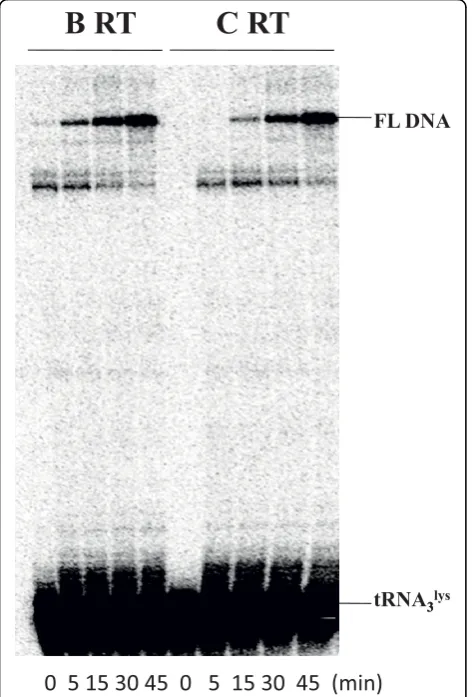
DNA products were monitored in time course reactions. Figure 2 shows that both enzymes displayed similar levels of tRNA-primed synthesis of (-) ssDNA. This result also indicates that the two enzymes exhibited similar efficiency in regard to tRNA-primed (-) ssDNA synthesis.
Processivity analysis of recombinant HIV-1 subtype B and subtype C RTs
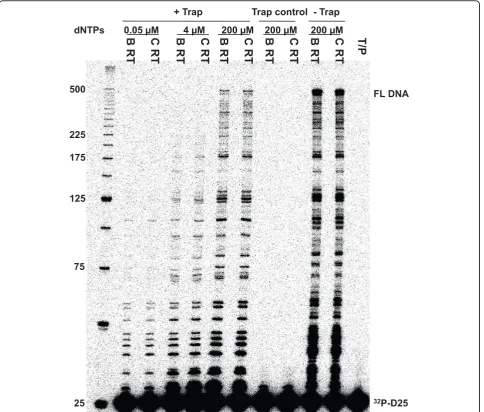
[image:3.595.304.539.114.218.2]The processivity of a polymerase is defined as the number of nucleotides incorporated in a single round of binding, elongation, and dissociation. Earlier studies showed that HIV replication efficiency is related in part to RT processivity [29,30]. We compared the enzyme processivity of the two subtype RT enzymes by using homopolymeric poly (rA) RNA template (average length 500 nt) annealed to 5’32P-labeled oligo dT pri-mers in a fixed-time experiment in the presence of heparin trap to ensure that each synthesized DNA molecule resulted from a single processive cycle. Figure 3 shows that both enzymes share similar processivity on the homopolymeric RNA template within a size range of the longest products at 160 nt-260 nt. We also compared the processivity of the two RT enzymes using a heteropolymeric RNA template under three dif-ferent concentrations of dNTPs. The results of Figure 4 clearly demonstrate that both enzymes possessed simi-lar processivity at all three dNTP concentrations dNTPs tested. Primary subtype C HIV-1 isolates have been reported to be less fit than subtype B isolates in PBMCs, CD4+ T cells, and macrophages [31], and these differences seem to be related to lesser efficiency at host cell entry [32]. The results presented here show that subtype C RT does not have a processivity defect compared to subtype B RT.
Table 1 RT inhibitor susceptibilities for HIV-1 subtype B and subtype C recombinant RTs
RT inhibitors IC50(μM) a
B RT-1b B RT-2c C RT-1d C RT-2e
ZDV-TP 3.1 ± 0.5 2.9 ± 0.4 4.3 ± 0.4 3.8 ± 0.5
3TC-TP 2.7 ± 0.3 4.2 ± 0.5 3.7 ± 0.6 4.1 ± 0.4
TFV-DP 2.5 ± 0.3 2.1 ± 0.3 2.6 ± 0.5 2.9 ± 0.4
NVP 3.2 ± 0.4 5.3 ± 1.4 3.3 ± 0.4 4.3 ± 0.3
EFV 0.11 ± 0.03 0.22 ± 0.03 0.20 ± 0.02 0.18 ± 0.02
ETR 0.17 ± 0.03 0.16 ± 0.02 0.15 ± 0.04 0.19 ± 0.03
a
Data represent means ± standard deviations of three determinations.
b
NL4-3
c
HXB2
d
Isolate BG05 (GenBank accession number AF492609)
e
Isolate M01 (GenBank accession number AF492603)
Table 2 RT inhibitor susceptibilities for HIV-1 subtype B and subtype C viruses
RT inhibitors EC50(nM) a
Subtype B HIV-1 Subtype C HIV-1
ZDV 12.9 ± 5.9 34.8 ± 12.9
3TC 45.4 ± 16.4 105.9 ± 40.2
TFV 334.8 ± 140.9 304.8 ± 93.1
NVP 50.2 ± 29.6 170.4 ± 79.5
EFV 0.6 ± 0.2 1.3 ± 0.4
ETR 0.9 ± 0.4 0.5 ± 0.01
a
[image:3.595.56.292.575.682.2]Misincorporation efficiency by HIV-1 subtype B and subtype C RTs
[image:4.595.305.538.86.558.2]HIV-1 RT has low fidelity compared with RTs of other retroviruses and cellular DNA polymerases. Point muta-tions in HIV-1 RT may strongly affect the fidelity of HIV-1 RT, and we and others have shown that the fide-lity of DNA polymerization of M184V-mutated HIV-1 RT is significantly higher than that of wild-type RT [33]. In order to assess the fidelity of recombinant subtype B and C RTs, we performed misincorporation experiments to monitor primer extension in the absence of a single dNTP complementary to various template nucleotides.
Figure 2Efficiency of tRNA3 Lys
-primed (-) ssDNA synthesis in cell-free assays. The efficiencies of synthesis of (-) ssDNA with HIV-1 subtype B and subtype C wild-type RTs were compared in time course experiments using 5’-end32P-labeled human natural tRNA3
Lys
as primer and HIV-1 PBS RNA as template. The HIV-1 PBS RNA template used in this system consists of 258 nucleotides (nt) at the 5’end of the HIV-1 genome, which contains the R, U5, and PBS regions. Synthesis of full-length DNA (FL DNA) by recombinant RT enzymes was monitored in time-course experiments. Reactions were initiated by the addition of MgCl2and dNTPs and stopped at different time points during a period of 45 min. The position of the full-length DNA product (FL DNA) is shown on the right.
M C
B RT C R
T
B R
T
C R
T
500
Trap
- -
+ +
T T
T T
125
75
25
25
Figure 3 Processivity assay using a homopolymeric RNA template. Processivity of the recombinant HIV-1 subtype B and C RT enzymes was assessed using homopolymeric RNA template poly (rA) and oligo (dT)12-18DNA primer. The DNA primer was labeled with32P at the 5
[image:4.595.57.294.90.439.2]This misincorporation assay employs a primer extension protocol that qualitatively monitors both misinsertion and mismatch extension in the presence of biased dNTP pools containing only three of the four natural dNTPs. Under these conditions, the elongation of the primer past a template nucleotide complementary to the excluded dNTP requires the insertion of an incorrect nucleotide (misincorporation) and further extension of the generated mismatch primer (mispair extension). In
the absence of one of the dNTPs, primer extension stalls one base before the template nucleotide for which the complementary dNTP is withheld (stop site). A higher efficiency of primer extension beyond the stop site reflects a higher ability to utilize incorrect dNTPs, i.e. lower fidelity of the RT. When incubated with mixtures of only three dNTPs in the presence of template-primer ppt57D/ppt17D, both subtype C and B RTs catalyzed substantial extension past the stop sites on the template,
B
C
B
C
B
C
B
C
B
C
T
0.05 µM 4 µM 200 µM 200 µM 200 µM + Trap Trap control - Trap
dNTPs
B
RT
C
RT
B
RT
C
RT
B
RT
RT
C
B
RT
C
RT
B
RT
C
RT
T
/P
500 FL DNA
225
FL DNA
125 175
75
[image:5.595.58.543.89.501.2]25 32P-D25
indicating low fidelity (Figure 5). However, under condi-tions that excluded one complementary dNTP, both RTs catalyzed similar extensions beyond the stop. In particular, both RTs showed the highest levels of exten-sion in the minus-dCTP reaction, followed by those involving minus-dATP, minus-dTTP and minus-dGTP. These results show that subtype B and C RT possess a similar degree of fidelity.
RNase H activity
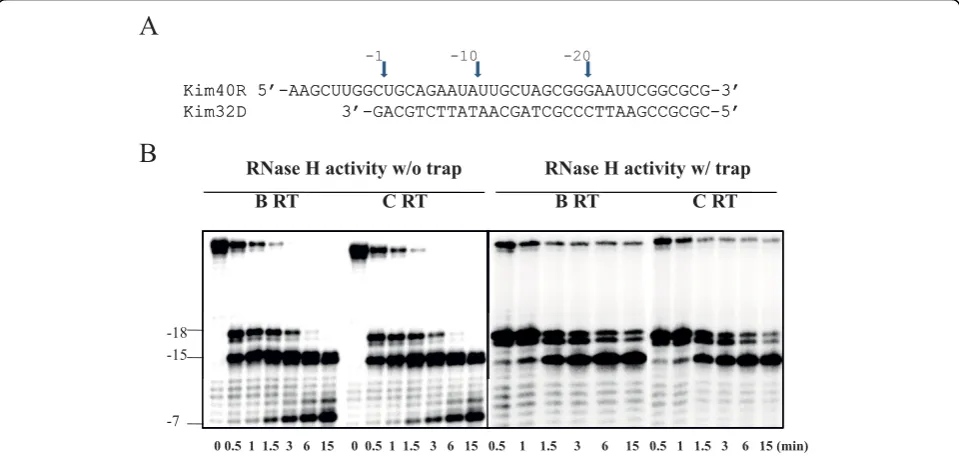
RNase H activity is an integral part of RT function and is essential for viral replication [34]. Mutations abrogat-ing the degradation of template RNA can impact resis-tance levels against certain NRTIs [35]. Therefore, we compared the intrinsic RNase H activities of subtype B and C RTs using a 40-mer RNA template that was32 P-labeled at its 5’-end and annealed to an unlabeled 32-mer DNA pri32-mer, such that there was a 8-nt overhang at the 5’-end of the RNA. Equivalent amounts of RT activity were added to the template primer and incu-bated in the absence of dNTPs. Time-course experi-ments were employed to compare RNase H cleavage efficiencies in the context of the two RT enzymes.
Figure 6 shows that both RTs displayed similar patterns and rates of template cleavage, indicating that they share a common profile of RNase H activity.
Discussion
This manuscript represents the first attempt of its type to directly compare RT enzymes of different subtypes in regard to processivity, fidelity, RNase H activity, and sus-ceptibility to RT inhibitors. Moreover, our analysis has been conducted using both homopolymeric and hetero-polymeric templates. We have further documented that few differences exist among the various RT enzymes stu-died in regard to each of these characteristics.
[image:6.595.58.540.89.363.2]These findings are important because of the possibility that factors that relate to polymorphisms within RT could potentially be responsible for appearance of muta-tions related to drug resistance and/or susceptibilities to HIV inhibitors in a manner that would distinguish between HIV subtypes. Were such differences to be important in regard to enzyme processivity and/or other characteristics of biochemical behaviour, it might follow, in turn, that different therapeutic regimens might be recommended for different HIV subtypes. The fact that
few such differences exist suggests that the same anti-RT drugs used to treat subtype B infections should have equal relevance to HIV infections of other subtypes. This relieves a major concern and is of clinical significance. On the other hand, differences in regard to viral template sequences can directly lead to differential appearance of resistance mutations [14,36,37]. This notwithstanding, choices of antiretroviral therapies to be used in therapy should not be affected. Of course, relevant considerations in such decision-making include drug efficacy and toler-ability as well as convenience of dosing.
The fact that different mutations may sometimes appear differentially in regard to viruses of different sub-types may have implications in regard to secondary treatment strategies in the aftermath of treatment fail-ure. This is a different topic than that of the initial use of antiretroviral drugs discussed here, and may also have implications for transmitted drug resistance. This rein-forces the need to conduct genotyping prior to com-mencement of antiretroviral therapy in newly infected individuals and/or individuals about to undergo therapy for the first time.
The fact that RT polymorphisms do not appear to impact on enzyme function, as studied by multiple methods in this manuscript, is encouraging news in regard to future development of antiretroviral drugs.
Previous findings from our laboratory have also indi-cated a paucity of differences among HIV integrase enzymes of different subtypes in regard to both 3’ -pro-cessing and strand-transfer activities [38]. Future studies should be carried out to document that polymorphisms have little or no effect on the behaviour of HIV-1 and other retroviral proteases, but such work has yet to be carried out. It is important, however, to note that pre-vious studies have suggested that resistance to HIV-1 protease inhibitors can occur along different mutational pathways as a function of HIV-1 subtype [39]. The cur-rent manuscript allays concerns that functional bio-chemical differences in RT might play an important role in regard to antiretroviral drug susceptibility.
Conclusion
Our results provide biochemical evidence that RT enzymes from HIV-1 subtypes B and C share similar catalytic activities in regard to each of (-) ssDNA synth-esis, processivity of DNA polymerization, efficiency of misincorporation, and RNase H activity. RT enzymes and viruses from both subtypes were inhibited by NRTIs and NNRTIs to a similar extent. These findings are supportive of the use of recombinant RTs of either subtype for enzyme analysis, drug design, and for study-ing mechanisms of drug resistance.
A
Kim40R 5’-AAGCUUGGCUGCAGAAUAUUGCUAGCGGGAAUUCGGCGCG-3’
Kim32D 3’-GACGTCTTATAACGATCGCCCTTAAGCCGCGC-5’
-1 -10 -20
Kim40R 5’-AAGCUUGGCUGCAGAAUAUUGCUAGCGGGAAUUCGGCGCG-3’
Kim32D 3’-GACGTCTTATAACGATCGCCCTTAAGCCGCGC-5’
RNase H activity w/o trap RNase H activity w/ trap
B
Kim32D 3 GACGTCTTATAACGATCGCCCTTAAGCCGCGC 5
Kim32D 3 GACGTCTTATAACGATCGCCCTTAAGCCGCGC 5
B RT C RT B RT C RT
-18 -15
0 0 5 1 1 5 3 6 15 0 0 5 1 1 5 3 6 15 0 5 1 1 5 3 6 15 0 5 1 1 5 3 6 15 (min)
-7
[image:7.595.58.538.90.319.2]0 0.5 1 1.5 3 6 15 0 0.5 1 1.5 3 6 15 0.5 1 1.5 3 6 15 0.5 1 1.5 3 6 15 (min)
Materials and methods
Chemicals, cells and nucleic acids
Poly(rA)/oligo(dT)12-18, oligo dT12-18,ultrapure dNTPs
and NTPs were purchased from GE Healthcare. [3 H]-dTTP (70-80 Ci/mmol) and [g-32P]-ATP were from Per-kin Elmer Life Sciences. Natural human tRNA3Lys
puri-fied from placenta by high-pressure liquid
chromatography (HPLC) was purchased from BIO S&T (Montreal, Quebec, Canada). A HIV-1 PBS RNA tem-plate spanning the 5’ UTR to the primer binding site (PBS) was in vitrotranscribed from BSSH II-linearized pHIV-PBS DNA [40] by using a T7-MEGAshortscript kit (Ambion, Austin, TX) as described [41].
The oligonucleotides used in this study were synthe-sized by Integrated DNA Technologies Inc and purified by 6% polyacrylamide-7M urea gel electrophoresis and the sequences are as follows:
D25, 5’-GGATTAACTGCGAATCGTTCTAGCT-3’;
dPR, 5’-GTCCCTGTTCGGGCGCCA-3’; ppt17D, 5’-TTAAAAGAAAAGGGGGG-3’;
pp57D, 5’
-CGTTGGGAGTGAATTAGCCCTTCCA-GTCCCCCCTTTTCTTTTAAAAAGTGGCTAAGA-3’;
kim40R, 5’
-AAGCTTGGCTGCAGAATATTGCTAG-CGGGAATTCGGCGCG-3’;
kim32D, 5’
-CGCGCCGAATTCCCGCTAGCAATAT-TCTGCAG-3’;
Tenofovir (TFV) and tenofovir diphosphate (TFV-DP) were kindly provided by Gilead Sciences (Foster City, California, USA). Zidovudine (ZDV), lamivudine (3TC), ZDV-TP, and 3TC-TP were gifts of Glaxo-SmithKline Inc. Etravirine (ETR) was a gift of Tibotec Inc. Efaverenz (EFV) and nevirapine (NVP) were obtained from Bristol-Myers Squibb Inc. and Boehringer Ingelheim Inc, respectively.
Recombinant reverse transcriptase expression and purification
The plasmid pRT6H-PROT [17] of which the RT coding region is from HIV-1 HXB2 was kindly provided by Dr. S. F. J. Le Grice. For construction of subtype C and subtype B HIV-1 using RT heterodimer expression plas-mids pcRT6H-PROT and pbRT6H-PROT, the RT cod-ing regions of subtype C HIV-1 isolate BG05 (GenBank accession number AF492609) or subtype B HIV-1 pNL4-3 (GenBank accession number AF324493) were subcloned into pRT6H-PROT by standard PCR cloning procedure to replace the original RT coding region [41]. The accuracy of the RT coding sequence was verified by DNA sequencing. Another subtype C RT preparation from isolate M01 (GenBank accession number AF492603) was prepared as reported previously [42]. Recombinant RTs were expressed and purified as described with minor modifications [17,23]. In brief, RT expression inE. coliM15 (pREP4) (Qiagen, Mississauga,
ON) was induced with 1 mM isopropyl-b -D-thiogalacto-pyranoside (IPTG) at room temperature. The pelleted bacteria were lysed under native conditions with BugBuster Protein Extraction Reagent containing benzo-nase (Novagen, Madison, WI) according to the manu-facturer’s instructions. After clarification by high speed centrifugation, the clear supernatant was subjected to the batch method of Ni-NTA metal-affinity chromato-graphy (QIAexpressionist) (Qiagen). All buffers con-tained Complete protease inhibitor cocktail (Roche). Histidine-tagged RT was eluted with an imidazole gradi-ent. RT-containing fractions were pooled, passed through DEAE-Sepharose (GE Healthcare), and further purified using SP-Sepharose (GE Healthcare, Missis-sauga, ON). Fractions containing purified RT were pooled, dialyzed against storage buffer (50 mM Tris-HCl (pH 7.8], 50 mM NaCl and 50% glycerol), and concen-trated to 4 mg-8 mg/ml with Centricon Plus-20 MWCO30 kDa (Millipore). Aliquots of proteins were stored at -80°C. Protein concentration was measured by a Bradford protein assay kit (Bio-Rad Laboratories) and the purity of the recombinant RT preparations was veri-fied by SDS-PAGE.
Specific activity determination
The polymerase activity of each recombinant RT pre-paration was evaluated in duplicate as described [42] using varying amounts of RTs and a synthetic homopo-lymeric poly (rA)/p (dT)12-18template/primer (Midland
Certified Reagent Company). Each 50-μl reaction con-tained 0.5 U/ml poly(rA)/p(dT)12-18, 50 mM Tris-HCl
pH 7.8, 60 mM KCl, and 6 mM MgCl2. Reactions were
initiated by adding 5 μM dTTP with 5 μCi [3H]-dTTP (70-80 Ci/mmol, Perkin Elmer). Aliquots of 15 μl were removed at 3, 7 and 15 min to ensure linearity of the reaction and quenched by the addition of ice-cold 10% trichloroacetic acid containing 20 mM sodium pyropho-sphate. After 30-min incubation on ice, aliquots were fil-tered using 1.2-μm glass fiber type C filter multi-well plates (Millipore) and washed sequentially with cold 10% trichloroacetic acid and ethanol. The extent of radionucleotide incorporation was then determined by liquid scintillation spectrometry. The amount of incor-porated [3H]-dTTP was plotted as cpm versus time and specific activities were determined from the slopes of the linear regression analyses. An active unit of RT was defined as the amount of enzyme that incorporates 1 pmol of dTTP in 10 min at 37°C.
RT inhibitor susceptibility assays
containing 50 mM Tris-HCl (pH 7.8), 6 mM MgCl2, 60
mM KC1, dNTPs (5 μM each) with 2.5 μCi of [3 H]-dTTP (70-80 mCi/mmol), 30 nM heterogeneous HIV-1 RNA template/primer, 10 units of RT, and variable amounts of RT inhibitors was included in 50-μl reaction volumes. In each reaction, 0, 0.1, 0.3, 1.0, 3.0, 10.0, 30.0 and 100.0μM of RT inhibitors were added for ZDV-TP, 3TC-TP, TFV-DP and NVP while 0, 0.01, 0.03, 0.10, 0.30, 1.00,3.00 and 10.00μM were added for EFV and ETR. The reactions were incubated at 37°C for 30 min and the reactions were terminated by adding 0.2 ml of 10% cold trichloracetic acid (TCA) and 20 mM sodium pyrophosphate and incubated for at least 30 min on ice. The precipitated products were filtered through a 96-well MutiScreen HTS FC filter plate (Millipore) and sequentially washed with 200μl of 10% TCA and 150μl of 95% ethanol. The radioactivity of incorporated pro-ducts was analyzed by liquid scintillation spectrometry using a 1450 MicroBeta TriLux Microplate Scintillation and Luminescence Counter (Perkin Elmer). The 50% inhibitory concentration (IC50) of each RTI was
deter-mined by nonlinear regression analysis using GraphPad Prism software. For determination of RT sensitivities to ZDV-TP, 150μM sodium pyrophosphate was included in each reaction.
Phenotypic RT inhibitor susceptibility assays
Phenotypic analysis of RT inhibitor susceptibility was performed with wild type HIV-1 subtype B and Subtype C viruses in a cell-based in vitro assay. Briefly, cord blood mononuclear cells were infected for 2 h with var-ious viral isolates and plated in 96-well plates, at a den-sity of 5 × 10⁶ cells per well, in the presence of each RT inhibitor. The drug concentration ranges for the inhibi-tors tested were as follows: ZDV (6.4-400 nM), 3TC (3.2-2000 nM), TFV (16-10000 nM), NVP (3.2-2000 nM), EFV (0.05-160 nM), ETR (0.05-160 nM). After 3 days in culture, the culture wells were refreshed with media containing the corresponding drug dilutions. After 7 days, the culture supernatants were collected and analyzed for RT activity to determine the dose response curve. The EC50(50% drug effective
concentra-tion) was calculated using GraphPad Prism software [12].
Efficiency of (-) ssDNA synthesis primed by tRNA3Lys
Using a cell-free system, the efficiencies of synthesis of (-) ssDNA by HIV-1 subtype B and subtype C RT enzymes were monitored using human natural tRNA3Lys
(Bio S&T, Lachine, Quebec, Canada) and an HIV-1 PBS RNA primer-template system [40]. The PBS RNA was
in vitro transcribed from BSSH II-linearized pHIV-PBS DNA by using T7-Megashortscript kit (Ambion, Austin, TX) as described [41]. Human tRNA3Lys, purified by
HPLC from placenta, was labeled at its 5’-end with [g
-32
P]-ATP using a KinaseMax kit (Ambion) according to the manufacturer’s instructions and heat annealed to the RNA template by incubation for 2 min at 95°C followed by 10 min at 70°C and slowly cooling to room tempera-ture as described [28], with the modification that a 30μl mixture was used that contained 50 mM Tris-HCl (pH 7.8), 50 mM NaCl, 50 nM tRNA3Lys, 50 nM32P-labeled
template PBS RNA and RT enzymes. Synthesis of (-) ssDNA was initiated by the addition of 6 mM MgCl2
and dNTPs. Aliquots were removed at different time points and the reactions were stopped by adding 4 volumes of formamide sample buffer (96% of forma-mide, 0.05% each of bromophenol blue and xylene cya-nol FF and 20 mM EDTA). The products were separated on 6% polyacrylamide-7 M urea gels and were exposed to x-ray film after gel drying. The intensity of gel bands was analyzed with Scion Image software (Scion Corp., Frederick, MD).
Processivity assays
The processivity of recombinant RT proteins was ana-lysed using both homopolymeric and heteropolymeric RNA templates in the presence of a heparin enzyme trap to ensure a single processive cycle, i.e., a single round of binding and of primer extension and dissocia-tion. Assays on homopolymeric RNA were performed as described elsewhere [29,43]. The primer-templates were annealed by heating the solution of 32P-end-labeled oligo dT12-18 (GE Healthcare) with an equimolar
con-centration of poly (rA) homopolymeric RNA template (GE Healthcare) to 90°C for 2 min and incubating the solution for an additional 10 min at 70°C, followed by slow cooling to room temperature. RT enzymes and T/Ps were preincubated for 5 min at 37°C in the same buffer system as described above for (-)ssDNA synthesis. Reactions were initiated by the addition of dTTP and heparin trap (final concentration 2 mg/ml) and incu-bated at 37°C for 10 min; 2μl of reaction mixture were removed and mixed with 8 μl of formamide sample buffer (90% formamide, 10 mM EDTA, and 0.1% each of xylene cyanol and bromophenol blue). Reaction products were heat denatured and analyzed by 6% dena-turing polyacrylamide gel electrophoresis and phosphor-imaging. The effectiveness of the trap was assessed and verified in pilot experiments in which the heparin trap at various concentrations was preincubated with sub-strates before the addition of RT enzymes.
of the gag region [40]. The 25-nt DNA primer D25 is complementary to the 5’end of the gag sequence. The primers were [g-32P]-ATP-labeled and filtered by Nuc-Away spin column (Ambion, Austin, TX). The tem-plate/primer complex was prepared as follows: the template and primer were mixed at a molar ratio of 1:1, denatured at 85°C for 5 min, and then sequentially cooled to 55°C for 8 min and 37°C for 5 min to allow for specific annealing of primer to the template. Reac-tions were performed as above except that three differ-ent concdiffer-entrations of dNTPs were used.
Misincorporation assay
The template-primer ppt57D/ppt17D was used to deter-mine the extent of misincorporation in the absence of one complementary dNTP. The 17-mer DNA primer ppt17D was 32P-labeled at the 5’end by [g-32P]-ATP using a KinaseMax Kit (Ambion) and annealed to the 57-mer DNA template at a molar ratio of 1:3. Reaction mixtures (20 μl) contained 50 nM template/primer, recombinant RT enzymes at equal activities, 50 mM Tris·HCl, pH 7.8, 60 mM KCl, and 6 mM MgCl2.
Reac-tions were incubated at 37°C for 5 min in the presence of all four dNTPs (250μM each) or in the presence of 3 dNTPs by excluding one complementary dNTP. Reac-tions were stopped by adding 4 volumes of formamide sample buffer (96% of formamide, 0.05% each of bromo-phenol blue and xylene cyanol FF and 20 mM EDTA). The products were denatured by heating at 90°C for 3 min, separated on 6% polyacrylamide-7 M urea gels, and exposed to x-ray film after gel drying.
RT-catalyzed RNase H Activity
Intrinsic RNase H assays were performed as reported [44]. RNase H activity was assayed on 40-mer 5’-end
32
P-labeled heteropolymeric RNA template kim40R annealed to the complementary 32-mer DNA oligomer kim32D at a 1:4 molar ratio [45]. Reactions were con-ducted at 37°C in mixtures containing 200 nM RNA-DNA duplex substrate with equal RT activities in assay buffer of 50 mM Tris-HCl, pH 7.8, 60 mM KCl, in the presence or absence of heparin trap (2 mg/ml). Reac-tions were initiated by adding 1/10 vol of 50 mM MgCl2. Aliquots were removed at different times after
initiation of reactions and quenched by adding 4 volumes of formamide loading dye. The samples were heated at 90°C for 3 min, cooled on ice, and electro-phoresed through 6% polyacrylamide-7M urea gels. The gels were analyzed by phosphorimaging. The efficacy of the heparin trap was verified by pre-incubation experi-ments performed by 10-min preincubation of various concentrations of heparin trap with substrates in the presence of magnesium followed by initiation of the reaction with RT enzymes.
Acknowledgements
We thank Dr. Stuart Le Grice for providing the pRT6H-PROT DNA. This research was supported by grants from the Canadian Institutes of Health Research (CIHR).
Author details
1McGill University AIDS Centre, Lady Davis Institute for Medical Research, Jewish General Hospital, Montreal, Quebec, Canada.2Departmens of Medicine, McGill University, Montreal, Quebec, Canada.3Department of Microbiology and Immunology, McGill University, Montreal, Quebec, Canada.
Authors’contributions
MAW supervised the project and corrected the manuscript. HX and YQ purified the enzymes, performed biochemical experiments, and drafted the manuscript. EA and MO performed phenotypic analyses. DM performed sequencing reactions. All authors read and approved the final manuscript.
Competing interests
The authors declare that they have no competing interests.
Received: 4 May 2010 Accepted: 7 October 2010 Published: 7 October 2010
References
1. Rambaut A, Posada D, Crandall KA, Holmes EC:The causes and consequences of HIV evolution.Nat Rev Genet2004,5:52-61. 2. Robertson DL, Anderson JP, Bradac JA, Carr JK, Foley B, Funkhouser RK,
Gao F, Hahn BH, Kalish ML, Kuiken C,et al:HIV-1 nomenclature proposal.
Science2000,288:55-56.
3. Esparza J, Bhamarapravati N:Accelerating the development and future availability of HIV-1 vaccines: why, when, where, and how?Lancet2000, 355:2061-2066.
4. Hemelaar J, Gouws E, Ghys PD, Osmanov S:Global and regional distribution of HIV-1 genetic subtypes and recombinants in 2004.AIDS
2006,20:W13-23.
5. Goff SP:Retroviral reverse transcriptase: synthesis, structure, and function.J Acquir Immune Defic Syndr1990,3:817-831.
6. Fischl MA, Richman DD, Grieco MH, Gottlieb MS, Volberding PA, Laskin OL, Leedom JM, Groopman JE, Mildvan D, Schooley RT,et al:The efficacy of azidothymidine (AZT) in the treatment of patients with AIDS and AIDS-related complex. A double-blind, placebo-controlled trial.N Engl J Med
1987,317:185-191.
7. Kohlstaedt LA, Wang J, Friedman JM, Rice PA, Steitz TA:Crystal structure at 3.5 A resolution of HIV-1 reverse transcriptase complexed with an inhibitor.Science1992,256:1783-1790.
8. Schultz SJ, Champoux JJ:RNase H activity: structure, specificity, and function in reverse transcription.Virus Res2008,134:86-103.
9. Tramontano E, Esposito F, Badas R, Di Santo R, Costi R, La Colla P: 6-[1-(4-Fluorophenyl)methyl-1H-pyrrol-2-yl)]-2,4-dioxo-5-hexenoic acid ethyl ester a novel diketo acid derivative which selectively inhibits the HIV-1 viral replication in cell culture and the ribonuclease H activity in vitro.
Antiviral Res2005,65:117-124.
10. Johnson VA, Brun-Vezinet F, Clotet B, Gunthard HF, Kuritzkes DR, Pillay D, Schapiro JM, Richman DD:Update of the drug resistance mutations in HIV-1: December 2009.Top HIV Med2009,17:138-145.
11. Sarafianos SG, Marchand B, Das K, Himmel DM, Parniak MA, Hughes SH, Arnold E:Structure and function of HIV-1 reverse transcriptase: molecular mechanisms of polymerization and inhibition.J Mol Biol2009,385:693-713. 12. Brenner BG, Oliveira M, Doualla-Bell F, Moisi DD, Ntemgwa M, Frankel F,
Essex M, Wainberg MA:HIV-1 subtype C viruses rapidly develop K65R resistance to tenofovir in cell culture.AIDS2006,20:F9-13.
13. Gupta RK, Chrystie IL, O’Shea S, Mullen JE, Kulasegaram R, Tong CY:K65R and Y181C are less prevalent in HAART-experienced HIV-1 subtype A patients.AIDS2005,19:1916-1919.
14. Invernizzi CF, Coutsinos D, Oliveira M, Moisi D, Brenner BG, Wainberg MA: Signature nucleotide polymorphisms at positions 64 and 65 in reverse transcriptase favor the selection of the K65R resistance mutation in HIV-1 subtype C.J Infect Dis2009,200:1202-1206.
16. Gonzales MJ, Machekano RN, Shafer RW:Human immunodeficiency virus type 1 reverse-transcriptase and protease subtypes: classification, amino acid mutation patterns, and prevalence in a northern California clinic-based population.J Infect Dis2001,184:998-1006.
17. Le Grice SF, Gruninger-Leitch F:Rapid purification of homodimer and heterodimer HIV-1 reverse transcriptase by metal chelate affinity chromatography.Eur J Biochem1990,187:307-314.
18. Stahlhut MW, Olsen DB:Expression and purification of retroviral HIV-1 reverse transcriptase.Methods Enzymol1996,275:122-133.
19. Maier G, Dietrich U, Panhans B, Schroder B, Rubsamen-Waigmann H, Cellai L, Hermann T, Heumann H:Mixed reconstitution of mutated subunits of HIV1 reverse transcriptase coexpressed in Escherichia coli -two tags tie it up.Eur J Biochem1999,261:10-18.
20. Pandey VN, Kaushik N, Rege N, Sarafianos SG, Yadav PN, Modak MJ:Role of methionine 184 of human immunodeficiency virus type-1 reverse transcriptase in the polymerase function and fidelity of DNA synthesis.
Biochemistry1996,35:2168-2179.
21. Stahlhut M, Li Y, Condra JH, Fu J, Gotlib L, Graham DJ, Olsen DB: Purification and characterization of HIV-1 reverse transcriptase having a 1:1 ratio of p66 and p51 subunits.Protein Expr Purif1994,5:614-621. 22. Held DM, Kissel JD, Thacker SJ, Michalowski D, Saran D, Ji J, Hardy RW,
Rossi JJ, Burke DH:Cross-clade inhibition of recombinant human immunodeficiency virus type 1 (HIV-1), HIV-2, and simian immunodeficiency virus SIVcpz reverse transcriptases by RNA pseudoknot aptamers.J Virol2007,81:5375-5384.
23. Le Grice SF, Cameron CE, Benkovic SJ:Purification and characterization of human immunodeficiency virus type 1 reverse transcriptase.Methods
Enzymol1995,262:130-144.
24. Kim B, Hathaway TR, Loeb LA:Fidelity of mutant HIV-1 reverse transcriptases: interaction with the single-stranded template influences the accuracy of DNA synthesis.Biochemistry1998,37:5831-5839. 25. Kim B, Ayran JC, Sagar SG, Adman ET, Fuller SM, Tran NH, Horrigan J:New
human immunodeficiency virus, type 1 reverse transcriptase (HIV-1 RT) mutants with increased fidelity of DNA synthesis. Accuracy, template binding, and processivity.J Biol Chem1999,274:27666-27673. 26. Fleury HJ, Toni T, Lan NT, Hung PV, Deshpande A, Recordon-Pinson P,
Boucher S, Lazaro E, Jauvin V, Lavignolle-Aurillac V,et al:Susceptibility to antiretroviral drugs of CRF01_AE, CRF02_AG, and subtype C viruses from untreated patients of Africa and Asia: comparative genotypic and phenotypic data.AIDS Res Hum Retroviruses2006,22:357-366. 27. Diallo K, Marchand B, Wei X, Cellai L, Gotte M, Wainberg MA:Diminished
RNA primer usage associated with the L74V and M184V mutations in the reverse transcriptase of human immunodeficiency virus type 1 provides a possible mechanism for diminished viral replication capacity.
J Virol2003,77:8621-8632.
28. Wei X, Liang C, Gotte M, Wainberg MA:The M184V mutation in HIV-1 reverse transcriptase reduces the restoration of wild-type replication by attenuated viruses.AIDS2002,16:2391-2398.
29. Back NK, Nijhuis M, Keulen W, Boucher CA, Oude Essink BO, van Kuilenburg AB, van Gennip AH, Berkhout B:Reduced replication of 3TC-resistant HIV-1 variants in primary cells due to a processivity defect of the reverse transcriptase enzyme.EMBO J1996,15:4040-4049. 30. Caliendo AM, Savara A, An D, DeVore K, Kaplan JC, D’Aquila RT:Effects of
zidovudine-selected human immunodeficiency virus type 1 reverse transcriptase amino acid substitutions on processive DNA synthesis and viral replication.J Virol1996,70:2146-2153.
31. Ball SC, Abraha A, Collins KR, Marozsan AJ, Baird H, Quinones-Mateu ME, Penn-Nicholson A, Murray M, Richard N, Lobritz M,et al:Comparing the ex vivo fitness of CCR5-tropic human immunodeficiency virus type 1 isolates of subtypes B and C.J Virol2003,77:1021-1038.
32. Marozsan AJ, Moore DM, Lobritz MA, Fraundorf E, Abraha A, Reeves JD, Arts EJ:Differences in the fitness of two diverse wild-type human immunodeficiency virus type 1 isolates are related to the efficiency of cell binding and entry.J Virol2005,79:7121-7134.
33. Diallo K, Gotte M, Wainberg MA:Molecular impact of the M184V mutation in human immunodeficiency virus type 1 reverse transcriptase.
Antimicrob Agents Chemother2003,47:3377-3383.
34. Wendeler M, Lee HF, Bermingham A, Miller JT, Chertov O, Bona MK, Baichoo NS, Ehteshami M, Beutler J, O’Keefe BR,et al:Vinylogous ureas as a novel class of inhibitors of reverse transcriptase-associated ribonuclease H activity.ACS Chem Biol2008,3:635-644.
35. Ehteshami M, Gotte M:Effects of mutations in the connection and RNase H domains of HIV-1 reverse transcriptase on drug susceptibility.AIDS Rev
2008,10:224-235.
36. Coutsinos D, Invernizzi CF, Xu H, Moisi D, Oliveira M, Brenner BG, Wainberg MA:Template usage is responsible for the preferential acquisition of the K65R reverse transcriptase mutation in subtype C variants of human immunodeficiency virus type 1.J Virol2009, 83:2029-2033.
37. Harrigan PR, Sheen CW, Gill VS, Wynhoven B, Hudson E, Lima VD, Lecocq P, Aguirre R, Poon AF, Sluis-Cremer N:Silent mutations are selected in HIV-1 reverse transcriptase and affect enzymatic efficiency.AIDS2008, 22:2501-2508.
38. Bar-Magen T, Donahue DA, McDonough EI, Kuhl BD, Faltenbacher VH, Xu H, Michaud V, Sloan RD, Wainberg MA:HIV-1 subtype B and C integrase enzymes exhibit differential patterns of resistance to integrase inhibitors in biochemical assays.AIDS2010.
39. Lisovsky I, Schader SM, Martinez-Cajas JL, Oliveira M, Moisi D, Wainberg MA: HIV-1 protease codon 36 polymorphisms and differential development of resistance to nelfinavir, lopinavir, and atazanavir in different HIV-1 subtypes.Antimicrob Agents Chemother2010,54:2878-2885.
40. Arts EJ, Li X, Gu Z, Kleiman L, Parniak MA, Wainberg MA:Comparison of deoxyoligonucleotide and tRNA(Lys-3) as primers in an endogenous human immunodeficiency virus-1 in vitro reverse transcription/template-switching reaction.J Biol Chem1994,269:14672-14680.
41. Xu HT, Martinez-Cajas JL, Ntemgwa ML, Coutsinos D, Frankel FA, Brenner BG, Wainberg MA:Effects of the K65R and K65R/M184V reverse transcriptase mutations in subtype C HIV on enzyme function and drug resistance.Retrovirology2009,6:14.
42. Quan Y, Brenner BG, Marlink RG, Essex M, Kurimura T, Wainberg MA:Drug resistance profiles of recombinant reverse transcriptases from human immunodeficiency virus type 1 subtypes A/E, B, and C.AIDS Res Hum
Retroviruses2003,19:743-753.
43. Sharma PL, Crumpacker CS:Decreased processivity of human immunodeficiency virus type 1 reverse transcriptase (RT) containing didanosine-selected mutation Leu74Val: a comparative analysis of RT variants Leu74Val and lamivudine-selected Met184Val.J Virol1999, 73:8448-8456.
44. Gopalakrishnan V, Peliska JA, Benkovic SJ:Human immunodeficiency virus type 1 reverse transcriptase: spatial and temporal relationship between the polymerase and RNase H activities.Proc Natl Acad Sci USA1992, 89:10763-10767.
45. Operario DJ, Balakrishnan M, Bambara RA, Kim B:Reduced dNTP interaction of human immunodeficiency virus type 1 reverse transcriptase promotes strand transfer.J Biol Chem2006, 281:32113-32121.
doi:10.1186/1742-4690-7-80
Cite this article as:Xuet al.:Comparative biochemical analysis of recombinant reverse transcriptase enzymes of HIV-1 subtype B and subtype C.Retrovirology20107:80.
Submit your next manuscript to BioMed Central and take full advantage of:
• Convenient online submission
• Thorough peer review
• No space constraints or color figure charges
• Immediate publication on acceptance
• Inclusion in PubMed, CAS, Scopus and Google Scholar • Research which is freely available for redistribution