PROGRAMME
PROGRESS
REPORT
January -June 1981
COMMISSION OF THE EUROPEAN COMMUNITIES
JOINT RESEARCH CENTRE
Ispra Establishment
Italy
Central Bureau for Nuclear Measurements
Geel Establishment
Belgium
Petten Establishment
The Netherlands
European Institute for Transuranium Elements
Karlsruhe Establishment
Federal Republic of Germany
DECLASSMED
released as
Lui*
COMMUNICATION
Category 1.0
Nr 3893
Specific support
for the Commission's
sectorial activities
WARNING
The information contained in this document is
communicated confidentially by the Commission of the European Communities to Member States, persons and undertakings and should not be passed on to third parties.
(Euratom-Treaty. Article 13, and Regulation (EEC) No. 2380/74 of the Council of Ministers).
Programme Progress Report ■ JRC Ispra JanuaryJune 1981
Specific Support for the Commission Sectoral Activities
INFORMATICS
Abstract
The programme «Informatics» aims at providing a public service in the field of automatic collection, automatic treatment and dissemination of technicalscientific information and the underlying techniques. Three activities are included in the pro gramme, staffed with 34 research men:
a) Contribution to the research in the field of Telelnformatics which include running a Test and Reference Centre for EURONET, further study on information net works through the development of an Internal Network in view of contributing to the larger Interinstitutional Network and the preparation of satellite connections.
b) The European Computer Program Institute (EUROCOPI) with an information ser vice on computer programs and their application.
The new EUROCOPI Data Base was made accessible through EURONET and tests for the commercial service are in progress.
c) The European Shielding Information Service (ESIS), a specialized information centre on shielding data and shielding computer and calculation methods. In the reporting period the work concerned mainly the assessment of data to be used in neutron deep penetration calculations and the completion of the measurements for the iron benchmark experiment.
For each of these activities details are given about the planning for the reporting period, the results obtained in selected fields and the orientation of the future work.
COMMISSION OF THE EUROPEAN COMMUNITIES
JOINT RESEARCH CENTRE
Ispra Establishment
Italy
Central Bureau for Nuclear Measurements
Geel Establishment
Belgium
Petten Establishment
The Netherlands
European Institute for Transuranium Elements
Karlsruhe Establishment
Federal Republic of Germany
Specific support
for the Commission's
sectorial activities
B E M Æ R K
Den viden, som rummes i dette dokument, meddeles som fortrolig fra Kommissionen for de europæiske Fællesskaber til Medlemsstater, per-soner og virksomheder og må ikke videreaives til trediemand. (Euratom-traktatens artikel 13 og Minersterrådetsforordning(EDF) N° 2380/74).
Hverken Kommissionen for de Europæiske Fælleskaber eller nogen, som optraeder pa Kommissionens vegne er ansvarling for den eventuelle brug af information, som er indeholdt i det folgende .
ZUR BEACHTUNG
Die in diesem Dokument enthaltenen Kenntnisse werden von der Kom-mission der Europäischen Gemeinschaften den Mitgliedstaaten, Per-sonen und Unternehmen der Gemeinschaft vertraulich mitgeteilt und dürfen nicht an Dritte weitergegeben werden. (Euratom-Vertrag, Arti-kel 13, und Beschlussdes Ministerrates (EWG) Nr. 2380/74).
Weder die Kommission der Europäischen Gemeinschaften noch Perso-nen, die im Namen dieser Kommission handeln, sind für die etwaige Verwendung der nachstehenden Informationen verantwortlich.
NOTICE
The information contained in this document is communicated confi-dentially by the Commission of the European Communities to Member States, persons and undertakings and should not be passed on to third parties. (Euratom-Treaty, Article 13, and Regulation (EEC) No. 2380/74 of the Council of Ministers).
Neither the Commission of the European Communities nor any person acting on behalf of the Commission is responsible for the use which might be made of the following information.
AVERTISSEMENT
Les connaissances contenues dans le présent document sont communi-quées confidentiellement par la Commission des Communautées euro-péennes aux Etats membres, personnes et entreprises et ne peuvent être transmises à des tiers. (Traité Euratom, article 13, et règlement (CEE) N° 2380/74 du Conseil de Ministres).
Ni la Commission des Communautés européennes, ni aucune personne agissant au nom de la Commission, n'est responsable de l'usage qui pourrait être fait des informations ci-après.
A V V E R T I M E N T O
Le cognizioni contenute nel presente documento sono comunicate con-fidenzialmente dalla Commissione delle Comunità europee agli Stati membri, persone ed imprese e non debbono essere trasmesse a terzi. (Trattato Euratom, articolo 13, e regolamento (CCE) N° 2380/74 del Consiglio dei Ministri).
Né la Commissione delle Comunità europee, né alcuna persona che agisca per suo conto, è responsabile dell'uso che dovesse essere fatto delle informazioni che seguono.
OPMERKING
De kennis, die in dit document is vervat, wordt door de Commissie van de Europese Gemeenschappen vertrouwelijk aan de Lid-Staten, per-sonen en ondernemingen medegedeeld en mag niet aan derden worden doorgegeven. (Euratom-Ve'rdrag, artikel 13, en het besluit van de Mi-nisterraad (EEG) No. 2380/74).
CONTENTS
page
INTRODUCTION 3
EXECUTIVE SUMMARY 5
PROJECTS 9
1. Data Communications 9
INTRODUCTION
The programme «Informatics» Includes those activities in which efforts have to be concentrated in order to make
contributions to the Commission policy in this field and to promote the use of advanced and efficient systems for
the automatic collection, analysis, automatic treatment and dissemination of information and the underlying
techniques. Three main items make up the programme, selected out of the public service activities, that can be
ex-pected to be performed by the JRC and on the basis of the specific experience available:
— contribution to the research work in the field of Teleinformatics which shall lead to extend and improve the
com-munication between geographically disseminated computers. The research is centered on the two subjects of
«network» (language, operation, protocol) and «data» (data-banks, standards, processing).
— management of the EUROpean computer Programme Institute (EUROCOPI), with the aim to integrate closely
the research and service activities in software evaluation and dissemination. The research is oriented on
pro-gramming techniques and software information transfer problems; the information service is pursued by
setting-up a computerized data base on program information and by the organization of a program distribution
and program information service.
— running the European Shielding Information Service (ESIS), which in a specific field, where very relevant
ex-perience has been accumulated at Ispra, fulfills the task of analysing, evaluating and synthetizing information
on shielding data and calculation methods, as well as performing a shielding benchmark experiment. This
infor-mation is exchanged with the interested organizations and firms in the European Community.
The work is in general pursued in collaboration with a range of bodies in the Community countries and in close
con-tact with the relevant Commission services.
EXECUTIVE SUMMARY
1. Data Communications
In the first part of 1981 some activities In the field of telein-formatics began to acquire new strength. They are grouped under the heading «Data Communication» and split into two main parts: Teleinformatics and Data Base Query Language.
1.1. TELEINFORMATICS
Teleinformatics covers three major axis of research: — Terrestrial networks (Internal Network and EURONET) — Satellite networks (STELLA and SPINE projects) — Information networks (burotique, INSIS project). The Internal Network project has reached a satisfactory level of assessment in full accordance with plans. The pro-ject constitutes the very first example of the realization of a private network fully compatible with the emerging interna-tional standards and connectable to the advanced public networks (EURONET).
The basic services include: packet switching and routing, broadcasting, virtual call, terminal handling and file transfer. The network software runs as a distributed system on several interconnected minicomputers (SOLAR 16). It provides accessibility from local or remote terminals to the informatics services offered by the local mainframe com-puter or by the hosts connected to EURONET.
The operation of the network still shows some level of unreliability. This is mainly due to the frequent modifications to the configuration of the basic hardware and software. Those modifications are necessary in order to support the research experiments. The reliability of the system is ex-pected to improve following the end of the experiments at the lower levels of the architecture.
In the framework of EURONET a service on the Reference and Test Center for EURONET higher level protocols Is of-fered by JRC. This service is provided for the benefit of the ¡mplementors of the EURONET-compatlble terminals (the European manufacturers). It provides fully automated assistance in debugging and testing the realization of the recommended protocols. With the recent set up of the Remote Printing Test Facility the full set of EURONET pro-tocols is covered.
In the future the RTC concepts and facilities will be applied to the fields of local networking and interconnection of equipment for office automation.
The JRC is currently establishing the appropriate contacts at the organizational and technical level for joining the two European satellite projects STELLA and SPINE.
The ESA board which is responsible for the management of the SPINE project has recently accepted our request for participation. Technical discussions are currently carried out on the definition of a common approach for the inter-face between the antenna and the computer that runs the network applications.
Joining the STELLA project poses no further organizational and technical problems. The hardware for the Link Driving Computer has already been ordered and the appropriate computer interface will be manufactured by CERN for us as
it was the case for all other members of the STELLA pro-ject.
The software to drive the satellite link is going to be provid-ed by CNUCE in the framework of a joint research contract whose aims are the integration of terrestrial and satellite networks.
Some problems arise with the procurement of the antenna which is going to be installed by Telespazio on behalf of the Italian PTT. Telespazio unofficially informed that the anten-na can be installed at Ispra by the end of the year according to our plans.
Under the title information network we intend to launch a new series of research activities in support to the In-terinstitutional Information System (INSIS) project. The IN-SIS project is managed by the Commission in the framework of the major «Telematics» plan as discussed by the Parliament and approved by the Council.
The goal for INSIS is to provide the European Institutions and the National Administration with the appropriate telein-formatics services, as they are made available by the ad-vanced technology, which allow the exchange of informa-tion in its various forms (voice, text, facsimile, graphics). The design phase of INSIS has already been activated. The experts of the JRC contribute to the definition of a number of feasibility and preparatory studies in the follow-ing fields: network technology, computerized mall, user re-quirements and human and social aspects.
In terms of teleinformatics research, our effort is concen-trated toward the realization of a prototype computerized mail system. The project, called SCRIBA, plans for the in-tegration of three types of advanced technologies i.e.: distributed data bases, digital networks and office automa-tion.
The idea is to create a prototype working system, to be us-ed by some volunteer internal staff, which will allow us to develop and test concepts and equipment which might usefully orientate our contributions to the design of INSIS. As a final remark it should be stressed that the JRC research activities in teleinformatics, as described above, originate and are carried out in strict collaboration with the partners of the COST 11 bis project.
The COST 11 bis project provides the adequate framework for joint research ventures at international scale. The JRC is at present contributing to common projects in the fields of transport and file transfer protocols, computer mail systems, local networks.
The JRC is also a candidate for a possible future col-laborative effort in the field of satellite networks to be per-formed in the framework of the COST 11 bis project.
1.2. DATA BASE QUERY LANGUAGE
Two lines of activity were developed In the field of Data Base Query Language:
— the study of a generalized query language for the JRC data banks, in connection with the Common Command Language (CCL) in use at EURONET-DIANE.
Technical progresses were made on the first point, as in dicated in the «project» section of this report, and a pro gram implementing some results of the work Is now being written.
Concerning the Automatic Indexing System, the contrac tual study developed in collaboration with the University of Linz has been completed. The software necessary to insert the context vector option into the indexing algorithm and the retrieval system is available.
We are now endeavouring to create an effective collabora tion among Ispra, GID and Linz University in order to measure retrieval improvement and to better familiarize the GID with our system.
Furthermore it is hoped that in the frame of a cooperation agreement between Germany and Austria, now under discussion, our automatic indexing system will be adopted as an element of collaboration.
2. EUROCOPI
The activities concerning EUROCOPI during the reporting period were in evolutionary phase because of the prepara tion of the new data base and of the new orientation of the contract of the program library.
In this period the emphasis has been upon the completion of the data base developments. All functional elements (loading of data, maintenance of files, interrogation of the data base) are now tested and function without any error.
The connection with Euronet DIANE has already been suc cessfully performed.
Concerning research activities the completion and printing of «A Theoretical Manual of STRUDL» can be considered as an essential contribution to technology transfer by com puter programs.
As far as the service is concerned there was a steady em phasis on implementation and maintenance of large engineering packages used in various research fields within the JRC and continuous direct user support'in the ap plication of these packages.
External cooperation has been pursued by contributing to: a) EASIT Annual Conference
Preparation and organization of the 5th EASIT Con ference at the computer centre of the University of Mannheim, Germany (11-12.6.81). This conference is dedicated to current developments in Distributed Data Processing.
b) EASIT questionnaire
Development and dissemination of a questionnaire to reactivate Working Groups activities and to produce a reorientation in the policy of the Society.
c) IUG(ICES User Group)
Participation in IUG Directory Meetings at Madrid and Vienna.
[image:12.595.34.554.340.804.2]This board manages all concerns related to the maintenance, further developments and applications of the Basis System and its different subsystems of the total ICES System.
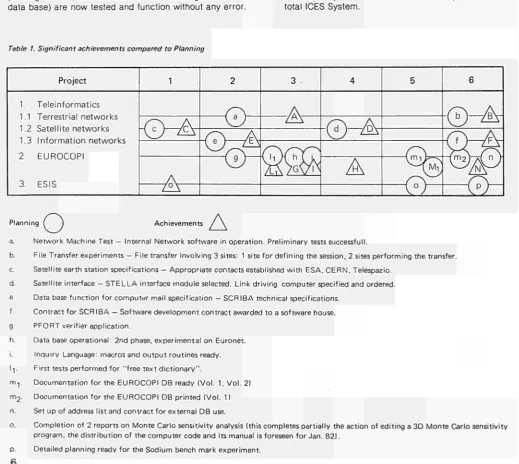
Table 1. Significant achievements compared to Planning
Project
1. Teleinformatics 1.1 Terrestrial networks 1.2 Satellite networks 1.3 Information networks 2. EUROCOPI
3. ESIS
O ^
Q-A-A
0^r
Planning ( J Achievements
Δ
a. b. c. d. e. f. a-h. i.
'1-m1 -mo.
n.
P.
6
Network Machine Test — Internal Network software in operation. Preliminary tests successfull.
File Transfer experiments — File transfer involving 3 sites: 1 site for defining the session, 2 sites performing the transfer.
Satellite earth station specifications — Appropriate contacts established with ESA, CERN, Telespazio.
Satellite interface — S T E L L A interface module selected. Link driving computer specified and ordered.
Data base function for computer mail specification — SCRIBA technical specifications.
Contract for SCRIBA — Software development contract awarded to a software house. PFORT verifier application.
Data base operational: 2nd phase, experimental on Euronet.
Inquiry Language: macros and output routines ready.
First tests performed for "free text dictionary".
Documentation for the EUROCOPI DB ready (Vol. 1, V o l . 2)
Documentation for the EUROCOPI DB printed (Vol. 1 )
Set up of address list and contract for external DB use.
Completion of 2 reports on Monte Carlo sensitivity analysis (this completes partially the action of editing a 3D Monte Carlo sensitivity program; the distribution of the computer code and its manual is foreseen for Jan. 82).
As far as the planned activities are concerned, in the near future the following tasks will have the first priority:
— connection of the Data Base with Euronet DIANE — setup of a user network for the first external use of the
data base in a noncommercial test phase
— completion and printing of data base documentation. — Study on conversion of FORTRAN codes from one
dialect to another.
3. ESIS
During the reporting period most of the ESIS activities were focussed on the assessment of shielding design data to be used in neutron deep penetration calculations. To this end the work on our data adjustment procedure has been con
tinued with particular emphasis on threedimensional uncertainty analysis. The mathematical relationship bet ween correlated sampling and a differential Monte Carlo perturbation algorithm could be established. Furthermore a general Monte Carlo procedure for calculating the com plete sensitivity matrix was elaborated. The integral measurements of the iron benchmark experiment at the Euracos facility have been continued for large penetration depths. At energies above 1 MeV Ne213 scintillation counters were used; however, at distances where the gammabackground became too large, sulphur activation detectors had to be employed.
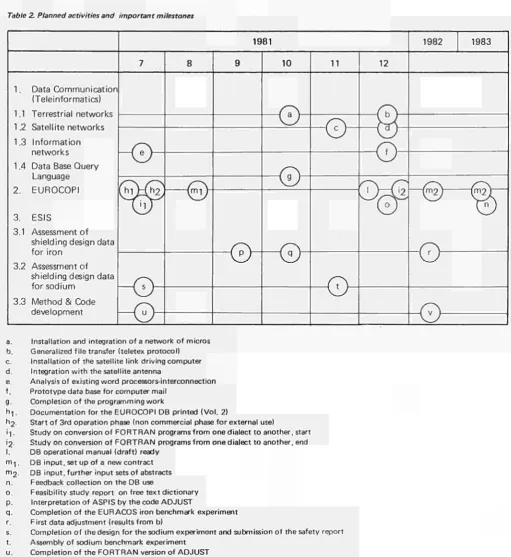
In table 1 the significant achievements during the reporting period are summarized and compared to the planning. In table 2 the planned activities for the next reporting period and the important milestones are Indicated with a short ex planation for each of them.
Table 2. Planned activities and important milestones
1981 1982 1983
10 11 12
1. Data Communication (Teleinformatics)
1.1 Terrestrial networks 1.2 Satellite networks
1.3 Information networks 1.4 Data Base Query
Language 2. EUROCOPI
3. ESIS
3.1 Assessment of shielding design data for iron
3.2 Assessment of shielding design data for sodium
3.3 Method & Code development
β
-G>
^
>
<D-<Z> -Θ-
■Q
€>
Φ
a. b. c. d. e. f.' 1 '2 I.
m1 m o . n. o. P. q. r. s. t. u.
Installation and integration o f a network o f micros Generalized file transfer (télétex protocol) Installation of the satellite link driving computer Integration w i t h the satellite antenna
Analysis of existing w o r d processorsinterconnection Prototype data base f o r computer mail
Completion o f the programming w o r k
Documentation for the EUROCOPI DB printed ( V o l . 2)
Start o f 3rd operation phase (non commercial phase f o r external use)
Study on conversion o f F O R T R A N programs f r o m one dialect t o another, start Study on conversion o f F O R T R A N programs f r o m one dialect t o another, end DB operational manual (draft) ready
DB i n p u t , set up of a new contract DB i n p u t , further input sets o f abstracts Feedback collection on the DB use
Feasibility study report on free t e x t dictionary Interpretation o f ASPIS by the code A D J U S T
Completion of the EURACOS iron benchmark experiment First data adjustment (results f r o m b)
Completion o f the design f o r the sodium experiment and submission o f the safety report Assembly of sodium benchmark experiment
Completion o f the F O R T R A N version of A D J U S T
[image:13.595.39.551.230.788.2]PROJECTS
1. Data communication
1.1. Teleinformatics
The activities within the project have recently been redefin-ed according to current trends in teleinformatics research. Indeed the interest is rapidly moving from the area of low band networks to high speed networks. The terrestrial data transmission networks (ex TRANSPAC, EURONET, DATEXP) already provide the appropriate service for sup-porting the transaction oriented applications such as infor-mation retrieval and data collection.
A large and dispersed community of users can now benefit of the informatics services which are provided by the hosts connected to the public network.
Apart from the definition and the assessment of the ade-quate standard protocols for interconnecting terminals and applications, no further substantial research effort is re-quired for this type of technology, which can now be con-sidered of common use.
The challenge for research activities arises now In the fields of local networking and satellite data communication. The two technologies are both providing wide band with transmission means which can properly support the traffic for the new types of applications such as office automation, file transfer and distributed data base.
In particular the rapid evolution of the microcomputers, which allow an effective decentralization of the functional capabilities, requires that new flexibility and capacity be provided at network level.
In accordance with the above mentioned introductory remarks, our activities are now classified In the following
way:
— terrestrial networks (Internal Network and EURONET) — satellite networks (STELLA and SPINE projects) — information networks (burotique, INSIS project). With the development of a gateway function for intercon-necting other types of networks (EURONET, satellite or local micros) the Internal Network project has now reach-ed its final phase.
Our network constitutes the very first private network which is fully compatible with the existing and emerging interna-tional standards. The network software runs as a distributed process on several interconnected minicomputers (SOLAR 16).
The Internal architecture of the system reflects recent recommendations by ISO in terms of Open Systems Inter-connection.
Indeed the modularity of the design allows for complete in-dependence from the characteristics of the physical links for data transmission and from the nature of the network services.
As an example two Solar machines can be connected by a point to point line, by some virtual links established over a public network or even by a satellite subchannel and still be capable of proving the same transport services as required by the applications.
The network is essentially a packet switching network whose routing algorithm makes no assumption on the nature of the transmission media. The topology is deduced
independently by each node on the basis of the oncoming traffic.
To guarantee the end-to-end error and flow control, each couple of network nodes (they might not be adjacent) per-forms the Transpac multiline protocol.
By this approach error free «logical lines» are established between each node and all the others. Thus allowing for an error free «logical full connectivity» between nodes. Each logical line carries the traffic between a couple of nodes in exactly the same way as an X25/2 connection car-ries the traffic between two adjacent nodes connected by a single physical line.
The logical line concept protects the higher levels of the ar-chitecture from the peculiarities of the physical topology, from the disordering introduced by the routing algorithm and from possible errors due to congestion on the nodes or malfunctioning of the links. Our X25 level 3 virtual call ser-vice Is built on top of the logical line concept and therefore it has an end to end significance.
The virtual call service is used via a software interface by the higher level protocols such as ESP20 for handling asyn-chronous terminals, DEVT for handling data entry terminals and File Transfer.
The Internal VC service is also used by the gateway func-tions. Each gateway function drives a connection to an ex-ternal network such as EURONET or the network of micros or the satellite network.
The calls to the internal services which originate from an external network are addressed by the gateway function to the internal destination that offers the required service. A peculiar characteristics of the network is that the users of our informatics services are not concerned with our
inter-nal addressing scheme. They can select the required ser-vice by name without any further knowledge of where the service has physically been installed.
This flexibility is the result of a parallel service to the virtual call service which Is called «broadcast».
The broadcast service provides for a common data struc-ture which is present on each node and whose instances are kept synchronized by a distributed broadcasting algorithm. The overall effect is similar to a television transmission. Each network application owns a «screen» and can select the «channel» and therefore be informed about the required information.
A network application can also act as a «transmitting sta-tion». The broadcasted data structures normally represents status information of general interest. This is the case for the gateway process: whenever a service is activated on the internal network, its name and its address are broad-casted all over the network. Wherever the gateway func-tions are installed, they can consult the «television screen» and perform the mapping between the requested service and the appropriate internal address on behalf of the remote user.
The mechanism is complicated by the possibility for two or more processes to offer the same service (ex. duplicated access points for reliability or performance purposes). Sim-ple strategies have been adopted so far, but more sophisticated resource allocation strategies can also be
troduced in the system.
At its present state of development the internal network represents a rather valuable and flexible tool for carrying out experiments in the field of internetworking and for sup-porting new applications of the teleinformatics technology. Indeed with Its terminal handlers, Interfaces to mainframes and gateways the network offers full accessibility to local/remote terminals/applications and to other types of networks.
In addition the recently developed file'transfer service sup-ports file transfer sessions which can automatically resume after a network break down.
Another relevant characteristics of our file transfer service is that a session can be defined and monitored by a third party actor who does not necessarily belong to the two sites which actually perform the transfer.
This feature is going to be used, as an example, by the pro-cess performing the distribution of documents over the net-work on behalf of a computerized mail and conferencing system (SCRIBA project).
The idea is to provide SCRIBA with the appropriate network service that allows the definition of the document transfer sessions between any two sites. This is particulary useful If one considers the physical mobility of mailboxes, archives, and workstations. Thus the file transfer becomes the basic network service on top of which a distributed system for the delivery of the correspondence can be built.
In the following part of this report, a brief description of the other results achieved in the framework of this project is given.
More detailed technical information will be presented by the future repoits as soon as relevant milestones are reach-ed.
Reference and Test Centre for Euronet higher level protocols
— The software that drives the test facility for the Remote Printing Protocol has been finalized. The JRC is now ready to set up test and debug sessions for the Euro-pean implementors of the remote printing stations. The planning for such sessions is going to be discussed jointly with DG XIII and the manufactures.
— Analogous facility is under development for testing and controlling the behaviour of simple asynchronous ter-minals according to the ESP20 protocol. The current Im-plementation covers the recognition of the characteristics of the remote terminal such as parity, speed and alphabet. Further enhancements are to be discussed and defined according to DG III wishes. — Appropriate software tools have been activated for
sup-porting the tests carried out on EURONET by the Univer-sity of Dublin. The UniverUniver-sity of Dublin has been ap-pointed by DG XIII for a study on the performance of the EURONET data communication service as seen by the end user.
In this context the JRC host plays the role of rebound (echo) receiver/transmitter of the data sent by Dublin over EURONET.
The RTC service has been extended to the test of other types of networks: in particular the X25 and ESP20 behaviour of a micro-based network node manufactured by a French company has been checked against EURONET and against our internal network. This micro system could be considered a building block for a widely
10
spread network that connects a large population of ter-minals to be installed in the offices.
Satellite networks
The technical and organizatorial problems related to the in-stallation of the satellite earth station and its interface to the Data Processing equipment has been partially solved. We adopted the solution proposed by the members of the STELLA project with the extensions as suggested by CNUCE-Pisa.
Those extensions will allow us to perform the Internetwork-ing between terrestrial and satellite networks and In par-ticular to interconnect local networks based on the «ether» or «ring» approach. This is a research item of a particular in-terest to us as it is for some other laboratories in Europe (CERN, CNUCE, the UK UNIVERSE project).
The SPINE approach to the earth station interface is also carefully followed by us.
The status of the current technical discussion within SPINE shows that the specification for such an interface will be finalized in short time.
Information network
A series of visits to the European manufactures and to the European PTT laboratories have been organized by the technical Working Group of the INSIS project.
As a result of those visits we can now claim to have a reasonable-clear picture of the current trends in the field of the office automation and the public services for electronic mail. This allows us to properly orientate the SCRIBA pro-ject which is intended to be a prototype information distribu-tion system.
The data base function for SCRIBA has been defined and is currently under development. It represents the logical kernel of the system in the sense that the data base collects all relevant information about access rights, membership to conferences, location of archives and mailboxes. The data base drives the appropriate network sessions that allow the transfer of the required information according to the whishes of the users (senders, receivers, chairmen etc). The data base in Itself has a distributed structure that allows the realization of «local post offices» which can deal with the local population of users without Involving the
resources of the external networks.
Another aspect of the project has been touched: that is the connection of advanced word processors to the network. The characteristics of an Olivetti 401 have been examined and an adhoc terminal handler has been designed for mak-ing this terminal appear as a workstation to SCRIBA.
Collaboration with external organizations
Our activities are to be considered In, the light of other inter-national projects supported by the Commission and in par-ticular the COST 11 bis, the STELLA and the Interinstitu-tional Information System (INSIS) project. Those projects offer the scenarios in which our own Initiatives are defined and performed. Due to our interest in the Satellite aspects of networking, a promising relationship has been establish-ed with ESA.
References
1. See working documents COST 11 bis and INSIS 2. A. ENDRIZZI, M.T. PAZIENZA
The data base function of SCRIBA
4.
J.C. REY
The Internal Network at JRC
Journées de l'Informatique — Paris June 81. K. WEAVING
The verification of higher level Protocols ONLINE — London June 81
1.2 Data Base Query Language
Concerning the study of a Generalised Query Language for the Ispra data banks, a thorough analysis was performed to single out the main requirements of Ispra DBs, which need on the one hand text handling capabilities and similar In-struments typical of information retrieval systems and on the other hand of the facilities proper to the «factual» Data Base Management Systems. We then matched our DBs re-quirements with the logical tools which are currenlty provid-ed by the Common Command Language (that is the query
language defined under the responsability of the DG XIII, used at present in the framework of EURONET-DIANE to query bibliographical Data Banks) and with the new com-mands proposed as extension of the present CCL by a study monitored also by DG XIII.
The findings of the study are the following:
— a list of new functions (and, therefore, commands) pro-per to specific needs of technical/scientific Data Banks has been established. F.i.: floating point number treat-ment, unit of measurement conversion etc.
— these functions will be included in the Common Com-mand Language
— the extended set of the CCL will be interfaced with the ADAGF query language (which is our local version of ADASCRIPT in ADABAS)
— ADAGF will be further improved in view of its interfacing with all the command statements foreseen for the CCL. — The programming work in now in progress.
2. EUROCOPI
The main objective of the EUROCOPI project is to provide EC users of scientific/technical computer programs with a program information and program distribution service. These service activities Include the related research ac-tivities In the following fields:
— Information service and program library techniques — Praticai Programming and documentation techniques
for the development of portable and usable programs — Preparation of a theoretical manual concerning
com-plicated and large engineering codes.
Some activities are performed in cooperation with EASIT (European Association for Sofware Access and Information Transfer) in order to keep in touch with a major user com-munllty.
During the last half year there has been an emphasis on the completion of the EUROCOPI Data Base, which is now operational under the DBMS ADABAS in the environment of the Direct Information Access Network for Europe (Euronet DIANE).
This means in detail:
— The implementation of a user oriented Query Language (QL) for the EUROCOPI Data Base
— Construction of Macros so that the designed retrieval commands can be executed
— Completion of routines to make the retrieved output available to the end user
— Completion of the appropriate documentation on use of the Data Base.
The results are reported under the following main headings: — Research Activities
— Service Activities
— Data Base Developments
In addition, a more detailed report is given on the develop-ment of the interrogation language for the Data Base.
2.1. Research Activities
In this period and with respect to the first priority on the Data Base developments, «Research» has been considered as a temporary less Important activity. Nevertheless we have completed «A Theoretical Manual for STRUDL» writ-ten by Dr. A.W.M. Kok of the Delft University of Technology (under contract with the Delft University of Technology). STRUDL (Structural Design Language) is a subsystem of ICES (Integrated Civil Engineering Systems) and forms an Important part in technology transfer by computer pro-grams. Such a theoretical manual is a necessary tool for referring back to the basic knowledge applied and im-plemented in these packages.
2.2 Service Activities
This activity mainly concerns the Program library, i.e. a) the distribution of codes
b) the implementation and maintenance of large computer codes, and the appropriate user support.
a)
The library is subdivided into two sections: — EDPA (European Program Distribution Agency) — EIDA (European ICES Distribution Agency) EDPA:
The total material (different kinds of documentation, source decks, etc.) is being reviewed.
The scope is to arrive this year at a sound bases for new developments.
EIDA
The ICES System consists of a set of engineering programs, developed by MIT or contributed by the user community. The programs and the related documentation are distributed, on a non-profit basis, by the ICES Users Group (IUG), an international users association with more than 500 members.
A European Section of the IUG was formed in 1974 and at present it has about 200 members.
In 1975 EUROCOPI accepted the task of maintaining and distributing the materials; EIDA was contractually establish-ed.
The tasks of EIDA are:
— Maintenance of a stock of manuals, about 100 titles, — Maintenance and updating of the ICES programs, — Distribution of manuals and programs,
— Shipment and invoicing for delivered services, — Technical and scientific assistance to the users. The principal reasons for the establishment of the contract were:
— To gain experience in the field of maintaining a sofware library,
— To establish close contacts with the ICES user com-munity for a flexible exchange of know-how In the field of computational engineering.
Now, by 1981, both aims have largely been achieved: EUROCOPI obtained sound experience in program library handling and the expertise gained on the ICES System serves many research teams at the· Joint Research Centre. From 1975, when the JCR started the distribution of the ICES materials, we have noticed the large expansion of the system throughout Europe.
It has been a very positive experience to participate active-ly in this process. The frequent contacts with other users especially brought important scientific benefits to our Cen-tre.
After five years of operation of the Distribution Agency, the market for the present products seems to have approached saturation as from 1978 the number of transactions has declined.
Presently the consequences of a possible closing of this ac-tivity is investigated.
b)
Activities concerning large computer codes: 1) BERSAFE
— maintenance of versions
— user support for application and use (informatics related aspects) of the system.
2) NASTRAN
— this system contains 420.000 records, 185 modules and three different languages (FORTRAN, ASSEMBLER, DMAP)
— study of DMAP (Direct Matrix Abstraction Program-ming)
— analysis of structure and organization of the code — analysis and tests of different application
possibilities
— general maintenance
— creation of user - and application oriented pro-cedures
— direct user support (application and informatics aspects).
3) ICES and subsystems
— discussions on the «Basic System ICES» concerning structures and characteristics of different languages used. The purpose is to restructure and to rewrite the Basic System to make It more por-table,
— user support (application and informatics aspects) especially for STRUDL and TABLE,
— creation of user - and application - oriented pro-cedures,
— general maintenance.
2.3 Data Base Developments
During this period the main emphasis was on the comple-tion of the EUROCOPI Data Base and on the following topics should be reported:
a) Authorized Files
The authorized files EPOS, COMP, LANG, ORGA have been regularly updated according to new information gained from the abstracts.
b) Programs and procedures for loading data into the new Data Base.
The final test of programs and procedures is still going on. Errors in programs detected during loading opera-tions have been corrected and the procedures have been adapted to user requirements.
c) Data Input
— ca. 800 abstracts have been loaded
— a contract for the classification 'of 2500 new abstracts has been set up
— the in-house production of abstracts from catalogues is still continuing
d) Interrogation of the Data Base
See the detailed description of the EASI-L Interrogation Language following this section of the report.
e) Documentation for the Data Base 1. General Documentation Manual
This manual In now ready to be printed. It Is con-sidered as an introduction to the data base (con-cepts), the files and file relations, data structure and data content.
2. User's Manual 14
This manual is now ready to be printed. It has been written to guide people interested In the interroga-tion of the EUROCOPI Data Base.
3. Data Base Operation Manual
This documentation is to help those driving the data base and maintaining files. It is still In preparation and describes files (data, programs), procedures, and the links between all these elements. There are ca. 90 single funcional elements or modules for the data base.
f) Data Input Sources
There have been discussions with various partners con-cerning data acquisition. The aim is clearly stated: many data, good data and cheap data.
Considering different collection procedures there has been also discussed the possibility of aiming at a «Deci-sion of the Council of Ministers» as a so called «data col-lection tool».
Such a decision could have two objects:
— feeding a Data Base available throughout the Com-munity via Euronet DIANE
— maintaining order in computer program production and its administration at non commercial computer centres financed by public funds of the member states.
g) Data Base Access Tools
At present we have five different kinds of logical access to the data:
— EPOS file (subject classification) — COMP file (computers)
— LANG file (Programming Languages) — ORGA file (Corporate Authors, Distributors) — free text search on some items as e.g. «program
name».
Using our main access tool, the EPOS file, requires of the user a large amount of structural thinking and a fair thourough deep knowledge of this file which com-plicates and therefore limits the use of the data base. A useful additional access tool can be a so called «free text dictionary». This technique was discussed during our last half-day special session. The GID, Frankfurt, of-fered EUROCOPI the approporiate hard - and software to test these facilities. We accepted this assistance with pleasure and performed the necessary tests with a set of 30 selected abstracts. The results will be published in a later feasibility study report.
References
1. A.W.M. KOK; A Theorical Manual of STRUDL; EIDA, EUROCOPI;
JRC Ispra; Feb. 1981
2. T. LEO-MENARDI, U. SPIEKER; EUROCOPI Data Base: Vol. 1, General Documentation Manual;
JRC Ispra; May 1981
3. A.A. POLLICINI; EUROCOPI Data Base: Vol. 2, User's Manual;
JRC Ispra; May 1981
2.4. The EASI-L Interrogation Language
(A.A. Pollicini)
Introduction
A standard language has been proposed for the interroga-tion of the various data bases made available via EURONET. This proposal Is known as EURONET-DIANE Common Command Language (CCL). (1)
Since a full implementation of CCL is not yet available at the JRC Ispra Establishment, a simpler interrogation tool has been designed and implemented.
EASI-L is the Language provided for the retrieval of the EUROCOPI Application Software Information.
The following points should be noted in considering the con-formity of EASI-L to CCL:
— the provided command set is a subset of the full pro-posal;
— each command implements only part of the full specification proposed for the corresponding primitive; — special extensions which are useful for referring to
soft-ware products have been introduced. The command SET
The interrogation language EASI-L provides the user with five basic primitives which are identified by the following keywords: — HELP — DISPLAY — FIND — SHOW — STOP
The HELP command
The function of the HELP command is to obtain: — general information about the use of the language; — more details about the use of a specific command; — a summary of all previous issues of a specific
com-mand.
Notice that this function applies only to commands DISPLAY, FIND and SHOW.
The DISPLAY command
The role of the DISPLAY command is very important in ap-proaching the data base.
It gives indeed useful indications to establish a sound retrieval strategy.
With the acquisition of information such as: — structured classification codes,
— text of controlled terms and associated terms, — hierarchical and collateral relationships,
the user may understand the logic structure of the data base and express his query as an effective set of FIND commands.
The FIND command
The real retrieval action is performed by the FIND com-mand which obeys search criteria based on the following items of Information:
— abstract number, — program name, — author name,
— corporate author code, — corporate distributor code, — classification code, — computer systems code, — programming language code, — release year.
For each item either a single data value or a boolean OR between two data values may be used in the search criteria. Moreover, a boolean AND is allowed between: — two classification codes;
— a classification code and a programming language code;
— a classification code and a computer systems code; — a programming language code and a computer systems
code.
The list of program abstracts retrieved by means of a FIND command may become the scope of the retrieval action of any subsequent FIND command.
This corresponds to a logical AND between the search criteria of the two FIND commands.
The SHOW command
The function of the SHOW command is the selection of the Information to be displayed from a list of retrieved program abstracts.
The selection may depend on one of the following elements or on a combination of them:
— the list retrieved by a specific FIND command; — the sequential number of a program abstract within the
list or an ordered range of them;
— the content of the program abstract which may be specified at either Item or macroitem level or complete. As a result of a SHOW command the user will obtain at the terminal an output In form of report whose lay-out is similar to the «PROGRAM SHORT DESCRIPTION FORM» in use for the collection of information on application software. The STOP command
The aim of this command is usually to close an Interroga-tion session.
However, when a series of queries is logically concluded, it may be used to restart a new series of commands in the same terminal session.
Implementation considerations and schedule
The EASI-L interrogation language was designed in August 1980. It was then decided to implement the language as a set of macros driven by the macro processor ADAGF (2) which is the JRC enhanced version of ADASCRIPT + . After a first implementation study (Sept. 1980) it was realiz-ed that some features of the designrealiz-ed language could have been Implemented only if the macro facilities of ADAGF were extended.
The implementation phase split therefore, in three distinct tasks:
— implementation of the set of macros;
— implementation of some independent modules ac-tivated by the macros which implement the HELP and SHOW commands;
— extensions of the macro facilities.
The macro file was almost ready during November 1980. This allowed for the start of the testing phase in parallel with the completion of the implementation.
The independent modules were almost ready by the end of 1980. This allowed for the testing of the output functions. The longer task was the extension of ADAGF which Implied: — a preliminary manipulation of the user command; — a series of refinements of the macro expansion
pro-cess;
— the introduction of elements of the user command in the interface between a macro and an independent
module;
— the assignment of an internal identification to any user command which is syntactically correct, for its une-quivocal reference from any unit within ADAGF; — the set up of an internal table in which all identified
com-mands are stored. This table plays the role of an Inter-face between all ADAGF units involved in the execution of the command.
As far as the Implementation progressed the core re-quirements of the application grew.
The need of fitting within the allowed foreground region of TSO caused a month delay to merge the main output file and the one produced by the output module.
The extension task was finally completed In March 1981. According to the results of the testing activity some refinements to the implementation were still needed and achieved In April 1981.
As a final summary of the implementation, EASI-L consists of:
— the extended ADAGF processor; — a library containing:
6 macros for the HELP command, 18 macros for the DISPLAY command, 46 macros for the FIND command, 10 macros for the SHOW command and
2 macros for the STOP command that is a total of 82 macros;
— a sophisticated output module for the SHOW command; — 5 simple output modules for the HELP command. The draft of the user's manual was ready in December 1980. Since then the document was kept up-to-date accor-ding to the progress of the implementation.
The text was also revised after circulation and after discus-sions among people Involved in the EUROCOPI project. The document is being published with the following title: EUROCOPI Data Base. Part II: User's Manual.
It has to be recalled that the development of EASI-L is the result of a fruitfull collaboration among people of the EUROCOPI sector, the ADABAS support group and ADIP-Graz.
References 1. NEGUS A.E.
EURONET Guideline: standard commands for retrieval systems.
Final report on a study carried out for the Commission of the European Communities, D.G. XIII. (Dec. 1977) 2. CHRISTIANSEN T., FATTORI G., PERSCHKE S.
The use of ADABAS for Management and Interrogation of Scientific Data Banks of the JCR Ispra.
Proceedings 7th International ADABAS Users' Con-ference, San Diego 13-15 June 1979.
3. ESIS
3.1. Methods and Codes
COMMENTS ON PERTURBATION MONTE CARLO
The Relation between Correlated Tracking and Differential Perturbation Algorithms
(H. Rief)
The solution of the radiation transport equation by the Monte Carlo method consists in a more or less direct simulation of the particle motion in matter. A straight foreward formulation of this problem is the integral transport equation:
φ M
ƒ
ψ (y) Κ (χ, y) dy +S (χ)
(D
where χ, y are coordinates in the six-dimensional phase space, K(x,y) the transport kernel from y to χ, φ (χ) the colli sion density and S (χ) the first collision density of source particles.
The Monte Carlo algorithms solving equ. (1) can directly be described by the Neumann series
ΨΜ=
S (χ) + 2-rf In (χ)
n= 1 (2)
consisting of
ln (x) = / . . . . / Κ (x,un) K(un, un _i
R R
. . . . K(u2, u-j) S(u-|) dun . . . . du-|
(3)
In the case of a parameter-perturbation in C or/and Τ a new solution φ*(χ) will be obtained for equ.(2).
o° ç ç η
φ
* (χ) = S* (χ) + Σ
J . . . . J
Κ* (χ, u
n) Π
η=2 R
Κ* (u¡, u¡i ) · du¡ · S* (ui ) dui
=2
(5)
If φ (χ) and φ*(χ) are sampled independently the variance of
φ (χ) ι/<*(χ) = Δ φ goes to infinity as Δ φ — 0. As shown in (1) this difficulty can be overcome by applying correlated tracking, a procedure in which the perturbed history is forc ed to follow the unperturbed one along the same tracks in phase space. The resulting biasing is taken care of by an adjustment factor a (u¡, u¡.|; Δ ρ) being a function of the parameter perturbation Δρ.
Κ* (u¡, u¡i; ρ + Δ ρ ) =a (u¡, u¡i; Δρ) K(u¡, u¡.|) (6)
Introducing equ.(6) into equ.(5) and subtracting it from equ.(2) leads to
PO
l
//(x,Ap) = ( 1 a
0) S ( x ) + Ç
/ \ . . . / | 1 a
n• (ι- β·ι)(Π "ι*.)
+ 1) K(X,Un)
R R
1 a i ) S ( u i ) d u i ( 7 )
For the factored kernel K¡ = C¡ T¡ the biasing adjustment factor a¡ is for i > 1 also split into two components such that
In the following considerations it will sometimes be conve
nient to use shorter symbolic expressions such as: q = £¡.C¡andT<f = 7 ¡ T ¡ ( i > i ;
Kn + 1 = K ( x , un) and
K¡ = K(u¡,u¡_i) for n > ¡ > 2
Usually the kernel K(u¡,u¡.|) Is factored into two functions, one dealing with the energy and direction change and the other with the change in spatial coordinates i.e.:
according to equ.(4b) for i = 1 one gets a-\ = r -\.
In correlated tracking the £j's and r¡'s are calculated at each collision point for one or more perturbations Δ pm and
the resulting Δ ^m' s a r e sampled simultaneously with the
unperturbed history. (Remember: they are an exact solution for the perturbed easel). The biasing adjustment factors £¡ and τ\ are simple analytical expressions which can be calculated with little additional computing effort.
K ( un, un. . , ) = C ( En, En_l; rn.1) T ( rn, rn.1, En) (4a)
and
S (u, ) = J Q (r
0, E
0) T (
r i, r
0; E
0) dr
0(4b)
There is, however, a further simplification possible if Δρ 0:
hm
Δ ρ -*■ o
Αφ M
δι/Mx)
Δρm
5pr
In the classical notation this quantity is defined as the sen sitivity of φ (χ) with regard to a parameter change in pm.
If C¡* and T¡* are expanded into a Taylor series
( 1 Π É ¡ T ¡ ) i=2
C (u¡, u¡+i, Pm + A pm)
5c¡ o
= C\ + Apm^^ + Afa
δρ m
82C¡
oc.
ST¡
and if (1 + ΔΡ η ι " ' ) · (1+ΔρΓη — ) = a ¡
C¡opm T¡Opm
is inserted into equ.(7) one obtains
δφ
(χ)
lim
ΑφΜ
ô pm Δ ρ ^ ο ΔΡΓΠ
δΤι
Æ
Q ( U o ) d u
°S//E
R η=2 R R ,=2
OC;
+
δΤ;
(8)
CjÖpm T¡op m Cn+1 Τη+ ι
τ\ 9 Τ1
( I i C ¡ T ¡ d u ¡ ) — Q ( u0) d u0
= 1
a
Ρ mThe Monte Carlo score of equ.(8) is somewhat different from the one of equ.(7). It requires that in each collision point and along each particle track the derivative of the respective kernel is determined instead of the expressions £¡ and τ\.
The sum of these normalized derivatives is then multiplied with the corresponding weight of the detector response of each history.
According to equ.(8) the sensitivity of any response function can be obtained by transforming the collision density into the desired quantity at point x. If the detector extends over a region in phase space an appropriate integration has to be performed. Formally this can be written as:
The factor £¡ η is one except in points where the particle tra jectory passes through a perturbed region (in phase space). Since this procedure does not affect the original game, as many perturbations Δ pm as desired can be determined for
each history.
n
The resulting products . Π a¡ (Apm) are then used
to score simultaneously the different Δ φ (x)m's.
In the case of calculating directly the sensitivities „ _ 'the product term £¡ T¡ is replaced by the sum δ Pm
f I
Σ(
i = 2 λOC;
Cjôp
+
δΤ;
m T j ö p m ,
whilst everything else in the procedure remains unchanged.
This Monte Carlo scheme is in fact identical to the one described by Hall (3), which was, however, derived by a direct differentiation of equ.(7). Since equ.(8) follows direct ly from equ.(7), Hall's method consists in correlated track ing with infinitesimal perturbations.
Conclusion
The two perturbation methods, correlated tracking as described In (1,2) and a new differential approach (3) are based on the same sampling schemes. Both allow with an equivalent programming and an almost equal computing ef fort to calculate simultaneously different types of perturba tions and sensitivity profiles. The fact that correlated track ing is not limited to first order effects makes it certainly more attractive for all applications where larger perturba tions have to be considered.
From «field applications» reported in (1, 2, 3) It follows that further efforts are necessary to reduce the statistical errors of perturbation effects by modifying some of the classical biasing techniques. Especially Russian Roulette gives rise to relatively large errors In sensitivity profiles due to undesired correlations.
Results
S°(Pm)
-f°
D
3 i / / ( x )
D ( X ) a ρ m
dx (9)
Eq.(7) and (8) can easily be Interpreted in terms of a typical Monte Carlo scheme. In the case of correlated tracking the contribution of a history to the perturbation Δ φ (χ) is calculated by multiplying its weight reaching the detector point (or region) with the factor
18
As a typical example the sensitivity profile of the fluence leaking from an iron sphere (radius = 20 cm) with a central californium source was calculated by the use of correlated tracking according to eq.(7) and the differential perturbation algorithm as expressed in eq.(8). In both computer runs the same set of histories (and particle tracks) was employed. In the case of correlated tracking a perturbation of only 1 % had been assumed (i.e. Δ Σχ = 0.01 Σ τ).
Energy group E (MeV)
0.0525403337 0.3337 1.353 1.353 4.724 4.724 14.92
total Fluence 0.273 0.564 0.0874 0.00468 0.9286
Sensitivity Calculated by:
differential correlated
algorithm [eq.(7J] Στ δ R/R δ Στ
0.0727 0.0582 0.0233 0.0023 0.1566 tracking [eq.(8)] ΣΤΔ Ρ / Π Δ ΣΤ
0.0720 0.0583 0.0233 0.0023 0.1558
1) Δ ΣΤ= 0 . 0 1 Στ
References
1. Α. DUBl, Η. RIEF: «A Note on some Aspects od Sensitivi ty Analysis in Monte Carlo», NEACRP Specialists' Meeting on Nuclear Data and Benchmarks for Reactor Schielding Paris Oct. 1980 and earlier papers referenc ed therein.
2. G. DEJONGHE, J. GONNORD, J.C. NIMAL: «Etude de Perturbations Utilisant la Methode de Monte Carlo; ibid. 3. M.C.G. HALL: «DUCKPOND A Perturbation Monte Carlo and Its Applications», NEACRP Specialists' Meeting on Nuclear Data and Benchmarks for Reactor Shielding Paris, Oct. 1980.
4. H. RIEF: «An Attempt of Sensitivity Calculations in 3D Geometries by Monte Carlo Techniques», Proc. of the Specialists' Meeting on Sensitivity Studies and Shielding Benchmarks, OECD Paris (1975)
5. H. RIEF: «The Relation between Correlated Tracking and Differential Perturbation Algorithms». ESIS Newsletter Jan.81.
A General Differential Perturbation Algorithm W. Matthes
A Monte Carlo procedure has been elaborated which allows the evaluation of a complete sensitivity matrix ηχ ( = δη/δρχ; i numbers the counting rates, λ the system parameters) playing a normal (unperturbed) game only. The essential points are:
a) A normal game for the unperturbed system Is played ac cording to given transport and collision kernels.
b) The running particle carries a weightvector with as many components as we have derivatives plus one. c) During transport and at each collision the weightvector becomes modified by a weightmatrix.
d) At each collision point a contribution to the counting rate and.its derivatives of each detector is evaluated separately.
A. General Perturbations
Let ri (i = 1,2...N) be the counting rate of a detector Di with detectorcrosssection distribution H¡ (xv) In a neutron flux φ
(xv).
We have: Π
=/ø
Hi
dxdv (1)Now we keep the neutron source Q(xv) and H¡ constant and perform several perturbations Δ χ (λ = 1.2...L) on the sy stem.
If ζ Is some parameter of the system (e.g. Σ Total) then we define by Δ χ ζ the change of ζ due to Δ χ.
Our problem is to calculate the change Δ χ r¡ of the coun ting rate r¡ due to the perturbation Δ χ.
Applying Δ χ to an equation for the flux φ (e.g. in Integral form, for details and further references see [1]) and then reinterprete the perturbed equation in terms of the unper turbed system we obtain the following recipee for a solution of the problem with the Monte Carlo method:
1) START Put:
W = 0; i = 0; Δ χη = 0 (for all i, λ)
2) SOURCEROUTINE
Choose a starting point χ and an initial velocity ν out of a normalized source distribution Q (xv).
Put:
w = w0(xv) (weight of source particle)
W = W + w Χ χ = 0. (for all λ)
3) SCORINGROUTINE
Calculate the contributions of the particle leaving (x,v) with weight w to the counting rate ri and their perturbations Δ χ r¡ through:
r¡ = ri + w. Fi (2)
Δ χ ^ Δ χ π + w { Δ ^ + Χ χ · (Fi + AXF ¡ ) } (3)
4) TRANSPORTROUTINE
Choose a next collision point x' out of the normalized transportkernel.
If x' is outside of the systemboundary go to 6.
If x' is within the systemboundary evaluate (for all λ):
Χλ= Χλ ( 1 + f \ ) + f \ (4)
5) COLLISIONROUTINE
Choose a new velocity v' (out of a normalized collision kernel) for the particle after the collision and evaluate:
w = w · m
χλ= χλ <1 + 9 λ ' + 9 λ (for all λ )
(5)
(6)
If some weight criterion says: «Stop history», then go to 6, otherwise put: χ = χ', ν = ν' and go to 3.
6) ENDROUTINE
If there are still some particles left, go to 2. If all particles are played, then calculate
r¡ = r¡/W
Δχη = Δ
λπΛ/ν
and STOP.
The symbols used are: W: total weight
w: weight of the running particle Χχ: auxiliary quantities
lx'-xl
S
Δ χ Στ ( χ + s n , V) ds)
fA= ( e 1
gX = AxC / C , η = v / NI
where C is the collision kernel:
C (χ', ν~*ν') = / ]
θρ{χ'v) m
vfy (x'v
v
(7)
(8)
O)
(10)
( ρ χ is some system parameter) (1 + f λ ) by 1
(1 + g λ ) by 1 (Fi + Δ λ F¡) by F¡
and put: ί χ
lx'-xl
'ff
1
J δ ρλ
(χ + tn, ν) dt (14)
At the end of the game the quantities Δχ r¡ =
-^-contain directly the elements of the sensitivity matrix.
C) Geometrical Perturbations
Geometrical perturbations can in most cases be represented by a displacement of a surface.
Let the (open or closed) surface S (see Fig. 1) be shifted parallel to direction m.
If parameter d measures the displacement parallel to m we obtain (from 14):
fd
Σ .
ß
2 (Ρμ.ν) -Oy (Ρμ,ν)
cos/3M
cosa, (15)
summed over all contributions to fd from the crossing points Ρ μ of the flightline from χ to x' with S. (in direction Ω).
σν (x'v): macroscopic cross section for reaction type ν
mv : number of secondary particles emitted at this reaction
\v (χ',ν — ν'): normalized velocity distribution for these
secondary particles
C ( x ' v * v')
Σ
Τ(x'v)
m (x'v) fc (x'v*· v') (11)
m~ (x'v) : mean number of secondary particles emitted at a collision at x' initiated by a particle of velocity v.
fc(x'v — v') : average (normalized) velocity distribution for
these secondary particles.
For the contribution to the detector D¡ from the particles leaving (xv) we have:
Fi (xv)
oc
ƒ
d s e ^( s ) H¡ ( x + s η, ν)(12)
Als
:/Σ
τ
(χ + t n , ν) dt (13)Β) Calculation of Sensitivity Coefficients
We modify the procedure in A and replace
δ
Δχ
by
20
δρχ
Fig. 1.
ολ (PV)
v\
cos/3 =
cos α =
is the total crosssection at the crossing point
Ρ of that material Into.which m (at P) points
normal to S in Ρ
(m rf)
(Ω η)
Using this tø and putting all gx = 0 we obtain the sensitivity
Ær
-coefficientsΓΓ oa
References